The popularity of the UK's Classic FM ... which treats classical music like the modern stuff, with song-length excerpts of the best bits and chart countdowns ... shows that bringing pop music marketing to the classical music scene works wonders. The industry needs to be careful, however, or this strategy can backfire.
I'm thinking of a clear case of bait and switch in the marketing of the Miloš Karadaglić concert in
Basingstoke last night.
The Anvil, a surprisingly good arts centre in the heart of town, regularly hosts classical music within its broad repertoire. It's a wonderfully intimate space, with top tickets the price of cheap ones in London, and a commute time of five minutes for us. When we saw Miloš, one of our favourite classical guitarists, heavily promoted as being in concert, we snapped up the tickets.
The reality: an evening with the English Chamber Orchestra, with Karadaglić as guest artist playing two pieces: Rodrigo's Concierto de Aranjuez and a short romance. A limited role in the programme is fairly standard stuff in traditional classical concerts, but the posters clearly promised a night with the 30-year-old star.
I can picture the discussion in the marketing department now. "We need to appeal to a broader audience, and this kid is hot. Just look at him. We'll promote him like a rock star, and the young girls will flock in."
Karadaglić is, indeed, exceptionally easy on the eye. He's also wonderfully talented. Born in Montenegro, he won a Royal Academy of Music Scholarship in London and signed his first record contract in 2011. His most recent album, Latino Gold, is both soothing and evocative of warmer, more exotic climates. It's a favourite summer soundtrack of mine at the moment. Added to all that, he seems to be a genuinely pleasant guy, who comes across well on TV interviews and appeared to have a strong rapport with the conductor and the orchestra last night.
His performance was assured and confident, bringing two very familiar pieces to glowing life. Some classical music doesn't sound that different in performance than it does at home on a good sound system. Not so the Rodrigo concerto, to which Karadaglić gave a whole new layer of depth and resonance. In the cosy confines of the Anvil, about 20 rows back from the stage, we were also treated to the fascinating drama of his flying hands magically stroking sound out of his instrument. I don't think there's anything quite as much fun to actually watch people play.
In the wider programme the orchestra continued the Mediterranean theme with Rossini's Overture from the Italian Girl in Algiers , Falla's Ritual Fire Dance from El Amor Brujo (it may not sound familiar, but you'd probably know it if you heard it) and Mendelssohn's Italian Symphony (No. 4) in its entirety. I enjoyed the latter just as much as the guest star. It's popular enough that all four movements were familiar, but I don't think I'd ever heard it as a complete symphony. It's an exquisite piece, wrapping up an evening that left me feeling like I'd been sitting in some bouganvilla-draped courtyard drinking sangria and fanning away the heat.
So no disappointment for me, despite my surprise at young Karadaglić's brief appearance. And did the marketing ploy work in the end? I fear not. Most of the upper balcony was empty, and the audience was solidly our age and above. No teeny boppers swooning over the guitarist, despite his swarthy good looks.
I suppose the pop approach only takes you so far.
More than a thousand articles on travel, fine dining, good wines, art and culture. Mostly European, with some further afield. If you’re using a mobile device you’re probably only seeing a handful of the most recent posts. Switch to a desktop browser or scroll to the bottom and click “view web version” to see the search function, archives and location-specific collections of articles.
Friday, 14 June 2013
Sunday, 9 June 2013
My English garden starts sinking some roots
I officially declare my garden OPEN.
We gained a lot by buying a new-built house on a modern estate. Square footage. Energy efficiency. Value for money. But I gave up the garden. We'd looked at some beautiful spaces, with plenty of room and established herbaceous borders. What I got was a blank slate. A modest-sized, L-shaped garden, with perhaps 100 feet of lawn sloping down a slight hill and a patio onto which the back door and the sitting room opens. Two sets of steps, with a flower bed between them, head down to the garage, my office door and the path to the drive where we park the cars. A tremendous advantage: the whole garden is enclosed by 8-foot brick walls. The disadvantage: It's overlooked by neighbours. That's the inevitable sacrifice of a modern estate.
But the money we saved on a new house gave me budget to devote to garden construction. And so, perhaps for the only time in my life, I've done things the way you're supposed to. I started out with a plan. I hired landscapers. I had all my hard landscaping done first. I built everything around an impressive water feature. Then I had my beds dug with several tonnes of topsoil and manure. And finally, the plants. A garden is never finished, but as of this weekend I declare Phase I concluded. The foundation is established. Now ... I have 20 or 30 years to potter.
If you came in the back gate ... the way we come in and out of the house every day ... you'd see this. That first flower bed, between the stairs, will eventually be filled with flowering perennials. For now, I have to screen it from meddlesome dogs.
The first plants in the bed between the steps offer a clue as to what it may eventually look like. A gentle pink rose, Geoff Hamilton, anchors the bed. The magnificent blue anchusa Loddon Royalist is blooming now, while the monkshood behind it, braced by the obelisk, will add blue colour later in the summer. Behind you get your first glimpse of my pergola, one of the architectural anchors of the garden. The lurking puppy trying to stick his head into things shows why this bed is screened off.
Look behind you at this point and you'll see a lovely little alcove that's a sun trap in the morning. That's an espaliered apple, egremont russet, that's going to be growing up the wall. (A rare and wonderfully tasty apple that's great with cheddar cheese.) It's behind what will eventually be a little hedge of lavender. The gate on the right leads to where we keep the cars, and is our main entry in and out of the house.
Walk a little further and you get to the water feature. It's the centrepiece of the whole garden, with an upper pond cascading into a lower. Some vivid orange goldfish live there, but wouldn't oblige to be in this afternoon's photos. The pond gives a lovely soundtrack to the whole garden, and provides me with the opportunity to use water plants within it and alpines in the rocks around the edge. Pots have their place, too. That's parsley in the foreground, and an oversized bowl of spinach at the back.
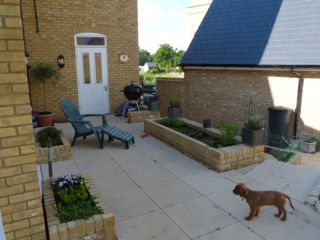
Now we've reached the far side of the garden and have turned around to look over the water feature back towards the gate to the drive. From here you get a sense of the two levels ... the upper patio, lined by herb beds, has doors into our laundry room and sitting room.
This starts to give you an idea of my colour scheme. Purples, pinks and blues. That's a beautiful little double geranium in the foreground, and a lovely clump of Siberian iris that should be blooming in the next week. Bright pink sea thrift, behind the iris, is settling happily into the cracks between the rocks. Here you can see the one major disadvantage of the garden ... the apartment building across the street that looks over us. (Fortunately the patio and the French doors to the sitting room aren't overlooked.) A possibility ... when I have at least £500 spare ... is some large pleached hornbeam planted on the other side of the wall to make those windows less intrusive.
Standing at the end of the pergola with that bed at your back, you look left and see the patio. The beds are filled with kitchen herbs and greens we cut and use regularly: rocket, fennel, rosemary, sage, oregano, basil. I have different kinds of mint in pots on the corners (chocolate, apple and basil), and that's an olive tree in the corner. The Weber kettle is, of course, just next to the back door. Over the wall you can see one of the glories of our location ... the wildflower meadow, wetland and trees over which the North side of our house looks.
And if you look down, over the water feature, you see the lower patio. This gets the afternoon sun so is a great place to sit and enjoy cocktails. We can set a table here for dining outside ... helped by that thing that looks like a coffee table, but is actually a firepit. (We cooked dinner on it tonight but, despite the fact it's early June, had to go inside to eat in a comfortable warmth.) The screen at the back matches the pergola, and separates the formal part of the garden from an area I've set aside for the dogs and the greenhouse. The two doors you see on the left are part of the garage; the one on the left leads into the garage itself, and on the right leads up to my office. (From which, on a warm day, I can leave the door open and hear the gurgling of the waterfall from my desk.)
Behind the screen I have a little area of lawn I jokingly call "the paddock". There you'll find this great lean-to greenhouse, currently housing tomatoes, eggplant (aubergine) and poblano pepper plants bursting to life. Our carpenter, Andris, custom built the dog house at right to match his pergola and screen. Sadly, neither dog seems inclined to spend any time it it. That brick wall is the back of the garage, and the window is the toilet underneath the stairs to my office.
We gained a lot by buying a new-built house on a modern estate. Square footage. Energy efficiency. Value for money. But I gave up the garden. We'd looked at some beautiful spaces, with plenty of room and established herbaceous borders. What I got was a blank slate. A modest-sized, L-shaped garden, with perhaps 100 feet of lawn sloping down a slight hill and a patio onto which the back door and the sitting room opens. Two sets of steps, with a flower bed between them, head down to the garage, my office door and the path to the drive where we park the cars. A tremendous advantage: the whole garden is enclosed by 8-foot brick walls. The disadvantage: It's overlooked by neighbours. That's the inevitable sacrifice of a modern estate.
But the money we saved on a new house gave me budget to devote to garden construction. And so, perhaps for the only time in my life, I've done things the way you're supposed to. I started out with a plan. I hired landscapers. I had all my hard landscaping done first. I built everything around an impressive water feature. Then I had my beds dug with several tonnes of topsoil and manure. And finally, the plants. A garden is never finished, but as of this weekend I declare Phase I concluded. The foundation is established. Now ... I have 20 or 30 years to potter.
If you came in the back gate ... the way we come in and out of the house every day ... you'd see this. That first flower bed, between the stairs, will eventually be filled with flowering perennials. For now, I have to screen it from meddlesome dogs.
The first plants in the bed between the steps offer a clue as to what it may eventually look like. A gentle pink rose, Geoff Hamilton, anchors the bed. The magnificent blue anchusa Loddon Royalist is blooming now, while the monkshood behind it, braced by the obelisk, will add blue colour later in the summer. Behind you get your first glimpse of my pergola, one of the architectural anchors of the garden. The lurking puppy trying to stick his head into things shows why this bed is screened off.
Look behind you at this point and you'll see a lovely little alcove that's a sun trap in the morning. That's an espaliered apple, egremont russet, that's going to be growing up the wall. (A rare and wonderfully tasty apple that's great with cheddar cheese.) It's behind what will eventually be a little hedge of lavender. The gate on the right leads to where we keep the cars, and is our main entry in and out of the house.
Walk a little further and you get to the water feature. It's the centrepiece of the whole garden, with an upper pond cascading into a lower. Some vivid orange goldfish live there, but wouldn't oblige to be in this afternoon's photos. The pond gives a lovely soundtrack to the whole garden, and provides me with the opportunity to use water plants within it and alpines in the rocks around the edge. Pots have their place, too. That's parsley in the foreground, and an oversized bowl of spinach at the back.
Now we've reached the far side of the garden and have turned around to look over the water feature back towards the gate to the drive. From here you get a sense of the two levels ... the upper patio, lined by herb beds, has doors into our laundry room and sitting room.
This starts to give you an idea of my colour scheme. Purples, pinks and blues. That's a beautiful little double geranium in the foreground, and a lovely clump of Siberian iris that should be blooming in the next week. Bright pink sea thrift, behind the iris, is settling happily into the cracks between the rocks. Here you can see the one major disadvantage of the garden ... the apartment building across the street that looks over us. (Fortunately the patio and the French doors to the sitting room aren't overlooked.) A possibility ... when I have at least £500 spare ... is some large pleached hornbeam planted on the other side of the wall to make those windows less intrusive.
Above the water feature you have the only significant bit of lawn I've left in my design. Mostly to provide a base for the hammock stand, to the honest. (This gets afternoon sun, and an ipod set up on a hammock-side table streams baseball games off MLB.com.) You can see a lovely dwarf ornamental cherry in the foreground, just to the left of centre. This is the anchor for the flower bed at the top of the water feature. The path to the front gate (this opens onto the main road at the front of the house) is covered by a custom-made pergola that will eventually be draped by a light pink rose called the generous gardener. At the back is another herbaceous border, and the Tunisian tiles that used to decorate the back wall at Thames Cottage.
Here's that back bed, seen a bit closer. On the right you have the generous gardener, now just a little starter plant. Under the obelisk is a bunch of sweet peas, starting slowly because of our cold spring. One challenge of this bed: the three feet on the left never get any direct sun. So I've built it up as a little hillside and have planted foxglove, ferns, heuchera and hosta. Standing at the end of the pergola with that bed at your back, you look left and see the patio. The beds are filled with kitchen herbs and greens we cut and use regularly: rocket, fennel, rosemary, sage, oregano, basil. I have different kinds of mint in pots on the corners (chocolate, apple and basil), and that's an olive tree in the corner. The Weber kettle is, of course, just next to the back door. Over the wall you can see one of the glories of our location ... the wildflower meadow, wetland and trees over which the North side of our house looks.
And if you look down, over the water feature, you see the lower patio. This gets the afternoon sun so is a great place to sit and enjoy cocktails. We can set a table here for dining outside ... helped by that thing that looks like a coffee table, but is actually a firepit. (We cooked dinner on it tonight but, despite the fact it's early June, had to go inside to eat in a comfortable warmth.) The screen at the back matches the pergola, and separates the formal part of the garden from an area I've set aside for the dogs and the greenhouse. The two doors you see on the left are part of the garage; the one on the left leads into the garage itself, and on the right leads up to my office. (From which, on a warm day, I can leave the door open and hear the gurgling of the waterfall from my desk.)
Behind the screen I have a little area of lawn I jokingly call "the paddock". There you'll find this great lean-to greenhouse, currently housing tomatoes, eggplant (aubergine) and poblano pepper plants bursting to life. Our carpenter, Andris, custom built the dog house at right to match his pergola and screen. Sadly, neither dog seems inclined to spend any time it it. That brick wall is the back of the garage, and the window is the toilet underneath the stairs to my office.
And finally ... my favourite plant so far, the wonderful anchusa Loddon Royalist. This photo doesn't even begin to capture the intense indigo blue. It seems happy to be sinking its roots into my (much improved) Hampshire soil. Hopefully, others will follow with equal zest, and these great garden bones will be softened by clouds of colour.
Monday, 3 June 2013
A woman's name belongs above this three-star door
There are currently four restaurants in the UK holding three Michelin Stars. Only one of them is run by a female chef. Sadly, it's Gordon Ramsay's name, rather than hers, above the door. Which is a real shame. Because Clare Smyth and team gave me one of my most memorable dining experiences.
What separates three stars from one or two? It's hard to put a finger on it. The food's no more elaborate, the ingredients no more precious. If anything, the dishes were simpler. But there was perfection in their simple elegance. Every element there for a reason, every flavour distinct and complementary, every plate arranged as a work of art.
This treat was the other half of our Chelsea Flower Show excursion. Normally, we three girls ... former PR colleagues ... meet up annually at the Hampton Court Flower Show for breakfast and a long catch up before hitting the display gardens and the plant sales. This year I've ruined that by heading to the States in July. So we went for Chelsea instead. And, as if a sign from God, the day I got the tickets I also found a table for three available at Restaurant Gordon Ramsay on Hospital Road, about 150 yards from the Show entrance. There's a £55 set menu for a three-course lunch. Not cheap, but we figured we could stretch to that. And since the big difference between Chelsea and Hampton Court is that they don't sell plants at the former, we argued to ourselves that we were spending on food what we normally laid out in horticulture.
Too often on these set price deals I'm lured to more expensive menus, because there seems a wide gulf between the cheap options and the rest. Not so here, where we were all delighted with the choices and felt no need to wander.
While perusing the menu we nibbled on savoury profiteroles stuffed with chicken liver mousse; a lovely complement to the kir royales we'd felt the need to splurge on. Next came the amuse bouche, a spring pea puree decorated with tiny flowers and vegetables (pictured top); an homage to the gardens down the street and as delicious as it was beautiful.
I was sorely tempted to go on to the lobster, asparagus and herb tortellini with lobster, broad bean and
tomato consommé. (It certainly would have been the weight watcher-friendly choice.) But, fortunately, my friend Alex ordered that so I could have a look and a little taste. Light, delicate yet packed with flavour. The magic words "foie gras" had jumped off the menu page, however, and I felt compelled to order the chicken liver, foie gras and bone marrow crouton with artichoke, apples and truffle vinaigrette. Despite its rich ingredients this was delicate as well, with the meaty elements in an elegant sufficiency beneath the seasonal crunch of the fruit and the raw, shaved baby asparagus. Presentation was again artful, with the circles of vinaigrette matching the pattern of the serving plate below.
On to roasted rabbit loin with Bayonne ham, salted baked turnips, toasted hazelnuts and pickled mustard seed. Stunning. Rabbit's a tricky meat to cook; easily dried out. Each bite-sized morsel of loin rolled with ham was, as you'd expect at this level, perfect. Salt baking (all the rage in London right now) transforms a turnip's flavour into a concentrated, richer version of itself. And pickled mustard seeds were a revelation, adding a bit of crunch, sweet, savoury and tart all in one go.

Dessert was the one place I was tempted to wander off the set menu. Cheese, no matter how lovely the cart, wouldn't satisfy my sweet tooth, and roasted pineapple with coriander financiers (small, almond-flavoured sponge cakes, not bankers), coconut sorbet and vanilla cream sounded too virtuous. Having been surprised by the peanut butter mousse at Bruno Loubet's place last month, I decided to give it another go. This time a quenelle of the stuff served beside banana parfait, a bitter chocolate sandwich and caramelised bananas. Like the rest of my meal, this was a combination of ingredients that could have turned into a stomach-filling lead weight in the wrong hands. But again, Clare and team created a small work of art so concentrated in flavour, yet light in texture, your taste buds spun with satisfaction. Leaving your stomach replete, yet not stuffed. I sense I might finally get a handle on the portion control challenge if I had a three-star chef in the kitchen.
All of the surrounding elements were as fine as the food. Clare recently appeared on Saturday Kitchen talking about the redecoration of the dining room: its greys, silvers, mauves and gentle pinks create a soothing, neutral setting while still looking distinctive. A delightful German sommelier is happy to work to a budget and, indeed, has something to work with. There are a reassuring number of bottles priced between £35 and £60 on a comprehensive wine list that, as you would expect, rises to stratospheric names. And prices. (He produced a £55 Austrian white, a seasonal special not on the menu, that performed the admirable trick of working across our diverse menu choices.) Front-of-house staff is constantly on hand ... I'd guess there are 10 of them for the 40 diners ... managing to anticipate every need while being unobtrusive.

And, the sign of great service: when they make a mistake, they over compensate. We'd almost finished our wine. Alex had just a sip or two left in her glass. A waiter had topped it up ... with water. Easily done, to be honest, as the wine was very pale and we were sitting next to the window in a pool of sunshine that further drained colour from the glasses. But it shouldn't have happened. And, let's face it, you don't want to waste even one sip of a £55 bottle. Mortified, the sommelier apologised profusely and then matched each of our desserts with complementary glasses of appropriate dessert wines. Turning a mistake into yet another reason why this extravagant lunch seemed like value for money.
I'm sure other tables spent far more than we did. But we engaged in a lot of amusing banter with the waiters and took obvious delight, and a deep interest, in every course. Plus the wine mistake. All of which, I suspect, contributed to the maitre d's invitation for us to take a peek into the kitchen on our way out. And so through the swinging door to a pristine laboratory of gastronomy. Sous chefs already working away with military precision on prep for the dinner service. And Clare Smyth in the centre of it all, brow furrowed over menu notes while she kept one eye on everything going on. Every inch the general of her troops. Stern, in complete control, yet beautiful and serene. (In the middle of a long work day in a hot kitchen? Not fair, really.)
We had a short chat. She was gracious and welcoming. "Your name should be above the door," I said. She gave me a knowing little smile. I suspect she's heard this before. Someday soon ... whether over this door or another ... I'm sure it will be true.
What separates three stars from one or two? It's hard to put a finger on it. The food's no more elaborate, the ingredients no more precious. If anything, the dishes were simpler. But there was perfection in their simple elegance. Every element there for a reason, every flavour distinct and complementary, every plate arranged as a work of art.
This treat was the other half of our Chelsea Flower Show excursion. Normally, we three girls ... former PR colleagues ... meet up annually at the Hampton Court Flower Show for breakfast and a long catch up before hitting the display gardens and the plant sales. This year I've ruined that by heading to the States in July. So we went for Chelsea instead. And, as if a sign from God, the day I got the tickets I also found a table for three available at Restaurant Gordon Ramsay on Hospital Road, about 150 yards from the Show entrance. There's a £55 set menu for a three-course lunch. Not cheap, but we figured we could stretch to that. And since the big difference between Chelsea and Hampton Court is that they don't sell plants at the former, we argued to ourselves that we were spending on food what we normally laid out in horticulture.
Too often on these set price deals I'm lured to more expensive menus, because there seems a wide gulf between the cheap options and the rest. Not so here, where we were all delighted with the choices and felt no need to wander.
While perusing the menu we nibbled on savoury profiteroles stuffed with chicken liver mousse; a lovely complement to the kir royales we'd felt the need to splurge on. Next came the amuse bouche, a spring pea puree decorated with tiny flowers and vegetables (pictured top); an homage to the gardens down the street and as delicious as it was beautiful.
I was sorely tempted to go on to the lobster, asparagus and herb tortellini with lobster, broad bean and
tomato consommé. (It certainly would have been the weight watcher-friendly choice.) But, fortunately, my friend Alex ordered that so I could have a look and a little taste. Light, delicate yet packed with flavour. The magic words "foie gras" had jumped off the menu page, however, and I felt compelled to order the chicken liver, foie gras and bone marrow crouton with artichoke, apples and truffle vinaigrette. Despite its rich ingredients this was delicate as well, with the meaty elements in an elegant sufficiency beneath the seasonal crunch of the fruit and the raw, shaved baby asparagus. Presentation was again artful, with the circles of vinaigrette matching the pattern of the serving plate below.
On to roasted rabbit loin with Bayonne ham, salted baked turnips, toasted hazelnuts and pickled mustard seed. Stunning. Rabbit's a tricky meat to cook; easily dried out. Each bite-sized morsel of loin rolled with ham was, as you'd expect at this level, perfect. Salt baking (all the rage in London right now) transforms a turnip's flavour into a concentrated, richer version of itself. And pickled mustard seeds were a revelation, adding a bit of crunch, sweet, savoury and tart all in one go.

Dessert was the one place I was tempted to wander off the set menu. Cheese, no matter how lovely the cart, wouldn't satisfy my sweet tooth, and roasted pineapple with coriander financiers (small, almond-flavoured sponge cakes, not bankers), coconut sorbet and vanilla cream sounded too virtuous. Having been surprised by the peanut butter mousse at Bruno Loubet's place last month, I decided to give it another go. This time a quenelle of the stuff served beside banana parfait, a bitter chocolate sandwich and caramelised bananas. Like the rest of my meal, this was a combination of ingredients that could have turned into a stomach-filling lead weight in the wrong hands. But again, Clare and team created a small work of art so concentrated in flavour, yet light in texture, your taste buds spun with satisfaction. Leaving your stomach replete, yet not stuffed. I sense I might finally get a handle on the portion control challenge if I had a three-star chef in the kitchen.
All of the surrounding elements were as fine as the food. Clare recently appeared on Saturday Kitchen talking about the redecoration of the dining room: its greys, silvers, mauves and gentle pinks create a soothing, neutral setting while still looking distinctive. A delightful German sommelier is happy to work to a budget and, indeed, has something to work with. There are a reassuring number of bottles priced between £35 and £60 on a comprehensive wine list that, as you would expect, rises to stratospheric names. And prices. (He produced a £55 Austrian white, a seasonal special not on the menu, that performed the admirable trick of working across our diverse menu choices.) Front-of-house staff is constantly on hand ... I'd guess there are 10 of them for the 40 diners ... managing to anticipate every need while being unobtrusive.

And, the sign of great service: when they make a mistake, they over compensate. We'd almost finished our wine. Alex had just a sip or two left in her glass. A waiter had topped it up ... with water. Easily done, to be honest, as the wine was very pale and we were sitting next to the window in a pool of sunshine that further drained colour from the glasses. But it shouldn't have happened. And, let's face it, you don't want to waste even one sip of a £55 bottle. Mortified, the sommelier apologised profusely and then matched each of our desserts with complementary glasses of appropriate dessert wines. Turning a mistake into yet another reason why this extravagant lunch seemed like value for money.
I'm sure other tables spent far more than we did. But we engaged in a lot of amusing banter with the waiters and took obvious delight, and a deep interest, in every course. Plus the wine mistake. All of which, I suspect, contributed to the maitre d's invitation for us to take a peek into the kitchen on our way out. And so through the swinging door to a pristine laboratory of gastronomy. Sous chefs already working away with military precision on prep for the dinner service. And Clare Smyth in the centre of it all, brow furrowed over menu notes while she kept one eye on everything going on. Every inch the general of her troops. Stern, in complete control, yet beautiful and serene. (In the middle of a long work day in a hot kitchen? Not fair, really.)
We had a short chat. She was gracious and welcoming. "Your name should be above the door," I said. She gave me a knowing little smile. I suspect she's heard this before. Someday soon ... whether over this door or another ... I'm sure it will be true.
Saturday, 25 May 2013
Chelsea celebrates its centenary by going deeply traditional
After one of the coldest, wettest winters on record, we had a stunner of an early May Bank Holiday. Warm, calm and sunny, it teased us with the idea that the long winter was over. For those few days, everything burst into bloom and we dreamt of the glories of a long, clement British summer.
Alas, it was a tease. The month that followed was ... surprise, surprise ... cold and wet. Plants that had given a little burst of growth at the beginning of the month seemed to go back into hibernation. Causing no end of stress for the growers preparing for the Chelsea Flower Show.
The grand-daddy of all horticultural events celebrated 100 years this week, and everyone was making an effort to create a superlative show. It was lovely, as ever, but I fear what I'll remember most is that despite valiant efforts, this was the year that a lot of the gardens remained in bud, rather than bloom. Growers coaxed enough out, however, for a glorious celebration. And the sun came out for us, though we were all in winter woolens. Here are a few highlights.
The anniversary show was definitely looking back and embracing tradition. We've had years where it was all stark modernism, foliage plants, high design, foreign influence. But this year ... exemplified by this garden created to mark 100 years of tradition ... was resolutely traditional with plenty of flowers, classic herbaceous borders and cottage garden feel.
Dominant colours were blues, purples and mauves, accented with reds or oranges.
The most common flower at the show seemed to be Queen Anne's lace (aka cow parsley, or for your purists out there ... anthriscus sylvestris). Used in multiple gardens, it created a billowing cushion of white to bring together all the other perennials. It looked great, but I'd be afraid to try it in my own garden. There's a fine line between this kind of planting and a serious weed problem.
My plant of the show was anchusa Loddon royalist. Stunning spikes of the most remarkable blue flowers ... turns out it's a member of the borage family. This was the one I had to have, and I'd purchased two from our local perennial specialist within 48 hours of seeing it.
Some gardens work better in concept than reality. The idea behind the one above was great: evoke England from an airplane, with its patchwork of fields, forests and rivers represented by all-English plants. Surround it with a cloister reminiscent of the great Medieval cathedrals, but modernised and made with English hardwoods. I'm afraid all I could think was funereal. The clipped box reminded me of graves, the black walls of a mausoleum.
Gnomes were the great joke of the show. They've never been allowed, but this year the RHS eased up the rules and they were dotted all over the place. Each painted by a celebrity, to be auctioned off to aid a gardening-based charity. This regal couple stood in the African-inspired garden created for the charity sponsored by English Prince Harry and Prince Seeiso of Lesotho.
A bold break from the gentle colour schemes and tradition. This one was supposed to make us think of a Jackson Pollock drip painting, and was surmounted by a giant glass sculpture of a single bloom ... blue with the same drops of colour. Fun, but far too garish to look at every day in your own garden.
In the floral pavilion you find the specialist growers who just do one type of plant very, very well. At this Iris grower's stand I discovered the identity of the yellow rogue in my garden. The one who was supposed to be the pink and purple Carnaby. Turns out his name is Rajah. And, I have to admit, he's growing on me.
There's at least one Oriental garden every year. This tiny Japanese model was exquisite. And if I had enough land for distinct garden "rooms", I'd be mighty tempted to build myself a little sushi hut...
And, of course, in addition to watching the plants, there's always celebrity spotting. We saw actresses Maureen Lipman and Miriam Margolyes. And, like the rest of the garden-mad crowds, paused to worship beneath the BBC broadcast balcony as TV gardeners Alan Titchmarsh and Dairmuid Gavin waved to the crowds.
Alas, it was a tease. The month that followed was ... surprise, surprise ... cold and wet. Plants that had given a little burst of growth at the beginning of the month seemed to go back into hibernation. Causing no end of stress for the growers preparing for the Chelsea Flower Show.
The grand-daddy of all horticultural events celebrated 100 years this week, and everyone was making an effort to create a superlative show. It was lovely, as ever, but I fear what I'll remember most is that despite valiant efforts, this was the year that a lot of the gardens remained in bud, rather than bloom. Growers coaxed enough out, however, for a glorious celebration. And the sun came out for us, though we were all in winter woolens. Here are a few highlights.
The anniversary show was definitely looking back and embracing tradition. We've had years where it was all stark modernism, foliage plants, high design, foreign influence. But this year ... exemplified by this garden created to mark 100 years of tradition ... was resolutely traditional with plenty of flowers, classic herbaceous borders and cottage garden feel.
Dominant colours were blues, purples and mauves, accented with reds or oranges.
The most common flower at the show seemed to be Queen Anne's lace (aka cow parsley, or for your purists out there ... anthriscus sylvestris). Used in multiple gardens, it created a billowing cushion of white to bring together all the other perennials. It looked great, but I'd be afraid to try it in my own garden. There's a fine line between this kind of planting and a serious weed problem.
My plant of the show was anchusa Loddon royalist. Stunning spikes of the most remarkable blue flowers ... turns out it's a member of the borage family. This was the one I had to have, and I'd purchased two from our local perennial specialist within 48 hours of seeing it.
Some gardens work better in concept than reality. The idea behind the one above was great: evoke England from an airplane, with its patchwork of fields, forests and rivers represented by all-English plants. Surround it with a cloister reminiscent of the great Medieval cathedrals, but modernised and made with English hardwoods. I'm afraid all I could think was funereal. The clipped box reminded me of graves, the black walls of a mausoleum.
Gnomes were the great joke of the show. They've never been allowed, but this year the RHS eased up the rules and they were dotted all over the place. Each painted by a celebrity, to be auctioned off to aid a gardening-based charity. This regal couple stood in the African-inspired garden created for the charity sponsored by English Prince Harry and Prince Seeiso of Lesotho.
A bold break from the gentle colour schemes and tradition. This one was supposed to make us think of a Jackson Pollock drip painting, and was surmounted by a giant glass sculpture of a single bloom ... blue with the same drops of colour. Fun, but far too garish to look at every day in your own garden.
In the floral pavilion you find the specialist growers who just do one type of plant very, very well. At this Iris grower's stand I discovered the identity of the yellow rogue in my garden. The one who was supposed to be the pink and purple Carnaby. Turns out his name is Rajah. And, I have to admit, he's growing on me.
There's at least one Oriental garden every year. This tiny Japanese model was exquisite. And if I had enough land for distinct garden "rooms", I'd be mighty tempted to build myself a little sushi hut...
And, of course, in addition to watching the plants, there's always celebrity spotting. We saw actresses Maureen Lipman and Miriam Margolyes. And, like the rest of the garden-mad crowds, paused to worship beneath the BBC broadcast balcony as TV gardeners Alan Titchmarsh and Dairmuid Gavin waved to the crowds.
Thursday, 16 May 2013
Book of Mormon and Don Carlo share the London stage, and a poke at religion
On first glance, you wouldn't imagine there was anything linking them.
The Book of Mormon. A rollicking, wickedly satirical musical from the creators of South Park that might also be called puerile, obscene and offensive. But so funny I laughed until I hurt. Don Carlos. A 4-hour epic grand opera by Verdi, directed by the world-reknown Anthony Pappano and staring the even more famous Johann Kauffman. High culture doesn't get much higher. At opposite ends of the scale?
Perhaps. But both were on the London stage this month. Both were equally enjoyable, both were incredibly tough tickets to get and both used art to cast a very wary eye over religion.
Let's start with the Mormons. If anything, I suspect this show will be an even bigger hit here than in the States. First, because the Brits are less easily offended. And second, because the naive, cheerful, blundering innocence of the young Mormon protagonists is pretty much the way the Brits see all Americans. Thus in London, there's an added layer of meaning as the show becomes a commentary on American culture itself.
It's not for the easily offended. The simple plot comes up against some horrific issues as our cheerful missionaries land in darkest Africa and confront a warlord threatening clitoral circumcision of our young heroine. Aids, famine, raping babies, God abandoning his people and suppressed homosexuality all turn up, along with language to make a hardened longshoreman blush. That should be grim going, but not in the hands of the South Park boys, who've always used humour to plumb some grim depths. The music, pacing and characters remind you of a cheerful ... even innocent ... high school musical, and that bizarre contrast ads to the laughs. The scenes when one of our heroes reveals Orlando as his dream of paradise, when another baptises his first girl (an obvious double for losing his virginity), the ironic take on Disney's "Hakuna Matata" and the big production number that is the "spooky Mormon hell dream" are all so funny you'll be fighting to breathe.
At the centre is, of course, a grand send-up of Mormonism, pushed beyond ridiculous as the show reveals its foundation myths of Jewish tribes in pre-historic America, golden tablets found in farm fields and the promise of your own planet in the afterlife. The official Mormon response, reportedly, has been to share the joke, buying advertising in show programmes. I can't help but recall the Catholic response to Life of Brian, which made them look small minded and made the film an even bigger success. (Is it time for Life of Brian, the musical?)
I wonder if anyone at the Vatican banned Don Carlo when it first came out because, frankly, it doesn't
do many favours for the establishment in Rome. The Grand Inquisitor is a villain of the highest degree, and the church casts a malign shadow across the plot. Which, much simplified, is as follows: Carlo, the son of Philip II of Spain, is supposed to marry a French princess and end war between the two countries. Prince and princess fall in love and look to a happy future, but this is opera and it's only Act 1. So that's not going to happen. Politics wed the young princess to Carlo's father instead. Leaving the next 4 acts for the prince to deal with thwarted love and serious paternal issues through involvement in revolution in the Netherlands and protest against the dreaded inquisition.
This opera isn't produced too often, probably because it's of almost Wagnerian length, but the plot rips along at a good pace and has enough twists and turns to make it closer to modern melodrama or soap opera than the great German's myth-based epics. This is one it's great to see in a place like the Royal Opera House, where they can pull out the stops on sets, costumes and extras. The scene where they burn the heretics, complete with golden cathedral and lavish royal procession, was magnificent. But, frankly, so was the forest in which our star-crossed lovers met at the beginning, and the grand tomb of Charles V where everything comes to a climax at the end.
This was a sell-out thanks to the star turn of opera man-of-the-moment Jonas Kauffman who was, as expected, both wonderful to hear and to look at. However, I must admit he seemed no stronger than an astonishing ensemble cast. Elisabetta (princess, then queen) was strong and poignant, the king ominous yet somehow pitiable, and the Grand Inquisitor chilling. There is a moment when he turns on King Philip, drawing himself up to issue a warning as the music swells, that's just as good as when the ghost arrives for dinner with Don Giovanni.
Ironically, it's the lowbrow show with the naughty humour that may leave you with a more positive feel for religion. After sending it up for two hours, at the end of Book of Mormon you're left with a message that the details of religion really don't matter as long as you can combine stories and traditions to get people to do good things. Meanwhile, the operatic tragedy at the end of Don Carlo leaves you thinking all religion is bad, and particularly dangerous when combined with politics. Both, whatever their nuances, left me vastly entertained.
The Book of Mormon. A rollicking, wickedly satirical musical from the creators of South Park that might also be called puerile, obscene and offensive. But so funny I laughed until I hurt. Don Carlos. A 4-hour epic grand opera by Verdi, directed by the world-reknown Anthony Pappano and staring the even more famous Johann Kauffman. High culture doesn't get much higher. At opposite ends of the scale?
Perhaps. But both were on the London stage this month. Both were equally enjoyable, both were incredibly tough tickets to get and both used art to cast a very wary eye over religion.
Let's start with the Mormons. If anything, I suspect this show will be an even bigger hit here than in the States. First, because the Brits are less easily offended. And second, because the naive, cheerful, blundering innocence of the young Mormon protagonists is pretty much the way the Brits see all Americans. Thus in London, there's an added layer of meaning as the show becomes a commentary on American culture itself.
It's not for the easily offended. The simple plot comes up against some horrific issues as our cheerful missionaries land in darkest Africa and confront a warlord threatening clitoral circumcision of our young heroine. Aids, famine, raping babies, God abandoning his people and suppressed homosexuality all turn up, along with language to make a hardened longshoreman blush. That should be grim going, but not in the hands of the South Park boys, who've always used humour to plumb some grim depths. The music, pacing and characters remind you of a cheerful ... even innocent ... high school musical, and that bizarre contrast ads to the laughs. The scenes when one of our heroes reveals Orlando as his dream of paradise, when another baptises his first girl (an obvious double for losing his virginity), the ironic take on Disney's "Hakuna Matata" and the big production number that is the "spooky Mormon hell dream" are all so funny you'll be fighting to breathe.
At the centre is, of course, a grand send-up of Mormonism, pushed beyond ridiculous as the show reveals its foundation myths of Jewish tribes in pre-historic America, golden tablets found in farm fields and the promise of your own planet in the afterlife. The official Mormon response, reportedly, has been to share the joke, buying advertising in show programmes. I can't help but recall the Catholic response to Life of Brian, which made them look small minded and made the film an even bigger success. (Is it time for Life of Brian, the musical?)
I wonder if anyone at the Vatican banned Don Carlo when it first came out because, frankly, it doesn't
do many favours for the establishment in Rome. The Grand Inquisitor is a villain of the highest degree, and the church casts a malign shadow across the plot. Which, much simplified, is as follows: Carlo, the son of Philip II of Spain, is supposed to marry a French princess and end war between the two countries. Prince and princess fall in love and look to a happy future, but this is opera and it's only Act 1. So that's not going to happen. Politics wed the young princess to Carlo's father instead. Leaving the next 4 acts for the prince to deal with thwarted love and serious paternal issues through involvement in revolution in the Netherlands and protest against the dreaded inquisition. This opera isn't produced too often, probably because it's of almost Wagnerian length, but the plot rips along at a good pace and has enough twists and turns to make it closer to modern melodrama or soap opera than the great German's myth-based epics. This is one it's great to see in a place like the Royal Opera House, where they can pull out the stops on sets, costumes and extras. The scene where they burn the heretics, complete with golden cathedral and lavish royal procession, was magnificent. But, frankly, so was the forest in which our star-crossed lovers met at the beginning, and the grand tomb of Charles V where everything comes to a climax at the end.
This was a sell-out thanks to the star turn of opera man-of-the-moment Jonas Kauffman who was, as expected, both wonderful to hear and to look at. However, I must admit he seemed no stronger than an astonishing ensemble cast. Elisabetta (princess, then queen) was strong and poignant, the king ominous yet somehow pitiable, and the Grand Inquisitor chilling. There is a moment when he turns on King Philip, drawing himself up to issue a warning as the music swells, that's just as good as when the ghost arrives for dinner with Don Giovanni.
Ironically, it's the lowbrow show with the naughty humour that may leave you with a more positive feel for religion. After sending it up for two hours, at the end of Book of Mormon you're left with a message that the details of religion really don't matter as long as you can combine stories and traditions to get people to do good things. Meanwhile, the operatic tragedy at the end of Don Carlo leaves you thinking all religion is bad, and particularly dangerous when combined with politics. Both, whatever their nuances, left me vastly entertained.
Monday, 6 May 2013
May bank holiday brings a verdant explosion
Few things are rarer than a British bank holiday with good weather. It was a rainy bank holiday that triggered this blog's first entry six years ago, and the majority of them since have seen rain, wind, clouds and cool weather. But not this year. After a wet, miserable winter that never seemed to end, the early May bank holiday sprung upon us with warmth and sunny skies. Nature is exploding to catch up with where it should be. It was a weekend to be outside. A weekend to let pictures speak louder than words.
I discovered that one of the UK's top 25 specialist nurseries, Hardy's Cottage Plants, was just half an hour from my house. I bought a few plants. Many more will come.
Back to the garden, where I planted the new things from Hardy's, then sat on this lower patio, watching the dogs romp and reading gardening magazines.
It's two picturesque miles across fields to the local National Trust property. Right now the paths are edged with blossoms. Because spring was late, the hawthorns are still in full bloom.
This year's late-blooming primroses, unusually, are side-by-side with the bluebells.
Just 20 minutes from the house, I can find this idyllic little stream bordered by bluebells. One of the best things about Basingstoke is how quickly you can get out of it!
Freshly-plowed fields, pregnant with summer.
Iconic English oaks fringed with new leaves.
A mix of tiny flowers at the edge of the path.
At the end of the walk, the formal glory of the gardens at The Vyne.
Far too exciting a weekend for a puppy. Bruno is exhausted!
Saturday, 27 April 2013
First chef's table (at Corrigan's Mayfair) a culinary disappointment
I'd been wanting to get to a chef's table for a long while. Just about every top restaurant in Europe seems to have one these days. Basically it's a table, in a space just off the kitchen, with a view of what's going on and special attention from the chef. In a world where it's increasingly tough to get jaded, seen-it-all executives to attend events, chef's tables offer a different twist on corporate hospitality. And the small tables ensure good conversation.
I've researched and planned these for my company, but I've never attended one myself. Thus I jumped at the chance to attend a PR roundtable at the chef's table at Corrigan's Restaurant in Mayfair last week. I fear my expectations were far higher than reality.
I'd accepted the invitation expecting a gastronomic experience above normal dining. At the dinners I've planned for others, the chef comes to the table for every course, discussing the food in detail. It's usually a chef's tasting menu, with many small courses, giving the chef a chance to show off and the diners a chance to learn. And there's a matching wine flight, with more good information coming from the sommelier. All with a great view of the kitchen. (At one event we organised in France, the view was actually over video screens and, if you wished, one or two guests were plucked from the table between each course to help with the cooking and get a mini master class.)
Corrigan's has two chef's tables. One, which seats no more than six comfortably, is in an alcove directly across from the pass in the kitchen. This might have been the option closer to my expectations. We were in a private dining room where two thirds of the back wall was a window looking onto the far end of the pass, with glimpses into a corner of the kitchen. As a private dining room it was lovely: wood panelling, mellow lighting, ten substantial, comfortable leather chairs, an elegantly laid table. All as if plucked from an Edwardian country house or gentlemen's club.
But as a culinary experience it was nothing special.
Rather than a tasting menu, we had a standard three courses chosen from a version of their a la carte menu (five options for each course). With everyone choosing different items, this offered no practical chance for thoughtful wine pairing. Just a multi-purpose red, or white, poured as you desired. (Interestingly, the white was a Picpoul de Pinet, with distinct flavours I would have thought a risky choice for a general pouring.)
The chef didn't come into the room, and we got little information on the food. The thing that started to elevate our experience was a wander back into the kitchen before we ordered, when we met Head Chef Chris McGowan (generally thought to be one of the young guns to watch on the British restaurant scene) and were able to have a little chat. This was a fascinating 10 minutes, in which we discussed the challenges of local sourcing through this year's rotten weather, the rising trend in foraging and how those suppliers were devastated by the cold, wet winter, and his tip for gnocchi. Use the dry, fluffy insides of baked potatoes. But that was over all too soon, and we were back to our table. So aside from the privacy, the glimpse of the kitchen and the chat with Chris, it was just a nice meal in a private dining room.
How nice a meal? Delicious, but unexceptional. I had nothing that made me think "I must make a booking and bring Piers back here." I started with Riddle Valley duck en croute with hazelnut. Essentially a round terrine of mixed duck meats with a pastry case, sliced and served cold on a salad. Worth investigating as a dinner party starter for its prepare-in-advance qualities. My main was certainly the most elegant beef rib I've had, with the thick slab of meat and fat cut off the bone and slow cooked until most of the latter was rendered out .. highly reminiscent of a good pork belly. It was served with the bone from which it had been cut arching above it, which the waiter kindly sent home for the spaniel in a posh Corrigan's bag. The real star of the plate, though, was the bone marrow toast. More of a crostini, actually, and the best thing I tasted all night.
The place is, according to Chef Chris, famous for its dessert soufflés. But the combo of chocolate, pistachio and salted caramel appeared on the menu, and I couldn't resist. I should have taken the chef's advice. An elegant looking dessert, but the dark chocolate was so dominant it drowned the other flavours. Chris sent a couple extra rhubarb soufflés out and my taste of this was, indeed, much better. Light, sweet yet sharp, a much better follow up to the heaviness of the beef.
So, as a gastronomic experience, Corrigan's chef's table wasn't exceptional enough to really be worth the round trip to London. But it did get me to accept an invite to an agency event I wouldn't have attended without it. Which, from a marketer's viewpoint, is the whole point of chef's tables anyway. And the conversation was worth the commute. Eight mostly senior executives in PR and marketing, most with at least 15 years under their belt, talking about the convergence of the two disciplines as the Internet, social media and the economy change the playing field. For me, that depth of interaction with peers outside of my own company is far rarer than fine dining experiences, so I was delighted.
Though perhaps not as useful as Chris' tip about baked potatoes for gnocchi. We shall see...
I've researched and planned these for my company, but I've never attended one myself. Thus I jumped at the chance to attend a PR roundtable at the chef's table at Corrigan's Restaurant in Mayfair last week. I fear my expectations were far higher than reality.
I'd accepted the invitation expecting a gastronomic experience above normal dining. At the dinners I've planned for others, the chef comes to the table for every course, discussing the food in detail. It's usually a chef's tasting menu, with many small courses, giving the chef a chance to show off and the diners a chance to learn. And there's a matching wine flight, with more good information coming from the sommelier. All with a great view of the kitchen. (At one event we organised in France, the view was actually over video screens and, if you wished, one or two guests were plucked from the table between each course to help with the cooking and get a mini master class.)
Corrigan's has two chef's tables. One, which seats no more than six comfortably, is in an alcove directly across from the pass in the kitchen. This might have been the option closer to my expectations. We were in a private dining room where two thirds of the back wall was a window looking onto the far end of the pass, with glimpses into a corner of the kitchen. As a private dining room it was lovely: wood panelling, mellow lighting, ten substantial, comfortable leather chairs, an elegantly laid table. All as if plucked from an Edwardian country house or gentlemen's club.
But as a culinary experience it was nothing special.
Rather than a tasting menu, we had a standard three courses chosen from a version of their a la carte menu (five options for each course). With everyone choosing different items, this offered no practical chance for thoughtful wine pairing. Just a multi-purpose red, or white, poured as you desired. (Interestingly, the white was a Picpoul de Pinet, with distinct flavours I would have thought a risky choice for a general pouring.)
The chef didn't come into the room, and we got little information on the food. The thing that started to elevate our experience was a wander back into the kitchen before we ordered, when we met Head Chef Chris McGowan (generally thought to be one of the young guns to watch on the British restaurant scene) and were able to have a little chat. This was a fascinating 10 minutes, in which we discussed the challenges of local sourcing through this year's rotten weather, the rising trend in foraging and how those suppliers were devastated by the cold, wet winter, and his tip for gnocchi. Use the dry, fluffy insides of baked potatoes. But that was over all too soon, and we were back to our table. So aside from the privacy, the glimpse of the kitchen and the chat with Chris, it was just a nice meal in a private dining room.
How nice a meal? Delicious, but unexceptional. I had nothing that made me think "I must make a booking and bring Piers back here." I started with Riddle Valley duck en croute with hazelnut. Essentially a round terrine of mixed duck meats with a pastry case, sliced and served cold on a salad. Worth investigating as a dinner party starter for its prepare-in-advance qualities. My main was certainly the most elegant beef rib I've had, with the thick slab of meat and fat cut off the bone and slow cooked until most of the latter was rendered out .. highly reminiscent of a good pork belly. It was served with the bone from which it had been cut arching above it, which the waiter kindly sent home for the spaniel in a posh Corrigan's bag. The real star of the plate, though, was the bone marrow toast. More of a crostini, actually, and the best thing I tasted all night.
The place is, according to Chef Chris, famous for its dessert soufflés. But the combo of chocolate, pistachio and salted caramel appeared on the menu, and I couldn't resist. I should have taken the chef's advice. An elegant looking dessert, but the dark chocolate was so dominant it drowned the other flavours. Chris sent a couple extra rhubarb soufflés out and my taste of this was, indeed, much better. Light, sweet yet sharp, a much better follow up to the heaviness of the beef.
So, as a gastronomic experience, Corrigan's chef's table wasn't exceptional enough to really be worth the round trip to London. But it did get me to accept an invite to an agency event I wouldn't have attended without it. Which, from a marketer's viewpoint, is the whole point of chef's tables anyway. And the conversation was worth the commute. Eight mostly senior executives in PR and marketing, most with at least 15 years under their belt, talking about the convergence of the two disciplines as the Internet, social media and the economy change the playing field. For me, that depth of interaction with peers outside of my own company is far rarer than fine dining experiences, so I was delighted.
Though perhaps not as useful as Chris' tip about baked potatoes for gnocchi. We shall see...
Subscribe to:
Posts (Atom)