Monday, 29 October 2018

Stop moaning, Britain. You have only yourself to blame for Halloween.


Americans are everyone’s favourite scapegoat. Lay blanket blame any other group for pretty much anything and you’re likely to get hauled up on charges of racism, sexism or snobbery. Americans, however, are fair game. From the toxicity of the current political environment to the rise of obesity to the dumbing down of popular culture, it is ALL the fault of the USA. I am yet to witness an American physically forcing a European to use Facebook, eat at McDonalds or watch Big Brother (which was invented by the Dutch, btw), but we will be blamed.

Long term expats living in England get used to this, generally allowing the stars-and-stripes bashing to roll away like rain off the back of the Queen’s swans, but there are times we get pushed to the limit. Halloween is one of them.

Let’s get this clear, Brits. We did NOT force you to embrace Halloween. You did it all by yourself. Nor did we invent it. I understand your disgruntlement, but do not shift the blame. Accept responsibility for the choices you have made and, perhaps, work to improve things.

Let’s look at the arguments against you.

WHERE’S THE GUY?
Bonfire Night was a glorious, and uniquely British, festival. I remember going to a magnificent party in the village of Hartley Witney my first year working here (1994). Locals had been stacking wood on the village green for a month; the pile was bigger than a 4-bedroom detached home. It was studded with “Guys” ... no longer representations of Guy Fawkes himself, but witty takes on authority figures who needed to be knocked down a peg or two, from an irritating French trade minister with beret and garlic strand to an insufferably smug pop star. As night fell, villagers slowly emerged from the adjoining woodland, swinging balls of fire on chains. When they reached the pyre they processed around it slowly , whirling the fireballs above their heads before launching them onto the waiting pile with its crowd of effigies. It felt deliciously ancient and pagan, despite the ceremony’s roots in hard-line Protestantism.

The ensuing inferno was the biggest I’d ever been near, raising the temperature across the whole green. We ate baked potatoes and drank numerous pints from the two local pubs, who had extended operations to the fireside.
There were no trick-or-treaters that year, nor for the rest of the ‘90s. But even then, I could feel Guy Fawkes Night fading. The English are often shockingly ignorant of their history: people in our office pointed “foreigners” at me to explain the significance of the celebration because they weren’t quite sure. (On 5 November 1605, a plot by Roman Catholic extremists to blow up parliament was narrowly foiled; they were executed and thereafter burned in effigy on the anniversary, along with other symbols of Popery, to celebrate the triumph of local authority over foreign influence. There were more significant plotters, but Fawkes was the one found with the gunpowder so became the poster child for the event.) For many, by the mid-1990s the stories and relevance had faded away until it was just a bonfire and some fireworks. 

Even more, I blame government. Between European air quality regulations and local government health and safety, it became almost impossible for local parishes to host their own celebrations. And in an era of hyper-sensitivity, the idea of burning anyone in effigy ... even with humorous intent ... has become a no-go area.

A few particularly famous local festivals remain, notably in Lewes and Ottery-St-Mary, but in many places events have become large, almost-industrial fireworks displays without any historic tradition or local flare. Parents and children are simply often finding local trick or treating to be more fun than the soulless municipal Bonfire Nights that are left in most of the country.

NOT A “HALLMARK HOLIDAY"
American capitalists did not invent Halloween to “force” you to buy greeting cards, home decorations and candy. It was your festival a millennium before the USA even existed. Look up Samhain. The Christians appropriated festivities with the double feast of All Souls on the 31st and All Saints on 1 November, beloved celebrations marked throughout Britain for centuries before the Puritans went into abolition overdrive.

Guy Fawkes celebrations, in fact, were promoted by Cromwell’s administration as a way to replace Halloween in the people’s affections. So, rather than adopting something new from America, today's Brits who celebrate Halloween are returning to their original tradition. Got it?

YOU’RE MISSING SOME KEY POINTS
Sure, there’s an unhealthy element of gluttony to Halloween. In my experience, English kids have quickly embraced the get-as-much-candy-as-possible part of the event while missing all the nuance.

First. It’s Trick or Treat. Where’s your trick? American kids know they need to earn their goodies, from telling simple jokes to putting on mini-plays on the doorstep. Many homeowners buy a range of sweets, holding back “the good stuff” for kids with the best trick or the cleverest costume. English kids don’t get this at all.

There’s no sense of working for their treat: they just want candy. They’re totally missing Halloween’s most valuable life lesson.

The trick element also builds confidence. Most Brits will grudgingly acknowledge that Americans are naturally better and more confident presenters than they are. Look to early doorstep candy canvassing for one of the reasons.

The English kids at my door also show shockingly little attention to costume. It’s inevitably a procession of the same mass-produced tat grabbed at the local supermarkets. Meanwhile, American kids may spend weeks planning; often in a great bonding exercise with their parents and exploring their creativity. Costumes are often home made; having the same outfit as someone else is abhorrent. Last year, I think my godson had the only hand-crafted costume amongst the hundreds of kids haunting our housing estate. Which is a nice cue to run that adorable photo again...

Costumes span all of imagination and are often quite clever. Halloween is where many American kids are introduced to current events and political satire. A fair number of Supreme Court justices showed up on friends’ Facebook feeds last year. Groups will organise team costumes. In Texas I remember a bunch of kids dressed as different fish, with their parents holding the frame of the aquarium. In Chicago, a set of cardboard boxes painted as buildings that turned into the city skyline when the kids stood in the right order. It’s also a great way to learn history. Since Hamilton, American doorsteps have seen a surge in founding fathers, many of whom will rap for you.

Oh, what I would give this year to see a WW1 soldier, a suffragette, a Russian with a Salisbury guidebook or a May-Corbyn Punch-n-Judy Show. Sadly, we can confidently expect the same repetitive stream of Sainsbury's vampire & witch costumes.

AND YOU’RE IGNORING SOME BENEFITS
When you get past the candy, you’ll see that there are some fabulous benefits to Halloween. If done properly, as described above, the annual outing builds creativity and self confidence. Costumed roll play fosters imagination. Parents and children work together on a shared project.

Even if you miss all of this, there’s still an element of communal fun that’s rare in modern life. In my Hampshire neighbourhood (see below), groups of parents go out with the kids, talking to each other and making community connections often missing in an English housing estate. People share photos of best decorated houses and cute kids on the local Facebook page. It’s one of the few things that’s managed to give our neighbourhood, full of commuters who spend most of their waking hours elsewhere, a community spirit more like an old, established village.

Even sugar-fuelled greed has its upside. The desire to milk my childhood subdivision for all the candy possible taught me early lessons in project planning , team management and map reading. 

AMERICANS DIDN’T COME TO EUROPE FOR AMERICANA
Yes, I’m excited that the MLB is bringing a few baseball games to London next year. Sometimes I feel the need to drop in to the Fat Bear for some home style cooking. Amazon delivery is a life-saver.

But on the whole, Americans in Europe want ... Europe. In France, we want to sit under the lime trees drinking Pastis and watching the locals play Pétanque. In Spain we want to see villagers parading flower-draped statues of saints. We thirst for locally-brewed beer in Munich gardens and shop for exquisite handicrafts in tiny Italian shops. If I wanted to drink Bud and shop at Wal-Mart, I could have stayed home. Offer most Americans in Britain the choice between that magical Hartley Whitney bonfire night and Halloween, and they’d take the former. It’s not our fault that the choice doesn’t exist any more.

Have I made my point? Good. If you’re still wound up about the incursion of this rubbish American event into your national traditions, then DO SOMETHING ABOUT IT. Go to your local council and volunteer to organise your Guy Fawkes celebrations.

I, meanwhile, will be polishing my arguments for why Black Friday is not our fault, either.

Saturday, 6 October 2018

Re-opened London Mithraeum underwhelms despite investment

No major construction project gets planning permission in the UK these days without an element of quid pro quo.

Our house builder won the right to lay suburbia over farmland with a snazzy new community centre. Earlier this year, I wrote of how London’s newest theatre was the by-product of a recent luxury Thames-side development. Now we get London’s newest heritage attraction as a consequence of Bloomberg’s impressive new corporate headquarters.

The Foster and Partners-designed building in the heart of the City of London has been showered with press attention, was the darling of London Open House weekend 2019 and just snagged the prestigious Royal Institute of British Architects’ Stirling Prize for best new building of the year. I wish I could say I was as impressed by the re-instatement of London’s mithraeum (an ancient Roman temple of the god Mithras) in its basement. Bloomberg's restoration and re-siting of the temple to its original location, surrounded by a new, small museum with free public entry, was the price for planning permission of the building above. While the new installation is far better than the open-air, back-alley site it had been mouldering in for decades, the experience didn’t live up to the slick marketing Bloomberg has been putting out about it.
In addition to a too-successful PR team, this may, in large part, be due to a combination of the people working there and poor design of the experience. I suspect the 20-somethings who welcomed us were recent graduates on rotation through the marketing department. They seemed to know little about Romans, Mithras or the temple, and had a remarkably laid back attitude to the whole thing. “Here’s the layout, explore what you want, the next show is in 5 minutes.”

At that, we rushed directly down to the temple itself, past other displays on two floors. Heavy use of the words “show” and “multi-media experience” had prepared us for something special. The newly-restored foundations do look good on first glance, with clumsy modern additions stripped out and a full-scale glass representation of Mithras slaying a bull where it would once have been on the altar. Promising. Lights went down. Some mist came up. A high-quality, “total surround” sound system gave us the audio effects of a ceremony, then the following banquet. And then the lights came up.

We were puzzled. That felt like a teaser. Where was the main event? It was back in the rooms we’d rushed through to get to the “show”, we later discovered.

The whole experience would be more meaningful if it if it worked more like a ride at Disney’s Epcot Center, with a gated flow from one section to another, learning about what you're about to see. Let the tension and the excitement build. So that when you get to the temple, you know what you're looking at and are better able to engage your imagination.  I suspect that’s how it was designed, but the youngsters on the door .... by rushing you straight to the end ... didn’t deliver. So let’s spool back and consider the experience again.

You arrive at a dedicated door into a big, empty room decorated with modern, but Roman inspired, floor-to-ceiling wall murals. The long-time marketer in me sees this for what it no doubt is: a corporate entertainment space. (And why not? If you’ve got a Roman temple in your basement, incorporating it into client cocktail parties makes sense.).
But instead of letting you pass straight through this cavernous echo chamber, the youngsters on the door could give an inspiring little intro to what you’re about to see and why it’s special. They could explain the murals that celebrate with photo-realistic detail the influence Roman architecture has had on London to this day. They don’t necessarily need to be in period costume but ... why not? The cult of Mithras was primarily adopted by the army. A centurion complete with plumed helmet, introducing himself as Ulpius Silvanus, donor of the building, would have been a great touch.

Most of all, they should stop you by the case of artefacts at the top of the stairs, all unearthed in recent excavations as they prepared foundations for the new building, and explain why they’re special. The showiest finds from the temple are across town at the Museum of London. This looks like a case of seemingly inconsequential household ephemera. While you can find the information in the guide book to explain its importance (the temple was next to a river; lots of stuff washed downstream; thus the latest excavations told us more about life in the whole city), the experience would be better if someone took the time to explain it live.
From here you climb down a long flight of stairs to reach the street level of Roman London. It looks like a staircase in a sleek corporate office building. Which, of course, it is. With some music, lighting effects and information on the walls they could have given more of a sense of time travel, plunging down into history. (Only after I left did I learn that there were historic street levels noted on the walls; they are so subtle and the lighting is so low we missed them.)

You emerge into an ante-chamber where the meat of the information about the temple is conveyed. For the temple to make sense, you need to spend some time here. This is the best designed of the rooms, with video projections on the walls setting a nicely-mystical atmosphere while telling the story of the temple. The audio feed is a documentary hosted by Joanna Lumley, including various experts on the site and Mithras. Information screens on plinths let you browse through a catalogue of artefacts found here and moved to the Museum of London, photos of the original excavation, reconstructions of what the temple and its surrounding neighbourhood would have looked like, etc. Once armed with all this information, you'll have a much better idea of what you're looking at and be far more impressed at how it's come to be here.
Another rather industrial hallway takes you to the temple entrance. Not for the first time, my mind turned wistfully to the Danish museums at Jelling and Moesgaard, with their remarkable ability to use multi-media technology to bring history to life. They, doubtless, would have found a way to make this hall look like the banks of the Wallbrook, and would have given us a sense of the half-submerged, grotto-like set-up of the temple. Like all Mithraea, this one was at least partially underground to evoke a cave that's central to Mithras' story.

If you've taken the time to pay attention to the artefacts and information before this point, then the short sound and light experience at the temple makes more sense. There's only one source for what might have happened here (a 4th century Egyptian papyrus), so the fact that you're essentially eavesdropping on the original Latin ceremony is rather cool. Still, I wanted more. Instead of reconstructing the temple on the computer screens outside, why not project walls and people against the mist to bring it all to life in situ?

Big picture: the London Mithraeum is surprisingly old school for a brand new cultural experience. The Danish museums mentioned above, the Dutch National Maritime Museum and England's own Mary Rose Museum are all great examples of people using technology to bring history to life and make artefacts more relevant. The Mithraeum could have so easily been the same. Sure, it's the quid pro quo afterthought to the building above, and it's free, so perhaps we shouldn't expect much. But given that the whole site cost £1 billion, has state-of-the-art environmental systems and is sheathed in 600 tonnes of bronze imported from Japan, a bit more investment in user experience doesn't seem like a big ask. As it is, I can't see many beyond true devotees of ancient Roman history getting too excited about this.

Why should an insignificant temple to a niche god be worth your time, anyway? Because Mithras has a direct connection to our world today. In the first century, jaded Romans bored with their state religion were dabbling in new "mystery cults". Three gods were running neck-and-neck for dominance on this scene: Mithras, Isis and Jesus. How the followers of the latter won the race, consigning the others to footnotes in history (while borrowing attributes of their worship) is not only relevant to anyone interested in Christianity today, but gives fascinating insight into why organisations succeed and fail. There's an intriguing theory that Mithraism, by being a cult limited to men and mostly confined to the military, put itself out of business with its exclusivity. While Christianity, by not only targeting but encouraging women and slaves amongst its early followers, hit upon a winning bottom-up growth strategy.

This is, sadly, not something you'll learn much about when you visit the London Mithraeum. But maybe it's enough to tempt you to check it out. If you're in the area, it's certainly worth half an hour of your time to take advantage of a free ticket. You will need to get one in advance: book here to do so.

Monday, 1 October 2018

Brownsea is a safe haven for more than just red squirrels

Most people know the stories of how vast numbers of native Americans died in the early days of European exploration as they encountered for the first time, and were defenceless against, diseases brought by the newcomers. We don't hear so much about biological disasters coming the other way across the Atlantic, but they happened. It's how most of England ended without its native squirrel.

The distinctive red creature, with its tufted ears, intelligent eyes and diminutive frame, is today more familiar from Beatrix Potter illustrations than live observation. That's thanks to imported American grey squirrels who, in less than a century, spread from a curiousity in one aristocratic park to the dominant breed scrambling through trees across the country. I'd always assumed it was because the immigrant grays, who are three times the size of the reds, either killed their hosting cousins or stole their food. It turns out there was no rodent genocide. The grays simply carried a disease that doesn't bother them, but quickly wiped out the reds.

My fresh awareness is thanks to a guided squirrel walk on Brownsea Island, one of the last refuges of the native animal. We'd decided on the National Trust property in Poole Harbour as something new and different to do on a gorgeous autumn day before my visiting father headed back to the States. Expecting little, we were blown away ... not just by the squirrels but by the secret garden quality of the whole island and the unexpectedly magnificent sweep of Poole Harbour.

The communities around the harbour host some of Britain's priciest real estate, and one look at the view on a fine day makes it obvious why. This is the second-biggest natural harbour in the world after Sydney, but it's surprisingly devoid of commercial shipping or large buildings. None of the ports in the harbour are big enough to host cruise ships. Instead, this massive stretch of water ... an inland lake but for a narrow mouth opening onto the Solent ... is populated by pleasure craft, yachts and an archipelago of small, mostly privately-owned islands. The shores to the north and east are fringed with charming small towns (Poole foremost amongst them), sleek blocks of modern flats and mansions torn from the pages of architectural magazines. To the west, the Dorset hills fill the horizon, still the wild, green expanses of Thomas Hardy novels. It's spectacular.

Poole is a pleasant place to poke around in, with a higher-than-average number of independently owned boutiques and restaurants thanks, no doubt, to the higher-than-average income of local residents. If you're making for Brownsea, it's notable as being the main departure point for the harbour ferries that will get you there. (You can also depart from Sandbanks, but it's further from the motorways you'll probably use to get here.) There's plenty of room in a multi-story car park to abandon your vehicle for the day, but drivers of larger models should proceed with extreme caution. This is a vintage facility from the era when Brits drove tiny cars; every column and tight ramp entry is marked with the paint of vehicles that didn't judge the tight spaces correctly. Including mine.

Try to get here by noon so you can grab lunch in one of the restaurants along the High Street. There is a National Trust cafe on the island but the selection is very limited.  Alternatively, pack a lunch and take advantage of the island's abundance of gorgeous picnic spots. The ferry costs £11.50 and is not part of island admission, so even National Trust members need to pay up. It goes direct from Poole Harbour to Brownsea, which is a quick 10- to 15-minute hop. On the way back, however, you'll continue on a clockwise circumnavigation of the harbour with some informative commentary, so it's a pleasure cruise as much as practical transport.

A Victorian faux-castle and a range of suitably baronial outbuildings welcomes you as you arrive on the island, but they're some of the only signs of "civilisation". The castle is a private retreat run by the John Lewis partnership for its employees. The National Trust cafe occupies the old stable and some waterside lawns with spectacular views. Other outbuildings house a small gift shop and a couple of holiday cottages. Beyond is 500 acres of woodland, lawns, heath, salt marsh and cliff walks. At just 1.5 miles long and 3/4 mile wide, it's small enough to cover in a day but big enough to offer variety and ... at least on a weekday in October ... to find yourself alone in glorious woodland solitude.

With its salt marshes, Brownsea is a haven for bird watchers. It's also a sacred spot for the Boy Scouts because Baden Powell started the organisation with camping trips here. Scouts still regularly come to stay. But it's the red squirrels that draw most of the crowds. Though visitors should be aware that it's possible, and even common, to spend a day here without seeing any. Red squirrels are small (about seven inches tall without their tail and weighing in at about 10 ounces), fast and reclusive. Fortunately, the National Trust offers daily squirrel safaris with knowledgeable guides who will take you to the spots where you're most likely to catch a glimpse of one of the 200-strong population. By pure circumstance we ended up on the island in peak squirrel-spotting season, when the population is hard at work finding and caching nuts for the winter. We saw five on the group walk, then I returned on my own to commune with a few more.

A stand of beech, hazel and pine forest behind the island's church was the week's hot spot. It's woodland from a fairy tale, dense enough to provide shade and a springy carpet of loam, but well-spread enough to allow glimpses of dappled sunshine and long views through tree trunks to distant clearings. I perched on a log and opened my ears as well as my eyes; you can hear the squirrels scampering through the leaves before you spot them. There was a magical moment when one paused atop a fallen trunk less than 6 feet from me and looked me straight in the eye, but I can't prove it. By the time I raised my camera, he was gone.

We wandered around the island for a couple of hours. With warm summer weather, well provisioned and with a good book, you could lounge here for hours. It's not just a refuge for squirrels. If you want to disconnect from the modern pressures for a bit, this haven feels much further away from the "real world" than a 15-minute boat ride.


Tuesday, 25 September 2018

You owe it to yourself ... and them ... to spend some time in corners of these forgotten fields

Even those who dozed through history class will feel a tug on their memories as they read road signs on a drive across northern France. Menin. Thiepval. The Somme. Verdun. Ypres. You may not recall the details of what happened here, but you probably remember that it was ugly.

That's because through two world wars (and numerous conflicts before) these broad, rich agricultural lands have been the contested mid-point between battling powers. It's hard to believe now, when the adjective "sleepy" is the one most likely to come to mind and there seems little in the way of chateaux or great cathedrals to tempt you off the motorway. But history is about more than sights. It's also human stories, sacrifices and tragedies; and on that front this is one of the most historically significant places on earth.

After four years of WWI commemorations, and with the 100th anniversary of the armistice nearing, we thought this was the perfect year to break our journey in the region and explore some of the memorials. We concentrated on the Somme, particularly the Lochnagar Crater and the Thiepval War Cemetery and museum, and also took a side trip to visit the grave of one of my husband's ancestors. I found visiting the whole area to be profoundly moving.

We also discovered that stopping here is tremendously practical for a quick get-away from England. You can work a full day, hop a channel-tunnel crossing after work and be in Arras for dinner. The town is just a little over an hour from the Channel Tunnel port in Calais and a few minutes south of the A26 motorway. Getting this far after work allows you to wake up in France on your first full day off, feeling like you're already properly on holiday rather than in transit.

Arras' architecture looks more like Amsterdam than Paris, a reminder that this region has long floated between nationalities. The compact, easily walkable town centre radiates out from two stately squares (the Grand'Place and the Place des Heroes) connected to each other by a short, impressive avenue. The modern, reasonably-priced IBIS hotel just a block off the two squares, and free overnight parking on the Grande'Place, further enhance Arras' journey-breaking credentials. And, once you drop your bags, a pleasant evening's stroll delights the eyes and gives you a sense of the place.

The houses have Dutch gables. There's a rather stolid neo-classical cathedral and a slightly more interesting early-20th century neo-gothic church, Saint-Jean-Baptiste, that shows off a rather magnificent Rubens. (It's a convenient 5-minute detour after breakfast at the IBIS.) The fanciful spires and dormer-studded roof of the town hall are distinctly Flemish. I expected someone to be hawking waffles on streetcorners. Instead, we stumbled onto a culinary outpost of Gascony. Le Domaine de Chavagnac is exactly the full-on French experience you want on your first night in the country, from checkered tablecloths and baskets of perfect bread to a chalkboard full of top-quality yet reasonably-priced wines. The unseasonably cold drizzle and architecture might have been saying Northern Europe, but the foie gras, duck and armagnac took us south. I suspect the Arras-IBIS-Chavagnac nexus may become our new M.O. for starting a journey across France.

Central Arras is in beautiful shape now, and dramatic lighting makes it magical at night. But it doesn't take long in the daylight to spot pockmarks from bullets and artillery in most walls. The front line surged back and forth around the town throughout WWI and most of what you see now was rebuilt from total devastation. These were the more somber thoughts that framed our explorations the next day. A 20-mile drive south takes you into the heart of the Somme, and the grim contemplation that this may just be the biggest battlefield in the world.

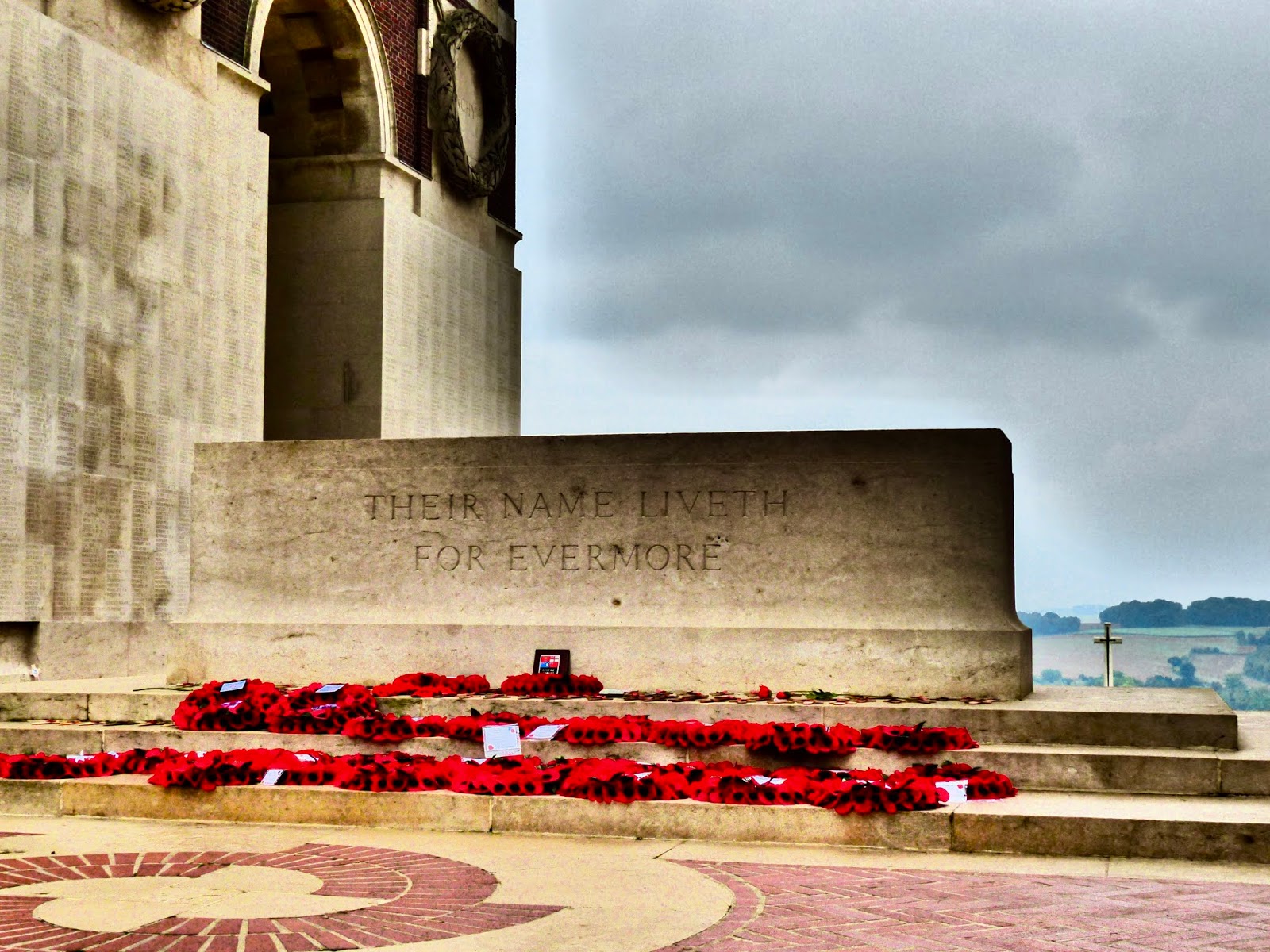
For mile after mile the monuments appear. Some are humble obelisks or stone markers. Some, like the British war cemetery at Pozieres (photo top), enclosed on four sides by impressive walls and colonnades, are so striking you're compelled to pull over and explore. Signs reveal the resting places of French, Brits, Germans, Indians, Australians ... emphasising that this was the first world war. Signs along the road mark where the front line was on certain days. There are a lot of them, and sometimes they're only separated by a few hundred yards. Villages along the way are neither charming nor characterful; though there are some local architectural touches it's obvious that almost everything you see was either new or rebuilt in the 20th century. In most places, the evidence of trench warfare has been ploughed flat beneath enormous fields of potatoes, cabbages and wheat. But not all. As you approach La Boisselle you see strange undulations. Grass has been allowed to grow back but the land still rises and falls in bizarre ridges that suggest the scars of war.

Just behind the main village of La Boisselle you'll fine the Lochnagar Crater (or, as it's called in French la grande mine). It is, quite simply, an enormous (98' x 330') hole in the ground left when the Brits set off an enormous explosion to start the advance we now know as the Battle of the Somme. Holes in the ground are not usually worth a detour. This, however, was one of the most evocative war memorials I've ever visited, second only in my experience to the Documentation Centre in Nuremberg.

Englishman Richard Dunning bought the land here in the 1970s, after the crater had been used for years as a rubbish tip and a cross-country biking spot. He set about cleaning it up and erecting memorials. Today you circle the crater, reading boards that tell the story of 1 July 1916 from the perspective of individual soldiers. There's the crazy, claustrophobic bravery of the sappers who spent weeks digging inch-by-inch closer to the German lines. The awe-struck descriptions of the never-seen-before devastation at detonation. (Thought to be the loudest noise made on the planet until that time, people claim to have heard it and felt the ground tremble in London.) There are first-hand accounts from soldiers who survived, and about many more who died, including the tale of one who described his vision of the heavenly host welcoming him as he expired in his friend's arms. Survivors, friends and family have added additional markers over the years, like the section of decking around the crater rim where each plank bears the name of a different former student from just one school in the north of England. It's a disturbingly long section. And most of all, there are the horrible statistics, of more than 11,000 casualties and little ground gained in that one action. Of a day that was supposed to be decisive, but opened a horrific four-month battle that devastated both sides with little result.

Fortunately, there are also quiet gardens with benches for reflection. Because, about two-thirds of the way around, I needed to just sit down for a while and sob. Lochnagar manages to commemorate both the horrible waste of war and the nobility of love and sacrifice people can achieve when they're defending what they treasure. It is both wonderful and horrible. And, like Nuremberg, the world would probably be a better place if everyone spent some time here.

With Dunning's private purchase and its intimate, small memorials, Lochnagar is a place of extremely personal reflection. At neighbouring Thiepval, you can see how governments do official, public remembrance.

This is the memorial to the dead of the Somme who are not buried or commemorated elsewhere. Given that you seem to have driven by scores of graveyards on the way to this place, it's hard to imagine there'd be many left to worry about. Wrong. The white stone walls at the base of the memorial, towering well above your head, are dense with the names of 72,337 Brits and South Africans who never returned. The structure itself is magnificent: architect of empire Sir Edwin Lutyens piled monumental arches one on top of another to reach dizzying heights. You can see it for miles, including from Lochnagar. Normally, such arches get the word "triumphal" stuck in front of them, but that's not the mood here. There is nothing triumphant about a mass of names so dense and vast your eyes have difficulty focusing. It is noble and dignified, especially standing at the altar at the centre of the arches. But by massing the thousands of names into a communal sacrifice for the good of empire, it lacks the emotional sucker punch of Lochnagar.

It does, however, have an excellent little museum embedded into the hillside behind. It provides a helpful overview of the Battle of the Somme, thus putting the memorial in context. There's a free section which goes over the basics, but if you have time and don't mind spending a bit of cash, it's worth paying to go into the restricted entry section for some particularly useful graphics (the time-lapsed map of the moving front line is great), fascinating photos of the devastation, collections of soldiers' letters and memorabilia and a WW1 aircraft. Most visually striking is a modern interpretation of a trench, laid down the centre of a gallery that's covered with black-and-white cartoon illustrations of life on the front from the innocent merriment of soldiers on leave to the dismembered body parts and dead animals of trench warfare. Stand on the glass above the trench and look down at some of the artifacts they've excavated out of such places,  including a German machine gun.

Thiepval, Lochnagar and the exquisite cemetery at Pozieres provided quite enough to think about for one day. It was time for a break from war. But we had one more stop to make on our return journey. Laventie Military Cemetery is typical of the scores of burial grounds that dot this landscape. Not much bigger than the plot beneath a large suburban house, established to house and honour the dead of just one three-day battle nearby, miles from any main road and surrounded by a tiny modern farming village whose residents have no personal connection to the men buried there, you'd think that such a place would be moldering and ignored. Not so, thanks to the extraordinary efforts of the Commonwealth War Graves Commission.

This organisation cares for the graves and memorials of almost 1.7 million men and women killed in the two world wars, maintaining 23,000 locations in more than 150 countries and territories. Every spot we visited was pristine: carving still sharp on tombstones, marble spotless, grass mowed. And in front of all the graves, gardens full of classic British plants. Though I didn't spot one of the CWGC's 850 gardeners, I didn't see a weed or a tuft of grass that needed trimming. Flowers bloomed, perennials were carefully managed and bushes pruned. That's a very British kind of respect.

And what had brought us to this tiny but not forgotten corner of a foreign field? Rather who. Lieutenant John Charles St. George Welchman was an ancestor of my husband's on the maternal side. Born to a military family stationed in India, he grew up there and though he was sent back to England for school, he followed in his father's footsteps and returned to the sub-continent after officer's training at Sandhurst. He and his troops ... tough tribesmen from the Himalayas ... were amongst the first to arrive at the front lines. They had some success taking trenches back from Germans. One of his men was the second Indian to receive a commendation in the war. They even took part in one of those legendary, spontaneous Christmas cease-fires and communal celebrations of 1914.

But by the 10th of March the following year, John's dead body was hanging half way through the barbed wire he'd been struggling to push through to reach the German lines. Every officer and many men of that battalion of the Garwhal Rifles died in that battle. Most of the bodies had been collected and dragged back to the field that became Laventie. John had been hurriedly buried where he fell, and his grave was later lost beneath further battles. He's commemorated on a stone at the back of Laventie, where 494 others are commemorated with him. Just another day in a horrific conflict that was to last three and a half more years.

Thanks to our little side trips in Northern France, this coming Remembrance Day will be so much more than words to me. When we say "we will remember them", them will have names and faces, places and stories. That, after all, is what remembrance really means.

Thursday, 20 September 2018

Spend some time around Mâcon to discover lesser-known, better-value fine French wines

The closer we get to the UK's departure from the European Union (29 March 2019), the longer grows the lists of unknowns. Assuming Bencard employment unaffected, one of the biggest worries in our household is what will happen to French wine imports.

Optimists in the leave camp insist trade will continue as normal. I expect that inexpensive, everyday wine will always find its way to British tables from somewhere. But since Burgundy lay directly in the path to our holiday, we thought we'd take the "better safe than sorry" approach on the good stuff. The cellar is now topped up with fine wines that will peak in the next two to seven years. If the post-Brexit economy does go to hell in a hand basket, at least we'll be serving some great wine at our dinner parties. We'll also have our memories of discovering two wonderful new (to us) wine regions: the Mâconnais and Northern Beaujolais.

The Mâconnais is Burgundy, but not as most people know it. The region's most famous wines come from a stretch of magical road on either side of the charming town of Beaune. (I've writing several times of this region in the past; just search "Burgundy" for more.)

This year, we had two objectives: Rounding out the high quality white wine in our cellar and continuing my husband's efforts to convince me that light reds deserve as much love as their big, bold cousins. This region was a great place to accomplish both, at much lower prices than in the two famous côtes to the north.

BASE CAMP
We based ourselves in Mâcon for three nights. The town that gives its name to the region is a thriving administration centre, more modern and less charming than Beaune. It does, however, gain ambiance from lying next to a broad, placid and picturesque stretch of the River Saône. In the old part of town, buildings are painted in cheery pastel colours; it's as if you've drifted over some invisible line into The South. There are doubtless scores of boutique hotels and vineyard-based accommodation in the area, but we went for practicality. The Mercure is on the river, affordable, a pleasant walk from the town centre, with comfortable rooms and plenty of parking. While the web site says they have a restaurant, it's really only a banqueting facility for group tours. A ten-minute stroll takes you to the best place to start your explorations in the region, whether or not you're staying at the Mercure: the Maison Mâconnaise des Vins.

This complex along the D906 main road comprises the offices of the local association of wine growers, a shop representing local growers that offers a range of tastings and a restaurant.

A large dining room and a broad veranda for al fresco meals serve up local specialties with ... naturally ... an impressive wine list. (American visitors will be amused to see that the main building's white, columned front gives it the look of an antebellum mansion, saying Macon, Georgia more than Mâcon, France.) We've always believed that the best way to understand local wines is to go to a good local restaurant and let the waiters help with introductions via food pairings. The Maison didn't let us down. In fact, we were so delighted we ate here two of our three nights in town.

Burgundy is famous for its Charolais cattle and their beef dominates the menu here, from tartare to grilled fillets and unctuous, marrow-filled bones. That gave us the excuse to try two reds new to us: Saint-Amour, one of the Beaujolais Cru, and Mercurey, a Burgundy from the Côte Chalonnaise. The former, with its fruity, smooth and slightly spicy profile, was to be our favourite discovery of the trip. We needed to taste the whites as well, of course, so chose our starters accordingly from an impressive range of salads, terrines and foie gras. It was here that we first encountered the range of wines that fall into the category of Pouilly Fuissé and started to explore what we might like to buy.

The shop below, of course, makes that easy. Curiously, however, the place doesn't seem to be attuned to foreign tourism. There's a regular flow of locals picking up stuff for their own consumption, but the fact that any information beyond the basics came to us in French limits the market. Fortunately, between the two of us we can get by fairly well, so were able to use our experience here as basic training before heading out into the fields. And, thankfully, for a bit of buying on our last day, after we discovered just how challenging tasting would be.

Thanks to a blazingly hot, sunny and dry summer, the 2018 grape harvest is, on average, two weeks early. Makers are ecstatic at the concentrated sugars in their fruit and are predicting one of the great vintages. So rather than catching makers with time on their hands as they waited for that final ripening, we drove past fields buzzing with pickers and tasting rooms closed tight. "Je suis vraiment désolé, c'est la vendage" was the phrase of the moment.

DAZZLING WHITES
The fact that Burgundy makes great whites should come as no surprise. Mersault, Montrachet and
Chablis are legendary names. Pouilly Fuissé belongs amongst them. It's also Burgundy, also made from Chardonnay, but lesser known. This is possibly because there are no Grand Cru in the Mâconnais. Officially, it's because the growers here never bothered to apply when the formal designations were being made. According to local stories, it's because this part of France was below the German occupation line in WW2. In an attempt to get locals on side, German High Command had excluded Grand Crus from the wines that occupying forces were allowed to commandeer. Thus there was a scramble in occupied territories to give every field they could justify the top classification. Below the occupation line, there was no need ... and farmers had better things to do.

Given that French classifications rarely change once set, a fluke of history means that the wines of this region are forever excluded from the official premier league. That's a great thing for the buyer, who can find the same qualities of Burgundy's bigger names ... including the ability to mature to complex richness ... at a much smaller price.

Start at L'Atrium in Solutré for an introduction to the region. This shop represents 450 growers in the area and, most importantly, offers structured tastings to introduce you to differences in terroir. The generic term of Pouilly Fuissé, it turns out, covers five "climats" (villages and their surrounding area), each of which have slightly different qualities in their finished wines. Moving from northwest to southeast, and from highest elevation to lowest, these are Vergisson, Solutré, Pouilly, Fuissé, Chaintré. The more famous Fuissé was our favourite, but we also like the Vergisson and the Pouilly.

L'Atrium plain labels a representative set of wines from the climats for their tastings, regularly changing producers, to give you typical flavours. You can buy these, or take advice from them and buy from their stock of other producers. We kept exploring, in search of a vigneron open despite the vendage.

It took a while to find one, but we had a glorious drive en route. This is a much wilder, more dramatic landscape than the gentle slopes of Northern Burgundy. Great rock escarpments jut up from the valley floor. Roads twist through deep forest. Villages cling to steep hills. The rock of Solutré stands at the heart of the region, both a popular destination for hikers and a dramatic element in the landscape that you can navigate by.

By sheer luck we stumbled into Pierre Vessigaud's tasting room while looking for someone else. This was exactly the kind of maker we were looking for: the fifth-generation producing here, one of the first in region to go organic in the mid-'90s, working across multiple climats in the AOC and with a vineyard in Saint-Amour, still hand-picking their grapes and dedicated to high-quality, boutique production. Vessigaud provides Pouilly Fuissé to BA's first class cabins, and ended up being the producer from whom we made our largest single purchase of the trip.

They also pointed us towards L'O des Vignes in Fuissé for lunch. Set in a pretty, early 20th-century farm house on the village's main street, there's a choice of two options here: a Michelin-starred restaurant at the back,  where the original interiors have been transformed into something surprisingly sleek and modern, or a classically traditional wine bar facing the street with oak tables and menus on blackboards. Having just shot the days budget Chez Vessigaud, we opted for the wine bar. Good, but unexceptional, traditional food with a great wine list. I suspect we missed out by not going to the full restaurant, which had tables available and was offering an intriguing multi-course menu. We noted that this was a restaurant with rooms, and it might be an ideal place to stop off on some future visit.

LIGHT REDS
By not bothering to pursue grand cru registration, you can argue that the makers of Pouilly Fuissé undermined themselves with a lack of ambition. In the Beaujolais, you might say they suffer from too much of it.

In the 1980s the Beaujolais Nouveau marketing campaign exceeded everyone's expectations, and suddenly the world was drinking far too much bad, young wine that never should have crossed the vigneron's threshold. By 2001, a backlash against Nouveau saw producers destroying more than a million cases, since nobody was buying and this cheap and cheerful stuff doesn't age. Later in the decade, mega-producer George Deboeuf ended up in court on a charge of mis-labelling after older vintages were mixed in to make a bad 2004 harvest taste better, while other producers were hauled up for illegally spiking their production with sugar. Beaujolais' reputation was at its nadir.

The region has been fighting back by getting serious buyers to focus on its ten cru. These are the most acclaimed wines in the area, grown in the foothills of the Beaujolais mountains and all produced from the notoriously tricky Gamay grape. (Treated well, it can be sublime, but in less talented hands it's often thin and bitter.) Tellingly, the cru tend not to put Beaujolais on their labels and are legally not allowed to produce Nouveau.

The cru, from the lightest to the heaviest, are: Brouilly, Régnié, Chiroubles, Côte de Brouilly, Fleurie, Saint-Amour, Chénas, Juliénas, Morgon and Moulin-à-Vent. The first three are generally thought to be good for three years in the cellar, the next three for four years and the last for up to 10, though some Moulin-à-Vent is considered as good as Burgundian Grand Cru and could mature for up to 20 years.

While Beaujolais is an enormous region, stretching more than 35 miles, the cru are all clustered together in an area just over the border from the Mâconnais, making this a logical inclusion addition to a Southern Burgundy trip.

Having learned our lesson with the harvest, we concentrated on restaurants and wine shops for our tastings and found that our favourites were Fleurie, Saint-Amour and Juliénas. With time running short, and cases of the last two already in the boot, we headed to Fleurie to taste more.

Fleurie is a pretty little town about half way up a big hill, with a church at the crossroads, a tiny market on Saturdays where locals sell bread, produce and crafts out of the back of their cars, and several shops offering tastings from multiple makers. We stumbled into La Maison du Cru Fleurie, primarily because they have the good fortune to share a door with the local tourism office.

La Maison is a small place representing just 25 of the scores of domaines making Fleurie. Each day, a different domaine has control of the shop. And though they're happy to recommend and sell you other producers' bottles, you'll really be focusing on whoever the luck of the draw gave you on the day you come in.

Fate dealt us a good hand. The Domaine de Chante-Terre not only has a surprising range of wines from across their relatively tiny (6 acres) vineyards, but had a son of the household with enough English to explain the variations in terroir and vinification that led to differences in what we were tasting. We fell in love with their 2017 gold-medal winning "Florence et Jacques Colin", the wine so good the makers put their own names on it. We learned that they're passionate about making traditional, elegant wines from their 60-year-old vines, with a blackcurrant nose, flowery minerality and a raspberry coulis finish.

While I couldn't have come up with that myself, the description fit. Light yet flavourful, fruity yet well-rounded, and should be even better in a year or two. We also fell in love with the price. At £11 a bottle it was some of the cheapest wine we bought the whole trip, even though it was just as good, and had similar aging potential, as the more expensive Saint-Amour, Juliénas and Mercurey already in the boot of the car. Had we come to Fleurie first, I suspect our purchasing profile would have been very different.

THE DANGERS OF REPETITION
Our least enjoyable day was, ironically, the one we'd forecast to be special. Five years earlier, on our first trip together to Burgundy, my husband and I had stumbled into a small restaurant in a relatively-undiscovered village in the Cote de Nuits to have not only one of our favourite meals of the trip (review here), but to discover our favourite Burgundian red. Restaurant Au Clos Napoleon has loomed large in our memory ever since, while every bottle in the case of their own-label Fixin that we brought home both improved with age, and reminded us of a magical day.

We thought we'd do it again. We failed.

Remembering a cosy, almost-empty place, we didn't bother to book. Mistake. Clearly, in the five years since our visit this spot has been discovered. And heavily refurbished into something far more trendy and fashionable than our memory. It was packed. No tables available. We should have come earlier. (It was 1:45.) But we could still buy wine at their shop down the hill, which was due to re-open from their lunch break at 2.

So we wandered down the hill we'd just hiked up, stopping at every place that served food looking for options. (He wandered. I limped. Entranced by the view on the ascent, I'd tripped, scraped my knee badly and twisted my ankle. I was in pain and just wanted to sit down for a bit.) No food available anywhere. Second mistake: forgetting that the French are inflexible about their lunch time. If you don't eat between noon and 2, you're out of luck. Sadly, they are not as rigorous about returning to work as they are about enforcing dining times, because by 2:15 the vigneron's office for Au Clos Napoleon was still closed. Hungry, angry at myself for not planning better and in increasing pain, we called quits on Fixin and headed towards Beaune, looking for other food options. Of which, in that whole 18 mile stretch, we saw none.

Ironically, we were saved by another memory from that 2013 trip. There'd been a McDonalds by the Mercure where we'd stayed. Yes, on the day I'd been anticipating a long, lingering Burgundian blow-out, I lunched at McDonalds. But not, I admit, McDonalds as we know it. This one had table service and a menu de chevre. I think the franchise around the world would benefit from goat's cheese salads and wraps.

So what had we been doing that saw us turning up so late in Fixin? We'd spent the morning at the Cassisium in Nuits-Saint-Georges. A sister facility to the Imaginarium wine experience we'd so enjoyed last time (more here), this modern, hands-on museum tells the story of one of Burgundy's other great products: cassis. Turns out that back in the 19th century, before demand for Burgundian reds became so great that every inch of arable land was given over to vines, Burgundy produced almost as many black currants as grapes. Black currants and Pinot Noir flourish in the same conditions. And though there are records of the fruit being used for cordials and medicines back to the Middle Ages, it wasn't until the late 19th century that the industry took off. Knocking back boozy fruit distillations became incredibly popular with fashionable types who liked to hang at the Moulin Rouge and buy Monets, and Burgundy's sweet yet alcoholic Creme de Cassis was a favourite. The Mayor of Dijon, one Canon Kir, created a cocktail by mixing it with local white wine and serving it at all government functions. The rest, as they say, is history.

As the Imaginarium does with wine, the Cassissium mixes sights, smells, films and games to take you through the history of the drink, then lands you in a tasting room to sample. Védrenne is the company behind the museum, producing more than fifty different crèmes, liqueurs and syrups as well as regular and super-concentrated Cassis. You can sample them all here, although sugar content will kill your palate after about six and too much enthusiasm could land you in a diabetic coma. Suffice to say, if you appreciate the mixology behind a good cocktail, this place is a playground. 

And so we played. And bought. And then we wandered over to the tasting room at the Imaginarium. And got into some interesting conversations with the staff about the French buying Californian vineyards. And then we discovered a Burgundian sparkling red. And suddenly is was 1:20, and we really needed to get to lunch, and then we parked in the wrong place, and then I fell, and then ... there was no room at the Clos.

Oh, well. There are no bad times, only good stories. If I had it to do over again, I would have made a reservation and watched the clock. Or, maybe, I would forget the whole idea of recapturing Fixin and would have investigated Brouilly instead.


Monday, 17 September 2018

Now a familiar bolthole, Annecy provides a lazy break

My mother used childhood holidays to bake a compulsive need for sightseeing into my soul. As much as it contributes to this blog, that need also, admittedly, challenges the ability to have a properly relaxing holiday. Unless I’m somewhere with absolutely no cultural or geological merit … or in a place I’m so familiar with that I’ve already covered most of Trip Advisor’s Top 10 … the call to explore always triumphs over the need to rest.

Lake Annecy in the French Alps now fits into that second exception. Thanks to frequent visits to dear friends who’ve lived here for six years, I can now retreat to this beautiful part of the world for pure R&R. Sleeping in instead of clambering around local castles. Reading on the patio rather than poking about Annecy’s historic streets. Helping my godson with his homework rather than discovering Alpine villages. Nipping down to the local SuperU for groceries and dining in rather than checking out local restaurants. Lolling on the local beach rather than feeding the brain. And thus went much of our recent summer holiday.

That’s not to say we restricted ourselves to our holiday home. Just that I felt no burning need to go out. Instead, I worked in the occasional outing, usually for a few hours in the afternoon, guided by tips from locals rather than the tyranny of lists. (One imagines this is how other people might approach holidays all the time…)

A more leisurely observation reveals that the variety of life in this valley is impressive. The tourist appeal is obvious: spectacular scenery, charming city, historic sights. The range of outdoor pursuits makes it a mecca for adrenaline junkies; paragliders flock over the valley like starlings. An enormous expat community, linked to Geneva but seeking a more reasonable cost of living here, ensures a sophisticated level of shops and services in villages that appear charmingly rural. (Only the broadband speeds, sadly, match the antiquity of the views.) More surprising, perhaps, is a backbone of heavy industry. Pretty Alpine streams can drive machinery as well as tourism. Turns out these mountains were busy in the industrial revolution. Ugine, at the eastern end of the lake’s valley, is still a big producer of specialist steel.

LAND OF MILK AND HONEY
Older industries here are indisputably more picturesque. The mother of them all is dairy. Our first Sunday coincided with the St. Jorioz village fair. Despite all the corporate and industrial influences in the valley, this was profoundly and joyfully agricultural. Fresh-picked apples went into an old-fashioned press and in to bottles for sale. Local game had been transformed into terrines. Step up to the honey stand and taste the terroir of four seasons: obviously, bees are visiting different flowers in each, and the taste of their output varies dramatically. There’s a petting zoo to visit the full range of farm animals, including some particularly handsome geese.

But it’s the milk producers … cows and goats … who take centre stage. In a world of extremes, where lush, green summers flip into long, snow-bound winters, turning milk into preservable food allowed survival. Centuries of necessity later, this region is a cheese-lover’s heaven. In the cow competition that is the climax of the village festival, it is not just about beauty; each animal is evaluated on how many litres of milk, and thus wheels of reblochon, she produced over a year. While the cows work on the rich grasses of the mountain valleys, goats clamber at higher elevations and eat scrub, meaning there's probably even more goats' cheese here than cow.

The Tomme & Beaufort shop in Sevrier is the place to get down to some serious cheese shopping. Run by the local milk and cheese cooperative, this is a temple to local produce. Giant wheels of Beaufort are the first thing you see, arranged as if on a celebratory altar. This firm cow's cheese tastes different depending on what season the milk came from and how long it's been aged. Summer cheese is milder and sweeter, reflecting the sweet grass the cows ate to make it. The sharper, and almost nutty winter, cheese draws its taste from hay. You can sample various wheels before making your choice and watching a fascinating cheese guillotine slice your portion.

Beaufort is delicious on its own but is also typically melted with white wine to make the local fondue. Wheels of soft Reblochon are the centrepiece of another local classic, tartiflette. (Imagine macaroni and cheese, but with potato rather than pasta.) Giant slabs of Emmental also await the guillotine, straw yellow and strewn with holes. There's a whole case of different Tommes, softer and more aromatic, this mountain cheese can be made from cow, goat or ewe's milk. Beyond that, there's another case just for the range of local goats' cheeses.

And you've barely started. Because this little shop celebrates all kinds of local produce. So there's also a fantastic meat counter, stocked with everything from the veal that's a byproduct of the dairy industry to wild boar hunted from the mountain slopes. Another counter offers a range of cured meats and sausages. Terrines and other preserved foods stand in jars next to local honeys, fruit liquors and syrups. And then there's the local wine and beer and, if you're particularly brave, the local spirit known as genepi, which is a distillation of wormwood.

Some basic French is useful here; this isn't a touristy place. Patience is also required if you're here on a weekend or after work, when locals are all coming in to buy this essential part of the Alpine diet. You may queue for half an hour, but watching the cheese guillotine do its stuff will entertain you.

WORKING OFF THE FAT
The region's carb- and cheese-heavy cuisine originated to fuel tough, physically-active mountain people. It is not, admittedly, a good match with a lethargic holiday. So even if I didn't need to see the sights, basic prudence demanded I get up from the garden furniture occasionally.

Our most physically rigorous excursion was a climb up up La Montagne du Taillefer. For the outdoorsy types and adrenaline junkies who holiday in this valley, Taillefer is hardly worth notice. The sign for the first part of the route says the walk from the car park in Duingt to the summit takes 25 minutes. I took more than double that, and was labouring near the top, but I'm proof that it is a route that can be conquered and enjoyed by the less active. You just need to take your time and be very careful on large parts of the route where ridges of bare stone erupt from the path. My hiking pole was essential for balance.

We started with the more direct ascent, closer to the lake, where a paved path rises in switchback curves dotted with shrines illustrating the Way of the Cross. (You're in a Catholic country, after all.) This bit ends at a bench about half way up the mountain overlooked by a large statue of St. Michael triumphing over a devil. Less ambitious hikers should admire the view and go no further.

There's no paved path after this and there are bits where scrambling over rocks can be a bit precarious, but it's all perfectly manageable if you take your time. There are rest points on the way up to admire the steadily improving view. Finally, you come out onto a small Alpine meadow with an astonishing vista of all of Lake Annecy and the mountains around it. The lake narrows to a pinch point at Duingt, with Taillefer forming a land barrier between two almost-separate valleys. Lake Annecy is ringed with higher viewpoints than this 765-meter summit (345 meters, or the equivalent of an 80-story building, from where you started), but none of the higher peaks puts you in the exact centre of the picture. You can return the way you came, or do a longer circle route. We followed the spine of the mountain away from the lake catching glimpses of villages, Alpine valleys and grazing cows below. The descent is heavily forested; the last half mile through a steep, quiet wood full of lofty pines is magical.

There's climbing to be had at the Chateau de Menthon as well, though it's medieval steps rather than mountain spines that will be taxing your energy. Having written about the ancestral home of St. Bernard here before, I won't go into detail beyond saying it was well worth a return visit. Even if the tours are only in French. This is one of a handful of buildings that claim to be the inspiration for Disney's iconic castle, and its exquisite cluster of towers makes that credible. Inside you'll find a warren of rooms both charming and fascinating, as only a home occupied by the same family for more than 1,000 years can be.

Another day we opted for more sophisticated pleasures in Megève. This legendary ski resort is about a 40-minute drive from St. Jorioz. In a few months it will be heaving with the rich and famous but at the moment, caught between school holidays and winter, it's almost empty and most of its luxury goods shops were closed. Though window displays were already well stocked with obscenely expensive apres ski clothes. Without shop attendants, we were spared the temptation of spending more than €1000 on cashmere pajamas or fine knit loden-style cardigans. Most of the people working here at the moment are in the construction trade, breaking the almost-eerie silence in the streets with the din of power tools as every landlord packed necessary renovations into the off season.

I suspect I enjoyed the town more as an empty stage set than I would once populated. The architecture is lovely (yet another village in the Disney Fantasy Land template), the window boxes and planters cascading with late summer abundance, streams gurgling through town beneath quaint bridges, green mountain slopes rising behind every view. We ate lunch at Le Prieure on the main square, where we enjoyed the marvellous views and the upscale ski lodge interior but had one of the worst meals of our trip. Dry, crunchy and almost flavourless risotto was only saved by a decadent chocolate cake. I wasn't expecting value for money in such a place, so wasn't disappointed.

The best part of this day was actually the drive between Lake Annecy and Megève. The route goes through a narrow mountain pass with a few miles of it winding crazily at the bottom of steep canyons of stone. A small river gushes below you, first on one side and then on the other as the road keeps crossing the water in tight bends. It's not for the faint-hearted driver, but will amply reward anyone who enjoys a challenge behind the wheel.

Aix-les-Bains is a much easier drive (mostly motorway) in the other direction. Its legendary hot thermal baths would have slotted nicely into our general theme of indolence, But this holiday ... like all we take to France ... had another theme. We were in Aix for wine.

BOUTIQUE BOTTLES
Domaine Xavier Jacqueline is the kind of tiny, family-run winery you're unlikely to find without local knowledge. They do little marketing, produce small quantities, keep all but the picking between Xavier and his two daughters, and their winery is in an unremarkable bit of suburban Aix far from their fields on hills above Lake Bourget. It's become one of our host's favourites in the region, and he now has the kind of relationship with the Jacquelines that meant the family slotted us in for a tasting despite being deep in the harvest.

Having run through their whole range on a visit last May, this meant we had the delight of comparing 2017s to the 2016s we'd already samples. Their limited run of Pinot Noir was sold out but we tasted the local red Mondeuse, though earlier purchases left no room for acquiring reds. We were here for their sparkling wine, made from a mixture of their white varieties: Chardonnay, Roussette and Malvoisie. We also picked up a case of their premium Chardonnay, part-aged in steel before being finished for a year in wood. It's all the more special because it's called Le Jardin du Mathilde, hand-crafted by his eldest daughter (and the lady who's taken us through both of our tastings) from the plot papa gave her to play with when she first expressed interest in joining him. Both wines and daughter have matured delightfully. We paid inside the production facility, where the whole family was processing the harvest of the previous day. I've spoken to plenty of wine makers before, but it's the first time I've ever been offered a glass of freshly-pressed juice right out of the fermenting vat. Heaven.

As the week ended we celebrated the intersection of our holiday, my birthday and the wedding anniversary of both us and our friends with a gourmet meal in  Annecy's old town. As I've written in previous French reports, the award of one Michelin "plate" in France tends to give you a restaurant that would hold a full star in most other countries. So it was with La Ciboulette.

CASUAL FINE DINING
This elegantly-decorated L-shaped restaurant wraps around a stone-flagged patio in the historic district. It was a warm evening, more late summer than early autumn, so their sliding glass walls were open and the place felt almost tropical. Stiff while linens, silver figurines on the table and original art on the walls reminded me a bit of London's Le Gavroche, but the vibe was decidedly more relaxed. Perhaps a bit too laid back, in fact. Having dressed for a big night out, we were all a bit surprised by the jeans, tee-shirts, shorts and flip-flops of some of our fellow diners. At least, I thought, we weren't suffering from the overly-reverential atmosphere that killed the mood for me at America's French Laundry.

No French Laundry-style extortionate pricing here, either. The €65 chef's menu was excellent value: four courses plus amuse bouche, appetiser and petit fours. The first course was either a rather unusual crayfish carpaccio or an earthy pot of new season ceps. Both were delicious. Most of the table opted for veal as a main, with one choosing and acclaiming the turbot. Next, as you would expect in this region, an astonishing and extremely local cheeseboard. I was delighted to be able to assemble a plate of five distinctly-flavoured goats' cheeses ranging from mild to off-the-charts. I like strong cheeses, but one rolled and aged in bitter genepi was a bridge too far for me. The excessive bitterness of that mouthful was soon a memory thanks to a slice of decadent chocolate tart accompanied by tropical fruits and ice cream. Both boys had opted for a far more sophisticated-looking raspberry and meringue number, the light sharpness of which was probably a better profile to follow cheese, but when have I ever passed up chocolate?

Fortunately for both the budget and the waistline, this big splurge was one of our few nights out in Annecy. Fitting in with the laid-back indolence of the holiday, we cooked a lot of lazy, simple meals at home, though we still took advantage of local ingredients. And lots of the little-known wines of the Haut-Savoie, consumed without restraint as nobody needed to drive home. Laziness has its rewards.

Sunday, 2 September 2018

Greenwich's Painted Hall tour is a unique adventure

Lovers of the English language bristle at casual abuse of the word “unique”. An adjective that should be used to describe the exceptionally rare and precious now seems to find its way into marketing copy for everything from laundry detergent to your corner restaurant. “Once in a lifetime” follows not that far behind in casual misuse.

Right now, and for just a few weeks longer, you can have an experience in Greenwich that … quite literally … gives you full rights to use that language. All you need to do is lay out £10, don a high visibility vest and follow your guide up four flights of scaffolding to get within inches of one of England’s greatest works of art.

The painted hall within the Old Royal Naval College is a kind of Georgian Sistine Chapel. Like its Italian cousin, this is one monumental room, painted wall and ceiling by the same artist for demanding patrons with very particular political messages in mind. Michelangelo’s mission was to glorify god. James Thornhill’s to glorify the Hanoverian dynasty, and the Glorious Revolution that preceded them to keep the throne Protestant. With his swirling clouds, cavorting deities, architectural elements and haughty aristocrats, Thornhill is as grandly bombastic as any Italian. In fact, in an era where it was still common to import Italians to paint palatial decorative schemes (witness Antonio Verrio’s Heaven and Hell rooms at Burghley House), Thornhill proved the English could do it for themselves.

The painted hall has always been a major tourist attraction, of course, but you’ve never been able to get this close. (Even if you've never been there, there's a good chance you've seen it on screen as this is a favourite filming location for historical drama.)

Roughly once every 100 to 125 years, the ceiling needs to be cleaned. Now, for only the third time in its history, scaffolding fills the hall so restorers can get at the paintings. And, much like the Sistine Chapel renovation that finished in 1999, Thornhill’s modern restorers are stripping off layers of varnish applied in well-meaning, but ultimately damaging, earlier efforts to reveal the luminous glory of the original colours.

Tours allow you to see the restorers at work and are escorted by a guide who explains both the process of cleaning and what’s going on in the vast series of paintings. One of the most moving sights of the visit is a jar full of discarded, oversized cotton buds that have been used to gently swab the ceiling. They've picked up so much dirt, they look like pieces of charcoal. It's also interesting to see how little fine detail is filled in on the figures. When you're standing far below, the almost-impressionistic flow of colours melds into realistic detail. This close, it's important to have the guide with you to explain what's going on. There's William and Mary, ascending to heaven in a blaze of glory. Above them, Apollo in his sun chariot leads the way. Gods and legends populate the clouds around them. They might have saved Great Britain for the Protestant faith but, ironically, it's a pagan pantheon that sweeps them to heaven.

Prows of massive ships occupy either end of the ceiling, showing off Britain's naval might. The men dining in the hall below, after all, would have been retired Royal Navy seamen. There's even a sprinkling of significant historic figures, and one Naval pensioner painted in to give his colleagues below a sense that everyone was included in this triumph. 

Beyond the Painted Hall, a stroll around Greenwich is always a delight. Just across the grand courtyard from the Hall is the Seamen's Chapel, a miracle of tromp l'oeil painting with a blue-and-white Wedgwood-inspired ceiling. It's one of James "Athenian" Stuart's masterpieces. 

The two magnificent ranges of Georgian architecture that these rooms sit in, facing each other through grand, columned arcades, are arms leading up to the Queen's House. Actually about a century older, this small palace was one of the first Palladian buildings in England. Though started for Anne of Denmark, it's most associated with Queen Henrietta Maria, a woman whose artistic taste was almost as good as her political instincts were bad. (She certainly contributed to the mess that led her husband, Charles I, to execution.) There's little of the original furnishing or decoration inside; the architecture itself, an exquisite circular staircase with sinuous wrought iron foliage and one exuberant Renaissance-style painted ceiling are all Henrietta Maria would recognise.

It's still worth a wander through, however, because the National Maritime Museum has moved some of its best paintings here, and other national collections have lent nautical masterpieces. The freshly-restored Armada Portrait of Elizabeth I is probably the grandest example. The main hall, which long ago lost its original decoration, has been given over to a modern art installation by Richard Wright. Now thousands of 23-carat gold leaf moths flutter over the ceiling and upper walls. It's a bit jarring against the Palladian architecture, but it is beautiful.

Best of all, the Queen's House is now free. Before the renovation, it was under English Heritage's management and had an admission fee. Now it's simply an extension of the excellent, admission-free museum next door.

This is all just the tip of the tourism iceberg in Greenwich. There's the Cutty Sark Museum (another newly-restored attraction), a particularly good artisans' street market, lots of high-end food trucks, the Greenwich Mean Time line, a gorgeous park and the ability to walk under the Thames through a marvel of Victorian engineering. Well worth a day out. 

But if you want a unique, up-close look at the Painted Hall ceiling, you need to get there before the end of September. It's a once-in-a-lifetime chance. Unless you plan to live for at least another century.