Friday, 31 May 2019

The Isle of Wight: Staycation that's 1/2 Cote d'Azur, 1/2 time travel

When I first started working in the UK, I was amazed to discover that none of my colleagues ever
went on holiday in their own country. Any time they had more than a long weekend, they were on a plane to France, Spain, Italy ...  anywhere with a better chance of sun. I, in love with every inch of my new land, just couldn't believe how little most people had visited of their home turf.

More than 25 years later, I have become them. Sure, I still do more sightseeing on the home front than the average Brit, but my husband and I have never done more than a long weekend on British soil. Until now. We hadn't planned any holidays until September, but the first half of the year has been filled with unexpected challenges and we needed a week of downtime to recover. We also needed to keep the budget in check and didn't have the energy to go far. The answer? The Isle of Wight.

The diamond-shaped island nestles against the South Coast of England facing the historic port of Portsmouth. We can go from home to the ferry in under an hour, then it's a 40-minute crossing. It's just two miles across the Solent at its narrowest point, but tides and traffic flow demand a longer V-shaped route. Brace yourself for pricey fares, and check with hotels who can often get you deals of half price or more. Locals boast that it's the most expensive ferry crossing-by-distance over any water in the world. I'm convinced they do this to discourage day-trippers and other "inappropriate" visitors. (The ridiculously expensive toll bridge to Sanibel Island, Florida comes to mind.)

It's a relatively tiny place. At just 148 square miles, you could fit more than four Isles of Wight inside the greater London area encircled by the M25. Being so close and well-connected to the mainland, you'd expect it to be much the same as the rest of Hampshire. But the Isle of Wight is gloriously different.

Many people describe it as Britain stuck in a time warp, circa 1950. It's not quite as antiquated as all that. I saw a handful of new housing estates and schools, there are a few grocery superstores and the main town of Newport has a shopping mall and plenty of modern brands. We discovered a handful of great restaurants, including one "on trend" enough to fit smoothly into London.

But most of the island is, undeniably, a throwback. Shops and restaurants are locally owned and one-of-a kind. I can't remember the last time I walked down a high street that was almost entirely filled with one-off establishments. Here, it's the norm. People talk to each other. Service is fantastically genial, though often a bit unsophisticated. Thatched cottages abound. Quaint tea shops do a thriving business. Souvenir shops sell the same tourist tat I saw in their windows on my first visit here 30 years ago. Given how badly the boxes of the Lilliput Lane miniature cottages had faded in one window, they might have been the same items. There are an enormous number of retirees on the island (one suspects most of the permanent population has pushed past 50) but the number of families on holiday with young children ... presumably trying to give them a taste of a sweeter, simpler childhood ... brings down the averages.

The overwhelming vibe on the island is late 19th century, thanks to its popularity with Queen Victoria. She and Albert built their family retreat here, she visited regularly throughout her widowhood and eventually died here. The architecture is heavily from that era, including town-scapes of Victorian row houses that could be in London and plenty of Arts and Crafts suburban villas with gingerbread details. But perhaps even more significant to the island's future was the endorsement of the queen's doctor, who proclaimed sea bathing a cure for a range of illnesses and said this was the place to do it.
While Victoria was settled in at Osborne House, closest to the mainland, the good doctor recommended the southeast shore. It became so fashionable that even the Empress of Austria came on holiday.

Here, a cataclysmic landslide near the end of the last ice age created a long shelf of coastline underneath a towering ridge of chalk. This "Undercliff", about five miles from Bonchurch to Niton, is essentially a giant sun trap creating a unique micro climate. It is, on average, 5 degrees celsius warmer here than the rest of southern England. The weather, the gardens and the architecture that followed all have a faint whiff of the Côte d'Azur, as if someone had awarded Cannes a "do over" and put it in the hands of sensible, unpretentious English people sworn to give you good value for money.

For an island you can circumnavigate in a few hours there is, however, a remarkable variety. Cowes, beloved of the yachting fraternity, is a bustling and affluent place full of trendy shops and restaurants and a vast range of places to drink. And, on any fine summer's evening, a vast number of drunken sailors. From Fishbourne to Shanklin, towns run around the eastern point of the diamond in a surprisingly charmless and almost continuous urban sprawl; neither the affluence of the Undercliff nor the sailing fraternity has reached here. The seafront areas look a bit down-at-heel and, were it not for the occasional, glorious views of the English Channel, you could be in any drab, hardscrabble bit of outer London. This part reminds you of the decline that most English seaside towns have faced since cheap airfares took their customers to the continent.

Yet on Shanklin's southern edge you'll find the old village, a cluster of pastel-painted thatched cottages in a wooded dell that is a hugely photogenic. It's a Disney fairy tale version of ye olde England and a must for any island visitor. Ventnor and St. Lawrence, just beyond, have obviously seen a recent influx of cash for building restoration and you sense that tourists are now sharing the space with a lot of affluent retirees.

The southwest coast of the IoW is almost entirely free of habitation, thanks to a vast track of National Trust ownership and protected wildlife areas, making an idyllic landscape for hiking or lounging. The National Trust car park at Compton Bay is the starting point for exploring this coast, which includes one of England's best sandy beaches nestled beneath orange cliffs that fade to white chalk as they turn and stretch to the island's western corner. The downlands there rise and fall to The Needles, a series of white chalk pinnacles rising from the channel (top photo). There used to be more of them, and they used to be higher, but chalk erodes. They're still an awesome sight, easily visible from the car park at The Needles amusement park if you don't fancy a long hike. (Top tip: arrive in the late afternoon and they no longer charge for parking.)

Inland, the landscape and mood changes once again. It's almost entirely agricultural, with rolling fields, forested hills and bosky dells inhabited by tiny, ancient villages. There's little Victorian incursion here; many farm houses look like they've been standing since King Charles I was held captive in nearby Carisbrooke Castle. Every village seems to have a sprinkling of late 20th century bungalows as well, but usually they're well enough dispersed and have nice enough gardens to blend in. It's all reminiscent of deepest, darkest Dorset, just over the water to the northwest. Placid cows and sheep decorate the landscape, but they decorate plates, too. Local meat is on most menus, as is the well-known produce of the island's garlic farm.

There are two vineyards and one distillery making the most of the island's bounty. Adgestone's wines are slightly better, and their gardens with views of vines and the distant sea are designed for lazy afternoons of drinking the product on site. But the team at the older Rosemary Vineyards is a friendlier bunch with a bigger shop offering a whole range of IoW delicacies. They're the same people behind Mermaid Gin. The distillery used to be in the vineyard but has now moved to its own place. Of all we tasted, it was the gin that proved most worthy of bringing home ... particularly the pink version produced with a subtle infusion of fresh strawberries. (Though we did buy a few bottles of Adgestone's blackberry and lavender country wine for summer spritzers.)
The pastoral inclination of the island and its appeal to walking holidays make for one of the most dog-friendly places I've ever visited in the UK. Your furry friends are welcome at almost all hotels and pubs and some restaurants. You can even bring them inside the Ventnor Botanical Garden. And, obviously, all those miles of coastal paths are a doggie delight.

Accommodation, however, can be surprisingly tricky. The rental cottage market was sparse compared to other top destinations. Most of the properties I liked weren't in walking distance to dining options, while the ones that were conveniently located lacked charm. So I switched to hotels and B&Bs. You really feel the "lost in time" mood here; boutique hotels and hip little B&Bs are few, old-style places with stolid, golden oak furniture and big florals abound. Most web sites show photos of interiors that look like they haven't been updated since the 1980s. When you do stumble on the rare property that looks modernised, it's stupidly expensive. (The good news is that the island overall offers one of the cheapest holiday options in the south of England, with most rooms under £100 a night.)

Once on the island, I saw a lot of places that hadn't showed up on my internet searches, then looked them up to find rudimentary web sites. My hunch: most places here are run by older people for whom social media, web design and search engine optimisation are alien concepts. There's vast potential here for someone with a modernising touch.

We ended up at the Eversley, a family-run hotel on the western edge of Ventnor next to its Victorian park and a  10- to 15-minute stroll to the waterfront with pubs, restaurants and promenades. The less fit should be warned that, according to my FitBit, the short walk includes an incline the equivalent of nine flights of stairs. But that's reality on the IoW. It's hilly. To the west of the town's bay, the Undercliff plunges to a deep valley, which rises to another hill, which then falls off in cliffs down to the water. The Eversley and the park sit in this deep valley. The hotel has its back to the seaward hillside, with gardens spilling down the slope, a pool at the bottom, and a path up to a private hilltop lawn with expansive views of the channel and a gate out onto the coastal path.

We upgraded to a superior room (No. 17), which definitely felt like someone had recently gone to the effort to get a boutique hotel look. The bathroom featured sleek tiles and an enormous claw-footed tub. The bedroom had a leather sofa, coffee table and large-screen TV for lounging, as well as a super-king bed. The room's real glory, however, was its huge windows looking across the valley to the Undercliff, and the towering Victorian ceilings. It was also tremendously convenient for the dogs, with quick access down a short hallway to a back yard and the upper reaches of the garden.

The Eversley is a quirky place that doesn't completely escape the IoW's "lost in time" negatives. The first thing you see upon arrival is a wheelchair in the front lobby. It never moved during our stay, but its prominent placement made the entry feel more like an old folk's home than a hotel. A feeling reinforced by vast expanses of anaglypta wallpaper, pub-pattered carpets in the public spaces and a lot of grey-haired guests. It also felt strangely empty. We only ever saw enough people to fill perhaps six other rooms, though there are almost 30 in the hotel. Several large and gracious reception rooms on the ground floor have almost no furniture and stand unused. Though they advertise a restaurant, it doesn't seem to be in operation. When we were too tired to go out on our first night, however, the hotel manager rustled up two tuna sandwiches for us to take to our room with a bottle of white wine. It's a lovely place with a deeply personal touch that I'd happily recommend ... just don't expect a modern boutique hotel.

Once you're settled in to Ventnor you'll find a surprisingly good restaurant scene and some fabulous things to do. I'll write about those in my next articles.

Friday, 24 May 2019

Royals, semi-shade and after hours access: Chelsea 2019 highlights

The BBC's official coverage was buzzing with discussions on the year of recycling, the predominance of green and the arrival of the first-ever judged show garden inside the floral marquee. But on the ground at the Chelsea Flower Show this year there was only one topic on everyone's lips: The Duchess of Sussex's garden.

It was not, to be accurate, the Duchess' garden, but rather the RHS' "Back to Nature" garden, designed by Chelsea veterans Adam White and Andree Davies, with royal input. But that didn't matter. To the fans queueing to see it (we waited 45 minutes, at times the wait was reportedly as long as 2 hours) or overheard talking about it, it was "the Duchess' garden" or "the royal garden". Was it worth the wait?

For me, and for most people I overheard: yes. It wasn't my favourite garden of the year, nor did it hold the best plants, but it connected on an emotional level the way few other gardens could. In my case, that's probably because I grew up playing in woodland. The tree swing, the woodland den, the fallen logs and the creek lined with shade-loving plants took me back to the forest in which I spent long childhood summers back in Chesterfield, Missouri. The tree house encrusted with branches to make it look like a bird's next was a particularly fabulous flight of fancy. The garden was also noteworthy for being a space the public can walk through, rather than the usual show garden that you view from the outer edges. Usually, only the media, sponsors and their guests get to walk inside the displays; I expect people would have queued for ages for the privilege even if nobody famous had been involved.

Here are some other highlights.
  • The media have proclaimed this "the year of green" because of the amount of foliage on show. The story is more complex. I would have called it the year of the semi-shade garden. Shade, of course, isn't conducive to showy blooms. We saw a lot of impressive trees, spreading their cover over ferns, hostas, astrantias, foxgloves, heucheras and primrose.
  • There was still plenty of colour. It was a year of traditional English palettes: gentle blues, purples and pinks contrasted with the occasional pop of yellow or white.
  • Every year there seems to be one plant that pops up in profusion across multiple show gardens. This year it was Trollius, aka Globeflower. 
  • My favourite garden, and the judges', was the Andy Sturgeon-designed M&G Investments Garden (below). Presumably, when you're the main sponsor of the whole show you can out-gun everyone else on your investment. Certainly, no expense had been spared here as the builders turned a flat space into a forested slope, terraced with massive oak sculptures that had been charred to a deep black. The way the plants and flowers "popped" against that inky background was extraordinary.
  • There were fewer jaw-dropping, how-the-hell-did-they-do-that gardens than in previous years, but the Welcome to Yorkshire garden was extraordinary enough to carry that brief. It was an extraordinary feat of construction: a canal, complete with two ancient lock gates leaking in places, water at different levels and a lock-keepers cottage. There's always a debate on whether these things are gardens or stage sets. As impressively naturalistic as the grasses, weeds and plants growing out of seemingly-ancient crevasses in walls were, there wasn't much memorable here as far as flowers and plants go. But full marks, and a gold medal, for creating an illusion.
  • Most years a sheik or sovereign wealth fund from the Arabian peninsula sponsors a main show garden for PR purposes. These work best when they bring a taste of the exotic. Dubai's entry this year did not. Aside from its painted earthen walls there wasn't much sense of place, and the planting ... while obviously draught tolerant ... was green and colourful enough to be European. It only dazzled at night, after most visitors have gone.

  • And what was I doing there at night? After more than 20 years of attending Chelsea, I finally scored tickets to some after-hours corporate hospitality. This is the invisible engine that keeps the show going. Corporations (some charities and the rare individual) pay to sponsor the gardens, and can pay more to entertain guests in them for an additional 90 minutes after the public must leave at 8pm. (Though your hospitality tickets let you in from 5:30.) The hour between 7:30 and 8:30 is magical, with unobstructed views and colours becoming more distinct in the twilight. The form is to use this time to see all you can, before turning up on the garden that invited you for drinks, canapés and a short talk from the designer responsible. Our host was the Family Monsters Garden, designed by Alistair Bayford and sponsored by Family Action, a charitable organisation celebrating 150 years of helping families in trouble. The garden was a birch grove, spiralling up a mound with an uneven path and boulders representing the issues all families face. Ultimately the garden leads to a space with benches and a quiet pool, where a family could gather to communicate and be together. This was a garden particularly suited for evening viewing, with the white birch trunks and spires of white foxglove standing out as the day's light faded.
  • Almost as exciting as after-hours access was speaking to Kazuyuki Ishihara. The Japanese designer is the only example I can remember of an individual sponsoring his own garden, and he's come from Tokyo every year since 2004, winning 12 gold medals along the way. His trademark stones and boulders covered in moss turn up every year, inevitably with iris, babbling water features and fascinating trees. This year's "Green Switch" garden (below) was no exception, with a glass tea room pavilion on one side and a glass shower room on the other, both overlooking a tiny sylvan paradise. Mr. Ishihara often stands across the path from his garden, alone and un-noticed, as he watches people react. I spent a brief moment telling him how much his gardens inspire me every year and we shared a mutual bow.
  • For the regular visitor, Chelsea's glory remains The Great Pavilion, where specialist growers and the nation's most prestigious nurseries come together to show off their wares. In a world where most garden centres are staffed by people who know little about what they sell, this is a chance to get all of your garden problems solved. I usually go with a list of questions, often accompanied by photos of specific issues. I emerged knowing that my geum is infested with whitefly, but cutting it back to the based and watering heavily will probably sort the issue and see the plant spring back from its roots. I understand why my passion flower vine isn't blooming, have the names of better allium varieties to intersperse in my hosta bed (Violet Beauty and Purple Rain) and have scouted out the perfect tulip to plant amongst my forget-me-nots next year (Louvre Orange).
  • I emerged with three packets of sweet pea seeds, new gardening gloves and a £5 glass garden ornament. "I never worry about you and Chelsea," said my husband, inspecting my loot. "I know you can't by plants there. Hampton Court's the dangerous one." Quite right, my love. Brace yourself for the 5th of July.

Saturday, 11 May 2019

Winchester, Kyoto and Tolkien combine for the perfect date night

Your sense of distance changes depending on your surroundings.

Growing up in St. Louis, pretty much every activity (including school) was half an hour away by car. Life was much the same in Dallas. Weekends regularly included two- or three-hour drives to local points of interest, and we thought nothing of a 300-mile weekend road trip to Chicago.

When I first started working in England, I brought that attitude with me. My first assignment came with a company car and a credit card for unlimited fuel. I used it. More than 500 miles a weekend wasn't unusual as I worked through every significant stately home, charming village, ruined abbey and dramatic landscape in reach.

More than 20 years on, and living permanently in the UK for 15, I've embraced a more British attitude. Infrastructure and expense are two culprits. Going anywhere in this country usually means sitting in traffic that will make the journey twice as long as it should be. Once you get there, parking will be hard to find, perilous to fit your car into and ridiculously expensive, and fuel is pricey. None of which, however, should deter me from weekend jaunts to our county town of Winchester, just 23 miles away.

Every time I go, I think to myself that I should go more. After this weekend, I'm making more of an effort to move our occasional "movie date nights" there. Winchester's Everyman Cinema is a marvellously sophisticated way to consume a film, and Kyoto Kitchen has been reviewed as one of the best Japanese restaurants in the country.

Each of the 28 Everyman cinemas in the UK is different, because they like to give new purpose to historic old buildings, but I think the ethos across all of them is the same. Intimate and sophisticated, they're more like some mogul's private screening room than a modern cinema. The manager gives a personal welcome and introduction to each film. Premium seats are oversized armchairs and sofas, and the lobby is a cocktail bar. They even deliver freshly-made pizzas to the seats. Clearly, this appeals to a rather niche target market: the pre-film advertising was for Sipsmith Gin, Hermes scarves and Green and Black chocolate. The only drawback is availability. With just two screens (in Winchester) rotating an handful of films, plus theatrical, operatic and ballet live broadcasts, you need to work to their schedule and booking in advance is usually a requirement.

We were there for Tolkien, the new biopic looking at how the youth of the master of epic literature shaped his writing. The difference between the mainstream reviewers' reactions (lukewarm to aggressively negative) and ours (highly positive) shows why I pay little attention to professional critics. I am clearly not their target market. Most of them griped about the film lacking daring or innovation, or how it was too pedestrian in its pacing. I saw an old-fashioned (in the best possible way) tale of love and friendship, and of dreams overcoming adversity. Set ... aside from the expectedly grim WW1 bits ... in a particularly easy-on-the-eye bit of English history. If you're a fan of Downton Abbey, or that elegiac twilight of British Empire, this film is for you.

The lush Arts and Crafts interiors, in fact, were almost a character in their own right. As well as I know that stylistic movement, and the tales of Middle Earth, I had never put two and two together.  Tolkien spent his childhood surrounded by a cultural zeitgeist that celebrated myth, legend and fairy tale. Of course that influenced his writing. If you know anything about the professor's life, the other influences ... the horrors of industrial Birmingham after a childhood in the countryside, the majesty of Wagner, the nightmare and loss of WWI ... won't be a surprise. But it's great to see them put together into a story both sad and joyous and, ultimately, inspiring.

Afterwards, it was a short walk through Winchester's picturesque Georgian and Victorian streets (Tolkien would have approved) to the Kyoto Kitchen.
This small (no more than 40 covers) restaurant in the repurposed ground floor of an Edwardian house in a row just off the high street was considered one of the best Japanese restaurants in the country by the late, great critic A.A. Gill. (I often quibbled with his film reviews, but almost never with his much-missed food writing.) It's also been awarded a plate in the Michelin-guide, one step below the star system. Kyoto Kitchen has, therefore, been on our "must do" list for years but, embarrassingly, we never managed to make it there. Now that we have, I suspect we'll be back soon.

The menu features a broad range of sushi, sashimi and tempura, plus main courses like grilled black cod, duck breast with raspberry teriyaki sauce and lamb chops with white miso. Thus you can assemble your meal as you wish: feast on raw fish, graze on a succession of small plates or assemble a more traditional European three courses. Since it was our first visit, we left ourselves in the kitchen's hands and went for the chef's menu. This featured a procession of nine exquisite plates, all shared between us, for the astonishing price of £34.95 per person. Here's another reason to love Winchester. I haven't seen a tasting menu in a Michelin-noted restaurant inside the M25 for any less than £70 in years. But even outside of London, we'd have been likely to spend as much at the functional, food-court style sushi place in our local mall. Kyoto Kitchen is a remarkable bargain.
We liked every dish, but thought some were particularly stellar. Tori Kara Agè combine the moreishness and comfort of chicken nuggets with gourmet spicing and light-touch frying. This is why panko bread crumbs exist. Their tempura is excellent, though don't dawdle. Every second it cools is a step away from perfection. In a world where sushi and sashimi have become commonplace lunch take-aways, this was a reminder of the vast differences you can find in fish. Itsu's boxes are excellent, but Kyoto Kitchen's sashimi was noticeably different: more delicate, yet at the same time more packed with flavour. We were less keen on the ume-shiso roll, where we thought the sea bass was overwhelmed by the shiso leaf and plum dust, but we appreciated the gourmet twist. Mochi ... glutinous rice parcels filled with azuki bean paste ... were far better than their description and opened my eyes to the fact that desserts may be my greatest leap into the unknown when we explore Japan later this year.

The restaurant decor says Japanese with a sparse elegance: light wooden floors, black ebony-style chairs, white tablecloths graced with an exquisite variety of pottery and kimonos and obi (wide belts) hanging on the walls. More essential to the properly Japanese experience is the staff. I've written before of the odd-but-typical experience of dining in London where the staff doesn't match the cuisine. Polish waitresses serving up Scandinavian, Australians presenting gourmet French, etc. While I don't have any problem with this, it certainly adds to the authenticity when the people taking care of you come from the same place as the recipes. Especially when your lead waitress takes the time to give you sightseeing tips from her home town and teach you some new Japanese words. We have now, usefully, mastered "oishī" with a big smile. That means "tasty". I suspect I'll be using it a lot when we reach Japan, and predict a few more practice sessions at Kyoto Kitchen in the mean time.

It is, after all, only 25 minutes away. And now, having scouted out exactly how far Kyoto Kitchen is from the train station ... just one stop past our own ... we can make the next trip by public transport, freeing us up for the matching 5-cup sake menu for an additional £20. Yes, that's right. A Michelin "plate" chef's menu, five courses with matching alcohol flight for less than £55. Londoners, eat your hearts out. Winchester is where it's at.

Friday, 12 April 2019

Miniature treasures at National Portrait Gallery confirm history can still pull crowds

The National Portrait Gallery has been pushing hard lately for street cred, with some recent exhibitions and a passion for celebrity photography seemingly laying the foundations for Hello magazine to take over sponsorship of the whole place. While I can happily binge on pop culture, I'm frustrated to see it taking over a national institution that supposedly exists (and uses my tax money) to illuminate the personalities of history and connect us to the people who made it.

Perhaps all of the faces in these modern exhibitions will indeed transition from celebrity mag to history book ... but I'm skeptical. Sadly, government-mandated free entry demands exhibitions that bring in a paying crowd to fill the coffers, and museum management has assumed they need Michael Jackson or Vogue to do the trick. Thankfully, Elizabethan Treasures: Miniatures by Hilliard and Oliver is a glorious return to form that shows the Gallery it can stick to its historical strengths and still pull in the punters.
This fact seems to have surprised management, however, who certainly didn't design the displays in anticipation of crowds and who seem to have set the pricing as if they thought this was a loss leader to bring in the blue hairs. At £10, Elizabethan Treasures is a bargain in a town where special exhibits are now typically £15 to £18. The show's been celebrated by reviewers, sold out on weekends and subject to long queues. There aren't many tickets left until the exhibit closes on 19 May; if you're interested, book in advance.

Here's a fun fact: "miniature" doesn't actually refer to size but to a way of painting. It comes from the Latin "miniare", which described the act of colouring a foundation with red lead. That was the secret to getting glowing, jewel-tone colours in illuminated manuscripts. When technology (printing) and current events (the Reformation) combined to kill the market for that ancient craft, artistic skills found their outlet in a new channel: the portrait miniature. You can see the direct line of descent early in the show by lingering over the founding charter of Emmanuel College, Cambridge, a gorgeous thing illuminated with a profusion of flowers and Italian "grotesquerie" by Nicholas Hilliard.

Though you can find miniature portraits across Europe, nobody embraced them like the English and the French, and in England nobody could match Hilliard (self portrait above left) and Issac Oliver (above right). Considered as great as Michaelangelo and Raphael in their lifetimes, the two men moved in the highest circles and painted just about everyone significant in the late Elizabethan and early Jacobean courts.

Playing "compare and contrast" with the two artists is one of the more obvious ways to approach the exhibition. Hilliard was the teacher, Oliver the pupil. Hilliard a better politician; he was Elizabeth's favourite because he flattered her and managed to paint realistic-looking scenes without problematic shadows. Oliver, however, was thought to be more artistically daring ... thus prized by the trend-setting Queen Anne of Denmark. To my uninformed eye, however, it's hard to tell the two of them apart. They both produce works of lush detail and penetrating personality, most so small they fit in the palm of your hand.

You can also enjoy this show as a window to history. All of the most famous faces are here. There are multiple versions of the British royals and a striking, never-before-exhibited miniature of French King Henry III. There's swashbuckling circumnavigator Sir Walter Raleigh; Shakespearean patron the Earl of Southampton; a 17-year old Francis Bacon, already en route to becoming a philosopher and statesman; the two artists in self-portrait.

Because of their specific use ... typically as highly-personal mementos for loved ones, sometimes as intimate diplomatic introductions ... miniatures deliver personality and emotion in a way other forms of portraiture rarely manage. If you're a fan of this time period, you'll love this show. Without a time machine, this is as close as you'll get to meeting these people in the flesh.

While I appreciated both the historical context and the artist comparison, however, I mostly just enjoyed sinking in to the lush beauty of these tiny masterpieces. Many have startling blue backgrounds made of crushed lapis. Lace collars are picked out in spidery complexity. Velvets gleam.  Eyes sparkle. Curls bounce. Gold and gems glitter. (Literally. Rubies, for example, were created by applying a pinhead-sized spot of pure silver, topped with a dot of resin, then a pinprick of red colour.) If these portraits are to be believed, early 17th-century Brits were some of the sexiest, most beautiful people in history.

Perhaps the ultimate example is a portrait of an unknown man wearing nothing but his lawn undershirt (a shocking state of undress at the time), standing in front of a curtain of flames, giving us a smouldering look as he caresses a locket that, presumably, holds a miniature of whoever was the intended audience. There's so much intimate sexuality radiating from this little painting you're almost embarrassed by your act of voyeurism as you enjoy it. Whoever the intended audience was, she (or he?) was clearly adored.

The only problem with this exhibition is a design that didn't seem to consider crowds. The only way to appreciate these pieces is to get nose-to-nose with them, which visitors can only do one at a time. You inevitably spend a lot of time queueing, and crowding up around cases that have multiple pieces in them. I had the good fortune to be able to slip in mid-afternoon on a weekday; weekends at full capacity must be rough.

 The exhibition would have been better in a larger space, with more of the miniatures suspended individually at eye level, and enlarged reproductions hanging above to give visitors something to study as they were queuing up. The excellent video providing background to the whole show could have been more prominently signposted at the start, and given more room than a narrow alcove with a single bench for four people.

That, of course, would have required the NPG to believe that Elizabethan and Jacobean history was going to pull the crowds. Let's hope they've learned their lesson.


Monday, 8 April 2019

Hammam al Andalus plunges you into hot water and Arabian Nights

Some spas are memorable for the quality of their treatments or the skill of their therapists. Others celebrate their link to a luxury brand. Some stand out for their unique locations, while others tout the source and health-giving qualities of their water. Most, these days, strive for luxury. But none, in my experience, does atmosphere like the Hammam al Andalus in Granada.

If Disney ran a spa inside an Aladdin-themed hotel, it would be like this. Except more crowded. By my count the Hammam limits each two-hour slot to about 30 people, meaning that while you're sharing the baths with others it never feels jammed (except in the changing rooms) and you have a fair chance of finding yourself alone occasionally in any of the four pools. (Photos borrowed from their web site.)

The Arabs were just as mad about bathing for cleanliness and pleasure as the Romans, building opulent, heated aquatic complexes in most of their cities. The Hammam presents itself as a luxurious bath from the time the Nasrids were living in their opulent palace on the hilltop immediately above. This isn't an original complex (it was a restaurant just a few years ago) but if your sightseeing took you to the medieval baths in either the Alhambra or the Albaicin you'll appreciate how carefully they've copied the original here. Opulent tiles cover the lower walls, plaster panels of intricate arabesques the upper. There are romantic scalloped arches, hammered silver tea sets laid out for your refreshment and those distinctive star-shaped openings punched through the ceilings and lit to give you the impression of sunlight filtering in, even though there's a building above you.

There are four different baths laid out along a corridor: One cold, two piping hot and the largest comfortable as a warm bathtub. On a floorpan this would look like a boring string of rooms along a single corridor, but they've used narrow archways, decorative columns, and pierced-metal lanterns make it into a mysterious warren. One of the hot pools is long and narrow, like an ornamental reflecting pool in a garden, and only about 16 inches deep; perfect for stretching out with your head on the lip and getting comatose. The other a much deeper rectangle with another, smaller rectangle leading off it. The smaller rectangle is shallower and has a screen at the back from which hot water appears to flow from the living rock. Sitting in the main rectangle, a tower stretches up at least three times the depth of the pool and is encrusted with ornate decoration to contemplate as you soak.

Health and safety regulations are clearly different here. My regular spa in the UK won't heat the water to these temperatures, in case bathers are too stupid to get out in time to protect their health. A good deal of the atmosphere comes from lighting far dimmer than any I suspect would be allowed in the UK, exacerbated by large groupings of flickering candles and mist that I'm fairly sure was occasionally pumped in. A gentle, Moorish take on spa music plays softly. You've definitely sunk into a world of exotic harems and Arabian Nights.

The largest pool was about the size of one you'd find in a domestic garden, but had columns springing out of it a bit like the famous cisterns in Istanbul.
So even with a larger group of people here, you could float into a dark corner behind a column and be lulled by the sound of water trickling in from a fountain in the wall. Talking is discouraged; this place is all about quiet contemplation. There's a steam room and sauna behind this which I didn't check out. (After thirty years of surviving St. Louis summers I've never been able to grasp the point of intentionally making yourself hot and sticky.)

Steps lead down from this main pool to another corridor forming the bottom of an "L" with the one that runs along the pools. Down here you'll find showers, a series of alcoves where therapists deliver treatments and a square room at the end where people can lie on marble slabs around another fountain post massage. I just went for the pool time (about £35 for two hours) but reports back on the massage indicate I missed a good one.

The two-hour time limit and the request for near-total silence are both unusual for a spa, but essential given the size of the place and the desire to maintain the atmosphere. And there's no wiggle room on that time. If you book for 10 am, that's your entire slot from check in to departure, including your time in the changing room. Get there 10-15 minutes early so check in doesn't eat into your pool time, and you'll be able to enjoy some tea in the spa's beautiful atrium before being escorted to the changing rooms. Then don't dawdle; get into your swimming costume and get to what you've paid for. If you're just doing the pools, two hours is an ample time slot. If you have a massage as well, you might find the pool lounging time a bit curtailed. The joy of these short slots is that they fit easily as a break in a longer day of sightseeing. The Hammam even offers sessions at 10 pm and midnight, for the real night owls.

With their limited capacity, I got the impression that most sessions are sold out. Pre-booking on their web site is essential, particularly for any treatments. There's no sense playing a guessing game over which days and times would be less crowded, because they're all pretty much the same. Just pick what's best for you. On a return visit, I might go for the 4pm siesta slot. Relax, re-energise and clean up before discovering more of Granada's wonderful bars and restaurants.


Friday, 5 April 2019

Dazzling Cartuja is Granada's hidden gem (and crowd-free)

The combination of anguish and triumphalism in the art of Catholic Spain always leaves me uncomfortable in the country's churches.

I find it neither surprising nor alien ... I am, after all, the product of 14-years of convent education ... but it’s still disturbing. The gory martyrdoms, wailing virgins and brooding colour schemes speak of a faith that’s all about guilt and pain. The ridiculous amounts of gold and silver are, to anyone moderately familiar with history, a reminder of the rape of the Americas. The infidels being vanquished beneath the swords, spears and hooves of the Reconquista make me think of the outsiders who went to their deaths on the bonfires of the Inquisition, and wonder if our current battles with Islamic fundamentalism would be quite so bad had the Spanish Catholics been more gracious in victory.

That’s why I find Granada’s cathedral and, to a lesser extent, its famous royal tombs, difficult to love. And why, surprisingly, I discovered my favourite post-Reconquista sight in the city’s Carthusian monastery (photo above). Both are masterpieces that deserve a visit, but neither should be approached lightly.

The cathedral was a monumental political statement from its inception. The conquering Catholics tore down the city's main mosque and covered it with this. Considering the wonders of the palaces of the Alhambra and the mosque-turned-cathedral in Cordoba, I shudder to imagine the beauty destroyed to make a political statement. It might have been worth it had the replacement been better, but Granada's cathedral is more concerned with power than aesthetics. The front is a triple triumphal arch, squat, graceless and far too heavy for the space it occupies. Inside, the white interior and the vaults decorated with swirls of tracery could be delicate, were it not for the disproportionate supporting columns. These things are huge bundles of columns that block views and dominate the scene. Was it intentional that they reminded me most of the fasces, the bundle of rods that indicated a magistrate's power in ancient Rome and has often been used as a symbol for domination?

I've never seen anything quite like the space behind and above the high altar. Circular galleries rise in successive stories, showing off paintings of saints and martyrs. Interesting as an art gallery, but it didn't really work for me in a sacred space. The altar itself was dominated by a solid silver tabernacle almost the size of a garden folly. A lovely classical temple beneath which crouching angels held up the container for the host. In a simpler environment it would have been the masterpiece around which the whole church was built; here it was almost lost amidst visual shouting from all the competing elements. The compulsory religious gore included a life-sized, anatomically perfect, recently removed head of St. John the Baptist bleeding out onto a silver platter, and a shrine of Santiago de Compostela with the saint ... live-sized again ... in combat armour on horseback, his steed about to kill the Muslim knight below with a hoof to the throat. (How Saint James, a Judean who died soon after Jesus, ended up dressed for and involved in a 15th century battle is one of those inexplicable mysteries of Catholicism.)

There are, naturally, little moments of magnificence throughout. In front of the altar there's a twin pair of organs built between columns, facing each other over the main aisle. They're white and gold, light and festive, and I'd love to hear them duel it out. A monumental door frame capped with Moorish-style woodwork nods to history. In the ambulatory (the semi-circular aisle fringed with side altars that circles the main altar and forms the back of the church) glass cases display exquisite illuminated manuscripts. And one side altar, a baroque symphony of rose, black and white marble with a poignant, but not gruesome, pieta is the best thing in the cathedral.
The royal tombs next door are a more satisfying ensemble, thanks to their earlier Gothic architecture, though they still have their frightening martyrdoms. (Don't miss Saint Vitus placidly enduring his boiling cauldron.) You can read what I wrote about them last year here. The cathedral and the tombs cost £5 each; if strapped for time or cash prioritise the tombs. But if you're really working to a short list, skip them both and head to the Cartuja de Granada.

One of the girls on the trip had a hot tip from people who used to live here that this was the most amazing thing in town and must be seen. How could it be, if none of us had ever heard of it? But our sources were quite passionate in their endorsement, so we hopped a taxi and investigated. Initial impressions were underwhelming.

The church sits in a commanding position on a hillside, its architecture stolid and a bit grim. (The view from the plaza outside the front door, however, is remarkable.) You'll start in the cloisters. Standard layout, minimal decoration, basic garden with some pretty patterned pavements. In to the refectories; long, plain white halls with gracious Gothic vaults where monks (in one hall) and affiliated lay brothers (in another) would eat a basic meal without conversation while they listened to scripture and contemplated paintings of martyrs. It appeared there was no escaping. The set of canvasses on English martyrs in the monk's hall was particularly horrific. Who knew Henry VIII and Cromwell had tortured with such creativity? There are priests being dragged behind teams of horses, taking axes in the head, having their hearts ripped out and in one particularly gruesome scene, being hung from a tree and butchered into halves like a pig. All this in the dining room. While it does put the Anglo-Hispanic tensions of the 16th and 17th centuries in context, it's hard going. I was afraid the horror show would continue in the church, but there things quickly started to improve.

The nave is a festival of white with gold accents, three-dimensional with statues, ornate plaster cornices and foliate decoration. It's like a wedding cake turned inside-out, designed on a religious theme. A painting of Mary triumphant over an intricately-carved wooden door starts to add colour, and there's more in the choir screen. It's a pastiche of paintings, multi-coloured marble, gold and a striking pair of wooden doors in the geometric inlay that is the Granada style. You get a peek at an even more ornate high altar through them. Had we been visitors to an active monastery, this is as close as we would get. But old divisions don't exist for tourists.

Once in the choir you can fully appreciate the explosion into the fantastical that is the high altar. A life-sized-Mary rules the heavens from her perch on the crescent moon, framed by barley-twist gold columns inset with lozenges of crystal to add a star-like glimmer. Putti frolic everywhere. The ornate decoration on the walls above and beside her, rather than the white of the rest of the church, is now drenched in cheerful pastels. Directly behind her is a wall of glass ... is it mirrors? ... that adds to the glitter. This is the 17th century equivalent of coming out of the dark into a room of strobe lights. Everything is intended to dazzle you into a state of awe.

Just off to the left, you'll find the sacristy, where sacred vestments were stored and priests got dressed for mass. It's big and ornate enough to be a church in its own right, and the decoration is so opulent it takes your brain some time to process it. Every white plaster column is encrusted with swirls, curlicues, flares and pinnacles.  The ceiling writhes with decorated coffers and swags of flowers. The crazy density of the decoration reminded me of a Hindu temple though, looking closer to home, one suspected these artisans were trying to meet and out-do the effect of the Halls of the Two Sisters and the Abencerrajes in the Nasrid Palaces.
And this is all just background. Add multi-coloured inlaid marble cladding to the first five feet of the room, then extend it up into a complex masterpiece of an altar. Add a few paintings on the walls, and a dome above the altar painted with a heavenly scene. Then, just to make sure there are no undecorated spaces, bring in more geometric inlay to cover the chests where you keep the robes (a masterpiece on their own), and the doors in and out. The only plain thing in the room is the glass in the mirrors above the chests, angled down to help the priests' dress. But, of course, they just reflect the surroundings.

Neither altar or sacristy, however, are the most magnificent part of this place. Move behind the altar to check out that wall of glass. They aren't mirrors, but clear, beveled panes that have refracted and broadcast the magnificence of what stands behind. All churches have a tabernacle to house the communion bread and wine, usually a model of a temple sat on the high altar. Here, the tabernacle has its own chapel. And it's a blockbuster.

It's a testament to the marble-worker's art; a score of different colours and patterns carved into exuberant shapes and fitted together seamlessly. There's a heavenly host of near life-sized saints and angels. No martyrdoms depicted here (though there are martyrs); everyone is in a mood of joyous celebration. Gold encrusts frames and column capitals. Fat putti dart in and out of every decorative element. The dome and pendentives above are painted in a blaze of yellows, pinks and blues, inviting you to a heaven of eternal joy and sunlight. Ironically, only Saint Bruno, the founder of the Carthusian order, looks unhappy in the heavenly scene. It's as if all the happiness is too much for him.

This room is on par with the greatest masterpieces of Baroque art and reminds me most of the joyous madness of the Asamkirche in Munich, my favourite thing in that whole city. It is awesome, in its original awe-inspiring, knock-you-to-your knees meaning.

The Cartuja is likely to strike the modern mind as a monument to hypocrisy. How unfair that the common folk and lesser monks lived on a diet of martyrdom, fear and inferior decorative schemes, while the guys in charge got to get close to, and enter, some of the most beautiful rooms in the city? How could they preach a life of austerity, yet build this for themselves? This is where Catholic education becomes useful, because it all makes perfect sense to me.

The architecture is a metaphor for life. The outer bits are our everyday striving. The closer we get to the altar, the closer we are to heaven. In a religion that believes literally that the consecrated bread and wine is the body and blood of Jesus, the tabernacle becomes the space where God lives. That chapel is, literally, heaven. The artists and architects who built it were doing their best to bring it to life on earth, and to give anyone who saw it a taste of the reward they were working for. This is what the Baroque movement was all about. And why I'd never make it as a protestant.

Wednesday, 3 April 2019

Homey private dining and other top picks for Granada restaurants

I’ve seen lots in the media about the trend of pop-up restaurants and private dining, but hadn’t tried it myself until Granada. If Francisco Lillo Roldán is anything to go by, this is definitely an option worth searching out when visiting a new place.

Francisco cooks and serves out of a building along the Calle Virgin del Rosario, just across from the noteworthy La Tana wine bar. (We were introduced to both by Marta Sanchez of Bite Granada.) La Oliva’s sign suggests a public venue, and its interior tells the tale of a former olive oil shop, but today it’s a very private domain. There are no menus, most of the views to the street are screened and you won’t get in without making arrangements in advance.

This is not a restaurant and Francisco is not a chef. Most of the food is assembled on a counter next to the table and the hot stuff comes off a burner closer to a camping stove than a professional range. Rather than getting formal, multi-layered courses ... for example a main of protein, starch, two veg and sauce on one plate ... you’ll get a progression of small dishes with just one thing in them. A single meatball with a bit of sauce. A generous spoon of the new season’s broad (fava) beans. There’s no high end presentation here. It’s the simple dishing up of the home cook.

And that’s the beauty of it. An evening at La Oliva feels like you’ve been invited into the home of a local who’s turning out his cupboards to give you as many tastes of local specialties as they’ll yield, all with running commentary.

You're a guest, and payment is simply a sordid little inconvenience at the end. And even that is unconventional. You’re presented with an envelope and invited to slip in whatever cash you feel would be appropriate for the evening. Francisco let us know in advance that the value of what he was serving would be at least €40 in a restaurant; what we left was up to us. Given that this was our last night in Spain, this was a better experience than our most expensive meal (e85 at Mirador de Morayma, discussed below), and we drank a lot of Francisco’s wine, we contributed far over his base cost.

I assume every evening will be different at La Oliva, depending on what’s in the market that day and how many people have booked in advance. There were five of us (the girls’ trip four plus one adventurous lone traveller) and the menu was surprisingly vegetal for Spain, reflecting the lush abundance of the local spring harvest. We’d lost count, and notes had become sketchy, by the time we were nursing our Pedro Ximénez, but photos attest to at least a dozen rounds of tasting flowing across the table before us. With wines starting with a dry sherry, progressing through white and rose before big reds and that final glass of sweet stuff. Abstemious diners should steer clear.

In line with tradition, we’d started with a range of charcuterie, olives, fresh bread and three types of olive oil. Francisco certainly knows his olive lore, explaining that there are 263 acknowledged varieties and so many different ways of preserving and pressing them that the variety of consumables to emerge at the end of the production process is almost infinite. Certainly the three oils he poured for dipping were radically different. Pigeon and mushroom pates followed.

As we started to move into first course territory, there was a pair of prawns on wilted spinach, a deliciously innovative mix of salt cod, radish and spring onion dolloped on orange slices and drizzled with olive oil, cod in saffron sauce and a dish of quickly pan-fried fresh asparagus tossed with olive oil, crushed almonds and lemon rind. I was so pleased to have the last; watching beautiful two-kilo bunches of pinkie-thick stalks being piled high in the markets earlier in the trip was the one time I'd had the urge to use our flat's kitchen. I will definitely be trying this flavour combo at home when English asparagus comes into season; in at least another month.

Next was a bit of tuna lightly fried with herbs, then a small bowl of chickpeas with onions and green
pepper in a few spoonfuls of broth, then broad beans with onions. If this had been a "proper" restaurant I'd have said too much repetition on the fish and the pulses, but in this environment it was instructive of what the locals would do with seasonal produce, so bring it on.  And if this is representative of what the Spanish eat at home, then it was far lighter on the meat than your average restaurant meal. Our only taste was the aforementioned meatball. Two simple sweets followed: a bowl of macerated strawberries and a plate of fried pastries and biscuits a bit like Italian cantucci. 

If you have only had one or two nights in Granada, I'd recommend a regular restaurant. But if you have more, this is a memorable alternative that gives you a distinctive local twist. Here are some other local dining options.

Mirador de Morayma Disappointing. My visit with my husband a year ago was magical, the service memorable and the food magnificent. It was almost a different restaurant this time. It took four contacts starting months in advance to get them to acknowledge my reservation (that should have been a clue), they didn't acknowledge me as anything but a walk-in despite the advance planning and my positive blog article, we were tucked in a poky upstairs room, the service was shoddy (the private event downstairs was clearly consuming all the attention), and we think we were probably charged for a bottle of wine we didn't consume (but recognised that we were tipsy enough that we didn't have the credibility to argue the bill. Most shocking was the emergence of two solomilio (beef tenderloin) well done when we'd asked for them medium rare. I didn't think it was even possible for a blood-loving Spaniard to cook meat that thoroughly. All we could think of is that they'd heard American accents and decided to cook meat the way they thought Americans liked to eat it. It's one of the few times in my life I've sent a dish back to the kitchen. It took so long for fresh steak to come out that the other half of our party had finished their mains, and though done properly this time it wasn't warm.

The starters had been much more successful, including a lush plate of jamon Iberico and wild boar croquetas. As it had been last year, the suckling pig was a triumph, and had we all gone for that we would have been happier diners. I'd still recommend Morayma, but only if you can sit in its romantic gardens with their incredible views, and only if you have the pig. 

La Vinoteca did manage to live up to last year's positive review. The almost-secret dining room behind the front bar still mixes classics and seasonal specials in a cool, modern interior. Plates edge towards fine dining presentation but at moderate prices. Squid, octopus and pork (below) were all memorable here, as was a decadent ... but totally un-Spanish ... chocolate brownie dessert. Good regional wine list.

Monje Taberna Espirituosa was an accidental find and a real delight. We'd been heading for the much-recommended Cunini fish restaurant, but even at 9:30 at night there was a 45 minute wait.  Espirituosa had one cozy table in the back corner, which we grabbed hungrily. This place has quite a modern vibe, with an open, airy decor that feels almost like someone's garden room. Plus tremendous  and very genial service from the very clued-in Jorge and Javier, who reminded us to fill out that Trip Advisor review even as they talked us through their menu. More beautiful Iberico and some classically grilled padron peppers, plus a chance to introduce the girls to the Granadan classic of fried aubergine with a drizzle of molasses. This is where we opted for the ubiquitous paella and we were rewarded with some of the best I've ever had, gorgeously presented and heavily studded with a variety of seafood including tiny crabs and a wealth of mini-marshmallow sized scallops. It broke our heart to send some back to the kitchen, but we were stuffed.
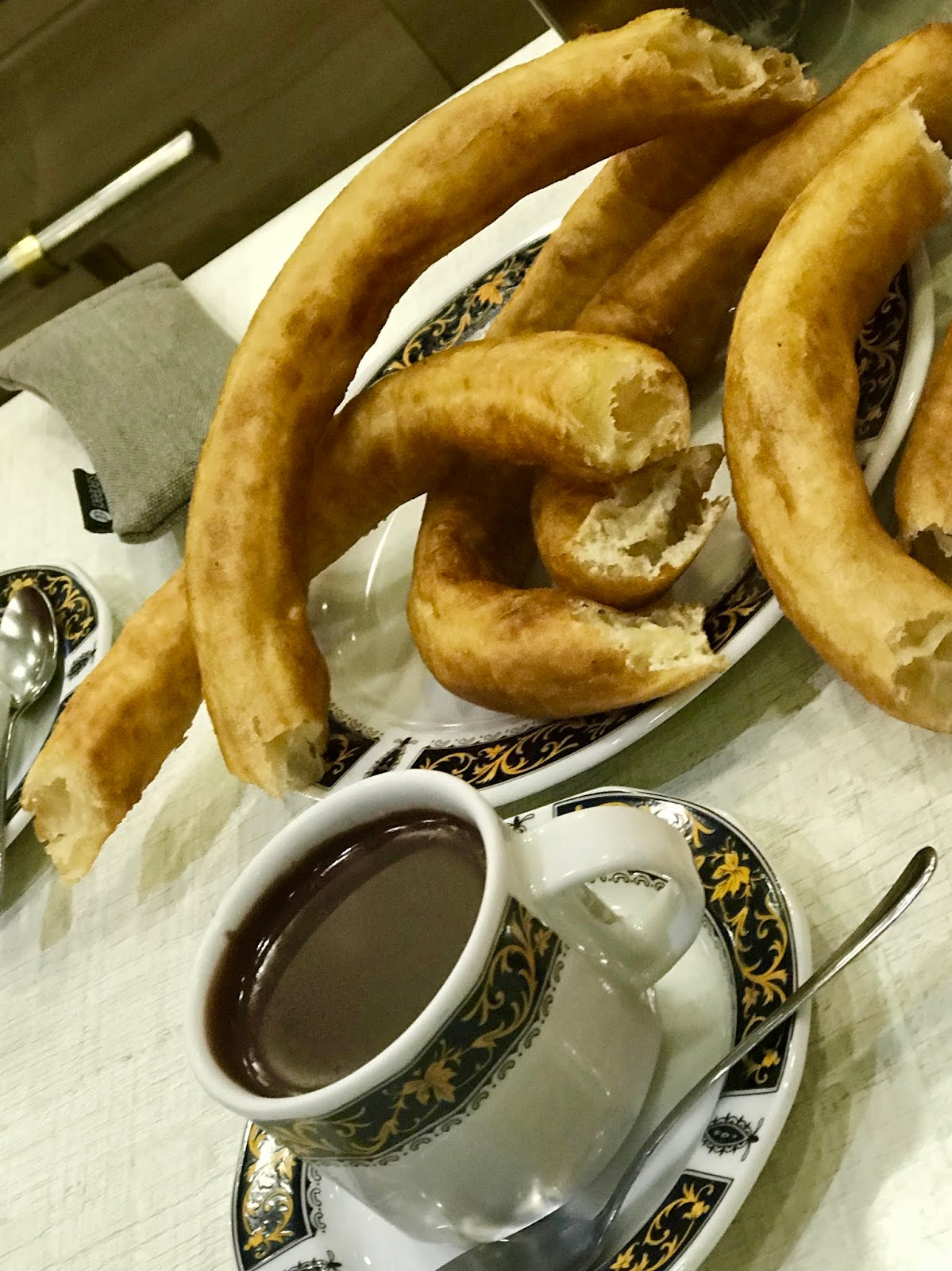
Churrería Alhambra Cafeteria Chocolatería proves that looks can be deceiving. This spot on the southwestern corner of the Bib Rambla looks about as touristy as it is possible to be, complete with "pizzeria" emblazoned on its awnings. But according to tour guide Marta Sanchez, they make the best churros in Granada. Naturally, we had to test that claim. And though we have no other Granadan examples for comparison, they were certainly the best any of us had ever had. Crisp, light, flavourful batons of fried dough, curving gently on the plate and served with a coffee cup of dark chocolate sauce. On its own, this chocolate was unpleasantly bitter. When used as a dip for the churros, however, the bitterness melds with the pastry's sweet to bring flavours into perfect balance. If we hadn't fallen so deeply in love with Pasteleria Lopez-Mezquita, we would have returned here for future breakfasts. So many pastry shops, so little time...