Saturday, 13 June 2020

Let's support diversity by raising UP, rather than tearing down

As if the world couldn't get any stranger: Covid-19 is now enhanced by yet more race-related tragedy out of the United States. We've been here before. I've been here before. Literally. Here's my report from St. Louis the night similar trauma in Ferguson erupted into violence. But this time it's different.

This time, instead of just looking on, the whole world seems to have gone up like a powder-keg of pent-up frustration, anger and resentment ... undoubtably fuelled by the once-in-a-lifetime anxieties of lockdown. Everything I saw in Ferguson in 2014 is happening again, but around the world. It starts with peaceful protests about an important issue. Then extremists hijack the agenda to tip the action into looting, vandalism and mayhem. Then come the impassioned debates about where the line needs to be drawn between the two. It's all happening in a world that ... even more now than then ... is so polarised that any comment, no matter how well meaning or crafted-for-balance, is going to be hated by one side or another and risks being pulled out of context to appear extreme.

The focus this week has evolved from the "easy" territory of people calling for police reform, while corporations clamour to shout their diversity credentials, to the much thornier cultural front. Many agree that Bristol probably should have responded faster to calls to remove slave trader Colston's statue, even if they don't agree with the way it came down. Of marginal artistic value and not installed until the 19th century, it's hardly a cultural loss. But what if the argument moves to Colston's tomb nearby? Designed by Gibbs and carved by Rysbrack, it's an exceptional piece of English Baroque art.

This week, driven by anxiety not to offend, the BBC removed the entire back catalogue of Little Britain and Fawlty Towers' classic episode "The Germans". HBO withdrew Gone With The Wind, not only an acknowledged masterpiece of film making but the first oscar-winning performance by a black actor, from its streaming service. Evidently after vociferous complaints Basil is not mentioning the war again, and Scarlett and Rhett are back with a new historical preface, but these cultural battles start us down a slippery slope.

If we are to only to erect statues of blameless, universally popular people, there will be no statues. If our art is sanitised to ensure that it doesn't offend, and we only consume works created or commissioned on the right side of history, there will be no art. Wagner wrote some of the most sublime music ever created, yet he was a notorious anti-semite. Most of the exquisite art of the Italian Renaissance was funded by brutal warlords to atone for their copious sins. To sanitise everything tainted by the horrors of trans-Atlantic slavery, we'll need to eliminate 300 years of European culture that also brought us Shakespeare, the Enlightenment and the Industrial Revolution.

I'd much rather learn from history than edit it to my taste. The world is not black and white; neither literally nor metaphorically. History is full of contradictions, populated by those who did both good and bad. Let's learn from that. When it comes to the current focus on racism, I'd love to see part of the energy on the streets directed towards celebrating and promoting Africa's rich cultural legacy. A legacy about which I'd guess most people, including many of the protestors, are unaware.

Here's my short list of wonders to get you started.
Harvard Professor Henry Louis Gates Jr's six-part documentary series, Africa's Great Civilisations, is an enthralling introduction.  Gates is a wonderful storyteller who unfurls a rich cultural legacy against a background of gorgeous location shoots. Even those who think they're pretty good on their world art and history will find much new here; the majority won't ever have heard these tales of impressive cultures with sophisticated politics, buildings and art. It will leave you wanting to learn more, which is the point of any good documentary. Sadly, neither original producer PBS nor the show's British broadcaster the BBC are streaming the 2017 series at the moment, which seems like a missed opportunity. You can stream it on Amazon Prime.

The African galleries at the British Museum are an intriguing treasure trove that show off a cultural legacy of bronze work, ceramics, carving and glorious textiles. Any fan of modern art will know how early 20th century Europeans were inspired to explore abstraction by discoveries coming out of Africa; many of the exhibits here show off that purity of line and fascination with geometry. (And, IMHO, are much nicer than many of the European extrapolations.) Speaking of modern, one of my favourite things here is The Tree of Life, made in Mozambique in 2004 from decomissioned weapons after that country's civil war. I love the way the artist has turned something ugly and tragic into a beautiful sign of life. The greatest masterpieces here from an art historical perspective, however, are the Benin bronzes, a series of plaques that are both beautiful and demonstrative of an impressive technical proficiency. Whether they should be here or returned to a museum in Nigeria is an incendiary argument I won't get into, but if you live in or have visited London and haven't taken the time to gaze at these in wonder, you're missing out.  The art in these galleries, which you can take an online peak at here, is sub-Saharan. Other masterpieces from the continent live in the Islamic galleries and, of course, in the British Museum's famous Egyptian collection.

Speaking of Egypt ... while there is much unproductive debate in sensational media about whether or not Cleopatra was black (as the descendant of Greek usurpers who adopted the pharaonic trait of incestuous marriage, the answer is "highly unlikely"), there were black-skinned pharaohs, and they were incredibly important. The 25th dynasty took advantage of Egypt's weakness in the 8th century BC to sweep north from modern-day Northern Sudan to take over the country for just over 70 years. As incomers often do, the Nubian pharaohs (aka Kushite) tried to prove they belonged by adopting the culture of the place they conquered. They went on a restoration binge, reviving monuments the native Egyptians had allowed to decay. When they retreated back to their homeland they took their new hybrid culture with them, building wonders of art and architecture. The spectacular pyramids at Meroë are little known, little visited and high on my bucket list.
Though they come from the other side of the continent, I imagine the Ife heads (top photo) show a similar regal strength and assurance to that possessed by those pharaohs. When archeologists unearthed the 18 heads in the late 1930s, artefacts that clearly came from before the time of European influence in Africa, they destroyed the idea that African culture was primitive. These are objects of breathtaking beauty, on par with the greatest Ancient Greek sculptures in giving you a sense that they could spring to life at any moment. There's one at the British Museum and I've seen a few others in travelling exhibitions over the years. They are wondrous.

Of course, anyone who had any doubt of African technical proficiency can start with the culture of ancient Egypt or ... less known ... the fact that African mosaic makers were arguably the best in the Roman empire. The Bardo Museum in Tunis, which I wrote about it back in 2007, has the most spectacular collection of Roman mosaics I've seen anywhere. And I've seen a lot. Unsurprisingly for a town on the African coast, the artists here were particularly good at portraying both sea life and the wild animals shipped up from the continent's interior to take part in gladiatorial games. The accuracy, depth and movement they create with small pieces of stone is spectacular.

Very different again, in style and location, are the carved stone churches of Lalibela. Ethiopia was one of the earliest nations to adopt Christianity, in the 4th century, but locals really hit their stride in the 12th when they decided to carve downwards into their hills to liberate holy places from the living stone. Thus the flat roofs are at ground level (Prof. Gates is standing next to one in the photo above) and you climb down into a pit to find the buildings rising above you. All of the interior decoration has been revealed as artists hollowed out the rooms. It's a mind-boggling work of artistic engineering and another one on my bucket list.
A very different cultural tradition is preserved in the libraries of Timbuktu. This trading hub in Mali flourished from the 12th century, is the home of some of the most distinctive mud-brick architecture in the world (also on my bucket list) and became a scholastic centre that collected the best of Islamic manuscripts when Islamic scholars led the world in science, philosophy and the preservation of classical wisdom. Tibuktu would also, by the way, be on the hit list if you want to tear down those who made their profits from slavery, as it was a nexus of the trade. The documents here were almost lost as the Malian empire declined from the 1600s, but in recent years modern scholars from around the world have re-discovered the treasure trove and have joined forces to preserve it. I'm proud to say that my own university, Northwestern, led a project to bring in scanners to digitise the documents. Meaning you can appreciate their beauty online with an easy Google search.

Sadly, the knee jerk reaction to any offence these days seems to be a desire to tear things down. On the cultural front, iconoclasm is often the default reaction to conflict. More than 3000 years ago, Hatshepsut's successors tried to carve her out of history, so great was their opposition to a female pharaoh. The Roman Empire thought the only way to resolve long-simmering conflicts with the Jews was to destroy their temple. Reformers swept through the churches of protestant Europe, and particularly England, hacking apart the artistic legacy of centuries to confront the sins they saw in the Roman Catholic church. More recently, we've seen fundamentalists blow up the giant Buddhas of Bamiyan and precious classical heritage in Palmyra.

I don't suggest that any of the examples above directly equate to the removal of Little Britain, or statues of Colston, Jackson or Lee. Simply that destruction is a typical, though unproductive, human reaction. And that in every one of the older examples I mentioned, descendants of those who did the damage have regretted the action. Because that destruction wipes away part of the human story; a story that is both ugly and beautiful, soul-destroying and heart-warming, cruel and kind. I believe the world is a better place when we focus on the positive side of that equation, and work to lift our brothers and sisters up to shared heights rather than knocking down history.

Sunday, 31 May 2020

Top picks for a pandemic-constrained English holiday

After nine weeks in pandemic lockdown, and just in time for the bank holiday weekend, restrictions in the UK started to ease ever so slightly. We could now drive beyond our immediate area to exercise, and meet up with a friend if we maintain the recommended two metre buffer. Thus the highlight of a holiday weekend so often spent in foreign parts was a gentle stroll around the lake at Virginia Water.

From tomorrow, there's a limited re-opening of offices for people who can't work from home. Groups of up to six can gather in gardens, with the usual rules about keeping your distance. No sharing of glassware or cutlery, and you're not supposed to use anyone else's bathroom. So the party potential is pretty limited. A handful of school kids are returning to the classroom (amidst much controversy that it's too early), garden centres have re-opened, car showrooms follow tomorrow and other non-essential shops are promised by mid-June. Given the requirement to follow one-way systems and clean anything anyone has touched, it will still be a long way from normal.

Unlikely as it seems, airlines are starting to advertise again as favourite sun spots like Greece and Portugal hint they'll be open for the British holidays. The Bencards have some potential plans to visit family in Denmark, but we're not optimistic. Practical minds will be looking to a holiday in the UK; something alien to pretty much everyone who can afford a plane ticket. Given the hit that the hospitality industry has taken, however, staying local seems an act of noble patriotism.

Here are a few ideas, if you're in planning mode:

THE NORTHEAST COAST
This is where our reservations are. All cancel-able up to a few days before, of course, since we've already been stung by a load of vouchers rather than cash for the holiday lost at the outset of lockdown.

The stretch of England between York and the Scottish border is packed with history, grand country houses, impressive castles and dramatic landscapes. We're hoping the Royal Armouries Museum will have re-opened by August to allow a pit stop on our way North, but if not we'll go direct to Harrogate. On a long-ago girls' trip I discovered this gracious, elegant town, similar to Bath in its Georgian architecture and origin as spa to the rich. York is an easy drive from there and one of England's most interesting historic cities, though we explored it on a pre-Christmas jaunt not too long ago so will probably forgo another visit. Castle Howard (of Brideshead fame) is probably the blockbuster country house in the area but my favourite is the Robert Adam-designed Newby Hall, and there are a brace of National Trust properties as well. If interiors aren't open, we could explore the evocative Fountains Abbey ruins or ramble over dramatic moorland.

From there we continue North for a couple of nights at Lumley Castle, a nostalgic trip down memory lane for me as it was the first English historic property I ever stayed in, back in 1982. The surrounding area offers us breathtaking views over the North Sea at Robin Hood's Bay, Dracula associations and jet jewelry in Whitby and the Medieval majesty of Durham.
Then we push on to Alnwick, where I've found what looks to be a world-class boutique hotel in The Cookie Jar. I loved Alnwick Castle when I visited 30+ years ago, but since then it's had the benefit of (and cash infusion from) Harry Potter fame and a new Duchess of Northumberland known for her innovative gardening style. Nearby on the coast is Bamburgh Castle, one of England's most dramatically-sited on a headland over the North Sea. The ruins of Lindisfarne Abbey are on a tide-isolated island off the coast and Hadrian's Wall sneaks through the landscape. I've hedged our bets. Even if we can't get inside anyplace, there will be lots to look at.

PEMBROKESHIRE
One of the most beautiful bits of the UK, this southwestern tip of Wales is full of gorgeous sandy beaches (that's Barafundle Bay below) and long stretches of picturesque countryside. It's remarkably isolated and undiscovered (or at least it was, when I was last here in the mid-'00s) because there are no major towns and ... once you drop off the road to the ferry to southern Ireland ... it's not a through-point to anywhere else.
It slipped behind the Northeast on my list because of less variety; fabulous for the great outdoors but limited on sightseeing fronts. St. Davids does have a charming small cathedral and some interesting ruins of a bishop's palace. Pembroke Castle ... though not as good as the more famous strongholds of North Wales ... is still an impressive site with notable Tudor history. Boat excursions offer puffin watching. My biggest holiday planning challenge, however, was that Pembrokeshire's dog-friendly accommodations all seem to be rental cottages or rather unexciting, slightly-downmarket B&Bs. There seems to be a dearth of upscale boutiques or small manor house hotels in the area.

DARTMOOR
The brooding, majestic wilderness immortalised in The Hound of the Baskervilles also offers sleepy villages, clear babbling brooks for high summer wading and expansive views. You can drop off the moor for sightseeing in Plymouth or Exeter, but a Dartmoor holiday is about the great outdoors. I've written about it before here, and it's one of the best places in the country if you're thinking about a walking holiday. Especially with dogs. And given that Dartmoor is one of the least-populated places in Britain, social distancing shouldn't be much of a problem. The experience will be much better, though, if the moor's many picturesque pubs can be open to serve walkers.

NORFOLK
If a return surge of Covid-19 closes hotels in the Northeast, we may beg a socially-distanced guest room with friends here. Like Pembrokeshire, Norfolk is an appendage of England rather than on a central path. In this case it's the hump bulging East in the middle of the country. Thus you only get people who mean to be here, rather than any passing through. The beaches are broad and sandy, especially at Holkham where low tide reveals one of the largest stretches in the world. There's no salubrious effect of the Gulf Stream here, though, so only the hardiest souls on the warmest days would ever dream of swimming.
The landscape lacks the drama of my other picks, being mostly gently-rolling agricultural fields re-claimed from marshes, but its famous fens offer opportunities for messing about with boats in a unique landscape. If they're open, the county offers one of the most densely-packed selections of grand country houses anywhere in England. My favourite is the remarkable neo-classical pile at Holkham, but it only narrowly tops Houghton Hall, first Prime Minister Robert Walpole's art-packed Baroque manor. There are at least three notable National Trust houses here (my favourite is Ickworth) and there's even one of England's best Medieval castles at Castle Rising. Swaffham is a charming, mostly-Georgian market town and Cromer is an old-world port with fantastic seafood.


It's anyone's best guess what might be open in July and August. Even if national borders are, unless the British government's travel advice changes from its current "don't leave the country" stance, your travel insurance won't be valid. Whether abroad or at home, restaurants, hotels and tourist attractions are desperate to get back in business. Many fear that without the summer season to replenish coffers they'll be out of business for good. Here's hoping things change, and we can venture out into the world in time for a proper summer vacation. Even those who love their homes and gardens are ready for a change of venue. And I feel certain that those of us who've been lucky enough to be employed throughout the pandemic are ready to do our patriotic duty and invest some cash in having fun.


Sunday, 10 May 2020

Life in lockdown has its delights Chez Bencard

Seven weeks have passed since the "non-essential" world shut down and we retreated into isolation, with one weekly grocery trip and one walk per day allowed beyond our homes. While there's some talk of moderate loosening, nobody expects restaurants, museums, theatres or international travel to be back any time soon.

For someone whose blog depends on that quartet, it's perhaps surprising that I haven't minded these first two months of isolation. Though days may not be giving me much to write about here, they've been packed with activity.

Of course, few could have an easier time of this, as we're constantly aware.  For the Bencards, isolation is a comfortable house with separate offices (that's mine in the photo), high-speed broadband, a full larder and a generously-stocked wine cellar. We don't have to worry about entertaining or educating children, and our one remaining parent is healthy and sensibly self-isolating in central Missouri while binge-watching opera. Our gorgeous garden has been flourishing through an unusually sunny spring. We are both able to work from home and are very busy. I'm putting in more professional hours, in fact, than I have in years. I sometimes envy those people wondering on social media what to do with all their free time. Then I remember my pay check at months' end and say a little prayer of thanks.

Even with a full-on job, I do have more time. At least thrice a week I get back the three hours I would have spent commuting to and from London. Half is recouped in much-appreciated sleep, the other given to my employer. Though as the days warm and lengthen, I'm hoping to leave my desk at a more reasonable time. At least one of our work week evenings would normally have been filled with a restaurant or theatre outing; now they're all clear and start the moment we shut down our computers. And weekends that were usually at least half filled with activities beyond the house stretch in un-interrupted peace.
We've appreciated the quiet time to focus on house and garden. We now have a tidy spreadsheet that lists projects needing attention once workers are allowed back into the house. (We are both wise enough to realise we have no DIY skills, and need to pay professionals to do things properly.) I have a detailed "mood board" in development for the renovation of our master suite bathroom. The garden is looking unusually tidy, though the absence of garden centres has left me without annuals to fill out my borders and plant in my hanging baskets. I tried seeds, but lost most of my seedlings to a pernicious, invisible army of slugs and snails. While I may be low on summer blooms, it looks like I'll have an abundance of straw-, logan- and raspberries.

Like most of the country, we've been spending a lot of time in the kitchen, and doubtless eating and drinking too much. After some early panics, grocery supply chains balanced out and we've been well stocked, though getting flour has been challenging. Our normal routine of getting deliveries from Sainsbury's is impossible, however, as the store has reserved deliveries for vulnerable customers only. From the start of lockdown we discovered, unsurprisingly, that the queues at premium grocer Waitrose were shorter than others, so our shops have gone decidedly upscale. Given that we're not spending money on anything else, I shrug and reach for the duck, sirloin, fresh pasta, French jams and jars of antipasti.

I've made a few loaves of bread, currently counting this remarkably easy French country loaf as my favourite. I continue my search for the perfect brownie recipe ... still unsuccessful ... have discovered that replacing half the dates with dried prunes lightens up a sticky toffee pudding and found remarkably accurate instructions for a favourite childhood cookie from St. Louis (Party Pastry's raisin bars).  We've dabbled with improving our presentation of dishes and our sauces. We've pulled down cookbooks to try new angles on fish (stuffed sole rolled in wild garlic leaves), leg of lamb (Ottolenghi's excellent Shawarma) and veg. Last Sunday, in a bittersweet acknowledgement that in a pre-pandemic would we would have been arriving at cooking school in Gascony that night, we feasted on duck in an armagnac and prune sauce, duck leg bonbons and red cabbage, followed by apricot frangipane tarts. Mr. B has used some of his free weekend time to update our "what to drink when" chart and we've been taking some nice bottles out of the cellar that pundits tell us are ready.

A decent broadband connection and keen desire by cultural institutions to keep themselves in front of potential donors has offered far more intellectual stimulation than I have time to consume. New York's Metropolitan Opera has dipped into their archives to broadcast a different opera every day. The days I had off work to recover from gall bladder surgery (slid in right before discretionary surgeries ended) coincided with a magnificent production of Wagner's ring cycle. I couldn't have managed four consecutive days of lengthy epics if I'd been working. I've quickly sampled and dropped out of much that wasn't to my taste (Russian, 20th century, austere stagings) but have found a new appreciation for Rossini. That's probably thanks to New York's decision to go with lavish, period costumes and sets. London's Royal Opera House only broadcasts one performance each week (on YouTube) and they've mostly confirmed why I don't bother with their pricey tickets any more. Modern re-interpretations, stark sets, simple costumes. Where does the money go?

The UK's National Theatre is following the weekly habit of its lavishly-subsidised operatic cousin, with much acclaimed productions from the archives of their previous cinema broadcasts. We enjoyed One Man, Two Guvnors and were relieved we didn't pay to see Frankenstein with Benedict Cumberbatch and Jonny Lee Miller. I'm excited for Ralph Fiennes in Anthony and Cleopatra this week, one I had meant to get tickets to and missed, and hoping their extraordinary revival of Amadeus which we loved in 2017 turns up.
My favourite intellectual stimulation, however, has come from the discovery that it's possible to watch lectures from Coursera for free if you aren't seeking credit. I've waded through two semesters of Ancient Egyptian Art and History from the University of Pennsylvania. The professor is too lifeless on camera for me to give it great reviews, but it will have been a worthy investment if our Egyptian cruise next spring goes ahead. Far more entertaining ... if you share my passions ... was a 23-lecture course from Yale on Roman Architecture. Through it I discovered that my Northwestern professor on the topic had gone on to become one of the world's leading experts on Trajan's market, spurring me to get back in touch for a heart-warming exchange. Jim Packer is 82 and, though retired from teaching, is still excavating and writing, currently working on a book on the theatre of Marcellus and frustrated he won't be able to get to Rome this summer. My latest discovery is a stimulating course on The Age of Jefferson from ... fittingly ... the University of Virginia, which the great man founded.

Of course, physical isolation doesn't mean abandonment of our wider social fabric.  This past Friday was the 75th anniversary of Victory in Europe day and a bank holiday, on which the government encouraged us to prepare a traditional tea and take it in front of our homes at 4pm. We were the only ones on our stretch of road, but the neighbourhood Facebook page showed people out across our estate. The weekly applause for the NHS at 8pm on Thursdays has drawn more crowds, and it's built a great sense of community with people I rarely saw before this.

The internet has brought others closer. I've done virtual tastings with the Accenture wine club, a virtual dinner party with friends in France and regular virtual happy hours with the girls I travel with every year. A friend's Zoom birthday party couldn't compare to live interaction, but it did have the benefit of including her mum from Florida and brother's family from Iowa, all of whom I've met on past London visits and was delighted to see. As people get into the habit of more video calls old networks are being revived; I'll be on a conference call later today with a group of sorority sisters who haven't all occupied the same room since 1986. Another university friend, in New York, has brought me into a book club discussing Robert Tombs' The English and their History with his friends from Singapore and Miami.

I would, of course, prefer to be living in a broad, real world rather than a confined, heavily-virtual one. But house arrest, Bencard style, is a busy cycle of work, social calls, intellectual stimulation and gourmet dining. We are blessed. And will continue to stay home as long as government advice tells us to do so.


Thursday, 19 March 2020

Art banishes gloom as I rush to London's museums before Covid-19 forces closure

I can date my first memory precisely: 20 July, 1969. My parents sat me before our television and proclaimed with solemn gravity: "Remember this, Ellen. You're watching history. You may live your whole life without something this important happening again." I didn't really grasp why Neil Armstrong stepping onto the surface of the moon that afternoon was so significant, but I knew it was a big deal.

Twenty years later, I was more conscious of the reasons for the history-book moment as I watched the Berlin Wall tumble. The next history maker was far less pleasant. A regular workday collapsed into horror on September 11, 2001 as our world changed forever. After that, frankly, I could have done without any more epoch-shaping events in my life. And yet here we are again.

We're all used to watching horrible diseases ravage developing countries. We give money. We say prayers. We don't imagine it will have much effect on us. Who in Europe or the US, just two short months ago, could have predicted how quickly normal life can tip into an apocalyptic drama? Who can say how far-reaching the impact of Covid-19 will be?

I suspect that, much as it was in the weeks following 9-11, the secret to fighting the dread is going to be making extraordinary efforts to keep life as normal as possible. For me, with the closure of London's museums on the horizon, that meant making my way into an eerily quiet capital to drink in the two exhibitions I'd planned to see this spring. Staying six feet away from other humans, trying not to touch anything and regularly sanitising my hands, naturally. I got there just in time. Cultural institutions locked their doors 48 hours later.

If you need cheering up, it's hard to go wrong with the exuberance of the British Baroque or the merry excess of George IV's collecting mania, now sitting in splendid isolation inside Tate Britain and the Queen's Gallery.

The Baroque was a truly international movement, starting in Italy as the Catholic church's response to the reformation. If protestants were going austere, the Pope would fight back with magnificence. The trend for enormous classical buildings, opulent decor, fanciful frescoed ceilings, luxurious clothing and complex, multi-layered music spread quickly. Even protestant countries adopted the style, though they streamlined it a bit and stripped most of the bombastic religious images out of it.

In Britain the Baroque aligns with the late Stuarts. It was the look of choice for Charles II after his restoration. He was heavily influenced by (and probably jealous of) his style-setting first cousin Louis XIV of France (Le Roi Soleil). Charles' successors James II, William and Mary, and Anne all followed suit. The Tate's show, called British Baroque: Power and Illusion, focuses on how those rulers and their courts used the style to dazzle the country with their authority.

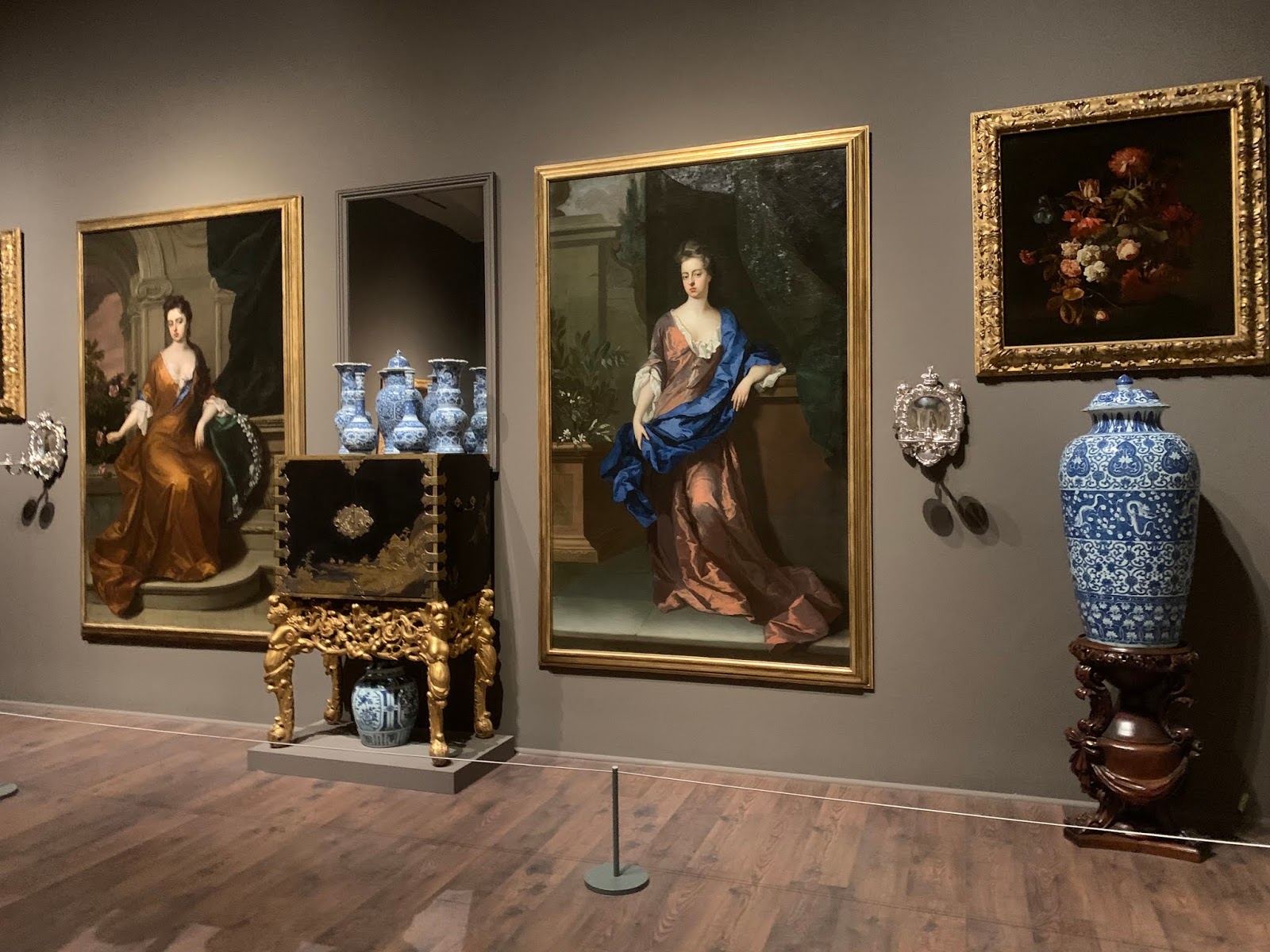
While there are interesting lessons in political history here, at its core this is simply a beautiful collection of things to look at. There are lots of sumptuous portraits of women in billowing silk and men in flamboyant wigs. (This may be the best era in fashion history for women. For men, condemned to shoulder-length curls, tights and ballooning short pantaloons, not so much.) There's an exquisitely-wrought silver chandelier, a font cover carved by Grinling Gibbons alive with putti, fruit and veg, an enamel and diamond portrait pendant of William II that would set any jewellery collector drooling, and some beautiful examples of pottery and furniture that show off the growing interest in the exotic Far East. The silver and gold loving cup in the shape of an oak tree, topped with a royal crown, is a masterpiece of the smith's art.

An intriguing section digs into the Baroque's obsession with fooling the eye, with photo-realistic flower paintings, the famous tromp l'oiel door from Chatsworth's music room with its painted violin hanging on a nail, and an amusing box that throws scenes painted on three sides into perfect perspective when you look through the designated eye holes.  There's a whole room devoted to the architecture of Sir Christopher Wren and his followers, with models, paintings and architectural drawings. In the next the curators try to bring to life the age's passion for exuberant walls and ceilings, often adorned with life-sized gods, goddesses and royals occupying heaven. One wall has an enormous reproduction of the view into the great hall at the Naval College at Greenwich, while the others have photos and sketches of  examples elsewhere in the country.
This exhibition wasn't quite as much fun as the Victoria and Albert's take on the Baroque in 2009, which included music, costume and much more of the decorative arts. But it was still a joyous outing, made more memorable by the sparsely populated galleries.

People were even thinner on the ground at the Queen's Gallery, a little-known secret that's rarely crowded even when London's operating at capacity.
The Queen's Gallery sits next to Buckingham Palace and exists to share treasures from the Royal Collection with the general public. While the source is always the same, exhibitions vary to show off items under different themes. For a bargain £13.50, you get into exhibitions for a year (that can be as many as three if you time it right), audio guide included.

While under normal circumstances I wouldn't have jammed two big shows into one day, George IV: Art and Spectacle is a fitting companion to the Baroque. George loved excess, was one of the monarchy's greatest collectors and was a big fan of his predecessor Charles II. George was particularly intrigued by the Catholic branch of the Stuart family that still existed in exile, ousted by his own protestant Hanoverians. There's an intriguing collection of Stuart memorabilia here.

That's probably the most humble of the many collections on view. George's irresponsible spending made him an unpopular king but left perhaps the biggest artistic legacy of any monarch since the Civil War. A savvy consumer of great painting, his purchases included priceless Rembrandts and some of Lawrence's greatest portraits,  on show here. His love of adornment gives the exhibition the glittering, diamond-studded circlet of national flowers familiar from the queen's image on stamps, and a whole range of over-the-top costumes and accessories from his lavish coronation. The Royal Plate had been liberated from its usual display at the Tower; a range of golden tableware that was supposed to be arrayed behind the monarch at state banquets, in an echo of Medieval tradition.
If, as I have, you've been a visitor to all of the Royal palaces, you will have seen most of this stuff before. The charm of the Queen's Gallery is that it brings items together to tell a story. And what we get here is a view into a man of impeccable taste, with greater depth and sensitivity than his historic reputation.

He collected a range of searing political cartoons lampooning him, suggesting a decent sense of humour. He commissioned multiple, beautiful portraits of his favourite sisters and his daughter, suggesting a soft spot for at least some of his fractious family. The books, prints, maps and memorabilia from Wellington's campaigns against Napoleon, including a captured French marshal's baton of command, demonstrate his intense interest in the greatest political events of his time. His love of Jane Austen, who ... when vigorously encouraged ... dedicated Emma to him, obviously shows his excellent literary taste. The presentation copy is here, in its original three-volume form. Most poignant are white marble and gold gilt copies of famous imperial arches in Rome. George desperately wanted to go on the Grand Tour, as his aristocratic peers would have done, but as heir to the throne he wasn't allowed to do so. These items show a desperate yearning for an Italy he would never see.

My two favourite items in the show, however, were the things I'd never seen before because they're not usually on display in the palaces' public spaces. The first was a pair of Humphry Repton's famous red books. An early example of visionary marketing, Repton would bid for potential work by presenting a watercolour of a landscape as it existed and then, with the movement of a flap, the landscape as it could be with his help. His before-and-after scenes were all the rage in the early 19th century, but few survive because they were essentially working design tools. The other is a suite of Oriental-style furniture created for the Royal Pavilion at Brighton. Lifelike, small Chinese sages hold up a console table, each dressed and presented with distinctive facial expressions. On either side loom porcelain pagodas, originally made in China but enhanced in Europe with tiny ormolu dogs and bells on every level. They are gob-stoppingly magnificent and possibly worth the price of entry on their own.
Sadly, now they sit in an empty gallery, seen by even fewer people than would normally pass by in the private East wing of Buckingham Palace, where they normally live.

With only a handful of people out and about, London's museums and tourist destinations last weekend were glorious. It was like an almost-private view. I wanted to stop time, so I could experience the same at the British Museum and the Victoria and Albert. But time marched on. Covid-19 marched on. The museums are closed, and there's no telling when they'll open again. Just like the businesses that are shutting down, our cultural institutions will take an enormous financial hit from this crisis. I can only hope that while they're inaccessible, people gain a greater appreciation for what they're missing and flock back through all those august portals when this significant moment in history has passed.

Thursday, 12 March 2020

Despite big budget firepower, ENO's Luisa Miller pales before a provincial Butterfly

Warning, readers: I'm climbing onto my opera soapbox again.

I've written regularly about my frustration when the modern preference for "innovative" opera staging tips over into something that's incomprehensible and just plain ugly. From its birth, opera was an art form of lavish visual spectacle. While I appreciate that artists get bored repeatedly staging the same interpretations, and smaller opera companies can't afford the spectacle that Mozart, Wagner or Puccini would recognise, I'm becoming exasperated by the major opera companies' love affair with sparse modernism and the reinvention of the original work's time and place.

In the UK, however, the less an opera company looks to London, the more liberated they seem to be to embrace traditional staging. The word provincial usually comes with negative associations: rustics from small towns aping urban sophistication and never quite getting it right. I suspect that's the way Londoners would dismiss the production of Madame Butterfly I saw at the Anvil in Basingstoke last month. But with its abundant kimonos and traditional setting, it was a classic interpretation that was easy on the eyes and far less challenging that the production of Luisa Miller I saw at the English National Opera a fortnight later.
If you'd listened to a radio broadcast of this Luisa, you'd make no mistake about which one was the big-budget, top-of-the-food-chain production.  The ENO's orchestra swells, powers, cajoles and stirs. This is one of Verdi's lesser known works but the music still moves the soul. Young American bass Soloman Howard was the best thing in the production; a spine-tingling voice and emotive acting that almost transformed the bad-guy Wurm into the hero of the story. He has the kind of headliner quality that pulls you to almost any opera just to see him. Elizabeth Llewellyn, playing the eponymous heroine, is a powerful soprano with an impressive range, and while David Junghoon Kim's Rodolfo sometimes lacked power he is a pure, sweet tenor in the classic style. Unfortunately, the love triangle that drives two of the three to a terrible death has no credibility. The acting is as wooden as the singing is lovely; I didn't buy Luisa as a sweet heroine or Rodolfo as an obsessed romantic hero.

But those issues pale in comparison to the stark, brutalist set. Luisa Miller was written as an exploration of class divisions in a 17th century Tyrolean village. (Luisa is the humble Miller's daughter, Rodolfo is the lord's heir who falls in love where he shouldn't.) But don't expect lederhosen, beer steins and sets with lavish mountain backdrops. The vast ENO stage was a brutal white rectangle with harsh light. A structure in the centre sometimes appears, just a ghost of a building made from white girders. The side walls sometimes come in and out. There's little to look at until characters start daubing graffiti on the white walls.

The lord of the manor seems to have morphed into a violent gangster ... at one point an enemy is executed in a hanging reminiscent of Catholic martyrdoms ... and the graffiti, daubed in thick black stuff that comes out of oil barrels, oozing with heavy menace. By the end it's dripping ominously from the top of the walls. Stark and horrific, the staging certainly made an impact. But it was exceptionally ugly. And I haven't even mentioned the bizarre costumes of the villagers, who seem to have been conjured out of one of Hieronymus Bosch's scenes from hell.

It was hard work.

Not so, our little provincial Butterfly. There wasn't an innovative thing about it. The set ... unchanged throughout ... would have been recognisable to anyone who saw the original in 1904. There was a charming Japanese house set in a blooming garden, regularly populated with a chorus of people in lavish silken robes. The singing was solid though not memorable, the acting occasionally over-the-top, but the total package was a delightful evening's entertainment. For about half the price of the middling tickets at ENO.
I'm not arguing that operas shouldn't evolve from their original staging. But if you're going to take chances, I'd like them to make sense. The ENO was pushing boundaries by casting a black woman as Luisa and a Korean man as Rodolfo. Why not run with that, and turn the class war Verdi wrote into an exploration of what happens when a poor girl from a rough bit of LA ends up in a relationship with a rich doctor's son? I also want operas that can attract the next generation. At Basingstoke's Butterfly I spotted a mother with her daughter, about 8 years old, dressed for a special occasion and alert with excitement. Butterfly's simple tale with its magnificent music and storybook visuals connected with a young audience in a way I can't imagine with Luisa's frightening modernism.

The ENO reportedly receives about £100 in public subsidies for every ticket it sells. That compares to £22 for the National Theatre and ... though I have no data on this ... probably a pittance for provincial companies. Surely with that amount of cash you can give me something better to look at? More importantly, if you're entrusted with public money, I think you should be aiming for entertainment that can reach a wider public rather than the shock value so beloved by opera's inner circle. 

Friday, 6 March 2020

Glorious Upstart Crow is one of the funniest things to ever bless the London Stage

If you appreciate Shakespeare, think the finest form of comedy is witty wordplay, believe that Blackadder is a masterpiece of British television, and can get to London before 25 April, you need to book tickets to The Upstart Crow

Now. 
You probably shouldn’t even finish reading this review. Because if you don’t catch this masterpiece’s short run you will miss one of the most gloriously funny, joyously silly yet fiercely intelligent productions to ever grace a London stage. 

The Blackadder reference is intentional, as this gem is written by that series’ scribe, Ben Elton, and he’s on top form here. And like the earlier historical romp, Upstart Crow started life as a TV series. This is not, however, one of those screen-to-stage copies that West End producers turn to when looking for quick profits (Mamma Mia, Pretty Woman) but an entirely new work. 

We’ve moved on from the TV show’s Elizabethan period to the new regime of James I, where Shakespeare needs to prove himself afresh. Naturally, his creative juices are running dry and much merriment ensues to get them flowing. 

We’re treated to the familiar leads from the original series. David Mitchell returns as the insecure, callous but ultimately kind-hearted Bard, pinching ideas from those around him before falling into genius when the spirit strikes. It’s hard to believe this is Mitchell’s first appearance on stage: his live timing is perfect and he’s remarkably moving when the action briefly turns serious and he has to do the mad scene from Lear. Gemma Whelan reminds us why she’s one of Britain’s best young actresses, banishing memories of her as a rampaging, hard-ass pirate queen in Game of Thrones and the prim sister in Gentleman Jack to give us the sweet, clever and determined Kate, clearly Shakespeare’s muse. 

History won’t allow Mark Heap to reprise his role as Shakespeare’s nemesis, theatre censor Robert Greene, as he was long dead by the Jacobean accession. So Heap comes back in a new role as a Puritan doctor channeling the spirit of Twelfth Night’s Malvolio. And Rob Rouse is back as servant, straight man and ego-pricker Bottom. 

In the best Eltonian ... and Shakespearean ... tradition, the comedy alternates between farce, slapstick and brainy wordplay. While the extreme role reversals, physical pratfalls and very modern send-ups of public transport and political correctness will get a laugh out of anyone, there’s no denying that the better you know your Shakespeare, the funnier this play is. The Upstart Crow treats Shakespeare’s work not as a sacred canon but as a living larder of human creativity, where the brilliant and the bad, the strikingly original and the shamelessly copied, all live side-by-side.

The plot gleefully mashes up Twelfth NightOthelloRomeo and Juliet and King Lear. For those who laboured over the plays at school, your efforts will be amply rewarded as you spot the jokes and chuckle at how one story slides into another. References to many other plays pop up, including jibes about the bad ones, the cheap plotting tricks and the plagiarism. Will’s constantly noting down lines that come out of other characters’ mouths that the Shakespeareans amongst us know will go on to become classics. There’s even an explanation of The Bard’s most enigmatic stage direction, complete with a dancing bear who almost steals the whole show. 
This isn’t new, of course. Elton and Mitchell take a path well trodden, most notably by Tom Stoppard in Shakespeare in Love. One my favourite Doctor Who episodes in the David Tennant era springs to mind. But for pure, glorious, feel-good comedy, it’s never been done better than here. 

I’d expect that much of this will eventually come to the small screen as elements of a fourth series. But there’s a magic on the live stage I doubt a filmed version will be able to capture. The communal joy of hundreds of people joining in belly-aching laughter. The actors playing to the audience. The wonderfully authentic Shakespearean set design. And the dancing bear. The dancing bear needs to be seen live. 

What are you doing still reading this? Go book some tickets. Now!

Friday, 21 February 2020

Leonardo grabs the headlines, Apollon wins my heart

Leonardo da Vinci draws superlatives like pollen pulls bees, so it's no surprise that the Louvre went big on the marketing of its current show. It was supposed to be the biggest, most insightful, most comprehensive of all the many exhibitions put on to mark the 500th anniversary of the death of the ultimate Renaissance Man. Most tickets sold out well in advance. The hype is so big that this coming weekend ... the last of the show's run ... it will be open 24/7 from Friday morning to late Monday afternoon. And as a special treat, if you go between 9pm and 8:45 am you get in for free.

Fascinating idea. And, maybe, if you went at 4am you might actually have enough space to enjoy it. Because with normal attendance, even with the Louvre supposedly limiting numbers by time slots, the crowds were so intense it made the whole experience profoundly uncomfortable. As a consequence, even though there were some remarkable items on display, we enjoyed our time wandering around the Louvre's regular galleries more than our claustrophobic visit to this "landmark" exhibition.

The show is undeniably impressive. Leonardo may be one of the most famous artists in history, but his output was tiny: there are just 24 complete or nearly complete paintings attributed to him by general agreement. Some can't move (such as the Last Supper, since it's painted on a wall) and many are so valuable that either their owners won't take the risk of letting them travel, or the insurance is prohibitively expensive. By getting 11 of Leonardo's total on the exhibition's walls, with the Mona Lisa upstairs and available on the same entry ticket, the Louvre has worked some impressive magic. (Although if you caught the National Gallery's Leonardo show in 2011, you probably saw the better effort.)

You can't have a major exhibition with just 11 paintings, of course, so the curators have expanded the show with Leonardo's drawings ... which remain in numbers as prolific as his paintings are sparse ... works by his teacher and contemporaries he influenced, copies, works by his students, and true-to-size x-rays of both paintings in the exhibition and some that couldn't travel. You're advised of this from the very beginning, when the major work that greets you isn't a Leonardo but a monumental bronze of Jesus and doubting Thomas by Andrea Verrocchio, his teacher. (Legend says Leonardo modelled Thomas' foot.) The show is, essentially, exploring the whole "ecosystem" of Leonardo.

It's always a delight when exhibitions bring you items you may never see on your own, thus I particularly appreciated the Madonna and Child from the Hermitage. Leonardo did many variations on this theme, however, and my favourite item in the whole exhibition was the Lansdowne Madonna, which has emerged from a private collection and was once owned by the same family that gave their name to, and once lived in, my club in London. The painting is exquisite and I love the personal connection. It hangs next to another version called the Buccleuch Madonna, and it's great fun to compare the two. The X-rays are fascinating and, in the case of the Mona Lisa, arguably more interesting than the painting itself (top photo). My biggest smile came from an old friend: Verrochio's Tobias and the Angel, which usually hangs in London's National Gallery, and features a ghostly, half-completed, shaggy canine reputedly by the young Leonardo that's one of the great dogs in art. I've always loved the idea that dogs are angels' best friends as well as man's.

There are 160 marvellous works to see here, but the density of the crowd made appreciating them an
endurance test rather than a joy. It was particularly frustrating in the room that was primarily drawings, arranged in long rows of display cases with narrow aisles in between. The scrum was so intense we skipped the whole section. This is a shame, as many art critics will tell you that the most intriguing masterpieces lay there. But I've been lucky to see a lot of Leonardo drawings in my life (the majority on display here come from the Royal Collection in Windsor), and I just wasn't up for the physical fight needed to see these.

When you know you're going to be packing the crowds in, putting so many things that require close study in low cases with limited access was a poor curatorial decision. A higher hang of the major paintings would also have created a better line of sight over the shoulders in front of you. They could have learned a great deal from the designers of the King Tut exhibit I saw in London earlier this year.

The curators could also, one assumes, have put a tighter limit on numbers and raised the ticket cost. At €17, Leonardo was priced well below the £20 - £25 of most major British exhibitions, and came with the added benefit of admission into the rest of the Louvre. Which normally costs €17. Bafflingly good value for money. Perhaps too good?

Though Leonardo should have been my highlight of the day, that honour belonged to the Galerie d'Apollon in the Denon wing. This jaw-dropping, gold-gilt blockbuster of a room dates from the time of the "Sun King" Louis XIV and was an artistic trial run before he commissioned the similar, but even grander, Hall of Mirrors at Versailles. You won't be missing anything with this version, however, but the people. The room has been closed for 10 months for renovation and even when open it's off the natural route through the Denon wing, so many people miss it. (I've spent many hours wandering the Louvre and I never knew it was here.) While still full of appreciative visitors, it's nothing like the crowds in Leonardo or the even more horrific body-to-body crush at Versailles. You have time and space to take it all in; though the human brain has a hard time processing this much grandeur.
The hall is 200 feet long, its barrel vault almost 50 feet above you, and its walls and ceilings are covered with paintings of mythological allegory, great battles and portraits of the artistic worthies of France, surrounded by an astonishing array of life-sized, nearly three-dimensional stucco figures, all covered with gold gilt. Few spaces in the Louvre deliver as potent a reminder that this was once a royal palace.

If you can tear your eyes away from looking upwards, you'll find that the room holds some of the greatest treasures in the museum: Louis XIV's collection of objects made from semi-precious stone and what's left of the French crown jewels. Given France's penchant for revolution, it's amazing any of this stuff survived, much less ended up in the same room.
There's only one crown here from the monarchy before Louis XVI lost his head, as the rest of his stuff was broken up during the political upheaval that followed. The regimes after that seem to have over-compensated for their feared inadequacies, much to the modern viewer's benefit. Louis Philippe presented his Bourbon queen with a set of diamonds and Sri Lankan sapphires that is the stuff of fantasy. The Empress Eugénie’s crown is a masterpiece of emeralds, diamonds and golden eagles with raised wings. Her diamond brooch is comprised of stones so big it's hard to believe they're real, though the refracted rainbows sparking out of them thanks to small, cleverly placed spotlights leave no doubt.
The Sun King's stones may seem humble next to this bling, but they are extraordinary in their own right. Lapis lazuli, malachite, agate and rock crystal have been painstakingly carved into goblets, bowls, boxes and other lovely little objects, then accented with gold and precious jewels. Any one of these would be a priceless treasure in most museums. Here, they're fighting with the architecture to get noticed. It's sensory overload, and it's glorious.

The Denon wing is also the home of a magnificent Roman sculpture collection, the galleries featuring the enormous history paintings of Jacques Louis David and Leonardo's most famous work, the Mona Lisa.

She hangs in the middle of an enormous gallery dedicated to the Italian Renaissance. The Louvre has recently renovated the gallery and instituted a new queuing system to see her. There's now an enormous one-way route so you can only enter the gallery through one door, and leave through the other. She hangs higher than before, so people who don't want to wait can see her from a distance. There's an amusement park style chicane of barriers organising the shuffling file of hundreds, who all wind their way forward to get their requisite selfie with the most famous painting in the world. Few of them bother looking at the rest of the gallery to see Veronese's monumental Wedding at Cana (for me, the best painting in the room) or the wall of luscious Titians. This isn't art appreciation, it's tourists ticking boxes.
I'm glad I had a chance to see the Leonardo exhibition. Seeing the Mona Lisa "live" is better than consuming her through thousands of tacky reproductions. But what my day at the Louvre really reinforced is that in this era of social media-driven tourism and uncomfortable over-crowding, the less appreciated experiences, off the beaten track, can be more meaningful than the "must sees".