Monday, 13 August 2012

Blur, The Specials and my Olympic let down. A lesson in the danger of assumption.

I never claimed to be cool.

Since this blog's inception five and a half years ago, I've written 13 opera reviews, more than 20 reports on exhibits at major museums, done a couple of entries a year on theatre and taken you to a hefty number of Michelin starred restaurants.  In all that time there's been just one popular music concert.  (Springsteen in St. Louis.)  It's never been my thing.  When I love a band, I have difficulty justifying the expense and hassle of tickets to see a performance that rarely sounds as good as a CD on your home sound system.  And if you don't love someone, then what would be the point?

Little did I know that starting point would put me on a collision course to have a deeply disappointing end to my Olympic experience.  More than most people ... I should have stayed home.

As an employee of sponsor BT, I'd managed to snag tickets to the closing concert in Hyde Park, taking place in parallel to the closing ceremonies.  We'd had a one-day window before tickets went on sale to the general public.  I was in a hurry, I didn't do any research, I just purchased.

Several bands were on the agenda.  New Order.  Fab.  Knew them from university days.  The Specials.  Never heard of 'em.  Blur.  No clue what they sang, but knew they were big in the '90s and very aware of one of their members, Alex James, who makes gourmet cheese and hosts "The A to Z of classical music" on classic FM.  But this was billed as an Olympic closing ceremony event.  So I made the assumption that this would be some huge, communal watching of the closing ceremonies taking place across town.  Since it was in Hyde Park, in the best tradition of country house "last night of the proms" concerts, we'd spread picnic blankets on the grass, eat lovely food, drink wine and be entertained.  I assumed the bands were warm up acts to the communal viewing, a few songs each before we got down to the business of the big show from the Olympic Park.

I had precisely 10 minutes in which I lived this fantasy.  The big screens were tuned to the BBC.  We all cheered when Prince Harry arrived.  100,000 voices around me joined in the national anthem.    Then Madness came on with Our House, and everyone started singing along.  Fabulous.  Although I wished everyone would sit down.  And then ... off went the BBC and on came Blur.  I was furious.  And disappointed.  But I'm not stupid.  By that point, I'd figured that's what was coming.

I'd started to clue in when we entered the park around 6.  New Order was playing.  Stuff I recognised.  Lovely.  But it wasn't a scene of gracious picnic blankets.  There wasn't even any grass.  A huge area had been covered with wood chips because of the traffic.  Turns out BT London Live had been hosting bands here for two weeks.  Most people were standing up.  It was hot.  And dusty.  And it all looked a lot more like those music festivals I see on TV, those ones where I wonder why any idiot would subject themselves to the physical discomfort and crowds.  Certainly not like any event on the grounds of the local National Trust pile.  Still, we managed to spread a blanket and a couple of people went off in search of drinks.  The queues were 45 minutes long.  Yes, you weren't allowed to bring liquids into the park for security reasons, yet getting any liquid was an endurance test.  My mood was souring.

Then The Specials came on.  They sounded a bit like UB40, but more discordant, jarring and generally irritating.  Hillary, who IS cool, explained that they were a ground breaking forerunner to the aforementioned more popular, but less critically regarded, reggae crossover band.  Now, to be fair to the performers, a live outdoor concert is not the place to hear music for the first time.  The sound is bad and the environment is uncomfortable.  But I didn't hear anything that was making me consider an iTunes download.  Halfway through their set, I wondered how soon I could leave without the people I was with thinking I was a complete nerd.

The answer was five songs through the Blur set.  Unpleasant music + thirst + tiredness + the inability to sit down = I don't care if everyone thinks I'm an old woman, I'm out of here.  I walked to the tube grateful, at least, that I was getting out ahead of the crowd, but really irritated ... at myself ... that I'd wasted the money and the time on something I could have predicted I'd hate, had I done my research properly.  And feeling particularly sour that my lovely Olympic buzz had been killed by this last night disappointment.

Fortunately, my husband (who'd come down with a cold and thus avoided the whole adventure) had taped the closing ceremonies for me, which I've been watching while writing this.  Not a patch on the opening ceremonies, but plenty of music I liked and recognised.  Eric Idle and the roller skating nuns, frankly, was so magnificent as to eclipse any other disappointment.  And I was happy to note that I had much of the night's running order on my iPod, including the youngest and newest of the bands.  (One Direction's You Don't Know Your Beautiful.)

So I may not be cool, but I'm not the grumpy old woman the Blur concert made me feel.  Right?

Sunday, 12 August 2012

Summer turns up just in time for the Olympic sailing

My Olympic sailing tickets were the ones that excited me most.  Despite the wettest spring and summer on record, I had a dream.  Seaside.  Sun.  Sails.  It would be just like the Caribbean, but a day trip from Basingstoke.

Unlikely, but that's pretty much the way it turned out.

Sailing may not be the best spectator sport (it is often hard to tell what's going on), but it wins the general atmosphere prize.  Start with pure, natural beauty.  The little beach town of Weymouth sits on a bay sheltered by the peninsula of Portland to the south.  White cliffs topped by emerald green gazing land stretch to the east.  A stretch of public gardens called The Nothe, built around a Victorian fort, served as the viewing grandstand.  While you could see the races from many points on the coast this bit had been fenced, secured, wired with jumbo screens and sound and provided with lots of amenities.  That's what spectators got for their £55 tickets.  That ... and the fact that the race course was directly in front of you.

Sun and warmth is no good for sailing without wind, of course, and we got lucky there.  It was the finals of the women's Elliot 6m.  (Basically, small yachts, crewed by teams of three, in head-to-head competition rather than sailing in a big group.)  A stiff breeze blowing inland made for what commentators called the trickiest sailing of the tournament.  For spectators, that meant thrills and spills like one boat literally stealing the wind out of another's sails, the Australian captain getting pitched into the water and the spinnakers, emblazoned with national flags, showily full as the boats headed towards us on the straightaway before the finish.  We watched the Finns beat the Russians for the Bronze before the Australians lost to the Spaniards in the gold medal round.

Though rebranded from yachting to sailing in the past decade to make it more egalitarian, there's no denying this is at the posh end of the Olympic spectrum.  At the top of the Nothe Gardens stood a purpose-built bar, decked out like yachting watering holes the world over, serving up jugs of Pimm's and bottles of chilled white wine as fast as the boats were zipping across the water below.  The food stands also went upscale.  You could choose from spit-roast porchetta on ciabatta, chicken and chorizo wraps or organic beef burgers.

Amusing.  And a relief from the usual big event junk food.  (An even bigger relief that we weren't forced to endure global sponsor McDonald's high fat fiesta.)  But it does emphasise one unfortunate fact of these Olympics.  There may be some heart warming stories about athletes from the wrong side of the tracks, and I've heard stories about getting school children from poor schools to experience the excitement.  But what I've witnessed after three events, most obviously at the sailing, is a resolutely upper middle class experience.  Which is no surprise.  The only way to get tickets was online, with a Visa card.  While tickets came in a range of prices, the £50 to £100 range wasn't unusual.  Add in transport.   Around £30 a head for us to get up to London for events ... though your ticket did come with a London transport pass once you got inside the M25 ... and £50 each for us to get down to Weymouth.  And then there's the food and drink while you're there.  Add in a souvenir programme for £10 and a tee shirt.  The most basic is £18 but you can get that at Sainsbury's; most of the nice shirts were £30.  You get the idea.  This was not an outing for the cash strapped.

I'll let the organising committee wring their hands over that one.  Back on the lawn at The Nothe, I was soaking up the sun, revelling in the atmosphere and thinking that a day out at the seaside doesn't get much better than this.  Hard to believe that today, it all comes to a close.  Years of anticipation and it was all over in a flash.  I'm so glad I got to take part.  Especially in the sunny bit.

Sunday, 5 August 2012

London, be proud. You're doing one hell of a job.

As mentioned in the last post, this is one of the most cynical cities in the world.  It's part of the English character to be negative, cutting and skeptical.  It's the obverse to that famous sense of humour; the dark side is necessary to bring out the light.

The national character laid the groundworks for the Olympics.  For years, the chatter went like this:  Anyone who was smart would leave the country, we were wasting ridiculous sums of money, the public transport system would collapse, a shame Paris wasn't saddled with this hassle, etc, etc.  Meanwhile, a silent majority was buying up all available tickets and stocking up on union flags.  Now, the games are here, they're magnificently organised, we're winning lots, and the proud-to-be-British movement that started swelling with the Queen's jubilee is reaching a sustained, red, white and blue climax.

We managed to snag tickets for two events this past weekend, beach volleyball on Friday night and fencing on Saturday.

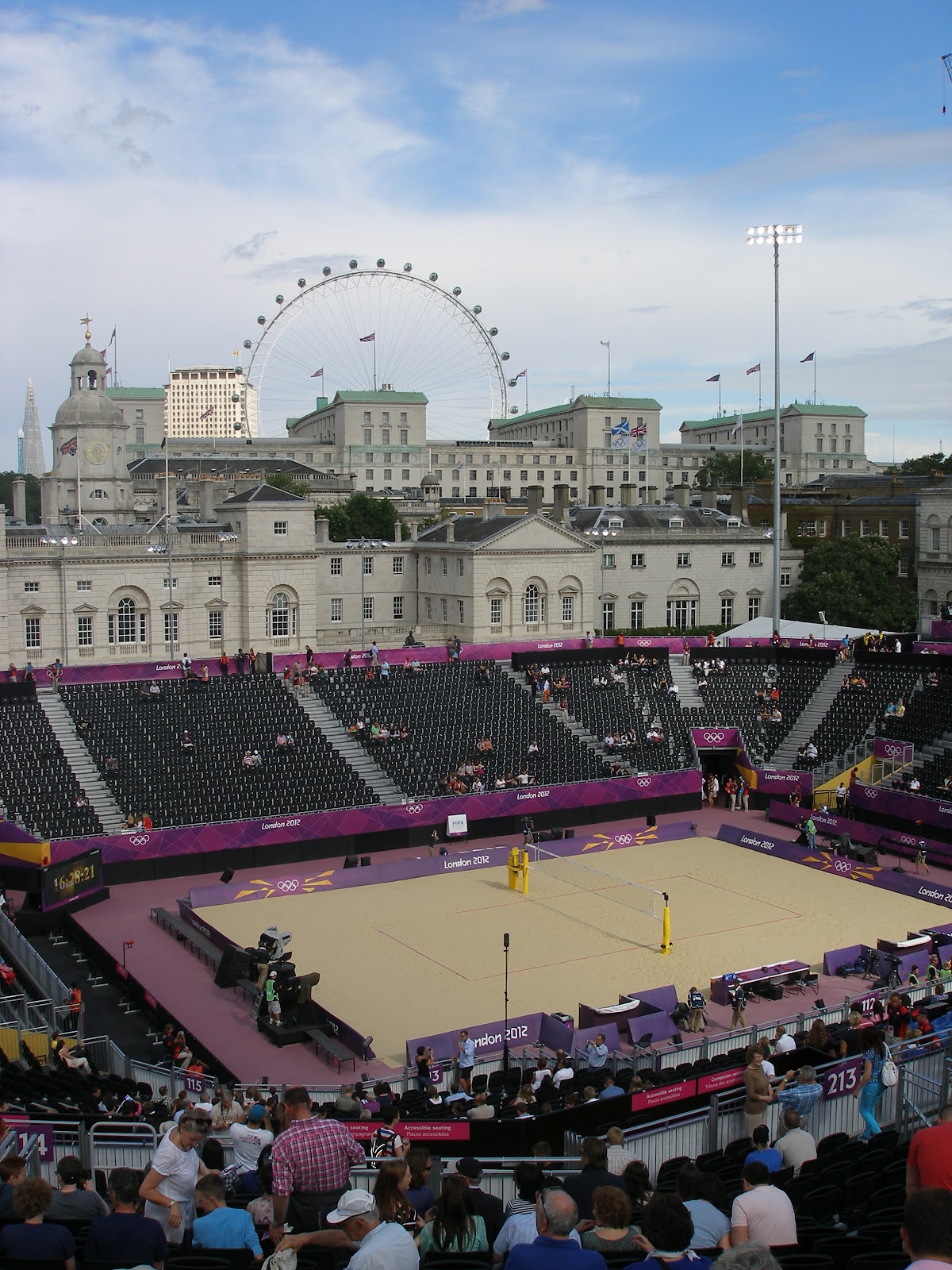
Beach volleyball is taking place in a temporary arena set on Horseguards Parade, a military parade grounds tucked between the neoclassical offices of Whitehall and and the green, urban lung of St. James' Park.  From our seats we got a breathtaking panorama of the London skyline.  There was Big Ben (for you pedants, that's officially the clock tower of the Palace of Westminster, as Ben is the bell itself) and the back windows of Downing Street.  There the London Eye, there the Shard, there a part of the facade of St. Paul's, and over our shoulder Lord Nelson on his column in Trafalgar Square, with a union jack on his hat and a gold Olympic torch for a cockade.

Yes, the Olympic Park is lovely, but for me one of the highlights of these games is seeing how the planners have worked the historic, magnificent fabric of our first city into the events.  Swimming in the Hyde Park Serpentine, cycling up Jane Austen's Box Hill and ending at Henry VIII's Hampton Court, archery at Lord's Cricket Grounds and the magnificent equestrian arena incorporated into the splendour of the Palace at Greenwich.  Nobody can doubt we're showing off the place to best advantage.

We're also running with a strange, uncharacteristic combination of German-like efficiency and American-style cheerfulness.  Even the most clueless couldn't get lost with the army of uniformed volunteers keeping things on track.  Paths from public transportation to the venues are clearly marked and cleared of traffic, security queues are efficient and move quickly, London transport has obviously laid on more trains.  We left the fencing at Excel centre as several other events let out.  Tens of thousands of people heading for the train at once.  I was expecting pandemonium.  Instead, volunteers were ready to organise orderly queues, which weren't really needed since the trains were coming one after the other.  Change at Canning Town ... train for Waterloo already there.  From leaving our seats to arriving at Waterloo:  20 minutes.  Nothing short of miraculous.  Across all this efficiency, place an overlay of carnival spirit.  Everyone's in a good mood.  The percentage of children in town has skyrocketed, but they all seem to be behaving.  Most people are draped in national flags or wearing goofy hats.  London's usual melange of languages is even more diverse.  The sun's even shining.
There's only one place I've ever been that feels like this, and most English will cringe when I say it.  It's Disneyworld on the Thames.

Of course, in theory, this is all about sport.  So what is going to an Olympic game actually like?  Radically different from any sporting match I've ever attended.

In the audience are a small percentage of people who are actually passionate about the sport.  But the majority aren't bothered; they just wanted the once-in-a-lifetime experience of being here.  Tickets need to be purchased long before you have any idea of who's playing.

Thus, the organisers put on a show that's as much about entertainment as sport.  For both sports, once we cleared security we were in a holding area with food, drink, shopping and activities.  At the volleyball, a sand sculptor dazzled.  At fencing, kids could suit up to have a go with the foils.  Beach volleyball features a swimwear-clad dance troupe and a throbbing '80s-heavy soundtrack for the breaks.  The stadium announcer doubles as cheerleader, starting Mexican waves, getting people on their feet for set points and generally whipping the crowd up to the frenzy this sport likes.  The fencing stage is white strips trimmed with coloured lights in an otherwise darkened arena.  Very Star Wars.  The pre-show entertainment here features a military band whose tunes include the soundtrack to Pirates of the Caribbean and a ballet troupe choreographed to Pulp's Common People.  Helpfully, the pre-show at both venues also included video on the basics of the game, and at fencing you could even buy an earpiece to listen to fight commentary.  Essential because, unlike beach volleyball, this sport demands silence during the action.


Get past all the flash, of course, and you're watching some amazing athletes.  Even if you're not an expert on the sport at hand, it's impossible not to admire the fitness and be amazed by the moves.  On the sand, we watched the American women defeat the Swiss to reach the semi finals.  In the next match, a scrappy Italian men's team kept us on the edge of our seats as they kept saving seemingly impossible shots to bring down the reigning gold medalists (also American).  Over at the Excel centre, the Americans took on the Russians for the bronze in the women's epee team finals, and won, followed by the Chinese versus the Koreans for gold.  (Gold to China.)  The grace, speed and menace of this sport makes it a spectator winner.  Though we enjoyed the volleyball, we thought the circus atmosphere ultimately detracted from the sport, while at fencing we were more able to focus on the skill on display.

Next Saturday:  sailing.  I can't wait.

Sunday, 29 July 2012

Slowly and steadily, Olympic magic blows the doubts away

Working for a major sponsor may not be the best way to get excited about the Olympics.

For the average British citizen, it's fun and games.  For us, it's been work.  A constant presence, an endless to do list, a cost, a stress point.  That's not helped by living in what's probably the world's most cynical city, where news stories are more likely to be negative than to get the populace pumped up.

My Olympic tedium started to shift about a fortnight ago.  There was no denying it.  As signs, facilities and lane closures started to go up in parts of town I traveled through (Waterloo, Horseguards, The Mall), I remembered that I was standing in what will, temporarily, be the centre of the world.

Then came the torch relay.  The organising committee has been clever.  The torch has zig-zagged across Britain in the run up to the games, with more than 8000 people doing a few hundred meters as official bearer.  Some have been famous, but most are average citizens who've contributed to their community.  And in that, they're not average at all.

My friend Sarah Crichton has been teaching disabled kids to swim for a decade.  Giving up her Saturdays, week after week.  Those precious Saturdays, so necessary for recharging batteries and getting the life admin done.  Most of us sleep in or get our groceries.  Sarah makes a difference.

Eight days before the games began, a group of friends drove to Kent to watch Sarah carry the torch into Canterbury.  It was an odd mix of village fete and national news.  Locals lined the streets, waving British flags and hoisting their children on their shoulders.  A pub on the route was making the most of the opportunity, serving drinks out front and using a sound system to give the neighbours updates on the torch approach.  Inside, TVs showed the local news' live coverage, talking about each bearer's merit as he or she took over.  Sponsors helped turn it into a parade, with branded buses pumping music, filled with logo clad youngsters tossing free stuff to the crowd.  Next, Olympic branded cars, then a bus carrying the other bearers, distinctively clad in white and gold, and then the phalanx of motorcycle police.  And then, Sarah.

It was truly magical, though over in a minute.  Fortunately, we had hours in the pub afterwards to relive the moment, examine the torch and celebrate our heroine.  All eyes were on her and her torch, and we felt special being with her.  That flame brought proper excitement to life.

A week later, I was in London.  One day to go, and the place was in carnival mode.  Familiar scenes like Horseguards and Lords had been transformed.  Crowds on the streets made it feel like everyone was on holiday.  Packs of fit young people in matching track suits were sightseeing, while to us, they were the sights.  It was a different city.

By Friday night, cynicism was giving way to anticipation.  And then the opening ceremony brought on the joy.

Film director Danny Boyle created a triumph, laced with self deprecating humour, music and contrast.  Instead of trying to better the spectacle of Beijing, he went in a totally different direction.  Small ... as these things go ... and quirky.  It managed to be very, very British, without wallowing in stereotype. We cantered through history, children's literature and music, reminding the world of all the brilliant things that come from Britain.  Famous faces turned up, and the Queen even chipped in by staring in a James Bond fantasy.  I did worry that the whole thing was TOO British.  We loved it, but wondered if much of the humour and many references would go right over the heads of viewers in other countries.


Even if it did misfire abroad, the ceremony worked a treat at home.  Everyone here ... including the cynics, the bored, and the skeptical ... seems to have been transformed.  The sun is shining.  Life is good.  And for the next little while, we're all going to enjoy being the centre of the universe.


Wednesday, 25 July 2012

When it comes to Italian, I'm questioning the Michelin factor

Italian and French regularly go head-to-head in world's best cuisine battles, but French wins the Michelin war by a mile.  While oft debated by reviewers, it doesn't surprise me.  Michelin-star cooking is generally a highly complex preparation of many ingredients, while the best traditional Italian dishes marry simple preparation to a few great components.

Still, the number of Italian-inspired Michelin stars is growing in London, and in the past month I've been to two.  Semplice, as its name suggests, celebrates that simpler style but still manages to turn out very special food, while Murano is the stage for famous chef Angela Hartnett to show off some Franco-Italian fusion.  But sandwiched between the two on the social calendar was Sunday lunch at Belgravia's Como Lario.  No stars, no famous chefs, no lofty reputation, but almost as good.  Which causes me to think that when it comes to Italian food, the only thing you're getting with that star is impressive presentation.  And a bigger price tag.

Murano was undoubtably the poshest of this trio, selected for a special lunch for my husband's birthday.    Italian is not his favourite, of course, but making reservations six weeks out was not enough time to get a table at the desired Le Gavroche.  We lingered at Angela's for almost three hours and were well taken care of; this is definitely a fine special event venue.  The room is small, elegant, but bright and cheerful.  The staff attentive, the wine list an excellent mix of French and Italian.  (It featured rare schioppetino by the glass, a major point in their favour before we'd tried a bite of food.)

I started with braised ox tail with hand-rolled tagliatelle and wild garlic, a very delicate version of a hearty, comfort food classic.  Piers' rabbit loin and belly with liver and kidney, Dijon creme fraiche and a croque monsieur with apple fennel relish was far closer to the usual Michelin complexity.  I went deeply traditional on the main as well, with sea bass on a fennel puree with baby artichokes and Scottish langoustine.  Classic combinations, beautifully done, but I've had similar at many other restaurants.  Again, Piers' choice was more innovative:  monkfish in a herbed crust, hand picked crab, avocado, asparagus and bitter orange.  His dish was the clear winner on that round, and the bottle of Greco di Tufo we had with it was a perfect accompaniment.

They showed fine customer care later when I was unable to decide on dessert.  I finally ordered one, but the waitress turned up with a combo plate of the two I had been debating between.  The dark chocolate mousse was delicious, but again very traditional, while the deconstructed carrot cake with yoghurt granite and caramelised walnuts was both tasty and more interesting.  Piers won again, with an apricot souffle with almond cream.  An excellent meal, and I knew I'd be paying a lot, but the final price tag had me kicking myself I hadn't planned far enough in advance to get that Le Gavroche spot.  It would have been about the same bill, and I suspect we'd have felt we got more value for money.  Angela's place was lovely, but there are others in the Michelin star firmament to which I'd return first.

Semplice, hidden on a curving lane just off Oxford Street in Mayfair, has a similar style, but the food's served in a darker, quieter atmosphere.  Murano's for being seen, Semplice for hiding away.  Murano has heavy French elements, Semplice is more resolutely Italian, more reminiscent of Locanda Locatelli. Unaffiliated with any famous chef, they're more reasonably priced, have some good lunch specials and offer a discount coupon if you to return in the next month.

My gnocchi of buffalo ricotta was a great example of how Italian food is "Michelinised".  The gnocchi had the same chewy density and richness you'd get in Nona's kitchen, but it had been rolled into tiny tubes and sliced so that each was the same size, then mixed with similarly-sized bits of asparagus, topped with the curling pink tails of Scottish langoustine.  My main of milk fed Piedmontese veal was exquisite, but here's what I mean about great ingredients making a dish.  In animal-obsessed Britain, it's impossible to find proper veal ... with white meat kept that way because the calves aren't allowed any exercise ... in shops.  One taste of the Italian-farmed animals illustrates a vast difference.  Meat this fine doesn't need much preparation. It came with a mix of diced zucchine, shitake mushrooms and Taggiasca olives on a sweet potato puree.  As with Murano, they let me mix and match the dessert menu, pairing a chocolate mousse that was more like a fudge cheesecake with a side of the pistachio ice cream that was designed to go with their rum baba.  Perhaps the best dish of the meal.

Unplanned and un-anticipated, Como Lario was almost as good as its starry competitors.  Squeezed between interior design shops on a street connecting Pimlico Road and Sloane Square, just a stone's throw from our church, it's a cozy, unfussy room that looks like it was last decorated in the late '80s.  In this neighbourhood, one of the richest in London, that indicates neither humility nor cheapness.  Probably, instead, a set of well-heeled old regulars who don't like change.  It's a traditional menu without innovative stretches or excessive attention to fussy presentation.  But the tastes are delightful.  Their tagliatelle with a wild boar ragu had the same pungent yet delicate balance as the oxtail at Murano, but served with a more traditional, wider pasta that I have to admit I liked more than Angela's thin, precision cut.  Attempting a bit of weight watcher balance, my main was a dish of simply grilled scallops on a rocket salad, healthy and delicious.  Piers gave his lamb, a more traditional Sunday lunch, equally good reviews.  We opted for glasses of vin santo with cantucci on the side to wrap up the meal.

Both Murano and Semplice are the essence of today's high end restaurant scene.  Gourmet interpretations of a traditional cuisine, innovative, exquisite, delicate.  A delight for both tongue and eye, in fashionable surroundings.  Very London.  At the less fussy, more traditional Como Lario, I felt that the streets of Florence or Siena might lie outside the door.  Murano is the place I'd save for the special occasion.  Semplice is an elegant, romantic retreat.  But Como Lario wins the value for money stakes hands down, and I suspect it's the place that will see a return visit soonest.

Monday, 23 July 2012

I'll never be a Wagnerian, but Longborough's Götterdämmerung was a fine afternoon. And evening.

There are opera fans, and then there's the Wagner tribe.

Maybe it's the fact that Wagner isn't easy. Complex music, intricate plots and great length take dedication from the viewer. Maybe it's the fact that he's not completely acceptable, having been tarred with the Hitler fan brush. And Wagner opera certainly makes no attempts to be populist, with productions that are inevitably modern, challenging, and sometimes just downright bizarre. Whatever it is, these Wagnerians are unique.

Despite all these elements ... or perhaps because of them ... they seem to have a passion about, and a dedication to, their man that I haven't encountered for anyone besides Shakespeare. As with fans of the Bard's plays, these Wagnerians will happily see the same operas over and over again. They know them intimately and take joy in watching, and dissecting, each new interpretation.

Our fellow guests at Windy Ridge fell into this category. We'd gone up for our second opera of the summer, Götterdämmerung. They were Longborough patrons (as opposed to our humble "friends" status) who were contributing generously to the funds needed to allow this small, countryside company to produce all four parts of The Ring, one of the most difficult endeavours in all opera. They'd seen these operas all over the world, including multiple times at the Bayreuth Festival. One couple planned their entire holiday schedule around Wagner, and at least once a year did the whole Ring Cycle somewhere. That's all four operas, staged in order, usually in a week. (Something Longborough plans to do next year.)

I couldn't do it. Having now seen three of the four, I can say they've all been much better than I expected. They are magnificent stories, set to great music. Longborough's Götterdämmerung was a fitting climax to the series, wringing your emotions as you watch the train wreck of Brünnhilde's heartbreak and Siegfried's destruction. There are some great moments here. The trio of Rhine maidens' interweaving their voices as they try to talk sense into Siegfried is gorgeous. Hagen is a magnificently nasty villain, and the half-siblings he dupes into precipitating the story's crisis evoke real pity. They're not bad people; just foolish ones turned into the fall guys for a disaster. Siegfried's funeral march has to be one of the most evocative and dramatic pieces in the operatic canon. And you could hardly get a more dramatic ending than Brünnhilde riding her magic horse into her fallen lover's funeral pyre.

Problem is, she doesn't. She just sings over the body in a ring of red light. Modern Wagner is, so our fellow guests told us, all about conceptual interpretations. There was no horse and no stage pyrotechnics. Rachel Nicholls voice was magnificent; combined with her acting, she showed me that Wagner could create heroines as compelling as Tosca.  But I wanted her performing in a setting worthy of her.  There are no dragons. The Rhine maidens may wear blue, but they're sure as hell not swimming in a river. This one wasn't too weird, but we still had the Gibichungs barefoot in business suits. I'm not looking for fat women with braids in breastplates and horned helmets, but I'd like a bit more tradition. The Wagnerians would be horrified at my words, but The Ring is basically a Tolkein-style tale set to music. I want a Peter Jackson production.


An unfair expectation of a bunch of excentrics who decided to put on Wagner in their barn, I admit. What Longborough managed with Götterdämmerung was critically acclaimed by the press, approved by the Wagnerians at the B&B and enjoyed by me. My big learning for future productions? Download a libretto with the original stage instructions and have it available on your iPhone, as I did. (Because from our seats in front, on the side, we couldn't see the surtitles. Which could have been a disaster.) The original painted a detailed picture of a land of myth and legend I could imagine in my head, even if it wasn't shown on stage.

Beyond the theatre, we had the best weather we've ever encountered at Longborough, with blue skies and sun showing off the green patchwork of the idyllic Cotswolds countryside to perfection. I went for the low-stress dining option and ordered a picnic through Longborough (provided by the Cotswold Food Store and Cafe). Excellent mix of traditional stuff like salads, quiche, Scotch eggs and cheese. Far more expensive than assembling it yourself, but very convenient.

Sunday, 8 July 2012

As Hampton Court shifts from flower to lifestyle show, garden ideas shrink as shopping grows

A browse back through the photos from past outings to the Hampton Court Flower Show tells the tale.  It's always been a shoppers paradise.  Every year, I go with my friends Philippa and Alex, and every year we wonder how the hell we're going to get home by the end of it.  (Pictured is Alex, wedged in the back of my convertible with a few of this season's prizes.)  And while plants have always been the backbone of our sprees, each year the other stuff seems to grow.

This year, a food and cooking pavilion in the middle of the grounds, where the Daily Mail-sponsored show gardens used to be, seemed to indicate a tipping of the balance towards a broader lifestyle show with gardening roots than the strictly horticultural outing of years past.  The arts and crafts tent seemed more crowded than ever and I'd guess more than half the vendors' booths were decorative geegaws, clothing, garden furniture or tools rather than plants.  There was even one stand hawking cars.  Granted, they were electric cars and the company was sponsoring a garden to play on the whole green agenda, but still...

Don't get me wrong.  I had a blast.  The food tent was a brilliant addition.   Themed around grow-your-own vegetables, it offered both plants and foodstuffs to take home, with a theatre to one side where chefs demonstrated recipes drawn from the garden's bounty.  I came home with a head of fresh giant garlic, almost impossible to find in grocery stores, and a subscription to Riverford Organics' weekly fruit and veg delivery.

But in this year where I went to Hampton Court with studious intent and a completely blank plan for the current mud patch that's soon to be my garden, actual gardening ideas were thin on the ground.  The only thing I actually photographed with a speculative eye was the bottle design feature in the Badger Beer garden.  Empty beer bottles, turned upside down, balanced on bamboo rods and massed together in undulating waves.  It would have sparkled nicely in the sun, had there been any, and we could whip that up in our own garden with empty wine bottles after just a few months.  (Or after the house warming party.)

There seemed to be fewer show gardens, and those were less memorable than in past years.  The modern, conceptual gardens bit seems to be getting bigger every year.  Dominated by plexiglass cubes, long tunnels and modern art installations, this bit always leaves me cold.  This year there was a large, unadorned square of concrete paving blocks.  Huh?  The only thing worth a lengthy pause here was one of those plexiglass cubes, filled with butterflies and their attracting plants.

Of the more traditional displays, a Hawaiian garden with tropical plants and a black tufa water feature entranced me, more for the memories it evoked of the islands than for practical planting ideas.  The urban gardens section was interesting, with glimpses of agrarian bliss through holes in grim, graffitied walls.  A tropical garden planted inside a building covered with artificial grass (sponsored by the grass maker, of course), viewable only through thin windows, was memorable if not beautiful.  Lots of pleasant things to look at, but my notebook remained closed in my handbag.  Across all the gardens, only a small one with a particularly good use of box hedging to divide a limited space into distinct garden rooms had me pausing thoughtfully.

That doesn't diminish the fun.  The main floral marquee was as magnificent as ever and, though I wasn't buying plants this year, it had my brain fizzing with plans for next.  The north facing exterior wall of the house, which I'm fairly sure will never be in direct sunlight, is crying out for a hosta garden.  I lingered over specialty suppliers' displays, appreciating the diversity of plants and wondering how many varieties I could get into a 9x3 bed.  And could I work in that little stream, as well?  I couldn't resist ALL the plants, however.  I am now the proud owner of a fig tree, something I've been fantasising about since I sat under the figs in my uncle's garden as a child and ate the warm, treacle-like fruit right off the branches.

The biggest flights of fantasy, however, came on two stands without plants.  First, magnificent bronze sculptures of trees, wired as fountains so that water flows from the top, dripping down leaves until it falls like tinkling rain into the pool below.  My imagination was designing a whole water garden around it.  And then there were the luxury chicken coups.  I adored the miniature gypsy caravan, but even in my fantastical early thoughts know there's not enough room for that.  However, it turns out that charming little fenced options can house four bantams happily.  And would fit easily behind the garage.  Fresh eggs and a nod to country living.  But could Datchet the bird-obsessed spaniel share a back garden with four hens?

I suspect our eggs will continue to come from the shop.