Showing posts with label English cathedrals. Show all posts

Tuesday, 22 June 2021

Westminster Abbey shows off the English talent for cultural mixology


The English have a magic at picking and mixing the best from other cultures and blending those elements into something so thoroughly their own that they forget the influences were even foreign to begin with. Dig deep enough into almost anything in this country, from culinary traditions to village names to family bloodlines, and you’re likely to find roots leading somewhere beyond this island.

My homeland of the United States, of course, is a nation of immigrants and imports. But hyphenated Americans hold onto their roots. (Witness American tourists in Ireland coming “home” 160 years after their ancestors couldn’t wait to shake the sod off their heels.) The English assimilate. Maybe not immediately, but slowly, steadily and permanently.

A brilliant case in point is the climax of any visit to Westminster Abbey: the Lady Chapel. This triumph of English Perpendicular Gothic is arguably the most beautiful single interior in the whole country. As a representative of the architectural style only King’s College Chapel at Cambridge can come close.

With its soaring windows, delicate tracery and ceilings like bunches of hanging lace, Perpendicular Gothic became so synonymous with the English that when the Victorians sought to kick out all of the foreign neo-classicism of the 18th century it was their go-to “local” style for the rebuild of the Houses of Parliament.

And yet…

If you look hard at Westminster Abbey’s exquisite culmination of Perpendicular Gothic you’ll see a Welsh-born king buried at its centre, who important Italian iron workers for his tomb, surrounded by a style originally created by the French, based on a pointed Arabic arch. (All, of course, glorifying a god born in the Eastern Mediterranean.) Yet, somehow, English gothic is distinctly English. There’s a playfulness and lightness to it that’s completely lacking in, for example, the royal tombs of Ferdinand and Isabella in Grenada that are from the exact same time period.

If you only linger over one thing in the vastness of Westminster Abbey, this magnificent room is it. In addition to the tomb of Henry VII and Elizabeth of York, founders of the Tudor dynasty, the side chapels are encrusted with additional royal and aristocratic tombs like barnacles on an old boat’s hull. But these are exquisite barnacles, bristling with spires, angels, faithful dogs, heraldic beasts and grieving relatives.

The chapel is also the formal centre of the heraldic order of the Knights of the Bath, with gorgeous mahogany choir stalls topped with helms and each members’ banner. Any lover of architecture and history could easily spend an hour just in this one small chapel.

But this is Westminster Abbey, national burial place of the great and the good, and the Lady Chapel is just a small fragment of what there is to see. Tombs are the thing, and a solid working knowledge of British history … or a good connection to Google … is hugely helpful. Beyond identifying the kings, signage is sketchy and the famous verger tours … where experts tell you who’s who … aren’t running because of social distancing. The most magnificent tombs don’t necessarily commemorate people whose fame has lasted, so you may end up playing detective. (Only bother laying out £5 on the audio tour if you are coming with absolutely no prior knowledge. It’s extremely basic.)

Medieval worthies lie beneath stone effigies of themselves in armour or their best court clothes, faithful hounds at their feet. Most of those have lost their original colour but William de Valence, a half-brother of Henry III, opted for bronze with enamel accents and still rests his head on a brightly coloured and patterned pillow.

Henry V is, sadly, on a perch too high to get close to, but the gothic chantry chapel forming a bridge above your head is spectacular.

The Tudors and Jacobeans loved colour, too. A riotous variety of their monuments show off not only the bodies they wanted remembered but exuberant architecture and decorative elements attesting to their wealth. But it’s the Georgians who really start getting extravagant, with sculpted scenes of the climactic moments in their life (a long-forgotten sea captain has a naval engagement in high waves so vivid it looks like the set for a play about to open) or extraordinary creatures either mourning or winging them to heaven. One of my favourites is the monument to General Wolfe, hero of the Battle of Quebec, whose tomb is guarded by two of the most emotionally stricken lions it’s possible to imagine.

Another favourite is David Garrick, superstar of the Georgian stage, who is shown full length and life-sized (at least it appears that way from the ground), throwing aside the theatre curtain to take his applause. Even the most self-obsessed “luvvie” wouldn’t have the confidence for such eternal self promotion these days.

The thing that was once the centrepiece of the whole church … the tomb and shrine of Saint Edward the Confessor … isn’t much to look at now and is in a raised area blocked off to visitors. That won’t matter to most because the tomb that now stands in his place in the veneration stakes is that of the unknown warrior, near the front door and near a memorial to Churchill. Framed with a perpetual border of poppies, the warrior’s is the only tomb in the Abbey nobody is allowed to walk on.

While the tombs could keep you busy for days, it is worth remembering that you’re in one of the great medieval cathedrals of Europe and paying some attention to the architecture. One of the most precious things in the building is something neither signage nor the audio tour give enough attention to: the magnificent Cosmati pavement.

The Cosmatis were a family of Roman craftsmen who reinvented the idea of mosaic for their own age. Rather than the tiny square tesserae the ancient Romans used to bring detailed illustrations to life on their floors, the Cosmatis went for a more abstract approach inspired by Islamic artists in North Africa, and used reclaimed bits of ancient Roman buildings for their materials. They were particularly famed for figuring out how to take thin discs off ancient columns, as if they were slicing a salami. You can see many of those big circles in the Westminster pavement.

Cosmati work is rarely found outside of the Italian world, went out of fashion by the high Middle Ages and the Westminster example is unique for having inscriptions set into the marble made of brass letters. It really is quite extraordinary to be able to see such a complete example, and another proof point of the English comfort with assimilating foreign styles.

The current, pandemic-driven low density of tourists gives visitors a chance to appreciate the stark beauty of the bones of the place. Look up from the tombs and notice the elegant simplicity of the black columns beneath the white vaults. I leave it to you to decide whether the exuberant Victorian choir screen and the towering organ enhance or take away from the scene. On the way out you’ll go through the old cloisters and the Chapter House, deft examples of English skill with an older, more French version of gothic than you see in the Lady Chapel.

A socially-distanced visit has its drawbacks. No guided tours is a problem in a place with so many layers of history. The chapels containing Elizabeth I and Mary I on one side and Mary, Queen of Scots on the other are closed because their tight spaces don’t allow enough room to keep people apart. And these are amongst the top 3 things you want to see here. The staircase up to the Queen’s Diamond Jubilee Galleries is also closed because of unenforceable social distancing, and was the one new thing in the Abbey I’d been wanting to see. The views are supposed to be fantastic and there’s a whole new design of the old museum to appreciate.

So as much as I loved the low-crowd visit, this is still a place I need to return once regulations loosen.

Friday, 14 August 2020

Religious sites tap into the ancient heart of England's North

The North of England feels older than the South.


It’s not, of course. Most of England can tell tales of the Stone Age, Romans, the Dark Ages or Roman Catholic glories. But the crowded, prosperous South has re-invented itself so many times ... and shifted so often to align with London trends ... that these ancient roots are harder to see. From Yorkshire on up, whether through lack of funds, a deeper appreciation of tradition or a pugnacious desire to go your own way, Northerners display a deeper, older history.

Roman Hadrian’s wall snakes through the countryside between Newcastle and Carlisle. Ruined abbeys and castles dot countryside and coast. The sinuous, writhing patterns of Anglo-Saxon, Celtic and Viking art are still prominent; Bamburgh Castle shows off a re-creation of the throne of the Northumbrian Kings. It's a thing of alien beauty closer to the Vikings or Tolkien than anything you’d immediately identify as “English”. 

The most obvious place to see this difference is in the Northeast’s great cathedrals, where muscular Romanesque architecture, Celtic patterns and local saints held out longer and harder against outside trends, whether they were pushing up from London or Rome.

Durham Cathedral is the greatest example, and without doubt the grandest Romanesque building still standing in England. The enormous, muscular, patterned columns in its nave (above) and low, round arches on its lower levels speak to a distant, misty past more suited to King Arthur than Tudors or Georgians. The banner of the sainted King Oswald that hangs in the chapel where his head is interred looks more like the Norse god Odin than a traditional Catholic icon, complete with spooky ravens.

When I first saw this cathedral more than 30 years ago, I found it dark, mysterious and impossibly ancient. Since then, they’ve illuminated the upper stories of the building’s interiors to show off the architectural details. That has transformed the nave and called attention to the later gothic additions. It helps you appreciate more of the building, though it is a lot less atmospheric. I’ve also travelled Europe a lot more in those intervening years, so realise that though this Romanesque style is relatively unique to England, when compared to Italian churches it has a familiar feel.

Thus something different inspired me on this second, more mature visit. The virtuoso chapel of nine altars is a high Gothic addition that practically bolts a separate church onto the rear of the original, starting a level below and soaring above the back of the choir of the main church. The chapel of Oswald and the more famous Saint Cuthbert jut out into it, almost seeming to float in the massive, light-filled space. Though its pointed windows, tracery and vaulting have familiar parallels in the South, I’ve never seen a juxtaposition quite like this and the nine altars are dedicated to Northern saints, many of whom, like Oswald, aren’t recognised by the Roman church. So even in its grand, newer parts, Durham retains a mysterious sense of the other. 


Ripon Cathedral is even more ancient than Durham, the current building’s foundations dating from the late 600s. Ancient Romanesque architecture features here, as well, and the original crypt is supposed to be magnificent, but it was still closed for pandemic safety due to its small, cramped proportions. This cathedral is most famous for its early gothic facade, comprised almost entirely of lancet windows and judged one of the best church exteriors in England by the architectural critic Nikolaus Pevsner. I’d recommend heading straight for the choir, however, where Ripon has managed to preserve one of the best collections of late medieval wood carving in the country, despite suffering the usual damage from reformers and civil wars through the years. 

Carved during the time of Henry VII, the monks’ places were crowned by graceful, pinnacle-studded canopies. The ends of rows are marked by fanciful finials, one a monkey said to poke fun at a pompous church official, another a magnificent elephant with 11 apostles in a castle on its back while Judas is being strangled in its trunk.

The most precious carvings are hidden below, where ledges called misericords jut from the bottom of monks’ upturned benches to help them stand for long hours. Because of their little-seen nature, carvers were allowed to stretch their creativity on misericords, which often feature scenes of everyday life, jokes, or wild imaginings from myth and legend. One here features a rabbit and mouse being chased down a hole by a griffin, and is said to have inspired a young Lewis Carroll ... whose father was a clergyman here ... to later create the fantastic inhabitants of Wonderland.


Ripon is full of similar touches of quirky individuality. Jutting from the organ above the west side of the choir is a wooden hand, which the music director could use to direct singers even though he had to face away from them to play the organ. I’ve never seen another, and the guide insisted it’s unique in the country. 

There’s a wonky arch where the architect got his measurements wrong. The Medieval stonecutters fixed it by inserting three bridging columns, then capped each with a laughing head to make fun of the mistake. A more poignant form of individuality stands above the high altar, where a Christ carved at the end of WWI is clean shaven, fresh-faced and short-haired, honouring the men who died in the trenches.

At the moment, Ripon’s greatest glory is its newest. A modern art installation called “On a wing and a prayer” invites worshippers to write prayers related to the current health crisis, and thanks for critical workers,  on pieces of paper to be folded into bird shapes. Those have then been strung above the nave, a growing flock of white doves of peace hovering between us and heaven. It’s beautiful and tremendously moving.

Even if you stay away from the active cathedrals, religion looms large in the Northeast. Ruins of communities shut down in Henry VIII’s dissolution of the monasteries are strewn across the landscape. Many, like Byland, are just a few picturesque walls left standing in remote villages, deep down country lanes and accessible to any who want to stop.

Others are major tourist attractions, most famously Fountains Abbey. Not far from Ripon and Harrogate, what was a massive Cistercian foundation is now a monumental set of ruins set in emerald lawns at the bottom of a deep, wooded valley beside an idyllic river. In summer, it is a place of spectacular peace and beauty, though it must have been hard going in the winter. Especially for monks who were only allowed a brief stint in the warming house after hard labour outdoors. Otherwise, that marvellous but cold stone architecture must have made hard going.

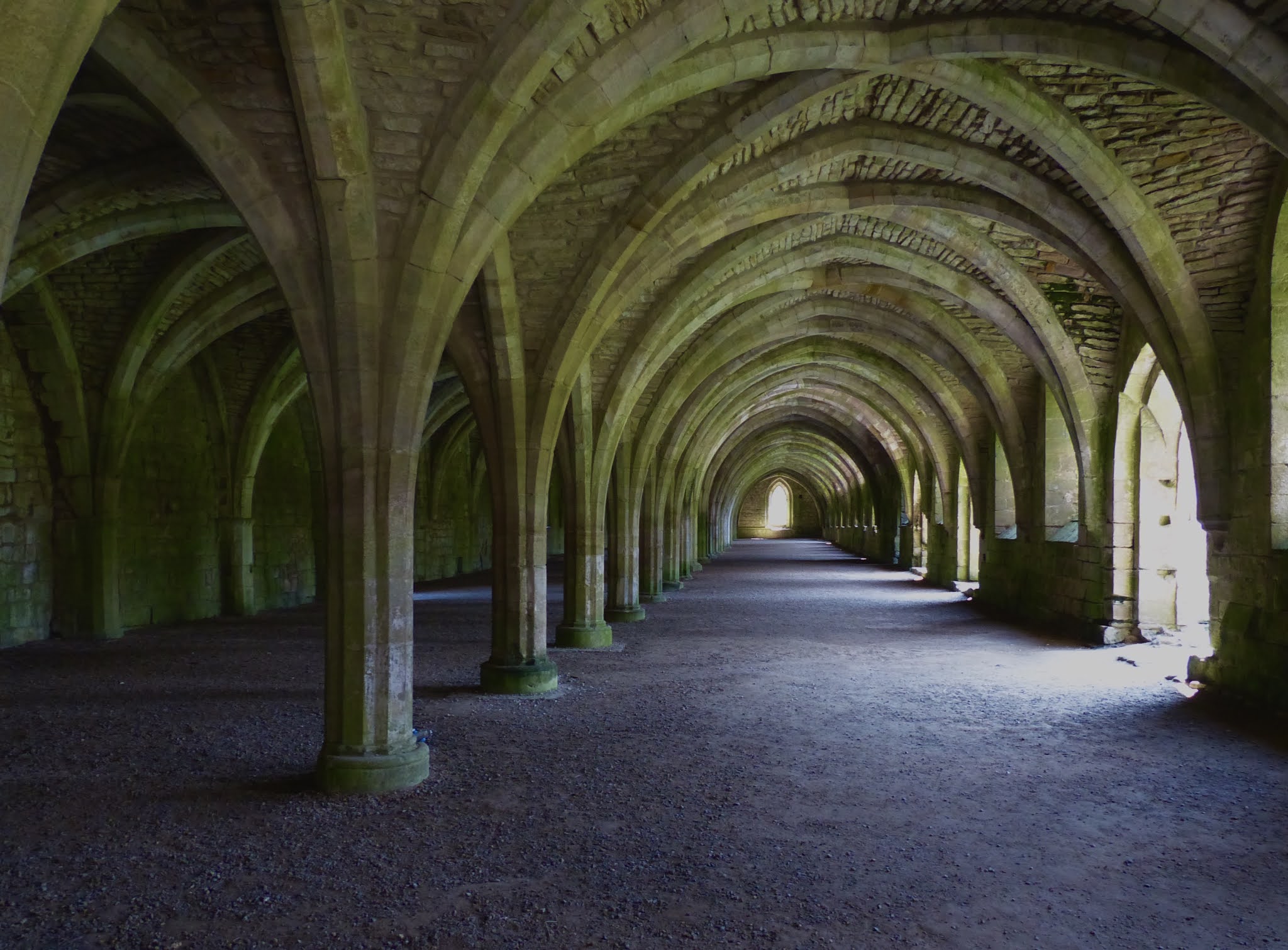
Today you can appreciate not just the substantial ruins of the Abbey church but enough of the outbuildings to give you a proper sense of the sprawling complexes the monks built to create a self-sufficient community. One of the most complete structures at Fountains is the enormous, vaulted cellars, which are beautiful in their own right and tell a story about just how rich these establishments became. (And why they attracted the government’s greedy eye.) 

In the 18th century, a local aristocrat made Fountains’ ruins the focal point of some exceptional water gardens. Visitors can explore those as well as the Abbey, wondering for miles along geometric pools of water, classical follies and woodland paths designed to open up at just the right point to offer artistically arranged views. This vast, outdoor area is perfect for sightseeing in the time of COVID-19, but even here numbers were limited and advance booking required. Most notable was the lack of diversity in accents. The families walking the paths or spread out on the lawns with picnics were overwhelmingly local. There were no bus tours, no large groups, and one assumes the handful of foreign accents I overheard were ... like mine ... current British residents who were born elsewhere. This lack of jostling, aggressive sightseers was one of the great joys of this holiday. And also made for some spectacular, people-free photos.

Though most of the Northern religious sites are either ruins or more tourist attraction than working religious space, we dropped by one notable difference. Ampleforth Abbey and College is one of the best-respected Catholic schools in England, and of particular interest to me as it is the “mother house” of the Saint Louis Priority, at which my mother taught and which my school considered our “brother” institution when we needed a co-educational experience. (Most notably, dates for school dances.)

English Benedictines maintained their traditions in exile for almost 300 years, returning to Yorkshire in 1802 to establish this beachhead for the renewed tradition. The majestic complex of buildings climbing a hill, with stretches of uninterrupted countryside as far as the eye can see, gives the visitor an idea of what the ruined abbeys might have been like had they survived. 

Under normal circumstances, Ampleforth is bustling with more than 600 students, plus teachers and the monks in the Benedictine community. There’s a visitor centre, access to the Abbey Church, a cafe and a shop selling the cider, apple brandy, beer and honey made by the monks. Sadly, this was all closed due to the pandemic, so we had a little wander around the exteriors, struck up a conversation with a septuagenarian monk who’d been there since he was a lad at school and let him show us around his garden. 

He, like so much of this part of the country, seemed imbued with something older and more mystic than life in the South. The profound sense of beauty and calm I found in the North’s religious sites would follow me throughout our trip.

Monday, 21 March 2016

10 reasons Winchester Cathedral outshines its rivals

Thanks to an impressive spire, a famous Constable painting, a copy of the Magna Carta and convenient positioning near Stonehenge, tourists flock to Salisbury Cathedral. The same can't be said for its near neighbour Winchester, which lies 25 miles east. (And is also the cathedral town for my part of the world). It's a real shame, as Winchester Cathedral is one of the great treasures of England in art, architecture, famous associations and great stories. Yet I know many locals who've never set foot inside the place, much less foreign tourists.

Like most of the great English cathedrals, you'll find stunning gothic architecture, an impressive choir, fascinating monuments and enthusiastic tour guides happy to show it all to you. (I've done the tour three times now with different guides, and I learn new things from each of them.) Here are 10 things that make Winchester Cathedral unique. Reasons why you, whether local or tourist, should invest the  time and money (£7.50, less for concessions) to take a proper wander around this treasure house.

Jane Austen
Cross the border into North Hampshire and the signs proudly tell you you're entering Jane Austen country. The great author lies buried inside the cathedral, an exceptional honour at the time even if she was already a well-known author. It's thought that family members with church connections pulled strings to get her here, and to place a prominent grave stone in the north aisle. Ironically, it makes no mention of her literary contributions. The glowing description of a genteel lady could apply to any of her characters, but gives no credit to their creator. A large and lavish brass plaque on the wall nearby, installed by her Victorian-era fans, addresses the oversight. You'll often see flowers here left by today's followers. There's a small exhibit here, too, that explains her connection to this part of the county.

William Walker
Like many Christian churches, Winchester took over what had been a pagan sacred space. Fine idea on the PR front, but a poor choice for construction when the sacred ground is a spring in a marsh. You can see the results best at the very back of the building, where parts of the floor undulate like the damp meadow that would have originally been here. At the turn of the 20th century, the foundations were so compromised that large sections of the cathedral were at risk. Enter William Walker, who spent six years in a primitive diving suit, working under water, in the dark, to haul bags of cement under the building to underpin the foundations. You owe your ability to visit this place to him; give thanks at his small but poignant memorial.

The crypt
Walker might have firmed up the foundations, but the sacred spring is still there and the cathedral crypt floods regularly. Modern custodians have made a feature of this. When it's covered in water (which is usually, in the winter and spring) you can stand at the gate and peer into the quiet, dignified Romanesque space where a single figure by modern sculptor Anthony Gormley is contemplating water held in his hands. It's ghostly, solemn and magnificent. When it's dry down here, there's other modern sculpture to check out. It works well against the ancient, austere backdrop.

The font
The cathedral's baptismal font is a rare survival from the 11th century. According to their web site, only 10 others of this time period exist in the whole country, and this is probably the best. In comparison with the typical gothic style of most cathedrals, the Romanesque carving here seems otherworldly and brutal. It conjures pictures of invading Vikings or Middle Earth. It's also very beautiful, its highly-polished black marble showing the story of St. Nicholas giving bags of gold to three sisters to keep them from descending to prostitution. Look at the round-arched building in the background to get a glimpse of what the cathedral probably looked like when the font was first installed.

Pre-Raphaelite stained glass
Equally rare is pre-Raphaelite stained glass. You know this artistic style, even if you don't think you do. Late Victorian beauties with pouty lips and billowing hair, generally in historical settings. Lush patterns of flora and fauna. Knights in shining armour. As the industrial age approached, William Morris and his set created a decorative style that denied modernity. Love it or hate it, it's still all around England, from the high culture of museums to the common mugs in kitchen cabinets. But I've never seen it in windows. Which is a shame, because the lush, fairy-tale quality suits them well. And is far more memorable than the usual heavy-handed Victorian re-creations of medieval originals. Go to the Epiphany Chapel to see these four windows by Edward Burne-Jones. They're bible stories, but they look more like scenes lifted from an Arthurian romance.

Chantry chapels
Most of the great cathedrals have these ornate churches-within-churches, but I think Winchester's are
some of the best and ... thanks to careful restoration ... in the best shape. Sometimes built between columns, sometimes free-standing, these towering enclosures are masterpieces of gothic architecture and stone carving. The tomb of the person who commissioned the chapel is usually in the middle; he bought this space and endowed the monks to say mass here daily to speed his soul to heaven. William of Wykeham's has been recently restored: the exterior stone glows golden, inside an astonishingly lifelike statue contemplates an exquisite blue and white gothic vault. Behind the main altar, there's the delicious irony of Cardinal Henry Beaufort ... you're not likely to forget his rank, since he managed the tricky task of lying down for eternity without taking off his wide-brimmed cardinal's hat ... entombed within sight of the monument to the woman he condemned to death. We know her as Joan of Arc. Around the corner, modern craftsmen showed off their skill by re-creating the statues on Bishop Fox's chapel so perfectly you'd never know they weren't the Tudor originals. Look out for St. George. His face is that of a local boy who died in World War I, making this a touching double memorial.

Burial place of kings
Winchester was the capital of Anglo-Saxon England, and most of the kings of that era are buried here. For years, their bones lay in ornate mortuary boxes perched atop the choir. They've currently been removed to the Lady Chapel, which is closed off and has been turned into a laboratory for DNA testing. There's not much to see now. But the results of the scientific work will undoubtedly make a great story, and the re-internment will be something to see.

The Winchester Bible
The largest surviving English bible of the 12th century, Winchester's version is so big that each cow vellum page required the skin of an entire animal. You can probably see better medieval illuminations in museums, but there's something special about getting up close to one in the setting for which it was created. The book is on display in its own pavilion in the north transept, and there are rarely many people here. So you can put your nose to the glass and really study the beautiful calligraphy and the lush illustrations, with vivid colours gained from precious materials like ground lapis lazuli and gold leaf. Only one spread is available for display at any one time, but they turn the pages occasionally to reward repeat visitors.

Pay once, get in all year
Save your ticket and your £7.50 investment allows you to explore for another 12 months. Taking the free tours as often as you wish, or simply popping in to look at one thing more closely.

Winchester itself
The town was just named the best place to live in Britain (story here), something that will come as no surprise as you walk around. It's a stately, dignified market town with plenty of views that haven't changed much since Jane Austen was here. There are other tourist sights (most notably the great hall of the old castle, the Westgate of the old city walls and a working water mill) and good shopping that includes a decent number of independent boutiques. It's become a bit of a foodie haven, with a collection of good restaurants and a sprawling farmer's market on the second and final Sunday of every month.