Showing posts with label Germany. Show all posts

Sunday, 4 May 2025

Adventures in lesser-known Germany: holiday stars are Dresden, Leipzig, Saxon country

Regular readers know the Bencard travel rule: milestone birthdays mean that the celebrant has total control of the year’s holiday schedule. Last year I drove our Italy-heavy itinerary. This year, my slightly younger husband turned us back to Germany. 

On his last milestone birthday he brought us to Bavaria to follow his family’s historical trail, focusing on the Renaissance and Reformation. This trip, we went further back in time, and further east. We based ourselves in Saxony and spent much of our time chasing the stories of the 10th and 11th centuries, particularly the lives of Ottonian rulers a remarkable man named Wiprecht von Groitzsch. A coming story will explain why.

Classical concerts and opera featured heavily, too, in this heartland of great composers. We mixed charming, atmospheric AirB&B’s with visits to 25Hours destination hotels. We gorged on white asparagus, the famous “spargel” over which the Germans obsess just coming into season. Between historic pilgrimages, musical indulgences, and sybaritic self-care, we stitched together a rich, resonant two-week journey. 

Thanks to extended holiday weekends at the start and finish of the break we travelled over 17 days, stopping at five places:
  • 2 nights in Aachen (Mercure, city centre) 
  • 6 nights in Dresden (“Weinblick” AirB&B, in the grounds of Schloss Albrechtsberg) 
  • 4 nights in Berlin (25Hours Hotel Bikini Berlin) 
  • 3 nights in Leipzig (“Palace by the Zoo” AirB&B in a grand 19th-century apartment on the edge of the historic centre) 
  • 2 nights in Cologne (25Hours Hotel The Circle) 
We drove the entire route, crossing the Channel via Le Shuttle. This the raised eyebrows of many, but when we crunched the numbers it came out cheaper than flying and hiring a car. And it broadened our itinerary: the Cologne and Aachen stops wouldn’t have happened had we flown. Of course, we didn’t really need a car in city centres, but it was essential for wandering in the Saxon countryside.

Dresden: The Expected Star
As a fan of the German Baroque I had high expectations. Dresden is world-famous for the reconstruction of its 18th century town centre, flattened in World War II. It is one of the world’s greatest examples of heritage restoration. But I didn’t realise how rich the offerings would be beyond architecture. The city’s museums are stuffed with dazzling treasures and its opera house is gorgeous. 

The 19th century treated Dresden even better than the 18th, seeing whole neighbourhoods of gracious apartment blocks and mini-mansions pop up for the wealthy bourgeoise. Factories were disguised as fantasies from the Arabian nights and opulent shops were kitted out to serve the rich. Pfund’s dairy, entirely covered in Villeroy and Boch tiles, is the German equivalent of Harrod’s Food Halls or the tiled cafe at the Victoria and Albert museum. 

Dresden is the best place I’ve seen in Germany to get a picture of the rich, gracious, sophisticated world destroyed by the stupidity of 20th century wars. What’s been restored helps you imagine it, while what’s still derelict, missing or has been replaced with modern architecture reminds you of the pain just below the surface.

The super-rich of the 19th century built castles on the top of the bluffs looking over the river Elbe towards town, culminating in the ridiculously cute suburb of Loschwitz. Day trippers coming here could take a funicular up to a glamorous viewpoint to drink and dine.  A few schlosses down the ridge towards town was our Albrechtsberg, where we were lucky enough to be staying on the estate.. Once home to Prince Albert of Prussia and his morganatic wife Rosalie, who moved here to escape disapproval of their relationship, the estate still exudes faded grandeur and is a popular walking spot for locals. Our accommodation was in a large farmhouse amongst the estate’s side buildings. We had two bedrooms, a generous sitting room, a kitchen and a garden terrace with views through the trees to the Elbe. It was splendidly isolated, so on most days we adopted a rhythm of big lunches out and light suppers in. 
Our Dresden days included:
  • Easter services in the historic Frauenkirche
  • A hop-on-hop-off bus tour 
  • A lavish afternoon in the Residenz palace museum 
  • Tosca at the Semperoper 
  • A leisurely wander through the military history museum
  • Day trips to castles tied to Wiprecht and to Meissen 
  • Several historic restaurants
Even with six nights, Dresden is the place I felt I needed more time. It’s certainly where I’d return first. There’s more to explore in the city’s museums and architecture, river cruises to be taken, and an entire wine region to be explored. In hindsight, we could have done Leipzig as a day trip and used this as the base for most of our holiday.

Berlin: Modern Power and Dark History
From Dresden, we drove north to Berlin, abandoning the car in the hotel car park for three days. Our base was the 25Hours Hotel Bikini Berlin. We loved our stay at this chain’s offerings in Copenhagen and Paris, and wanted to try more. I love their quirky design … usually re-purposing old commercial buildings … their ethos that works to deliver a boutique experience at large scale and the fact that no two are ever the same. This one has a jungle theme, tied to its location overlooking the Berlin Zoo. The rooftop houses the Monkey Bar and Neni, an Eastern-Mediterranean restaurant present in all of their hotels. 

The highlight of Berlin for me was our hotel room; we got an upgrade due to Piers’ frequent stayer status at Accor hotels, with which this chain is associated. The room had a freestanding bath and a cosy, round, upholstered reading pit perfect for a picnic dinner. 

The city itself has changed dramatically since my last visits in the early 20th century. What seemed then to be one big construction site has settled down. The new buildings are starting to age into place, there are fewer reminders of the GDR years and the old East German side of town has become super trendy, with most of the hottest bars and clubs here and old communist apartment blocks rehabbed as luxury condos.  

If Dresden is a dowager lady in cashmere in pearls heading off to the opera, Berlin is an affluent, 30-something professional who works hard and plays hard, the latter possibly in fetish gear. The locals enjoy their reputation for a bit of avant garde.

Our Berlin itinerary included:
  • A hop-on-hop-off bus tour (a useful intro but frustrating in the amount of time spent sitting in traffic and the sparse commentary)
  • A morning in the Neues Museum (Ironically, called “new” but home of ancient civilisations)
  • A sobering guided tour of Sachsenhausen Concentration Camp 
  • The GDR Museum
  • A stroll around Unter den Linden, the Reichstag and the Memorial to the Murdered Jews of Europe memorial 
  • Two classical music evenings 
  • A final flourish at Sanssouci, Frederick the Great’s Rococo masterpiece 
Leipzig: The other face of Saxony
Imagining Saxony’s second city as a character, I see a rebellious university student facing off to that Dresden grand dame across the fertile hills and valleys. He or she is likely to grow up to be a prosperous merchant driving hard deals, but university days bring a bit of rebellion and a taste for the new. This impression is doubtless shaped by the fact that we got caught up in a noisy but good-natured May Day march (Power to the People! Marx was Right! Anarchy!), but Leipzig immediately feels different from Dresden. Younger. Louder. More Diverse. A bit grubbier.
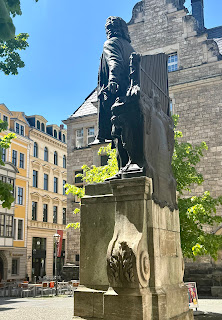
We stayed in a gracious 19th-century flat a short walk from the historic centre. Fittingly, given our Longborough Opera track record, we were just a block from Richard Wagner Platz. It had charm—lofty ceilings and abundant light—and was ideally located for exploring on foot. I wish we would have discovered Wagner’s restaurant and wine bar, just of the Platz, on our first night rather than our last. We would have been there more. The nearby zoo looked impressive, though it didn’t make our itinerary.

We really only had two sightseeing days here. The first was another day following Wiprecht’s trail and the second focused on Leipzig’s formidable musical heritage.

Cologne: Tomorrowland with Mezze 
We broke our return journey with a final two nights in Cologne, again at a 25Hours Hotel. This one occupies a circular mid-century modern office block, reimagined in a style that splits the difference between Disney’s Tomorrowland and an ‘80s arcade game. It was tremendous fun, and we appreciated the free parking.

To be honest, after two solid weeks of sightseeing our day exploring Cologne was a bit of a bust. We were too tired, too jaded, and had spectacularly bad luck. We walked half an hour to the edge of town to see the tomb of one of Piers’ many times great grandmothers, to find the church entirely closed for renovation. (Not something that came up on internet searches.) I returned to the main cathedral to see the bits that had been closed off on my earlier visit … at exactly the time they were closing it off again for confessions. We encountered the biggest crowds of the whole trip here and it made us grumpy. This is probably thanks to the combination of the booming river cruise industry and Cologne’s appeal to stag and hen weekends. The hotel’s Neni branch is so popular with locals we couldn’t get a reservation either night, and were too tired to go out in search of a traditional restaurant.  

So both the penultimate and final night of our holiday found us having some early cocktails in the rooftop Monkey Bar before ordering Neni mezze and picnicking on our bed while streaming the new Andor series. Given the hotel’s design, it was a perfect match.

What Comes Next
In the weeks ahead, I’ll share deeper dives into the themes that cut across this trip:
  • How following in the footsteps of medieval ancestors like Wiprecht von Groitzsch took us down some non-traditional paths well off the beaten track
  • An impressive range of classical music experiences that pushed the envelope, despite the historic composers
  • Exploring difficult stories from Germany in the 20th century: hard, but important
  • Food: the search for differentiation in the land of Schnitzel
For now, consider this your prologue. We went east in search of old stories. We found history, music, architectural splendour—and a few surprises that left me wanting more. Most of all, we found that Saxony deserves a spot on every serious traveller’s list.

Wednesday, 23 April 2025

Aachen: Breaking for Charlemagne and Bustling History

We could have driven to Dresden in a single day. A champion road tripper in a hurry would have. But twelve hours in a car isn’t our style. We needed to break the journey. And if you’re going to pause, why not make it meaningful?

Two nights. One full day to stretch our legs and explore somewhere new. Aachen became the first stop on our big German road trip.

More than a convenient layover, Aachen has been hovering on my must-see list since my AP Art History days. Despite the lure of its Charlemagne legacy, however, it’s never really made a splash on the modern tourism circuit. Which is precisely what made it appealing.

It also fit beautifully with our trip’s broader theme. Much of our itinerary was inspired by Piers’ ancestral research, which traced one family branch deep into medieval Saxony—and before that to Charlemagne himself. (Of course, statistically, anyone of European descent is likely descended from the great king. That’s just how exponential growth works.) Still, it’s thrilling when the tangled lines of genealogy align so neatly with your travel plans.

Step into Charlemagne’s cathedral in Aachen and the idea of a culturally stunted Europe cowering in the Dark Ages crumbles immediately. Built around 800 AD, this octagonal jewel box radiates opulence and ambition. Mosaic ceilings glitter with gold and blue ground from Afghan lapis lazuli, alabaster lamps glow softly, and Roman marble paves the floor.

If you’ve been to Ravenna, this will feel familiar. The church takes heavy inspiration from San Vitale, with its central dome and Byzantine elegance, and the blue starry ceilings of the side halls echo Galla Placidia’s mausoleum. From the centre of the cathedral, a massive brass chandelier dominates the space, while a second-story gallery—accessible only by guided tour—holds Charlemagne’s throne and the spot where centuries of Holy Roman Emperors were crowned. Sadly, tours weren’t running on Good Friday, but even from ground level, the mosaics and sense of grandeur astound.
In the 14th century, the Holy Roman Emperors added a gothic nave to their coronation church. It’s a glittering glass box reminiscent of Sainte-Chapelle in Paris. It houses Charlemagne’s golden sarcophagus, though access was limited during our visit. Still, the experience from the original octagon alone was so rich, I didn’t feel shortchanged.

The cathedral alone makes Aachen a worthwhile stop. But the town holds more delights. While much of its outer ring is post WW2 and there’s some brutal modernism even in the town centre, the town has done a good job keeping its core appealing.

The cathedral’s Treasury Museum is just a few steps away in some old cloisters, and ranks among the best of its kind. The modern presentation makes its medieval treasures shine. Of course there’s gold and gems galore, but the relics of Charlemagne steal the show. A jewel-encrusted bust contains part of his skull; a gilded arm reliquary holds a bone from his arm. The Cross of Lothair, set with an eclectic jumble of Roman cameos, is more ostentatious than beautiful—but its plain reverse, etched with a simple Christ figure, is quietly powerful.

My favourite object, however, was the crown of Margaret of York—sister to English Kings Edward IV and Richard III. It’s a typical high medieval circlet, all enamel, gold, and trefoils. But unique because, since Cromwell melted down all the Crown Jewels left in the UK, this is the only English-made medieval crown still in existence.
The town hall, just up the hill on a square surrounded by fine buildings, is a fantasy of medieval architecture, spiked with statues and twinkling with leaded glass. A neighbouring Renaissance gallery with twisted wooden columns now houses a tempting restaurant—though we opted for a lazier dinner closer to the hotel.

The Couven Museum, in a well-preserved bourgeois townhouse, offers a more relatable view of history. It’s filled with the trappings of an 18th- and 19th-century merchant family: tiled summer rooms, a complete pharmacy, and elegant Biedermeier salons. A quirky collection of miniature perfume bottles adds charm.

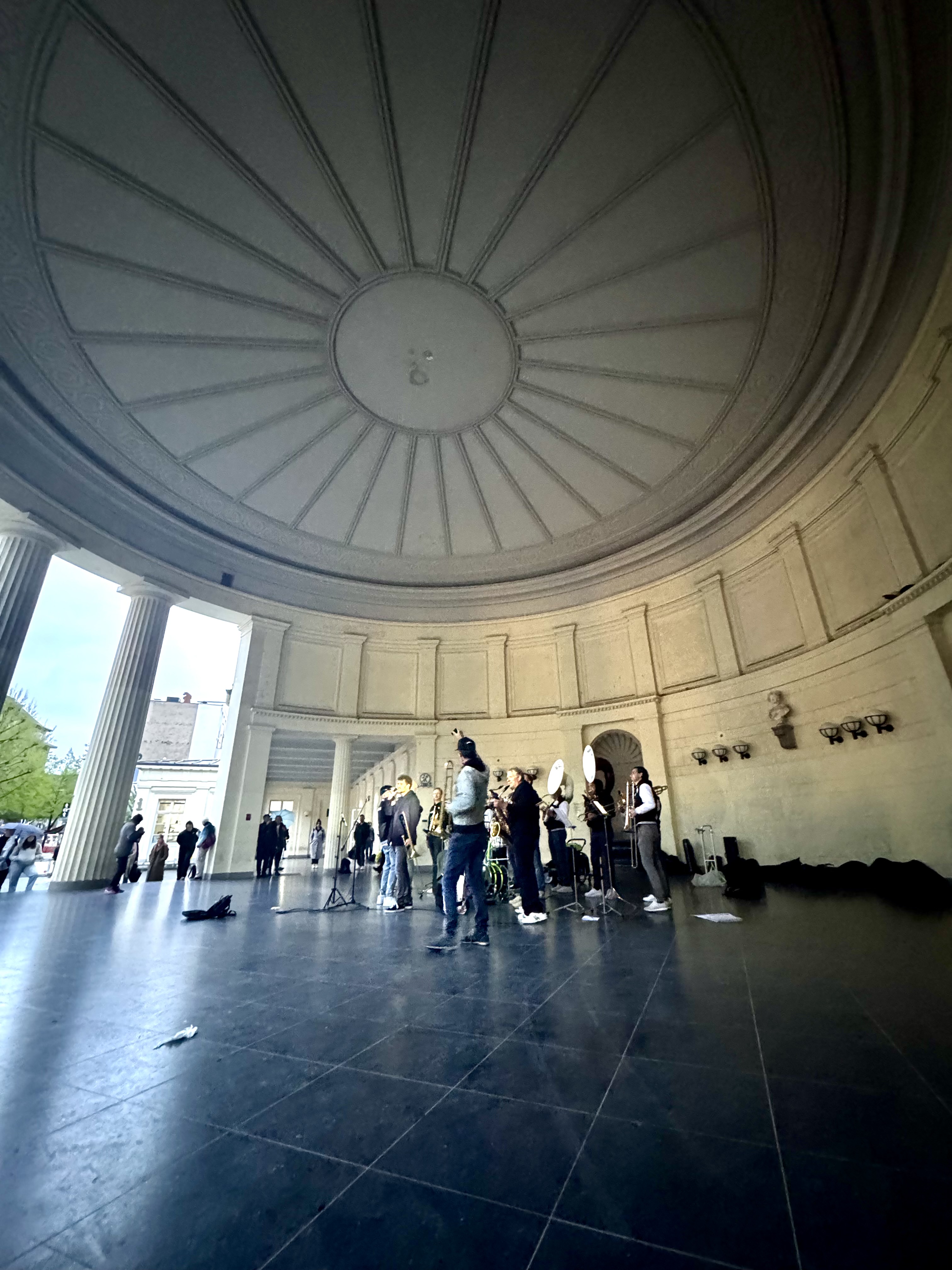
A neoclassical pavilion (which we'd call Regency in England, Biedermeier here) nods to Aachen’s 19th-century reinvention as a fashionable spa town—with, amusingly, a reputation for upscale prostitution. Sacred and profane, side by side.

We stayed at the Mercure Aachen, right in the heart of town, leaving our car in the nearby convention centre garage (€24 for the full visit). One day of sightseeing was plenty. Aachen was a sensible, fascinating, and satisfying pause on our route east. A kingly stopover—fitting, for a road trip inspired by family trees and imperial ghosts.

Tuesday, 19 November 2024

Picturesque but a bit boring, my German family's home region is surprisingly pleasant

After two highly indulgent trips to Italy, taken practically back-to-back, my wisest strategy would have been some quiet time at home, avoiding carbohydrates, alcohol and discretionary spending. But life doesn’t always support prudent decisions. Four days after my return from Sicily I was back at Heathrow. This time, however, I was heading to Germany.

For years, my father and I have been talking about going to the village from which our ancestor left for America in the mid-1800s. We’d visited the origin point of the Swiss side, the Wallemanns, outside of Lucern. But getting to the German homelands had been lingering on the to do list for a while. Probably because, from a sightseeing perspective, this bit of Hesse … about an hour north of Frankfurt … seems to have little appeal for tourism. My Dad is 86, however, and though he’s healthy and active I thought I’d better stop taking time for granted. We needed to complete the genealogical quest while we both had the ability to do so.

My expectations were low. So imagine my surprise when I discovered a region of half-timbered villages like sets from a fairy tale, attractive rolling countryside and picturesque castles. There were few other tourists and those we encountered were mostly German. They’re obviously keeping this part of the country to themselves.

Whalen is a tiny farming community which I suspect hasn’t changed much since my great-, great-grandfather Martin Scherstuhl left. There are no shops, offices or services. The only businesses are agricultural, a pig farm being the only one to bother with much signage. The barns here haven’t been turned into posh homes or holiday lets; they’re full of tractors and agricultural supplies. The architecture is split roughly half and half between 20th century housing and much older half-timbered farm houses. A few were freshly renovated but most are well-loved and well-used. At the highest ground in the village sits a red sandstone church with a plaque over the door that read 1780, but walls that looked older. It only opened for Sunday services, so we didn’t get inside, but we found the family name on a memorial next to the front door. It told us that a descendent of the brother Martin left behind had died in the Franco-Prussian war.
Over in the village cemetery, located on the edge of town rather than next to the church, we found that another Scherstuhl made the ultimate sacrifice in the opening months of WW1. The American side was luckier. Martin fought through the Civil War on the Union side, survived, and none of his descendants saw combat after. Despite the sacrifices of the German Scherstuhls the family survives in the village. Thanks to the magic of Google Translate we “talked” to two locals who pointed out their house, and the grave of cousins from my grandparents’ generation who’d helped another American cousin trace the line back to the first Scherstuhl in Wahlen in the 17th century.

With no ability to speak German on our side, and no common ancestor since the early 1800s, we thought we’d skip knocking on the modern Scherstuhl door and instead did a wandering road trip through nearby villages that were home to some of the women that the family tree told us had married into the family. They were all the same: small, quiet, attractive clusters of farm houses around a church, communities entirely dedicated to agriculture. Any modern young person with a desire for excitement would leave quickly, and I suspect that’s what drove Martin to American adventure all those years ago.

Thankfully, we did not follow my instinct to stay in the closest accommodation to Whalen. Kirtorf was big enough to have a small inn, but little else. We opted instead for the major town in the area, Alsfeld. This was about 15 miles away from Wahlen and would have been where villagers came when they needed to do any significant legal transactions or business deals. Though there’s no documentary evidence of it, we can be fairly sure our ancestors walked these streets.

And what picturesque streets they are.

Two years ago I patiently endured 90 minutes each way on a bus from our Rhine cruise just to get to the tourist hot spot of Rothenburg ob der Tauber, joining thousands of other tourists to appreciate its much-publicised glories. Alsfeld is just as attractive, and there’s almost nobody here. Many times across the long weekend dad and I found ourselves strolling almost alone down the cobbled streets, quietly appreciating their remarkable beauty.

Alsfeld has one of the largest collections of 16th century half-timbered housing in Germany. In modern times the town and its residents have invested heavily in restoring and preserving their heritage, so much of it is in pristine shape. We stumbled upon a few places in mid-restoration, wreathed in scaffolding and propped up by iron skeletons. It was obvious what an enormous job renovation of one of these old beauties would be.

Though the ring of medieval city walls is gone, their outline is still clear, and once you cross into their circle it’s like stepping back 400 years.

There’s no uniformity to the half-timbering; creative builders seemed to treat each facade as a fresh design opportunity. The patchwork of dark wood criss-crossing pale plaster beneath steeply-gabled roofs offers plenty to delight the eyes. But there’s much more. The original owners of these houses had their names, occupations, favourite phrases or bible verses carved across beams separating the ground and first floors; still lovingly picked out in white paint all these years later. Architecture always comments on the history of a place; rarely is it so obvious. Some buildings have patterns incised into their plaster panels, then picked out in contrasting dark paint. Usually flowers or animals, these are proper works of art. On many corners, vertical beams stretching multiple floors are carved with fanciful guardian figures picked out in bright colours. There are knights, angels and proud beasts both real and mythical.

A few of the grander buildings feature support brackets for protruding floors writhing with more carved guardian figures and foliage. Just a week before I’d been in Sicily’s Val di Noto, famous for the exuberant carvings supporting the region’s balconies. I realised I was looking at exactly the same architectural flourishes here, in a remarkably similar style from roughly the same time period. It’s just that in the north the fantasy was realised in wood, while 1,300 miles south they carved from stone.

Hessian and Sicilian blood didn’t mix in my veins until the 1960s, but artistically they were cross-fertilising long before.

Alsfeld’s market square is the climax of its decorative abundance, with some of the tallest buildings and the most flamboyant carving. There’s an impressive stone market building with a covered loggia on the ground floor. The cathedral next door might be Lutheran, but the town’s artistic sensibilities were never going to allow a stripped back, plain space for worship. The interior features more fabulous carving and a cycle of vivid paintings, including a host of Protestant founding fathers who manage to look both stern and a bit festive thanks to the artists’ bright colour scheme. Visiting at the height of the autumn harvest, we were lucky to find the altar dressed with the abundance of the surrounding farms.

There’s a tiny local museum, free to enter, that has a handful of historic artefacts displayed across two floors. The most troubling time in the town’s history is confronted directly here: Alsfeld is so cute, so quintessentially German, that Hitler named it a model town. His opinion was confirmed when the town was proudly ahead of its neighbours proclaiming itself free of Jews. (Heartbreaking museum displays show remnants of the extinct community.) The height of Alsfeld tourism was during WW2, when the Nazis used to run bus tours into town to show off what a good Aryan community should look like. I suspect that legacy may be why Alsfeld has been a bit slower than Rothenburg at angling for modern tourists.

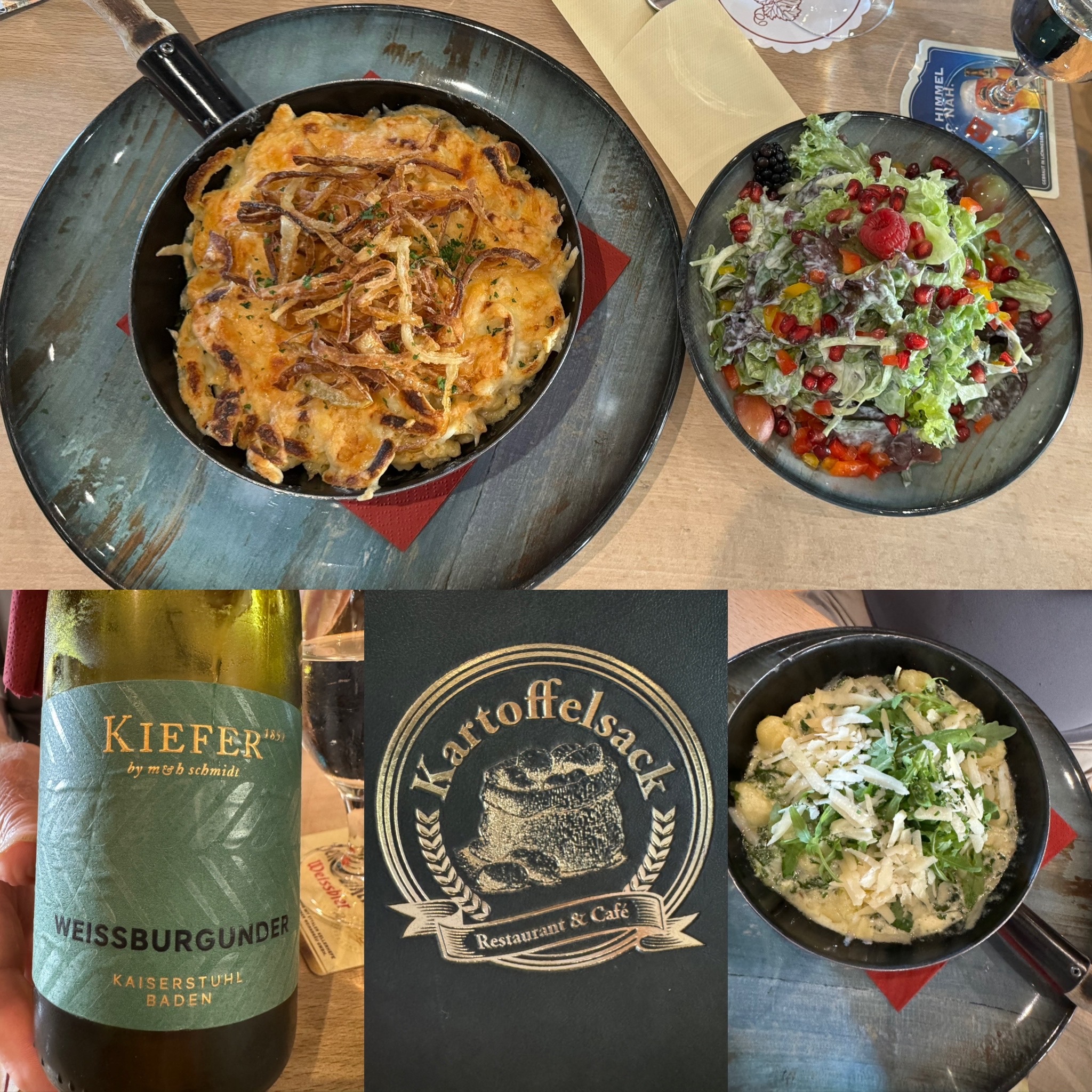
There was also a cute Brothers Grimm fairy tale house, but it was never open in the days we walked by. Tourists mostly seem to come to the market square, shop on the streets around it, and eat at the Restaurant Kartoffelsack.


This “potato sack” had a menu entirely built around the humble spud. If you think Italy is carb heavy, you will see it as a land of light dishes and vegetables after a few meals in Hesse. This is comfort food taken to rib-sticking extremes. Dad had cheesy potato gnocchi while I opted for spaetzle baked with cheese and friend onions. It came with a delicious salad, thank God, to ease the guilt of everything else. There’s also a local wine list here worthy of exploration, though the two glasses I tried were a bit sweet for my taste.

We stayed just outside the old walled centre at Hotel Zum Schwalbennest (the swallow’s nest). Between the town itself and online photos of a building that looked a bit like a German mountain retreat, we were expecting something with old world charm. We were amused to instead find Route 66 theming and decor that appealed to German Harley Davidson fans who ride this route on weekends. The rooms are functional, almost like a university dorm, but comfortable and reasonably priced. Few on staff spoke English but they were tremendously genial and took good care of the odd English-speaking tourists. Their restaurant also serves up some brilliant traditional food, with a whole double-page spread of the menu dedicated to variations on schnitzel. So while it lacked the historic charm of the town centre, its other attributes and its convenient location made it a perfect base for us.

There’s not a great deal to do in Alsfeld beyond wandering around to appreciate the architecture, so we were looking for something else to divert us on our fourth and last day in the region. I found a medieval festival at Ronneburg Castle, on our way back to the airport, to entertain us.

Ronneburg is an impressive pastiche of historic buildings on a hilltop to the east of Frankfurt. Medieval foundations now support 17th-century buildings restored at the hands of 19th century romanticists. Lots of floral wall paintings, dark wood furniture and antlers. Climbing the central tower is the equivalent of scaling an eight-story building, but if you make it … which my age-defying father proudly did … the views from the top are beautiful. As a historic attraction I wouldn’t go out of my way for it, but if you’re in the area it’s worth a nose around. Particularly if you eat in their restaurant, a grand hall where they serve more traditional, rib-sticking cuisine.

If the medieval festival is on, however, there’s a whole additional layer of fun to be had. Two stages with entertainment, loads of people in costume and lots of interesting craft booths. I’ve been to plenty of historical fairs in my time. While most of what was on offer here was consistent with what you’d find in England, there were a few curious discrepancies.

The food was oddly disappointing. I was expecting a variety of German specialties and a lot of sausage. There wasn’t a single German sausage booth of the kind that turns up at every English event. The closest they came was a guy selling gourmet venison sausages. Meat and some sort of sweet bread on skewers seemed to be everyone’s go-to dish.

While people who choose to dress up at English medieval fairs tend to be resolutely faithful to our home-grown traditions, the Germans spread their horizons further. On the edge of the encampment for the reenactors who were here for the whole weekend we found a Turkish bazaar, complete with a hot tub in which you could strip off and soothe your fair-weary bones. There was a disproportionate number of Scottish highlanders, both as costumed attendees and as the vendors in several tartan-draped booths. They all sounded like native Germans, however. I was unable to solve the mystery of whether people here just really love Outlander, or whether there’s some long-naturalised community of Scottish immigrants here who celebrate their heritage at the festival.

Most notably, in comparison with an English event, there was no fighting. Any medieval festival in the UK is built around jousting, or hand-to-hand combat of armoured knights. Both, if you’re lucky. There was little armour at Ronneburg, and nobody wearing it got into a ring to bash anyone else. Yet another legacy of WW2? I’ll never know without befriending a local.

Maybe I should look up those distant Scherstuhl cousins back in Wahlen. For now, it remains a mystery. The bigger question, however, of where the Swiss and German sides of my family came from has now been fully answered. In both cases, ambitious young men left fairly comfortable lives in generally prosperous but extremely unexciting places to seek adventure in a new world. Four generations later, it’s been great fun to see where their stories started.

Thursday, 11 May 2023

Wandering Rostock's Hanseatic glories beats hours on a bus to race through Berlin

It's easy, when confronted with the glossy marketing and the detailed itineraries, to forget that sea- and ocean-going cruises are weather dependent. You'll only be following that seductive itinerary if your ship can safely get in to the promised port. High winds in the Baltic scuppered three of the ten destinations we'd been planning on: Gdansk in Poland and Skagen and Bornholm in Copenhagen. While we were deeply disappointed, particularly in the loss of the medieval treasures of the first, the benefit was an additional and totally unexpected day in Rostock.

We were probably the only people on the ship to be excited by this. 

Rostock isn't the kind of place that turns up on sightseeing wish lists. I suspect many people outside of Germany would struggle to find it on a map. It doesn't even show up on Viking Cruises' official itinerary for our trip, which instead lists that well-known port city of Berlin ... roughly three hours by bus or train from the coast. But if you're putting together an itinerary for a bunch of Americans trying to pack as many big highlights into their trip as possible, then moving them from Rostock's port of Warnemünde is the most efficient way to get from a cruise ship to the German capital. In my opinion, it's not really fair on the cruisers, who spent roughly six hours of a 10 hour day in transit, or on Rostock, which is a lovely town that deserves to be better known. 

Admittedly, we had a vested interest. The Bencards were a prominent family here. There's a street named after one of them, another was mayor around 200 years ago, and one of the mayor's younger grandsons set off to Denmark in the mid-19th century to seek his fortune and found the branch of the family from which my husband descends. Rostock, for us, was a chance to bring family tales and historic documents to life.

Rostock is a beautiful place, its pastel-coloured buildings, fanciful gables, moulded terracotta decorations and towering red brick churches radiating cheerfulness under bright sun and pure blue skies. You don't need family roots here to appreciate the charm of the place. It was at its most powerful in the high Middle Ages and Renaissance, when its status as leading commercial city in the Hanseatic league made it extremely rich. Merchants splashed out on civic and residential architecture to show off their wealth. That legacy still shines through, despite a bad 20th century on the losing side of two world wars and 46 years under communist rule. For a city that existed and thrived because of the win triumphs of capitalism and multi-national trading, the last must have been particularly awful. 

Fortunately, restorers have been hard at work since Unification as money, commerce and capitalism has returned to the city. There is still a slight feeling of otherness compared to "the West" ... more rubbish, more graffiti and more soulless, brutalist apartment blocks on the city's fringes than you see in the former West Germany ... but today's city centre has eviscerated the bad times and feels prosperous. The main market square is lined on three sides with majestic gabled buildings, including an almost-frivolous pink and white town hall distinguished by seven spires on brick arches coming out of its otherwise baroque exterior. There's a fabulous restaurant in the Ratskeller here where you can get local classics. More later on that. One corner of the square is free of buildings (no doubt the effect of that terrible 20th century), opening up a view over part of the old town and the spire of the Petrikirche, one of Rostock's three impressive medieval red-brick churches.

With all that medieval commerce came a cosmopolitan attitude and one of Europe's oldest universities, still one of Germany's best. The university buildings add architectural glamour and variety to the city, particularly the main building behind the "fountain of joy". Its exuberant decoration features a wealth of moulded terracotta geegawgery reminiscent of London's Victoria and Albert museum but even more lavish. There's a beautiful green space between the fountain and the building, another park carved out from the grounds of an old abbey behind, a walk along the medieval town walls, and a collection of other beautiful academic and commercial buildings.

The area inside the old town walls slopes down to a little valley with a stream in it. (The stream's been contained into a watercourse in the centre of a road called Grubenstraße.) While most of the obvious tourist sites are in the 2/3rds of the land to the west of this, if you have time the eastern third offers a very pleasant stroll. This part is almost entirely residential, with tree-lined streets of charming houses and gracious apartment buildings running between Petrikirche and Nicholaikirche. People here put benches in front of their homes, seemingly inviting people to pause and admire the views. The only discordant note is a disturbing number of "stumbling stones", the small memorial plaques the German government awards when properties were proven to have housed people whose lives were destroyed by the holocaust. Rostock was, sadly, more enthusiastic in its Naziism than the average German city. Thus those benches are also a thoughtful, meditative place to think on those stones.

Petrikirche, forming the northern pole of this neighbourhood, is an austere example of a Northern German Lutheran church. It's all clean lines and unadorned whitewash except for some modern stained glass windows and the models of sailing ships hanging from the ceilings to give thanks for successful voyages. For a couple of euro you can take a blessedly convenient elevator up to the base of the spire for fantastic views of Rostock. At the southern pole of the neighbourhood, Nicholaikirche has been converted to apartments. It's fascinating to see their windows cut into the peaked roof. If we'd been ready to pause there, the Likörfabrik cafe looked fantastic. It's in an old liquor factory, just down the hill from the church, next to that little stream and enjoying a fantastic view of the old city walls from an outside patio full of happy and affluent locals enjoying Sunday brunch.

We'd always planned to explore Rostock rather than take the cruise's offered excursion to Berlin. Honestly, I'm confident we had a better day than the hundreds who sat in buses for hours to race past Berlin's key sites. And the benefit of a second day for us was an excursion to Schwerin Castle, another little-known destination that deserves more respect. I'll move on to that in my next story.

Saturday, 14 May 2022

Forget the cathedral. Beer, and a distinctive drinking culture, is the reason to head to Cologne

Sightseeing-wise, Cologne was a bust. I found the much-celebrated cathedral inferior to a long list of others*. The famous perfume is perfectly pleasant but I can buy scents I like better for a more reasonable price. Much of the city centre is remarkably ugly. Like many German cities, it was flattened by bombs in WWII, but post-war construction here veered towards modernism and away from re-creation. (In this, Cologne should be twinned with London.) For me, its star sight is a roman mosaic from an ancient dining room on display in a brutalist concrete museum now closed to the public but, fortunately, you can still see the floor through a window at the back and to the right of the cathedral.

The city was redeemed, however, by its beer. There's only one thing on tap here: Kölsch. It's pale, dry, crisp, and served pleasantly cold. It's all highly regulated, with ingredients limited, processes defined and the ability to call it Kölsch restricted to 50 km from Cologne. But that doesn't mean it's all the same. Many of Cologne's copious drinking establishments brew their own versions and aficionados claim different varieties have different fruity notes you don't often find in a German lagers. Anyone can wander into a Cologne pub and get a drink, but going out for an evening with a local guide brought us to the right places and helped us understand the distinctive drinking culture.

Kölsch is served in what, at first, may seem a laughably small glass. The tall, thin, 200 ml (6.8 oz) cylinder is called a Stange, and may strike you as an oversized shot glass. A thirsty drinker could down it in a few gulps. But here's the magic: it just keeps coming. 

You don't order a beer in Cologne. You enter the brew house , find your place, and a waiter (the Köbes) will come up with a circular tray with a tall handle in the middle (the Kranz), full of glasses, and give you one. Because this is really the only thing you drink in Cologne. When your glass is empty, your lovely Köbes is at your elbow with another. And he will be there, again and again, until you place your beer mat on top of your glass to stop the flow. While the initial 200 ml won't go to your head, you can imagine how constant top ups across the evening could do damage to your equilibrium and your wallet. Fortunately, all the evening’s drinking was covered by the excursion price, no matter when or if we decided to deploy our bar mats. This made the price better value for money for some than others.

While our guide on the day’s earlier walking tour (included in the basic cruise price) had focused understandably on history and architecture, the evening’s guide delved deeper into the people and culture. The locals, it turns out, are quite an anarchic bunch. Fiercely independent, fond of parties, lovers of food and drink and … according to our Cologne-born guide … have the best sense of humour in Germany. I couldn't help remembering the fun-loving the Osakans and their prickly relationship with Tokyo. 

Predominantly Catholic, Cologne was absorbed into the staunchly Protestant Prussian kingdom after the Napoleonic era and it was never a comfortable fit. Though there are statues of Prussian kings dotted around the place, they’re treated with mocking contempt. A pre-Lenten Carnival is the party of the year, characterised by Venetian levels of costume, drinking and mayhem. Naturally, the locals kick off the party under a statue of Prussian King Friedrich Wilhelm III, a devout Protestant who hated the whole Carnival idea and tried to shut it down.

We started our evening at the Brauerei zur Malzmühle across the street from the Heumarkt, the enormous town square on which that king’s equestrian statue prances. The Schwartz family have been brewing and hosting visitors here for 160 years, and they’re now one of the few establishments still brewing on site in the city centre. The decor is traditional but restrained 19th century German beer hall, with lots of stained glass, wood, festoons of dried hops and memorabilia from carnivals past.

In the best tradition of pub crawls, we lined our stomach here with a hearty dinner to better absorb the alcohol of the evening. Local delicacies here mean pork. Our group shared platters of pork knuckle, sauerbraten, smoked sausage, black pudding, and even a pork tartare. It was both delicious and a bold statement of faith in the freshness and purity of the local meat. (I suspect serving raw pork would be illegal in England, despite the quality of our pork industry.) On the side came fried potatoes and a lightly pickled sauerkraut that bore no resemblance to the cheek-puckering stuff sold in groceries. Even professed sauerkraut haters tried it and found it tasty. Of other vegetables, there was no sign and,  in the local mind, no need. It wasn’t the first time it occurred to me that a vegetarian might starve to death in Germany, and devout Jews and Muslims would be eating from a very reduced menu. My husband, meanwhile, was nearing a coma of transcendent happiness with so many interpretations of his favourite protein in one place.

After a stroll across the Heumarkt to let the food settle, we landed at the Pffafen Brauerei on the square’s northeast corner. You can’t miss the dignified, salmon-pink Baroque building with its ornate wrought iron pub sign, but it’s the crazy interiors that make this place memorable. There’s stained glass here, too, but more abundant and more modern, particularly in the multi-story entrance hall with its enormous chandelier that feels a bit like a cathedral of beer. Push in to the long, narrow building and you’ll be dazzled by a profusion of woodcarving. Local artists have been adding to the place since the current brewer took it over in the 1970s. There are carnival goers, cherubs, monks (pfaffen in the local dialect), hops and foliage. Much is traditionally decorative, but some gets quirky, with heads springing from barrels, figures holding up tables and mischievous faces looking around corners. Here’s Cologne’s anarchic sense of humour at work. 

While the brewers here, Päffgen, supply a variety of brew houses across the city, this is the only one where it comes straight from the wooden barrels. Which, experts tell me, makes a difference. I found their version slightly hoppier and heavier than the Malzmühle Kölsch, but I'd be hard pressed to tell the difference in a blind taste test.

A lane called the Saltzgass leads east from the corner, down a hill towards the Rhine. Its name, “salt alley” gives a nod to a precious commodity mined in Germany and shipped up and down the Rhine since Roman times. The street is all restaurants and brew houses now, our last stop dominating the middle stretch.

Bierhaus en d’r Salzgass is in a historic former brewery dating back 400 years. Brewing stopped here in 1907 and the place changed hands as a restaurant multiple times through the 20th century, but it saw new owners and a major renovation in early 2003. The beer was the same Päffgen we’d just left at Pffafen, just not out of a barrel. No, I couldn’t tell the difference. But that didn’t matter, because it’s the interiors that made this place. Polished, dark wood abounds: columns, panelling, an impressive central bar soaring two stories. In fact, the whole central room is double height, with a second story of revellers able to look over their wrought iron balustrades onto the drinkers below. Another festive establishment with the ambiance of a cathedral. I have a feeling that’s no coincidence in this city.

We Brits could have happily explored one or two more places, but our American fellow travellers were lagging and quick to raise their beer mats. We adjourned to the ship's bar and continued our celebrations there. No Germanic woodcarving, and Kölsch only in bottles that ... gasp ... exceeded 200 ml. We coped.

At 5pm that day, I'd considered Cologne a wasted stop on the cruise. By 11pm I was wondering if we could come back for the Christmas Market or Carnival. That's the difference some good local insight can make. Prost!

*To be fair, because it was the week before Easter the cathedral's ambulatory ... that horseshoe of chapels ringing the high altar ... wasn't open. Most of the cathedral's treasures are back there. If the building has any chance of competing with places like Chartres, Milan or Canterbury, you need to see it outside of Holy Week.


Monday, 2 May 2022

Imperial past turns up the sightseeing heat as rivers go East

 VIKING’S GRAND EUROPEAN TOUR, WEEK TWO Regensburg, Passau, Melk, Vienna, Budapest*

As you sail steadily towards each sunrise, everything gets grander. Church spires become domes, domes morph into showy onions crowned with golden spikes. Buildings take on increasingly festive colours and more statuary adorns their walls. The architecture of the aristocracy … palaces, gardens, tombs and abbeys … becomes more extreme.  

The first week had plenty to dazzle, but seemed a bit more democratic in its appeal. From Amsterdam through Nuremberg most of those historic towns had fierce merchant guilds who proclaimed their independence, or ancient universities pitting gown against town. The closer you get to the heartlands of the Habsburg emperors, and to the starting points of the exotic trade routes that filled their coffers, the more imperial it all gets in art, architecture, food and wine.

Even the waterways turn up the power. First comes the Rhine-Main-Danube canal, a miracle of modern engineering only completed in 1992. It's essentially an aquatic staircase climbing up and over the European watershed, which is marked my a monument in an otherwise pastoral scene. The canal connects the waterways that empty into the Black Sea with those that drain into the North Sea and the Atlantic, allowing navigation across the continent. The highest point is 406 metres above sea level and you get there through locks that are as deep as a five story building. When the ship pulls into one, and you're at the bottom of that inky cement well, it's both frightening and awe inspiring. 

Once up and over, you're into the Danube (Donau in the local language), the width of which makes the Rhine and Main seem small. And that's before it's joined by two tributaries at Passau and gets even larger; it's the first European river I've been on that can match the Mississippi. It's also generally the same muddy colour, despite what Strauss' waltz might lead you to expect. the Wachau Valley around Melk, however, is a good deal more picturesque than anything American rivers can throw at you, even without the castles and abbeys that elevate the landscape.

Besides the sailing itself, here are the highlights.

Regensburg and Passau

These two towns on the Danube have a lot in common. Both were Roman settlements marking the Northern edge of empire, both evolved into vibrant trading centres in the Middle Ages, wealthy enough to pack their city centres with lovely architecture, and both managed to avoid much WWII damage. And though both are technically in Bavaria, they're both in a bit called Franconia that stands proudly aloof from Munich.

By population, Regensburg is triple the size of Passau, but its town centre is still easily walkable. Though the architecture is primarily medieval through baroque, it's oddly cosmopolitan, with some buildings feeling almost Venetian, others copying the exterior fresco style of Southern Bavaria and most adorned in festive colours of more Southern climes. Our tour guide explained that much of this is fairly new; Regensburg has been on a 20-year mission to beautify its streets and attract tourists. Though it's slow waking up from COVID, the campaign has clearly worked, with a town centre rich with galleries and local craft shops, interesting hotels and a food scene that had been booming. Of all the places we visited, this was the one that leapt onto my "potential girls' trip" list. (And regular readers will know the balance of culture, restaurants, spas, shopping and exclusivity that we ask from a girls’ trip is tough to achieve.)

King Ludwig I of Bavaria was quite fond of Regensburg, too, building himself a neo-gothic summer residence on the edge of town and two magnificent neo-classical monuments on the river on either side. The Befreiungshalle to the West is a circular temple bedecked with goddesses representing the Germanic tribes, built to celebrate defeat over Napoleon. Walhalla, to the East, is a Parthenon-inspired temple to German genius, full of portrait busts of the nation's great and good. Sadly, these wonderful places were beloved of Hitler and tarnished with his ignominy. But, like much of Wagner's repertoire, enough time is passing that people are starting to appreciate them for their merit before the Nazi hijack. While both are spectacular seen from the river, I'd love to go back and get inside. 

Regensburg’s cathedral is also a blockbuster, complete with a spectacular triangular entry porch I can't remember seeing elsewhere. It's exterior stonework is delicate as lace, its statues expressive and all getting a good clean at the moment. Cologne Cathedral is traditionally thought to be the most significant on this trip's route, but I think Regensburg is better inside and out.

Passau’s claim to fame is the meeting point of three tributaries of the Danube. It's here that the river reaches its full, majestic power, and the landscape reflects the glory. The town centre is on a promontory shaped like an arrowhead pointing to the confluence where three differently-coloured streams come together. Hills rise on each side, adorned with castles and churches.

The town centre itself is a bit hilly, rising to a point with its magnificent baroque cathedral, and the surrounding buildings continue the Baroque look thanks to a fire in 1662 that triggered the building boom you seed today. The price-bishop's residence is on a grand, bustling square behind and below the cathedral; though it's mostly used for administrative offices you can poke your nose in and see the magnificent staircase.

Quieter streets towards the confluence point offered up surprises like early Medieval wall paintings preserved in a chapel set behind glass (just across from the Modern Art Museum) 

… and a magnificent potter's shop. 

Passau's also home to several quirky museums, including one about glass and another devoted to dachshunds. Just across from the glass museum is a lovely town hall with a carillon in its tower that offers concerts three times a day. On sunny days, the Ratskeller moves service from the basement to the square out front, where you can listen to the chimes while looking across the Danube at the castle above you.

Melk

When British royalty travelled around the country, they chose to say with the peers of the realm, leaving the UK with a legacy of grand country houses. When the Habsburgs and their nobles moved around their empire, they stopped at abbeys instead. It’s only by wrapping your head around this fact that you can make sense of the ludicrous grandeur of religious establishments dotting the Austrian countryside. (I’ll write more about another, Gottweig, in an upcoming post.) They weren’t just religious communities and schools, but royal palaces that could be fired up to accommodate the court. Abbey churches needed to offer a suitable backdrop to imperial ceremony. Nowhere makes this statement more profoundly than Melk, which is generally the No. 1 example trotted out in art history books for the pinnacle of the Austrian baroque.

There’s a lot more to explore here than the famous church. The complex, a fantasia of yellow and white stucco topped with red tile roofs and billowing sculpture, sits on a promontory atop the town in the beautiful Wachau valley. The views from there are magnificent, and no traveller could miss it. Still a Benedictine abbey and a prestigious school, recent renovations have turned the old royal apartments … approached up one of those ubiquitous grand staircases … into an interesting and thoughtfully displayed museum of the abbey’s history, full of lavish treasures. From there you spill out into the grand hall that would have been used for royal business: windows on three sides taking in magnificent scenes, scagliola columns offering “marble” in outrageous colours, royals and classical gods frolicking on a tromp l’oeil ceiling. Grand as this is, it’s the least impressive of the sights to come.

Next it’s out onto a horseshoe-shaped balcony. A courtyard and the sinuous front of the abbey church is behind you, the sylvan glory of the Wachau Valley before. At the other end of the horseshoe is the entry into the Abbey’s famous library. More tromp l’oeil ceilings, but here they crown two towering stories of gleaming wooden bookshelves accented with gold gilt and exotic marquetry. Doors within the shelves open to alcoves set into windows not otherwise seen; you could choose a book in the dark glory of the library, then slip away to the sunny embrasure to read. A second library room is equally grand, though slightly smaller, and offers an exquisite wrought iron stair to ascend to the upper level. (Monks and scholars only.) 

But it’s the church that’s particularly noteworthy here, and it deserves its glory. You enter, gasp and fall speechless at a vision that is almost too spectacular for the human brain to grasp. Baroque churches were supposed to transport you, for the length of the service, into the bosom of heaven. This delivers all the classic elements … gold and silver gilt, swirling clouds, joyous saints … with a cumulative impact I’ve only seen in Munich’s legendary Asamkirche. 

Particularly noteworthy here is the use of silver, gold and rose gold gilt (I can’t remember seeing the last), and a series of “boxes” in the clerestory on either side of the nave. These looked like opera or theatrical boxes, almost sacrilegiously so, with obelisks, grills, curtains and the like featured in the architecture. There was nothing about this detail in the tour materials; I can only guess it was for the royals and their court to be seated with the saints in heaven during services. 

If the counter-reformation is about celebrating the theatricality of the religious service, then Melk is a supreme example.

Vienna

Two days is a ludicrous amount of time to spend in a place as big and treasure-rich as the Austrian capital, so much so that I’m giving it its own story.  Here, I’ll simply mention that if you are doing a power-tourism sweep through Europe, Viking makes the most of those days. The ship pulls in on the morning of the first day and leaves early evening on the second, so you do have two full days for sightseeing. A half-day tour, part bus and part walking, is included. Then you can load up on organised tours (Lippizaners, art, classical music, etc.) or do your own thing. We were fairly unusual doing the latter, but we were the only Europeans on board and both knew Vienna well already.

Anyone who questions the size and impact of the river cruise industry need only take a look at Vienna’s purpose-built cruise port at Handelskai. At least nine ships were docked when we were there, and the facility could have berthed at least four more. Access roads are designed so tour buses can sweep right up to the ships; if you’re only doing organised activities this was the most convenient of all ports. It’s also about a 20-minute walk to the Vorgartenstrasse underground station, and from there just four stops to the centre of town at St. Stephansplatz. One more stop, a change of lines and six more stations offers public access to Schonbrunn Palace (a fraction of the cost of the organised bus tour). If you’re feeling lazy, it’s about 20€ in a taxi … which is actually a good call at night since the lighting on Handelskai isn’t great and the walk to and from the underground could feel a bit edgy after sunset.

Budapest

I can’t think of another city quite as spectacular from its river (Prague comes close). The flat bank of Pest is lined with grand imperial architecture while the opposing hills of Buda offer medieval ramparts, renaissance towers and monuments from all ages. The bridges crossing the span are all as decorative as functional. Surely there’s no better capital to arrive into on the water than this one, and our stately gluide to our dock on the penultimate morning of our tour was one of the most satisfying pieces of scenic cruising during the trip.

After that spectacular arrival, however, I confess that I couldn’t warm to Budapest. Though forever linked with Vienna as a joint capital of the Austro-Hungarian empire and sharing the other city’s late-19th and early-20th century architectural style, Budapest lacks Vienna’s atmosphere. The grandeur on the Pest side is barely skin deep. Look carefully in even the best areas and you’ll see buildings in bad repair, weeds and unkempt public spaces. The further you get off the main tourist track the more obvious the blight. Much of Pest reminded me of Palermo, but without the madcap Italian energy.  (Clearly, Budapest was held back from chasing Vienna’s and Munich’s revival by its decades under Soviet rule; the current building boom is trying to overcome the communist blight but they have a lot of work to do.)

The tourist money seems to be going into Buda, where the old-town atop the ancient citadel, mostly flattened in WWII, is being steadily rebuilt in classic style. The must-see spot up here is the Fishermen’s Bastion, a 19th century, neo-Romanesque observation point almost completely rebuilt from the late ‘50s. It’s lovely, but the whole area lacked authenticity. It felt like Budapest produced by Disney. But I might have just been tired.


River cruising is a stately and relaxing European holiday alternative, but this particular agenda skews the most significant sightseeing towards the end. I was far less rested at the end of week two than at the close of week one. It’s something to keep in mind if you’re considering doing this route; for a more restful start, head off from Amsterdam. For a more relaxing finish, Start from Budapest. 


* Viking runs this itinerary back and forth all season. If you start in Budapest, then what’s described here will be week one

Saturday, 23 April 2022

Welcome to the land of fairy tale and Baroque excess

VIKING’S GRAND EUROPEAN TOUR, WEEK ONE Kinderdijk, Cologne, Koblenz, Miltenberg, Wurzburg (Rothenburg ob der Tauber), Bamburg, Nuremberg 

I haven’t vacationed on an organised tour within Europe for more than 30 years, and its confines can feel as awkward as a stiff pair of new leather shoes. The sightseeing en masse, the constricted free time, the dashing through historical sites with only top-line summaries, the fresh locations with each day are all a far cry from the way we usually settle into a place and delve deep into local opportunities. It does, however, have its advantages.

A bit like a chef’s tasting menu, an organised itinerary pushes you to places you wouldn’t have bothered with on your own. Koblenz, for example, is a pleasant but unexceptional town best known for the monument at, and view down upon, the place where the Rhine and the Mosel come together. I wouldn’t go out of my way to visit its sprawling early-19th century Ehrenbreitstein Castle, but if you’re there already the guided tour conducted by an actor assuming the character (although not the accent) of a British officer who knew the place at its construction was quite entertaining. 

A deep restfulness comes with not having to think. If, as we were, you are mentally exhausted by the demands of leading projects at work, having someone else organising your every move so you don’t even need to be aware of what day it is or what you’re doing next is bliss. And if, like me, you have the tendency to sightsee to physical exhaustion, the need to weigh anchor and keep moving enforces the down time. 

I won’t bother with an entry on each destination as, to be honest, few are worth that level of detail. The first week of Viking’s tour collapses instead into four broad categories: fairy-tale villages, scenic cruising, baroque places and windmills.

FAIRY-TALE VILLAGES

Thanks to Walt Disney, people around the world know what to expect from picturesque German villages. Half-timbered, steep-roofed houses broader above than below. Stuccoed buildings in pastel colours with fanciful gables. Churches with onion domes or narrow, pointed spires. Wells adorned with baroque sculpture. Wooden shutters, gabled windows projecting from roofs and window boxes full of geraniums.  The town hall will inevitably have a Rathskeller for drinking and dining below (cue Gaston using antlers in all of his decorating) and a glockenspiel chiming the hours in the tower above. If you’re lucky, some automatons might pop out and do something interesting on the hour.

There are copious opportunities to take in such scenery in this first week. Miltenberg is a pretty little town beside the Rhine with a charming central square, a high street distinguished by an unusually long, uninterrupted run of historic buildings and a particularly pretty historic coaching inn that combines half-timbering with decorative painting, polychromed saints figures and an ornate wrought iron sign. 

Something that’s nominally a castle, but looks more like an aristocratic step-gabled manor house sits on a hill above town. Bamburg leans a little more to the Baroque, with its stuccoed building fronts and ornamental rooflines, but there’s charm aplenty inside its city centre. The town hall, built on an island in the river that cuts through town, is particularly attractive; part half-timbered, part covered in lavish fresco. Head to Schlenkerla brewery for a place so atmospheric Snow White and the Seven Dwarves could be in charge. (Their distinctive smoke-flavoured beer is one of the highlights of Bamberg).

Nuremberg is the second-largest city in Bavaria, so no village here, but the bit inside the old city walls has buckets of old-world charm. The square outside the Albrecht Durer House, tucked against those walls, is a particularly charming place to settle for a while, particularly as there are two establishments serving up Augustiner beers. The artist’s house is well worth a visit; something I may cover in more depth later. (And for more on Nuremberg, see my report from an earlier visit here.)

But for photographic charm, all these pale to insignificance beneath the fanciful towers, gables, spires and cupolas of Rothenberg ob der Tauber. It’s so perfect it’s been drafted into service as a film location multiple times, most recently notable in the live action version of Beauty and the Beast. Everything inside the city walls, which you can walk around, is stage set cute and the locals play on this. Every shop vies for tourist attention, every restaurant is traditional. Other places mentioned above have more history and culture … we dipped into the local museum on the 30 Years War and weren’t terribly impressed with the hotch-potch of displays and basic details … but nowhere else is so resolutely photogenic in every direction. Tourists have figured this out, of course, and this is the only place in Germany I’ve been to, other than Neuschwanstein, that feels like it exists only for tourists rather than having a reality of its own. I suspect that, like Mont Saint-Michel, the secret is to spend the night here so you can enjoy the edges of the day without the bus tours and drive to lesser known villages when they arrrive.

SCENIC CRUISING

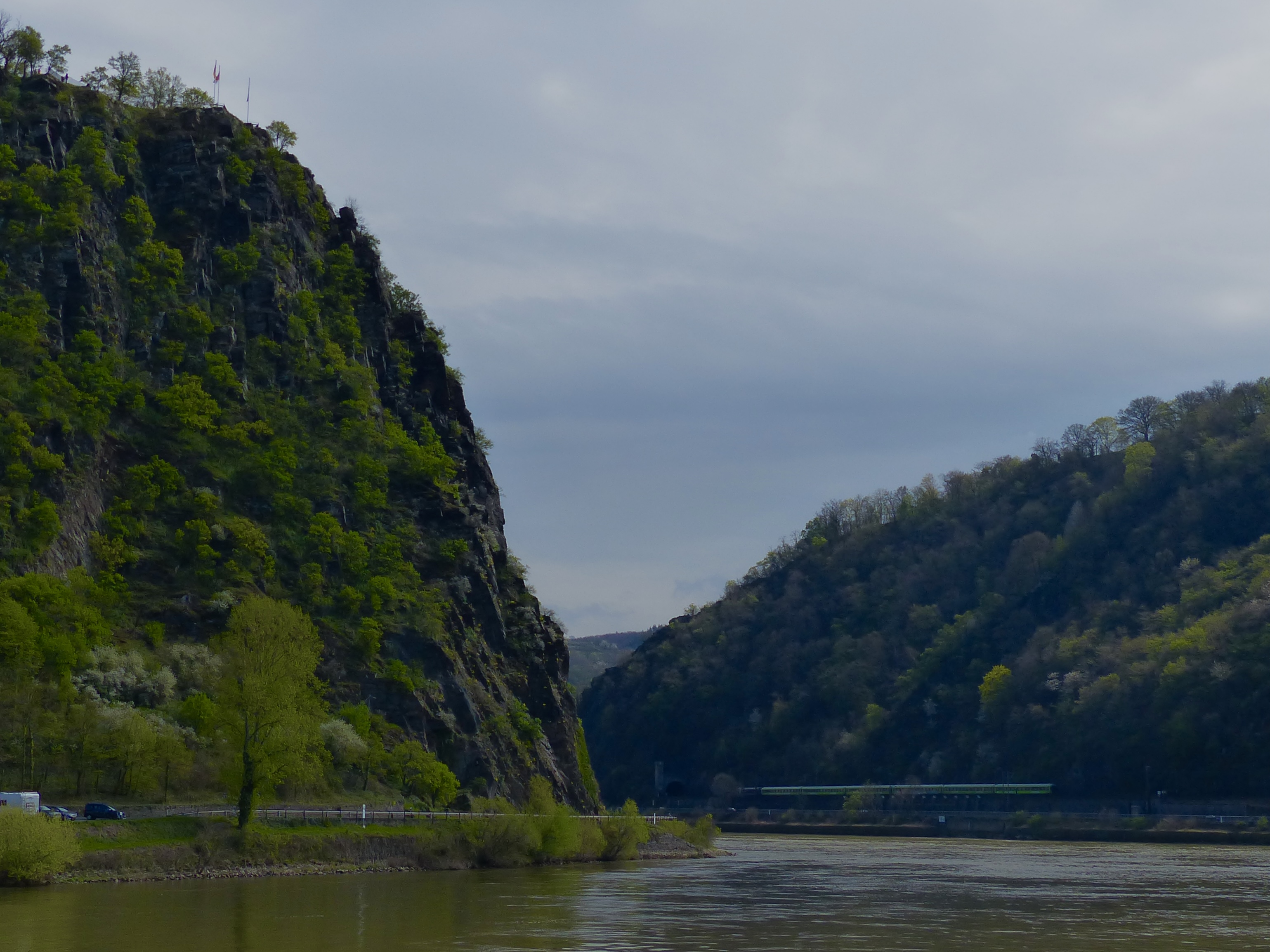
The stretch of the Rhine between Koblenz and Miltenberg is a highlight of the trip. For more than two hours of steady cruising the Rhine squeezes between forested hills broken by outcroppings of ruddy granite. Where the land slopes to gentle bottomlands there are charming villages. Vineyards climb up steep terraces. Orderly caravan parks expand the local population in riverside fields while every picture-worth building seems to be a hotel. At one dramatic point, the Lorelei Rock, the river here is particularly narrow, deep, and … before modern navigation aids … dangerous. Winds around the rock murmur and sigh, and the area is laden with legends.

Whether cruising or staying, visitors undoubtably enjoy the pastoral views, but it’s the castles that pull people in. It seems like a new one comes into view each time an old one disappears to your stern. And there’s a reason for that. The owners of these castles maintained commerce on the river. You can think of them as servants of the people or owners of a brutal protection racket, but whichever way you fall you’ll admit the architecture of their fortresses makes this a special part of the world. 

Ironically, most were just mouldering ruins until the 19th century, when the Romantic movement coincided with all those German states jockeying for power in a Germany on its way to unification. They look like something out of storybooks because that’s the way they were designed. At their most picturesque there are castles on the heights and at the riverside, presumably once working together. The most picturesque is Burg Pflazgrafenstein on an island in the river with Burg Gutenfels looming above. 

The lower could be a jewelled charm in a medical monarch’s cabinet of wonders; the upper is the kind of brooding ruin worthy of gothic horror.  The progression of castles on this stretch runs the gamut in between. Unsurprisingly, many now operate as luxury hotels. If you live in Europe, we’ve realised you could book into one of those hotels for a long weekend, take a day cruise and re-create this part of our journey fairly easily.

BAROQUE PALACES

Catholic Germany had a tradition of strong prince bishops who had both secular and religious authority and a taste for grandiose architecture. While they rolled out lavish Baroque architecture in their churches to assert the appeal of their religion over dour, ascetic Protestantism, they used the architectural style at home to demonstrate their political heft. Just like Louis XIV, father of the movement, they equated architecture with power.

The biggest of these examples in the first week is the episcopal palace in Wurzburg, a hefty block of golden stone that would make the French king feel at home. These places have a pattern across Germany: a porte cochere that allows carriages to unload their passengers at the bottom of a grand staircase. 

Shallow treads ascend to a landing, divide and continue up on either side. Statuary ornaments the railings, there’ll normally be some massive architectural statement on the landing and it will all be covered with a tromp l’oeil ceiling full of Greco-Roman deities frolicking their way across the heavens. Wurzburg looks like all the rest, with the exception that its ceiling is by Tiepolo so far better than most. A series of state rooms always follows, dripping with ornamental plaster work. Wurzburg is unusual in its embedding of mirror fragments into the swirls of the plaster, no doubt adding an exceptional glow to candlelit events. The best site here is a mirrored room, larger than these things usually are and unusual in that the mirrors are over-painted with scrolls and scenes. What you see today is a post-war recreation of what was destroyed by WWII bombs; even in modern incarnation it’s magnificent but a bit too much to live with.

Grand as Wurzburg is, I far preferred the smaller palace, its accompanying hunting lodge and the grotto-style chapel at Brühl. 

They’re all the creation of Clemens Augustus of Wittelsbach, a young man who had no interest in the church … he was forced in by his power-seeking family … but a great passion for hunting and showing off. The lodge, Falkenlust, celebrates falconry in its interior decor, complete with a blue-and-white tiled staircase hall with hand-painted tiles showing stages of his birds’ lives. Blue and while tiles (the Wittelsbach family colours) also clothe a delightful dining room in the main palace. 

The mirrored room in the lodge, though only a fragment of the size of the Wurzburg room, is much nicer, and more traditional with its writhing gilded wooden frames with little plinths occupied by china birds.

Back at the main palace, the artists behind the staircase might not be as famous as in Wurzburg, but I found the colours fresher and the architecture … complete with giant figures holding up the columns … altogether lighter and more fun than other examples. The chapel, created as a fashionable shell grotto in the ever-present blue and white, has the same effervescence. August Clemens was doubtless a terrible representative of the Catholic Church but as a builder and part host, he was my kind of guy.


WINDMILLS

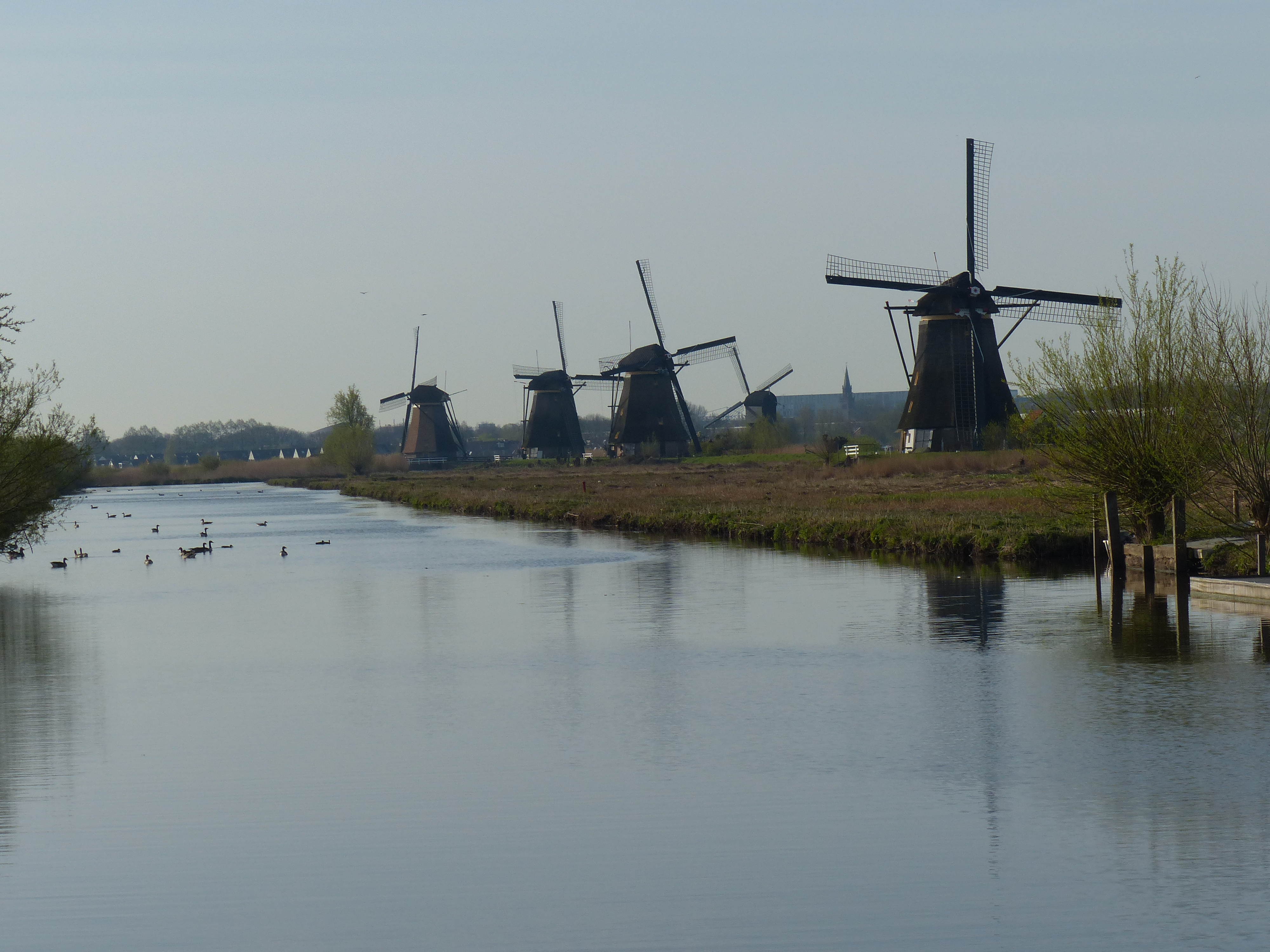
This falls into one of those pleasant surprises. Never in 20+ years of regular visits to Amsterdam has it ever occurred to me to travel to the windmills at Kinderdijk. I’ve been to individual Dutch windmills. I’ve seen them in the landscape. We have similar in Norfolk. What’s the big deal?

Well … UNESCO knows what they’re doing when they hand out those World Heritage Site designations. Kinderdijk isn’t just a bunch of windmills. It’s the largest concentration of these historic buildings … 19 from the 18th century or before … in the world, and demonstrates a unique ecosystem. The mills pumped water from one holding area to another, ever upward and to the sea. The “polder” is the cleared area left behind; a peat-rich, below-sea-level area of rich, green fields perfect for dairy farming. Windmills in such profusion are remarkably picturesque, and worth the visit to see whether you’re on a ship or in Amsterdam.


 * Viking runs this itinerary back and forth all season. If you start in Budapest, then what’s described here will be week one