Showing posts with label Mauritius. Show all posts

Friday, 23 September 2011

Dolphins disappoint, but paragliding becomes a new favourite

I wrote this entry after returning from Honeymoon, but the posting date coincides with when we were actually experiencing what's described here.

With a sufficient pile of reading material and the occasional dip in pool or ocean, supplemented by the odd cocktail, I could spend months on a beach. I am most certainly NOT one of those people who gets bored in the scenario; in fact, I'm hoping heaven exists, and provides me with an eternity of reading really good books in lovely surroundings without having to move around much.

My new husband is a far less slothful soul. He is also so pale that, even slathered with factor 30, spending more than half an hour in direct sunlight is dangerous. So we had a challenge. The week of beach lounging was definitely for me, but if he was to have as good a time as I was having, we needed to do more. Thus I reduced my novel consumption and agreed to spend some time on my feet.

Mauritius seems to have about a dozen tourist attractions across the island, all of which are advertised in the Air Mauritius in flight magazine and then pushed steadily to you by hotel concierges. In our case, it was a rep from Mauritours, our travel agent's local partner. Sadly, the rep was the only really bad experience we had on the whole trip. An unenthusiastic, ill-informed, disorganised and inarticulate English expat who looked badly rumpled and smelled worse, Roger certainly didn't fit in to our luxurious surroundings. His trips were good value for money, however. Averaging £60 per person, they provided transportation, access to activities and refreshment. Quite a deal when we were paying about that much each night for wine and cocktails.

We chose two tours: swimming with dolphins, and Ile aux Cerfs. Our big lesson: We should have pushed the rep for far more information. In both cases, our experiences didn't match his short descriptions (in one case worse, in one better) and we were unprepared for the day.

To get to the dolphins, we had to be ready for pick up in the lobby at 6:30. Too early for breakfast or any chance of coffee. We were picked up by a taxi driver who, unlike our airport transport, spoke little English and wasn't interested in attempting much conversation in any language. The rep had recommended this over another place where you could play with lion cubs because that one was so far away; we ended up driving past the lion place on the way to the dolphins. The drive was an hour and a half, crossing the whole island and stuck twice in urban traffic. Combining the drive out and the return, we spent more time in the back of the taxi than we did with the dolphins.

Arriving at a small public beach just below the posh holiday home enclave of Flic en Flac, the taxi driver motioned us towards three motorboats anchored in the shallows, without any more instruction. One of the captains decided we were with him and told us to wait. After about 20 minutes of aimless milling, about a dozen of us clambered aboard and headed out into the bay.

This is not, it turned out, the kind of swimming with dolphins that's offered in many tropical resorts, where the dolphins are either captive in a facility or tame and trained to come to a certain area. These are wild dolphins, who come and go at will and move fast. What Roger SHOULD have said is that you will probably see dolphins, and you'll get in the water, but you may not get that close. That expectation not set, this trip was a bit of a bust. Wild dolphins do frequent this bay, in numbers and varieties that change daily. Some days there are 200 bottle nose, who love people and come right up to the swimmers. On our day, there were about 30 spinners who are far more reticent. We would motor up to them and jump off the boat, only to have them disappear. I saw some dark shapes below, and could clearly hear their clicking communication, but the photos from the boat were our closest encounter. After 40 minutes of chasing the elusive beasts, we progressed on to a reef and had the option to snorkel. The reef didn't look as well-populated as ours at the hotel, and towels weren't provided on the boat (another critical piece of information Roger didn't provide), so I decided to stay on the boat and bake dry; the thought of an hour and a half in the back of the taxi in damp clothing didn't appeal.

The second trip was more of a success, though again bore no resemblance to Roger's description, which was basically ... you'll go to the very pretty Ile aux Cerfs (island of the deer), and lunch will be provided. This time, we were ready with towels, but left behind the waterproof camera we'd brought for the dolphins.

The trip should have been described as a day on a catamaran, with a wide mix of activities and a stop by the island at the end. After a 40-minute drive down the east coast of the island, stopping at three resorts to pick up others (and confirming that we were at by far the nicest place) we arrived in the fishing village of Trou d'Eau Douce, where a small harbour lies at the bottom of a steep hill. This is filled with catamarans and mock pirate ships and is, clearly, the key port for excursions on this side of the island. Ours was a medium-sized cat with a crew of three and about 25 passengers, though we could have held more.

We spent the first hour sailing further south down the coast, though it was such a still day we eventually had to add the motor. This offered the most beautiful views of Mauritius on the trip. As we sailed between the reef and the shore, with beaches, green coastal plain and mountains framing the view, we were treated to scenes on par with the best of the Caribbean, complete with crystal-clear waters and a dizzying array of blues. Eventually we turned into the mouth of the Grande Reviere Sud Est, waiting our turn for the next part of the excursion. The river gets very narrow very quickly, so the passengers on each boat need to transfer to smaller, flat bottomed craft to make their way up it. Once aboard that, you motor up the river, flanked by stone cliffs and jungle foliage. Monkeys play in the trees and exotic birds skim above you. After the driver navigates some boulder-studded shallows, you come to an impressive waterfall crashing through volcanic black boulders. It's a sight worth the effort to get there.

Back on the boat, the crew had the barbecue on the back corner smoking, the bar open and Mauritian pop music blaring. (The latter is a mix of reggae, Bollywood and urban funk. Fun and appropriate for the day, but I won't be looking for an iTunes download.) We then motored out to the reef and dropped anchor for a bit of snorkeling before lunch. The reef at the hotel was actually better, with richer coral and a colony of striking purple spiny sea urchins, but I spent about 40 minutes happily floating here before lunch. (Piers, not a snorkeling fan, stayed on the boat.) There followed a very competent meal of chicken, slaw and garlic bread, with the crew eager to refill your plate or top up a bottomless rum and coke.

The lunchtime lounge finished, we headed for the headline destination, the Ile aux Cerfs. Which is, technically, two islands. Tourists get dropped on the margin between the two, which at low tide is a stretch of beach between pine forests and at high tide a strip of water 10-feet wide that can be easily waded through. The south island is mostly the golf course of Le Touessrok, the north left to nature, and the strip in the middle provided with some sun loungers, a bar and restaurant and a cluster of huts selling local crafts and ice cream. It is, according to the guidebook, possible to walk around the whole island in a couple of hours and in so doing you can find completely deserted beaches. But we only had an hour here, so settled for getting an ice cream and sitting in some shade (Piers had begun to realise he'd overdone the sun by this point) to take in the stunning views.

The fact that we only had an hour, I must admit, was due to the fact that we'd taken a 40-minute detour via the paragliding platform on our way to shore. This turned out to be one of the top 10 experiences of honeymoon. Strapped into harness together, linked to a parachute behind and a speedboat in front, it's amazing just how smoothly you glide off the platform and sail up into the air. You're only aloft for about two minutes, but every second was astonishing. The views are exquisite, the sense of weightlessness intoxicating and the silence magical. Sadly, I have no pictures in the air because there's always a chance of taking a dip if you miss your landing (ours was perfect) and the staff don't want you blaming them for water-ruined camera equipment. So they stand on the platform with your camera and take pictures of you, instead. I had the underwater camera, of course, which could have done the job. But it was back at the hotel thanks to Roger's failure to mention most of the activities of the day. At £60 for the two of us it was a pricey two minutes, but we'd do it again in a heartbeat.

I'm glad we got out to see something of the island beyond our hotel, but in retrospect I would have skipped the dolphins. The experience didn't merit the six hours we spent away from the paradise that was our own hotel. But the Ile aux Cerfs expedition was definitely worth the effort. If you do it, just remember to bring your waterproof camera.

Thursday, 22 September 2011

Melange of ethnic traditions makes Mauritian food a treat

I wrote this entry after returning from Honeymoon, but the posting date coincides with when we were actually experiencing what's described here.

Sitting along a rich trade route gave Mauritius its political value and influenced its history. The location is also the source of its culinary traditions, a rich melange of western European, Indian and Asian.

We were caught by surprise by the range and quality of the food here. From bread and pastries as good as any in Paris (remember, this was a French colony for a long time), to delicately spiced curries to top quality sushi, centuries of world travelers left their mark on our dinner plates. We were so impressed, in fact, that we spent half a day on a cooking course with one of the hotel chefs.

The Constance Prince Maurice has two restaurants, one in two large, thatched pavilions beside pool and overlooking the lagoon, the other on floating pontoons back amongst the mangrove swamps of the lagoon itself. The latter is only open for dinner. The standard package at the hotel is half board, with a generous buffet breakfast and a three course dinner included each night. Lunch, snacks and drinks are an additional charge. (Cocktails and wine from a fine list each night, of course, adds on quite a bit to the final accounting at check out.)

Lunch was rarely necessary, of course, given the size of the breakfast and the fact it was served 'til mid morning. All the traditional English options were there ... eggs, bacon, sausages, roasted tomatoes ... plus a dizzying array of French pastries and a nod to the Northern Europeans with platters of cold meats and cheeses. There was a chef making crepes, and another carving up an array of tropical fruit. But so far, so traditional. The only truly Mauritian thing on the breakfast table was smoked marlin. Delicate and sliced so thin as to be almost transparent, this is an ingredient I'd use a lot if it were available in Europe. But I've never seen it before, and doubt I will again any time soon.

It was on the dinner menu that the exotic and the multi-national really came into play. Options always included both Mauritian-inspired and traditional European, and sometimes it was very hard to make a choice. More than one evening mixed things up. Starting, for example, with gnocchi in a saffron cream sauce before moving on to prawns in a spicy tomato creole sauce. Or putting the green mango salad up front before rolling into the steak with Hollandaise sauce.

Several evenings had a particular ethnic theme. On Asian night we mixed satay ... served with its own table-top barbecue to finish the cooking yourself ... curries, sushi and sashimi. The Mediterranean buffet night featured a range of classic Italian and Provencal dishes, with a bit of North African thrown in for good measure.

Like any good restaurant, however, what distinguished all these meals was the quality of the raw ingredients. Mauritius is one of the world's leading producers of hearts of palm, which showed up not only in salads but cooked into terrines and sauces, or included in the canapes served with cocktails in the bar before meal time. The tomatoes were the best I've had anywhere outside of Italy, like a concentrated version of the varieties you get anywhere else. Local pineapples and passion fruits were both a revelation, and the barman's signature passion fruit mojito was my favourite cocktail of the entire honeymoon. And though the meat was good, it was, unsurprisingly, the fish that stole the show. Local prawns are like little lobsters and don't need much beyond a few turns on a grill to bring out their flavour. Several types of oysters farmed from the lagoon, swordfish and tuna were excellent, particularly the albacore tuna, which was unlike any variety we knew. White with a slightly pink centre when served rare, it was a whole new ... and utterly delightful ... experience.

It took less than 48 hours of exposure to this cornucopia of delight for us to decide to sign up for the half-day cooking class with the hotel chef. Priced at £130 per person, it was cheaper than classes of similar quality back in London. And far more exotic!

We met the chef and our four classmates at 9:30, piled into one of the hotel vans and headed for the local market, which had one of the most impressive ranges of fruit and vegetables I've ever seen. But the first sense to kick in wasn't sight; it was smell. The air was intoxicating with a combination of thyme, coriander and the sharp, unmistakable tang of freshly harvested tomatoes just out of the field. Much was familiar, but at least 20 percent deserved the chef's explanation: breadfruit, jackfruit, white cucumber, mysterious varieties of eggplant, zucchini and gourd. I had anticipated Mauritian food being hot, but there were many more herbs than spices for sale here. And almost no meat, with the exception of a few stalls crammed with a wide range of dried fish. Interesting, but covered with flies. Not very appetising! Far more appealing were the local pineapples, usually not much bigger than your two fists clamped together, skinned and carved in showy spirals before being wrapped in cellophane and a ribbon. Turns out what I thought was exotic presentation on the Prince Maurice breakfast table was just the standard way of packing the fruit at the local market. Clearly, a people with style!

Back at the hotel, one of the restaurant pavilions had been reconfigured as an alfresco kitchen, with portable cookers and prepping stations for all of us arranged in a square, with the chef's demonstration table on one side. We learned how to make tuna tartare ... a European dish made exquisite with local fish ... and seafood vindaye. The latter was a stir-fry style main course of mixed fish with a mustard and vinegar base. An unusual combination, but one we'll definitely try again at home. The course also came with a Mauritian cookbook, which offers lots of inspiration. But I'm not sure where we'll find ingredients like batfish, manioc or green papaya. But the hunt will be fun.

Wednesday, 21 September 2011

Prince Maurice sets my new standard in luxury hotels

I wrote this entry after returning from Honeymoon, but the posting date coincides with when we were actually experiencing what's described here.

It's official. From this point forward, all hotel entries on this blog will be compared against a new model of perfection. It is the Constance Prince Maurice on Mauritius' east coast, and it can claim most of the superlatives I have to offer. Best service. Best view from the room. Most remarkable bathroom. You get the idea. Honeymoon is supposed to be the holiday of your life, of course, and I can confirm that this hotel made for a blockbuster start.

One story captures the levels of care and attention that go into making the guests happy. One morning we were sitting on the wide deck beside the pool, eating our breakfast and gazing out over the beach and lagoon towards the line of surf where the Indian Ocean broke over the reef. I saw six snorkelers close to shore, kicking their way from the boat dock towards the large, D-shaped area of water roped off for swimming. Once inside of it, they started snorkeling back and forth in a regular line. What were they doing? Cleaning the sandy bottom to ensure that nothing disturbed a guest's tender feet.

These are the kinds of things you can do with what we were told was a 4-to-1 staff-to-guest ratio. That's not the first thing you notice, however. Upon introduction, all you can really grasp is just how beautiful the place is.

Mauritius offers no impressive architecture on the way from the airport. It's neither traditionally tropical, nor charming, but modern, functional and very basic. All of which makes the luxury of the Prince Maurice even more striking. On the main road just past a ramshackle village, you find a plinth of volcanic stones with the hotel's logo set in a metal plaque. Turn in, and follow the road for about a mile through sugar cane, tea and potato fields. At last, you'll come to a sturdy gatehouse flanking elaborate iron gates, staffed by guards in smart uniforms derived from the 19th century age of empire. Nobody without a reservation, or employment on site, gets through. It's another half mile of driving now, but here the agricultural fields have slipped away and we're into tropical gardens, with palms and piles of volcanic tufa screening the village of apartments of live-in staff to the right. Finally, the main building comes into view.

It's a large, open-sided thatched pavilion with towering peaked roofs. Staff in pristine white uniforms know who we are already (thanks to those efficient guards), welcome us warmly with cool towels presented on a silver tray, whisk our luggage away and escort us into the main pavilion. We walk up the stairs of the formal entry, over a short wooden bridge that spans the moat-like reflecting pool, and onto the glistening marble floors of the reception area. It's so quiet the only thing you notice is the gurgle of the fountains in the middle of the room (cream marble enlivened by yellow and red hibiscus floating in the water) and the call of birds. Ahead of us, the far edge of the pavilion frames a view of the infinity pool, bordered by other thatched buildings, and beyond that the lagoon, a far tropical shore, the reef and the ocean. Yet another staff member, this one a beautiful young woman who could easily pass as a southeast Asian princess, sits us down on a wicker couch to enjoy the view while a waiter turns up with fresh fruit juice. I am, officially, in heaven.

The first five minutes set the pattern for the whole place. Architecture: Thatched pavilions with open sides to let the breezes and the birds pass through. Decor: Colonial chic with lots of wicker, teak, Asian art and fresh flowers. Staff: Constantly attentive without being intrusive. Mood: Quiet tranquility.

In fact, one of the marvels of the place is how they create the mood. This isn't a small place; there are more than 70 rooms. Given the staff-t0-guest ratio, even if only half of them are "front of house", this means that with good occupancy rates there are easily 300 to 400 people wandering around. And yet, aside from meal times, we often felt we were some of only a handful of people there. Both the price and the honeymoon nature of the place contribute to this mood, of course. Almost everyone here is in couples, and interested in a quiet, romantic time with each other, alone. There are no loud packs of friends on holiday together, and almost no children. We did spot two families with progeny, amazingly. Who spends almost 300 euro a night on kids? (Honeymooners get a 40% discount.) The staff, highly aware that a loud child could destroy the whole ambiance of the place with the force of a tsunami, circled around them like a private entertainment detail, managing to shut them up the moment they uttered much more than a gurgle of happiness.

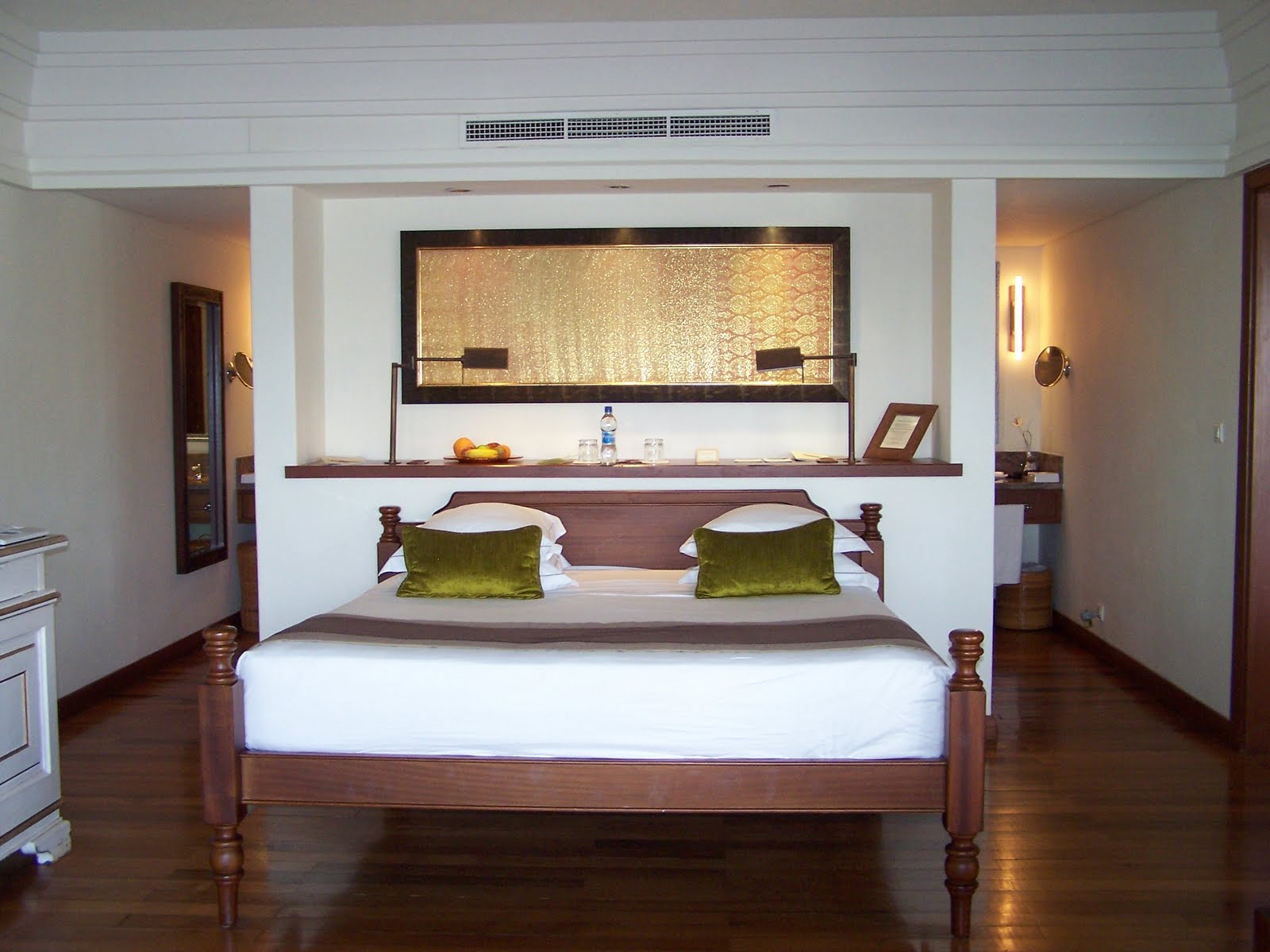
The standard rooms are billed as junior suites and are 70 square meters. The polished wooden floors, high ceilings and glass on three sides at the front (screened by wooden blinds for privacy), with french doors leading out to a large loggia with table, chairs, couch and gorgeous view, mimic the open air feel of the public spaces. Inside, in addition to the king sized bed, there's a sofa, coffee table (laid with champagne and sweets on our arrival), a desk and a large, flat-screen TV with internet access. (There's free wi-fi throughout the resort as well.) The view towards the lagoon and the mountains was the best part of our room, closely followed by the enormous and luxurious bathroom.

That had double sinks, his and her closets stocked with two dressing gowns per person (terry cloth for after bathing, cotton for relaxing), a large dressing area, separate rooms for shower and toilet, an enormous built-for-two tub complete with pillow for lounging and pot of lavender bath salts, and an oversized ottoman in the centre on which someone could sit to converse with the bather. We were delighted to spend many hours in our suite, and afternoon naps within it featured largely in our schedule. In fact, we were so immediately attached to the place that we ordered breakfast in the room on the first morning, which came with two waiters who brought not only food, but enough linen, china and silver to dress the table on our balcony as if we were in a top restaurant. Then they quietly disappeared, leaving us to enjoy our food and the view, swaddled in those cozy robes.

We didn't want to spend all our time indoors, of course. The beach called. The hotel features a long, completely private stretch of it. At the centre of things, overlooked by the pool and the main buildings, it's unoccupied except for a few dining tables in the sand. Want to have a formally served meal but not leave the beach? No problem. Relax under the umbrella and the staff will take care of you. On either side of this, stretching in front of the pavilions housing the accommodation, are large teak sun loungers with thick mattresses, arranged in pairs underneath big market umbrellas. Choose one, and a member of staff is there quickly with towels and bottles of cold water to help you make it your own. Lounge here long enough, and they may pop by with some ice cream or an offer to clean your sunglasses for you.

On one side of the pool are two restaurant pavilions and a bar, on the other side another bar. The latter had a small stage for entertainment, generally mellow jazz, plugged into a sound system that carried it around all the public areas. Further back, so to not squander the sea views, were several shops, the Air Mauritius office, the spa, a pitch and put green and a children's play area.

If you followed a raised walkway past our room for about a quarter mile, you walked into the lagoon, through mangrove swamps and to the hotel's floating restaurant. Four pavilions on pontoons, reached by bridges and lit by swaying lanterns, bobbed gently on the water as leaping fish added to the soundtrack of the night. We ate dinner here twice, and spent the rest of our time in the main restaurants.

A discussion of food, however, signals a transition to another entry. Mauritian dining, and our fabulous local cooking class, comes next.

Sunday, 18 September 2011

Mauritius is eastern-influenced melting pot with potential and disparity

I wrote this entry after returning from Honeymoon, but the posting date coincides with when we were actually experiencing what's described here.

I am fairly sure that I made it through my formal education never having heard of Mauritius, much less being able to identify it on a map.

I first encountered it in some history of piracy, no doubt. Its position in the Indian Ocean, between the southern tip of Africa and the Indian sub-continent, made it a perfect place to lay up while stalking trade routes. This is Captain Kidd territory. But it didn't come to prominence in my mind until we started discussing honeymoons. It is surely one of the Top 10 locations for European newlyweds who have the time and money for a long-haul trip.

And for good reason. The island, formed by a long-extinct volcano, has all the attributes of the stereotypical tropical paradise. Powdery white beaches bordered by swaying palms, hibiscus, bouganvilla and other exotic plants form the coastline. A reef rings much of the island, creating shallow lagoons glimmering turquoise and pale blue. Inland, the land rises to a central plateau dominated by sugar cane production, though fields of tea and all sorts of other vegetables intersperse. Like any volcanic territory, the earth is incredibly rich and well-drained; bananas, mangos and pineapple all grow wild by the roadsides to be harvested by locals as needed.

Pinnacles of black stone, their tips eroded into jagged, picturesque shapes, frame the horizon. Occupying the best coastal spots, as with most tropical paradises, are upscale resorts. Fantasies of thatched pavilions and infinity pools, staffed with graceful, smiling natives who provide unparalleled service. I'll get to that in a later entry.

But in this introduction to the island, it's important to say that dream world is just one small part of Mauritius, and not a representative one. We had excellent drivers on our one-hour transfers to and from the airport, and from them we got a good sense of what life is like beyond the resort gates.

The island is a true ethnic melting pot. It was uninhabited when discovered by Europeans, thus today's native population reflects the different peoples who came ... either as slaves, indentured servants or immigrants ... to work the cane fields. The faces are mostly African, Indian, Southeast Asian or a mixture thereof. It's a huge point of pride for the islanders how well everyone gets along. Most villages we drove through had a Catholic church, a mosque and, most impressively, a giddily-decorated, god-encrusted Hindu temple sitting cheek by jowl, and almost everyone will quickly use that as a proof point of community spirit.

Add to that the cultural overlay of colonialism: first Dutch, then French, then English. (Plus those pirates of every nation.) Today this is a part of the British Commonwealth and the official language is English. But, frankly, you'd never know that without a guidebook. In reality it's French that dominates here, and though everyone in the tourist trade pretends to understand your Anglo-Saxon words, a working knowledge of French will prevent a lot of misunderstandings.

This is no Shangri La, however. It's immediately obvious that this isn't a rich country. Once you're off the single main highway that cuts cross-island from southeast to northwest, the roads are winding, narrow and often bumpy. Look to the fields on either side and you'll see natives, many of them old women, hand harvesting with machetes and straw baskets. Villages are a haphazard hotch-potch of mouldering governmental buildings, tiny shops and snack bars, patches of waste land (some strewn with plants, others with rubbish) and brightly painted houses.

Many of these residences look surprisingly big for such humble villages, but this is because the Mauritians tend to live in multi-generational family groups; the average house may have 15 or 20 occupants. At least one of them is probably assigned middle-of-night water duties. Mauritius is suffering a drought, with global warming suspected to have interfered with the once-dependable annual rains. Thus while resorts fill their infinity pools with millions of gallons and sun-worshipping guests take multiple showers a day, the natives are limited to a couple of hours of running water daily, when they need to fill buckets to supply themselves for the other 22. They are philosophical about this, though. The hotels pay plenty for the water, the guests pay the hotels, it all puts money in the economy.

The villages are interesting to drive through, but offer little sightseeing. These are utilitarian places for living and putting food on the table, not Tuscan farm villages converted for picturesque exploring. In fact, you really don't see white (tourist) faces outside of the resorts and the official attractions. Indeed, one of our drivers confided to us that "whites" means rich people in Mauritian creole, even if they're Indian or Chinese. The average salary here is between £200 and £300 a month, roughly the same as most honeymooners are paying for a single night in their luxury suites. I suspect our view ... through a BMW window en route to and from manicured tourist spots ... was a typical tourist one. There's little trickle down effect to the "real" people from tourism, beyond the tips those in the industry take home. (And those, of course, can equal a month's salary in a few good days.)

Unlike many Caribbean islands, however, Mauritius isn't entirely dependent upon tourism. Those cane fields aren't just decorative; this is one of the world's major sugar producers. There's a thriving textile manufacturing industry, and the same geographical placement that made the island a hot spot in the days of sail is starting to come into play again as China and India continue their rise to prosperity. It feels like a place with great potential, yet it also, according to one driver, suffers the usual African problem of corrupt government. The rich and powerful are harnessing the country's resources for their own prosperity rather than for the general advance of the population.

In our limited exposure, we didn't hear or see anything to make that disparity a dangerous one. All the locals we talked to seemed happy, helpful, truly concerned that we were enjoying ourselves and inordinately proud of their homeland. Still, I left with a nagging concern for the future. There's clearly a lot of money pouring into this place, and tomorrow looks set to bring more. If that cascades down to help establish a comfortable middle class, then the potential here seems vast. If, however, all the profits stay in the hands of a few, then I have to believe that someday the Mauritians, despite their abundance of cheerful contentment, may lose patience and demand a bigger slice of the pie.

Friday, 16 September 2011

Honeymoon Overview: Balanced, idyllic and adventurous ... the trip of a lifetime

This entry was written after returning from Honeymoon, but the post date is the day we left on the trip.

Any regular reader will know that I'm a compulsive travel planner. It's a trait I got from my mother. As soon as one trip concludes, I'm online researching the next. I am inevitably the organiser of holidays, whoever I'm traveling with. So it was completely out of character for me to follow the age old tradition of running the wedding show, but leaving the honeymoon to the groom.

I am delighted I did. Not only did he do a fabulous job, but I didn't have to lift a finger. I just let the wonder of every day wash over me, unconcerned about what was coming but sure it was going to be great.

For two weeks of primarily laid back relaxation, there's an enormous amount to report on. So we'll start with this summary entry before dipping in to a series of articles on the specifics. Hopefully, you'll enjoy it, while the writing will help me hang on to the sun, service and romance for a little longer.

The trip divided into three distinct phases. First, soul-reviving sun and sea in Mauritius. Second, stimulating outdoor adventure in the South African bush. Third, foodie delight on the coast near Cape Town. We had generally good weather throughout, though the second week was a bit cooler than expected (making the fleeces we both purchased at the game lodge our major souvenirs of the trip.)

Our home for the first week was the Constance Prince Maurice, on the east coast of the island. A retreat of almost shameful luxury, we were told the staff-to-guest ratio was four-to-one. And though there are more than 70 rooms, the place is so well designed, and the spaces so generous, we often felt we were two of just a handful of guests. The hotel sits on a long lagoon screened from the ocean by a coral reef, providing the advantages of a private snorkeling area, wide, shallow swimming beaches and multiple water views.

Like so many tropical islands, there's a melange of culture here that makes it a cultural experience as well as a beach holiday. French, English, Indian and Southeast Asian influences all blend here, influencing food, architecture and social traditions. It ticked all my beach holiday boxes.

The exotic beach holiday had excited me most in the planning stages, but in the reality of travel, it was safari that brought the trip's most extraordinary moments. Mauritius and the Cape held elements familiar from other holidays; safari was completely unique. From the moment our private bush pilot met us at Kruger airport, walked us out to his six-seat Cessna, flew us over a landscape that had The Lion King soundtrack pounding in my head and landed us on a dirt airstrip he had to buzz once first to drive away the giraffe and warthogs, I felt like I was in a film. I had been on safari before (see 5.10.09), but this experience was vastly superior.

We were at Chitwa Chitwa in the Sabi Sand, one of a network of private game reserves to the west of Kruger National Park. There are no fences for hundreds of miles here. Wildlife wanders free, is fiercely protected and accustomed to the safari vehicles that accompany them each day. We saw the Big 5 (lion, leopard, rhino, buffalo and elephant) daily, often from a distance of less than 10 feet. The experience was enhanced by a knowledgeable and friendly staff, the handful of other guests and a jaw dropping suite that resembled our own game lodge rather than a simple hotel room.

I feared anything after this would be a disappointment, but the radical change of scenery and the culinary delights awaiting us in Hermanus were magical in their own way. This part of the Cape is, I suspect, what California must have looked like before humanity paved it over. A narrow coastal strip bordered by rocky cliffs, boulders jutting into the pounding surf and beaches in picturesque coves. Seals basking on rocks, flowers cascading along paths, mountains framing the view inland. In between those mountains, lush green valleys carpeted with vineyards and orchards. You'd be hard pressed to design a landscape more perfect than this one.

The point of Hermanus isn't just scenery and wineries, however. (As if that weren't enough!) It's whales. Specifically, Southern Right Whales, who spend their summers basking along this coast, giving birth, rearing young and mating to produce the next generation. The bay on which Hermanus sits is so full of the animals that there's no need for whale watching excursions. Linger on any cliff path bench, stare out to sea and it's unlikely you'll spend more than five minutes before spotting one of these giants send up a plume of spray through its blowhole, lift its fin out of the water for a bit of sunshine or breach with a massive splash.

I doubt there's anyplace more luxurious from which to watch this spectacle than Birkenhead House. Essentially an extremely upscale B&B. What was originally a private home atop the cliffs is now an 11-bedroom hotel built around a series of courtyards with pools and fountains, with a glamorous sitting and dining room, looking out on a wide terrace with infinity pool hanging over the bay. The meals served in that dining room were the best of our trip, with fantastic wine pairings.

We had one of the two oceanfront bedrooms. Quite small, and therefore lacking some of the magnificent bed frames we saw in the other rooms, but I'm a sucker for a view and this one was hard to beat. I saw my first whale before I got out of bed in the morning. The sliding glass doors on two sides of the room opened up a wide vista of sea and coastline, and we were welcomed with flowers strewn across the bed and a bottle of champagne. I was happy.

I have never had a better trip. Magnificent locations, complete pampering, succulent food and wine, and all in the company of my adored (and adoring, he adds in the editing process) husband. Flowers and champagne showed up on all the hotel beds, in fact. That's part of the magic of honeymoon. I suppose that a few nights in Bognor Regis would have been just as wonderful, given the extraordinary celebration of sharing my life with the man of my dreams. But I'm glad I didn't have to test the theory. One of the reasons he is my perfect match: he orchestrated this magnificent holiday, designed to trip every pleasure trigger I have. I fear the travel reviews in this blog will now be setting a much loftier standard.

For more on our adventures, stay tuned over coming weeks as I go into detail on the hotels, the food and the sights.