Showing posts with label Milan. Show all posts

Saturday, 14 June 2025

A rugby fan's first football game: average sport, impressive fans

My cousins are the sporty side of the family. They travel to championships and competitions the way my side sought out museums and history. My cousin acquires team-branded sportswear the way I hunt down regional food specialities for the larder.

Thus while my focus for this trip to Milan was introducing them to the Sforza Castle and the rooftop of the Duomo, their advance planning was all about snagging tickets to take me to an important Inter Milan game on the Sunday. Plus a shopping spree at the Inter store on Saturday to kit the whole family out appropriately.
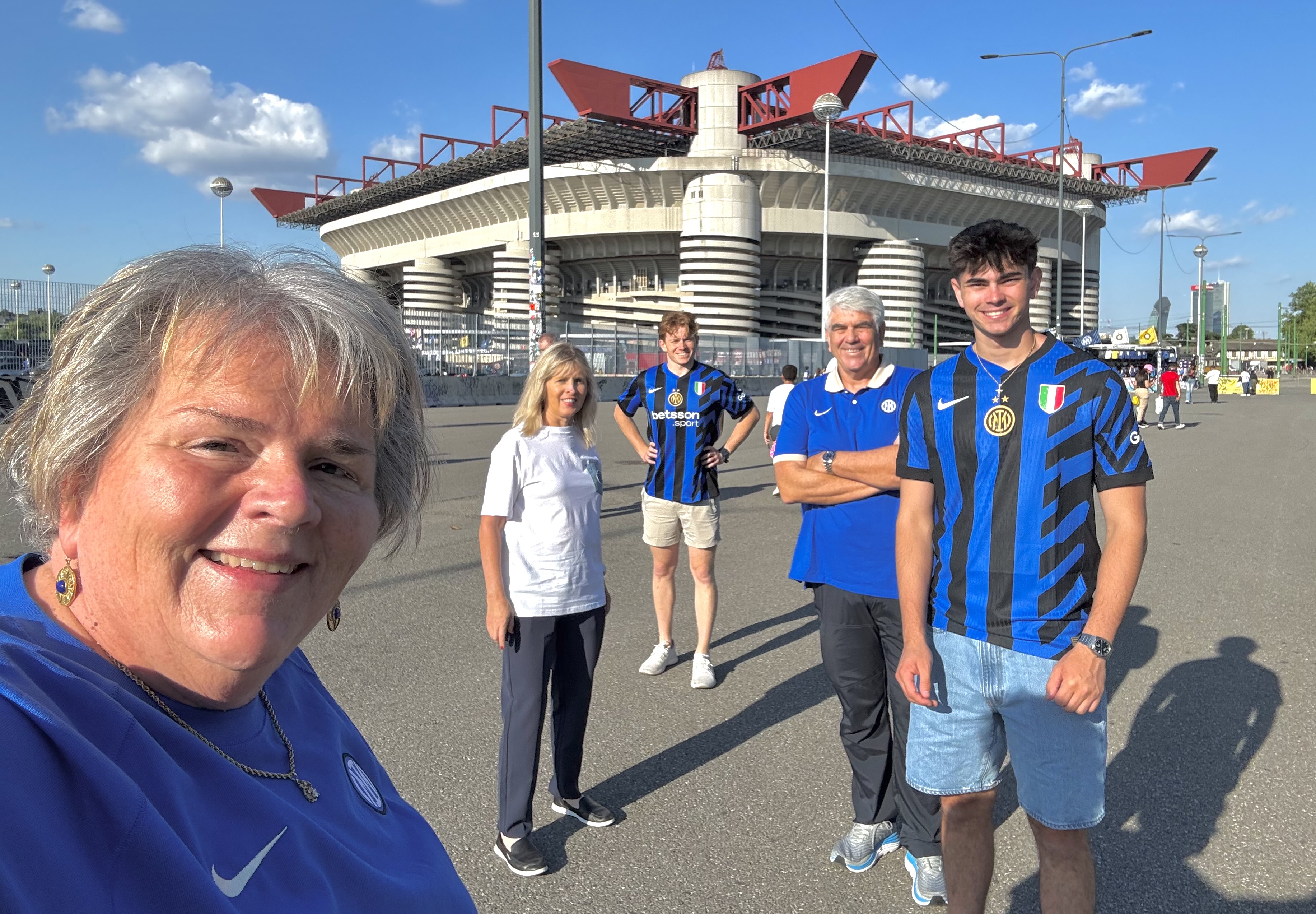
Athletic spectacles are not, as regular readers will know, entirely alien to me. As a St. Louisan, baseball is my birthright; I’ve seen Cardinals games in multiple cities — including London. Rugby features prominently in the Bencard social calendar, with at least five England internationals in our diary each year and a strong track record of following the team to foreign fields. At the end of this summer, we’ll be attending three Women’s Rugby World Cup games as the tournament plays out across England.

But I’d never been to a football match.

To be honest, I had never been tempted. As a rugby fan whose only exposure to football comes via television news — which is often as much about player antics, tacky wives and hooligan fans as it is about actual gameplay — the prospects weren’t promising. I approached the game with three primary prejudices:

1. Compared to rugby, football is slow and boring, with little action.

2. Football players are badly behaved prima donnas, collapsing dramatically at the lightest touch.

3. Football fans are thugs. The atmosphere is potentially dangerous, alcohol is banned in stadiums, and opposing fans have to be kept apart for safety.

That was not a recipe for enjoyment. But this was Italy, my cousin's sons were very excited, I had three large men to protect me, and I’m up for anything once. So why not?

Surprises from the Start
I was pleasantly surprised. The game was moderately interesting — still boring compared to rugby, but watchable, with some genuinely exciting moments. More importantly, there was no sign of bad behaviour. Though opposing fans are kept in separate sections, I saw no unpleasantness before, during or after the match. The crowd included far more women and children than I expected, and — contrary to what I’d heard — alcohol was available. In fact, as in American stadiums, vendors walked the aisles, passing drinks to your seat.

This may be down to practicality. The rows at Milan’s San Siro stadium are steeply raked, and the seats don’t flip up. Navigating past people already seated requires the balance of a mountain goat and a physique slimmer than mine. Only true desperation could tempt you to move once settled.

Though the original 1926 stadium has been updated — most recently in the 1990s — it’s not exactly comfortable. There are very few lifts and no escalators, so get ready to climb. The vertiginous elevation means everyone has a good view, but the lack of handrails makes descent fairly terrifying. One wrong move and you feel you could launch yourself like an Olympic diver onto the pitch below.

The Real Entertainment: The Fans

Any discomfort was worth it just to witness the show the fans put on. I’ve never attended a sporting event where the audience sustains such constant, passionate involvement. While most stadiums erupt during moments of opportunity or crisis, here the crowd is engaged from start to finish.

There are rituals to respond to each player’s name as the team is announced. Fan conductors on booming drums lead chants and songs, which the rest of the crowd bellows in unison. Supporters’ clubs from across northern Italy bring enormous banners and flags, waving them throughout. I couldn’t help but think of the group rituals of the Catholic mass and the precision of Renaissance flag drill teams — distilled into modern sport.

The game itself didn’t shift many of my prejudices. Though we got two goals from each team, at least 70 of the 90 minutes seemed to consist of men passing a ball back and forth with little effort toward scoring. The players certainly lived up to my image of them as delicate flowers. I confess to indulging in a few wicked fantasies of how they’d fare if three rugby players tackled them properly.

But my assumptions about the fans were totally overturned. Though the two sides were physically separated, there was no aggression. Everyone was cheerful, polite, and respectful. I was particularly surprised by how many families with children were there. In a country where queuing barely exists, fans at San Siro were as orderly as the English..

Food and Public Transport beat the British Experience
While the event food lacked the variety we enjoy at Twickenham — vendors span the world with British hog roasts, African barbecue, Eastern Mediterranean wraps and Asian salads — San Siro more than made up for that in quality. Here. you're pretty much limited to panini. Truck after truck of them, wrapping around the stadium. We weren’t expecting much, but it was late and we knew restaurants would be closed by the time we got back to the hotel.

What we got was a sandwich worthy of a proper restaurant: succulent chicken breast, grilled peppers and onions, some kind of piquant sauce, all tucked into crusty bread engineered to absorb and amplify the flavour of the juices. Perfection.

Even more impressive than the sandwich? The return journey on Milan's metro.

Anyone who stereotypes modern Italians as disorganised should experience Milan’s public transport during a major event. Turnstiles control entry to the station, with electronic screens above counting down the seconds until the next group is let in. Once the gates open, the screens display the number of people allowed in the next wave, counting down as passengers pass through. Once they reach their limit, the timers for the next intake return.

The result? No dangerous crushes. Once inside the station, the is kept at manageable levels; unlike the truly frightening crushes I've encountered at Twickenham or after an event at the 02. Milanese football fans outside at least know how long they’ll be waiting. It’s orderly, efficient and surprisingly calm. London could learn a lesson. And we could use one of those panini trucks at Twickers.
Find a video about my experience here on TikTok 

Thursday, 5 June 2025

A bit of culture and a lot of convivial dining dominate a return to Milan

I didn’t expect to be back in Milan just six months after entertaining you (hopefully) with our last adventure here. But my family from Los Angeles was starting a 10-day Italian holiday in the city. I hadn’t seen most of them in five years, so I couldn’t miss the chance and this was the most efficient place for us to meet up.

I had two days on my own before they arrived, then two days to show them around. They’re moderate sightseers but—unsurprisingly, given the cumulative total of Italian DNA in our bloodstreams—like to catch up over a dining table. So our adventures included a bit of culture, a lot of food, and a football match I’ll describe in my next article. 

Here’s a roundup of what we got up to. If you’re planning a trip to Milan, do consider this in partnership with my articles from December 2024. (Sforza Castle, which I revisited, was covered here.)
The Museo Poldi Pezzoli
Unlike the Certosa di Pavia, which I explored on my first solo day, this museum is right in the heart of tourist Milan—just a few hundred yards from La Scala opera house. Yet as far as visitor numbers go, it’s just as far off the beaten track.  I never shared a room with more than three other people as I wandered through this exceptional museum, very similar in size and mood to London’s Wallace Collection.

Like Sir Richard Wallace, Gian Giacomo Poldi Pezzoli was an aristocratic 19th-century collector who, having no children, donated his urban mansion and its collections to the nation. The Milanese palazzo houses a quirky and exquisite collection of treasures: late medieval and Renaissance art from Milanese masters, a Baroque room overflowing with porcelain and decorative arts, a couple of very famous Botticellis, an eye-popping collection of pre-19th-century clocks and pocket watches, jewellery, striking portraits, and an armoury.

My star sight, however, was the studiolo: Poldi Pezzoli’s personal study, and reportedly his favourite room—where he chose to be moved before he died. It’s a glorious combination of frescoes, gilding, stained glass, and sculpture, pushing 19th-century Gothic Revival to its limits in anticipation of the Italian Liberty style. A sumptuous jewel box of a room, and worth the price of admission alone.
The Duomo Roof Walk
This is about as solidly “on” the beaten track as you can get—probably second only to Leonardo’s Last Supper on the must-do list for Milan. There’s a reason for that: it is magnificent.

I’m on record saying the inside of the cathedral is a disappointment; its exterior is what’s worth your time. And there’s no better way to appreciate the splendour of the medieval stonework than to get up on the roof and see it close up.

You can walk up or pay a bit extra to take the lift, then do a circuit around the whole building, with a final climb up another set of steps along the front façade to reach the spine of the cathedral. It’s fascinating to compare the original statuary and decorative elements to newer replacements (easily spotted by their lighter colour), and to marvel at the level of detail. Much of this work would have been invisible to those on the ground, yet every fold of a robe, line of a cheek, or vein of a leaf is carved in loving detail—for the glory of God.

Even if you take the lift up, most tickets assume you’ll walk down. If you have a walking stick or mobility issues, you can talk the guards into letting you ride down as well.

Sunday Like Locals
My cousin’s wife has her own cousins in Milan, so we all came together for an extended family Sunday. We started with Mass at Santa Maria del Carmine. This is a church that, in Milan, is unremarkable and barely makes the guidebooks, yet would be a headline attraction in many other cities.

It has Renaissance bones, a Baroque altar lined with impressive life-sized silver reliquary busts, and a variety of side chapels ranging from original Renaissance to baroque to Gothic Revival. As a Catholic, I find attending Mass in a foreign country an interesting way to dip into local culture. The ritual is familiar, but the language foreign—you’re participating like a native, yet still an outsider.

The church sits in the heart of Milan’s posh Brera neighbourhood, which hosts an excellent Sunday market—mostly antiques with a few crafts. After Mass, we took a pleasant passeggiata through lively but not overcrowded streets, eventually circling back to almost exactly where we’d started.

Convivium Ristorante, just across the square from the church, was our lunch spot. Its eclectic East-meets-West design (including some enormous Buddha heads) contrasts with its resolutely Milanese menu. The staff filled our nine-person table with shared starters before we tucked into individual mains. The food was excellent, but secondary to the atmosphere—an ideal Sunday afternoon of familial connection, lingering until the place closed for its afternoon break.

Eating in the Galleria
Even more than the previous meal, this was about the experience rather than the food. You’re going to pay a premium—probably 20% to 40% more than elsewhere—for the same dishes you’d get across town, but you’re buying the privilege of sitting in one of the most iconic architectural spaces in Europe. 

Don’t bother with any of these restaurants unless you’re sitting outside with a view. Neoclassical buildings rise around you under a sparkling glass arcade, while the world promenades by on inlaid marble streets inspired by Ancient Rome.

We ate at Salotto, near the Piazza della Scala exit. I suspect all the restaurants here are similar: cheerful staff fluent in English, decent antipasti, weak spritzes, slightly soggy pizza—but no pressure to leave once you’re settled. That’s what you’re paying for, so linger. See and be seen.


Meat Feast
Il Mannarino is a top-quality butcher with an attached restaurant just south of Centrale Station (Via Carlo Tenca 12). Vegetarians need not apply. Culinary heretics who prefer their meat well-done should also stay home. But if you revere beef and pork, this is the place for you.

You order at the counter, take a seat, and wait for the magic. The family had just arrived after an epic trek from LA and were far too tired to make decisions, so we told the staff: just bring us nice things. A procession of delights followed. Highlights included rare bistecca fiorentina, meatballs, and Puglian bombetta—little meat rolls of pork shoulder and caciocavallo cheese wrapped in prosciutto and fried crisp.

Wine isn’t available by the glass—the smallest unit is a carafe. Sensible, really. This food deserves multiple glasses of red. 

Antica Trattoria della Pesa
Worth booking. Worth taking a taxi. This classic Milanese restaurant claims to be one of the city’s oldest in continuous operation. Today, its Porta Garibaldi neighbourhood has been transformed by cutting-edge redevelopment. This is where you’ll find the Bosco Verticale, high-rises planted with vertical forests and visible from the train station.

The restaurant itself is a holdover from when this was a gritty industrial area near one of Milan’s main gates. They set up the kitchen where the best produce first arrived in town. Their menu is firmly rooted in traditional Lombard cuisine, serving ossobuco and risotto alla Milanese on par with Trattoria all’Antica in the Solari district. (I would have returned there, but it was too far from our hotel. This was a worthy substitute.)

Where We Stayed
Continuing our loyalty to Club Accor—and collecting those all-important reward points— I tried out the Ibis Milano Centrale, near Centrale Station. While I prefer the Solari neighbourhood, with its Mercure and direct connection to Linate Airport, I was surprised to find I actually preferred this Ibis.

Technically, it’s  a lower-tier hotel than the Mercure, but the room décor was more cheerful, the lobby larger and more comfortable, with a proper bar and restaurant (unlike the Mercure’s pokey breakfast room). It’s also just a short walk to the stop for the Line 1 tram, which runs right past La Scala, the Galleria, and the Castle. I’m likely to book here again—despite its “budget” label, it was the better hotel.

Wednesday, 28 May 2025

The Certosa di Pavia rewards efforts to get off the beaten track in crowded Italy


The Certosa di Pavia is a perfect reminder that it’s still possible to see marvels in Italy without having to elbow your way through a crowd. You just need a bit of fortitude—and a willingness to stray from the usual tourist path. 

In central Milan, tickets to see Leonardo’s Last Supper sell out within 24 hours of coming online. The Duomo’s rooftop is impossible to access without booking well in advance, and the Castello Sforzesco is a magnet for dense, slow-moving tourist clusters. But just 25 miles south of the city centre lies the astonishing Certosa di Pavia. It’s every bit the masterpiece as those headliners in town, yet you’ll stroll right in—and likely have the place almost to yourself. It’s even free. Though good form suggests buying something from the monks’ shop, and a guided tour warrants a donation at the end.

“Certosa” is Italian for “Charterhouse,” the name used for Carthusian monasteries. This one was funded by the ruling Visconti family, dukes of Milan. When the last Visconti married into the Sforza line, the new dynasty took over the dukedom—and continued the sponsorship. The same people commissioning the blockbuster masterpieces of Renaissance Milan sent artists down here to decorate their private entry ticket to heaven. They spared no expense.

(Carthusians, by the way, have a long history of hosting lavish aristocratic patronage. Miraflores in northern Spain—with its royal tombs and perfume-making monks—is one of my favourite sites in that country.)

The complex, strategically located between Milan and Pavia—the first and second cities of the old Visconti-Sforza dukedom—is anchored by a glorious church. Its facade is encrusted with inlaid marble, detailed carvings, and Gothic pinnacles to rival any cathedral in Italy. Its architecture sits right at the junction of Gothic and Renaissance, managing to capture the best of both. A sequence of courtyards and cloisters surrounds the church. Some are open to the public; others can only be accessed on a monk-led tour. 
You know you’re in for something special from the moment you enter the gatehouse. Look up: frescoed Renaissance grotesques twirl overhead. Then emerge into a long rectangular courtyard, neoclassical façades embracing you, with the glittering jewel box of the church gleaming at the far end.

The church interior—and in fact the whole complex—has been much restored. It was shut down by Napoleon in 1796 and left mostly empty until the Italian government designated it a national monument 70 years later. You’d never know it had fallen into disrepair. Cross from the sunlit courtyard into the dusky interior and the first thing to catch your eye is the ceiling: alternating vaults painted in cerulean blue with golden stars and bold geometric patterns. The large, rectangular nave is spare, but the chapels along either side are brimming with masterpieces.

The floor plan is cruciform, but you’ll only get as far as the base of the cross before a towering wrought-iron screen blocks your way. The Carthusians were a cloistered order; they didn’t speak or interact with the public. Everything beyond the screen was for the monks—or their noble patrons. Today’s resident Cistercians are more outgoing. Several times a day, one of them will unlock the gate for a guided tour. The tour is in Italian, but you don’t need to understand it to join. (If your Italian is minimal, reading up in advance will help you appreciate what you’re seeing.)

What lies beyond the screen is even more extraordinary than what you have seen so far. 

In the arms of the cross-shaped plan you’ll find magnificent funerary monuments. One side holds the marble, recumbent figures of Ludovico “Il Moro” Sforza and his wife Beatrice d’Este. (Top photo.) History tells us he was never the same after her death—a grief that may have contributed to his disastrous invitation to French troops to help him defend his lands. That call for help kicked off a cycle of foreign invasions that kept Italy under outsider control for centuries. But Ludovico also bankrolled Da Vinci and sparked Milan’s greatest artistic flowering. Flawed though he was, his tomb is surrounded by artistic paradise: inlaid marble, frescoed walls, and stained glass of breathtaking quality. In the opposite chapel rests Gian Galeazzo Visconti, founder of the dynasty, in a far more flamboyant canopy tomb. Between the two, portals adorned with reliefs of noble faces lead to ornate sacristies bursting with gilded altars and woodwork marquetry. 

The choir and altar area at the head of the cross were redone in the late 16th century in full Baroque style: neoclassical temple elements, bronze statues in dynamic motion, and yet more exquisite marquetry. (Not quite as spectacular as the treasures at Santa Maria in Organo in Verona—but close.)

From the church, your guide leads you through the monks’ doorway into the first of two cloisters. This one offers a glorious view of the church’s rear façade. While the front blends Renaissance and late Gothic styles, the back leans hard into the Romanesque and Gothic. Stacked colonnades, soaring pinnacles reminiscent of Milan’s Duomo, and exuberant terracotta detailing are everywhere. You’ll also find a striking terracotta lavatorium, where the monks would wash before meals, and a frieze in the same style circling the cloister. If you’ve ever wondered where London’s Victorian architects got their ideas for all those fanciful red-brick embellishments—like those at the V&A—look no further. There are similar examples elsewhere in Italy, but none better than here.

The adjacent refectory may be more modest, but for those who couldn’t get tickets to see Leonardo’s Last Supper, Ottavio Semini’s version here offers a worthy consolation prize. While no match for Da Vinci’s genius, its setting—with original benches and tables still in place, and a pulpit projecting ten feet above the dining room floor—offers a more authentic sense of how these rooms were used. The refectory was a place of silent reflection, where monks ate without speaking while scripture was read aloud. Unlike Leonardo’s mural, now encased in a functional museum setting, this room retains its sense of sacred function. 

From this cloister you move into a second, even larger one. At first glance it seems plain—until you realise what you’re looking at. The lawn at its centre is bigger than a football pitch. Terracotta decoration continues around the arcade. And instead of monastic cells, this cloister is lined with individual houses. Yes, houses. If you ever found yourself consigned to a cloistered life, this would be the place to do it. 
Each monk’s home had its own entrance foyer, sitting room with generous fireplace, a clever drop-leaf desk built into a bookcase, a bedroom filled with light from leaded windows, and a private L-shaped garden with a shaded loggia. It’s hardly full compensation for a life of isolation, but certainly a generous interpretation of the vow of poverty.

One corner of this cloister offers a view out to the monks’ vineyards—just one example of the work they performed when not in prayer.

The tour ends with a walk down a long hallway leading back to the main courtyard. Along the way: a small museum and the monks’ shop. The Cistercians continue monastic traditions of agriculture and healing, offering honey, beer, wine, and herbal remedies prepared in a beautifully preserved Renaissance pharmacy. Photography is strictly forbidden inside. Fortunately (for my wallet), I had no checked baggage allowance on my flight and couldn’t bring any liquids home.

Despite being within Italy’s largest metro area (Rome is technically the largest city, but Milan takes this broader category), the Certosa is surrounded by fields growing rice for the famous  risotto Milanese. There is a profound, rural quiet. To process everything you’ve seen, stop at the Gra-Car café just outside the gatehouse. Nestled in a garden of herbs and roses, it served up a giant Aperol Spritz—with included side-platter of olives, crisps, and nuts—for just €8. I could have lingered for hours, but didn’t want to gamble with my return logistics.

And therein lies one of the reasons this place is off the beaten track. While it’s not necissarily hard to get to, it does require some effort. 

There’s a station at Certosa di Pavia, but it’s a 20-minute walk from the monastery. Trains are infrequent, and reaching Milan’s Centrale station requires a transfer. I opted instead for a frequent, inexpensive (around €4 each way) direct train to Pavia.

Even as a seasoned European train traveller with passable Italian, I found the system challenging. Multiple train operators run from Centrale, it’s not obvious which one you want without asking, and queues at the ticket desks were long. Ticket machines refused to print, and the mobile app wouldn’t let me register. Eventually I managed to buy as a guest via the website, but downloading the QR code was far from intuitive. Once I had it, I still had to decipher which platform to use—since Pavia is a stop en route, not an end point. The trick: the departure main hall just outside the platform gates has a big, electronic board that shows destinations will all the stops along the way.

All this faffing meant I was an hour behind schedule. (Allow time to admire Milano Centrale while you’re there—it might be Europe’s most majestic train station.) Once in Pavia, I had lunch in the lovely Piazza della Vittoria, then hunted for the bus stop to the Certosa. Apple Maps was off be almost two blocks, and there was no signage to help me correct my error. Fearing I’d run out of time, I hailed a taxi. And, tired and uncertain of return logistics, I called the same driver to bring me back. My cheap train, bargain cocktail, and free admission were ultimately offset by €70 in cab fares. Oh—and the return train was half an hour late.

One more tip: the monks close for lunch. Check the website for exact opening times.

So, fair warning: getting off the beaten track demands patience, effort, and cash if you want to speed things up or cut down on the walking. But the reward is immense. You’ll have the time and space to reflect—without interruption—on spectacular treasures. In Lombardy, the Certosa di Pavia is the finest example. 

Friday, 20 December 2024

Milan’s cultural wonders deserve more attention than the average tourist gives them

Milan may be Italy’s richest city and its business hub, but when it comes to tourism it’s an also-ran. People may arrive here, but they’re more likely to be in transit through town en route to Venice or Florence. They might pop in to da Vinci’s last supper, or use a hotel here as a base for a day trip to Como, but they’re unlikely to linger.

That is a shame. 

Milan is as rich in history and cultural gems as any of the more popular destinations. Though it’s lacking in rustic charm and feels more modern than other Italian towns, the very fact that it’s less dependant on tourism than its neighbours makes it more authentic than the staples of the tourist route.

Most visitors start with the Last Supper, as well they should. It one of the great masterpieces of Western Art. Seeing it takes long-range planning. The official website opens sales for three months’ worth of tickets at a time, and they quickly sell out. We booked our tickets for early December on the first day of their availability, 24 September, when tickets for November, December and January became available. The official website does not publish those drop dates very far in advance. Your best bet is to follow them on social media and check regularly; they announced new ticket availability on their Instagram feed about two weeks before the date.

Adult tickets are €15. You may be able to get in without advance planning, but it will cost you a lot more. A handful of official tour guides get blocks of tickets they resell as part of packages, but these tend to go for well over €100 per person. Sure, you’re getting a guide and a tour of a few other things nearby, but it’s a huge difference. Go for the standard admission unless a last-minute trip gives you no other option.

So what’s the big deal? Da Vinci anticipates the immediacy of film by 400 years, dropping us into a moment of high-tension live action that’s been freeze-framed. If you need proof of just how revolutionary this painting was, you only have to turn around and look at Giovanni Donato da Montorfano’s Crucifixion on the opposite wall. It’s beautiful, and it was painted at roughly the same time, but it’s almost cartoon-like. It’s bland and devoid of emotion in comparison to Leonardo’s masterpiece across the hall
Visits last 15 minutes, admit 35 people at a time and are orchestrated with a rigorous efficiency that may cause you to re-evaluate Italian stereotypes. You will turn up a bit before your booked time, go through the security screening, then pass through two air-locked rooms. The high tech procession allows the curators to control exactly the temperature and humidity of the old refectory that the Last Supper decorates, and while you’re waiting you can read useful information about what you’re about to see. The painting’s history has been precarious. Most people know the stories of Leonardo’s experimental fresco technique starting to fade almost as soon as he completed the work, and of Napoleon’s troops abusing the space, but not that the whole room was almost destroyed in WW2. Photos of its wall standing in the open air surrounded by rubble are striking. 

 Recent renovations have worked wonders and the strict visiting procedure makes the experience a joy. In so much of Italy you’re jammed shoulder-to-shoulder with others trying to get a glimpse of the star sights. Here, there’s plenty of space to drink it all in and sit in wonder before you’re moved on. While true art lovers could spend hours in there, 15 minutes seemed the perfect amount of time for most people to appreciate the details without getting bored.

Sadly, I watched most visitors come and go from the Last Supper without ever checking out the church next door. It is the anchor of the monastery complex da Vinci was working to beautify. Santa Maria delle Grazie was a Dominican church and was the burial place of the Renaissance ruling family, the Sforzas, ergo the artistic firepower lavished on the place. It’s had as hard a time as its refectory, with the tombs being moved out by later rulers and the French looting its best painting. (Titian’s altarpiece of Christ Receiving His Crown of Thorns is in the Louvre these days.) But nobody could move Bramante’s dome, which is as much of a masterpiece on the architectural side as the Last Supper is to painting. It’s innovative and unusual; Bramante was introducing Renaissance style to Milan. Outside it’s a curious mash-up of plaster and brickwork, arcades and neoclassical windows. Inside it’s clearly drawing inspiration from the Pantheon with its coffers, but Bramante throws in all sorts of other classical shapes. It’s an elegant study in geometric forms.

The next most visited place in town has to be the Duomo and the streets immediately around it, for good reason. Milan’s cathedral has one of the most gorgeous exteriors in Europe, a fantasy of gothic spires and fantastic statues. It’s even better now that it’s been cleaned and really does resemble an ornate wedding cake. Walk all of the way around it to appreciate the variety of sculpture. The cathedral wasn’t officially finished until 1965 and there are some surprisingly modern gargoyles around the back. Skip the interior if you are short on time. Like many European churches it’s a mix of different time periods and styles, but the Milanese manage to be particularly graceless and heavy-handed putting it all together. The quality of some of the art in here is shockingly second rate, given the wealth of the great and the good in town.

I think it might be the ugliest cathedral interior in Europe. The strange, chunky gothic capitals on top on the ponderous supporting pillars are particularly awful.  It’s not just my opinion. The famous British art critic John Ruskin wrote that the cathedral ”steals from every style in the world, and every style spoiled.” The round classical temple sheathed in patterned silver that serves as a high altar is a bit of a redeeming feature for me, but it clashes so badly with its surroundings it’s hard to take seriously. See what you think.

The streets immediately around the cathedral are full of elegant boutiques and luxury brands, most notably the cross-shaped Galleria Vittorio Emanuele II. This is surely one of the most beautiful shopping malls in the world, full of elegant restaurants as well as shops beneath its glass barrel vaults. You’ll pay a premium for anything here, of course, but if you want to see and be seen this is the spot.

Cross through the Galleria to the Piazza della Scala to see the famous statue of da Vinci. He’s facing one of the most famous opera houses in the world, the Teatro Alla Scala. Our timing was terrible. It was opening weekend of the new season, with performances restricted to patrons and no tours taking place to facilitate the national broadcast of opening night. Opera in Italy is a big deal. But under normal circumstances there are regular tours of the interior and tickets for performances are easily bookable via their website. Prices are much closer to London’s Royal Opera House, however, than to the bargain that is the Teatro Massimo in Palermo.

My favourite cultural experience of the weekend, after getting one-on-one with Leonardo, was a leisurely ramble around Castello Sforzesco. This is one of the largest castles in Europe, a quintessentially Renaissance assertion that something can be both lethal and beautiful. It’s free to walk beneath its massive gates and explore its lovely courtyards, but you’ll have to ante up €5 to get inside. This has to be the best value for money in Milan.

Technically, there are nine different museums here, all entered by this one ticket. The scale and range of the collection is on par with any of the major museums of Europe, and in many cases the rooms and their painted ceilings are as interesting as the collections displayed within them. It would take at least a full day to walk through everything, many more to view the collections in depth.

With only a few hours, we started with one of the museum’s great treasures: an unfinished pietà by Michelangelo. This has been restored relatively recently and moved to a new display space that reflects its importance; it has a whole hall to itself and the explanatory displays about it and its artist. We wandered through the “Museum of Ancient Art”, which is a bit of a misnomer. It’s mostly sculpture from late antiquity through the high Renaissance, plus an armoury. The arms and armour collection is small compared to those in Vienna or London’s Wallace Collection, but it’s worth checking out just for the gorgeous display of Ludovico Sforza on his horse, both recreated in lifelike detail and dressed in their parade armour. This is also the part of the castle that has the most impressive rooms, including a large chamber frescoed by Leonardo to give the impression of being deep in a magical wood. The painting is in terrible shape but you can make out enough to be impressed. Restorers are trying to recover more.

The Applied Arts Collection is an Italian equivalent to the V&A. Objects range from the Middle Ages to modern times, with much from the Sforza family making the Renaissance galleries predictably strong. There are whole interiors pulled out of buildings, furniture, lush decorative objects, glassware and jewellery. It’s so big that at one point we got lost and drifted into the painting collection. By this point we were too exhausted to even contemplate the hundreds of metres of canvas-filled galleries ahead of us … despite the prospect of some Caravaggios … and doubled back, using my bad knee as an excuse to talk the guards into letting us go out the entrance. We didn’t even touch the Egyptian Museum, the print collection, prehistoric stuff and special rotating exhibitions.
That was the extent of our sightseeing time but was only the tip of the Milanese cultural iceberg. The Brera Art Museum and the Basilica of Saint Ambrogio would have been next on my list. I wouldn’t have minded a day trip down to Pavia and its magnificent Certosa, of which I have misty but dazzling memories from childhood. Lake Maggiore and its magnificent palace on Isola Bella lies in the opposite direction. And I wouldn’t mind a much deeper exploration of the local wine scene. 

Clearly, Milan is not just for business trips and getting to other places in Italy. It’s a tourist destination in its own right.

Sunday, 8 December 2024

Milan’s improved since my last visit. Go for the year-round fun, not Christmas markets.

Germany is the logical destination for a weekend break dedicated to Christmas markets, and I wanted my husband to experience something like the giddy fun the Girls’ Trip had in Munich last December. But this was going to be the last trip in my Big Birthday Year of Italy. Thus I opted for a non-traditional pre-Christmas weekend in Milan. 

The flights were cheap, we could use loyalty points for the hotel and it was an easy drive for our dear friends to drive down from their home on Lake Annecy to meet us. The Milanese PR also said they had Christmas Markets. So why not?

The verdict? If Christmas markets are your prime objective, stick to places north of the Alps. There was a pleasant spread of stalls around the Cathedral, typical of most German-style markets with a bit more emphasis on food. Given that Milan is the home of the Christmas staple, panettone, I was hoping to find lots of artisan makers hawking special varieties. Nope. The market promoted as the biggest in Milan, running around three sides of the Sforza Castle, had little Christmas theming. Most of its stalls were reminiscent of a low-end Saturday town market. Despite there being little to tempt, the crowds were fierce.

Decorations around the city centre are pleasant, with the most picturesque scenes being in front of the Duomo and in the Galleria, but there’s nothing extraordinary. A further drawback is likely to be the weather, which in Milan in December has a fair chance of being cold, wet and misty. You’ll get the same weather with better markets and decorations in London.

However, if you think of Christmas theming as a small bonus and concentrate on the bigger picture, it’s obvious that Milan is a fantastic location for a quick weekend break. With its easy transport links, sophisticated social scene, dignified architecture, phenomenal restaurants, upscale shops and a shortlist of cultural blockbusters, there’s enough here to give you a great four days without overwhelming you.

It’s been years since I’d been here; at least 17, given that this is its first appearance in Bencard’s Bites. All of my adult knowledge of the place was work-related. I spent a lot of time here on a project in the late ‘90s and had returned after that for several conferences. I always found it pleasant enough but a bit boring compared to Tuscany and points further south. But I had roots here. I’d first set foot in Italy … and in Europe … when I spent a summer here living with a family in the hills outside of the metropolis.

Modern Milan has changed significantly from my memories. The public transport system is now fabulous, with frequent trams above ground and an underground system that … as of a line extension completed just a few months ago … whisks you straight from Linate to the centre of town for less than £3. The Duomo, and much of the centre of town, has benefitted from a huge cleanup campaign and sparkles with clean, pale marble facades.

The most significant change from a tourist perspective, however, is the restoration of the Navigli area, which was a rough, rarely-considered industrial zone when I last knew the city. Now, what was once the docks has become as popular with visitors as the central streets around the Duomo. 

The geographically savvy amongst you will wonder at my use of “docks’, as Milan is neither on the coast nor can boast a major river. From the Middle Ages, however, it was home to an impressive network of canals linking it to the rest of Northern Italy, and they all converged in what’s now known as Navigli. Warehouses, workshops and later train lines followed. These days most of the canals have been filled in, but the Naviglio Grande has become a stately watercourse lined with imposing, restored buildings now hosting restaurants, bars, galleries and quirky shops. 

The canal is the heart of the district but the attractions sprawl down streets branching from either side. It’s become the go-to place for nights out, a hub of noteworthy restaurants, and I suspect is also quite a fashionable place to live. Even on a grim Friday night in early December, the whole area was heaving. Bar hopping here on a clement May evening would doubtless be a non-stop party.

Cocktail bar Backdoor 43 is a glowing example of what makes this district so special. Inspired by American speakeasies of Prohibition days, you gain entry when you knock and a small hatch to one side slides open to ask your business. You’re unlikely to get in without a reservation, though you can order cocktails to go through the hatch. Inside is a space about the size of a walk-in closet, with room for up to four. You book for an hour, and in that time you enjoy the services of a private bartender who discusses your tastes and comes up with custom cocktails for each of you. In a typical hour, you’ll probably each have two. We were impressed with our bartender, who seemed to have an encyclopaedic knowledge of his subject and came up with six radically different drinks for the three of us across our time slot. Only once did an attempt fail to delight the drinker; he immediately dumped that attempt at no charge and came up with another option that hit the mark. 
The tiny space is beautifully decorated with polished dark wood panelling and shelves from an old pharmacy, towering to a ceiling decorated with a world map far above your head. Careful design means the bartender can reach scores of different options, including all sort of liqueurs decanted into oversized test tubes. A fabulous jazz soundtrack plays behind it all, though you can change the music to anything you fancy. This experience was as much a highlight of the trip. as DaVinci’s Last Supper; these are the two things you simply must book in advance. Backdoor 43 is actually an adjunct to the Mag Cafe next door, so if you wanted to continue drinking or get a bite to eat, one assumes the quality remains as high. We were off to a dinner reservation elsewhere. I’ll cover food in a separate article.

Our hotel, the Mercure Milano Solari, was on the edge of the district. It’s a slightly odd place that falls short of the usual Accor chain standards: marble floors and hard modern furniture might be stylish, but the lack of soft furnishings combined with intermittent heat meant a cold stay; the lobby and dining area/bar feel more like amenities in an office building than a hotel; the front desk messed up both our and our friends’ reservation, in the latter case leaving the exhausted couple waiting and potentially roomless for too long at 1 am, despite a confirmed reservation. A weird layout, broad variation in room designs and two different entrances makes me suspect this is a converted apartment building rather than a purpose-built hotel.

And yet, I’d probably stay here again. Why? Beside the loyalty programme points: location, location, location. It’s a 300 metre walk to the Metro station (Coni Zugna) that whisks you direct to Linate in about 25 minutes. Trams heading into the city centre are a short stumble from the front door. Depending on traffic, the Duomo is as close as 10 minutes. On foot, that same 10 minutes will take you to the Navigli Grande. The number of top quality restaurants between the hotel and the canal is staggering; you could probably eat in a different place every day for a month without ever needing any transport besides your feet. 

Like any location in Italy, dining is as important as history or culture. It is, of course, a component of both of those things. So coming next: the food.