The same can not be said of Copenhagen, which is now so firmly established as a capital of cool and a culinary hot spot that its normal crowd of visitors accelerates to a heaving mass in the summer holidays.

Sadly, we were the victims of the last as ... returning in a taxi from dinner one night ... a man assaulted my husband on the steps of our hotel, stripped him of his watch and ran off. Two conscientious police officers were on the scene in 15 minutes, took a full report, collected the hotel's cctv of the event and even did a swab of my husband's arm in hopes of finding the bad guy's DNA. (Tourists, don't expect that in London!) Their care, and the horror of the hotel receptionist who saw it all, somewhat assuaged the shock of the whole thing. But we learned a lesson: tourists should be as wary in Copenhagen as anywhere else in Europe during high holiday season.
Fortunately, crowds are a relative thing. Nowhere in the Danish capital is going to be as unpleasantly jammed as Florence or Versailles, and most people stick to a very narrow tourism flight path. It doesn't take much to step outside of it and see other wonders. Though the area near the (underwhelming) Little Mermaid statue is uncomfortably packed, if you linger at the far more impressive Gefion fountain nearby you'll find a comfortable seat from which you can appreciate the cascading waters and watch busloads of tourists on the far side of the fountain trudging to and from the more famous landmark.
 Walk a few yards Southwest and you'll be in the pretty Churchill Park, almost free of tourists. St. Albans, the English church on its edge, is well worth a visit. At the time of its construction Britain's Princess of Wales was a Dane (Alexandra), so the building went up with significant royal backing. Royal Doulton contributed a custom-created font, lectern and reredos, now recently cleaned and well worth a detour for decorative arts geeks.
 So is a fantastic life-sized sculpture of a wind-whipped Valkyrie on horseback, on the other end of the park.
 Even the main attractions aren't so bad if you bide your time to let the tour groups pass by. There are, however, more of them than ever to dodge. Copenhagen's tourism board said it expected a record 1.2 million cruise ship passengers to visit Denmark this year, almost all of them stopping off in the capital. Fortunately they're usually on tightly-timed, escorted tours so never linger long in one place. This was particularly obvious in the National Museum, a treasure trove of pre-historic and Viking artefacts and one of my favourite gift shops in town. I've written a full article about it here.
 Even if you've visited the collection before, it's worth a return to check out the new "Meet the Vikings" galleries. They've divided opinions in Copenhagen, and in the Bencard family. Clearly feeling pressure to modernise and no doubt influenced by the reach of Amazon Prime's television show, the museum has turned three galleries over to a blatantly populist approach. Created by a Danish designer and TV presenter named Jim Lyngvild, the exhibition plucks some of the most significant pieces out of the collection and uses them to "dress" imagined Vikings. We see the characters and the artefacts in highly-detailed, oversized photos and in vividly-lifelike models (complete with tattoos, scars and showy moustaches.) Artefacts are in cases below and beside the characters. You're even invited to sit on the king's throne.
It's good fun and does bring this world to life, but there's a lot of imagining and "what if" going on here. I thought it was a fun way to spark the imagination and get kids (or simply the less interested) into the topic. My husband was irritated by the leaps into historical fiction. When it opened last year, a lot of serious art historians were frustrated than the museum poured money into this at the same time it eliminated more than 20 jobs. Visit the exhibit to make up your own mind; it's included in general museum entry.
You'll be both cruise-group and controversy-free at the Medical Museion, an unlikely destination unless you are in the health care field, studying to join it or have a relative who's a curator here. Our detour to say hello to my husband's cousin turned into an unexpectedly fascinating hour of exploration.
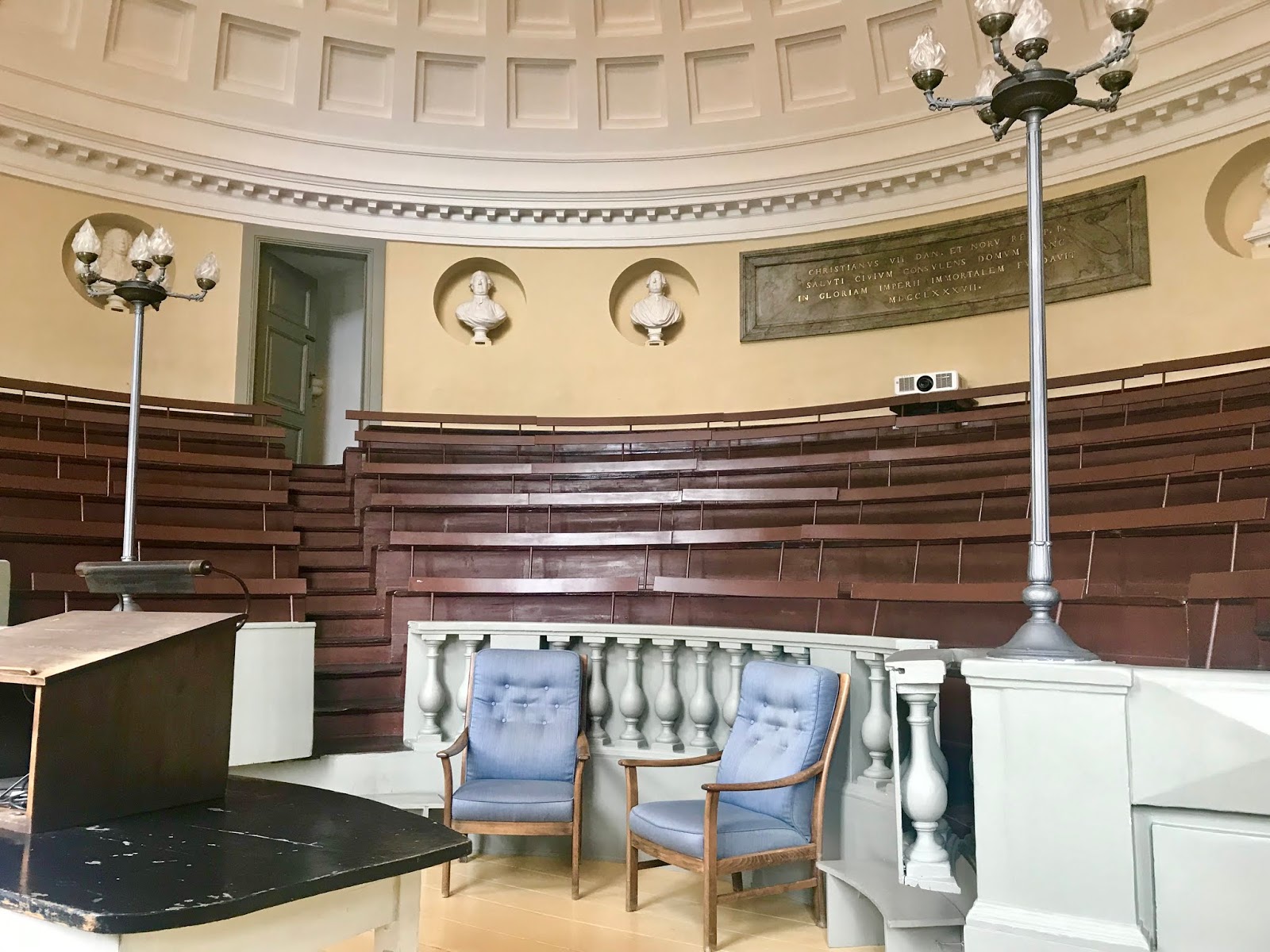
There's a large collection of medical samples, not for the squeamish, assembled by doctors a century or more ago to study the human body and its diseases. An architectural highlight is the neo-classical dissection theatre, a grand indoor amphitheatre facing a "stage" backed by tall windows letting in all-important light. In the basement there's an award-winning exhibition (curated by Adam Bencard) called Mind the Gut, which examines the relationship between the brain and the stomach. (Something I, sadly, have far too much experience with. Though it does provide you, dear reader, with a lot of fine restaurant reviews.) There's a lot of fun stuff to balance the academic inquiry here, including an artsy and entertaining film that shows how digestion works (yes, really) and an interactive quiz that generates your healthy mind and gut diagnosis. I'm supposed to always remember to escape and not let ideas leak away. No change there, then.
 Neither tourists nor locals seem to take much notice of another of my favourite sites in Copenhagen: the central train station. People make pilgrimages to see the station in Porto, Monet immortalised Paris' Gare du Nord, yet I find this building just as striking and almost unknown. There's little information in any guide books about it, other than revealing that it was built at the start of the 20th century and designed by Heinreck Wenck in what's known as National Romantic Style. This was a bit like the Gothic Revival in the UK, but when the Brits looked backwards, the Danes mixed their historic architecture with modern elements to come up with something more like Viking Art Deco.
The station is most striking for its wooden roofs, both in the main hall and the train shed, which give the buildings a grand yet deeply historic feel. The exterior is castle-like, and both interior and exterior share design elements recognisable from the collections back at the National Museum: Romanesque arches; ironwork in looping, Viking-style filigree, statues of Danes in historic dress, crests in glazed terracotta, stained glass windows. It's a delight. And is one of the easiest and most direct connections from airport to city centre in all of Europe. If you're flying to Copenhagen, don't waste your money on a taxi. Take the train into town and enjoy this architectural masterpiece on your way through.
 There's a vast variety of hotels within a short stroll of the station, but it's worth appreciating some nuances of geography. To the North and East of the station's main entrance are some of the city's most expensive lodgings. The pleasure grounds of Tivoli and its world-class Nimb Hotel are literally right across the street from the Eastern exit from the main hall. Exit to the West, however, and you're in the old red light district. As such places go, this one is fairly innocuous and the city is doing its best to redevelop it into a trendy tourist area. In the blocks closest to the station it's mostly hotels and restaurants. There's none of Amsterdam's blatantly seedy sexuality on display, and the less observant wouldn't even note the change in neighbourhood. In the four square-block area between our hotel, the station and the neighbourhood dividing line of Vesterbrogade, there was one low-key sex shop and one "gentleman's club" with fairly upscale branding. I wouldn't have noticed the handful of working girls on the street corners had my husband not pointed them out.

Though the hotels here are just a few blocks from their posh counterparts, the subtle shift in neighbourhood brings the prices down. And perhaps makes management try harder. The Andersen Hotel here is my favourite of all the places we've stayed in four trips to Copenhagen. The staff works hard to earn their boutique branding, with hand-written notes welcoming you to your room, a free wine happy hour in the afternoons and an honour bar at other times, and a basket of knitting in the lobby ... which feels more like a living room or cocktail lounge than a hotel ... inviting you to make scarves for homeless people. The rooms have individual temperature control, including air conditioning, which is a bit of a luxury in old European buildings. The decor includes fun light fixtures and splashes of bright colour, a relief in a country where traditional Danish modernism can fade into boredom when applied on a corporate scale.
 Unfortunately, I also have to factor getting robbed within clear view of the hotel's front desk into my review. (It was 11:30 at night. Late, but by no means unsociable hours.) The hotel staff was mortified, getting the police there quickly, apologising repeatedly and leaving a note and chocolates on our bed the next day. I would happily return here with my husband or a group of friends and keep my guard higher, but I wouldn't recommend it for a single female traveller.
Bottom line: Copenhagen is worth visiting at any time of year, but August can make this delightful city hard work. Spring and autumn are much better for drinking in the city's laid back aura.


 Even if you've visited the collection before, it's worth a return to check out the new "Meet the Vikings" galleries. They've divided opinions in Copenhagen, and in the Bencard family. Clearly feeling pressure to modernise and no doubt influenced by the reach of Amazon Prime's television show, the museum has turned three galleries over to a blatantly populist approach. Created by a Danish designer and TV presenter named Jim Lyngvild, the exhibition plucks some of the most significant pieces out of the collection and uses them to "dress" imagined Vikings. We see the characters and the artefacts in highly-detailed, oversized photos and in vividly-lifelike models (complete with tattoos, scars and showy moustaches.) Artefacts are in cases below and beside the characters. You're even invited to sit on the king's throne.
It's good fun and does bring this world to life, but there's a lot of imagining and "what if" going on here. I thought it was a fun way to spark the imagination and get kids (or simply the less interested) into the topic. My husband was irritated by the leaps into historical fiction. When it opened last year, a lot of serious art historians were frustrated than the museum poured money into this at the same time it eliminated more than 20 jobs. Visit the exhibit to make up your own mind; it's included in general museum entry.
You'll be both cruise-group and controversy-free at the Medical Museion, an unlikely destination unless you are in the health care field, studying to join it or have a relative who's a curator here. Our detour to say hello to my husband's cousin turned into an unexpectedly fascinating hour of exploration.
There's a large collection of medical samples, not for the squeamish, assembled by doctors a century or more ago to study the human body and its diseases. An architectural highlight is the neo-classical dissection theatre, a grand indoor amphitheatre facing a "stage" backed by tall windows letting in all-important light. In the basement there's an award-winning exhibition (curated by Adam Bencard) called Mind the Gut, which examines the relationship between the brain and the stomach. (Something I, sadly, have far too much experience with. Though it does provide you, dear reader, with a lot of fine restaurant reviews.) There's a lot of fun stuff to balance the academic inquiry here, including an artsy and entertaining film that shows how digestion works (yes, really) and an interactive quiz that generates your healthy mind and gut diagnosis. I'm supposed to always remember to escape and not let ideas leak away. No change there, then.
The station is most striking for its wooden roofs, both in the main hall and the train shed, which give the buildings a grand yet deeply historic feel. The exterior is castle-like, and both interior and exterior share design elements recognisable from the collections back at the National Museum: Romanesque arches; ironwork in looping, Viking-style filigree, statues of Danes in historic dress, crests in glazed terracotta, stained glass windows. It's a delight. And is one of the easiest and most direct connections from airport to city centre in all of Europe. If you're flying to Copenhagen, don't waste your money on a taxi. Take the train into town and enjoy this architectural masterpiece on your way through.


Though the hotels here are just a few blocks from their posh counterparts, the subtle shift in neighbourhood brings the prices down. And perhaps makes management try harder. The Andersen Hotel here is my favourite of all the places we've stayed in four trips to Copenhagen. The staff works hard to earn their boutique branding, with hand-written notes welcoming you to your room, a free wine happy hour in the afternoons and an honour bar at other times, and a basket of knitting in the lobby ... which feels more like a living room or cocktail lounge than a hotel ... inviting you to make scarves for homeless people. The rooms have individual temperature control, including air conditioning, which is a bit of a luxury in old European buildings. The decor includes fun light fixtures and splashes of bright colour, a relief in a country where traditional Danish modernism can fade into boredom when applied on a corporate scale.
 Unfortunately, I also have to factor getting robbed within clear view of the hotel's front desk into my review. (It was 11:30 at night. Late, but by no means unsociable hours.) The hotel staff was mortified, getting the police there quickly, apologising repeatedly and leaving a note and chocolates on our bed the next day. I would happily return here with my husband or a group of friends and keep my guard higher, but I wouldn't recommend it for a single female traveller.
Bottom line: Copenhagen is worth visiting at any time of year, but August can make this delightful city hard work. Spring and autumn are much better for drinking in the city's laid back aura.


