Showing posts with label The Queen's Gallery Buckingham Palace. Show all posts

Wednesday, 1 February 2023

It’s good to be king. Especially when you’re collecting Japanese art.

Given the intensity of our cultural sightseeing across the three weeks we spent in Japan in 2019, I didn’t rush to get to The Queen’s Gallery at Buckingham Palace for Japan: Courts and Culture. That was a mistake. I imagined the royal family’s stuff couldn’t be that different than what’s on display at top Japanese museums. I was wrong.

It’s not the kinds of objects that differ, but their quality. All the things you’d expect to see in any Japanese exhibition are here: Samurai arms and armour, lacquer boxes and furniture, delicate porcelains, beautiful screens, exquisite prints. Everything was either acquired by a royal for his or her personal collection, or received as a gift from either the government or … more often … the imperial family. In the period between the commercial opening of Japan in 1853 and the beginning of WWII, both countries were empires with an exalted opinion of themselves and each fancied the other their match on the other side of the world. The gift giving was prodigious.

Of course, as any fan of Japanese culture knows, it’s more about elegance and craftsmanship than bling. So what you get here in four tasteful galleries is a subset of art and craft that exemplifies tasteful perfection. It’s all breathtakingly beautiful, one of a kind and manages to pull off that Japanese trick of being both simple and complex.

Britain’s fascination with Japan is an old one. The most striking piece in the first gallery is a set of armour sent as a diplomatic gift by the newly-established Tokugawa shogunate to King James I and VI. It’s hard, in our diverse and variety laden world, to imagine just how alien that beautiful but menacing costume must have been in Renaissance England. Given the age’s love of the exotic, and James’ love of both showing off and of beautiful things, I suspect he adored it. More intriguing, if you can tear your brain away from the sinuously writhing dragons, the spectacular flared helmet and the silk needlework that makes the arm covers look a bit like feathered wings, is the contemplation of what this could have meant. It invited trade. Had the country not changed its mind 20 years later, how might British trade and expansion have changed?

The Tokugawa armour was a false start in international relations, however, and from the 1630s to 1868 the British royals were just like everyone else. They had to buy from Dutch traders, the only Europeans the Japanese let in during their time of isolation. (The Dutch, thought the Japanese, so obviously put money above religion or making social judgments that they didn’t bring the risk of cultural contamination other Europeans threatened.) Seeing the spectacular pieces of porcelain Queen Mary I brought into the collection, you have to wonder if the fact she was Queen of the Netherlands before taking the British throne put her at the head of the shopping queue. 

The most profligate collector, however, is the same spendthrift who usually takes that title in these galleries: good old George IV. Unfortunately, George was splashing the cash when Europeans just couldn’t stop themselves from blinging their oriental collectibles up with French ormolu mounts. They were thought to make the items even more precious. While it’s interesting to see how European craftsmen played off the Japanese foundations, and what they created was masterful, they almost always take away from the allure of the original. 

While purchased collections brought in some wonders, it’s the re-opening of Japan … and the Imperial gift giving that goes with it … that move to jaw dropping territory. 

There’s more armour here, three sets each wonderfully different from the other in their intricate decorative schemes. A set of spears is black lacquer inlaid with chips of mother of pearl; the effect in a procession on a sunny day must have been incredible. Lacquer display cabinets are mind-boggling in the complexity of their creation, but pale to insignificance before a glass bowl created using a cloisonné technique to separate the powdered glass into panels, but then using chemicals to dissolve the wires so you’re left with a translucent, patterned object that seems impossible in its creation. 

There are ceremonial swords aplenty, as beautiful for the patterns and fire in their steel blades as for the ornate hilts, scabbards and presentation boxes. Throughout these objects, however, what is ornate is also generally small and subtle. I regretted deeply not having reading glasses to help me study the fine points. 

Like all the best gifts, many things here combined utility with an outrageous luxury you’d probably not lavish on yourself. The delicate mother of pearl, bamboo and gold fans. The subtly-patterned writing set and lap desk with a variety of bits and pieces that entice you to take up Japanese calligraphy just to learn how to use them. Most intriguing, an “incense game”, packaged in yet another purpose-built lacquer box with customised trays and compartments to hold all the kit. A master of ceremonies lit different bits of incense and challenged players to identify the smell, much as you can do today with sets that help to identify different essences in wine. A variety of small implements for preparing the incense made it clear some expertise was needed to run the game. I was a bit sad to see that the set appears never to have been used, all of the blocks of incense still carefully wrapped in their tidy packaging. 

The curators save the best for last. Just before the exit you’re confronted with two extraordinary screens. Choosing between them, should someone offer you one, would be painful as both are beguilingly beautiful … but in completely different ways. 

The first, a gift for Queen Victoria’s Diamond Jubilee, is an almost monochrome study in browns.  It’s a scene of mountains, rocks and water, both wild and soothing. There are hints of brownish green in the mountains, and brownish red in the autumnal trees, but the whole scene manages to stay within one colour palette yet be completely realistic. From a distance it’s an almost impressionistic landscape. Up close, you realise tiny houses, crags and trees are all worked in such detail that a few square inches could be cut out and displayed as a precious miniature. It’s so real you feel yourself falling into the landscape, like the children in The Dawn Treader heading back to Narnia through the painting in the guest room. 

The other screen, a coronation gift to Edward VII, uses all the colour not deployed in the mountain scene. Here are birds, trees and flowers in riotous profusion, with one screen for each of the four seasons. Peacocks preen, cranes strut, exotic ducks and pheasants show off plumage unknown in the West, surrounded by billows of peonies, cherry blossom, quince and more. It’s as if the residents of Birdland were let loose at the Chelsea Flower Show. 

Both screens are masterworks of embroidery, so detailed that at a distance you think they’re painted. Up close, you can admire how the use of different threads, materials and techniques creates different visual effects. Usually, by the time you get to the end of an exhibition you’re a bit jaded by the wonders and might walk quickly past the last items. Here, they are worth the price of admission for the whole show.

One of the beauties of The Queen’s Gallery is that you can get your admission ticket validated for use for return visits for the next year, which means you can usually take in two exhibitions on one ticket, with all the return visits you wish. I’m already wondering if I might be able to get back before the show closes. I don’t usually invest in exhibition catalogues but couldn’t resist this one. (It was on sale!) Browsing through reveals a good many items that didn’t even register in my brain, so overwhelmed was I by all the beauty.  

If you want to drink in these wonders of Japan, make it quick, the show closes on 26 February, after which the items will return to their usual places throughout the Royal palaces. 

For more stories on Japan, please see the index “The Joys of Japan” in the right column of this blog. It lists all of my coverage from our trip in 2019, with links. Note the 3-column layout doesn’t come up if you’re viewing on a mobile device.


Thursday, 19 March 2020

Art banishes gloom as I rush to London's museums before Covid-19 forces closure

I can date my first memory precisely: 20 July, 1969. My parents sat me before our television and proclaimed with solemn gravity: "Remember this, Ellen. You're watching history. You may live your whole life without something this important happening again." I didn't really grasp why Neil Armstrong stepping onto the surface of the moon that afternoon was so significant, but I knew it was a big deal.

Twenty years later, I was more conscious of the reasons for the history-book moment as I watched the Berlin Wall tumble. The next history maker was far less pleasant. A regular workday collapsed into horror on September 11, 2001 as our world changed forever. After that, frankly, I could have done without any more epoch-shaping events in my life. And yet here we are again.

We're all used to watching horrible diseases ravage developing countries. We give money. We say prayers. We don't imagine it will have much effect on us. Who in Europe or the US, just two short months ago, could have predicted how quickly normal life can tip into an apocalyptic drama? Who can say how far-reaching the impact of Covid-19 will be?

I suspect that, much as it was in the weeks following 9-11, the secret to fighting the dread is going to be making extraordinary efforts to keep life as normal as possible. For me, with the closure of London's museums on the horizon, that meant making my way into an eerily quiet capital to drink in the two exhibitions I'd planned to see this spring. Staying six feet away from other humans, trying not to touch anything and regularly sanitising my hands, naturally. I got there just in time. Cultural institutions locked their doors 48 hours later.

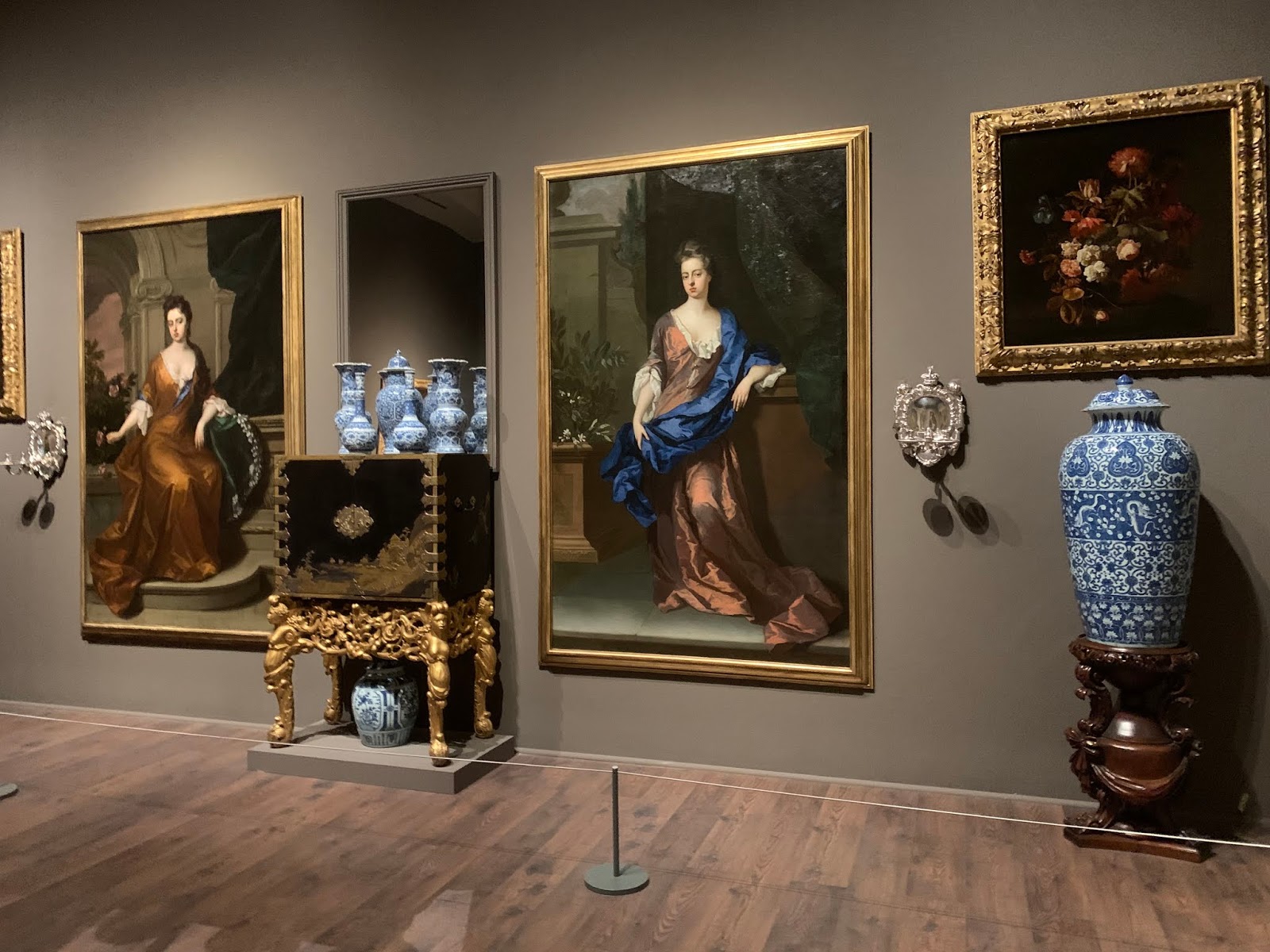
If you need cheering up, it's hard to go wrong with the exuberance of the British Baroque or the merry excess of George IV's collecting mania, now sitting in splendid isolation inside Tate Britain and the Queen's Gallery.

The Baroque was a truly international movement, starting in Italy as the Catholic church's response to the reformation. If protestants were going austere, the Pope would fight back with magnificence. The trend for enormous classical buildings, opulent decor, fanciful frescoed ceilings, luxurious clothing and complex, multi-layered music spread quickly. Even protestant countries adopted the style, though they streamlined it a bit and stripped most of the bombastic religious images out of it.

In Britain the Baroque aligns with the late Stuarts. It was the look of choice for Charles II after his restoration. He was heavily influenced by (and probably jealous of) his style-setting first cousin Louis XIV of France (Le Roi Soleil). Charles' successors James II, William and Mary, and Anne all followed suit. The Tate's show, called British Baroque: Power and Illusion, focuses on how those rulers and their courts used the style to dazzle the country with their authority.

While there are interesting lessons in political history here, at its core this is simply a beautiful collection of things to look at. There are lots of sumptuous portraits of women in billowing silk and men in flamboyant wigs. (This may be the best era in fashion history for women. For men, condemned to shoulder-length curls, tights and ballooning short pantaloons, not so much.) There's an exquisitely-wrought silver chandelier, a font cover carved by Grinling Gibbons alive with putti, fruit and veg, an enamel and diamond portrait pendant of William II that would set any jewellery collector drooling, and some beautiful examples of pottery and furniture that show off the growing interest in the exotic Far East. The silver and gold loving cup in the shape of an oak tree, topped with a royal crown, is a masterpiece of the smith's art.

An intriguing section digs into the Baroque's obsession with fooling the eye, with photo-realistic flower paintings, the famous tromp l'oiel door from Chatsworth's music room with its painted violin hanging on a nail, and an amusing box that throws scenes painted on three sides into perfect perspective when you look through the designated eye holes.  There's a whole room devoted to the architecture of Sir Christopher Wren and his followers, with models, paintings and architectural drawings. In the next the curators try to bring to life the age's passion for exuberant walls and ceilings, often adorned with life-sized gods, goddesses and royals occupying heaven. One wall has an enormous reproduction of the view into the great hall at the Naval College at Greenwich, while the others have photos and sketches of  examples elsewhere in the country.
This exhibition wasn't quite as much fun as the Victoria and Albert's take on the Baroque in 2009, which included music, costume and much more of the decorative arts. But it was still a joyous outing, made more memorable by the sparsely populated galleries.

People were even thinner on the ground at the Queen's Gallery, a little-known secret that's rarely crowded even when London's operating at capacity.
The Queen's Gallery sits next to Buckingham Palace and exists to share treasures from the Royal Collection with the general public. While the source is always the same, exhibitions vary to show off items under different themes. For a bargain £13.50, you get into exhibitions for a year (that can be as many as three if you time it right), audio guide included.

While under normal circumstances I wouldn't have jammed two big shows into one day, George IV: Art and Spectacle is a fitting companion to the Baroque. George loved excess, was one of the monarchy's greatest collectors and was a big fan of his predecessor Charles II. George was particularly intrigued by the Catholic branch of the Stuart family that still existed in exile, ousted by his own protestant Hanoverians. There's an intriguing collection of Stuart memorabilia here.

That's probably the most humble of the many collections on view. George's irresponsible spending made him an unpopular king but left perhaps the biggest artistic legacy of any monarch since the Civil War. A savvy consumer of great painting, his purchases included priceless Rembrandts and some of Lawrence's greatest portraits,  on show here. His love of adornment gives the exhibition the glittering, diamond-studded circlet of national flowers familiar from the queen's image on stamps, and a whole range of over-the-top costumes and accessories from his lavish coronation. The Royal Plate had been liberated from its usual display at the Tower; a range of golden tableware that was supposed to be arrayed behind the monarch at state banquets, in an echo of Medieval tradition.
If, as I have, you've been a visitor to all of the Royal palaces, you will have seen most of this stuff before. The charm of the Queen's Gallery is that it brings items together to tell a story. And what we get here is a view into a man of impeccable taste, with greater depth and sensitivity than his historic reputation.

He collected a range of searing political cartoons lampooning him, suggesting a decent sense of humour. He commissioned multiple, beautiful portraits of his favourite sisters and his daughter, suggesting a soft spot for at least some of his fractious family. The books, prints, maps and memorabilia from Wellington's campaigns against Napoleon, including a captured French marshal's baton of command, demonstrate his intense interest in the greatest political events of his time. His love of Jane Austen, who ... when vigorously encouraged ... dedicated Emma to him, obviously shows his excellent literary taste. The presentation copy is here, in its original three-volume form. Most poignant are white marble and gold gilt copies of famous imperial arches in Rome. George desperately wanted to go on the Grand Tour, as his aristocratic peers would have done, but as heir to the throne he wasn't allowed to do so. These items show a desperate yearning for an Italy he would never see.

My two favourite items in the show, however, were the things I'd never seen before because they're not usually on display in the palaces' public spaces. The first was a pair of Humphry Repton's famous red books. An early example of visionary marketing, Repton would bid for potential work by presenting a watercolour of a landscape as it existed and then, with the movement of a flap, the landscape as it could be with his help. His before-and-after scenes were all the rage in the early 19th century, but few survive because they were essentially working design tools. The other is a suite of Oriental-style furniture created for the Royal Pavilion at Brighton. Lifelike, small Chinese sages hold up a console table, each dressed and presented with distinctive facial expressions. On either side loom porcelain pagodas, originally made in China but enhanced in Europe with tiny ormolu dogs and bells on every level. They are gob-stoppingly magnificent and possibly worth the price of entry on their own.
Sadly, now they sit in an empty gallery, seen by even fewer people than would normally pass by in the private East wing of Buckingham Palace, where they normally live.

With only a handful of people out and about, London's museums and tourist destinations last weekend were glorious. It was like an almost-private view. I wanted to stop time, so I could experience the same at the British Museum and the Victoria and Albert. But time marched on. Covid-19 marched on. The museums are closed, and there's no telling when they'll open again. Just like the businesses that are shutting down, our cultural institutions will take an enormous financial hit from this crisis. I can only hope that while they're inaccessible, people gain a greater appreciation for what they're missing and flock back through all those august portals when this significant moment in history has passed.

Sunday, 7 January 2018

Queen's Gallery captures lush and lavish world of Restoration

In a drawer awaiting my retirement lies the first two chapters and an outline for the rest of my novel, started at university and abandoned when real work got in the way. A sweeping historical saga charting an English Royalist family's attempts to survive through the Commonwealth and take advantage of the Restoration, it reflects my early and enduring fascination with Charles II. He's my favourite of all the British monarchs, and his court had a panache few others have equalled.

It's no surprise, then, that I was an early visitor to the latest show in the Queen's Gallery, London. Charles II: Art and Power shares my fascination, exploring how The Merry Monarch used art to validate his reign.

Charles chose his 30th birthday for his coronation (29 May 1660), celebrated with a blaze of magnificence.

His life up to that point, however, had probably been the hardest of any person to occupy the English throne since before the Norman Conquest. Though his father and mother kept a magnificent court, the tensions that exploded into the Civil War were present from his earliest memories. He was barely a teenager when circumstance forced him to the battlefield, 20 when Parliament executed his father, and by 22 was fleeing to exile as the Royalists lost their last battle at Worcester.

For the next eight years he lived off the generosity of friends and family on the Continent. The early years weren't so bad, hosted by his glamorous cousin Louis XIV. (Charles' mother, Henrietta Maria, was sister to Louis XIII.) But as the Commonwealth's grip on power tightened, France decided the benefits of trade with a current ... though illegal ... British administration outweighed the benefits of supporting a rightful heir with dwindling prospects. Louis asked his cousin to leave. By the late '50s, Charles and a tiny group of friends were living hand-to-mouth in freezing garrets in the Netherlands.

Had Cromwell been a bit less of a Puritan, Charles' story might have ended there. But history proves that few people like the restrictions brought on by religious fundamentalism; particularly not the English. When Cromwell died without an effective succession plan (his son Richard was a disaster), the head of the army took the initiative and invited the rightful heir back home.

Though Charles vaulted from pauper to king, his worries weren't over. He had to re-establish the business of monarchy from scratch when the Parliamentarians had sold off or melted down most of its trappings. He had to reconcile two sides in a society that had been in conflict for almost 20 years. European politics demanded military involvement, plague popped up and London burned down. Through it all, the treasury was never full and Parliament ... the organisation that murdered his father ... controlled the purse strings.

It's thus no surprise that Charles became a master of compromise. The Merry Monarch on the surface, he was a practical man of the people, scholar, scientist and secret Catholic at heart. He was the centre of a newly-glamorous court, but always managed on a budget. (His plans for a palace near Winchester to rival his cousin's Versailles never got funded. He made do with makeovers at Windsor that, while in the height of lavish fashion, were done on the cheap ... thus in poor enough shape by the early 1800s that most were swept away by renovations.) He was often quoted as saying that he had no desire to go on his travels again, thus would do whatever was necessary to keep the new status quo.

The objects on display here illustrate three storylines from Charles' life that have always fascinated me.

  1. The role of the visual arts in what we now know as public relations, used by Charles to shore up his position and create a new story for his family.
  2. Charles' career walking a knife edge between delivering the magnificence expected by both the public and fellow monarchs, while limiting spending and staying on parliament's good side.
  3. How Charles managed his inner demons: coping with, and trying to redress, a tragic family legacy
We start in a room dominated by a somber portrait of the father, Charles' I, captured during his trial. The strange combination of intelligent nobility and pig-headed obstinance that drives so much of the Stuart family saga is obvious in his face. We move to the restoration of 1660 quickly, however. This is an art show, after all, and the dreary years of Civil War, Commonwealth and exile produced little. More often, it destroyed or eliminated art ... making it particularly appropriate that the first blockbuster display here is the plate Charles II commissioned for his coronation.

With the exception of the solid gold chalice and paten (the small plate used for the communion wafer), the collection of platters, ewers, candlesticks and a weighty mace is "only" silver plate. Still, it's enough to make a statement of serious bling. The royals were back, and livin' large. The work on these pieces is exquisite. (Check out the cavalier King Charles spaniel characteristically scrounging for scraps from the table of Jesus' last supper; sadly the only appearance I spotted in the show of the era's iconic.) Normally, this set lives at the end of the gallery with the crown jewels in the Tower of London, where you've been overwhelmed with other bling and you're buffeted by tourists. It's a delight to see it here, given its own space in a gallery generally free of crowds.

Though they initially pale before the glitter of all that gold, the prints and books that dominate the rest of this first large gallery provide a fascinating exploration of the Restoration world. The real artistic firepower, however, comes in the following galleries.

One, dominated by a ceremonial portrait of Charles II enthroned (pictured above), is mostly lush and lavish portraits of the key players in the Stuart court. There's no better way to drink in the spirit of this age than to revel in how its key players chose to be remembered: strong men, romantic women, everyone dressed in ridiculously expensive, lovingly detailed fabrics while they flash their bedroom eyes at you. The the real people couldn't possibly have been as attractive as the artists made them. Within the exhibition you can compare some early, and probably more realistic, portraits of Charles' Queen Catherine of Braganza with the sexy, oversized painting of her as a shepherdess. This is first-class image management for PR spin.

The last large gallery looks at Charles II's efforts to re-establish a Royal Collection after his father's was sold off. Though cursed with abysmal political instincts, Charles I was arguably the greatest single connoisseur of art in English royal history. As sensuous in their own way as the portraits, his son's treasures include pastel-perfect Renaissance scenes, photo-realistic Dutch old masters, magnificent tapestries and noteworthy furniture. Most impressive amongst the last is a rare silver furniture set. The table, matching mirror and pair of pedestal stands usually live at Windsor Castle, where they can be lost in the surrounding opulence. Here ... much like that Coronation plate ... their isolation in a plain background allows you to appreciate them for the magnificent items that they are. Especially as the whole set has just been cleaned and restored, shining with an almost eye-damaging gleam.

Three smaller rooms offer additional insight into Charles' re-assembly of royal treasures. There's ornate dining decor, including the magnificent Exeter salt; precious books, some of which demonstrate Charles' serious commitment to science; Old Master drawings (here's the source of the Royal Collection's wealth of Michelangelo, Leonardo and Holbein on paper); detailed portrait miniatures, jewellery and a blockbuster ivory and ebony altarpiece.

Overall, the exhibit does a fine job of capturing Charles' story and conveying the lush style of the court. Your £11 admission includes an interesting audio guide and the right to return to the gallery for a year. As with anything in the Queen's Gallery, the intimate spaces mean the show is digestible without being overwhelming, and you can appreciate items without big crowds.

It is, however, a solidly traditional exhibition and thus perhaps best for people who already have an interest in the topic. Last month I wrote about how the Opera show currently on at the V&A sets a new high bar in how to present culture and deploy multi-media. After that, the Queen's Gallery seems much more solemn, and like harder work. Charles II might have been famed for his common touch, but this show appeals to more rarified tastes.

Charles II: Art and Power is on at the Queen's Gallery, Buckingham Palace, until 13 May.


Saturday, 17 June 2017

For a connoisseur's cut of Canaletto, it's the Queen's Gallery

It's good to be king.

Particularly if it's the 18th century, you're young, rich, and your nation is becoming the most impressive global power since Ancient Rome. That was George III's situation when he decided to beef up the Hanover family art collection. His ancestors hadn't been keen on the stuff ... music was their thing ... but No. III was different. And by a magnificent piece of art historical serendipity, one of the age's great patrons was liquidating his mighty collection just as George started shopping.

The collector, Joseph Smith, had been British Consul in Venice for decades. A visit to his palazzo on the Grand Canal was a "must do" on every aristocrat's Grand Tour, and Smith made a tidy sideline of selling art to them while they were there. He hung his walls with local artists, particularly an exciting discovery of his by the name of Canaletto. The English milordi would order their own versions of what they liked at Smith's. Canaletto made a tidy sum. Smith took a commission. And, naturally, he kept all the best stuff for himself.

Which is why, despite fact that the National Gallery's 2010/11 Canaletto exhibition has barely faded from memory (review here), it's worth making an effort to see Canaletto & the Art of Venice at the Queen's Gallery in London. There is a lot of Canaletto strewn through the country houses and museums of the UK, but in purchasing Smith's originals, the royal family ended up with the best of the lot.

You'll also benefit from an atmosphere a lot less crowded than the National's blockbuster. Though it's been 15 years since the Queen's Gallery re-opened (after a major renovation that tripled its size and made it one of my favourite exhibition spaces in London) it still feels like one of the capital's great, undiscovered secrets. You'll be able to ramble around in here with plenty of open floor space to appreciate the art in quiet contemplation.

And these are works that deserve the time and attention. Canaletto was a master of detail. There's no better place to appreciate this than the early galleries of the show, which are primarily pen and ink drawings. Here, you can see the grid lines Canaletto used to build his perspective, and the obsessive way he'd study particular elements of a building ... down to noting specific colours he'd use later. Here's where we also first encounter some of the pastiches of ruins and buildings, both real and imagined, he'd sketch to stretch his imagination. This style of painting, known as a capriccio, has always been one of my favourites. It was a real delight to discover Canaletto's photographic style grafted onto these fantasy worlds.

You're really here, though, for just one room. The largest space at the back of the galleries is a riotous jewel box of Canaletto's best. On the left wall, the twelve scenes of the Grand Canal, covering sections from one and to another, that Smith hung in his house as the ultimate sales samples. I have seen many versions of these scenes, but never a complete set, hung together, in geographic order. On the opposite wall hang five spectacularly oversized canvasses of Roman ruins. I wasn't aware he'd ever tackled the subject. Forget Venice. I would have been ordering one of these! The other two walls offer more spectacular scenery, mostly Venetian, including a fascinating view of an alternative design for the Rialto bridge that lost out to the one we know today.

Other rooms show off the work of Canaletto's contemporaries. Smith's eye didn't falter. There's more luscious stuff here, from historical paintings and romantic landscapes to more architectural scenes and some exquisitely lifelike character heads done in chalk. You've probably never heard of Zuccarelli, Ricci, Carriera and the rest. If it weren't for Canaletto's enormous reputation, you probably would have. These works are worth your attention, too.

One of the glories of the Queen's Gallery is that a full-price admission is good for a year. Meaning you can pop back whenever you like to have another look. I'll certainly be doing so.

Canaletto & the Art of Venice runs until 12 November 2017.