Showing posts with label Verona. Show all posts

Tuesday, 20 June 2023

Verona: Where to stay; what and where to eat

WHERE TO STAY

One of the first cultural differences I learned to appreciate in Italy was to never judge a building by its exterior. Non-descript architecture or graffiti-scrawled, crumbling walls often enclosed palatial rooms or high-design interiors with all the mod cons. Thus it is with Verona’s Hotel San Luca.

Its location down a grubby alley behind a McDonalds doesn’t promise much. The double-height lobby enclosed in gauzy curtains, filled with traditional carpets and furniture and illuminated with a crystal chandelier under a ceiling painted to mimic the sky is a surprise after a humble, mid-century-modern entry in an alley off the alley. If you didn’t know the hotel was there, you’d never stumble upon it, and you’d never guess at the comfort and luxurious design within. 

The hotel’s greatest advantage, however, is location. It’s a five-minute stroll to Piazza Bra, the town square dominated by the Roman amphitheater, and from there on to the rest of the historic centre. Despite that central location, the San Luca’s back alley location … plus solid windows screened by metal shutters … make it remarkably quiet. Bedrooms mix modern design with a traditional sensibility, mattresses and pillows are high quality sheathed in crisp Italian linens, and the air conditioning works well. (The last is a real gift when you’re returning from a day of hot, sticky sightseeing.)  

Everyone we met on staff was fluent in Italian, English and German and those on the front desk were conversant on all the local tourist attractions … including a local’s grasp of the city’s operatic traditions. Breakfast is basic, in classic Italian style. A few cakes and pastries, a bit of fruit, a plate of ham and cheese, with a lovely duo who ran the room quick to serve up the coffee of your choice. 

The hotel even has a very limited amount of parking if you arrange it with them well in advance. Rooms start at around £170, with costs rising in line with the tourist seasons. This would definitely be my choice for a return to Verona.

WHERE TO EAT

Tre Marchetti - If you want to push the boat out with a full Veronese tasting menu, complete with theatrical light and video projections to make your dinner a work of art, this is the place to go. (Booking essential for the visual experience, or on any opera night.) But you needn’t indulge to that full extent to enjoy a meal here. We dined a la carte, on two courses each, and had a marvellous evening. 

Tre Marchetti is just a stone’s throw from the arena but, critically, it’s down a small lane at the back rather than fronting on to the Piazza Bra. That makes the atmosphere quite different, as you are free of the crowds but still have the atmosphere. The arches of the arena loom above the end of the street, historic buildings lean in above you and tables under awnings in the street are set with white linen and gold gilt Venetian water goblets. 

Verona sits in the middle of a rice-growing region and is therefore known for its risotto. But our friends who knew the town well went for another starch: bigoli. This is essentially very fat spaghetti, usually freshly made and rarely found outside local restaurants in this area. We enjoyed it here, and at several other spots. I did, however, observe a connection between the size of the restaurant and the bigoli. The smaller and more family-run the place appeared to be, the fatter the bigoli. The larger and more commercial, the more likely what’s called “bigoli” on the menu comes out looking like spaghetti. 

This is also a region full of lakes, so duck appears on a lot of menus. Here, my husband had it in a confit-style leg. Pork, veal and horse are also quite common on the meat front. I had suckling pig here that had been brought to an almost pulled-pork consistency, covered with cheese sauce. Given that Verona is close to the mountains, dairy herds contribute a variety of local cheeses. It’s also a wine region, and locals seem very fond of cooking with the white Soave and the red Valpolicella. Given that this was once part of the Venetian empire, there are a lot of seafood dishes here from that city. If you’re avoiding animal protein, aubergine (eggplant) seems to be a favourite vegetable. In short, there’s a broad range of local specialities here and you’ll eat well at many places. Though at Tre Marchetti you’ll do it in a bit more style, with a more delicate and sophisticated touch to flavours and presentation.

Emanuele Cafe - This is perhaps a more obvious choice, given that it’s in the long run of restaurants on the Piazza Bra overlooking the arena. Note that this is not the Ristorante Vitorio Emanuele, closer to the statue of the king of the same name, but a spot two businesses down. We stopped here because they had a large selection of pizze bianche, an appealing option for my tomato-allergic husband. We liked it so much we returned for another dinner, and lingered here until closing time after we went to the opera.

Multi-page, laminated menus with multiple languages and a bit of everything are usually the warning of a tourist trap in Italy, but that wasn’t the case here. Other than the bigoli, which was too close to normal spaghetti to win our friends’ approval, the food was excellent. Pizzas here have hand-shaped sourdough bases that give that wonderful little acidic bite and erupt with air bubbles in the blazing pizza ovens. Local cheeses and a light but well-balanced touch with a wide range of ingredients offered options for everyone.

They demonstrated a more sophisticated touch with dishes like torta melanzane, a local delight that’s chunks of cooked tomatoes, on their way to sauce, enclosed in a parcel of thin aubergine slices that have been softened by cooking in oil, then served on a bed of burrata cheese. Vegetarian dishes don’t get much better than this. 

El Cuciar gets an honourable mention. I only had one dish here so can’t offer an informed review, but their bigoli with a duck Raghu was fantastic. Most important for my day was that it’s directly across from the front of the duomo in an area where there’s little else around, I was dropping from exhaustion and they offered a shady table with a view of the cathedral’s medieval front porch, and quickly arrived with ice cold beer and equally chilled carafes of water. I sketched. I drank. I ate. They were happy to let me while away the heat of the day at the table. This is what the Italians call Dolce far Niente … the sweetness of doing nothing … and El Cuciar was a perfect spot to embrace it. If I were back in that part of town I’d definitely try it again.

Monday, 19 June 2023

Marquetry masterpieces and an iconic garden are my Verona highlights

Verona probably wouldn’t make most Brits' lists of the top 5 dream destinations in Italy … but it probably should. The city is so much more than the Shakespearean associations and the opera festival that draws most tourists from the UK.

A major cross-roads on affluent trading routes since its founding, Verona has all the layers of history you can find in Rome, lashings of the distinctive gothic architecture that makes Venice (its former owner) so romantic, and churches and palaces filled with enough Renaissance art to rival Florence. But it’s a lot less crowded with tourists than its more famous sister cities. And it’s only two hours on a direct flight from London. Perfect for a long weekend, or as a base for longer if you want to include the Italian lakes, the beautiful Venetian back country or … just over an hour on a fast train … Venice itself.

We got our bearings with the Hop On Hop Off bus tour which starts its rounds from the central Piazza Bra, just across a small park from the Roman arena. (£25 for adults for a 24-hour pass.) If you’re unfamiliar with the city and its history, as we were, you may only retain a fraction of the copious commentary. The automatic triggers are often slightly off, leaving you desperately looking around for what the recording is talking about. But it’s a great way to cover a lot of ground and get an introduction to more than 2,000 years of Veronese history.

If you are short on time, start with the B Line. This route runs a minibus, rather than the full open top bus, so is able to drive through part of the historic city centre. It also winds up a forested hillside to a magnificent view of the city and its encircling Adige river. Line A can only go around the outskirts, and about a quarter of its commentary is shared with the tour on the smaller bus. Thus taking both tours is a nice to have, but not strictly necessary.
Whether you ride one or both, you will get a sense of the extraordinary bend in the Adige river that creates almost an apostrophe of land, an easily defensible site for a city in more difficult times. And there were plenty of those. There are Roman walls for holding back barbarians, renaissance castles for fighting off other Italians or invading French armies, and lots of impressive fortifications from the 19th century, when the Austrias and French fought over the place. There are a lot of famous churches, a Roman theatre to match the city’s arena, lots of picturesque bridges and several striking piazzas.

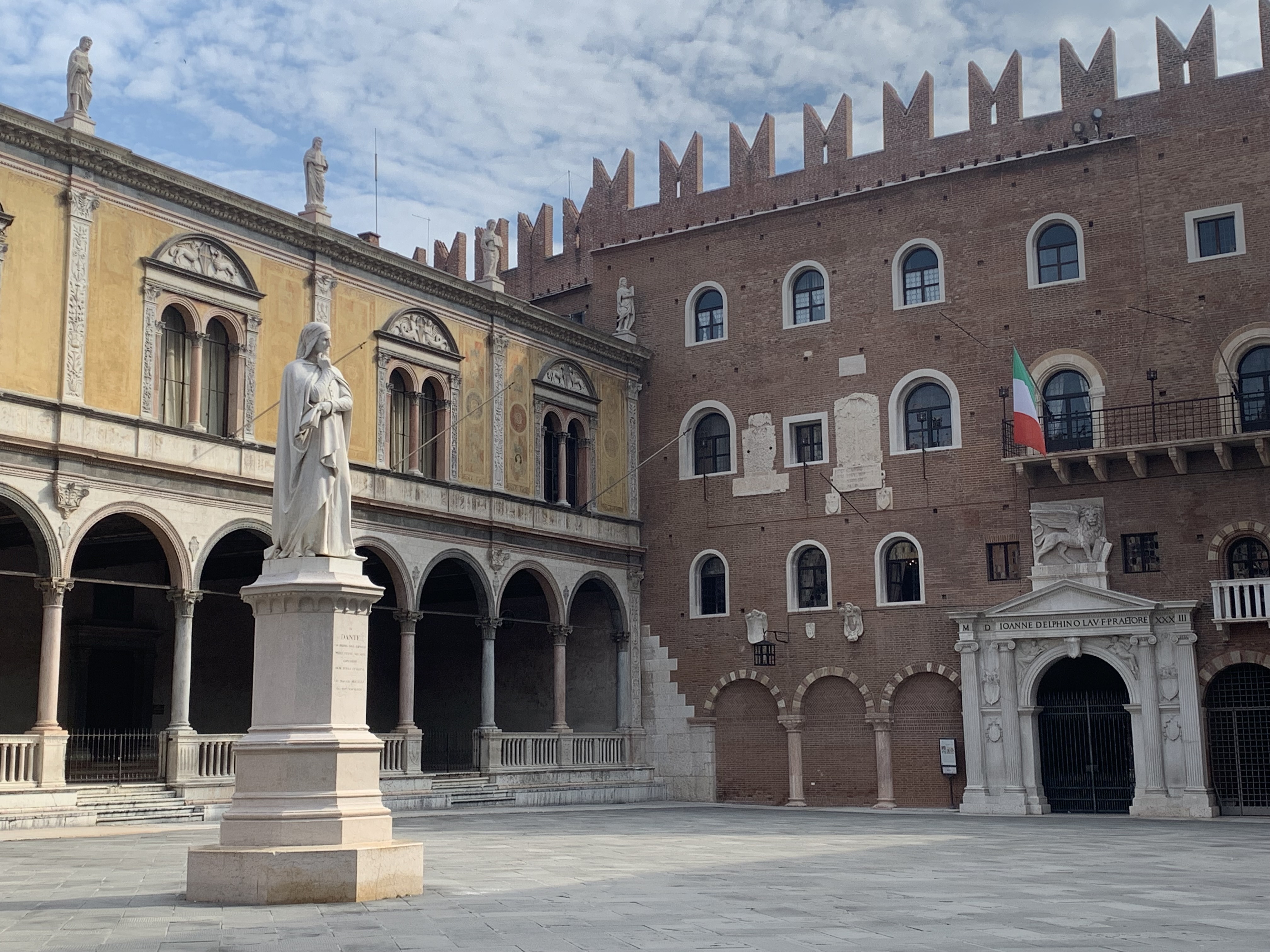
While Piazza Bra is probably most famous for the arena, Piazza Della Erbe is the beating heart of the old town, with market, stalls and restaurants overlooked by handsome houses and towers. Just behind that is the Piazza della Signoria, far less crowded even though it is just a stone’s throw from the other. It’s arguably prettier, with a statue of Dante in the middle… he spent his part of his exile here … and surrounded by the buildings from which mediaeval and renaissance rulers ran the place.
In one corner, you can just spot the Scaligere Tombs, one of Verona‘s artistic masterpieces. Most mediaeval aristocrats like to have their monuments inside churches. The Scaligere must have had quite a penchant for showing off, because they built their tombs outside, on a high traffic corner. They are as detailed and lavish as reliquaries, but each are two or three stories tall. Exactly what you would expect from a dynasty founded by a guy named Cangrande. Literally “big dog”.
I would have liked to have seen the inside of big dog’s castle, now called Castel Vecchio and a museum that combines the delights of wandering around a medieval fortress with lots of art and history. Plus excellent views of the river. Sadly, the museum is closed on Monday, which was the day available for diving into stuff that intrigued me on the bus tour.

Instead I headed for the Giardini Giusti, just across the river at the top that apostrophe of land that was the ancient city centre. Likely to make any expert’s list of top gardens in Italy, these are a classic of the late renaissance style. Goethe, Mozart, Ruskin and the Tsar of Russia were amongst the notable visitors. The place was so famous that, when Verona was part of the Austro-Hungarian empire, the Habsburg emperor had the family officially change their last name to Giusti del Giardino.

Close to the house there are lots of formal hedge parterres and a maze, gravel paths on geometric lines, classical statuary marking central points and narrow spikes of cypress edging the central path. That leads to dramatic stairs and a tower bisecting the steep, forested hill that forms the back half of the garden. Along the sides, things start to get a bit more informal, with some shady bits and less formal statuary, including picturesque jumbles of old Roman tombstones and sarcophagi. I wonder if any of those aristocratic Romans, when planning their memorials, could have imagined they’d become garden ornaments?

The whole garden changes mood dramatically when you hit the steep hillside at its back, where earthen paths twist and wind at crazy angles, their surfaces often broken by thick tree roots or broken shards of ancient pavement. (This is no place for people unsteady on their feet.) Quirky surprises litter your path, like a grotto with fake stalactites that were once covered with shards of mirror. You may think you are at the top when you reach a pretty pavilion held up on delicate marble columns, with a gorgeous view of the city. But you’re not done yet. Follow another path between trees and an enormous old wall and you come to the base of that tower you saw on entry. Climb about 50 circular steps and you’ll come out on yet another radical change of mood; gently-sloping lawns dotted with bushes. The views from here are extraordinary, as you’re now probably the equivalent of eight stories above the formal bit at the front and have a bird’s eye view not just of the city, but of the Giusti family’s lovely villa.
Your entry ticket includes the family apartments inside, which were renovated after they reclaimed the property following significant damage in World War II. (Little is said of the building’s time as the HQ of the Luftwaffe in Italy, no doubt a catalyst for destruction.) While the gardens are the star attraction, it’s fun to have a poke around the house of the family who still owns the place.

The best thing I saw in Verona, however, is barely mentioned in guides. I’d arrived in the neighbourhood before the gardens opened, so popped into Santa Maria Organo. The sign out front talked about an early medieval wooden carving of Christ on a Donkey that was much beloved. I was looking at it when a caretaker beckoned me down a non-descript hallway and into an exquisite sacristy with wooden stalls around the bottom half and lively paintings above. The back of each stall held a marquetry picture of dazzling complexity. City scapes, animals, household objects, scientific tools all done in perfect perspective and depth with tiny pieces of coloured wood.
Another set decorated the backs of the stalls in the choir you enter from the sacristy. Below the lectern there is a wooden panel of a rabbit so lifelike it looks like it may jump away. Its fur is picked out in pine needles. Its reflection shown in water made from wood naturally turned blue by a type of fungi. All of the panels, and all the carving on the frames around them, were created by one man: a monk associated with the church called Fra Giovanni da Verona.

These are some of the most extraordinary examples of marquetry I’ve ever seen. They are as beautiful as those from the Studiolo of the palace in Mantua, part of which is in the Metropolitan Museum of art and all of which is world famous. The Mantua panels are a standard feature in most art history textbooks, while the Verona panels are almost unknown, left to serendipitous discovery at the back of a small church, easily missed if the caretaker doesn’t offer to unveil its secrets. 

Most visitors to Verona will be queue and jostle to stand under the supposed balcony of Juliet. Skip that. If time is short, skip everything else. Get to Santa Maria Organo and be dazzled.