Sunday, 20 February 2011

Venice's "must sees" are familiar, impressive ... and cleaner than they used to be

You know it's been a while since you've been someplace when they manage to build a whole new airport in your absence. It's a bit disconcerting.

I always liked arriving at Venice's tiny, old world airport where you walked straight out of the terminal and onto a boat dock. But no worries. Venice, I assured Piers, was the most unchanging of all European cities. The one almost untouched by chain restaurants, where all the stores were local and all the sites hadn't evolved much since Ruskin wrote his guide. Then I cleared the sparkling new immigration area and saw the big poster for the Hard Rock Cafe. Was I about to be proven wrong? Had Venice sold out?

Mostly not, although there are a few more touches of modernity here. In addition to the Hard Rock, there are two McDonalds. But on the whole, this is still a place into which the modern world has barely barged (you'll find almost no free wi fi; I haven't been that out of touch in years), and where you're going to be paying attention to the same things your grandparents did. The biggest difference these days: things are a lot cleaner.

Everything around the hub of St. Mark's square is in the middle of a major restoration campaign. It's a bit disappointing for the first time visitor, as many of the elegant facades along the sides of the square are under scaffolding and the base of the bell tower is a construction site hidden behind fences. It's definitely not a Canaletto view at the moment. But work is finished on both St. Mark's cathedral and the clock tower to the left, producing a shocking transformation. The church was always a bit overwhelming and garish in its decorative profusion, but you didn't get much color. Mosaics and sculptural detail rose out of a dull gray stone. Now you can see that all the flat surfaces are different color marbles, from the palest pastels to deep reds and greens. There's no symmetry at all, of course. Every column is a different shade. One expanse of wall might feature 10 different marbles. It's impressive, lush, beautiful and a bit ugly all at once.

Much more restrained is the clock tower, an amazing piece of 15th century engineering. It's gorgeous golden dials, pointers and symbols on a bright blue ground show you not only the date and time, but moon phase, what symbol of the zodiac you're under and all sorts of arcane astrological details. Up top, two larger-than-life metal shepherds swing mallets against a big bell to ring the hour. This is all set within, or upon, an elegant construction of white stone that's now dazzling in its cleanliness.

White is not a colour you see much once you get inside the famous church next door. Gold dominates, and those early Christian mosaics, fresh from restoration, are sparkling like a pile of newly cleaned jewelry. There are so many things to look at in St. Mark's, it's hard to know where to start, and nearly impossible to rest your eye on just one thing. The ancient mosaic floor is justifiably famous. Every inch of wall space is crammed with mosaics, monuments or sculpture. There are side chapels, rooms of relics, a treasury, opulent hanging lanterns, highly decorated domes and, of course, hundreds of milling tourists. Frankly, it's a place you can't stay for too long without being completely overwhelmed. I find it wise here to concentrate on a handful of details each visit, as it would take years to actually take it all in. Piers was pushed over the edge by the little room filled with more than 100 reliquaries. (According to The Rough Guide, it's rarely open. So we should consider ourselves lucky.) Toes, locks of hair, bone fragments, bits of the true cross, the stone that martyred some saint. It was all too reminiscent of the worst excesses of the pre-Reformation church. Protestantism rose in him and we decided it was time to check out more secular delights.

The logical next step is the Doge's palace. St. Mark's was, after all, simply the Doge's private chapel for much of its history, rather than the official cathedral. Which should immediately clue you in that you're unlikely to find humility or simplicity in the man's house, either. The palace is interesting in that it's both the home of an elected official and the seat of government. For most of history the Doge didn't actually have much power. He was a figurehead and the brand ambassador for one of the world's most impressive trading empires. Everything about the place is built to impress: the Doge's quarters to awe visiting ambassadors, the huge assembly halls to remind the younger governmental members of their place, the smaller rooms of justice to make citizens quake and bow in awe of the all powerful committees of state. You wander through so many rooms here that, like the church, your eyes start to dull. But it's a rich feast. Magnificent carved or plastered ceilings, some in dark wood, some painted, some gilded. Some all three. There are many impressive paintings, most of them exceedingly large propaganda pieces designed to promote Venetian power or capture its glorious moments of history.

The most jaw dropping room is probably the sala del maggior consiglio, one of the largest rooms I think I've ever been in. It was built to hold a meeting of every man entitled, by his family's entry in the official "golden book", to the ruling classes. By the mid 16th century this was around 2500. Tintoretto's amazing Paradiso is the largest thing in a room of massive paintings; it features 500 individuals all painted in detail. My favourite room, however, is the salla della scudo, a long reception room decorated with frescoed maps of all the places in the world with which Venice did business. (They're later copies of the 15th century originals.) It's a fascinating world perspective from the time of Marco Polo. There's a passable armory; not nearly as good as the one at the Tower of London, but useful for re-capturing the attention of boys whose attention has started to flag from too much art appreciation. At the end of the tour you'll wander through the dungeons, which provide quite a grim contrast and would have sent a shudder down our spines even had they not been cold and damp enough to make us feel we were trapped in a refrigerator's fruit and veg drawer.

Next on the iconic, must see list is the Rialto Bridge. It's a truly awe-inspiring piece of architecture, with a gracious, sweeping arch below and an arcade of shops above rising to a peak dominated by a triumphal arch. Unfortunately the view is marred a bit by the fact that it's the shop backs that face toward the canal, and these are often coated with graffiti. The most elegant views of the bridge are either from a distance, or from the bridge itself. Up top, the store fronts glitter with glass baubles, jewelry and silks (we found great deals on men's ties and cravats), parting at the bridge's summit to offer you rest in sophisticated loggias on each side with some of the best views of the Grand Canal.

After St. Marks, the palace and the Rialto, the island of Murano comes on most people's top sites lists. In addition to being canny traders, the Venetians held a monopoly on the manufacture of the world's most sophisticated glass for almost two centuries. All the glass blowers were kept in splendid incarceration on Murano. A miniature Venice with lovely houses, stately canals and gracious churches, the workmen and their families lived far more prosperous lives that the typical craftsmen of the era. The catch was that they couldn't leave the island. If they did, legend had it, the government would send an assassin after them to protect Venice's coveted trade secrets. Today the monopoly is gone, there are far fewer glass blowers and any of them are free to leave. They're more likely to be producing baubles for tourists, chandeliers for hotels and restaurants or art glass for rich collectors rather than glassware for the tables of Europe's monarchs and aristos. The work, however, is just as beautiful.

One of the best places to see the continuity is the glass museum, which has displays of glass from Roman times all the way up to modern art pieces of today. Don't miss the impressive Barovier wedding cup in deepest cobalt blue, painted with scenes of courtly life in the Renaissance, and the 18th century glass table decorations that allowed you to build an entire formal Italian garden down the centre of your banquet.

Most of Murano is, unsurprisingly, glass shops. The moment you come off the vaporetto you'll be greeted by touts luring you to their demonstrations. Try to avoid these, as they are usually assemblages of work of marginal quality but generous mark ups, fronted by glass blowers of only basic skill. I highly recommend Franco Schiavon's gallery at Fondamenta dei Vetrai 15. They have their own workshop in back, which they'll happily take you into and explain the process while the craftsmen work. Downstairs there's the usual selection of glassware, jewelry, lampshades and chandeliers, but of a higher quality than most. Upstairs their gallery veers towards the collector, with displays of some truly ravishing pieces and gold gilt glasses fit for royal tables. Were I a rich woman, I could have spent a lot of money here.

And speaking of shopping, one of the places here that always gets a repeat visit from me is Paolo Olbi's tiny book binding and paper shop. He's been hand crafting books and desk items from decorated leather and marbelised Florentine papers for almost 50 years, still producing every item himself while his sister works the shop. Over the years I've bought exquisite notebooks for myself and watercolour portfolios for my mother. This trip we invested in the photo album and guest book for our wedding, each made from luscious white leather tooled in floral patterns. You'll probably pass his shop on the calle della mandola on the way to the Accademia Bridge.

Familiar yet still surprising, these top sites are worth repeat visits. The wonder of Venice, however, is that there's so much to explore beyond the familiar. And once you get off the beaten track, it's amazing how few tourists you'll find around you. Next entry I'll explore those new discoveries.

Saturday, 19 February 2011

Opulent Venice works its magic ... sort of ... for a Valentine's Day break

The challenge: you, one quarter Sicilian and imbued with the love of all things Italian, want to inspire in your Anglo-Danish, Francophile fiancé a similar appreciation. Where to start?

Going with a conjunction of timing and tradition I thought I'd try Venice at Valentine's day. This much-cliched combo must inspire some magic, right?

Well, he wasn't glassy eyed and rhapsodic at the end of it. There were parts he liked, and Byzantine-Baroque elements he found so-over-the top that his brain simply stopped processing. I became more firm in my belief that the symmetry, logic and elegance of the Florentine renaissance is going to do the trick. But, in the mean time, we bobbed down canals on vaporettos, wandered past mouldering Gothic palaces, froze to our bones in grand but unheated museums and enjoyed quite a few very fine meals. With an early Saturday departure and a late Tuesday return, the four-day weekend felt like a much longer break, and we were both relaxed and culturally sated before returning to our desks on Wednesday morning.

So, the overview. We went out on a package tour with Expedia. Since the debacle of snow closures at Heathrow over Christmas I'm less of a fan of the company (I'm still waiting for my £800 refund for a canceled flight, which would have been far easier to get had I gone direct with the airline) but when it comes to flight and hotel packages for European city breaks, Expedia still tends to deliver the best deal. For a bit less than the trans-Atlantic flight Piers never took, we both got to Venice on BA and spent three nights in a five star hotel with a room upgrade. Given that a 5 star room in Venice can easily go for 200 a night, I was satisfied that we'd scored a bargain.

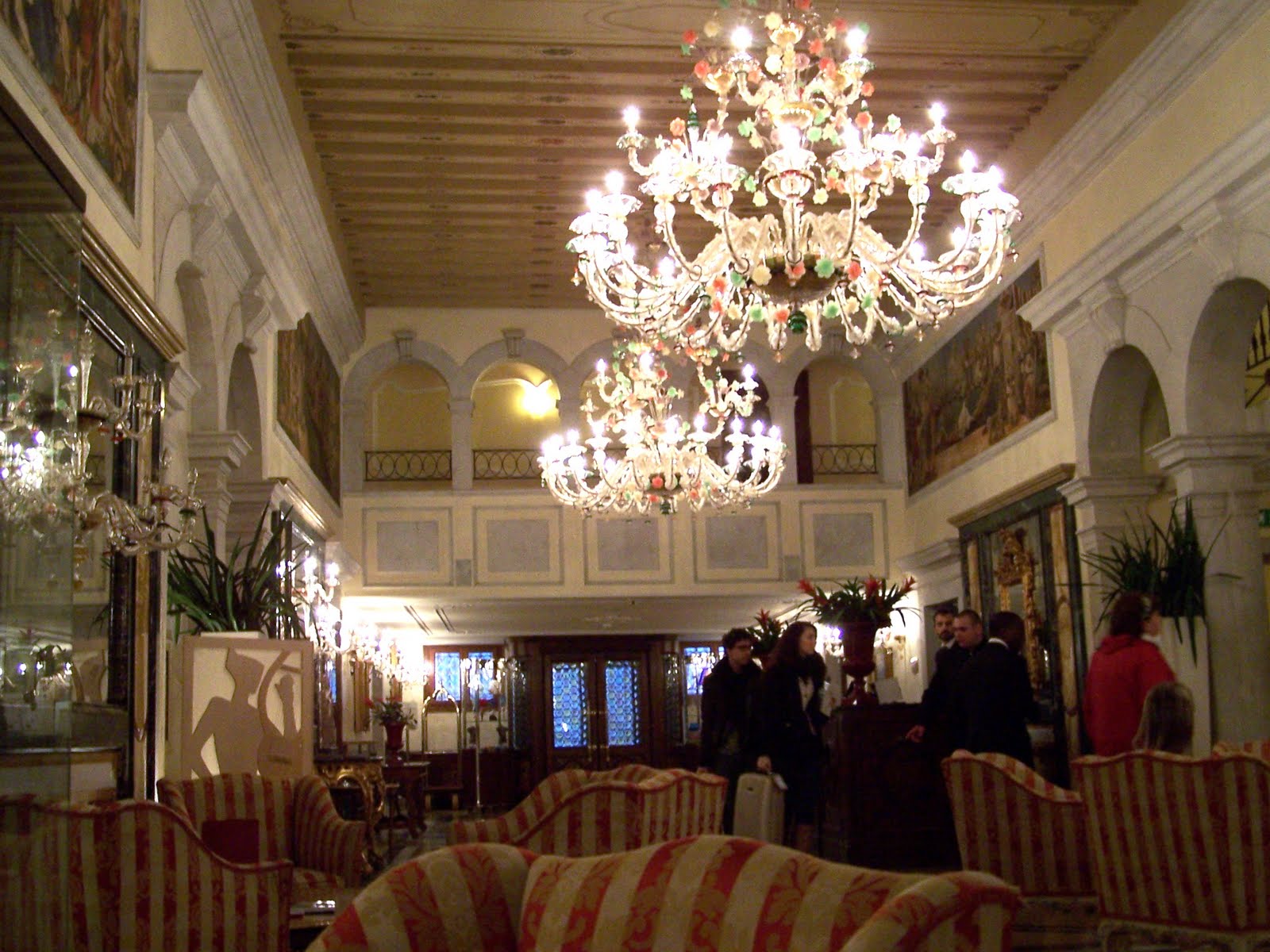
We stayed at the Hotel Dei Dogi, a place I discovered on a shopping weekend with a friend nearly a decade ago. It has lavish, classically Venetian interiors (befitting the family palace and then the French embassy that it once was), the largest private garden in Venice and it's own jaunty motorboat that zips you from the canal in front of the hotel down to St. Marks on a regular shuttle schedule. And yet, because it's in the quiet, off-the-beaten-track area of Cannaregio, its prices are about 30% below what you'd pay for an equivalent hotel closer to St. Mark's.

I have to admit, I actually prefer Cannaregio. It's heavily residential, so its lanes and canals are filled with locals. The absence of tourists means it's quiet and, late at night wandering down silent lanes with the canal glimmering beside you, wildly romantic. Its dominant church, Madonna dell'Orto (a stone's throw from the hotel), is a masterpiece of Gothic restraint not often seen in this city. It's the district closest to the airport, so either a straight shot by the Alilaguna shuttle (13 euro) or a short walk from the Piazzale Roma and the train station gets you there with ease. Once you figure out the route, it's a tolerable 20-minute walk to St. Mark's. And, best of all, it's the district in Venice with all the best restaurants. What's not to like? If someone else would like to pay for me to stay at the Danieli, I'll be there in a heartbeat. But on my own cash? Dei Dogi it is.

As Piers had never been to Venice, the plan was as follows. Day 1, having cleared the airport and checked into our hotel by 1:30, was devoted to rambling around the city and getting a feel for the place. It was, amusingly, also devoted to trying to find someplace to watch the England v. Italy rugby match that kicked off at 2:30. We went to a spot near the train station where the girl behind the bar helpfully went through nearly a score of sports channels on the satellite, but no rugby. A disappointed Piers sucked it up and fell into sightseeing. Ironically, we arrived back at the hotel to find the game on national TV with a time lag, so he got to see the second half after all.

Venice is such an opulent, decadent place, almost overwhelming in its sights, smells and design, I always figure you should ease a new visitor into it. Climb to the centre of the Rialto Bridge and gaze over the Grand Canal. Walk along it for a bit. Wander over to St. Mark's. Gape at the church, watch the clock strike, stroll through the piazzetta to see the outside of the Doge's Palace. Gawp across the basin at the rows of gondole, the outer islands and the Palladian magnificence of Santa Maria della Salute. Up the Riva degli Schiavoni for a bit. Check out the bridge of sighs. Look back at the that most famous of Venetian scenes. And then, frankly, quit while you're ahead. Because any more, as a first timer, is going to put you into sensory overload.

Sunday we concentrated on the glass-makers' island of Murano, then the museum at the Ca'Rezzonico. Monday St. Mark's, the Doge's Palace and La Fenice theatre. Tuesday the naval museum, the church of Zanipolo and shopping. And then a mid-evening flight home. For me, it was a great balance between the familiar and, though this was at least my fifth visit, a good array of new stuff. That's one of the beauties of Venice that goes beyond its lovely skin: There's enough to see in this compact territory to keep you occupied for years.

A few more essential tips for any such sightseeing breaks in Venice.

First, go off season. Even now, in the lowest of low times, we queued to get into St. Mark's, packed body-to-body on the No. 1 vaporetto up the Grand Canal and found some of the smaller lanes to be uncomfortably crowded. Nothing in this city is worth the hell of overcrowding it experiences on school holidays.

Second, don't plan to do anything quickly. Walks from point A to B may only take 25 minutes if you're moving briskly and know where you're going. But if you get turned about (highly likely in the warren of twisting lanes and canals bereft of easy sightlines to identifiable landmarks), or have to take a boat anywhere, that quick jaunt can easily take an hour. Don't sweat it, you're on vacation.

Third, look into tourist cards. If you're planning to go into at least two attractions a day (palaces, museums, churches) for three or more days, the HelloVenezia card is a good investment. Just under 40 euro per person for a 7-day pass, it not only works out cheaper but encourages you to pop your head into attractions that you might otherwise skip. An additional 30-ish euro gets you a 72-hour pass for the transport system. I'm undecided on the value of this one. If you're not planning to leave the main islands, you can probably walk everywhere and save the cash. Especially if your hotel, like Dei Dogi, has its own shuttle. But a trip to Murano and the ability to hop back and forth up the Grand Canal probably meant we broke even.

Fourth, try to only eat at recommended restaurants. Venice is notorious for having the worst food in Italy. Unsurprising when you think that this is a city supported almost entirely by tourism. When you're not working for return customers, it's all about being in a good location and snagging passing trade for a meal palatable enough to keep them from complaining while making you as big a margin as possible. So get off the beaten track and go for places validated by a critic like the Rough Guide. Or this blog, of course, which will naturally be getting around to restaurant reviews.

But first, we have some culture to discuss in coming days...

Tuesday, 8 February 2011

RIP: Joanlee Ferrara

My mother died on 23 January.

Two years after a terminal cancer diagnosis, seven weeks after returning from her last trip to England and starting a steady decline, and two days after becoming confined to her bed and ceasing conversation, she slipped away quietly in her sleep in the early hours of a Sunday morning.

She'd had a good talk and been given the last rights by the local priest, had been with those she loved most most, was never in too much pain (thanks to the morphine) and, most importantly, spent those last days in her beloved house, surrounded by family heirlooms and looking out the broad picture window at her beautiful woods. It wasn't a bad way to go.

Friends who've been through this tell me it probably won't hit me for a while. That grief ebbs and flows, triggered by silly little things, and that once you lose a parent there's a hole that can simply never be filled. That's all still to come. Now it's just a jumble of emotions kept at bay by a "to do" list of staggering proportions. Being an only child has its advantages but not, I assure you, when it comes to sorting out an estate.

Had I had the time and inclination over the past weeks I could have written a score of entries on this whole experience. But this blog is supposed to entertain and inform, not burden you with melancholy, so let me just offer a round up of the most salient observations through this strange time.

Hospice is a remarkable organisation, and all who work within in are on a fast track to sainthood. I don't know what I would have done without these people. They were magnificent, taking away stresses, providing answers, getting rid of all the little worries so I could spend quality time with mom at the end. I particularly appreciated their positive, pragmatic attitude. Death is a part of life. It comes to all of us and, actually, it comes in a fairly predictable way. They removed the gloom, fear and uncertainty, helped us to know what to expect and to deal with each stage as it came. All as part of a natural, if unpleasant, evolution.

Family has nothing to do with blood.
Mom's death, as expected, showed where the closest bonds were, and who really counted as family. Her best friend from childhood flew in from Baltimore to be there until the end. My dearest friends from high school stepped in to be the sisters I needed to share the worst of the responsibilities. Her own high school friends, former students and a handful of close colleagues provided frequent support. And my father, her ex-husband, helped her make another kind of peace at the end. Death is, oddly, inextricably bound up with love, because it brings those you love most ... and who love you the most ... together.

People don't know how to handle it. Unfortunately, for every one helpful person there are five who make life more difficult. There are the people who don't know what to say, so inevitably state: "if there's anything I can do, just ask." Don't. I learned early on, this is an instinctive statement, like "have a nice day". People don't really mean it, and if you actually take them at their word and ask them to do something specific, they quickly find excuses and disappear. The people who actually want to help will come up with specific suggestions for what they can do, then come on over and do it.

Then there are the people who can't handle illness. They just disappear. They certainly don't visit. This is a shame, especially when they're really close friends. But you have to give them a break, as you realise they just can't cope with the situation. But it makes those visitors who are uncomfortable with terminal illness, yet fight their fears and come anyway, even more wonderful.

Most difficult for me were the people who wanted to have long conversations about how things were going or, after the fact, how she died and what her last days were like. Everyone handles grief differently, but it certainly did me no good whatsoever to have people weeping at me or talking away for hours, especially when my stress levels were through the roof because of everything that needed to get done.

God bless that inner circle who came over, took tasks off the to do list or simply sat with mom so I could get out of the house for a while. If you want to help someone in this situation, that's the way to go.

Nothing shapes you like your parents. I've always known it, of course, but the past weeks have brought into sharp relief just how responsible my mother was for shaping me. In many ways, it was rebellion. My desire for a tidy desk, my desire for logic rather than emotion in times of stress, my hatred of long phone conversations and my attempts at budgeting (such as they are), are all reactions against things my mother did that drove me crazy. But my love for a beach, my passion for travel, my appreciation for culture and good food ... most of the things that drive this blog ... are all her passions, carried directly through to me. Both my parents always claimed that I inherited the best of them and managed to skip the worst. If I did that with Joanlee, then I'm proud and honoured.

I could go on, but I think that's enough. For those of you who knew her, there will be a memorial service on 12 March in the Villa Duchesne chapel in St. Louis. It would have been her 71st birthday. She would, no doubt, have expected me to be taking her on a cruise or a trip to some glamorous location. Here's hoping a host of saints and angels is doing that for her instead. I wonder if Saint Anthony is any good at mixing up a rum punch?

Monday, 10 January 2011

National Gallery brings Venetian sun to a grey London

I had one brief weekend in London between holiday travel and getting back to St. Louis to look after my mother. Top of my "to do" list was "Venice: Canaletto and his rivals" at the National Gallery, which was due to close on 16 January.

It was a top priority because I adore both this time period and this genre. I've always been fascinated by the idea of the grand tour, with those 18th century young aristocrats wandering around Italy, drinking in culture (along with alcohol and inappropriate relationships) and buying stuff to cram into their country homes back in England. One of the essential souvenirs on these tours was a scene painting of Venice, by Canaletto or a handful of competitors all working in along the canals of that magical city.

I was intrigued by the show's stated desire to compare and contrast the work of different artists. As a frequent wanderer throughout British stately homes I'm used to seeing these scenes on the walls (indeed, there's a whole dining room full at Woburn Abbey), but they're usually one offs, so you don't get the chance to see them side by side.

And the final reason: We're off to Venice for Valentine's Day, Piers' first visit to the city. A preliminary tour via oil on canvas seemed a fine idea. And so, through gray London to the Sainsbury wing, into the basement, and onto the Grand Canal.

The show delivered on expectations. What's not to like? Sunlight glimmering off canals, magnificent yet slightly crumbling architecture, crowds of people in opulent costume. Who wouldn't want one of these on his wall? My favourite room, unsurprisingly, was the large, central space dedicated to festivals and ceremonies. Vast canvasses depicted arrivals of ambassadors, flotillas of costumed teams on large gondolas or the magnificent Ascension Day ceremony during which the Doge took his golden barge, the Bucintoro, out into the Adriatic to throw a wedding ring into the sea and, by so doing, pair his republic with the seas for another year. These paintings aren't just beautiful, they are windows into another world. Worlds of opulence, colour and unimaginable glamour, each painting must have been the 18th century equivalent of today's special effects-laden film.

But what's special about this show isn't those expected scenes. It is, rather, seeing paintings of similar views by different artists grouped together. In this way you get a real sense of the strengths and weaknesses of each artist. Canaletto's confidence with light and casual disregard for reality (if an architectural feature didn't suit his composition, he just moved it). Belotto's detail. Guardi's almost impressionistic approach. Northern painters like Gaspar van Witte and Johan Richter moved south to cash in on the scene painting rage, and nobody but an expert could differentiate their work from the natives. It gives you a good sense of just how big this market was.

We both agreed that were we touring Venice in 1740, rather than next month, we probably would have returned with a Belotto. (The one at left would do.) Canaletto's nephew, he learned at the master's knee and then added his own touches, including far more respect for the architecture, thicker layers of paint and a much cooler light. He's far less known than his uncle because he worked in Venice such a short time, heading to Dresden just before his 25th birthday to carve out a career free from the older man's dominance.

What I would have loved to return from the show with, but what wasn't on offer, was a small, inexpensive paperback that reproduced the show's paintings against a map of modern Venice. Standing in this gallery comparing one interpretation of the Rialto to another was great fun. Standing in front of the same bridge comparing art to reality would be even better. Guess I'll have to load some jpegs onto the iPhone and do it myself next month.

Saturday, 8 January 2011

From homey to high cuisine, Danish food surprises and delights

Almost a year ago, after a particularly memorable meal at La Distillerie in Luxembourg (see 5 February 2010), we asked the award-winning chef where he got his inspiration. Denmark, he replied without hesitation. It was, according to him, the country with the most innovative chefs, setting the latest trends in high cuisine. A few months later, Copenhagen's Noma was named the best restaurant in the world.

Clearly, Danish cuisine featured more than the pickled fish, open-faced sandwiches, beer and snaps to which I'd thus far been introduced. Copenhagen, it seemed, wasn't just going to be about sightseeing and meeting future family, but would be a journey of culinary exploration.

The town delivered on its promise. From a high end restaurant that ranks as one of my top 5 meals ever, to delicious family-style lunches and great street food, Denmark turned out to be a seriously "foodie" destination. But be warned, come with deep pockets. Even our average meals would be very expensive in London, and the cheapest bottles of wine on a list were rarely under £30. You pay for your pleasures here.

So, let's start with the high end. Vaulting into my Top 5 restaurant list, clearly standing shoulder-to-shoulder with places like The Fat Duck and La Distillerie, is Restaurant Herman within Tivoli's Hotel Nimb. The New York Times skipped the more famous Noma and opted for this one in their luxury guide to the city. (Amusingly ... or maybe not ... headlined Copenhagen on $1000 a day!) The five course tasting menu is 850 kroner, with another 850 for the matching wine flights, plus a few extra drinks. If, like me, you have no brain for numbers, you won't figure out until the next day that's £250 per person, thus deferring the financial pain until you've made your wonderful memory.

Like the Fat Duck, the Herman experience is a combination of exquisite food, theatrical presentation and magnificent service. Though we officially paid for five courses, there were at least three amuse bouches and one pre-dessert, and each "course" was served in two or three stages. So, in reality, we worked through a progression of at least 10 plates of food, each highly original and very flavourful, but none particularly odd. At other chef's table experiences like this I've always had a couple of courses I didn't like; at Herman, while some of the presentation was exotic (for example, chamomile steam billowing from beneath a bowl of shellfish stew), nothing was so bizarre that you thought the chef had overstepped the bounds of culinary common sense.

Favourites amongst this staggering profusion were oysters with a granite of pine, seared foie gras with cherries (no surprise there), and venison with mushrooms and cabbage. The last was elegant, yet filled with the simple goodness of the forest. Piers had dessert ... a three-stage extravaganza featuring artistry with pears and gold leaf ... while I went for the Danish cheeses, selected from a detailed and descriptive menu (displayed in the picture). Each course came with carefully selected wines, all explained with great detail and genial anecdote by one of the best sommeliers I've ever encountered. I really regret not taking notes, but the whole experience was so delightful, I simply lost myself in the joy and never thought of it. Add to this a wonderful room in the Moorish palace that's one of the architectural highlights of Tivoli; the white room looks out expansive Arabic windows at the festive lights of the park.

Our next best meal was just a stone's throw away, at the same hotel's Brasserie Nimb. Architecturally this shares the same windows and views, but the interior is more casual, with simpler place settings, less linen and open kitchens set amongst the tables. We booked here for New Year's Eve, a single price all-inclusive that featured pre-dinner cocktails, a five course meal with wine, cigars, port and whiskey on the terrace after dinner, beautifully timed to take in the impressive fireworks spanning the horizon from midnight, and then upstairs to a ballroom sized bar for a band, dancing and as much as you cared to drink, with snacks to help balance the alcohol. (The next day's general malaise tells me I should have had more snacks, less champagne.)

I'd never been to an all-inclusive New Year's party like this and was a bit skeptical. Even at £200 per person, I figured that there would be some recession-beating cuts on their part to maximise their profit margin. Slowing down drinks service, using cheaper ingredients, etc. Nope. The evening featured copious amounts of everything, at the highest quality, with steady service. Favourite courses included pan fried scallops with Jerusalem artichoke puree and a fabulous white chocolate parfait with pistachio powder, but my favourite memory by far was Piers indulging in an impressively large cigar and a generous snifter of brandy on the terrace at midnight. He really does suit prosperity well.

While painfully expensive, both these meals were actually value for money, and cost roughly the same as equivalent experiences in London. It was when we moved to moderate dining that things were less satisfactory. A deeply average 2-course Italian meal with a bottle of wine at Il Peccato, a casual wine bar affiliated with our hotel, was £60 per person. A 3-course outing in the steak house at the Imperial Hotel with a bottle of red, really not worth writing about, was £80. For those prices you can get a really memorable meal in London. Clearly, it's the moderate meals that kill you here.

Fortunately there's street food to stretch your kroner. The Danes have an odd fascination with sausages. There are stands throughout Copenhagen's city centre, dishing up no gourmet varieties, but rather a few versions of the humble hot dog. These come with a bun on the side, a pile of fried onions and serve-yourself vats of ketchup and mustard. Surprisingly delicious and not to be missed.

One of my most memorable culinary experiences in Copenhagen is one that you, unfortunately, will probably not be able to copy. That was being invited into homes of locals for a traditional Danish lunch. These were festive family affairs, similar in spirit to American holiday meals but slightly more formal in the way each new arrival greeted everyone else, existing guests naturally forming a receiving line each time the doorbell rang.

The traditional meal takes place in two courses, the first heavy on cold dishes and fish, the second incorporating more meat, hot options and cheeses. Neither course does much by way of vegetables; this is eating heavy on protein and bread (both white and a lovely dark rye). For a woman who considered pickled fish an unappealing oddity 15 months ago, I'm growing quite fond of the stuff. (See the photo below for an indication of how many varieties are available in stores.) There's a somewhat spicy variety in a red sauce, and a curried version that's my favourite. Danish meatballs are excellent, surprisingly so considering they lack the tomato sauce my Italian roots never considered optional. I was less fond of the soft, hot mound of ground liver pate, but impressed by a range of Danish cheeses, most of which were completely new to me.

All this is accompanied by free flowing Danish beer, which is a light, easy-going lager that complements the fish particularly well. Beside your beer glass is a shot glass filled with snaps (the local aquavit), raised regularly as different guests propose different toasts. It's a pleasant little tradition that brings a pleasing formality and sense of festivity to your basic Sunday lunch.

I left Denmark with a new appreciation for the Danish Food Direct web site, and the suspicion that I'll be trying to recreate one of those classic lunches before the winter is out. While the high-end restaurants were most memorable, it's the traditional fare that's likely to become a regular part of my life.

Thursday, 6 January 2011

Copenhagen sightseeing: The best of the rest

Typically, I was carried away with the palaces. But there's a lot more in and around Copenhagen to see, and one of the advantages of such a compact place is that you can cover a lot in a short time. By the end of our five-day visit, I felt we'd ticked off most of the big sights.

A walking tour of the centre of town takes in most of the top attractions without a great deal of effort. Unless, of course, it's the deep of winter after heavy snows. We slipped and slided our way around, fortunate to never end up on our backsides but definitely prone to a few of those comic, arm-windmilling moments of near collapse.

Certainly the most magical snow and ice fields through which we trekked were in Tivoli Gardens. For some reason I had always had the (incorrect) impression of this as formal gardens in the European style, with flowers, parterres and fountains. Nope. It's Disneyland. Quite literally. The legend has it that Walt's visit here is what inspired the original park. It's easy to see the inspiration, with themed areas, loving attention to architecture, careful landscaping and a balance between rides, restaurants and shops. I looked longingly at the roller coasters but, frankly, I was already having difficulty with the sub-zero temperatures. Accelerating the speed of the arctic air didn't seem like a good idea. Instead, we tried a progression of mulled alcohols (wine at one booth, cider at the next ...) and drank quickly before the libations cooled. (Drinks went from boiling to chilled in about 10 minutes.) The whole place is magical at this time of year, kitted out with Christmas lights and featuring a Christmas land where elves play amongst the igloos and romp with polar bears. Go after dark for the best effect.

A comprehensive walking tour of town started on the Strøget, a long, pedestrianised area linking the west and east parts of town. Though recognisable global brands were present, the town seemed to retain more local vendors than the modern average. Royal Copenhagen is, of course, worth a look in, but the most interesting shop is probably Illums Bolighus, a multi-story emporium of kitchenware, furniture and design all with that clean, bright Danish style.

Strøget empties into an exceptionally large town square called Kongens Nytorv. Here you'll find the country's most famous department store, Magasin du Nord, and the Hotel d'Angleterre, supposedly the city's grandest hotel (poky, dark lobby and a '70s-feeling coffee room and restaurant across the front; I wasn't impressed), the royal theatre and all manner of grand facades of former palaces surrounding an equestrian statue of Christian V, the "Kongens" for whom it was named. I saw photos of the square in summer in which it looked lovely and gracious. I have to admit that at this time of year it was just a greyish white stretch of tundra with dirty slush around the edges, disfigured by a massive public transport construction project.

While here, we picked up the sound of the royal guard coming down Strøget for their change in front of the current Queen's palace of Amelienborg. Here, Copenhagen beats London, as the ceremony covers a much longer distance and is more interesting at its culmination. The guards march a good half mile, led by an impressive marching band that pulls tourists and natives like a group of pied pipers of Hamlin. When at last they reach the palace, the change takes place four times, because Amelienborg is actually four matching neo-classical palaces, set on corners of an octagonal courtyard, with the massive dome of Frederick's church anchoring your eye out one sightline, and the modern opera house along the other. All this dramatic architecture, designed to be a fluid, monumental whole, makes Amelienborg one of the great architectural set pieces of Europe. Even better when a bunch of nattily dressed guardsmen in bear skin hats are enlivening the scene.

Frederick's Church, more popularly known as the marble church or Marmorkirken, is more impressive on the outside than in. It's the dome of St. Peters, brought north and put atop an imposing classical building. Unfortunately they ran out of money in its construction, delaying its completion for a century, so the deft, light touch of the baroque gave way to heavier, darker 19th century styles. Worth a look, but it's a brooding, somewhat oppressive interior that won't encourage you to linger.

Nearby (in fact, just off Kongens Nytorv) is Nyhavn, the picturesque harbour. A procession of colourfully painted warehouses stand on either side of a channel filled with sailing vessels. Most of the buildings are now restaurants or hotels. It's clearly a hub of nightlife on the tourist scene, but was too far a walk for convenience from our hotel, so we simply walked around at mid-afternoon and took a few photos.

Just beyond Amelienborg in the other direction you can walk along the waterfront until you get to the statue of the little mermaid, for most people certainly the most well known attraction in Denmark. She is, I'm sorry to say, a disappointment. I'd always had the impression of her sitting in the middle of the harbor, framed by water. Instead she's right up on the shore, perched on a rock on a small, pebble strewn beach and surrounded by busloads of tourists. Much more impressive, to my mind, is the monumental statue of Gefion you pass on the way to see her.

Gefion was a minor Norse goddess to whom the King of Sweden offered as much land as she could plough in a day. She used magic to turn her four sons into supernatural oxen, and the quartet was able to circle enough acreage to create what is now the island of Zealand, on which Copenhagen sits. The statue is of a much larger than life Gefion driving the four impressively energetic oxen before her plough, and sits at the top of what, in summer, is a large, cascading fountain. It doesn't take long amongst the Danes to pick up the long-standing, passionate rivalry with the Swedes, so this isn't just an attractive monument, it's a statement of national pride and a reminder of superiority over the northern neighbours.

Within three days we'd ticked off the majority of sites in my Top 10 Copenhagen book, so thought a trip outside the city was in order. A decision reinforced by the fact that few other things were open on New Year's Day. So it was off to Roskilde.

This is an ancient city with deep Viking roots, ranging up a hill above a fjord. There's a good variety of tourist attractions, but the top two are the cathedral and the Viking Ship Museum, the first at the top of the hill and the second below, on the harbourside. (This is worth mentioning (a) because there are so few hills in Denmark and (b) because slipping and sliding our way up and down that hill was one of the most precarious parts of the holiday.)

The cathedral is absolutely fascinating. Unusual in that it's entirely of brick construction, yet light and airy inside due to generous windows and plaster vaults of bright whitewash decorated with vivid medieval designs. I was surprised, in a royal cathedral in a protestant country, to find many ancient catholic touches remaining, from the wall paintings in the chapels to the saint-encrusted tomb of Margaret I to misericords on the bottoms of the choir stalls. Either the reformation was a lot more gentle here than in many other parts of Europe, or they've done a lot of restoration. The main draw of this church, however, is the procession of royal tombs from the legendary Harald Bluetooth to the present day. You can even see the artists' model of the radically modern glass egg that will someday hold the present queen and her consort.

Christian IV is here, of course, in a gloriously over-the-top mortuary chapel (see right), a private box and the pulpit. Elsewhere are clusters of later 17th century tombs beneath marble canopies, baroque fantasies encrusted with fluttering angels and a room of early 19th coffins that look more like a display of oversized French Empire urns than anything funereal. Our wander triggered a real interest in Danish history, as when I look at a grandiose memorial I want to know more about the person inside. Does the sculpture honestly reflect the majesty of a life, or is it architectural compensation for under achievement? While not sure of her contributions, I was pleased to spot the baroque splendour of Queen Charlotte Amalie's tomb. Any woman who gives her name to a Caribbean capital filled with great duty free shopping and within spitting distance to some of the finest beaches in the world is going to deserve a few extra prayers from me for the gentle repose of her soul.

Down the hill, the Viking Ship Museum is a smaller and far more austere experience. The whole place is built around the carcasses of five early medieval ships that had been scuttled to make a breakwater. Not enough to make a whole museum, you'd think. But from the bones of these vessels the Danes have crafted a rounded experience. First, there are the ships themselves, displayed cleverly, in an austere, featureless hall with a glass wall behind them looking over the fjord, so it's not hard from certain angles to imagine them sailing again. There are exhibits and dioramas about the different kinds of ships, how they were used and why they were sunk. A film showing the voyages of a reconstruction of one of the ships does a fine job of conveying how brave the original sailors must have been to take to the high seas in these things.

At the end of the exhibit you get to a hall with reconstructed sections of ships, decked out with supplies, sails and painted backgrounds. On pegs across the wall are Viking costumes to try on before scrambling aboard. Were I five, or even 15, you couldn't have kept me out of them. Trying to maintain a dignified 40-something I resisted the dress-up-and-take-a-picture game, though I do think I would have looked fetching in one of those fur lined cloaks. Maybe next time.

Coming next: Why Denmark is the world's new culinary capital.

Tuesday, 4 January 2011

Copenhagen sparkles through the arctic chill


The guidebook says there are only two months not to visit Copenhagen: January and February. Short days, wind whipping in from the Baltic, leaden grey skies and, this year, snow and ice that even the Danes say is exceptional. I think it's safe to say I was introduced to this city at its worst. Even so, I loved it. Imagine how I'll react to a clement June day...

The first half of this momentous holiday didn't go as planned. Snow-disabled Heathrow managed to get me to America, but left Piers in London. We still got engaged, but on a quiet evening at home rather than at some showy holiday occasion. I spent Christmas up to my ears in doctors, drug lists, lift chairs and all the accoutrement required to try to keep a very ill woman in her own home. Back on my original schedule on the 28th, I flew to Chicago, spent a day with my best friend from university, caught the overnight to Amsterdam, then hopped to Copenhagen, to finally be back in my fiance's arms by mid-day. On the agenda: 5 days of magical sightseeing, fine meals, family gatherings and a glittering New Year's Eve event before returning to the reality of work, mother and wedding planning.

So, let's talk sightseeing. Copenhagen is a small, low, flat city. In size it reminded me of Dublin. In its urban architecture, of Amsterdam, and its palaces of London. The ubiquitous hot dog stands and the wind knifing off the water were all Chicago. It's a melange of many other places, yet design elements from its Viking past, the sleek, pale modernity of its interior design and its vowel-laden, unpronounceable language make it clear you're someplace new.

My favourite sights, by far, were the two royal palaces we visited. Both are heavily stamped with the spirit of Christian IV, Denmark's longest-reigning king and one who was fortunate enough to have both the flowering of the Northern Renaissance and military and financial successes under his belt.


His magnificent crown, on display in the treasury at Rosenborg Castle in the centre of Copenhagen, screams of confidence, power and a fondness for complex opulence. It is an example of the apogee of the jeweler's art. For my money, this single piece of regalia beats the British crown jewels hands down. As does the viewing experience: on this late December day we were almost alone in a treasury filled with magnificent jewels and works of art, able to take our time and linger over details. A far cry from the Tower of London's treasure room, so overwhelmed with crowds that you're now compelled to float by the bling on a moving walkway.

The castle above the treasury is small and surprisingly intimate for royal lodgings, with the unusual layout of monarchs' sitting and bedrooms on the ground floor, while the public space of the throne room is in a long gallery two flights up. The style here is what the English would call Jacobean: intricately carved walls and plaster ceilings, both heavy with strapwork, grotesques, pinnacles and obelisks, black and white chequered marble floors, intricate marquetry furniture. There's a fine collection of solid silver furniture and the silver, life-sized lions that go along with the Danish throne, a couple of eye-popping baroque rooms encrusted with curving shelves filled with china and a rather spine chilling collection of wax figures of former monarchs sitting inside glass booths, like nothing so much as those carnival fortune tellers who move and spit out a card with your future upon it when you pump in a coin. These are relics of a Germanic tradition of private museums of curiousities, which ... amongst other ephemera ... could include life-like wax models of your monarchs, friends and heroes.

The most remarkable room to my eyes, however, was a chamber with mirrors not only on walls and ceiling, but laid in an oval on the floor. When you looked down, you were gazing into an pool that went down forever. Still an amazing effect in the 21st century, it must have been astonishing in the 18th.

About an hour outside of Copenhagen, on the edge of the small town of Hillerød, is the much larger Frederiksborg Castle. A fairy tale cluster of towers on an island on the edge of a lake, its dreamy quality is enhanced by the fact that much of it is a 19th century reconstruction. After a devastating fire, the wealthy industrialist behind the Carlsberg brewery contributed the cash to rebuild the place to its former glory. It then became a museum of Danish history, much of the story told in portraiture.

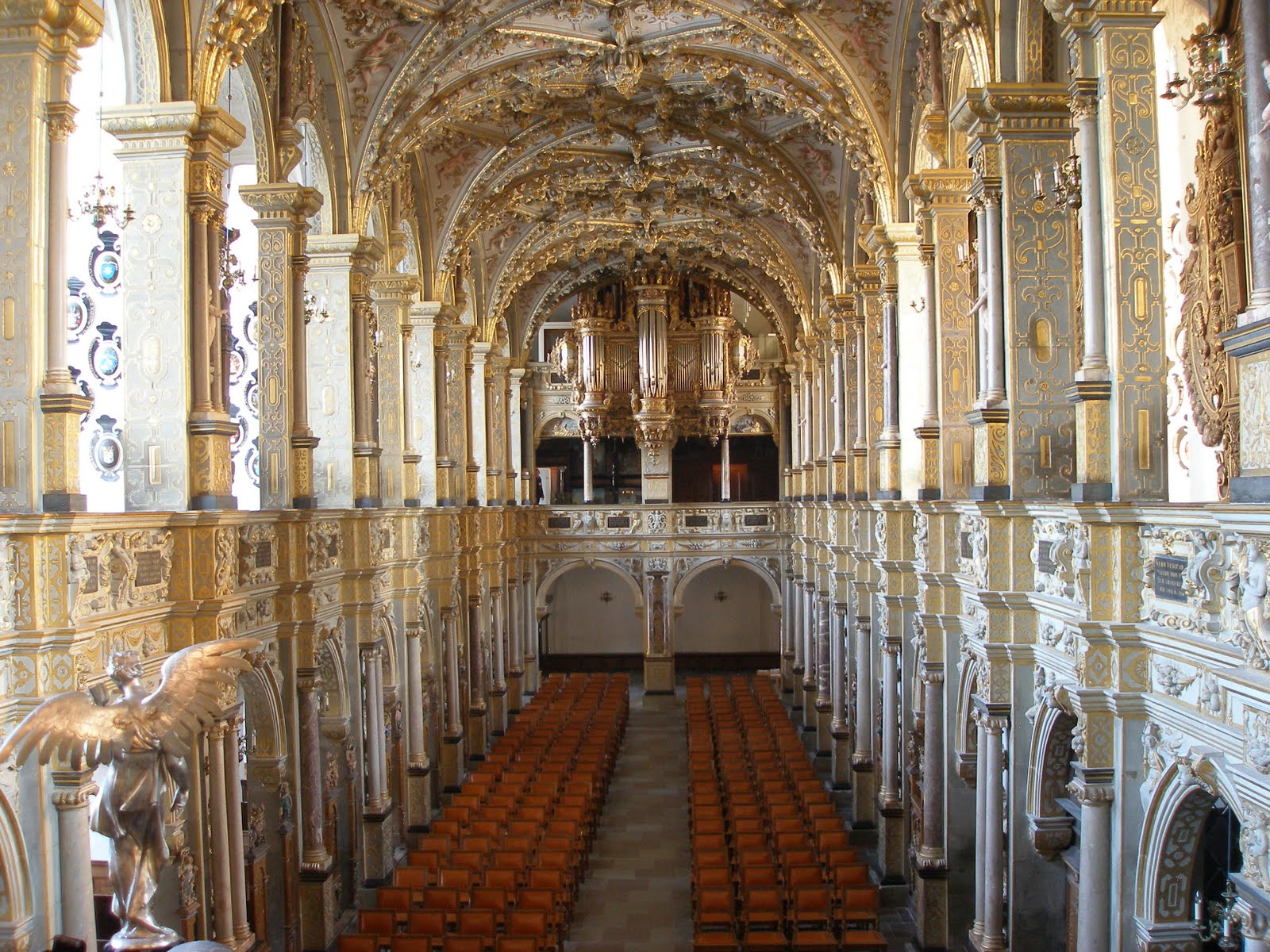
There are a handful of jaw-dropping rooms, most on a much larger scale than the town palace, and a few mostly original. The royal chapel is perhaps the most magnificent and the most authentic, with lavish decorations on the ceilings and walls so ornate you'd swear it was Christian IVs remarkable crown writ large. Similar to St. George's Chapel at Windsor, this is home to Denmark's highest order of chivalry (the elephant) and the window embrasures are decorated with the shields of current and former holders, a veritable roll call of the world's monarchies and heads of state.

Also of note is the vast great hall, with gleaming marble floors and ornate gilt plasterwork, lined with monumental portraits of past monarchs; a knight's hall called "the rose" (supposedly after the Roman concept of "sub rosa", a place where you can speak confidentially), darkly Germanic with its wooden paneling and lifelike freizes of deer and stags made more realistic by the insertion of real antlers; and an audience chamber with a domed ceiling down a long, window-lined passage, all white, Baroque and encrusted with floating putti.

Admission comes with an iPod-based commentary. It goes into great detail and reveals plenty of drama in the history of Denmark, but you'll realise about an hour into your visit that you've hardly seen a fifth of the rooms, and if you listen to everything you'll need two days to get through. With early closing hours in the winter we certainly had to pick up our pace by the time we reached the mid eighteenth century, and a procession of lovely rooms from the Napoleonic and Victorian eras, including a re-construction of Hans Christian Andersen's study, flew by. Up under the eaves is a 20th century collection, heavy on heroic stories of the Danish resistance and rescue of Jews in the second World War.

Outside, beneath the thick blanket of snow, we could see the outlines of the magnificent Baroque garden across the lake, reconstructed in the 1990s. Even had the weather been mild, I'm not sure I would have had the energy to explore, as the scale of Frederiksborg is so massive that by the end of the tourist route both my feet and my brain were near collapse. Like any great museum or palace, this is a place that needs more than one visit to appreciate its diversity. I look forward to a return.

Coming in the next entry ... the best of the rest of the sightseeing.