Friday, 8 April 2011

A parade of strong women reminds me to focus, soldier on and look for the positive

The theme for the week past seems to have been strong women. Particularly appropriate for a stress-filled period in which I felt in great need of fortitude, and encountered a few more lost and helpless moments than usual.

It started on Mothering Sunday, as I sat next to my soon-to-be mother-in-law for a family lunch at Madsen's. (Another blog topic could have been how quickly humans can change their perception of what's tradition. I now have no problem accepting, and enjoying, pickled fish, dark rye bread and a small glass of snapps as celebratory fare.) Piers' Mum, like mine, was raised to be a housewife rather than a wage earner. But, as with mine, marriage didn't work out as planned and she had to make it on her own. She turned her training as a pattern cutter into a deft skill with curtains and upholstery, and from there built an interior design business. She's interesting, assertive, stubborn ... all traits she passed on to her son ... and has enough of the classic English eccentric to fascinate our American wedding guests.

The next woman of the week is Joanna of Naples. Strolling down Cheapside early in the week I was delighted to find a newly-opened branch of Daunt Books, my favourite bookstore on earth. (And another alternative blog topic for the week. This still-independent shop, headquartered in its gorgeous original Edwardian building in Marylebone, is famous for organising its selections by geography. So you'll find travel guides to Florence, "The Agony and the Ecstasy", Tuscan cookbooks and biographies of Lorenzo il Magnifico all in the same section. As that list implies, they specialise in travel, history and historical novels, biography and other thoughtful fare. I can't go in without finding something to add to my must read list.) Screaming out from a central shelf was "Joanna: The Notorious Queen of Naples, Jerusalem and Sicily" by Nancy Goldstone. I'd come across mentions of Joanna in Sicilian history, always with anecdotes tempting enough to make me wonder why she wasn't better known. Now Ms. Goldstone comes to the rescue

In the cutthroat, male-dominated 14th century, Joanna inherited the powerful kingdom of Naples from her grandfather at the tender age of 17. She survived the manipulations of an horrific family, the various branches of which were all scheming to get her off the throne and place their own candidates on it. She avoided the plots of a mother-in-law from hell, who tried to get her convicted for her son's (Joanna's first husband) murder in order to get her out of the way to place her elder son (Joanna's brother-in-law) on the throne. Joanna hung on to expand her empire, marry three more times and preside over a court famous throughout Europe for its art, literature and sophistication. Her biography is as good as any novel.

Later in the week I was at a work event with Dame Ellen MacArthur. (And there's the third potential, but dismissed, alternative blog entry. The Tower of London has gone in for corporate hospitality in a big way, usually hosting two or three different events an evening. Wonderful for the corporate guests, who get to see a peaceful and quiet inner ward and get private access to the crown jewels without the hoards of packed tourists. This has sadly diminished the Ceremony of the Keys, however. What was once an almost mystical event for a small group (free tickets by request, by post) is now flooded with all those hospitality guests, who outnumber the handful of tourists from the general public by three to one.)

Ellen has parlayed her fame from solo round-the-world sailing into a career devoted to green issues and a foundation that builds confidence in "at risk" children. This, alone, is very impressive. Most sports figures dabble in philanthropy. It seems a necessary PR tick in the box for such people. But I've rarely seen anyone approach it with such passion. Ellen could have done just enough for her reputation, made a good living off public appearances and sports commentary, and generally kicked back and enjoyed life. Instead she has a driven zeal to make the world a better place, and exploits all of her sponsorship contacts to drag various corporate social responsibility programmes along with her.

Of all the things she said, one stuck out: "When you're alone in a boat, 2000 miles and weeks from land, you know what finite resources are." That certainly got me thinking. We live in such a quick, easy, disposable society. I can have the majority of items I can imagine in my hands with no more than a 10-minute drive and a wave of a debit card. What's not instantly available near home can usually be delivered after the magic of internet shopping in less than three days. Nothing seems finite in a world where everything is at our fingertips. It's an illusion, of course. Whether it's oil, out-of-season cranberries or the perfect white flats to go along with my wedding dress, there's a limit to everything. Not seeing and respecting that limit will get the whole planet into a lot of trouble. So my hat's off to Ellen for her efforts to get us to see this.

Finally, I spent a lot of time thinking about, and praying for, one of my oldest and dearest friends. She's had buckets of my admiration since we first met at the age of 17, when I thought she was the coolest person on the planet. Later I was humbled by how she managed to juggle law school with motherhood, then wowed by her magnificent career, and always impressed by her maintenance of her marriage ... the most long-standing and strongest of all my friends' and a model I hope to copy. Unfortunately, this week I've been most awed by something I wish she didn't have to do: keep far too many plates spinning, and present a capable, professional face to the world, when she's dealing with a mountain of worry and stress. I listen, console, try to provide what support I can. I wish I could do more. I have the confidence she'll make it through the bad times.

Strong women always do.

Saturday, 26 March 2011

Roussillon stays true to form, delivering masterful French cuisine with great service

Balance, I've always believed, is the secret to life. Whether it's spices in a dish, decorative elements in a room or the things keeping you busy, balancing the elements around you leads to contentment.

Letting things slide out of proportion is a recipe for stress.

Of course, sometimes you can't do anything to avoid the madness. I'd been doing pretty well on the balance beam lately, managing to keep the Mom, work, travel, Piers and wedding planning balls up in the air. I did this by temporarily jettisoning a few things ... pro-active management of my social life, diet and exercise ... but things were going well. Then came the element I couldn't control. Work has exploded, with time required and related stress roughly doubling. Without an ability to adjust the balance any further, spots of well-managed stress relief become critical. Sleep. Weekend hours doing nothing (and ignoring the to do list while doing so). Long hugs. Good meals.

This is all my excuse, and I'm sticking to it proudly, for heading to Roussillon and opting for the chef's menu on a totally average Wednesday night, without a special occasion in sight to justify the flagrant expense, the copious alcohol or the high calorific content. (Well that, and the fact that we were just up the street for a pre-nuptial session with our vicar. As long as we were in the neighbourhood...)

This is, without doubt, one of my favourite restaurants in London, right up there with Locanda Locatelli for delivering something beyond the ordinary every time. (See 8.11.07 for a previous visit's write up, though I have been since.) Like Locatelli's, it takes traditional food ... in this case, French ... and delivers with twists and nuances that present a whole new level. My French boss admitted that this was a far better French restaurant than the majority of fine dining establishments in his home country. It certainly beat any of the meals we had in Paris, and as this blog records, we ate well.

Things started happily with the triple whammy of a cozy corner table next to a window, a tasty amuse bouche (parmesan puff with goat's cheese) loaded with tomato, so I got to eat them all, and an unprompted offer of tap water. Three cheers for restaurants who don't try to guilt you into paying exorbitant prices for something you don't need. Another fine example of their service mentality? The moment they heard Piers was allergic to tomato, another plate of parmesan puffs hit the table. Accompanied by a chatty maitre d' and sommelier who steered us towards some exceptional and little known French varieties in the bottom third of the price list. How can you not love these guys?

We started with Salcombe crab with mango and passion fruit and coriander. The white crab and the orange of the fruit (it came as a sauce encircling the meat) made for a gorgeous plate, and one we'll try again at home. But with more crab. It was a tiny serving. Of course, we had a lot of courses still to come. Next up, pan fried foie gras with kumquat jam, pistachios and a slight dusting of dark chocolate. A mouthful of unctuous richness, cut through with the sharpness of the fruit, given a hint of bitterness by the cocoa and a bit of salt from the nuts. Bliss. And at the beginning of this course our friendly maitre d' had appeared with glasses of sweet gewurztraminer on the house, because the white we were drinking with the rest of the meal was very good, but just wasn't going to do the foie gras justice.

It was at about this time that the stresses of work and life started to slide away. A process helped by the confit of Scottish salmon (so beautiful we wondered, would it be totally pretentious to put a sous vide cooker on our wedding registry?) atop a velvety slick of curried parsnip. Then, just as a little palate cleanser, mind you, came the wild mushroom cappuccino with coffee jelly and cep veloute. A necessary break to separate the salmon from the next fish course, Atlantic halibut with Yukon gold potatoes, bergamot, lemon and clams. An incredibly simple dish, but cooked with such skill I knew I could never get close in my own kitchen.

And then, as any good chef's menu should, they finished the mains with a hearty, meaty option to put the savoury icing on the cake. Anjou squab pigeon with almond milk puree and ravioli of the confit leg with a sauce of cherry and pigeon jus. (We had, of course, ordered a couple of glasses of red to go with this course.) The almond puree was the only real misfire of the meal; far too sweet for the dish, we decided it would make a fantastic filling for a chocolate cake but didn't work here. The confit ravioli was, however, absolutely sublime and one of the high points of the meal.

That was really the climax from the rich, comfort food perspective, as the desserts that followed were about cutting those heavy flavours and leaving your taste buds on a light and lively note. First Yorkshire rhubarb with goats curd and macadamia nuts ... an airy take on a cheesecake ... then a blood orange souffle with dark chocolate sorbet. I've never been a sorbet fan, figuring that if I'm eating something cold, scoopable and sugary I want the hit of dairy as well. But this did a remarkable job of making me forget the absence of the cow's contribution. And of course, it would have been low fat as well! The two desserts were accompanied by another complimentary glass from the maitre d', because you really shouldn't finish your meal without it.

This is such great guest management. Two free glasses of wine on top of the chef's menu and our existing wine purchases is hardly going to put a dent in their profit margin. But it leaves me feeling like I got fabulous value for money, rather than wondering in horror how I could spend that much on a mid-week dinner. Why don't more people figure this out?

And so, I feel a lot better. I was pampered and treated like a queen. I marveled at the artistry set before me and relished every bite. I got to do it looking into the eyes of the love of my life. Frankly, my faith in the worth of mankind was restored. As long as there are evenings like this to be had, then I can put up with the stress required to earn the cash to pay for them.

Thursday, 17 March 2011

St. Louis makes a pitch for quintessential American town while feeding us well

Our guest commentator today is blog sub editor and blog writer's fiance, Piers. You've heard plenty about St. Louis from me over the years, all clearly tinted by the fact that I grew up there. Today you get an objective report from a first-time visitor. Not just to St. Louis, also to the middle of the country, as his previous trips to the States have been to LA and Washington DC/ Virginia.

The circumstances, of course, were not ideal. In town for Mom's memorial service and to start cleaning out the house, Piers was also working every day so he didn't have to take leave to be with me. Thus his introductory sightseeing consisted of evenings out with friends and two weekend jaunts around town when we needed a break from the house sorting.

Piers' strongest impressions? How similar it was to the stereotypical America he'd seen on TV. From the slightly down-at-the-heel cluster of tall buildings and stadia that is downtown to the leafy lanes of suburbia, St. Louis was, to him "everytown USA" as presented by the American media.


"In size, dimensions, buildings and density of urbanisation the city centre was not so different from an English town," said Piers. "However, as soon as you got into the suburbs it was very much more open, less dense, more like the American suburbia on TV. Houses all set back. Big gardens, drives with multiple cars, every house with a garage, no shrubbery around the front of the gardens so that it has the open feel of continuous parkland dotted with homes. I now understand the traditional image of the paper boy cycling down the sidewalk and throwing papers at the porches on his way past."


The domestic architecture was a bit of a shock for him, and, unsurprisingly, he found the older, more subtle, elegant and architecturally pure homes of Frontenac and Ladue far more to his taste than the lumbering "McMansions" that are going up in Chesterfield.


"Overly ostentations, pretentious, attempting to claim something they're not, and in so doing are actually generating an entirely new form of architecture," he observed. "The French chateau style was very amusing, because I could almost see the originator of that style turning around to an architect, showing a picture of a bad chateau in the first place, then adding a bit more of this style, mashing in a bit of that, then popping a southern mansion's columned porch on the front."


Also high on his amusement list was how clearly fascinated by English style the St. Louisans are, yet how many of their mock Tudor homes looked far more Bavarian to his British eyes than anything actually found at home.

We took a quick walk around Chesterfield's Faust park one evening, where buildings from the town's settlement days have been moved and assembled into an historic district. "I can’t quite see how those buildings evolved into the offices and homes of modern St. Louis," Piers said. "I just didn't see the progression of architecture."


Then he saw the older, more modest neighbourhoods of The Hill and South Saint Louis, and saw a whole different style. "Almost more like LA with all small houses behind tiny lawns. It didn’t have the suburban feel that Chesterfield had. So effectively there seem to be three types of urbanisation: the City itself with its business and industrial feel, then two types of suburbia, inner and outer," he said.


The bit of sightseeing we did brought him back to a more accustomed popuation density and sense of history. St. Charles, the original capital of Missouri, and Laclede's Landing both made impressions with their early 19th century architecture and their cobbled streets. "I can get a feel for some of this history you're always going on about," he said.

Our quick drives around town were really scouting expeditions for the trip coming at Easter, which was always planned as a proper vacation. What's high on Piers' list to return to?

"Definitely the brewery. I was quite interested that it was thrown over such a large space and that people could drive in and around it. I loved the wolves, or whatever they were," he mused. (Those are giant stone foxes in Bavarian dress, sitting on the corners of the bottling plant hoisting large beer steins.) "I definitely want to go to the top of the Arch and have a see through those little windows. I’d like to go back and see the zoo and spend some time in Forest Park."


On his first drive around Busch Stadium (something he has, of course, seen a lot of already on his fiance's MLB.com feed and yet barely recognised from that), he was surprised by how small it looked. This is a trick of architectural perspective, as the lines to the outfield are of the usual length and there's a huge entertainment area behind the bleachers, but he thought "were someone to hit a home run I would suspect it would fly out and hit a car. I can only anticipate, once we're in it, that it will be open, full of light." Stay tuned for Piers' first baseball game on 23 April.)


Most of our free time wasn't spent sightseeing, however, but over evening meals. So while Piers had only a sampler of tourist attractions, the week gave him a full immersion into the St. Louis restaurant scene.


His best experience? As expected, Annie Gunn's. "Quality plates of food, a fantastic sommelier, a broad wine list and a menu that made the most of local, seasonal meat and produce. Very much like a top quality restaurant in Europe," he said, while tucking into a melt-in-the-mouth pork belly with caramelised apples, sauteed potato and sweet and sour cabbage. (A dish calculated to delight him in any restaurant.) My pork chop (so big it provided two more meals) with pecan molasses sauce topped with grated fresh horseradish was exquisite, and dad gave top marks for his wild Alaskan Salmon. We also discovered a couple of excellent American wines: the Kent Rasmussen winery "Carneros" 2007 pinot noir and the Penner-Ash 2008 Willamette Valley pinot noir.


In second place stands Charlie Gittos, an Italian institution from "The Hill" that's recently expanded into Chesterfield. Piers' review: "The service at Gittos was great, I liked the fact that the waiter knew enough about the menu to really advise us on our choices and on the wine, but then when he realised we were serious about the wine he offered to bring the sommelier over to enhance the experience, it wasn't necessary as the wine chosen by your usual author was excellent. They understood my tomato allergy and, despite being an Italian restaurant heavy on that ingredient, provided me with excellent options." The white pizza with clams is something we'll try again at home, and the veal scaloppine topped with crab sauce was a big hit. Piers also judged this the best toasted ravioli (a St. Louis specialty) he'd had thus far.


We had a good Sicilian red here, which was probably the best value for money on what we found to be a pricey wine list. In fact, we noticed across all the restaurants we went to that American wine lists actually seem to be more expensive than British, with the cheapest bottles often coming in at $40, where we'd expect to see £25 bottles ... and remember, that's with tax included ... on the lists of similar restaurants at home. Do Brits drink so much more that the volumes bring the prices down, we wondered? Or is it that with the preponderance of wine makers in Europe provide more competition and therefore make it more economical?


Cunetto's House of Pasta (dubbed the "house of waiting" by our friends Anne and Mike) didn't fare so well, with average service and sub-standard pasta served up after waiting almost 2 hours to get a table and food at the no-reservations establishment on The Hill. Now that I spend my life in much nicer restaurants I realise that the appeal of Cunettos was huge piles of food for not a lot of money. Fortunately, we're both at a point in our lives where we can go for quality over quantity. And Cunetto's is not going to win in that game.


Piers got exposure to a good mix of the casual, hamburger and basic fare bar and restaurant scene that makes up so much of American dining. The Brick House in Chesterfield was average but filling, delivering one of the biggest burgers he'd ever seen but let down by the fact they're not allowed to serve them rare. The sliced roast beef sandwich at O'Connell's got good marks, and Piers admitted that the place had a good homey feel. But his favourite meal on this front was at Sportsman's Park, another bastion of tradition, where the roast beef sandwiches in little buns, served with dishes of au jus, were a huge hit.

Later that same night he was perhaps the most memorable thing to hit Schneithorst's bierkeller in many a month, sending his beer back because the glass was too cold. (He had specifically requested a room temperature glass and got a frosted one.) "I'm sorry, you Americans serve beer far too cold," he harrumphed. "Fine when it's bad beer and you need the temperature to kill the taste. But this was a good Bavarian wheat beer. Why chill it to the point that you can't taste the quality?"

And just to complete the sweep of St. Louis culinary tradition, we took him to Ted Drewes. The 1930s era ice cream hut has been standing beside what was Route 66 since that road was the only main highway to the west, and its "frozen custard" is justifiably famous. "Unctuous, very filling and a nice balance of flavours," Piers said of his "Cardinal Sin" concrete that mixed chocolate and cherries into the vanilla custard. Terrible for my diet, of course, but it's clear we're coming back here after the ball game next month. Traditions must be upheld, after all.

Sunday, 13 March 2011

Adversity tempered by tradition, travel and friends ... Joanlee's eulogy

This is the eulogy I gave at Mom's memorial service yesterday. Thanks to all at Villa for organising, to Kaci Machacyk for flying in from Vegas to open the ceremony with an amazing rendition of "Wishing You Were Somehow Here Again", and to everyone who came. We raised more than $2500 for Villa in the charity auction of her work that followed.

______________

Looking at the bare facts, you wouldn’t have picked the ‘80s as the best of times for my mother. Her marriage had broken down. She found herself on her own, emotionally distressed and financially strapped with a teenager to bring up. And yet, I’d suggest that the ‘80s were the making of Joanlee Ferrara. All that adversity pushed her to great things, while her friends in St. Louis provided the emotional support to keep her going.

This, I suspect, is the era from which many of your strongest memories come. Joanlee teaching advance placement art history at Villa … a class that most of the people who took it can now reflect was a deeper, more insightful … and certainly more heartfelt … foundation in Western Culture than most University classes. There were those great school trips to Chicago, where … in addition to teaching us all the delights of museum exploration … she passed on her love of travel and luxury hotels. (In Mom’s mind, Stan Musial was a legend not because he was one of the greatest ball players ever to grace the game, but because he got her art history trip a magnificent, long term deal at the Palmer House.)

Later on, when budget cuts eliminated her programme at Villa, she went on to reinvent herself at The Saint Louis Art Museum, where she inspired who knows how many hundreds of children by making art a grand adventure that they could understand with their hands and hearts as well as their heads.

Throughout the decade she was forced to really stretch her pennies. And yet, she wasn’t going to let that get in the way of the things she thought were important.

My mother … who was, let’s face it, chronically disorganized … became a master of scholarship applications and financial aid forms, ensuring that I could go to one of the nation’s best … and most expensive … universities when she had no hope of paying even a fraction of the tuition. She skimped on utilities, clothes and entertainment in order to scrape together the money for me to make my Fleur de Lis debut, something I must admit I didn’t see the point of at the time, but was vital to her.

And of course, there was the travel. There are few things Joanlee loved as much as heading to the airport … but in the ‘80s, she couldn’t really afford to do so. Undeterred, she got a part time job as a travel agent. Organising and leading group tours got her to Europe multiple times when she had no ability to pay for her own trip.

Here, she was in her element, as she herded her flocks through the delights of the great European capitals, feasting on a rich diet of art, architecture, shopping and local delicacies. (I don’t know which story I heard more from her Spanish trip … the delight at the private tour of the Lladro factory, or the horror of an intact roasted suckling piglet being placed before her at the dining table.)

It was an era where the travel industry essentially gave away free samples so that agents could experience what they were to sell, and boy … did mom take advantage of those discounts. That’s how we managed to spend the summer after my college graduation wandering through Italy, Austria, Germany, and Switzerland … despite the fact we could hardly afford to keep gas in the car. In Joanlee’s mind, the educational and emotional benefits of a good trip were always going to trump the basics of everyday life.

This is, of course, the woman who, in the two years after a terminal cancer diagnosis, and while undergoing serious chemotherapy, managed to get to … five Caribbean islands, four Hawaiian ones, Los Angeles (three times), Disneyworld (for a full week of being a kid again with her nephew and his family), and … finally … back to London. Yes, she was failing fast and just two months from death, but she pushed herself through the Gaugin exhibit at the Tate Modern, then held court with my friends in a fine restaurant overlooking the majestic, illuminated dome of St. Paul’s.

And yet, for all that she loved to travel, she always insisted on coming back to St. Louis. I made several attempts as she neared retirement to get her to liquidate everything and move to Florida. Lauderdale by the Sea had, after all, been her beach escape since her teenage years, and daily access to a beach would have made her exquisitely happy … while maintaining that amazingly deep tan we all used to admire. But she wouldn’t do it. This was home. And for all she loved new experiences, it was tradition and history … especially family history … that kept her grounded.

No drive through the Central West End could be made without triggering a stream of tales about City House; Kathleen, Bonnie and Karen weren’t just my mother’s friends, they were characters in oft-told stories from an idyllic St. Louis of the 1950s … Mom had written Happy Days in her head long before Gary Marshall brought it to TV. A certain stretch of Baxter Road always produced the tale of Mary Lou Clifford driving Mom out to Chesterfield in the early ‘70s and suggesting it would be a great place to invest.

There’s a spot near Forest Park where a colleague of my grandfather saw my mother cruising in her 1958 Chevy convertible, clearly cutting class. The incident sparked the confiscation and sale of the car, and repeated tellings of the story whenever we drove through the scene of the disaster. We couldn’t pass Chaminade Drive without accounts of Betty Crean’s Derby Day parties, evidently the social event of the ‘70s.

And any visit to the Hill’s Missouri Baking Company would spark a whole range of family stories, from my grandfather being the favored doctor of the original bakers, to my grandmother teaching my mother to make pizza with their fantastic dough, to the toddler version of me being cute enough to con Joanne Arpiani out of multiple cannoli on every visit, all of which I ate promptly and with a seemingly limitless capacity. (Frankly, these days I am more likely to remember that last tale at Weight Watchers meetings.)

Of course, St. Louis is like that. Our “where did you go to high school” culture assumes you’re born here, die here, and generally have Mississippi and Missouri River Water running through your veins. This is a town with a long memory and intimate social connections … a very small town, despite its population size. Mom both hated and loved that, but it made her who she was. It meant that the people around her at the end were the people who had always been there.

Marian Briscuso, beloved friend since they were toddlers in Bellerive Acres, who flew in from Baltimore for the final week. BJ Wenger and Lucie Nordmann, City House sisters who shared her memories and could give her tough love when she needed it. Anna Ahrens, first student, then colleague, always a kindred spirit. My father, with whom she reached a comfortable peace at the end. Tricia Hannegan, who spent almost as much time in our house as I did from the tender age of 3. And Annie Bruneel, who she really did forgive for spilling that glass of illegally obtained red wine over her pale blue living room carpet in 1982.

The conjunction of places … things … people … and history. Call it roots.

You’ll see it a lot in her paintings. After decades of teaching about the work of others, and coaching children to discover their own creativity, she picked up her own brushes again. She produced more work in the year after her cancer diagnosis than she had in the three decades preceding.

Sure, you’ll see a lot of wonderful foreign spots in her watercolours. She found it hard to resist England. It was, after all, a second home … as well the place that had captured her daughter and provided a much-approved future son-in-law. There are some lovely Italian scenes, a few French spots. But her most meaningful work, I think, is the St. Louis stuff. The scenes from the botanical Garden, the views from Chandler Hill Winery. Most significantly, her beloved trees. Old, tough, with roots sunk deep into the Missouri soil. Just like Mom.

She had an abiding respect for tradition and history. She treasured old friendships. She loved to travel. And when times seemed worst, it was the adversity that pushed her on to better things. This is what I hope we’ll all remember about her. And, more importantly, I hope it’s what we’ll all be inspired to incorporate into our own lives.

Sunday, 27 February 2011

A tale of two operas shows why music reigns supreme

Only tourists and the ignorant rely on public transport in the UK on weekends without checking their routes in advance. Or, in my case, silly women who simply forget.

This is what I told myself over and over again as we sat motionless on a wooded track in Hampshire yesterday. We'd already been en route 45 minutes. Under normal circumstances we'd be pulling into Waterloo. But now we were awaiting a signal from engineering works to go backwards, then forwards, and eventually creep into London. Irritating at any time, but particularly distressing when you're on your way to town for a much anticipated outing to the Royal Opera House.

ROH tickets are disastrously expensive, pushing well over £100 for the good seats. There are, however, a handful of "cheap" options at around £50 each up near the top of the theatre and, as reported in past entries (read about Turandot on 24.1.09, and Simon Boccanegra on 30.5.08) they still offer a great view. But to get them, you have to move fast. I booked yesterday's tickets to The Magic Flute five hours after they went on sale last October. Four months of planning, and I wasn't sure I was going to get to the performance at all.

We arrived at Waterloo at 12:40, ten minutes after the performance had started. Twenty minutes later we were walking into the historic foyer but, of course, couldn't disrupt proceedings to get to our seats. So instead of the spectacle of Mozart on a grand stage, we got the first half of the opera on a big TV screen set up in one of the grand reception rooms. Trying to look on the positive side, it did mean we were first at the bar at the interval, able to snag a table and enjoy a lunch of gourmet open faced sandwiches and champagne in the neo-Victorian glass house that is the Paul Hamlyn Hall.

Finally in our seats for the second half, Mozart's fantastic music soothed away what stresses remained from the journey, and within a few minutes I was fully engaged in the preposterous plot. Set in what's notionally ancient Egypt, but also bears a striking resemblance to Enlightenment Europe, a prince is engaged by the Queen of the Night to rescue her kidnapped daughter. Upon arriving where the princess (with whom, of course, he's instantly fallen in love) is being held, the prince discovers that the kidnapper is actually a good guy, and our hero instantly wants to join the sacred mysteries and intellectual nirvana of the kidnapper's kingdom. Thereupon follows a Masonic-inspired journey as our brave lad and his intrepid sidekick, who also provides the comic relief, undergo all sorts of tests to prove themselves worthy of joining the fellowship and winning the love of their respective fair maidens.

On paper, it's a stretch. A big chunk of the opera is taken up with Masonic mumbo-jumbo. You're given no good reason why we should suddenly see the Queen of the Night as the baddie, except that a key point of the plot is that women shouldn't be in positions of authority because they're not capable of rational thought. Not a plot you'd think would have maintained its popularity into the 21st century, really.

But none of this matters because of Mozart's score. The music is glorious from beginning to end, with the Queen of the Night's arias being some of the most beautiful ever written for the soprano voice. When you get a really top singer, as we did with Jessica Pratt, you find it hard to believe that it's actually a human generating the amazing trills of her famous vengeance aria. ("Der Hölle Rache kocht in meinem Herzen".) Hearing it live is a literally breath-taking experience. The opera's pacing is quick enough to keep you from ever getting bored. The comic relief is truly funny and gets some of the best arias. The Queen of the Night and her vampish handmaidens have great costumes, and there are some strange child spirits who zip around in a flying cart and sing with the treble voices of angels. It was a magnificent production, and I could have happily sat through it again, immediately, for the evening performance.

It was an interesting contrast to the week's earlier operatic experience. The English National Opera, generally known as the cutting edge risk takers while the ROH holds up the grand tradition, brought in film director Mike Figgis to create a version of Donizetti's Lucrezia Borgia. Figgis (Leaving Las Vegas, Internal Affairs) hadn't seen an opera until a year before he got involved in the project, so he brought completely fresh eyes. The result ran live on Sky Arts, with the full work playing on Sky Arts 2 and a director's commentary simultaneously on Arts 1.

Back on paper, while The Magic Flute shouldn't work, Lucrezia Borgia should. It's a ripping yarn of political intrigue, sex and jealousy loosely based on one of the most fascinating times in Italian history, full of mistaken identities, guilt, violence and big surprises at the end. Figgis did some interesting stuff, particularly in designing sets lifted directly from famous Renaissance artists, such as the pictured banquet before our hero's friends all get poisoned, arranged to look just like DaVinci's last supper. He filmed a back story to cut into the overtures and longer musical interludes, giving you historical context and some character exposition for Lucrezia. It should have been great. The problem? Musically, it's just a bad opera.

There's not a memorable tune anywhere in it. At no moment does the music make your heart soar with joy, weep with emotion, shudder with fear or melt with love. Mozart manages all of that in The Magic Flute. Repeatedly. More oddly, all the music sounds the same. Whether it's our hero and his buddies carousing, the Duke of Ferrara (Lucrezia's husband) plotting or Lucrezia herself collapsing in grief over her son's death, the music is all a vaguely cheerful, rather inane 19th century bundle of notes. It reminds you of all those forgettable, sound-the-same national anthems that run together at the Olympics.

Unfortunately Donizetti's ability to turn a great proto-mafia tale into pretty boredom scored a big point for my fiance in our enduring German v. Italian opera debate. I had to concede, Wagner could have done something great with that plot. And in the hands of Mozart? I tremble to imagine.

Friday, 25 February 2011

Da Rioba tops list of Venetian restaurant finds, but avoid eating at Hotel Dei Dogi at all costs

As a general rule of thumb for Venice, the further you get from St. Mark's Square, the better the food will be. (With an exception for the area immediately around Piazzale Roma and the train station, generally filled with execrable places taking advantage of hungry new arrivals who will never return.)

In the main islands of the city, your best bets tend to be in the districts of San Polo and Cannaregio. If you're staying in the main mass of tourist hotels around the Rialto or in San Marco, this may look like a daunting walk. Once you get the hang of navigating the city, however, nothing is more than about 20 minutes away. Trust me, it's worth it. Get into the areas where the natives actually live, and you'll find places serious about the food because they need their regulars to come back.

Our top find for this trip was Ostaria Da Rioba, at Fondamenta de la Misericordia 2553. As with most of the best places here, it's tiny ... about 10 tables ... so essential to book. They put additional tables on the pavement in nice weather; they're on a lovely but almost entirely residential canal with wonderful views. The menu is varied with both fish and meat dishes (the latter being more unusual in Venice) and the preparation leans toward the gourmet. The service is fantastic; English-speaking waiters know the details of dishes and aren't afraid to make recommendations, both from the menu and the wine list.

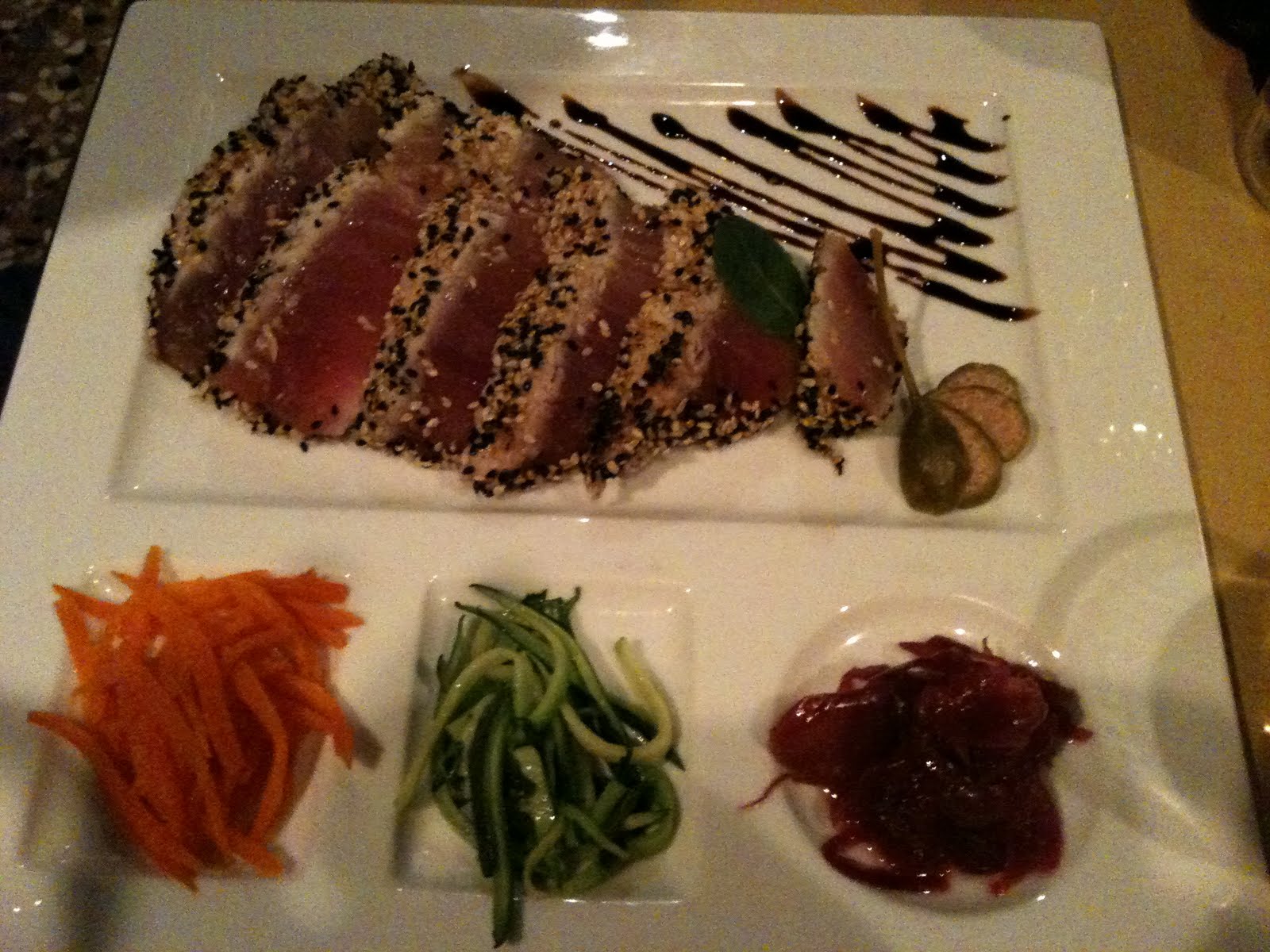
Piers started with a most un-Venetian goose carpaccio with mango jam, baby salad leaves and candied walnuts which was the clear winner for this course. My spaghetti alla seppia, with a black sauce made from cuttlefish and their ink that's one of Venice's most classic dishes, was delicious but lacked the novel delight we got with the goose. We both triumphed with the mains: Piers with a gorgeous piece of tuna crusted with black and white sesame seeds and grilled perfectly so that it was still very rare at its centre, me with melt-in-your-mouth goujons of lightly battered turbot served over a pile of grilled baby artichokes. On the side we'd ordered a spinach salad with pears and walnuts, also gorgeous. This was all accompanied by the waiter's wine choice, a 2009 collio bianco from Edi Keber, a Friulian who doesn't export much. Decanter magazine gives it five stars and says "ample fruit and floral aromas, soft and full bodied with a long tasty finish." Yes. A second bottle was a must. Which means that neither of us can now remember what I had for dessert, other than to say it was great. (Piers had the first of many tiramisus; every restaurant tells you theirs is unique) I suspect if those particular brain cells weren't killed by the wine, they were done in by the complimentary grappa the waiter brought at the end of the evening. The whole meal came in at £140 which is, of course, not cheap, but good value for three courses each and two bottles of excellent wine.

The runner up prize goes to Osteria Da Alberto, on calle Giacinto Gallina not far from Zanipolo. Less elegant and more homey than Rioba, its handful of tables are scattered over two rooms. At the front there's a bar where locals pop in and get sandwiches and snacks to eat while chatting with the proprietors; most of the starters and desserts are dished up from here. I started with sarde in saor, a Venetian classic from the days before refrigeration. The fish are breaded and deep fried, then marinated in a sweet and sour vinegar with lots of onions. It's not a dish for the faint of heart, and I have to say that the Danes win the pickled fish contest by miles. But you really should try the dish while you're here, and Alberto's was an excellent example.

Piers started with a dish of tiny gnocchi in gorgonzola sauce. Delicate and rich, this combination of two of his favourite ingredients ... potatoes and cheese ... had his eyes rolling in delight. He went on to a fillet steak, cooked rare as he requested and served on a bed of balsamic dressed rocket, while I had the spaghetti al mare. It's tough to avoid the latter dish in Venice, as just about every restaurant does it, but this was a particularly good example loaded with fresh seafood and delicately flavoured with garlic, oil and excellent tomatoes. We had another excellent wine here: Marco Scolaris' pinot nero from the Collio region was the kind of fruity yet light red that can easily cross over between meat and fish.

Next on the list is Anice Stellato (Star Anise), on Fondamenta de la Sensa. It is the closest restaurant to the Hotel Dei Dogi, and one that's been in the guidebooks for a while. I'm fairly sure we ate here on the Northwestern Girls' trip in 2001, something I didn't remember until I got inside and was almost certain I'd been there before. A bit bigger than either of the restaurants above, Anice Stellato spreads over three rooms with a bar anchoring the space between the first and second. While Rioba looks like a slightly trendy local wine bar, Alberto like an un-improved workers' lunch spot, this place is a more consciously modern restaurant, with stripped wooden floors, bare wood tables and lots of modern art. The food was good but the service less so, something you'll see reflected on their Trip Advisor reviews. We couldn't get in on our first night, so made a reservation for 9 on the next.

Our table was waiting when we arrived but service was slow ... after a long delay posy starters the waitress removed our bread basket and handed us dessert menus. I'm sure they forgot the second half of our order. Because of the delay, we were the last people in the restaurant and while we had dessert the staff was changed to go home, sat in the front room, had a good gossip and generally forgot about us.

The food might have made up for it but for some sloppy mistakes in the kitchen. We started with a little ciccheti ... the Venetian take on tapas ... of prawns in saor. A more delicate and enjoyable taste than the sardines, but this is never going to be my favourite way to prepare a prawn. Piers' first course was tagliatelli with locally caught spider crab and zucchini, which he pronounced excellent but for stray bits of shell in the dish. My bucatini in a light tomato sauce with smoked tuna was good, although I'm not sure I'd do that combo again as I felt the sweetness of the tomato and the smoke of the fish were actually battling with each other; a cream sauce would have been better. When the mains finally arrived, they were average. Piers' lamb rolled in pistachio had potential, but had been cooked too long for much taste to remain. My swordfish steak was beautiful, done with lemon, butter and breadcrumbs and melting in the mouth, but the plate beneath it was swimming in far too much butter and the potatoes that accompanied it were bland and unattractive. I'd try it again if staying at the Dei Dogi, but I'd book well in advance so I could be there with the main dinner crowd, and I'd be much more assertive about how my mains were cooked.

One place I would NOT, under any circumstances, eat again if staying at Dei Dogi is Dei Dogi itself. We reserved a table in their small dining room for Valentine's Day dinner, figuring it would be convenient not to leave the hotel and responding to a great looking Valentine's Day menu in a brochure left in our room and promoted at the front desk. We should have been warned when the front desk seemed surprised that we wanted to eat in the restaurant, offering to book us a local place instead. Our first surprise that evening: No sign of the promised menu. What was on offer bore no resemblance to the brochure, and was an odd selection of dishes all in a jumble rather than broken into starters and mains. Second surprise: The window table the hotel manager had specifically walked us into the restaurant that morning and told us he'd save for us was already occupied. The service at Anice Stellato was world class compared to here, where one man alone was working the nine tables of the restaurant and the hotel bar. We waited almost an hour between starters and mains. Third surprise: The biggest bill of the trip ... over £200 ... for the least amount of food and wine.

We split a decidedly mundane carpaccio of over-marinated beef which I suspect had also been left out longer than health standards would say is wise. (Piers' stomach was not its usual robust self the next morning.) Piers had badly overcooked tuna; the "tartare" of courgettes on the menu arrived as diced aubergine and potato. My mixed platter of fried local seafood was lukewarm and uninspiring. At least the wine the waiter recommended was good, but at 45 euro it should have been. At that price we paced ourselves and kept to one bottle, a challenge since the creeping service meant our dinner took more than three hours. Still trying to make it a special evening we tried for dessert. Piers' plate of local cheese lacked diversity and had too many hard, sharp varieties that are better cooked with than eaten alone, and my tiramisu ... really the only appealing thing on the menu since they were out of the chocolate fondant ... was well below what I can whip up myself at home. A final insult: they refused to serve tap water. Bottled only. That, my friends, is simply blatant extortion. And after all those indignities, it took another 20 minutes to get the bill.

Sadly, the outrageous rip off off the restaurant countered the great deal we got on our room, and left me with both a literal and figurative bad taste in my mouth. While I still recommend the hotel, based on that experience I will be shopping around for other options for my next visit. Fortunately, I have the memory of the other restaurants to remind me that you can dine well in Venice, with enough research and planning.

Monday, 21 February 2011

Zanipolo tops new and surprising sights in this Venice trip

Venice's glory days were the Middle Ages and the Renaissance, when the world's riches throbbed through its markets and the ensuing profits made the Republic a power to be respected. These are the centuries that gave us most of the city's architectural and artistic masterpieces. I, however, love Venice in her decline.

By the 18th century she was without political power and world trade was flowing through other channels. This, however, was when the rest of the world fell most in love with her. English aristocrats flocked here on their grand tours, Goethe wrote descriptions that drew early tourists and anyone with money who wanted a fast, decadent life with great clothes and an exotic mask could rent a palace and live the dream.

Ca'Rezzonico, an impressive palace on the Grand Canal, exemplifies this age. Not completed until 1756, it's hundreds of years younger than its neighbours and strikingly different in its neoclassical regularity. A few years after completion, a family member became Pope and another made a fabulously prosperous marriage. At the time, the combination made this palazzo one of Venice's most significant places to be seen. It's thus wonderfully logical that it's now a museum to Venice in the 18th century.

While there's an interesting collection of paintings and some impressive pieces of furniture, the real thing to see here is the palace itself. The main rooms wind around a piano nobile of exceptional height. You enter on the side away from the Grand Canal, climbing a magnificent white marble staircase to arrive in a ballroom covered with some of the most magnificent tromp l'oeil (fool the eye) paintings you'll ever see. Billowing draperies, columns, balconies, gods and putti thrusting their limbs into the room all look real, but are simply illusions created with paint. There follows a procession of rooms with grand ceilings, most with more frolicking deities and fat baby angels who hover over slightly more restrained classical interiors. At the front, two salons and a great hall look over the Grand Canal. Here the decor is a bit less flamboyant, if only because it's hard to compete with the picture postcard views out the towering windows.

There are two more floors, mostly filled with paintings. Here the architecture is less grand, but still worth a wander. Though of great architectural and historic significance, Ca'Rezzonico is a second tier museum in this city and sees far less traffic than the main sites; we were alone in many rooms and never had more than six people for company even in the biggest spaces.

Another blockbuster without a lot of tourist traffic is La Fenice opera house. This is certainly, in part, because it's very expensive (8 euro) for the little bit you see, and not on the Venice Card scheme. Thus only the dedicated are there. But for either the serious opera fan, or those who wonder at architectural re-creation, this is a must see. The place couldn't have a better name. Fenice means phoenix, and this theatre has, like its avian namesake, risen from the ashes more than once. The most recent fire destroyed the entire theatre in 1996. Fifteen years later you'd never know it, as the whole place has been rebuilt to the exact details of old.

Tourists get an audio tour with their admission that talks them through the history of the building and the story of the latest restoration. You get to explore the entry foyer before going upstairs to look at an impressive model of the building inside and out. After that you can settle into a seat in the royal box to take a good look at the theatre itself. The box is so opulent, with its gilded putti, baroque woodwork and copious mirrors, that it actually takes a moment for you to look beyond. You then see an impressive galleried space around a traditional stage, topped by a ceiling painted to look like a dawn sky. A few frolicking deities seem to have flown over from the Ca'Rezzonico. The colour scheme is actually a bit off-putting: pink, light blue, white and gold, it is feminine bordering on what the English would dismiss as "twee". But it's of its time (the 1830s), and would no doubt be a great place to see and be seen while enjoying a performance. I don't know if we were lucky, or if this is a regular feature, but a pianist was practicing on stage while we were there, which added greatly to the atmosphere.

Once you tear yourself away from the theatre, you can explore a series of reception rooms at the front of the building used for entertainment during the intervals. Clearly, they also do a fair amount of corporate entertaining here, and the ballroom at the end of the complex is used for smaller concerts. If you can't get to a concert here, then paying to take the self guided tour is an excellent second best.

Venice's naval museum was another new sight on this visit and, I'm afraid, a rather disappointing one. You'd expect a former maritime empire that derived all its fortune and power from trade over sea routes, and whose capital works on water rather than roads, to have one of the best naval collections on Earth. And it might, if it had several million to invest in installation, explanation and the building itself. Alas, this is like so many of Italy's museums: a treasure trove of great stuff bundled together into a crumbling building with little staff and only the barest, dry and academic labels for what you're looking at. (And yes, my Italian is good enough to tell you that the locals don't get much better than the English translations.) Its organisation is also confusing, as you're confronted with World War II upon entry ... let's face it, not Italy's finest hour, although Piers said the manned torpedo on display was actually justifiably famous ... and don't get to the glory years until you're upstairs.

It is, however, worth the making the effort for the model of the Bucintoro alone. One of the most lavish crafts ever built, probably second only to the legendary barge on which Cleopatra seduced Mark Antony, the Bucintoro was essentially a floating version of the Doge's palace. It represented Venice's special relationship with the sea, and played its biggest ceremonial role on Ascension Day, when the Doge, the most important members of court, ambassadors and special guests would board to be rowed into the Adriatic, where the Doge would throw a golden ring into the sea to "marry" her for another year and proclaim his dominion. The model is meticulous in its detail, showing the parquet floors, stately throne, lavish sculptural carving and typically Venetian levels of gold leaf. You'll wish you could, Alice-in-Wonderland-like, sip some potion to shrink so you could scramble around inside it. Alas, you'll just have to stand behind the glass and gawp.

The museum has many rooms of detailed ship's models, and a good collection of full-sized gondole. (Yes, I spelled it right. That's the plural of gondola.) A good example of the poor labeling ... it's from the Rough Guide, rather than anything in the museum itself, that I learned the reason for so many, and such exact, models is that the craftsmen in the dockyards worked from these rather than any kind of blueprint. Make sure you get to the gondole rooms, where you'll see the range of craft from the workday basics to the lavish private boats built to take aristocratic families to grand social occasions. (Even in the 1830s, when they were building La Fenice, they insisted on both a water and a land entry, as the most fashionable would make a grand arrival by gondola.) Also look out for the model of the clever lift system which surrounded a ship and elevated its draft, allowing heavily loaded vessels of the 18th and 19th centuries to get into the shallow lagoon. You'll also find galleries of naval costume, sea shells, ship models from other countries, even a Swedish room dedicated to Vikings and several artistic and military partnerships between the Swedes and the Venetians (who knew?). With limited time, however, you're best to stick to the highlights mentioned above.

My last new discovery was a trio of magnificent churches. The blockbuster amongst them was the basilica of Santi Giovanni e Paolo (known in the local dialect as Zanipolo), a place which, I'll admit, it now embarrasses me to say I didn't even know existed. It was a shocking hole in my art historical knowledge of the city, because Zanipolo should be on anyone's Venetian top 5. A vast Gothic church, its undecorated ceilings and large windows make it lighter and less claustrophobic than the heavily decorated St. Mark's. But don't imagine you'll find austerity. This is the burial place of most of the doges, and almost every inch of the wall space is filled with grand tombs. Most are monumental sculptures. A few are painted. (There are some fine Veroneses.) One portrays the grisly story of a doge who was captured by the Turks and flayed alive; his dried skin is preserved in the urn near the top of the memorial. Outside, don't miss the ornate marble facade of the building next door. It is, believe it or not, the hospital.

That same treatment of marble ... multi-coloured yet symmetrical, ornate yet ordered in its Renaissance sensibilities ... is the most memorable aspect of the second of our church discoveries, Santa Maria Dei Miracoli. It's a small place compared to Zanipolo, remarkable because the interior has the exact same marble walls as outside. It's a striking yet calming effect, which therefore doesn't distract you from the church's most unusual architectural feature. The altar is raised a full story above the rest of the church, up an awe-inspiring white marble staircase. It's so ancient Roman in its influences that you almost expect Augustus to emerge at the top to welcome a triumphant general home. Instead, you get a lovely but unremarkable statue of the Madonna and child that was reputed to work miracles, hence the church's name. The only thing that throws off this vision of classical elegance is the ceiling. Don't look up, if you can help it. The barrel vault is dark wood of many coffers, each painted with a different scene. As if that Venetian tendency for excess took over at the end and the architects said "well, we have to cover something with ornate bits and bobs."

The final church that gets a nod is Madonna Dell'Orto, located conveniently next to our hotel thus un-missable. It's probably not worth going out of your way for, but if in this area, it's worth popping in to admire its austere (for Venice) Gothicism and its excellent collection of Tintorettos (he's buried here).

So there you are. It was my fifth trip to Venice. I had four days. I managed to explore six places I'd never seen before. And the best part? There's still a generous list of museums, palaces and churches into which I have yet to set foot. Now that's a city with hidden depths.