Sunday, 8 July 2018

Traviata outshines the English sun, while Hampton's gardens seem confused beneath it

It's been a remarkable summer in England. Consistently clement since early May, memories of our miserably wet winter and spring's surprise snows have been banished by an atmosphere that feels positively Mediterranean. The smell of barbecue lingers constantly in the air. Gardeners report bumper crops of berries. Pub gardens are packed. The national team is still playing in football's World Cup. Commuters into The City have shifted down to Bermuda shorts, polo shirts and deck shoes.

It is, of course, not all good news. The global warming that's brought this weather is wreaking havoc in more extreme climes. Arguably, as we down another Pimms in our sultry gardens we're fiddling while Rome burns. Water companies are having difficulty processing enough supply to meet demand. A large chunk of Saddleworth Moor is burning and brush fires closer to home are disrupting the train network. An unexpected carbon dioxide shortage is endangering the supply of fizzy drinks, meat and packaged salad. Worst of all, in a country where the average summer high is just 18C (66F), air conditioning is rare. Our buildings are designed to retain heat. Public transport rarely offers more than a weak fan. Any temperature beyond 27C (80F) turns London into a miserable heat trap. The underground system is like the sixth circle of Dante's hell.

One inevitable effect: the weather has eclipsed all else in our consciousness. Longborough Festival Opera's La Traviata was both one of the most innovative and enjoyable productions they've ever staged, but our sun-burnished picnic and worries about surviving the heat in the un-air-conditioned opera house dominated. At the Hampton Court Flower show, finding shady places to drink and rest exerted a more powerful pull than the show gardens.

LOVE AT LONGBOROUGH
That Traviata deserves to be remembered, however. It is, of course, an opera that rarely disappoints.
Verdi's tale of the the scarlet woman who proves herself the most virtuous of all, then dies for love, is one of the genre's most enduring crowd pleasers. It's also packed with one exquisite tune after another, making it one of opera's most approachable productions. (Indeed, it was delightful to see several families bringing children to this show.) Director Daisy Evans' re-imagining of the story as the tale of an exhausted, clinically depressed Marilyn Monroe type in 1950s Hollywood was fascinating and worked surprisingly well. The party scenes in acts 1 and 2 were re-imagined onto film sets, with action bouncing between "filming" of movie scenes and the between-take banter of the actors and crew. This was particularly effective when we got to the gypsy and matador sections at Flora's party in Act 2, which usually seem bolted on to give the chorus and corps de ballet something to do. Here, instead, it was riveting as our heartbroken heroine tried to stumble through the "movie" she was supposed to be making as her world collapsed.

The references to Marilyn Monroe were obvious (though soprano Anna Patalong looks more like Maria Callas than the blond bombshell), and the shift of Violetta's death to an irreversable overdose rather than the traditional tuberculosis made everything seem more real. Her final cry of "I want to live" plugged into the poignancy of every soul who's ever squandered their life, then realised they wanted redemption when it was too late to take it. Patalong is one of the best sopranos I've ever heard at Longborough, with a real star quality that enhanced ... or what enhanced by? ... this particular role. Her acting was as fine as her singing, giving us a persuasive picture of a mentally-fragile woman imploding. My only complaint: her compelling death scene played out from the floor, where much of the audience couldn't see her over the tops of the heads in the next row.

Peter Gijsbertsen sang a wonderful Alfredo, entirely credible as he rockets from adoration through betrayal and regret. In fact, all of the voices were top notch and the acting equally compelling; something essential in Longborough's intimate space where facial expressions, or lack of them, are glaringly obvious. The Hollywood trope also provided the costume department with an unusually bright moment in the spotlight. From the Marie Antoinette setting of the first "movie" to the black and white surrealist of the second, with gorgeous late-'50s looks to tie it all together, they gave us a feast for the eyes.

LIFESTYLE AT HAMPTON
Having survived the hottest Hampton Court Flower Show on record three years ago, we had a plan for this one. Go slowly. Pause often for rest and liquid. Make no attempt to see it all. Instead, compile a short list of shopping needs in advance and stick to it. It was efficient, though expensive, as I was completing the garden furniture hunt I'd begun at Chelsea. Some unusual pelargoniums to complete my Cordoba-inspired patio wall, a few showy dahlias and one clematis to to fill specific blank spaces followed. On the whole, I was a master of restraint.

As if anticipating our unusual hot spell, this year's gardens evoked warmer, dryer places. The best in show garden featured so many impatiens and semi-tropicals that I felt like I was back in Texas. Other gardens featured palms and bananas, canna lilies and grasses, garish yellows and flaming oranges. The soft pastels and lazy drifts of England's green and pleasant land weren't much in evidence this year. The other big trend was "lifestyle gardens". Outdoor rooms with fireplaces, kitchens, bars and clusters of furniture, with block planting more notable for its decorative effect than its horticultural interest. Too many gardens this year looked like the landscaping in corporate hotel chains. Pretty, but uninspiring.

In recent years the concept gardens have become the most noteworthy part of the show. They're not all beautiful, but they do make you think. Witness the garden making a point about de-forestation of the Amazon: you started in a walled enclosure full of Amazonian plants, moved on to another full of tree stumps, then to an empty abattoir still stained with blood, ending in a processing pen where one plant struggles up through the sand floor. In case you missed it in the heavy-handed setting, the main reason the Amazon is disappearing is to feed the growing South American desire for meat.

Both beautiful and thought provoking was a garden commenting on the dangers of social media addiction. At the front, a normal suburban garden with a ragged lawn scattered with toys and some surrounding borders in need of attention. Someone's abandoned an iPhone on a table. The back of this plot is outlined by a giant iPad frame. Step through it to the very kind of lifestyle garden we've seen elsewhere in the show. Everything is perfect. But look closely! The grass is plastic, the flowers silk, the hanging chair would be impossible to get in and out of. It's a beguiling but unobtainable illusion, as are ... the designers imply ... most of the posts on social media we're led to believe are typical slices of our friends' lives.

My favourite garden in this section, and in the show, made a simpler point. On the 100th anniversary of the end of World War I, a large plot started with dusty, grim trenches and morphed into an exquisitely-planted wildflower meadow. Out of anger comes beauty. Time heals. And, it turns out, in the middle of a sun-drenched English heat wave, a wildflower meadow both survives well, and looks like it belongs here.

Thursday, 28 June 2018

From British trains to Roman cities, civilisation can be a precarious thing

When I started working in Europe in the mid-‘90s, my employer awarded me a “hardship bonus” for living in England. It wasn’t nearly as much as colleagues posted to what we then called “3rd World” nations, but it had been a welcome gift when I had wanted to come here in the first place. 

That was back in the days of generously-funded ex-pat packages, and I worked for a company confident in its belief that living anywhere outside of the USA was a sacrifice that deserved compensation. They had some points. The UK was a different world back then. Shops weren’t open in evenings or Sundays (with no Amazon or delivery as an alternative). Customer service rarely rose above grudging resentment. Retail options and value for money were so bad that not only did I do all my clothes shopping in the States, but I regularly imported groceries, too. The internet was still in its infancy, so you were essentially cut off from American news, sport and entertainment. Decent dining out was expensive and limited. Worst of all, it was difficult to exercise your God-given American right to get in a car, drive smoothly from point A to B and quickly find free parking a stone’s throw from your destination. You were often expected to walk long distances or, even worse, crowd with others into public transportation.

I hadn’t thought about that for decades. Then I hit two weeks in a row of public transport meltdown at Waterloo Station and wondered if maybe those HR wonks at corporate HQ back then had a point.

Fires on the line featured in both cases, on consecutive Tuesdays. Though fairly small and quickly extinguished, both incidents shut down all trains for hours. Problems were exacerbated by our current extended heat wave (which Midwestern Americans would see as gloriously mild late-Spring weather). British infrastructure is designed to operate in a narrow band of climactic clemency; pushing beyond it in either direction generally wrecks havoc. I understand these things happen; my issue was with the complete lack of official guidance. Information boards offered the most basic news: there'd been a fire and trains were delayed. No estimated time for renewal of service. No suggestions of alternative ways home. On the second Tuesday, there wasn't a uniformed employee in sight. On the first, there'd been a few but they were almost as useless as the notice boards. In a world of ubiquitous, instant communication, you'd figure a crisis management team would at least have news online, right? Wrong. Network Rail's journey planner had the same basic warning of disruption, while South Western Railways was completely silent. Allowing their Twitter feed to be taken over by hundreds of angry commuters tagging them in rage. 

The comments, many dripping with hysterical sarcasm, were fine entertainment while you were waiting. That is, of course, if you could even get a web page to load. Mobile reception is notoriously dodgy at Waterloo and with thousands of stranded commuters looking for answers and killing time, it was on its knees. It all just added to the environment of general chaos. The Brits are famously patient in the face of adversity, but nerves were fraying. 

On the second Tuesday it did, ironically, define the lesson of the day. Civilisation is a thin and worryingly unstable veneer. 

We'd stayed in London past our usual 16:45 dash for Hampshire for a members' lecture at the British Museum. The Inaccessible Roman Empire toured us around the Eastern and Southern swathe of the Mediterranean that current conflicts now make mostly a no-go area. It was once one of the richest parts of the Roman empire. From Syria around to Tunisia, this crescent was packed with dignified cities, luxurious villas, exquisite mosaics; many in fairly good condition until recently. Sam Moorhead, a British Museum specialist on ancient coins and an archeologist who's dug at many of these sites, offered a bucket list of fascinating locations any ancient history buff would be keen to explore. Many of them are relatively unknown to the Western world and would have offered gloriously uncrowded experiences. (Like my magical 2007 excursion to Dougga in the Tunisian hinterlands, described here.)

The past decade, however, has been cataclysmic for Rome's legacy. Conflict has not only played a direct role in destroying these sites ... most famously Daesh's attacks on Palmyra ... but created an environment of anarchy that's allowed the twin evils of neglect and looting to take over.
Apamaea in Syria is a disturbingly vivid case in point. Once famous for having the longest intact colonnade of any ancient Roman site, it's now a poster-child for looting. The photo says it all. On the left, the mostly-unexcavated site in farm fields at the start of the civil war. The right is three years later, now pockmarked by holes in a near-industrial level of looting. The war wasn't even into its worst years yet, said Moorhead. As soon as authority was looking the other way, the floodgates of abuse opened.

Dura-Europos was another revelation of riches. The border town (with the Parthian empire) was made wealthy by trade routes, then destroyed and abandoned in ancient conflicts. In its last siege, however, defenders had piled mud against house walls to enhance their defences. A thousand years later, excavations revealed vivid wall paintings in one of history's oldest synagogues, and churches. These include the oldest painting of Christ in the world. Who knows if their still there, Moorhead pondered sadly.

Our journey continued through the horrors of Palmyra, the devastation of Hatra, and the more benign neglect in Libya. Though nobody there is purposefully destroying anything, and there's enough national pride in the monuments to prevent looting, a failed state's lack of funding means dangerous neglect. The astonishingly beautiful seaside theatre at Sabratha, for example, risks crumbling into dust as rising sea levels send destructive salt seeping up its columns.

All of this led to fascinating discussions, from the role of 3D printing (we can re-create some of this stuff, but should we?) to the ethics of hanging on to artefacts from these places taken to Europe in the colonial era to what the West can and should do to help with protection. Translating current guidebooks into Arabic was one fascinating suggestion. It turns out that many of these sites, so venerated by Western scholars, are little known by their locals. Tunisia is in better shape, Moorhead argued, because there's more understanding of the cultural value of its heritage sites. So the people themselves are banding together to protect them.

That's a noble aspiration. But the whole day was a reminder that it takes peace, comfort and stability to allow civilisation. Later that night, when I was tired, grumpy and desperate to get home, I probably would have happily traded a Jacobean drinking glass or a medieval floor tile to Hampshire. Hell, we have lots of those. If the world was crumbling around me and my life was at risk, liberating a Gainsborough or two in exchange for survival may not be noble, but it's understandable. Civilisation is a luxury. Let's hope the British train network can get its act together and do its bit to make it possible.

Saturday, 23 June 2018

Monet wins me over to a new appreciation with architecture

Monet is my guilty art historical secret. I'm not a fan.

Maybe familiarity does breed contempt. The Art Institute of Chicago, to which we made an annual pilgrimage when I was growing up, has one of the largest collections of Monet's work outside of France. There were so many of them that everything in the museum seemed more exotic than those damned haystacks. Back home in St. Louis, the art museum where my mother worked boasted one of his huge water lily paintings. Mom liked it so much she wallpapered our bathroom in something very much like it. Just one of scores of modern lifts from the Impressionist's work, of course, from advertising to fridge magnets, fabric to wrapping paper, Monet's pretty, inoffensive, perfect-above-any-sofa dabs of colour are everywhere.
Thus I was completely ambivalent when the National Gallery started making a big deal about its Monet & Architecture show. I could take it or leave it. In the midst of a busy summer, it would probably be the latter. And then I ended up with a few hours to spare on a day off before meeting friends in Chinatown for lunch. Given the media fervor and the heavy advertising, I doubted I'd get tickets, but thought I'd try.

Surprise No. 1: I walked straight in. Surprise No. 2: I loved it.

The architecture hook isn’t just a gimmick. It’s a fabulous way to take a fresh look at someone you think you know well. Architecture gives Monet’s scenes a focal point and a structural complexity his landscapes often lack. His frequent choice of a lonely building in a wider, unpopulated landscape sparks a thoughtful contemplation far more profound than the insipid (IMHO) cheerfulness of his portraits. He’s still playing around with the changing effects of the day’s light across a repeated subject, but to my eye the results are so much more dramatic … and worthy of prolonged study … when you’re looking at Rouen Cathedral or Thames river scenes. There also seems to be a wider range of styles here, from his “classic” loose, pastel-coloured brushwork to much more traditional street scenes with sharp detail and dark corners.

Most astonishing is the final room. Monet was born to paint Venice. There’s no other city so perfectly suited to his mastery over water, light and the interplay between the two. The nine canvasses hanging together here are almost worth the price of admission alone. (More on that hefty pricing later.) Standing in this room is like submerging yourself in a dreamy alternative reality. These are the latest paintings here; Venice was Monet’s last trip before age, failing eyesight and overstretched finances kept him at home. So we’re also seeing the culmination of 40+ years and hundreds of paintings' worth of experience. The version of his Palazzo Contarini hanging here … on loan from a private collection so little known … is one of the most beautiful things I’ve ever seen. Not just paintings. Things. In the whole wide world. All turquoise and purple twilight, water dancing with mesmerising movement, the shadows imbued with the melancholy of an exquisite beauty sinking past her glory days with a gentle grace.

From the earliest paintings here (the first on display came off Monet’s brush 44 years before Contarini), it’s the combinations of architecture, light and water that takes us into masterpiece territory. Early village scenes are surprisingly dark and heavy-handed. They’re of a certain genre type still for sale on railings in Monmarte, worth attention if only because they’re so counter to what you think of as Monet. In the canvases from his home village of Vetheuil you can observe him starting to play with light, particularly in one scene where you can see his use of a subtle white outline behind the church tower to give a halo-like effect that makes it pop from the canvas.

But it’s a View of Amsterdam that’s the first in the show to proclaim brilliance. A building of green and subtle salmon pink, bright sunshine dappling the leaves of the trees, a canal reflecting it all back in a merry glitter. That contrast between that painting and the rest of its fellows in the first gallery remained for me throughout the show: whether lonely houses on windswept headlands, suburban villas or the Houses of Parliament, the most miraculous stuff here combines architecture with water.
This may also be a factor of Monet’s own development. Every time I checked the date of something I really liked, it tended to be from later in his career. The show is organised by subject rather than date … the village and the picturesque; the city and the modern, the monument and the mysterious … so you get a wonderful sense of the variety of styles Monet worked in, but it’s much harder work to piece together a chronological progression of his style.

That variety, however, is one of the strengths of this exhibit. I came away with much more respect for Monet’s diversity and willingness to experiment. And for his influence over other artists. Gustave Caillebotte must have seen Monet’s The Pont Neuf (1871) before painting his own much more famous Paris Street: Rainy Day (1877). The treatment of the rain, the colours and mood are an exact copy. American impressionist Childe Hassan’s The Avenue in the Rain (1917), in the White House’s collection and often chosen by presidents to hang in the oval office, is a striking riff on Monet’s The Rue Montorgueil, Paris, on The National Holiday of 30 June, 1878.

My biggest complaint about this exhibition is its price. Since the government abolished admissions fees, museums rely on blockbuster shows for critical operating budget. That's reality. But a £20 admission is enough to screen out all but the very enthusiastic, and makes sure shows like this are primarily the preserve of the well-funded middle classes. This is not a pricing strategy to encourage anyone to try new things. Even with the ability to comfortably spend that on my own enlightenment, I was offended that the audio guide was another £5. (I skipped it.) If you’re going to push exhibition admission into special event pricing, National Gallery, then learn something from the Queen's Gallery and throw in the guide with admission. 

It all reflects the National Gallery's resolutely traditional view of the world. Paintings hang in a straight line on walls. No music. No lighting. No interesting display techniques. And, god forbid, no photography. Little wonder I was amongst the youngest of the crowd wandering the galleries. I suspect that Monet, dabbling with innovation until the end, could have connected easily with digital natives. As interpreted and priced by the National Gallery, however, I fear he has little chance.

Monday, 11 June 2018

Longborough's Dutchman is a perfect introduction to Wagner; if only more could see it

I've written before about how the intimacy of Longborough Festival Opera's 500-seat theatre transforms the dynamics of a performance. When even the worst seat is a stone's throw from the stage, you pick nuances of facial expression and production design lost in a bigger theatre, and the music flows over you in waves.

Who does Senta really love? It takes death to tell for sure. Photo: LFO
Never, in my experience, has the intimacy effect worked with more power than at last weekend's performance of Der Fliegende Holländer (The Flying Dutchman). I'd seen it only once on stage before, at the Royal Opera House in London, and while my review of that performance attests to my appreciation for both the story and the music, I found Longborough's version vastly better in terms of characterisation, emotional punch and drama. Most significantly, the ROH version set the scene in a grim, almost dystopian world where anyone would do anything to escape ... making our heroine's actions more understandable. Here, Senta's home town is a cosy Scandinavian place full of friendly people, hospitality and hygge. There's no need to run. In fact, the home town boy who loves her while she fantasises about the Dutchman is very much a man to stay for. Sung and acted admirably by Jonathan Stoughton, young Erik tore at Senta's allegiances and gave us a proper love triangle with far more emotional complexity than I could pick up from the upper reaches of the Royal Opera House.

Senta's character blazed with passion, brought to life by the impressive voice of Longborough newcomer Kirstin Sharpin. In fact, there were times her powerful delivery seemed too big and bold for such a small venue ... but it was only the second performance and she's no doubt getting used to the place. I'd certainly put a good wager on her showing up as Brunhilde somewhere in Longborough's upcoming ring cycle. Simon Thorpe as the haunted lead took us credibly from doom to hope and back again in his classically Wagnerian bass. I particularly loved the staging at the end where ... unlike the traditional conclusion of the Dutchman sailing away while Senta throws herself into the sea ... he returns to take the dying girl in his arms, torn between the tragedy of her end and wonder that she's broken his curse. Just as important for this production, however, was the chorus. It was probably the biggest I can remember for any opera here and brought every scene they were in to glowing life. Particularly excellent was the party near the end, where they're trying to convince the Dutchman's cursed crew to join them. In a particularly clever twist, rather than turning up the outsiders are only heard over an old radio, adding to the spookiness of the ghost story while letting the whole chorus bulk out the stage as revelling townspeople.

Photo: LFO
This was an approachable, well-paced, highly-entertaining Dutchman that would have been ideal for any first-timers who wanted to dip their toes into Wagnerian waters. This being Wagner at Longborough, however it's unlikely that any but serious fans managed to get the limited tickets. But it's a nice thought. I live in hope that someday some communications or tech company will sponsor a web broadcast of Longborough productions like this, so a broader audience could partake of the magic.

The rest of the weekend brought other flashes of delight. We're still looking for a new regular place to lodge since the owners of Windy Ridge, our beloved old bolthole, decided to stop doing B&B. This weekend we decided to check out Stow-on-the-Wold, the closest town to the opera. It's a very different vibe from the pastoral country places we've been staying, but there are advantages to that. Primarily a wide range of pubs, restaurants and shops within easy walking distance. Rather than worry about prepping the opera picnic in advance we could just wander local delis to assemble goodies. Stow also has one of England's best clusters of high-end antique shops. While I couldn't afford most of what I admired, it's good to know where I can to turn once I win the lottery and need to kit out my new manor house in a hurry.

All of Stow's businesses are housed within classic Cotswold stone architecture that makes this one of the most picturesque towns in England. And, frankly, calling it a town is a bit grand. There's a large market square, one other main street, and if you venture much beyond that you're back into countryside.  It's also remarkably dog friendly, allowing us to have our boys with us for breakfasts, dinners and pubbage.

With such a broad choice it's not easy to pick a dining spot. Lured by the words "wood fired oven" and "St. Louis-style ribs" we chose The Sheep. The classic Cotswold architecture outside might say old world, but the interior design screams hip modern bistro with a long bar, premium cocktails and that oven on prominent display. It was a beautiful evening so we ended up in an exterior courtyard where a live band did a cheerful and highly proficient delivery of most of the classic covers you'd want at your wedding disco. Plenty of people were on their feet dancing. Who knew the sleepy Cotswolds could deliver such a Friday night party?

And then, much to my surprise, I was not disappointed by the ribs. I was delighted. A full rack, trimmed as St. Louis style should be (with plenty of meat left on the bones), slow-barbecued to extreme, smoky tenderness and slathered in sweet and spicy tomato sauce. Blindfolded, nobody from my home town could have identified these as "foreign". (Given that the Brits have really only started to take barbecue seriously in the past decade, that's staying a lot.)

This dinner and its musical accompaniment is a strong argument for moving our regular accommodation to Stow. But the hunt continues, and there are two more Longborough weekends ahead to offer comparative experiences. Stay tuned for more.


Sunday, 20 May 2018

Our royal wedding: Rolling out Northwestern purple in the global spotlight

The newly-created Duchess of Sussex, nee Meghan Markle, is probably the most famous woman in the world at the moment. A host of people, from green campaigners to fashion designers, feminists to handbag creators, are hoping to ride on her generous bridal train. Including me.
Meghan is, like me and more than 1,000 others living in her new home country, a graduate of Northwestern University. In the United States, we benefit from the reputational premium of our degree. From journalism to theatre, engineering to business, music to medicine, the appearance of this prestigious Top 20 institution on your CV impresses most and engenders respect from those who matter. Cross the Atlantic and forget about that. Few have ever heard of us.
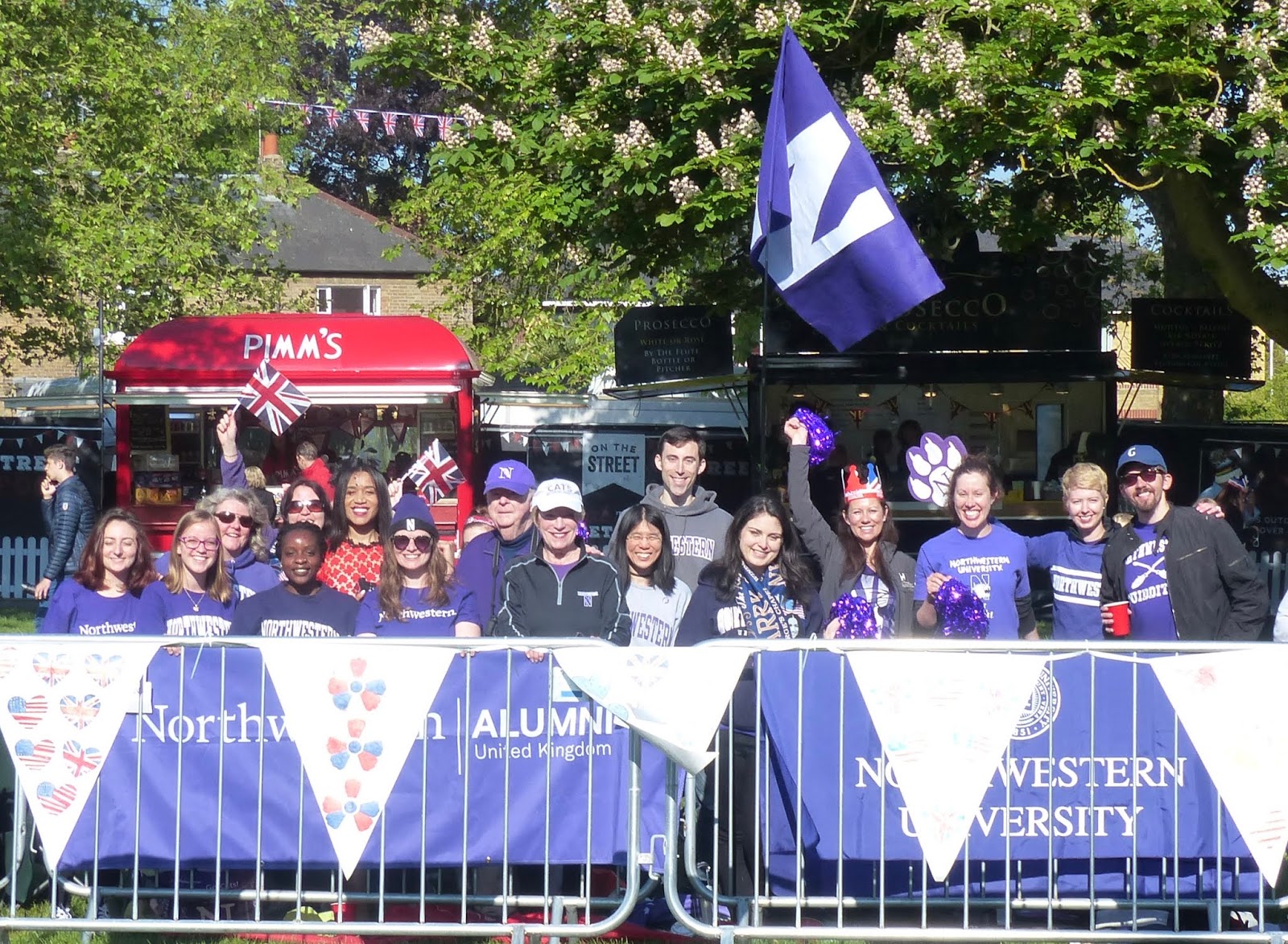
So amongst all the other good Meghan is expected to do in the world comes the likelihood that she'll raise awareness of Northwestern overseas. The Northwestern University Alumni Club of the UK is eager to help. Which is how I ended up driving to Windsor at 2:30 in the morning, car packed with friends, lawn chairs and purple flags, to grab a good spot to wish our new duchess well. Here are some random observations from what was, for a few hours, the centre of the world.
The early bird gets the worm
We left the house at 2:30. In the car park queue at 3:15 for car park opening at 4. My intrepid advance party bailed out, loaded our foldable wagon with lawn chairs, Northwestern branded materials and breakfast and hiked the additional half mile to the parade route. My God, it's dark. Good thing Mr. Bencard insisted we take the lantern.
 I waited to park and joined them after my own hike. We remembered our clothing layers and waterproof things to sit on, but forgot how wet our feet would get. My God, it's cold. Why didn't Cristy wear socks? Fortunately, Meghan and Harry commemorative scarves also make handy foot-warmers.
 This is how you claim enough territory for 20 more people to join you at the front of the barricades.
The rest of the alumni start drifting in from 7 as the trains start running from London. We're at full strength by 9. Which feels like at least noon. When are they opening that Pimm's van? (Answer: 10am.)
Well done, Windsor
I was a resident of the Royal Borough for more than a decade and still miss it. Thus it's with a feeling of some proprietorial pride that I say this charming little town put on the best-managed big crowd event I've ever attended. Consider this: more than 100,000 people along the parade route and we never waited more than three minutes to procure refreshments. Never waiting at all for the loos, which were always clean and had been refreshed with toilet paper. Amazing, frankly.
Security pulled off the trick of being both extensive and pleasant. Temporary fencing turned the whole route into a series of chambers separated by narrow access points looked over by guards. Access from one bit to another was possible but took time; the town had laid on so many food vans and loos that once you were settled you didn't really need to move, anyway. Security (and other) staff were abundant but friendly, smiling and joking with the crowd.
That festival feeling
Meghan and Harry announced that they were after a "festival feeling". They got it. The weather helped; though freezing at 5 am, we were slathering on sun cream and shedding layers under azure skies by 10. Picnic blankets, hampers, bottles of bubbly and bands. These sorts of environments magically unlock British reserve. Strangers have conversations and share provisions. Everyone adopted the unusual number of Americans with good will, coaching them through the little oddities of the day. Lashings of fancy dress keep the crowds and the news photographers engaged.
Media merriment
After years of rolling out PR campaigns on behalf of big tech companies, it was nice to be doing some for a personal cause. We got our messages out, and had live moments of glory on CBS (US), CBC (Canada) and BBC radio. I turned down Sky because they booked me into their studio at 7:15 pm (I would be back home by then. The Sun (London) interviewed us but we didn't make the cut. We got a mention in the Sunday People (UK) with a great photo of Meghan reacting to a "university chant" as they drove by us, but the paper got their facts wrong: that was "Go U, Northwestern" delivered by our alumni group, not Kappa Kappa Gammas.
The university flag was waving in crowd scenes reportedly seen by 2 billion people around the world. Granted, you had to look for that N ... and probably wouldn't know what it was unless you had a personal tie ... but it's still a thrill to contemplate. We probably could have done more were it not for that "kettling" strategy that applied to media as well as private individuals. From about 10 am, nobody was moving.
A rubbish way to watch a wedding
Like many major events, if you want to actually have a good viewing experience ... stay home. I watched recorded television coverage after I got home to see what we missed. A 2:30 start followed by a nine-hour wait to see a 2-minute carriage pass by is not rational. Even if we have visual evidence that Meghan saw and appreciated our presence.

But that's not what this is about. It's the experience. A lovely day out with your friends, drinking in atmosphere and being a part of history. A moment when 10s of thousands of people, spreading to the horizon, wave flags and sing along to Stand By Me in an electric moment of community. Magic.
It's all about love
Michael Curry's evangelising sermon on the power of love reminded everyone that love is more than the romantic stuff. We were out there for love of university. A place that, in different ways for all of us, had shaped our characters and our lives. And had, at the same time, made us somehow all the same. I'd never met most of the 26 that I had organised the day for and spent 10 hours with. It didn't matter. In that way Northwestern events always seem to have, there was an instant comfort with my fellow alumni even though they ranged in age from 19 to 75 and came from a variety of backgrounds and fields. Across the generations, Northwestern chooses and shapes the same kind of people. I love spending time with them.
I'm sure Meghan would fit right in to that mix. She's welcome to drop by any of our alumni events if she ever needs a break from the royal gig. Somehow, I doubt she'll have time. I hope she doesn't mind if, while she gets on with her new life, we celebrate our connection in order to build the profile of our shared university. It does, after all, have a track record of instilling characteristics like a passion for excellence, a commitment to thinking globally and a need to give back to our communities. Meghan believes in those things and is about to make a career out of them. Others look at her and see an American actress turned duchess. We see a fellow graduate made good.


Wednesday, 16 May 2018

In Cordoba, the Middle Ages still burn brightly

Like Grenada, Cordoba has hitched its tourism wagon to the star of the glories of medieval, multi-cultural, Islamic Spain. That story reached its romantic end in Grenada, but it started here, and Cordoba was the capital of a sprawling empire for centuries. It also fell to the Christians earlier ... 1236 ... and the re-conquerors did everything in their power to obliterate memories of the past. Fortunately, they weren't completely successful and Cordoba's city centre is now a Unesco World Heritage Site thanks to the remarkable layering of its Roman, Islamic, Jewish and Christian legacies.

The place to start, as every travel article will tell you, is at the great mosque-turned-cathedral. It deserves its superlatives. On par with the Great Mosque of Damascus when it was built, it is arguably far more beautiful with its striped, double-horseshoe arches stretching to seeming infinity. And you're unlikely to get to Damascus any time soon, so best enjoy this one. The Christians turned it into a church after the re-conquest. Naturally. They ripped out the centre and injected their own architecture. Unfortunately. But they couldn't bear to tear down the whole thing, so the forest of columns surrounds the Christian bit like a giant ante-chamber. Thankfully. Remember that scene in Alien where a monster erupts from one of the character's stomachs? The horror and mismatch is pretty much the same here. Even the Emperor Charles V, who signed off the building project, is said to have been horrified by what he'd done once he'd seen it.

Cordoba's cathedral is much like Grenada's Alhambra: the star site, with tickets selling out in advance and thick crowds sapping magic from the whole experience. Fortunately, the fact that it's still a functioning church means they can't be as draconian with admissions policies here. Get up early and be there for the 8:30 am free admission, then stay for mass at 9:30 to get the best from the place. You'll be sailing out on a cloud of inspiration as the tourists trudge in for the first official visits of the day. You will still find several hundred people gathered at each door by 8:15, but these initial numbers are swallowed by the vast scale of the building, leaving you to enjoy some quiet moments of contemplation. Head immediately for the mihrab (the prayer niche indicating the direction to Mecca) at the back, slightly to the right, as this is where the crowds pile up to admire the most intricate of the Islamic decoration (uncovered after years of camouflage). Then wander to admire the interplay of Islamic arches with Christian chapels. Mass is a full bells-and-whistles, one-step-away-from-the-Vatican affair: there were 11 celebrants on the high altar and a full choir my morning despite a lack of high holy days. Anyone raised Catholic will slip into the vibe even if they don't know Spanish. Even heathens will enjoy the "show" for which this building is just one great stage set. Sitting inside the inserted Christian section you realise it's actually quite a lovely building on its own; it just suffers from its impossible circumstances.

Now walk across the Roman bridge ... an impressive site in its own right ... to the Calahorra Tower at Living Museum of Al-Andalus. At €4.50 for admission, including an informative audio guide and access to the roof where you'll get one of the best views imaginable of the whole city, this place is a bargain. And that's before you start exploring the displays, which mix artefacts with dioramas and animatronics to tell the story of Cordoba's golden age and the mix of Muslims, Jews and Christians that enjoyed it. There's a scale model of the mosque here that shows what it was like before the insertion of the Christian church, cleverly juxtaposed with a window so you can look over the river to the real thing. Even more magical is the room that presents a model city peopled by figures all made by local potters. It's enchanting.
its far end, where you'll find the

Our other star attraction inside the walls was the equestrian and flamenco show in the royal stables. Yup. Horses and dancers. Why not? The beautiful Lipizzan horses you probably associate with Austria started here, when the Hapsburg kings of Spain based their breeding programme for the perfect knightly steed in Cordoba. The tradition continues. The Spanish have a national passion for dressage. And the people of this region take flamenco seriously. Why not combine them? Most of the acts are the horses performing on their own, in the performance ring within their dignified stables. (Pay extra for a premium seat and you get in 20 minutes early to explore the yard and see the horses in their stalls before the show.) This, frankly, would be magical enough. But when a flamenco dancer comes out and does her stuff, with an exquisitely-trained stallion prancing around her in partnership, it's one of the most bizarre ... and totally jaw-dropping ... things I've ever seen. Worth every penny of the remarkably modest €15 general admission ticket, but make sure you check dates and book in advance; performances are not daily and audience numbers are fairly small.

I suspect the Cordoba synagogue, one of the oldest in Europe and a tiny jewel in the Mudejar architectural tradition, would also have been a favourite had it been open. It is, however, closed for a multi-year renovation. This is the most picturesque part of town to wander, so you won't be disappointed to head in that direction anyway. Just down the little lane from the synagogue is the Zoco de Artesanos, a warren of craft galleries spread across several courtyards with proper artisanal work including jewellery, leather goods and pottery. In the same lane there's a man who makes medieval stringed instruments with exquisite inlaid woodwork. There's a great deal of tat on sale throughout Cordoba, so this little stretch is a real find.

Another highlight is the Palacio de Viana, which I wrote about in this previous entry.

About the only thing that disappointed us in Cordoba ... other than the shoulder-to-shoulder crowds ... Alcazar. Southern Spain practices a cheerful caveat emptor: it's hard to find tourist site's official websites, when you do there's very little information on them about what you're actually going to see, and once inside the signage and staffing is often terrible. Thus it most certainly is with this castle, a brooding hulk on the edge of the historic district and once home to the dreaded Spanish Inquisition. Only one room is furnished (with representative pieces to give a sense of where Columbus presented his plans to Ferdinand and Isabella) and there's nothing special about the interior architecture. There's a narrow scramble up stairs to some ramparts with an average view (the one from the Calhorra Tower is much better) and a sign limiting numbers to 20 at a time. Everyone ignores that, however, making both ascent and descent uncomfortable and the whole experience a frightening fire hazard. The main reason to go inside is a fine set of Roman mosaics in the main hall which tell the story of the powerful, leisured class that ran things here in antiquity. What you're actually paying to see is gardens: a series of formal and informal rooms, shady courtyards and sun-drenched parterres, with plenty of water features and statuary. They pale in comparison to Grenada's Generalife, but they're a pleasant place for a walk.
was the

While most of Cordoba's sites are within easy walking distance of the cathedral, you'll need a car for one of its most intriguing attractions. Medina Azahara is a sprawling ruined city spreading up a hillside about a 15-minute drive out of town. Built by the first Umayyad Caliph of Cordoba as his palace and administrative centre in the late 10th century, it was an opulent, legendary court for just 70 years before civil war triggered its abandonment and looting for building materials. Modern excavations didn't begin until 1911 and 90% of the place is still to be unearthed. Cordoba clearly has its eyes on Unesco World Heritage status, however, and has poured money into an impressive modern museum at the foot of the hill. It's essential, in fact, to spend time here if you want to make sense of the ruins. Without the excellent models and animated tours of the palace in its heyday, it's quite a stretch to see much impressive about the abundance of waist-height walls that remain on the hillside.

This is yet another place let down by Spanish attractions' failure to master digital communications. You probably won't find the official website in standard searches; instead you'll be led to believe the only way to get in is to take the one English-speaking bus tour a day which may already be sold out. Ignore this, especially if you have a car. (You can take public buses out here, too.) The museum, car park and archeological park are all vast enough to accommodate plenty of visitors. Entry to the museum is free for European union members; you need to pick up a ticket there that allows you in to the excavations above.

Do not miss this step, as you can NOT get a ticket at the Medina itself. You need to leave your car next to the museum and take a bus up the hill to the site. Once there you'll find stunning views, a few reconstructed archways to give you a sense of past grandeur and plenty of old foundations to emphasise how big the place once was. Looking down on the ruins of the mosque currently being excavated, you realise it would have given its sister building in Cordoba a run for its money. Approach the site with caution, however. You'll be scrambling over wildly uneven pavements, climbing a lot of steps and site management does not bother to tell you what is or is not open. I got all the way to the bottom to discover that the star site of the place, Abd ar-Rahman's reception hall, was closed. And then, of course, had to climb back up to the bus drop-off point to catch a ride back down to the museum. If you're ambivalent about ruins, a quick nose around the museum will probably satisfy you.

WHERE WE STAYED
The winding, narrow nature of Cordoba's streets makes a car a nuisance, and the medieval city itself is the main attraction. Thus it seemed logical to make this our holiday accommodation splurge so we could be in the heart of the old town. We stayed at the NH Collection Amistad, a 108-room hotel spread across two 17th century mansions facing each other across a square in what was once the Jewish quarter. It's hard to imagine a better location; minutes on foot from the cathedral, Alcazar or the square that's the heart of the modern town and a stone's throw from copious restaurant choices. For €250 a night, and another €22 per night for parking, we were somewhat disappointed.

Positives: We had a great room in the secondary building, overlooking the square, plenty of space, excellent soundproofing; our building had a charming roof terrace with small plunge pool, there's a larger courtyard pool in the main building; excellent concierges gave us valuable advice on restaurants and avoiding crowds; they have a phenomenal breakfast spread and a solid restaurant for other meals; there's a series of charming courtyards to relax with a drink and get away from the crowds outside.

However: my husband thought the bed was uncomfortably hard (I was too exhausted from sightseeing to notice) and the staff's command of English was generally far below where it should have been at a 4-star catering to international tourists (the front desk people didn't really understand when I tried to explain that my wallet had been stolen and didn't really react, much less express comfort or try to help). Most significantly, the place had a taint of corporate hotel about it I didn't like. The ground floor of our building was clearly being used as a muster point for a walking tour company and the covered courtyard dining area ... made much of in their promotional materials ... felt more like a conference centre circa 1990 than a dignified, elegant space. For 20% less, we wouldn't have noticed, but this is in the price range where we start getting very picky. I kept walking by La Llave de la Juderia, the nearby hotel I'd try to book but couldn't get into, and peering into their courtyards with envy. Photos suggest that this offers more of the boutique hotel vibe we prefer, but it also sells out much further in advance. Note for next time...

Sunday, 13 May 2018

Cordoba’s festivals are a gardener's delight, but prepare for crowds

Being in Cordoba for the back-to-back celebration of its two biggest festivals is a Dickensian proposition: the best of times, the worst of times.

On the positive side, the city is decked out in its floral best. The Cruces de Mayo (May Crosses) sees religious fraternities compete to decorate crosses with flowers, while Los Patios de Cordoba has private buildings opening their lush interior gardens for the public to snoop. It's like the National Garden Scheme and the Chelsea Flower Show rolled into one. It's a properly local time to get a sense of the place: the overwhelming majority of the accents I heard were Spanish. And the good times keep rolling. First communion for Roman Catholic children is on or around 1 May, filling the streets with adorable little girls dressed as miniature brides and boys in their best jackets and ties. It's likely you might encounter a procession carrying a statue of the Virgin Mary with a brass band following behind. The whole place is a party.

With the merriment, of course, comes crowds. We're talking Disney-World-at-Christmas, London-tube-at-rush-hour, body-to-body crowds. And because these are Spaniards, there will be no orderly waiting. Watch out for the grandmothers. They may look benign, but they are professional queue bargers who will have a sharp elbow in the small of your back the moment you try to block their incursion. Every sunny al-fresco table is taken, every charming restaurant packed. And, of course, with crowds come pickpockets. I am a savvy traveller who hadn't been robbed in 30+ years of exploring Europe. A wily Cordoban lifted my wallet within 20 minutes of our first foray onto the streets.

My bottom line: if you're a keen gardener, it's a wonderful time to come ... you just need to develop strategies to cope with the crowds. If flowers aren't your thing, I suspect there are far better times to enjoy Cordoba's delights.

From a horticultural perspective, the crosses are a less impressive festival. Once you've seen a few, they start to look much the same. Each display uses the same size and shape of cross; many cover theirs in red roses or carnations. White with blue or lavender was a secondary favourite. Creativity comes from the floral displays around the crosses ... mostly pots of pelargoniums with a few branching out to a variety of plants and the occasional water feature. The most impressive made use of nearby architecture to deliver a wall of flower pots.

It quickly became obvious, however, that this is less about the flowers and more a progressive drinking party. Every fraternity gets sponsors, sets up a beer tent, has a particular tapa (snack) for purchase and sometimes has a band. Locals were having a fabulous time. We felt a bit surplus to requirements. I was undeniably in a rotten mood after the theft and an hour spent on the phone cancelling debit and credit cards, on top of another stress-inducing hour earlier in the day creeping a car through gridlocked traffic and crowds of pedestrians to reach our hotel's garage. I'd be willing to give the Crosses another try when better prepared both mentally and physically.

The patios were a different story. I was in gardeners' heaven.

Houses in Cordoba follow a model started by the Romans and continued by the Arabs: rooms are arranged around courtyards that provide private garden space and almost always have a water feature; long ago to capture a precious resource, today for pleasure. Brightly-coloured tiles often line the walls up to waist height. Arrays of flower pots affixed to the walls and paving of black-and-white cobbles set in various designs are recurring features. Cordobans, the general wisdom goes, are passionately proud and seriously competitive when it comes to these patios. Once a year they open them for charity. Admission is free but there are collections for owners' favourite causes. Plus prizes, people's favourites and plenty of local press coverage. From framed prizes and articles in many gardens it was clear that some owners opened year after year and had accumulated plenty of accolades. This year there were five "routes" with more than 60 gardens open to the public. (Maps are freely available from hotels, tourist information centres and all participating gardens.) Navigating can be a bit challenging; Cordoba's twisting, narrow lanes quickly sap your sense of direction. Fortunately enough locals are doing the routes that you can usually just follow other people with maps.

Here, I found the variety lacking in the crosses. Some patios were tiny, hardly more than light wells between several apartments. Others were grand processions of interlinked spaces. One joined a church, the priests' house and offices, with a baroque chapel between gardens. Some were white-walled sun-traps with arrays of potted pelargoniums and cascading bougainvillea, others bosky dells of ferns, hostas and mosses. Many had clear themes that presumably reflected their owners' passions: new age crystals and American Indian dream catchers; bullfighting; flamenco; tools of historic crafts. Several complemented the gurgling of water with the trills of caged songbirds; a few had impressive sound systems. One was even a doll's house courtyard produced in magnificent detail ... grains of rice for the patterned cobbles, tiny bits of rolled paper for the flowers ... in the front room of an artisan's workshop and gallery. Patio owners were usually on hand to talk details, but Spanish was a requirement to get into any horticultural specifics.


Once again, the trick with the patios was to get away from the most obvious tourist hot spots. Patios in the Alcazar Viejo district needed a wait of more than half an hour per property to get a peek. That's right next to major tourist attractions. I didn't bother. instead, I walked a mile to the furthest-flung and heavily residential Santa Marina and San Lorenzo districts, where I explored 18 different gardens during the 11 am - 2 pm morning opening and only queued once. (As with much of Spain, the Patios close for a long lunch break and re-open for an evening session.

If you're not in Cordoba during the festival, you can get a sense of the patio tradition at the Palacio de
Viana. This ancient aristocratic home has grown over the centuries, acquiring neighbouring buildings until it sprawls over the equivalent of several city blocks and encompasses 12 different courtyards. Like the patios in the festival, these display a wide range of styles from intimate domestic spaces to water gardens, orangeries and maze-like spreads of hedged parterres. Each has signs that explain the theme, design and planting of the patio in both Spanish and English. It' obvious that the current owners cherish and continue family history, as several of the courtyards feature either new schemes or significant renovations.

There's a two-tiered price structure; less for just the gardens and more for a full ticket that includes a house tour as well. My time was too short for both, but enticing glimpses into some rooms assured me that without all those other patios to see, I would have happily explored the interiors, too.

If you do plan to head to Cordoba for these festivals, always in late April and early May, book your hotel early. By January there was already very limited availability for any lodging in the historic district.