More than a thousand articles on travel, fine dining, good wines, art and culture. Mostly European, with some further afield. If you’re using a mobile device you’re probably only seeing a handful of the most recent posts. Switch to a desktop browser or scroll to the bottom and click “view web version” to see the search function, archives and location-specific collections of articles.
Sunday, 31 March 2024
British Museum makes Roman army life fun for all ages
Quite simply: my mother had a unique talent for bringing art and culture to life for children. Trailing along in her wake, I never realised that she was the one turning places like The Art Institute of Chicago, The Getty Villa and the Victoria and Albert Museum into worlds of fantasy and wonder.
Thankfully, her superpower is no longer unique. Many are reinterpreting their collections and adding hands-on experiences to bring the past to life for children of all ages. The British Museum’s new Legion: Life in the Roman Army exhibition is a gloriously entertaining example. The curators have teamed up with Terry Deary, writer of the Horrible Histories series, to create an alternative path through the show for the young, and young at heart. Legion has received rave reviews across the board for its gorgeous design, exceptional artefacts and meaningful insights, but it’s this outreach to young people that impressed me the most.
You’re greeted by a cartoon rat named Claudius Terratus who’s decided to join the army to see the world, gain his citizenship and reap a juicy pension at the end of his service. He pops up throughout your visit to highlight the difficulties and pleasures of the life he’s selected, often accompanied by things to touch and do. You can see if you’re tall enough to make it into the legion, and see how you compare to the tallest-ever Roman. You can lift weights equivalent to the average pack of a soldier to see how you might fare on a march. You can play with knuckle bone dice. You can even put on a helmet and grab a shield.
It’s been a long time since I’ve seen that many children in a major exhibition, much less having so much fun. Curators around the world need to take note.
Sceptical academics, meanwhile, needn’t fear. The children’s track sits beside a serious deep-dive into this fascinating topic. My friends and family who’ve seen the show include army veterans, military historians and specialists in the Eastern Roman empire. All were impressed.
There are things of great beauty here, from a bronze head of Augustus to ceremonial helmets to one of my British Museum favourites … the Molossian dog that usually sits in a gallery that is too often closed to the public. It’s good to see him taking pride of place. There is, as you would expect, a lot of evidence of war, from the best-preserved Roman shield in the world to swords to horse armour. There’s a lot of evidence of everyday life, from letters home to an almost perfectly-preserved legionaries’ sock.
Poignant touches throughout make this the story not just of an empire or an army, but of people. The tombstones of the soldiers who never made it to that retirement; especially one shown with his grieving father. The armour of a man who died in the famous massacre of Varus’ legions in the Teutoburg Forest. The skeleton of a soldier who died trying to help the citizens of Herculaneum survive Vesuvius’ eruption.
There is something for everyone in this exhibition. Happily, that includes small people who might think museums are boring. Make some time to introduce them to a Roman rat and his horrible adventures, and you might just open a door to a world of fantasy and wonder they can enjoy for the rest of their life.
Legion: Life in the Roman Army is on at the British Museum until 23 June.
____________________
Joanlee’s Playbook
Want to get your kids to museums but don’t have something as cool as the British Museum’s take on the Romans to help you through? Here are three of my mother’s best tactics for getting young people involved.
Go treasure hunting
Pick one thing … dogs, crowns, swords, etc. … and set children out on a treasure hunt to find as many of that object as possible. This is particularly effective if you have two or more kids on your hands, especially if you offer a small amount of cash to be spent by the winner in the museum gift shop at the end of the visit. The hunt makes them actually pay attention to what’s in each room.
Be a time traveller
Tell your young people they have access to a time machine for a one-way journey. Because of some kindof impending disaster (make it nasty, kids love that), you need to move to some other time in history. The kids are using the museum to do some research. Where are you going to go and why? What is life going to be like? What are you going to bring with you? What type of people will you set yourself up as when you go? Why not book a meal out after your museum visit and let the kids report back on their decisions over the food?
Go shopping
The kids have just won an enormous lottery and everything in the museum is on sale. They can buy three things. What would they buy for their palatial home and why? Where would they put it, or how would they use it? If they had to put the things in order, from what they’d pay most for to least, what would their order be? A variation on this, particularly useful in traditional art museums full of paintings, is to tell them that they can bring one artist back to life to paint their portrait. Who will they resurrect and why? What surroundings will they be painted in and what things will they have painted with them?
These days, almost all museums have education teams specifically dedicated to bringing their collections to life for young people. They’ll produce guides, games and videos that are often free. For many more ideas, seek them out and use them. Many are downloadable before your visit, so you can do some preparation as a family and turn your day out into a special event.
Tuesday, 23 May 2023
Whether made for politics or pleasure, Persian luxuries at the British Museum delight the eye
Luxury and Power: Persia to Greece digs into an old, familiar story and largely debunks it. Anyone educated in the West grew up with a narrative of us v, the East that’s lasted for more than 2,000 years. The Greeks started it, telling us their democratic, egalitarian, plain-living lifestyle is what ultimately triumphed over the luxury-loving Persians. That’s because all that extravagance, mixed with an authoritarian monarchy, made the Persians weak, effeminate and lazy. You don’t need to be a classical scholar to have drunk this in. Just watch 300 … or any grass-roots politician railing against elites … to see the dynamic alive and well.
Yes, there’s a lot of blingy Persian luxury in these galleries … and that’s probably the main reason for going … but you’ll also learn how the Persian establishment promoted and strategically deployed that luxury to keep power. And you’ll see copious proof of hypocritical Greeks, protesting against luxury but creating and using Hellenised versions for themselves.
If there’s one item that summarises the whole idea of luxury here, it’s a rhyton; and there are a lot of them here. A rhyton is a horn-shaped container used for drinking ceremonies, usually featuring animals but sometimes people. Contrary to appearances, however, you don’t drink out of it. You hold it in one hand, your shallow drinking bowl in another, then a servant pours wine into the rhyton, which emits the liquid from a hole in its front in a steady stream which you’re supposed to catch in your bowl. This is the kind of ritual you only design to show off, and the amount of coordination required to drink this way would take a lot of practice. Which you’d probably be willing to do if your barware was this extraordinary.
A set of silver blockbusters hits you on entry: not just the elegant griffin that’s on the exhibition poster but an antelope, a man on a horse and several others along with examples of the drinking bowls they’d spout into. There are other lovely examples throughout the show, culminating in the eight glimmering objects of desire … some animals, some human heads … from Bulgaria’s Panagyurishte treasure. Whatever their composition, you’d stand in amazement at their delicate workmanship. The sinuous buck’s horns. The proud female heads. The boldly-rearing centaurs on an unusual, vase-shaped rhyton with two holes, probably designed to cement peace treaties (and guard against poison) by spouting out two servings at once. But the fact that these are all made from glistening, solid gold kicks the wonder up to another level.
The last piece in the exhibition is a Roman glass model, from hundreds of years later and now meant to be drunk from directly, with the hole filled in. It’s a nod to the enduring love of this glamorous design, and the fact that the Romans carried on the luxury debate and hypocrisy.
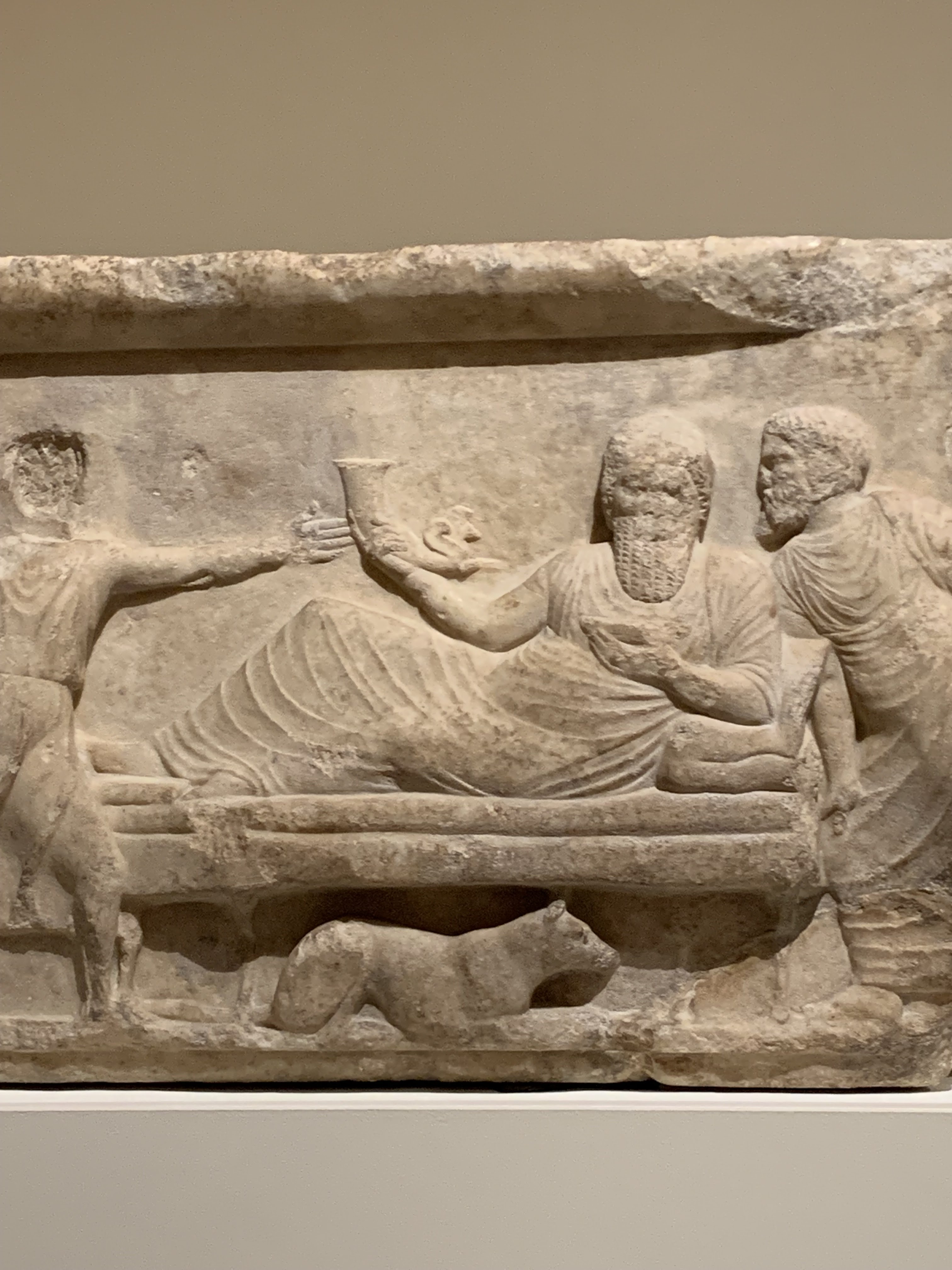
From the Greeks, we get a whole case of their version of the rhyton, more miracles of animal artistry but here made from glazed terra cotta to protest their humility. Pushing from aping the tradition to full hypocrisy is a ruler from the Greek world, immortalised in a panel from the Nereid Monument brought up from its usual home downstairs, who is showing off the whole two-handed serving technique. Don’t miss the marvellous human touch of his dog crouched beneath his couch, perhaps waiting to clean up spills.
These objects alone would almost be enough for the show. But we go much further. Jewellery, housewares, clothing and decorative objects all show off the Persian flare for conspicuous consumption and the Greek’s grudging, democratised copies.
A particularly innovative aspect of the show is incorporating videos of modern craftspeople creating the same opulent objects today. One shows the creation of the colour purple, from the harvesting of a particular gland of the Murex snail to its boiling or drying to get various forms of pigment. In another, a modern Japanese glass artist demonstrates how coloured glass rods get heated, wrapped around a plaster core then smoothed together to create an exact copy of an ancient bowl on display next to the screen. Most fun is a modern textile artist, using ancient sources to weave and recreate a royal outfit, complete with dangling golden lion’s heads and enamelled metal trim. Met Gala catwalk, eat your heart out.
This isn’t a large show. It’s up in the galleries above the Reading Room, not in the main exhibition space. But every item within it is a rare joy. By bringing it all together in this context the curators have elevated things you might have walked past for years into a treasury of precious objects that will drop your jaw and leave you wanting to win the lottery. You can go out afterwards for a bit of wine and some discussion on whether luxury makes you weak. Maybe even with a rhyton. But I’d wear a bib. We haven’t lost our taste for extravagance, but I suspect we have given up the knack for showy, two-handed alcohol consumption.
Monday, 21 June 2021
In the battle between saint and sinner, curious visitors come out the winners
We had a packed weekend. The British Museum after work on Friday, Westminster Abbey on Saturday, and the Tower of London on Sunday. Add dinner at the renown Cinnamon Club on Saturday and a relaxing stay in a junior suite at our club for a proper mini break.It’s no surprise we started things at my favourite repository of culture, of course. Granted, the British Museum does not fit onto that list of the long-avoided. Between my membership, a fabulous members' lounge, and my continuing love of the ancient world, it is instead one of my boltholes for seeking respite from London's madness. But it's even better when near empty. Until regulations lift, all attendance must be booked in advance for either the main galleries or special exhibitions, and there is a one-way system throughout. Even with cavernous spaces and lofty ceilings, social distancing regulations demand sparse numbers. So sparse, it reminds me of the days when my mother worked in museums and we could wander through galleries before they opened to the public. Bliss.
Our objective: a double dip into current exhibitions. The infamous Roman Emperor Nero is in residence in the main exhibition space on the ground floor, while saintly Thomas Becket holds court in the smaller gallery above the rotunda. Both shows are excellent, but I give the slight edge to Becket for the completeness of its concept and storytelling.
But first to Ancient Rome. Nero is legendary as a monster who persecuted Christians, murdered his mother, kicked his pregnant wife to death and fiddled while Rome burned. Nero: the Man Behind the Myth's main objective is to remind us that history is written by the winners. And in the late 1st century AD, those were people with no love for Nero or the dynasty he ended. Thus it's credible to imagine the last Julio-Claudian Emperor was not as bad as his press.
Nice premise, but there wasn't enough evidence here to completely exonerate one of history's great villains. Though they did bring balance and if you don't know a lot about him to start out with, this may be an eye-opener.
I felt that Nero's position in the arts was particularly underplayed. The section dedicated to the architecture he left behind in Rome … the Renaissance-era discovery of which sparked design trends that lasted for centuries… was beautifully designed to sit in an octagon beneath a gauzy dome. This mimics Nero's famous octagonal room with its rotating ceiling reflecting the heavens. But the materials on display below it were sparse. Someone could have put video to work so much better here. Why not project an artist's interpretation of the famous room for me to walk through, rather than leaving me with a ghostly remnant? In the music section, why not offer us a reproduction of the ancient water organ Nero loved to play, or give us an audio track of what that instrument might have sounded like?
The section on the great fire in Rome is where the exhibition really hits its stride. Here we do have a creative audio visual interpretation showing us the progress of the fire over days, with contemporary sources confirming Nero wasn't even in town when the fire started and revealing the help he gave to his people. An atmospheric soundtrack gives us the crackling of fire and distant screams of people running to safety. The show needed more moments like this.
The British Museum also missed a trick not finishing with an exploration of the impact Nero has had on Western culture. That was a surprise, considering the vast exhibition space seemed quite sparsely filled and the pop culture angle is a frequent closer there. We could have been treated to Nero on film (there is a large picture of Ustinov playing him at the shows entrance but we get no more of that), on stage and in music. Where were the box sets of I, Claudius in the gift shop? Monteverdi gave us a more-balanced-than-usual Nero in his Coronation of Poppea, and if had featured we could have been treated to one of the most beautiful duets in the whole operatic repertoire while enjoying the artefacts. And then there is the influence of the art and architecture. Think of the fiddly, brightly-coloured style of wall painting with garlands, arabesques, mythological characters and dancing goddesses, beloved of everyone from popes to English aristocrats to late 19th century hotel designers and you're thinking about copies of the paintings in Nero's palace. The original meaning of "grotesque" meant this style of design, from the cave or grotta, before it took on its more sinister meaning. Such an example of the shifting nature of language might have helped the argument about the shifting nature of Nero's reputation.
We got it upstairs with Thomas Becket: Murder and the making of a saint. This may be because the curators aren’t trying to prove anything here. They are simply telling Thomas Becket story as most of us know from school, or from the epic film with Richard Burton and Peter O'Toole, with artefacts, illuminated manuscripts, and video projections. (If you haven't seen the 1964 film, Becket, make the effort to do so before seeing the show to bring things to life.)
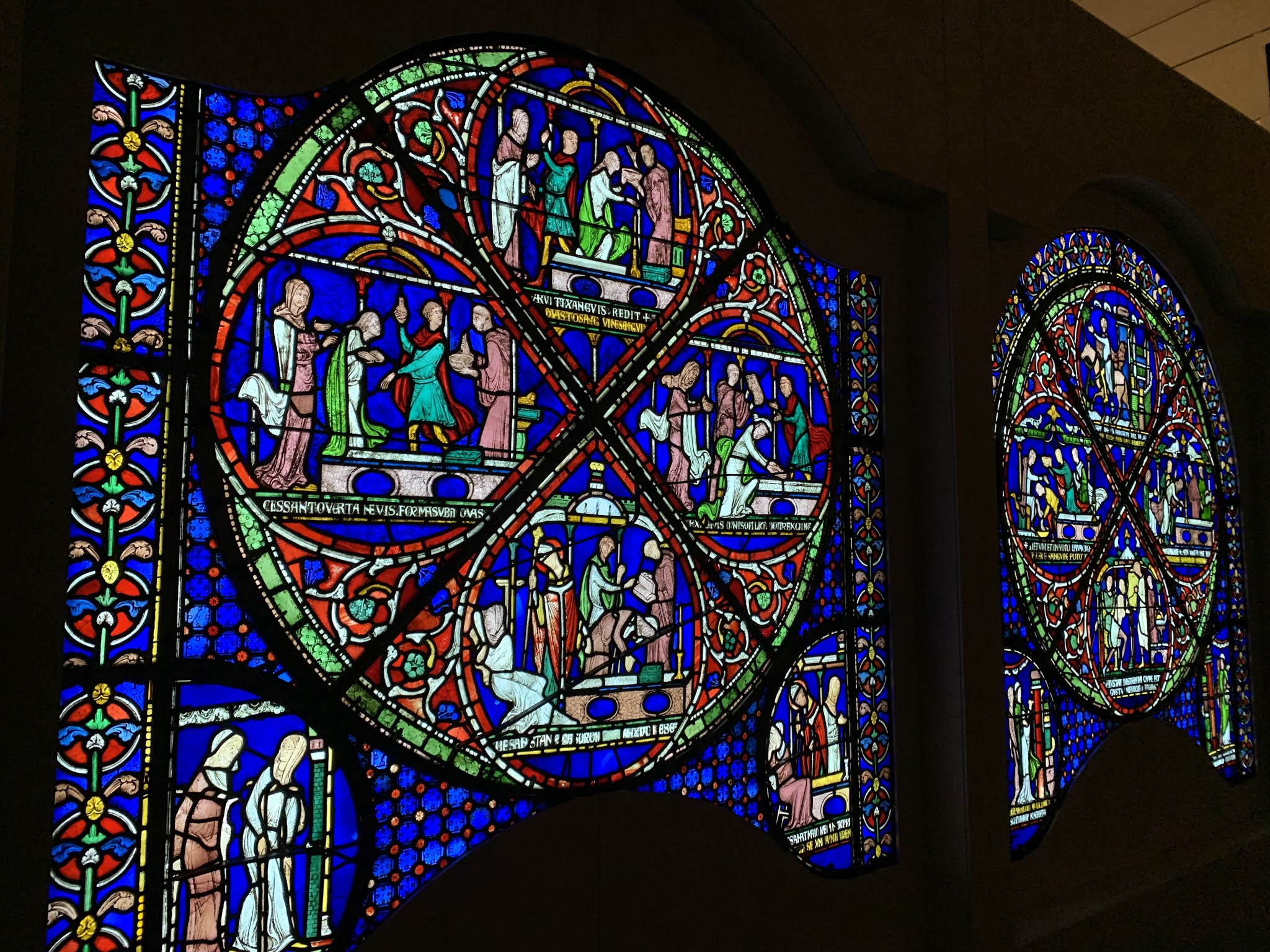
A series of medieval stained glass windows taken from Canterbury Cathedral, cleaned and restored for this show, is reason alone to make the effort to visit. They are exquisite, and provide a strong rebuttal to anyone waffling on about the blue in the windows at Chartes being unique to the French. Here is proof that the English could produce the same heavenly work. (We just lost so much more of it in our internal religious battles than the French did).
The windows, however, are late in the show, and there are plenty of goodies to fill your eyes until you get to them. Four knights murdered Becket in 1170 ... whether or not on the king's direct orders may never be resolved ... and canonised just three years later. His cult spread quickly across Europe, its flames fired by anyone who was for the pope or against England's Henry II. The king's estranged wife, the magnificent Eleanor of Aquitaine, and his daughters were active supporters of the new saint and Henry was generally held responsible for killing. His PR was so bad he opted for a spectacular show of public penance in 1174, submitting to a beating from the monks of Canterbury Cathedral.

The smaller display space suited the story well, with each enclosed area revealing one chapter before you moved through into the next. It builds drama, and made the story more manageable. I suspect Nero suffered from the vast main exhibition area, and might have been better if broken into the same bite size chunks as the Becket show.
Either show is worth your time if you have an interest in their time periods, and both show how far curators working in the UK have come in the last decade with show design and storytelling. With current Covid regulations remaining in place until mid-July, they still offer the glorious opportunity to linger over displays without crowds.
Make Becket your priority not just because it is the slightly better show, but because it closes on 22 August. Nero and his world are with us until 24 October.
Monday, 12 October 2020
Crowd-limited British Museum is a rare treat for advance bookers
No longer.
One of the silver linings of Covid-19's cloud is the visitor experience at cultural attractions. Though pre-booking is a hassle and the limited numbers are killing institutional finances, the situation has created an idyllic environment for the thoughtful visitor. The British Museum is a case in point.
The limited number of tickets per time slot ensures plenty of distance between you and other visitors, meaning galleries are sparsely populated and ... since the UK's "rule of six" eliminates the possibility of school groups ... remarkably quiet. Though I'm a British Museum member and know the place well, the circumstances revealed new wonders. I usually push through the ground floor Egyptian galleries on my way somewhere else; they're always too noisy and crowded to enjoy. This time, I could stand alone in pools of dappled sunlight, look into the faces of long-dead pharaohs and have space to contemplate.
I lingered with the Elgin marbles appreciating the nuances of drapery over the human form. I took time in the Enlightenment Gallery to peer onto shelves and read labels. I still moves fast through the Aztec section, where bloodthirsty gods in dim lighting are even creepier when you're alone with them.
The real genius of the current situation, however, may be the enforced one-way system, which drives traffic through some galleries that most visitors usually race through in their determination to cover the star sights, or skip altogether. (Detail-oriented readers may remember I've raged against set museum routes in the past, particularly at the Uffizi, but in the current circumstances this works.) The route includes the oft-missed early Greek galleries, where a massive and rare terracotta sarcophagus deserves more fame, the never-missed Elgin marbles, and the stately Neried monument. Sitting in front of the last is a fascinating modern work by Grayson Perry called the Tomb of the Unknown Craftsman, which imagines a ceremonial burial ship for all of the nameless artisans who made the treasures in the collections here. The ship is clad with plaster casts that echo masterpieces from around the museum, bringing every artistic tradition together in the celebration of the act of creation itself. It's spectacular.
On the other side of the building you can explore the Americas gallery where you can see an array of Native American costumes and artefacts that many museums in the "Wild West" would envy. There are those spooky Aztecs, and the Enlightenment Galleries which were originally built for George III and represent the museum's collections in miniature.
But the greatest triumph of the enforced route will be increased traffic through the African galleries, often missed because of their basement location.
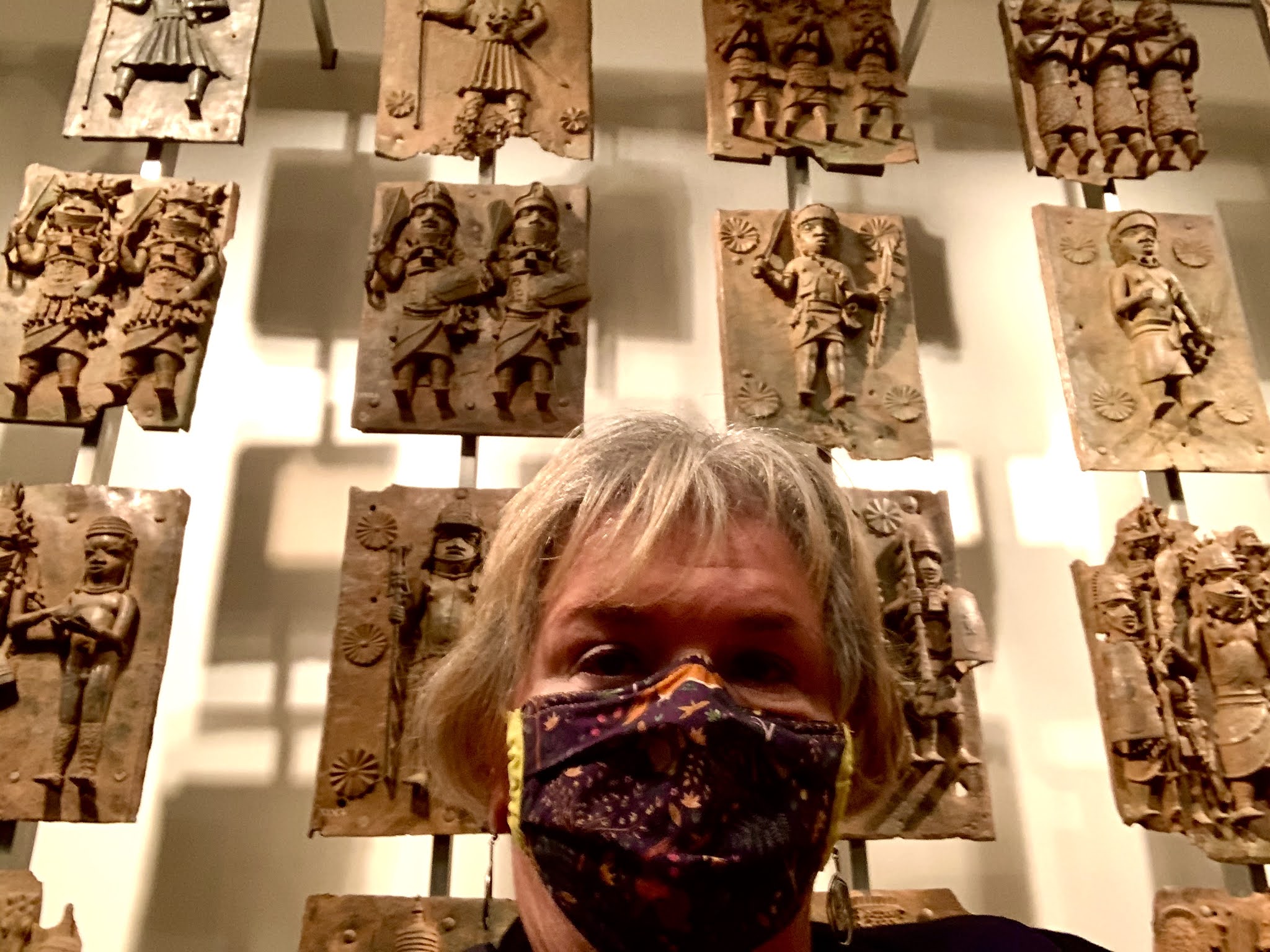
These rooms bring together art, furniture and textiles from across the continent, though they're light on Egypt and Islamic North Africa since those cultures are amply represented in their own galleries. The greatest masterpieces here are the Benin Bronzes, gorgeous casts of human heads, animals and ceremonial scenes created in the 1500s. The most remarkable are a set of plaques showing palace life and ritual that once decorated the palace of the king. They're also probably the most contentious of all objects in the museum as, unlike the legally purchased Elgin Marbles, these were undeniably the legacy of an aggressive campaign of looting at the end of violent conflicts in the late 19th century.
More than 80 museums around the world ... but outside Nigeria ... now own treasures removed in those wars. An organisation called the Benin Dialogue Group, in which the British Museum plays an active role, is working with the government of Nigeria to care for the treasures, raise their profile and knowledge of the culture that produced them and discuss repatriation. However you feel about how the bronzes got here, and where they should live today, if you live in London and haven't seen them you're doing yourself a real disservice.
I find the clothing and textiles particularly beautiful. The workmanship is exquisite and the patterns remind you of just how much traditional African patterns have influenced Western design. I'm particularly fond of a display of hats and headgear which is not only enormously fun in the way they seem to float in their glass case, but show off in a very tangible way just how diverse the cultures of the continent are. There's no shying away from the historic conflicts that have, and still do, rip those cultures apart, but there are some good news stories here. One of my favourite pieces is The Tree of Life a sculpture of a tree brimming with wildlife made completely from decommissioned arms turned in at the end of Mozambique's civil war.
There's more than history down here. Unlike most of the rest of the museum, these galleries feature modern craftsmanship that rotates through on a regular basis, so you're never sure what you're going to find. There's currently a display of some of the most spectacular masquerade costumes I've ever seen, combining venerable traditions with modern metalwork to give us something I suspect most humans born before 1700 might have mistaken as gods.
There's also an abstract stone sculpture of a woman that's reminiscent of the African artist's booth at the annual Hampton Court Flower show. For a bit of an investment, you too could have something worthy of a museum gallery.
The big drawback of the current pre-defined route is that it takes you through just a tiny percentage of the collection. The entire first floor and the whole northern building, with the exception of an exit route, are closed off, as are side galleries on the ground floor. You won't see anything from the European collections. No palace walls from Ninevah. The Sutton Hoo treasure remains in splendid isolation, as do the recently renovated Arabic galleries and all the Chinese and Japanese collections. Most important to note, should you be contemplating a visit with the younger generation, is that the galleries of child-enchanting mummies are out of bounds.
Don't let any of that dissuade you from reserving tickets. Your visit may be limited, but the quality of the viewing experience more than makes up for the quantity of sights available. And if it encourages you to spend some time in those African galleries, you will have found a real silver lining to this pandemic's cloud.
Friday, 22 November 2019
New Troy show celebrates foundations of Western storytelling
After a two-month Japanese hiatus, it was time to re-engage with Western civilisation. Troy seemed a good place to start.The three epics that sprng from the fall of this legendary city ... The Iliad, The Odyssey and The Aeneid ... are arguably the foundations from which all the rest of Western literature springs. Every basic plot line that writers have been spinning and enhancing for 3,000 years starts here: star-crossed lovers; the toxicity of jealousy; duty vs. desire; dysfunctional families; the nature of friendship; the capriciousness of fate ... and so much more. This is the genesis of storytelling. (And pre-dates the official Book of Genesis by as much as 500 years.) Much of the time, artists and writers haven't even bothered to invent their own variations on the theme. They've simply re-told these great tales from Roman mosaics to medieval tapestries, Renaissance plays to modern film.
That's the lens through which the British Museum sees things in its new exhibition Troy: Myth and Reality. Blockbuster shows here usually assemble the cultural treasures of lost civilisations to allow us to imagine what they must have been like in their glory days. There is a bit of the real Troy here, but those humble artefacts can't compare to the art that's been created in celebration of what may (or may not) have happened there.
To remind you of the basics: three goddesses are debating their supremacy. They pick a human to arbitrate, Paris, Prince of Troy, and bribe him shamelessly. He falls for the offer of Aphrodite, goddess of love: the most beautiful woman in the world will be his. Problem is, she's married to King Meneleaus of Sparta. Paris and Helen run away to Troy. Meneleaus rallies his brother, King Agamemnon of Mycenae, and all the other Greeks, to sail to Troy to get Helen back. Many adventures and side-plots take place as they're gathering the troops.When the Greeks get to Troy, they find the city too strong to take, so they start a siege that lasts 10 years. Many more adventures and side-plots ensue as they camp on the beach below town. Eventually, a series of tragedies leads to an epic battle between two of the greatest heroes of all time, Greece's Achilles and Troy's Hector. Achilles wins, but his brutal desecration of Hector's body pretty much ensures that he'll die soon after. Unable to break the siege, the Greeks finally win by treachery, pretending to give up and sailing away but leaving a wooden horse as an offering to the sea god Poseidon on the beach. The Trojans bring it inside. Greeks are hiding within. The city falls. Nobody ever trusts a Greek gift again. That gets us through The Illiad.
Then there are two sequels. The first, also by Homer, tells us about the journey home of Odysseus. He was the genius who came up with the horse idea, and was basically the tricksy strategist throughout Part 1. But he sucks at navigation. He spends 10 years getting home, regularly frustrated by capricious gods who'd been on the Trojan side and want him to pay for his tricks. Even the most basic perusal of a map will suggest that a decade of travel time between Troy and Odysseus' kingdom of Ithaca is preposterous (you could drive it today in 14 hours). But Odysseus' adventures through the islands of the Aegean and Mediterranean are a ripping good yarn.
At the same time Odysseus is going through his travails, a Trojan prince by the name of Aeneas manages to escape the flaming ruins of his city. He also has a rip-roaring series of adventures, including making the queen of Carthage fall in love with him and throw herself on a bonfire when he leaves her. Because he's got better things to do. Namely, travelling up the Italian peninsula to become one of the founders of Rome. This is one of history's earliest examples of PR spin, as author Virgil whipped up this fantasy 1,000 years after Homer's original epic to give his scrappy upstart of a country a more noble backstory. It worked.
The first half of the exhibition tells these stories and some of their more popular spin-offs through the medium of classical art. The British Museum has been able to mine its own collections extensively. Greek vases that normally sit upstairs on shelves with scores of others are called out to individual glory here, their storytelling enhanced by projected text and images and, occasionally, a soundtrack. Early on, hearing the cadence of the lines in ancient Greek before they’re translated into English reminds you that these tales were poems created to be listened to, and translations never capture the music of the original. Sculpture, wall paintings from Pompeii, sarcophagi and other treasures augment the tale, sourced selectively from other museums.
My favourite piece was an enormous table base depicting Scylla and Charybdis (an episode from The Odyssey) on loan from Naples’ magnificent archaeological museum. The two writhing sea-monsters, each the size of a person, would have hoisted the table on their backs. The sculptor was clearly more interested in beauty than capturing the menace of the story, since both “monsters” are deeply attractive and the three-headed hound accompanying one ... who is supposed to be ripping drowning sailors to shreds ... looks like a drowsy spaniel gnawing on an after-dinner bone.
Even before we leave the classical age, there are signs of the tale’s global traction. There’s a beautiful repousse silver cup with a scene from Achilles’ life, made by the Romans and unearthed in a Danish chieftain’s grave. (Proving that the Danes have always had cosmopolitan tastes.) More surprising is a scene showing the Trojan horse being brought into the city, localised for the Indian market. A Hindu goddess oversees proceedings.
The museum makes the most of its flexible, modern exhibition space with clever lighting and hanging partitions; views through gaps mean the sections bleed into each other more than usual, emphasising the eternal nature of the story. You may be looking at an Etruscan sarcophagus, but there’s a Rubens painting in your peripheral vision. A magnificent wooden cage evokes the famous horse, insubstantial enough that it’s actually more effective if you don’t look at it directly. As with the original poem, your imagination puts the finishing touch on the story.
The half-way point offers a brief sojourn in the real Troy, architecturally separated from the rest of the show in a pod as if to emphasise the gulf between epic and reality. The curators are keen to point out the irony that while the stories never went out of circulation, the city itself was so thoroughly lost that many people believed it to be a myth. Turkish locals never really “lost” the place, of course, but it took a German to put it back on the global map.
This section introduces us to Heinrich Schliemann, whose obsession led to the first modern archeological dig on the site. His techniques were cavalier, he bent a lot of facts to fit his theories and he effectively looted all the good stuff he found to take back to Berlin. (In a karmic turn of fate, the Soviets took the treasures for themselves at the end of WWII so they now live in Moscow's Pushkin Museum.) But he was probably in the right place. In the 150 years since his time, more scientific excavations have discovered seven different levels of habitation over 1,000 years. The latest ones reveal a substantial walled city could fit the narrative, but there’s still no conclusive proof that Paris, Hector, Achilles and the gang were here.
It doesn’t really matter, of course. The story is more culturally significant than the truth.
The second half of the exhibition returns to the narrative of Troy as inspiration for art through the ages. There are magnificent Italian Renaissance wedding chests. A maquette of the stage design for Offenbach’s La Belle Helene.
Pathos-stirring Victorian sculpture. Copies of the jewellery Schliemann unearthed and, famously, had his wife photographed wearing. Presumably, the Pushkin wouldn't lend the originals for fear that the Germans would find a way to keep them once they were in the European Union.
And even a few masterpieces. The aforementioned Rubens is fine, but Cranach’s “Judgement of Paris”, on loan from the Queen, may be the most significant work of art here.
The show ends with two interpretations of The Shield of Achilles. The first is a Regency re-imagining of what it might have looked like in the grandest of traditions, based on Homer’s description. It’s glistening silver gilt. Apollo and his four-horse chariot emerge in high relief from the centre. Detailed figures in lower relief process around the rim. It weighs nearly 40 pounds. Impractical for any hero. The contemporary interpretation is an equally dazzling though entirely different take in multi-coloured neon.
Given that this show was more about the art of storytelling than the artefacts of a place, I would have liked a bit of literary analysis on why these epics are so enduring. Surely it’s more than just the plot lines. Could we talk about Homer’s use of language? The connection to the human psyche? (I dimly remember these being major points when I studied it in high school.) But these are small things and no doubt addressed in some of the museum's related special events.
Overall, this is a great show for anyone with any interest in the tales of ancient Troy, and would be a gift from heaven for students encountering it in their curriculum at the moment. Sure, you can screen the recent BBC version or roll the Brad Pitt film (the latter makes an appearance here) but the figures on the artwork in the exhibition display more drama and human emotion than most of the acting in either of those productions. And it’s all a great deal more fun than the very worthy production of Euripides’ Trojan Women I endured at age 16, which almost put me off the whole saga for life. After the British Museum exhibition, a new translation of Homer is on my Christmas list. I think it’s time to re-read the original binge-worthy epic.
Saturday, 1 December 2018
Two thought-provoking shows conjure delight from the British Museum's existing collections
I thought I knew the British Museum's collections from the ancient Near East well. And yet, almost every time I looked at the provenance of artefacts in the current I am Ashurbanipal exhibition, I was surprised. The label said it was owned by the British Museum, but I couldn't remember seeing it. Where had it come from?The basement.
Turns out the British bought so much of what archeologists dug up of the ancient capitals of Assyria
and Babylon (thanks to disinterested Ottoman Turkish sultans happy to sell) that even the expansive, then-new British Museum building couldn't hold it all. The museum created additional galleries and excavated a vast basement to hold the treasures. Throughout the late 19th and early 20th century, when the cultures of the Ancient Near East were a popular source of design inspiration, these galleries were well-patronised. But public interest has drifted to other cultures in recent times, while museum funding plummeted. In 2006 they quietly closed the basement rooms. While some artefacts have occasionally been loaned out for other exhibits, this is the first time they've been on general view on their home turf since those galleries closed.
The time is right for a re-discovery of these glories. Ashurbanipal was the last and most powerful king of an imperial line that had held sway for 300 years over what was then the largest empire the world had known. By the time he was running things in the middle of the 7th century BC, he controlled all of what we now know as Iraq, Iran, Egypt, Turkey and Cyprus. He directly ruled the whole Eastern coast of the Mediterranean and exerted significant influence on the other cultures starting to flourish around its shores. His empire was famed for its efficient administration and its brutal army. But Ashurbanipal also revelled in his reputation as a scholar and built a famous library. A towering display of its clay tablets is a moving centre piece of the show, and many sculptural representations show him with a pen in his belt along with his weapons. He was also fabulously wealthy, building a palace-cum-capital at Nineveh that was a wonder of the world.
Nineveh goes by a different name these days. Mosul. In the 170 or so years since ancient Assyria's wonders here were excavated, they've been caught in a lot of crossfire, but nothing so damaging as the past decade. Contemporary estimates say that 80% of what was left in situ at Ninevah was destroyed by ISIL during their occupation. Almost all of what's left of this ancient capital is in the British Museum. Anyone who doesn't understand why that's a tragedy, and why we must do whatever is necessary to save what's left, needs to spend some time in this show.
The Assyrians left behind images of staggering beauty. The fluidity of their lines and their ability to breathe life into their figures is exceptional for their time period. If you have any doubt about that, just look at the second part of the exhibit that includes artefacts from Assyria's vassal states and partners. There are some beautiful objects there, too, but most of them look positively primitive beside the triumphal artwork of their overlords.
The Assyrians are at their best when depicting animals. Their lions are exceptional and there's a pair of hunting dogs here so real you expect them to leap from the stone that imprisons them. It's no wonder that the feline heads that once covered chair arms have been worn to a high sheen; they are eminently strokeable.
Most of what we have left of the Assyrians are shallow relief sculptures on giant gypsum slabs that once decorated palace walls. Some scenes are practically life-sized, like the jolly servants carrying in platters of easily-recognisable fruits and treats for a banquet, but most take place in strips like high-action comics. Today most are a sandy cream colour, but when people lived amongst them they were plastered and coloured. In several places the curators have done a dramatic job of using light to "paint" the walls to their original forms. Much more unusual, and precious, are fragments of furniture and jewellery. These, with the extraordinary decorative detail still clearly visible in the reliefs, give us a clear view into a culture obsessed with tiny, nuanced detail. Even their cuneiform script has an exquisite symmetry to it, whether on clay tablets or large, multi-sided cylinders that were buried beneath building foundations to record the circumstances of construction.
You're looking at 2,600-year-old design innovations that have lasted. There's a carving of a rug that could easily be a CAD design for a modern weaver. You wouldn't have to look far in modern fabrics and wallpapers to find many of the designs that show up on the belts and borders of the people striding through those reliefs. This is a world of beauty.
At the same time, you can't avoid the reality that these were also brutal people. Ashurbanipal revels in killing lions and other beasts to demonstrate his authority. Death scenes are both gruesome and poignant, as if the artists are acknowledging the natural nobility of the animals dying beneath Assyrian blades and arrows.
There's no such empathy for enemies of the state. Here are some getting their tongues cut out. Others crushed under chariot wheels. Body parts get severed and stacked up like firewood. In one of the most perverse scenes here, Ashurbanipal and his queen sit in an exquisite garden, surrounded by beautifully detailed flora and dressed in ornate costumes. It's a vision of calming bliss. Until you realise that the ornaments hanging from the trees are the severed heads of enemies. It is one of the great paradoxes of the Assyrians that a people with such an eye for beauty and an intense respect for the written word were also savagely violent.
One suspects that Ashurbanipal didn't have to deal with much protest around Nineveh, given all the lavish public art leaving no aspect of its horrific punishments unimagined. For a look at those who did rebel, you can head upstairs for the British Museum's other special exhibition at the moment. I Object: Ian Hislop's Search for Dissent pulls a remarkable range of objects from across the museum's collections together to look at how people have used various creative arts to protest the establishment throughout history.
Given Hislop's long-time editorship of Britain's great satirical magazine, Private Eye, I had imagined that this show would be primarily about the British tradition of satirical cartooning, from Hogarth and Gillray down to Gerald Scarfe. While there's a nice selection of classic Georgian establishment-bashing, this show is much broader and at times surprising. There are defaced coins, subversive clothes and jewellery and messages of revolution designed into tableware. Some items ... like the collection of election buttons ... are blatantly public, while others stayed hidden for years. Most notable amongst the last was a medal designed to reward communist patriotism; only when she neared death did the artist reveal that the woman portraying a virtue on the medal's face was a portrait of a girl who'd been unfairly killed by Stalin's regime.
There are times where you feel Hislop and the curators are working a bit too hard to make their point. Is an ancient Egyptian tomb artist's pornographic scribble really a protest against the pharaonic hierarchy, or just a bit of laddish fun? Is the word "sex" hidden in the engraved palm leaves on this bank note, or are people imagining things? Would the printer of a 17th century bible really risk his career (and maybe his life) for the puerile joke of leaving "not" out of the commandment about committing adultery, or was it just a particularly painful typo?
Like Hislop's magazine and Have I Got News for You appearances, this show works best when it makes you smile. There are plenty of such moments; we never lose track of the idea that humour is subversive. The best item of all is the show's parting shot. Seeming to be a fragment of neolithic cave painting, it's a modern hoax featuring a stick man pushing a shopping cart. British artist Banksy managed to hang it in the ancient British galleries here in the museum, complete with an accession number and a glorious label that sends up the pomposity of traditional descriptions. It was three days before anyone noticed it didn't belong there. That's British satire at its best.
Both Ashurbanipal and I Object rely on the museum's existing collections. In past reviews of major exhibitions I've had an issue when curators do this. When you're paying £12 and up to get into a show, you expect to see something new. Both of these are exceptions. With I Object, Hislop and the other curators are pointing out things you wouldn't normally notice, and are telling a story you simply wouldn't put together yourself ... especially since many of these items are quite unexceptional on their own. Ashurbanipal liberates treasures from long storage and with the help of dramatic lighting, powerful storytelling and a link to modern events gives us a visual feast.
In using their collections to illuminate the past, and then getting us to ask relevant questions about our present, the British Museum is once again delivering on what it does best.
Thursday, 28 June 2018
From British trains to Roman cities, civilisation can be a precarious thing
That was back in the days of generously-funded ex-pat packages, and I worked for a company confident in its belief that living anywhere outside of the USA was a sacrifice that deserved compensation. They had some points. The UK was a different world back then. Shops weren’t open in evenings or Sundays (with no Amazon or delivery as an alternative). Customer service rarely rose above grudging resentment. Retail options and value for money were so bad that not only did I do all my clothes shopping in the States, but I regularly imported groceries, too. The internet was still in its infancy, so you were essentially cut off from American news, sport and entertainment. Decent dining out was expensive and limited. Worst of all, it was difficult to exercise your God-given American right to get in a car, drive smoothly from point A to B and quickly find free parking a stone’s throw from your destination. You were often expected to walk long distances or, even worse, crowd with others into public transportation.
I hadn’t thought about that for decades. Then I hit two weeks in a row of public transport meltdown at Waterloo Station and wondered if maybe those HR wonks at corporate HQ back then had a point.
Fires on the line featured in both cases, on consecutive Tuesdays. Though fairly small and quickly extinguished, both incidents shut down all trains for hours. Problems were exacerbated by our current extended heat wave (which Midwestern Americans would see as gloriously mild late-Spring weather). British infrastructure is designed to operate in a narrow band of climactic clemency; pushing beyond it in either direction generally wrecks havoc. I understand these things happen; my issue was with the complete lack of official guidance. Information boards offered the most basic news: there'd been a fire and trains were delayed. No estimated time for renewal of service. No suggestions of alternative ways home. On the second Tuesday, there wasn't a uniformed employee in sight. On the first, there'd been a few but they were almost as useless as the notice boards. In a world of ubiquitous, instant communication, you'd figure a crisis management team would at least have news online, right? Wrong. Network Rail's journey planner had the same basic warning of disruption, while South Western Railways was completely silent. Allowing their Twitter feed to be taken over by hundreds of angry commuters tagging them in rage.
On the second Tuesday it did, ironically, define the lesson of the day. Civilisation is a thin and worryingly unstable veneer.
Our journey continued through the horrors of Palmyra, the devastation of Hatra, and the more benign neglect in Libya. Though nobody there is purposefully destroying anything, and there's enough national pride in the monuments to prevent looting, a failed state's lack of funding means dangerous neglect. The astonishingly beautiful seaside theatre at Sabratha, for example, risks crumbling into dust as rising sea levels send destructive salt seeping up its columns.All of this led to fascinating discussions, from the role of 3D printing (we can re-create some of this stuff, but should we?) to the ethics of hanging on to artefacts from these places taken to Europe in the colonial era to what the West can and should do to help with protection. Translating current guidebooks into Arabic was one fascinating suggestion. It turns out that many of these sites, so venerated by Western scholars, are little known by their locals. Tunisia is in better shape, Moorhead argued, because there's more understanding of the cultural value of its heritage sites. So the people themselves are banding together to protect them.
Friday, 30 March 2018
Beauty is more than skin deep on London's new Fourth Plinth sculpture
A lamassu first opened my eyes to the realisation that there was civilisation beyond the Western European tradition I called my own.I couldn't have expressed it like that at the time. I was eight.
My mother used to escort her art history class to Chicago to show them more of what they studied "in the flesh". The University of Chicago's Oriental Institute was always on the agenda. And there, wandering by myself in a quiet, cavernous gallery, I came face to face ... actually more face-to-kneecap ... with one of the the giant winged creatures that served as guardian figures at the gates of Assyrian palaces. The towering statue is a placid bull with a man's head, delicate feathers carved from shoulders upward to give him a mighty wingspan. Chicago's lamassu gazes down with a benign smile. As alien and awesome as the creature was, I instantly understood it was a guardian.
I've had a soft spot for the creatures ever since, and that one sparked my appreciation for the staggering cultural larder between the Tigris and Euphrates. I've never been there and have no family links to the place, but I am one of those odd people who ... as politics and wars have raged across the territory ... think of magnificent ziggurats, signature scrolls, relief carvings and winged bulls before oil, deserts, dictators and terrorists.
I was, therefore, pleased to see that a modern take on a lamassu was going to top Trafalgar Square's fourth plinth for the next two-year slot in London's rotating civic art scheme. Pleasure that turned to delight when I discovered the artist is also a professor at my alma mater, Northwestern University.
The lamassu took its place on Wednesday, and I was lucky enough to attend a chat about it between artist Michael Rakowitz and journalist Jon Snow at the British Museum yesterday. Complex layers of meaning surround the sculpture. You can enjoy it in complete ignorance ... it is remarkably beautiful ... but understanding its origins makes it all the more magical.
The new sculpture is part of a series Rakowitz has been producing since 2003 called the invisible enemy should not exist. In it, he re-creates artefacts stolen from the National Museum of Baghdad during the war or, in the lamassu's case, destroyed in ISIS' iconoclastic fury. He skins his figures in Arabic newspapers and hammered-flat tins of Iraqi foodstuffs, creating a poignant memory of lost culture.
"I was interested in making ghosts, not fakes," Rakowitz said.
London's lamassu is mostly comprised of date syrup cans, an iconic ingredient in Iraqi cooking and one that Rakowitz' grandparents .... who immigrated from Iraq to the United States ... used to import. Though modern politics mean he's never visited Iraq, he grew up highly influenced by the culture. Like the diaspora of so many nations, the taste and the smells of the family kitchen maintained the strongest link to a family's origins. (I get this: the oregano-laden mist of my mother's pasta sauce and the sweet crunch of cannoli preceded art or history in my awareness of Sicily. Food is as critical a piece of culture as great art or music; a truth that lies at the heart of this blog.) So the date syrup tins aren't just a clever way of colouring the sculpture, they plug directly into that sense of lost heritage that immigrant food celebrates all over the world.
There are harsher realities here than lost art and grandmother's kitchen, of course. These are symbols for lost lives and lost economies. Dates were a bedrock of the Iraqi economy, with groves of more than 30 million trees once supplying global markets. Now numbers have dropped to something like 3 million. So the lamassu's skin speaks of a collapsed economy. It stands looking south, toward parliament; it could shift its eyes left towards Iraq 3,200 miles beyond: a beguilingly beautiful reprimand to how quickly we forget.
While the Iraq war is over in the minds of most Americans and Brits, Rakowitz pointed out, it's still very much a live trauma for those on the ground. And for more than two million Iraqi refugees around the world who don't feel it's safe enough to go home. Estimates say that somewhere approaching a quarter of that number live in the UK. Scores turned up at the British Museum to see Michael and hear about his project, which clearly connected with their souls. The most touching moment came when a young woman born in Iraq but living in London for most of her life spoke with passion about how much this work meant to her, and of her fervent hope that it would spark awareness that could help young people like her get home. I was standing with her afterwards when we met Michael. She cried. Her mum cried. I suspect, down the road in Trafalgar Square, the lamassu cried.
Beauty and tragedy. Comfort and harsh truths. Protection and destruction. The London lamassu is a creature of contradictions. As Michael reminded the audience: "hospitality and hostility come from the same root word ... things are complicated."
You can see the lamassu at the northwest corner of Trafalgar Square for the next two years. Look on it and be amazed. But be thoughtful, as well. Like my friend at the Oriental Institute, this sculpture has lessons to teach.
Saturday, 21 October 2017
British Museum's Scythian show brings mythic people to life
Hold on, I hear you say. They're not mysterious. Horse people? Russian Steppes? Attila, Huns and the fall of the Roman Empire, right?Close, but no. The Scythians were indeed mounted, nomadic warriors who occupied an informal empire that stretched from modern China in the east all the way to Greece in the west. But they roamed the steppes hundreds of years before the Huns; they were active from about the 9th c BC to the 1st c BC. Their contemporaries were Alexander the Great, the Ancient Greeks, and Persian kings like Darius and Cyrus rather than the last Roman Emperors and terrified medieval monks. And while the Huns produced some gorgeous portable art and did us the favour of inventing the stirrup, Scythian art makes the later stuff look simple and crude.
More intriguing, the Scythians almost disappeared from history for more than 1,000 years and are still little known today. Thanks to Ghengis and Attila (perhaps the ultimate example of the idea that "no press is bad press") the Huns blaze a trail through Western civilisation. Most people know at least a little about them. When it comes to the Scythians, there wasn't much in the historical record beyond a few mentions by Herodotus, and no physical remains. Many people assumed they were a myth. Then, under Peter the Great, Russians started digging into burial mounds and unearthing astonishing treasure. The tsar was captivated, and declared all Scythian excavations to be the property of the crown. In the 19th century, construction of the Trans-Siberian railway unearthed more magical stuff, again sent straight to royal hands. Keeping the entire archive of a culture in a private collection for two centuries, then having it fall behind an iron curtain for almost a century, is not a recipe for global awareness. Even in post-Soviet Russia, the only way to see this stuff was to seek it out in the Hermitage and ... fabulous as they are ... the Scythians probably don't make the Top 10 list in most tourist visits to that great museum.
Thus this treat, on loan mostly from the Hermitage, feels more like the discovery of a mystical race from a fantasy novel than "real history". Nomadic equestrian societies are, after all, a staple of fantasy fiction, from Tolkein's Riders of Rohan to Game of Thrones' Dothraki to David Edding's Algars. The Scythians would fit comfortably beside any of them, though probably trump them all in their lush artistic sensibilities.
The most striking thing here is the gold work. All nomads are distinguished by carrying their wealth with them, but I've seen no more glorious example than the Scythians. They wore enormous golden belt buckles that told adventurous stories of hunts and mythology. There's magnificent jewellery: torques, earrings, pendants. They developed a clever production method to mass produce small, but beautifully detailed, golden images that could be sewn onto clothing like shimmering sequins. These all share an extraordinary ability to portray both animals and the human figure. Horses leap with energy, stags seem ready to toss their antlers, huntsmen are about to spring towards their prey. Curves are sinuous, definition sharp, gems set with fine precision. This stuff is extraordinary, and if the show was only about the gold, it would be enough.
But there's a whole world here. Siberian permafrost does as good a job of preservation as Egyptian sands. Thus we have beautifully preserved, modular furniture and cooking utensils. Beautiful woven cloth, stitched hides and furs. There's a pair of women's shoes with rich patterns in crystal and glass beads on the soles. If you spent your life in the saddle, or sitting around a campfire, why not show off the bottom of your feet? There's a teepee-style tent made to go with a charcoal brazier; Scythians evidently unwound their stresses by throwing hemp seeds onto the fire and sniffing the drugged fumes contained in the tent. They were also particularly fond of wine (trading the Greeks for it is part of what earned them Herodotus' notice), and the drinking horns and cups here are exquisite.
Unsurprisingly, the equestrian trappings, armour and weapons are impressive. The Scythians were
horse-borne warriors, after all. There's a particularly striking wooden helmet topper of a menacing dragon's head. If having a warrior riding at me at full pelt weren't horrifying enough, seeing this towering above him would scare me into immediate submission. They've even transported the massive wooden logs of a burial chamber here, the primeval size of the tree trunks adding to the mythic quality of it all.
Perhaps most striking are the human remains themselves. We come face to face with a real Scythian warrior, skin tremendously well preserved through permafrost mummification. Though his inner-workings of his limbs are long gone, his skin is spread flat here to show off his tattoo scheme. Whether on jewellery, utensils or themselves, these people loved pattern. Later on we come across particularly lifelike funerary masks.
Rarely have I encountered a show that paints such a well-rounded picture of a whole people. My only complaint? No audio guide to add more depth to the experience. Given how little most of us know of the topic, a way for the public to dive more deeply into it seems a no-brainer. At least I got there early. Scythians: Ancient Warriors of Siberia is on at the British Museum until 14 January, so there's plenty of time for a return visit to learn more about this compelling society.