Showing posts with label Nero. Show all posts

Sunday, 20 February 2022

Nero's Golden House was worth a lifetime of waiting; it's Rome's greatest hidden treasure

Before the pandemic, Rome’s Colosseum was averaging 20,000 to 25,000 visitors a day. While numbers are still far below that, the effort we needed to push through the milling crowds, guides and hawkers outside the metro station across the street is a reminder that while Europe's best-known attractions are magnificent, the effort needed to fight the crowds in order to see them can take both the joy and the awe out of the experience. 

There’s another option, just a few hundred metres further up the street, that offers all the magic of time travel back to ancient Rome, but with so few people you can feel like an explorer discovering its secret depths for the first time. Readers, I give you the extraordinary Domus Aurea, or Golden House of the Emperor Nero. This little-known treasure, closed to tourists for most of modern history, left me on the brink of tears of excitement and wonder.

In this blog I’ve introduced you to several rulers whose patronage of the arts outstripped their talent for leadership, most notably Charles II and George IV. But in this list of “misunderstood” connoisseurs*,  Nero gets the gold star.

Amongst the spectacular abuses of power (and PR disasters) laid at his feet is his reaction to Rome’s great fire of 64AD. While there is historical evidence of him re-housing the poor and sending out fire-fighting crews, what everyone remembers is him fiddling while Rome burned, and the way he cleared more than a square mile of the city centre to build himself an opulent new palace. The place was legendary for its marble walls studded with gemstones, gold enhancements and exceptional frescoes. The Colosseum stands on what was once the ornamental lake. 
Nero was assassinated before his vision could be complete, and his successors were embarrassed by his profligacy. (Much as Queen Victoria was by her uncle’s OTT Brighton Pavilion.)  They stripped out the ornaments, re-purposed parts of the complex and filled in others with earth to provide the foundations for Trajan’s enormous public baths complex. It’s this last section that you can see today, thanks to a local falling through a sinkhole into one of the rooms in the 1480s.

But wait! I hear you thinking. If it was re-discovered more than 500 years ago, why isn’t this place better known? If you studied art history, it is. A procession of famous artists, including Michelangelo and Raphael, scrambled around the cavernous discoveries marvelling at the paintings and incorporating the designs into their work. Artists and architects have been copying the Domus Aurea's walls ever since. It became quite the thing for grand tourists to have themselves lowered through holes in the palace ceilings (see below) and leave their initials carved in unadorned bits of ancient plaster. The Marquis de Sade and Richard Wagner are amongst the famous spelunkers. 
But access since the turn of the 20th century, when the government started taking firmer control of its heritage sites, has been a tricky thing. Through most of the last century access was limited to archaeologists and academics with a specific interest. The general public finally got access in 1999, but the place was shuttered again six years later after floods, ceiling collapses and a worrying decline in the state of the frescoes. 

Sixteen years of restoration have worked wonders. Architecturally, the whole site has been stabilised, including skimming much of the vegetation and earth off the top and replacing it with a lighter-weight garden full of plants familiar to the ancient Romans. The paintings have been restored and augmented with sympathetic pieces of sculpture throughout. 
There’s a dramatic new exit … like the Louvre pyramid, a beautiful example of modern design dropped into a historic space. 
Nero’s famous octagonal dining room, with alcoves off five sides and a dome that once had an inner shell that depicted the constellations, rotated, and dropped rose petals on diners, is the culmination of your visit and a gallery space currently telling the story of the Domus Aurea’s influence on Raphael. My corporate event instincts tell me that with its modern entry/exit and the flexible nature of the octagon and alcoves, Nero’s former dining room will soon be available to hire for events.
The most dramatic, and visible, contribution of the recent restoration is a dramatic lighting scheme. (You can watch a video about how they did it here.) Sensors activate lights when guides come and go, so you’re exploring the whole site in puddles of light flickering out of the gloom, just as the Renaissance artists would have. In key spots, there are video screens offering views of what the area would originally have looked like.
In the larger spaces, lighting designers have worked to simulate a subtle, golden daylight as close as possible to the building’s original design. 
This part of the palace was essentially a giant pleasure pavilion with one side open to the air, natural sunlight flooding through open porticoes and high windows. In many places, dramatic spots highlight statuary against the gloom beyond. Designers selected the tone of each room’s lighting to bring out as much colour and detail as possible in the wall paintings.
The overall effect is stunning, as if you are the first to see these secret spaces in centuries. And with tours limited to 25, there are times where you can actually be completely alone, adding to that sense of adventure. Unfortunately, I do have to mention that what’s dramatic and atmospheric for most can be debilitating for the vision impaired. My husband, who is blind in one eye and thus has little depth perception and an extreme sensitivity to quick changes in light, found the whole place extremely challenging.

For me, however, the Domus Aurea was possibly the most exciting thing I’ve done since the thrill of setting foot in the forum for the first time 45 years ago. Part of it was certainly that atmospheric sense of discovery. But it was also the sheer beauty of room after room of ancient frescoes. Some are plain blocks of colour. Some architectural frameworks. 
Some landscapes or mythological scenes. By far the most exciting to my eyes, as they were to the Renaissance artists, were the tiny decorative details of flowers, foliage, architectural elements and strange half-human, half animal creatures. Before modern language changed the meaning to something negative, these were known as “grotesques”, referring to their discovery in a cave, or grotta. 
I could have remained for hours in admiration, and would have loved to sit and sketch, but I suspect those high tech lights would go off on me.

The official website (where you need to go for advance tickets, which are essential for entry) tempts with a virtual reality experience, but it's currently a dead link and there was no sign of it on site. I assume it's in development and I'll be able to return to a digital space soon to explore more. Ironically, it's the promise of deeper understanding of a 2,000-year-old building that's finally tempting me into the latest digital craze. Bring on the metaverse, with a plate of lark's tongues, a bottle of garum sauce and a glass of Falernian wine. And don't forget those falling rose petals, please. 

If you'd like to see more of my experience, I've posted a YouTube video here.

*Was Nero misunderstood? A recent exhibition at the British Museum explored just that question. You can read my review here

Monday, 21 June 2021

In the battle between saint and sinner, curious visitors come out the winners

With the prospect of all COVID-related restrictions lifting in late June, my husband and I decided there was never going to be a better time for a sightseeing weekend in London. Major tourist attractions were open, but visitor numbers were strictly limited and foreign tourists still absent. Like most people who live here, we hadn’t bothered with many of London's "star sights" for ages. I will put up with shrieking mobs of children on school trips, or aggressive power sightseers elbowing me out of their way for the perfect photo, when someplace new. But on my own turf? Not worth the hassle. Social distancing, however, meant no hassle ... so it was time to take advantage of one of the few benefits of pandemic.

We had a packed weekend. The British Museum after work on Friday, Westminster Abbey on Saturday, and the Tower of London on Sunday. Add dinner at the renown Cinnamon Club on Saturday and a relaxing stay in a junior suite at our club for a proper mini break.

It’s no surprise we started things at my favourite repository of culture, of course. Granted, the British Museum does not fit onto that list of the long-avoided. Between my membership, a fabulous members' lounge, and my continuing love of the ancient world, it is instead one of my boltholes for seeking respite from London's madness. But it's even better when near empty. Until regulations lift, all attendance must be booked in advance for either the main galleries or special exhibitions, and there is a one-way system throughout. Even with cavernous spaces and lofty ceilings, social distancing regulations demand sparse numbers. So sparse, it reminds me of the days when my mother worked in museums and we could wander through galleries before they opened to the public. Bliss.

Our objective: a double dip into current exhibitions. The infamous Roman Emperor Nero is in residence in the main exhibition space on the ground floor, while saintly Thomas Becket holds court in the smaller gallery above the rotunda. Both shows are excellent, but I give the slight edge to Becket for the completeness of its concept and storytelling.

But first to Ancient Rome. Nero is legendary as a monster who persecuted Christians, murdered his mother, kicked his pregnant wife to death and fiddled while Rome burned. Nero: the Man Behind the Myth's main objective is to remind us that history is written by the winners. And in the late 1st century AD, those were people with no love for Nero or the dynasty he ended. Thus it's credible to imagine the last Julio-Claudian Emperor was not as bad as his press.

Nice premise, but there wasn't enough evidence here to completely exonerate one of history's great villains. Though they did bring balance and if you don't know a lot about him to start out with, this may be an eye-opener. 
The displays throughout felt more like an illustration of Roman life at the time than any specific defence of the young emperor. Nero was the titular head of the army, so here is a gallery with lots of military memorabilia. Nero liked and staged lots of gladiatorial contests, so here’s an excuse to show some gladiators' armour. He fancied himself a great musician, so we get a wall fresco of Romans playing music. It all looks great, but it wasn't shifting the weight of history for me. 

I felt that Nero's position in the arts was particularly underplayed. The section dedicated to the architecture he left behind in Rome … the Renaissance-era discovery of which sparked design trends that lasted for centuries… was beautifully designed to sit in an octagon beneath a gauzy dome. This mimics Nero's famous octagonal room with its rotating ceiling reflecting the heavens. But the materials on display below it were sparse. Someone could have put video to work so much better here. Why not project an artist's interpretation of the famous room for me to walk through, rather than leaving me with a ghostly remnant? In the music section, why not offer us a reproduction of the ancient water organ Nero loved to play, or give us an audio track of what that instrument might have sounded like?

The section on the great fire in Rome is where the exhibition really hits its stride. Here we do have a creative audio visual interpretation showing us the progress of the fire over days, with contemporary sources confirming Nero wasn't even in town when the fire started and revealing the help he gave to his people. An atmospheric soundtrack gives us the crackling of fire and distant screams of people running to safety. The show needed more moments like this.

The British Museum also missed a trick not finishing with an exploration of the impact Nero has had on Western culture. That was a surprise, considering the vast exhibition space seemed quite sparsely filled and the pop culture angle is a frequent closer there.  We could have been treated to Nero on film (there is a large picture of Ustinov playing him at the shows entrance but we get no more of that), on stage and in music. Where were the box sets of I, Claudius in the gift shop? Monteverdi gave us a more-balanced-than-usual Nero in his Coronation of Poppea, and if had featured we could have been treated to one of the most beautiful duets in the whole operatic repertoire while enjoying the artefacts. And then there is the influence of the art and architecture. Think of the fiddly, brightly-coloured style of wall painting with garlands, arabesques, mythological characters and dancing goddesses, beloved of everyone from popes to English aristocrats to late 19th century hotel designers and you're thinking about copies of the paintings in Nero's palace. The original meaning of "grotesque" meant this style of design, from the cave or grotta, before it took on its more sinister meaning. Such an example of the shifting nature of language might have helped the argument about the shifting nature of Nero's reputation.
Granted, I know a lot more about Nero than the average punter. But my husband felt equally undernourished and unconvinced by what was on offer. It is a pretty show to look at, but we both wanted more depth.

We got it upstairs with Thomas Becket: Murder and the making of a saint. This may be because the curators aren’t trying to prove anything here. They are simply telling Thomas Becket story as most of us know from school, or from the epic film with Richard Burton and Peter O'Toole, with artefacts, illuminated manuscripts, and video projections. (If you haven't seen the 1964 film, Becket, make the effort to do so before seeing the show to bring things to life.) 

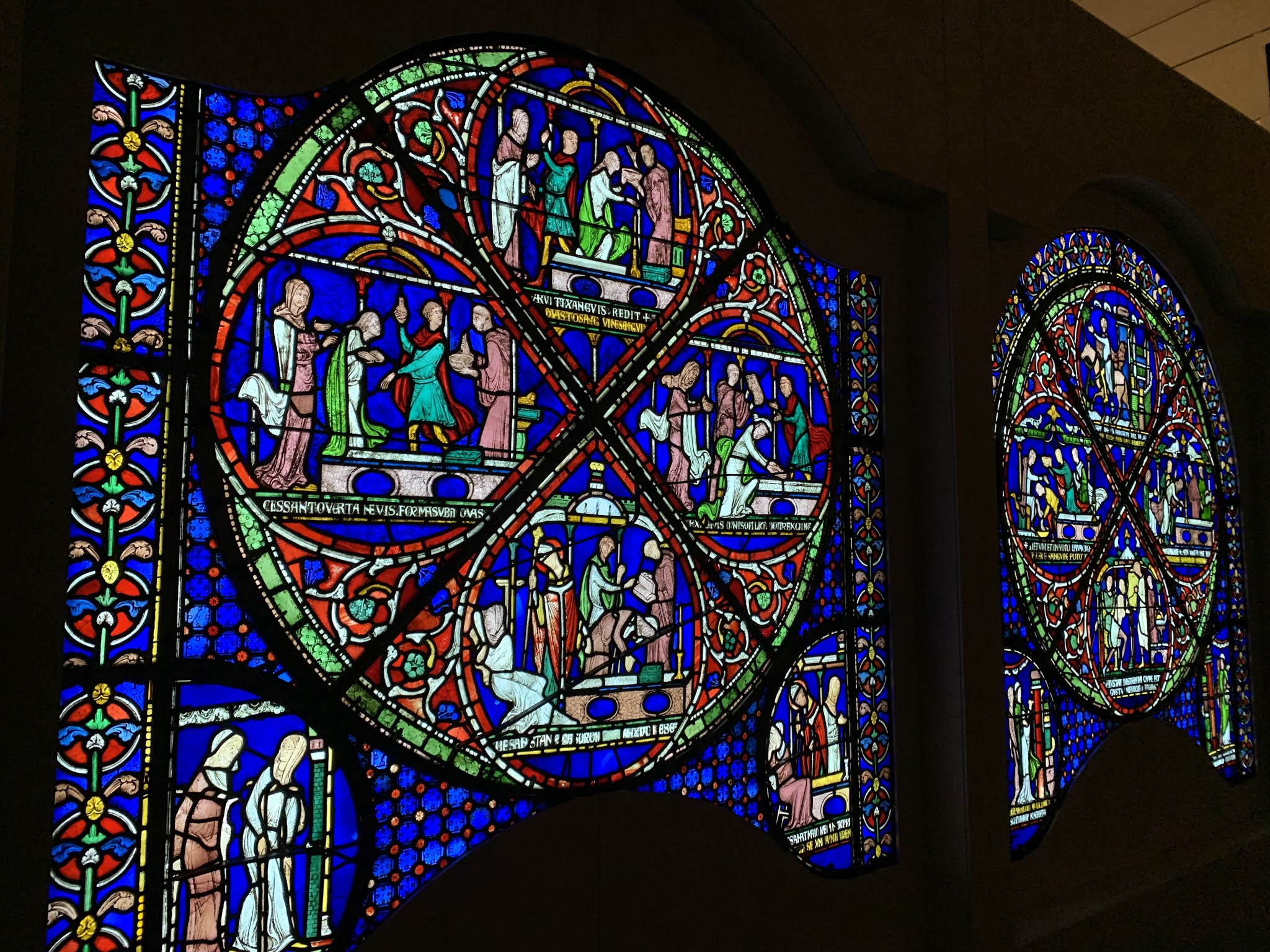
A series of medieval stained glass windows taken from Canterbury Cathedral, cleaned and restored for this show, is reason alone to make the effort to visit. They are exquisite, and provide a strong rebuttal to anyone waffling on about the blue in the windows at Chartes being unique to the French. Here is proof that the English could produce the same heavenly work. (We just lost so much more of it in our internal religious battles than the French did).

The windows, however, are late in the show, and there are plenty of goodies to fill your eyes until you get to them. Four knights murdered Becket in 1170 ... whether or not on the king's direct orders may never be resolved ... and canonised just three years later. His cult spread quickly across Europe, its flames fired by anyone who was for the pope or against England's Henry II. The king's estranged wife, the magnificent Eleanor of Aquitaine, and his daughters were active supporters of the new saint and Henry was generally held responsible for killing. His PR was so bad he opted for a spectacular show of public penance in 1174, submitting to a beating from the monks of Canterbury Cathedral. 


Such a delicious scandal triggered the equivalent of a modern media feeding frenzy, with every artist of the time taking on the subject. It was an era of lush decoration in fabrics, interiors, reliquaries and vividly coloured illuminated manuscripts. The exhibition is full of examples. They illustrate Becket's story but are also lushly beautiful in their own right. (This is something that Nero, mostly full of austere statuary and architectural fragments, could not match.)

With these beautiful visual aids, the curators take us through Becket's youth, his unlikely conversion to servant of the church, his rivalry with the king and eventual death as a political martyr. The death itself is a dramatic midpoint of the exhibition, told through a striking animation. Afterward comes the explanation of his growing cult, and some interesting insight into its spread beyond England. There is a bit on the Canterbury Tales, of course, and a fabulous animation of what the shrine would have looked like in its glory days. Though, like Nero's Golden Palace down below, I think they missed the potential of the technology by not projecting a life-sized image for us to gawp at.

The smaller display space suited the story well, with each enclosed area revealing one chapter before you moved through into the next. It builds drama, and made the story more manageable. I suspect Nero suffered from the vast main exhibition area, and might have been better if broken into the same bite size chunks as the Becket show.

Either show is worth your time if you have an interest in their time periods, and both show how far curators working in the UK have come in the last decade with show design and storytelling. With current Covid regulations remaining in place until mid-July, they still offer the glorious opportunity to linger over displays without crowds. 

Make Becket your priority not just because it is the slightly better show, but because it closes on 22 August. Nero and his world are with us until 24 October.