Showing posts with label Rome. Show all posts

Monday, 28 February 2022

Ferrara leads the Roman Restaurant Round-Up

Connoisseurs know that there is no such thing as Italian food. There are, instead, distinct regional cuisines strewn down the Italian peninsula. The differences between them can be extreme.  While you can get a flavoursome Florentine steak in Sicily, or a succulent Neapolitan pizza in Milan, you will usually have your best food experiences … as anywhere … if you concentrate on the local.

In Rome, this means three things. First, offal, called the “quinto quarto” in the capital city. Second, the four Roman pastas: carbonara, cacio e pepe, amatriciana and alla gricia. Third, artichokes, or carciofi in Italian. All are humble foods of the people. Only one is seasonal. If you’re going to eat local, you’ll need to have artichokes between February and April. Of course, Roman restaurants ship the ultimate edible flower in from around the world to keep them on their menus. But if you want proper Roman artichokes, in the Roman style, you need to eat them in the spring.

Locals know this, of course, and go into a frenzy of joyous artichoke consumption in the spring. Restaurants arrange the freshly-cut flowers in arrangements outside their doors to indicate availability. There are two time-honoured ways to consume them in the Eternal City. When cooked alla Romana they’re sautéed in olive oil and herbs until soft. Go alla guidia, the style brought to the city by Jewish immigrants in ancient times and loved since, and the flower is kept whole, except for the removal of the fuzzy “choke”, pounded on a counter to open up like a sunflower and then submerged in bubbling oil to deep fry. Both are magnificent. I took advantage of the happy coincidence of seasonality and vowed to each Cynara cardunculus at every possible opportunity. 


The stand-out restaurant of the trip, and the one I’ll now be booking every time I return, is Enoteca Ferrara. I do love an establishment that bears my family name, naturally, but they win even without that tenuous link. Established in 1988 and run by a pair of sisters (one’s the chef, the other the sommelier) in a warren of rooms that were once part of a convent, the restaurant presents traditional, seasonal cuisine with style that’s pushing towards fine dining but isn’t stuffy. The taverna/wine bar at the front looks resolutely old school, but once in the restaurant rooms behind you’ll find an airy space that combines the ancient and the modern … exposed beams and wooden dressers, modern art and light fixtures … that’s far more considered than your typical Roman tourist restaurant. 

The wine lists are the biggest I’ve ever seen; heavy volumes for red and white, respectively, with an encyclopaedic collection of Italian vintages. We were able to treat ourselves to two old favourites: schioppetttino, a light, fruity red rarely found south of Venice, where I discovered it on an early girls’ trip, and the Eruzione 1614, a fresh, mineral-rich white discovered on the girls’ wine tour of Sicily.  (And written about here) In fact, Enoteca Ferrara has all the hallmarks of a memorable girls’ trip restaurant, and I may need to throw Rome into consideration just so we can come back and eat here.

The food is in line with the restaurant’s rave reviews. I had my most sophisticated carciofi alla guidia here, served with a delicate stuffed and fried zucchini flower. The amatriciana here was the best I sampled, with the sacred trinity of tomatoes, pork cheek and pecorino combining to make something greater than its composite parts. Regular readers know that Italian is the only cuisine I measure by how it compares to what I can produce at home. I thought I made excellent zabaglione. Ferrara’s, thick and laced through with pistachio, leaves mine in the dust. My companions were equally satisfied.

Enoteca Ferrara sits at the heart of Trastevere, an area once down-at-heel and now legendary for its bars and restaurants. We came an hour early for drinks and saw how you could easily bar hop and nibble your way across the evening. It’s an area that deserves further exploration.

In second place comes Trattoria da Danilo, on a residential street that’s walkable from tourist areas but is resolutely not a tourist place. No English menu. Packed instead to fire-code endangering density with people who, given their rapport with the staff, seemed to be locals. The proprietor … one assumes he is the Danilo … welcomes people at the door and is shown in scores of photos next to prized visitors from th past. Nobody wanted to take our snap with him. The crowds and noise make this a far less comfortable dining experience than Ferrara, but it’s great fun to feel that you’ve dropped into a proper neighbourhood place.

Danilo has a simple, rather brief menu, but they’re not averse to mixing up the classics. (Something not often done in Italy.) My starter carciofi alla Romana came as the filling for a buffalo mozzarella “sandwich” … fun idea, though the cheese overpowered the artichokes … and my main was carbonara laced with pistachios … inspired, must try at home. I wouldn’t go out of my way to return, but if you’re in the neighbourhood already, it’s worth checking out.

Our hotel was around the corner from the restaurant that claims to have invented amatriciana sauce, La Matriciana, so that had to be tried. My husband and I had a split opinion on this one. I rated my food highly … amatriciana (not as good as Ferrara’s but close), saltimbocca with an artichoke alla romana on the side, a poached pear with a drizzle of chocolate sauce for dessert … but was disappointed by the perfunctory service. The decor looks like the place hasn’t changed since the ‘50s, which lends charm, and it’s right across the street from the opera house so is no doubt convenient to book ahead for outings there. But the place struck out for my husband, so we opted not to return despite its convenient location near our hotel

The lanes around the Pantheon are packed with small restaurants and it feels like you’re running the gauntlet getting through them, since each has a hawker outside enticing tourists in multiple languages. Such places are not normally a recipe for success but when you want lunch in the middle of a heavy sightseeing day you have to give something a try. My general rule of thumb: the better a view a place has of a major attraction and the closer it is, the worse the food is probably going to be. Rotunda is almost as far from the Pantheon as you can get before the continuous string of restaurants along the Via dei Pastini peters out. And its hawker was the only one to sing the praises of seasonal artichokes. 

The carciofi alla guidia were probably as good here as at Ferrara’s, though far less sophisticated. Just two whole flowers fried up and served with bread. If I went back, I’d happily just have that, all to myself. Instead, we split that as a starter and when for a meat course. My ossobucco was fine but a bit fatty. My husband happily tucked into a bistecca Fiorentina big enough it probably had its own carbon emissions certificate. He was happy.


Back home, I drove up to The Italian Store in Maidenhead and made my own attempt on the artichoke front. Not as tasty, or as pretty, as the Roman restaurants, but respectable. (Shown below with burrata and fried dough balls.) When in Rome, each artichokes. And when you’re not in Rome but dreaming of Italian sun, they work as well.


Saturday, 26 February 2022

Baroque bonanza brings joy to a meandering Roman morning

After 12 years, my husband can still be a mystery to me. How the man who found the irregularities of San Marco, Venice, “scabrous” and dismisses most Vivaldi and Puccini as “bombast” could find a place in his heart for Roman Baroque architecture is bewildering. But he likes it.

I suspect it’s a combination of three things. First, he tends to appreciate the quirky or strange. Second, he loves spotting imperfections and irregularities. Baroque, from its very origin as a style named after a malformed pearl, is full of oddities and clever rule breaking. But, third, it all springs from neo-classical order, so there’s a framework that keeps the chaos in control.

Whatever the reason, his appreciation for the riotous architectural style makes planning sightseeing in Rome easy. Because if there’s one thing I love, and this city has in abundance, it’s Baroque churches. You can get your fix just wandering around and popping through any open door, but I decided on a more targeted approach. While preparing for our trip I’d re-watched Waldemar Januszczak’s fabulous documentary on the birth of the Baroque, and decided to follow the path he’d taken through three churches that had each been instrumental in developing the style. Despite more than 10 trips to Rome I’d never been in any of them, so this was a real treat.

We started at San Carlo alle Quattro Fontane. The four fountains refers to the space just outside, where the corners of four buildings … one of them the church … have all been designed to match as they face off across the intersection. Fountains built into the corners feature larger-than life-sized figures representing, or lounging next to, major rivers. It’s a memorable architectural showpiece, though not that well known to tourists because the area leans towards government office buildings rather than tourist hotspots. Thus San Carlo, on the corner where a personification of the River Thames protects young Romulus and Remus sucking at the wolf’s breast, isn’t very crowded. 

That’s a good thing, because it’s also not very big. One hundred worshippers would pack San Carlo for mass, making it a surprisingly intimate space despite its grandeur. What it lacks in girth it has in height. It took an exceptional architect to avoid the illusion you’re trapped in the bottom of a well. Borromini did the trick with an innovative mix of geometry: an oval dome sitting on half circles and triangles above the wavy but generally rectangular shape of the church. There are so many architectural bits and bobs in here you loose count, but somehow they all coalesce into an elegant, soothing white space. The windows set inside the dome help, flooding the place with light.

If you head out the unobtrusive door to the right of the altar you’ll wind your way out to the double-storied cloister Borromini designed for the monks. It’s another triumph of height over footprint and something I wouldn’t have known was there without advance intelligence.

Barely 200 yards down the same street, just across from what’s now the presidential palace, is Bernini’s Sant’Andrea al Quirinale. While Borromini is a subversive Baroque rule breaker, Bernini turbocharges everything he touches. Most people will know him for his lavish interiors at St. Peter’s. His Quirinale church would hardly be a side-chapel in that blockbuster. But here, in splendid isolation, it’s a show-stopper. 

Few churches tell a story as comprehensively as this place, where its namesake is crucified on his saltire cross in a painting above the altar, then becomes a three-dimensional, larger-than-life sculpture ascending to heaven at the base of the dome before drifting into the celestial sphere represented by a golden-glazed cupola. Three-dimensional putti the size of real toddlers gambol around the dome, sometimes paying attention to St. Andrew and sometimes just being wilful children up to no good. (See top photo>) All of this takes place in an oval-shaped church a bit like a squashed Pantheon, ringed with side chapels and slathered with gold. Everything directs your attention up to that dome, which … like the Pantheon … covers the majority of the building’s space. It’s remarkable.

It’s a stone’s throw from Sant’Andrea on to the Piazza del Quirinale, where there’s an elevated view over the city with all the architectural grandeur of the Spanish Steps and none of the crowds. Linger here for a while before strolling down the wide staircase on the right which takes you into the neighbourhood around the Trevi Fountain. Turn right and make a quick detour to see it looking magnificent since its cleaning but don’t linger. Even with COVID-limited tourism this area is too crowded to be pleasant, and over-run with 20-something wannabe “influencers” and their friends taking alluring photos for their Instagram feeds. After photo-bombing a few or their attempts for the joy of it, continue over the Corso to the last in our Baroque trio: Sant’Ignazio di Loyola.

Those blessed with a Jesuit-influenced education will know from the name that’s a Jesuit church. As, in fact, was Sant’Andrea. The Jesuits like the Baroque. In fact, as the storm troopers of the counter reformation they knew the art movement to be one of their greatest weapons. (To read what they did with it north of the Italian border, read my report from the Goldener Saal in Dillingen, Germany here.) The grandeur of Sant-Andrea is a small, concentrated hit.  Sant’Ignazio turns the volume up to maximum. There are opulent chapels, stunning marbles, towering architecture, dramatic paintings, lifelike sculptures, a champion collection of relics in showy cases … every trick in the book of theatrical storytelling. But everything fades to insignificance beneath the ceiling.

Andrea Pozzo is arguably the best painter of trompe l’oeil (the style of fooling the eye to think there’s depth and reality in a painted space) who’s ever existed. Forget the Sistine Chapel. Come here and look up. Above the main nave, it’s as if there’s not a roof at all but towering architecture stretching to blue skies full of dramatic characters ascending to heaven. Humans and gods … both Christian and pagan … frolicking amongst the clouds is a stalwart of Baroque art and if you’ve been in many 17th century buildings you’ve seen plenty of this. But you’ve never seen it done so well. 

The dome where the transepts cross is another trick of the eye, actually Pozzo’s test canvas to prove he was up to the bigger church. It’s arguably more intriguing, with its unusual monochrome colour scheme. There’s more wonderful 3D trickery in the Eastern apse between the dome and the high altar, where high points of St. Ignazio’s life play out in high drama. It’s great fun to look at this stuff from where you’re supposed to see it, and then go out of your way to look at it from extreme angles where the trickery starts to become obvious.

I was tempted to lie down and just revel in the scenes above me, but that seemed a bit excessive. Fortunately there are plenty of chairs around and a big mirror you can use to take in the whole panoply of the main nave without straining your neck. You can also feed a euro into a box next to the mirror to turn on the ceiling lights. Do it. Illumination kicks the drama up another notch.

As if this weren’t magnificent enough, there’s a bonus sight in a chapel to the right of the main altar. Nope, I’m not talking about the monument to Gregory XV and Cardinal Ludovisi, even though it has all the gold, bronze, life-sized statuary and swirling angels to place it in Baroque masterpiece territory. Instead it’s one man’s humble hobby. Neapolitan Vincenzo Pandolfi started his project at the age of 78, deploying woodworking skills to create a doll’s-house scale model of a massive, domed, imaginary Ecumenical Church of Christ surrounded by scores of models of famous buildings of worship from around the globe. Gothic cathedrals, Islamic mosques, Hindu temples and Japanese pagoda all sit side-by-side in beautifully realised detail. He worked on it for 20 years before his death in 2005, leaving some empty spaces but mostly completing a very different but equally extraordinary piece of art. How it got here isn’t related on the explanatory labels, but it’s not to be missed.

No matter how much you love the Baroque, it’s a style on which you can overdose. Your brain simply won’t be able to take in any more after Pozzo’s heavens. You’ll want to recharge with a long, lingering, late lunch. Which must mean it’s time for me to write about food.  


Wednesday, 23 February 2022

A full day in Vatican Museums with light crowds is bliss

If money was no object, I would spend the next year diligently ticking off all of Europe's biggest, "must see" sights. 

Regular readers will roll their eyes. "Travel is always what you would do if you didn't have to earn a living, Ellen." True. But the year ahead is a very particular one. It's set to the be liminal zone between a time of total travel shut-down and a return to the world as it was. I am sceptical that lessons from the pandemic or the plight of the planet will keep anyone from long-haul travel. If anything, taste for it will have increased as everyone has dreamed of unattainable foreign climes for two years. Now, for a very short period while travel is technically allowed, but the hassle and increased expense of it is causing people to hesitate, there's a window for those of us who live in Europe to enjoy our continent's wonders without the pressure of too many outside visitors. Do I have any problem rubbing elbows with Americans, Chinese, and Australians at the Tower of London? Absolutely not. But as I've often written here, the  places we all want to see simply weren't built for the numbers who want to see them. For years, my sightseeing strategy has been to head for lesser known alternatives to all those Top Ten books. For this brief window, we can head for the big bets.

I proved that theory last week in the Vatican Museums. My last visit in 2006 was so awful I vowed never to return. Every hallway was thronged, every significant artwork required queuing to take a look. You risked life and limb getting in the way of bus tours being marched at high speed through the long galleries on their must-see pilgrimage to the Sistine Chapel. The Raphael rooms were as crowded as a London tube at rush hour, and the Vatican had built a new covered walkway on the outside of the building to stagger entry into the Sistine. Yes, after a mile of walking and no place to sit, you had to stand for more than half an hour just to press, body-to-body, into that famous room of Michelangelo's wonders.

What a difference a pandemic makes.

Our only queue was for the obligatory vaccination and temperature check at the front door. (This is because we pre-booked. Walk-ups waited.) By mid-day there was a healthy crowd, but you could always get a photo free of humans if you were patient. You could actually find a seat in the Sistine Chapel immediately upon entry. It was blissful, and I spent the whole day there.

“There” being the whole museum complex, not the Sistine Chapel. Yes, that famous room is beautiful, especially since its cleaning in the 1990s. It wows you with its vibrant pastels, and there's no denying the power of Michelangelo's figures. 

But I resent the fact that so many visitors are here to see only this, treating all the galleries on the way as an opulent race track. I think the whole visitor experience would be improved, and museum revenues boosted, if they offered a Chapel-only ticket at a premium, a museum only ticket at a discount, and a third tariff if you want to see both. There are so many masterworks to enjoy in the museums, some of them ... in my opinion ... better than Michelangelo's offer. But such major change is unlikely. The crowds will return, and the distances won’t change. So here’s my best advice for making your visit a joy rather than a chore.

PLAN Pre-booking tickets is essential. Go for the opening slot. Before you go, spend some time with the museum map working out what you want to see. There are seven kilometres of corridors and because the place is essentially a very long, narrow rectangle with a one way system, you’ll walk most of them. The Sistine Chapel is, naturally, at the far point from the entrance. You can leave the bulk of the galleries near the entrance to see later, but once you start down those long corridors there’s no easy way back, so take the time to see what interests you. The main route takes you through the Museo Pio-Clementino (the most famous of the Greco- Roman statuary), before starting down those long hallways. Once you get to the Raphael Rooms … the heart of the papal apartments, don’t miss the turn to the Borgia apartments. While not quite as magnificent, they feature a series of tiled floors and coffered, painted ceilings it would be a shame to miss, and because it’s a dead-end dogleg at the far end of your route, it’s easy to do so.

Even if you are walking briskly and looking at little, you’ll need 45 minutes to get to the Sistine. A typical visit is three to four hours, but you can easily spend … and I would recommend … an entire day. 

BE KIND TO YOURSELF Ignore everyone else. Set a pace that works for you and enjoy it. There are few places to sit so take advantage of them. The first is in the Cortile Ottogano, an eight-sided courtyard open to the sky close to the start of your hike. Though you may be full of energy, I still recommend pausing to sit here and take in what’s always been considered the best of the Vatican statuary. It is a beautiful space. You won’t see benches again until the Borgia Apartments, and then soon after in the Sistine. Have a good rest there before your return journey. 

The current tourist route forces you through the modern art museum between the Papal Apartments and the Sistine. You used to go directly from one to the other, and it appears it’s still possible if you ask the guards nicely. There are some lovely Chagall paper cut-outs in the modern galleries but the rest is uninspiring. So if exhausted, ask a guard in the last of the Raphael rooms if you might use the shortcut. 

Since my last visit the Vatican has dramatically improved food service, though it’s all on the entrance side of the complex. The standard circle tour will end near both a self-service food court and a small cafe that opens onto a section of the gardens open to the public. There is also a full-service restaurant in a marquee in the Cortile Della Pigna that you would have seen when you entered. (Nice wines, freshly-prepared pasta, not too expensive, with pleasant views around the courtyard.)

It’s a much more civilised option though, counter-intuitively, you need to follow signs to the exit to get to it. Proceed as if leaving and you’ll return to the top of the entry hall between the Pinacoteca and the Pio-Clementino. Cross straight over and your back beneath that famous pine cone. If you decide to spend the whole day in the museums, a leisurely lunch here is the perfect way to restore your energy before round two.

BRING BINOCULARS The ability to see details adds to the enjoyment of the Sistine Chapel, but this isn’t the only place binoculars will be useful. There are decorated ceilings throughout the complex that deserve attention, particularly in the Papal Apartments. And there are several windows with magnificent views over Rome or the Vatican Gardens that reward magnified viewing.

APPRECIATE THE ARCHITECTURE If someone took away the more than 70,000 items on display (and some have tried), this would still be an amazing building to explore. Look up regularly. the Sistine is just the biggest of the lavish ceilings that decorate the place. Pay attention to details, from tiny keyhole covers to vast marble inlaid floors. Look out the windows; most views have been arranged like a living painting.

For my money the two best architectural sights along the way are the gallery of the maps and the rooms of the Vatican Library. Pope Gregory XIII commissioned the map gallery as a tour of the papal holdings in 1580. It’s essentially a detailed look at Italy, region by region, starting in the South and working your way up the boot before culminating in maps of the whole peninsula, one contemporary and one Ancient Roman. The maps are works of art in their own right, embellished with cities, the occasional historical scene and decorative extras. The ships, sea monsters, water nymphs and putti gambolling off shore are a particular delight. The 40 panels in the 120-metre long gallery are surrounded by lavish ornamentation inspired directly from the then newly-discovered Domus Aurea, and the ceiling is one of the best in the complex. This room alone would be worth the price of admission.

As would be the Sistine Corridor of the Vatican Libraries, located directly below the map gallery. These rooms are even more influenced by the designs of Nero’s Palace, and are a joyous riot of colour, landscape and classical myth. 

GO BEYOND THE SET CIRCLE TOUR If you can spare the full day, there’s much more to see beyond the already rich offerings of the walk to and from the Sistine Chapel. A turn off the route from the Pio-Clementino galleries takes you into the Egyptian section, with a collection that rivals any museum in the world. While there’s an enormous amount from ancient Egypt itself, the most fascinating stuff to me is all the Egyptian-inspired fittings from Hadrian’s villa at Tivoli, now moved here. 

I’ve already mentioned the Borgia apartments. Another “dead end” (currently; the doors at one end are sealed) is the Braccio Nuovo, or new wing. It’s the bright white, obviously newer side of the Cortile Della Pigna. Instead of taking the steps up to the main rooms of the Pio Clementino, you turn the other way and go down a long hall filled with Roman busts on each side. At the end, turn right and you’re in a magnificent gallery built after the Napoleonic war to house all the goodies stolen by, and recovered from, the French. The Augustus Prima Porta and the reclining statue of Father Tiber are amongst the blockbuster statues framed by magnificent architecture and marble floors inset with ancient mosaics. The 1820s building set the model for just about every neo-classical 19th century museum wing to come after.

Most people walk straight by the Ethnological Museum on their way to the exit without giving it a glance. If you buck the trend you’ll find yourself wandering almost alone amongst glass cubicles stuffed with exquisite craftsmanship from Africa, Asia and the South Pacific. There’s a magnificent model of a Hindu temple in Indonesia that the Vatican has funded restoration on, and a fascinating collection of terracotta busts of Native Americans fashioned in the 19th century. 

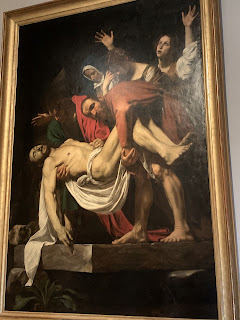
The pinocateca, or picture gallery, is another of the museums that rarely sees much traffic. And yet it’s stuffed with glorious religious art, including Fra Angelico, Giotto and DaVinci. There are more Raphael paintings, here, but you’ve drunk your fill of him in the Papal Apartments. I’d make my make way here for just three glorious masterpieces. Turn your attention to Raphael’s tapestries, woven to grace the lower walls of the Sistine Chapel on special occasions and displayed here in near darkness to let their colours sing. Londoners may know the preparatory sketches from their esteemed place in the Victoria and Albert Museum; the real thing is so much better. Melozzo da Forli is lesser known, but his heavenly host of musical angels are sublimely beautiful and have graced millions of Christmas cards. Supreme over them all is Caravaggio’s Deposition from the Cross, one of his most powerful works.

You might prefer the Etruscan museum, the coin and stamp collection or the early Christian art museum, none of which I managed to get to on this visit, or on previous ones. It is, after all, one of the biggest museums in the world. And for a few months more, I suspect, magically under-attended. If you have any chance to get there, or to any of the other great cultural sites, get there while numbers are still low. 


Sunday, 20 February 2022

Nero's Golden House was worth a lifetime of waiting; it's Rome's greatest hidden treasure

Before the pandemic, Rome’s Colosseum was averaging 20,000 to 25,000 visitors a day. While numbers are still far below that, the effort we needed to push through the milling crowds, guides and hawkers outside the metro station across the street is a reminder that while Europe's best-known attractions are magnificent, the effort needed to fight the crowds in order to see them can take both the joy and the awe out of the experience. 

There’s another option, just a few hundred metres further up the street, that offers all the magic of time travel back to ancient Rome, but with so few people you can feel like an explorer discovering its secret depths for the first time. Readers, I give you the extraordinary Domus Aurea, or Golden House of the Emperor Nero. This little-known treasure, closed to tourists for most of modern history, left me on the brink of tears of excitement and wonder.

In this blog I’ve introduced you to several rulers whose patronage of the arts outstripped their talent for leadership, most notably Charles II and George IV. But in this list of “misunderstood” connoisseurs*,  Nero gets the gold star.

Amongst the spectacular abuses of power (and PR disasters) laid at his feet is his reaction to Rome’s great fire of 64AD. While there is historical evidence of him re-housing the poor and sending out fire-fighting crews, what everyone remembers is him fiddling while Rome burned, and the way he cleared more than a square mile of the city centre to build himself an opulent new palace. The place was legendary for its marble walls studded with gemstones, gold enhancements and exceptional frescoes. The Colosseum stands on what was once the ornamental lake. 
Nero was assassinated before his vision could be complete, and his successors were embarrassed by his profligacy. (Much as Queen Victoria was by her uncle’s OTT Brighton Pavilion.)  They stripped out the ornaments, re-purposed parts of the complex and filled in others with earth to provide the foundations for Trajan’s enormous public baths complex. It’s this last section that you can see today, thanks to a local falling through a sinkhole into one of the rooms in the 1480s.

But wait! I hear you thinking. If it was re-discovered more than 500 years ago, why isn’t this place better known? If you studied art history, it is. A procession of famous artists, including Michelangelo and Raphael, scrambled around the cavernous discoveries marvelling at the paintings and incorporating the designs into their work. Artists and architects have been copying the Domus Aurea's walls ever since. It became quite the thing for grand tourists to have themselves lowered through holes in the palace ceilings (see below) and leave their initials carved in unadorned bits of ancient plaster. The Marquis de Sade and Richard Wagner are amongst the famous spelunkers. 
But access since the turn of the 20th century, when the government started taking firmer control of its heritage sites, has been a tricky thing. Through most of the last century access was limited to archaeologists and academics with a specific interest. The general public finally got access in 1999, but the place was shuttered again six years later after floods, ceiling collapses and a worrying decline in the state of the frescoes. 

Sixteen years of restoration have worked wonders. Architecturally, the whole site has been stabilised, including skimming much of the vegetation and earth off the top and replacing it with a lighter-weight garden full of plants familiar to the ancient Romans. The paintings have been restored and augmented with sympathetic pieces of sculpture throughout. 
There’s a dramatic new exit … like the Louvre pyramid, a beautiful example of modern design dropped into a historic space. 
Nero’s famous octagonal dining room, with alcoves off five sides and a dome that once had an inner shell that depicted the constellations, rotated, and dropped rose petals on diners, is the culmination of your visit and a gallery space currently telling the story of the Domus Aurea’s influence on Raphael. My corporate event instincts tell me that with its modern entry/exit and the flexible nature of the octagon and alcoves, Nero’s former dining room will soon be available to hire for events.
The most dramatic, and visible, contribution of the recent restoration is a dramatic lighting scheme. (You can watch a video about how they did it here.) Sensors activate lights when guides come and go, so you’re exploring the whole site in puddles of light flickering out of the gloom, just as the Renaissance artists would have. In key spots, there are video screens offering views of what the area would originally have looked like.
In the larger spaces, lighting designers have worked to simulate a subtle, golden daylight as close as possible to the building’s original design. 
This part of the palace was essentially a giant pleasure pavilion with one side open to the air, natural sunlight flooding through open porticoes and high windows. In many places, dramatic spots highlight statuary against the gloom beyond. Designers selected the tone of each room’s lighting to bring out as much colour and detail as possible in the wall paintings.
The overall effect is stunning, as if you are the first to see these secret spaces in centuries. And with tours limited to 25, there are times where you can actually be completely alone, adding to that sense of adventure. Unfortunately, I do have to mention that what’s dramatic and atmospheric for most can be debilitating for the vision impaired. My husband, who is blind in one eye and thus has little depth perception and an extreme sensitivity to quick changes in light, found the whole place extremely challenging.

For me, however, the Domus Aurea was possibly the most exciting thing I’ve done since the thrill of setting foot in the forum for the first time 45 years ago. Part of it was certainly that atmospheric sense of discovery. But it was also the sheer beauty of room after room of ancient frescoes. Some are plain blocks of colour. Some architectural frameworks. 
Some landscapes or mythological scenes. By far the most exciting to my eyes, as they were to the Renaissance artists, were the tiny decorative details of flowers, foliage, architectural elements and strange half-human, half animal creatures. Before modern language changed the meaning to something negative, these were known as “grotesques”, referring to their discovery in a cave, or grotta. 
I could have remained for hours in admiration, and would have loved to sit and sketch, but I suspect those high tech lights would go off on me.

The official website (where you need to go for advance tickets, which are essential for entry) tempts with a virtual reality experience, but it's currently a dead link and there was no sign of it on site. I assume it's in development and I'll be able to return to a digital space soon to explore more. Ironically, it's the promise of deeper understanding of a 2,000-year-old building that's finally tempting me into the latest digital craze. Bring on the metaverse, with a plate of lark's tongues, a bottle of garum sauce and a glass of Falernian wine. And don't forget those falling rose petals, please. 

If you'd like to see more of my experience, I've posted a YouTube video here.

*Was Nero misunderstood? A recent exhibition at the British Museum explored just that question. You can read my review here

Monday, 14 February 2022

Mercure Centro Termini is an efficient base for culture and rugby

Hard to believe it’s been six years since my last visit to Rome. The friendly folks at Facebook won’t let me forget, however, as they keep pushing memories my way. They look suspiciously familiar. Another Six Nations rugby weekend. Another Valentine’s Day. Another loss for the Italian team. For an explanation of why it makes sense to travel to Rome to watch rugby, read my original story

Not everything is the same, however. The authorities have laid on far more trams so transport to and from the Stadio Olimpico was far easier. Inside the stadium there’s been a complete overhaul of food and beverage provision, with a wide variety available from food trucks, stands and vendors strolling the aisles. It’s the only stadium I know surrounded by parkland; go early, grab a beer and relax on the grass under the umbrella pines. There was still an abundance of queuing, but this time a new cause: Covid-19. 

Given that the Italians were the European front line of the pandemic and suffered horrifically, it's no surprise that they're now hyper-vigilant on disease control. You probably stand more chance of getting hit by an asteroid than of catching Covid in Rome. FFP2 masks are required everywhere, only allowed off for seated eating or drinking. You won't get in to any public venues without showing your vaccination certificate; sometimes multiple times. To get into the game, the name on your ticket, photo ID and vaccination certificate had to match up. We saw multiple people turned away for a missing element. Major museums do the same triple check plus a temperature scan. At the stadium, we had to go through three different queues with variations of checks before we finally got to our seats. If this is the future of major events, plan on getting everywhere at least three hours in advance.

Despite the increased admin, prolific queues, and extended hours in a mask, a long weekend in Rome remains an ideal way to break England's winter gloom. We got lucky with sunny skies and 16C (61F) temperatures for the whole visit. Travelling out on a Wednesday evening and back on the Monday gave enough time for plenty of sightseeing and lots of wonderful Roman meals without being away from the office too much. Rumoured plans to eject Italy from the Six Nations tournament might be better for the game, but will strike a heavy blow to options for winter weekends away.

Prices at the hotel we'd used last time had skyrocketed, so we opted into our customer loyalty programme and went for the newly-opened Mercure Centro Termini. Its location 1/3rd of the way down the long, straight road between the main train station and the Victor Emmanuel Monument is ideal for sightseeing, with most things in walking distance.  It's amazing how much this area has changed since my early visits to Rome. In the '80s the station and everything around it was run-down and a bit dangerous. The whole neighbourhood has had a makeover (other than one small park across the street from the bus terminal that's still the preserve of weeds, rubbish and the homeless) and the station itself is modern, efficient, clean and studded with upscale shops.

The local Mercure is so new, however, that taxi drivers don't know where it is. Even when you tell them the specifics (at the corner of Via Nazionale and Via Agostino Depretis) they confidently take you somewhere else in the area. The newly-renovated building ... a pink Venetian Romanesque-style palazzo out of place in the grand, white, neoclassical street, obviously wasn't designed as a hotel. There's no real lobby to speak of, just a check-in desk across from the lift doors and a few couches on either end of the bar and restaurant that faces the street. If you didn't look up to see the Mercure flag hanging above, you'd never guess from what you can see through the windows that it's a hotel. Which might be part of the problem with the taxi drivers. While the street-facing restaurant is busy at breakfast time, when guests can add a functional but unexceptional buffet breakfast to their tab for €13, we never saw anyone eating lunch or dinner here, which made the whole place a bit odd and lacking in atmosphere. I'd like to see them lose some of the restaurant tables and create more lounging space.

Based on our lodgings, I'd guess there's a lot of variety in accommodation since they seem to have wedged hotel rooms into a space built for something else. Ours was generously sized but oddly shaped; a long, narrow rectangle with exceptionally high ceilings ...  the walls were taller than the rooms were wide ... divided into two distinct spaces by an archway. A super-king bed took up almost all of the second room, while the first by the door was occupied with a shelving unit, desk and one chair. A modern, spacious bathroom continued the enfilade on the other side of that. Tall glass doors in both rooms led onto a balcony that ran the length of the space but, sadly, had no chair or table. 

Staff were friendly and consistently helpful, particularly the attentive and charming Daniele who, running the bar and restaurant from breakfast into the afternoon, became the real face of the hotel as his domain doubled as the lobby. While short on atmosphere, the Mercure was functional, quiet, good value for money and I'd stay there again. The location gives easy, quick access to the airport via the Leonardo Express train (€14 per person, travel time about half an hour), though we did splurge on arrival and took a mini cab door-to-door (€60, but saved us 20 minutes of walking with luggage, with the only driver all weekend who knew the hotel). 

Our itinerary for the weekend balanced serious sightseeing with great food, shopping and sport. I was conscious of being at a tipping point perhaps never to be send again: all the tourist attractions were open, but there were few visitors beyond Europeans. Though the Spanish Steps and the Vatican were crowded, numbers were nothing like recent history. 

Sightseeing was a joy. Thursday was all about Baroque church architecture, Friday dominated by the glories of Ancient Rome, and Saturday given to the Vatican. With Sunday’s game not starting until 4pm we could fit in some shopping around the Spanish Steps in the morning. Monday was my only miscalculation; a day somewhat wasted because I forgot that museums are all closed in Rome at the week’s beginning. I should have saved the churches for departure day. Despite that miscalculation I still managed to pack a prodigious amount of art, architecture and history into a short period, and managed to tick one place of my still-to-see Roman bucket list. Enough to finally have some decent experiences to blog about. More to come…

Wednesday, 26 January 2022

Eight elusive Roman treasures still haunting my bucket list

I know Rome well. From my first visit on a school trip, when I ditched classmates more interested in shopping to scramble over the Palatine Hill on my own, I've always wanted to scratch beneath the standard bus-tour itinerary and touch history. Back in the early '00s I spent a whole week there on my own, dedicating myself to niche sights and small attractions unlikely to captivate fellow travellers. 

But Rome is a big city, with prodigious layers of history. It would take a lifetime to see it all. Here's my "bucket list" of eight places I'm keen to go but haven't managed to see in the Eternal City. 

SANTA MARIA DEL POPOLO

From its fabulous Medieval origin story of the exorcism of Nero's ghost to a line of popes who decided to endow the place with masterpieces, this is one of Rome's blockbuster churches. But Rome has a lot of blockbuster churches. Santa Maria del Popolo is the only one with two big Caravaggios facing off in all their dramatic glory. The Cerasi chapel features the Conversion of St. Paul on one side and the Crucifixion of St. Peter on the other. The bad boy of Baroque art rolled out all of his dramatic tricks of lighting and perspective to dominate the small space and pull you into the scene. Presumably you hardly notice the knockout-in-any-other-space Assumption of the Virgin by Carracci over the altar, the frescoed ceiling, and the opulent, gilded plasterwork. But I can't tell you, because every time I have tried to visit the church it's been closed for renovation. Now it's closed for Covid safety. I live in hope.

THE DOMUS AUREA

I suspect the Emperor Nero would have had a soft spot for Caravaggio, given their shared reputations for wild excess, violence and love of art. The last Julio-Claudian emperor built a palace called the Domus Aurea for himself that he set out to make an architectural and artistic wonder of the world. Its marble walls were studded with gold and gemstones and it had a famous dining pavilion with open sides and a rotating dome. It was lost for centuries before being re-discovered in the Renaissance. Much of the classically-inspired style of the time comes from artists ... including Michelangelo and Raphael ,,, who lowered themselves into the underground chambers, copied the decorations they found there and used them prolifically in their work. It was only opened to the public in 1999, and then floods in 2006 closed it down for more years. It now appears to be re-opened, and is run as part of the archeological park that includes the colosseum, but the "buy tickets" link leads to a 404 message.

PALAZZO FARNESE

Many a visitor to Rome has stood in the Campo dei Fiori and looked up into the windows of the French Embassy ... aka the Palazzo Farnese ... slack jawed at the glittering interiors on display. It is a famous treasure house of art, particularly noted for its ceiling fresco cycle on the Loves of the Gods by Annibale Carracci. The facade has been copied repeatedly by architects around the world. And opera fans know it as the place where Scarpia attempted to seduce Tosca before she killed him. In recent years the French have started to offer guided tours, but they are extremely limited and must be booked in advance through the official web page. No options work for my next trip, so my wait continues.

THE MUSEUM OF ROMAN CIVILISATION IN EUR

EUR is a business and residential district built by Mussolini in anticipation of a World's Fair that never happened. Its collection of distinctive buildings in Fascist neo-classical style has always intrigued me and would definitely be worth a wander on a day when you didn't have other things on your Roman priority list. (I haven't had one of those yet.) The key reason to make the trip is a model. The most famous display in the Museo Della Civilta Romana shows the Rome of 300 AD in astonishing detail at 1/250 scale. Though few tourists make it to suburbia to see the physical model, they'll see it repeatedly throughout their visit. It is the source for all of those guidebooks and display panels that show you what the ruins you're looking at used to look like. Ridley Scott even used bits of it in Gladiator. Sadly, the museum has been closed for renovation since 2014, though news reports say the work itself didn't start for another three years, and no date has been announced for re-opening. (I suspect you're noticing a pattern of inaccessibility here.)  

VIA APPIA

The Appian Way connected Rome to the port of Brindisi, jumping off point for the Eastern Mediterranean. It was one of multiple major arteries leading in and out of the city, but a quirk of history means this is the only one that still exists for picturesque stretches as Roman road bordered by Roman monuments. Those monuments are often impressive tombs. Romans forbid burial inside their cities, tending to commemorate their dead along the roads just outside city gates. What was then on the outskirts of the city is now a regional park ... the second-largest urban park in Europe ... that protects landscape and ruins around the road up to the 10th Roman milestone. It's a well-known though rarely crowded spot for a walk. Traffic is still allowed on part of the road but there's not supposed to be much, and it's closed to motor vehicles on Sundays. I did come this way to visit Christian catacombs as a child, but I've always dreamed of a leisurely meander to check out the tombs. Though this Vespa tour looks like a more stylish and efficient way of getting around.

PALAZZO MASSIMO

Some of the choicest pieces of art from ancient Rome have been collected and put on display in this relatively new museum, a branch of the Museo Nazionale Romano created from a derelict palace at the turn of this century.  From the website, it looks like this is probably the best concentration of Roman sculpture outside the Vatican museum; in fact they share a few, since most great Roman statues were copies of Greek originals. But the main attraction for me are the frescos from the house of Livia. I've only seen examples on loan to a travelling exhibition in Paris, but never seen them all or in their home city. I do know they set decorative trends for nearly a century, and are gorgeous. To be honest, I never even knew where they lived (and suspect they were in storage for a long time). This is probably my easiest visit to accomplish next trip, as both the museum and our hotel are near the main train station.


CINECITTA

The largest film studio in Europe, Cinecitta's early days gave us classics like Ben-Hur, La Dolce Vita and Roman Holiday. In the modern era the studio has continued with film (I'm highly amused that Gangs of New York was made here) but also branched into TV. Both Rome and The Young/New Pope series were filmed here on sets that delivered a completely convincing Ancient Rome and Vatican City. The Cinecitta studio tour has multiple routes for exploration including views into the production process and a costume collection. But I suppose most visitors are here for the sets: ancient Rome, the temple of Jerusalem and 1400s Florence. There's also the re-creation of an American S-33 submarine used in the film U-571, which I suspect will be of more interest to my husband than to me. (Although having looked up the film and seen that it stars both Matthew McConaughey and Bon Jovi in the full flower of youth, I could be persuaded to watch the movie.)

QUARTIERE COPPEDE

This 31,000 square metre suburban district was designed by a single architect, Gino Coppede, in the early 20th century. Given the photos I've seen, he's Rome's unsung version of Gaudi, and much of the highly-decorated Art Nouveau/historic mish-mash here reminds me of bits of Barcelona. Or Disney fairy tale film sets. While I know I would enjoy a wander around, my real ambition is to find a wonderful VRBO apartment in the district and stay here for a week or two. During which I would concentrate on getting through the list above, while also visiting old favourites.


Sunday, 23 January 2022

Ten quirky Roman sights beyond the average tourist list

We are 17 days away from our next attempt at international travel. While the risk of a major trip to Egypt and Jordan was not worth taking, a rugby weekend in Rome looks far more manageable. And, crucially, far easier and less expensive to cancel at the last minute if we must.

Italy is always an uneasy holiday venue for the Bencards. For me, it is a spiritual home where I feel more alive. It is rich with memories of childhood and exquisite family holidays, brimming with the art and food I like best. It is the only place in the world I have any chance of comprehending and making myself understood in another language. Though my husband is not quite the Italophobe I jokingly paint him, the country’s romantic appeal is mostly lost upon him. If left to make his own choice he would generally prefer to be anywhere else north of the Alps. His tomato allergy doesn’t help. And, crucially, for a man who can get by in four languages and, before meeting me, never really vacationed in a place where he couldn’t chat with the locals, not understanding what’s going on around him bothers him profoundly. 

Experience has taught us that a bit of travel planning is essential for marital harmony. If we each set out our priorities before a trip, and are honest about what we don’t want to do, life is more comfortable. I’ve also learned that my husband is far more likely to be captivated by the odd or quirky than anyone’s traditional Top 10 list. And so, to help with our preparations, here’s the first of two round-ups of Roman sightseeing possibilities. Below, my choice of the 10 best things to see that are off the usual tourist track. I’ve visited them all, but my husband has not. Next time, I’ll offer my wish list of things I still haven’t managed to see but want to explore.

1. THE OTHER THREE PAPAL BASILICAS

Everyone knows about St. Peter’s, but there are actually four papal basilicas in Rome. A papal basilica is differentiated by a holy door only opened in Jubilee years, a baldachin (decorative canopy) over the high altar and a restriction against anyone but the pope celebrating mass at that canopied altar. The three basilicas that most people miss are St. Giovanni in Laterano, St. Paolo Fuori le Mura and St. Maria Maggiore. Though all were “improved” by the same counter-reformation trends that made Rome’s churches a festival of the Baroque, the main fabric of these three is much older. All have the original footprint of the vast rectangular Roman civic buildings early Christians adopted as their first major churches, and a wealth of early Christian mosaics. They are unlike almost all the other churches in Rome and feel profoundly ancient. They aren’t close to each other, however, so seeing more than one of them in a trip would require dedication. If I had to choose one I’d opt for Santa Maria Maggiore, which has the most early Christian stuff plus a collection of impressive tombs. Though if you want really quirky, go to St. John Lateran and then pop across the street to the Scala Sancta. This marble staircase is supposedly the one Christ ascended for his appearance before Pilate. St. Helena brought it back to Rome. It now has a wooden staircase sheathing its precious original substance and pilgrims ascend on their knees, praying at each step. I am glad I did this when I was 11 as I can’t imagine my knees holding out for the whole climb these days.

2. SAN CLEMENTE

This church is a variation on the theme above. It is also an early-Christian, basilica-shaped building with fantastic early mosaics. It’s a lot easier to get to than the three above, being just a gentle stroll from the Colosseum. But what really differentiates it is what lies below. You can climb into the basement where you’ll see the foundations of the first church, which dates to the late 4th century. Then you get to scramble down another level, and you find yourself in the excavated remains of a Roman street with the foundations of an apartment block and a temple of Mithras, with intact altar surrounded by stone benches for the celebrants. (See photo above). There’s no better place in Rome to appreciate the city’s layers of history and probably no better-preserved Mithraeum. (London’s version, despite its curators’ high-tech attempts to bring it to life, looks sadly underwhelming in comparison to this one.)

3. OSTIA ANTICA

Pompeii is world-famous and the reason most tourists make the effort to get to Naples. Few realise there’s an ancient Roman cityscape almost as well-preserved that is easily accessible by a suburban train from the capital city. Ostia was the port of ancient Rome. Throughout imperial times this was a bustling, affluent and cosmopolitan town of up to 100,000 people. With political instability in the 5th century came a lack of engineering will to keep the waterways open. The port silted up, people moved away and nature reclaimed the abandoned site. These days you can walk down empty city streets where many buildings have preserved ground floors. There are several bath complexes with impressive mosaic floors in situ, and lots of architectural detail to stumble upon in shops and villas. At the town’s centre is an impressive theatre and a marketplace surrounded by offices of all the traders who were once based here, their businesses advertised in mosaic in front of their thresholds. The best part … at least when I visited … is that there’s hardly anyone here. For at least a third of my visit I was wandering through ruins entirely alone, creating the sense I was discovering the place for the first time. It’s magical.

4. THE CAPUCHIN MUSEUM AND CRYPT

The most macabre, bizarre sight in Rome and not to be missed if there’s a shred of Goth in your soul. When the capuchin friars moved in to their new church of St. Maria Della Concezione dei Cappucini in 1631, they brought 300 cartloads of remains of their deceased brothers through history with them. And this being the height of the Baroque era, they decided to not just bury them, but use their skeletons as building materials for a wildly ornate decorative scheme in the basement. Femurs, tibias, skulls, vertebrae and the like were separated like piles of Lego, coming back together as columns, arabesques, flowers, domes, circles, etc. And just so you don’t forget what you’re actually looking at, some of the brothers’ skeletons remain complete, dressed in moth-eaten robes, glaring down at you through empty eye sockets to remind you that the glory of the world is fleeting. 

5. THE MUSEUMS ON THE PINCIAN HILL

For a less gruesome take on the Baroque, head to the Galleria Borghese. This is one of the world’s great small museums: the collection is small enough to get round without feeling overwhelmed, but it’s jammed with masterpieces. It’s best known for having Bernini’s most famous sculptures and an impressive group of Caravaggios. It’s all housed in an eye-wateringly opulent palace that would be worth the trip even without the art. A short walk away is the National Etruscan Museum at the Villa Giulia. This is another aristocratic villa once built as a suburban retreat at the edge of Rome, now quite central. And like the Borghese, it’s worth visiting just to nose around the impressive building. The Etruscans are a bonus. Rulers of central Italy before the Romans turned up and muscled in on their territory, the Etruscans influenced the Romans but are distinctly a people apart, with art that’s more reminiscent of ancient Crete or Egypt. This is a fascinating repository of beautiful things from a mysterious and little-known culture.

6. TRAJAN’S MARKET

Almost all visitors to Rome will have seen this amphitheatre-shaped complex of ancient commercial buildings from the modern road that cuts through the Imperial Fora. Few would have gone in. This is essentially the world’s first multi-story shopping mall, with a design so practical it’s still used by urban planners today. (Though they may be unaware of the source.) Though heavily skewed towards shopping, the market held a library, concert halls, offices and spaces to hang out with your friends. The world’s foremost expert on the place happens to be a professor I studied with at Northwestern, Jim Packer, so I’ve felt a special bond since he introduced me to it. Like Ostia, it’s a place you can get up close and personal with the Roman world without lots of tourists bothering you.

7. TIVOLI

Trajan’s Market is vast and imposing, but it’s insignificant compared to the villa his successor Hadrian built at Tivoli. Anticipating Disney’s International Showcase at Epcot by almost 2,000 years, Hadrian made his holiday retreat from the capital a city-sized sprawl of architecture collected from around the Empire. There’s Greece here, Egypt there, a nod to the Near East over that bridge. It’s a glorious place to wander around, but it presents you with a major challenge. It takes most of the day to see it properly, and it’s just one of three notable attractions in this town 40 minutes northeast of central Rome. If you prefer gardens, or fancy yourself a hydraulic engineer, you’ll head for the Villa d’Este, where owners from the Renaissance through the Baroque shaped the steep inclines below the house into some of the most outrageously opulent water gardens ever seen. There’s also the Villa Gregoriana, a park full of managed, romantic wildernesses created around the ruins of yet another rich family’s country retreat. (I’ve never found time for that one.)

8. PALAZZO DORIA PAMPHILJ

Most tourists wandering down the Corso, Rome’s main commercial street, walk by the rather plain gateway of this palace without realising it’s a tourist attraction, much less one of the most lavish aristocratic palaces in Italy filled with one of the world’s most valuable private art collections. To tell the truth, I find the interiors a bit gloomy, but the sense of discovering a hidden treasure is better than the decor. I also love the way it’s occupied by a modern family still involved in its maintenance and management. The current owner, Prince Jonathan Doria Pamphilj, is a long way from your average Italian aristocrat. He travelled the world and ran a restaurant in Brazil before inheriting the house. He’s a gay rights activist who, with his partner and their adopted children, has been instrumental in advancing changes in Italian law and perception. And as the son of an Englishman … his Maidenhead-born father married into the family and changed his surname as the palace and title went down the female line … he takes an English aristocrat’s approach to managing the estate. He narrates the audio guide, rooms are available for private hire (a former employer of mine used to use the place for customer events) and upstairs apartments are let out at a peppercorn rent to artists and writers. Other space is given over to the centre that supports positive relations between Anglicanism and the Roman Catholic Church.  

9. TRASTEVERE

This eclectic neighbourhood sits behind the Vatican and across the river from most major tourist sites, so has traditionally gotten little tourist footfall. (Though this has changed in recent years.) The winding streets are a delightful hotch-potch of architectural remnants, with Medieval walls and Roman columns often turning up in the facades of more modern buildings. There are loads of interesting shops and restaurants that all feel profoundly local. It’s a great place for a gentle wander.

10. VILLA FARNESINA

Aside from eclectic wandering, this is the main reason to venture into Trastevere. Yup, it’s another lavish villa built by a famous Roman family with papal associations. And while the whole thing is very nice, those in the know seek it out for just one thing: a spectacular ceiling. Everyone flocks to the Sistine Chapel; I’ll take Raphael’s loggia here any time.  Originally open-sided and perched above the Tiber, the loggia served as a summer banqueting pavilion for the outrageously wealthy Chigi family. Legend says they served dinners on gold plates and once empty threw them into the Tiber below to show off their limitless resources. But the family money came from canny banking and they were no fools; they strung nets below the loggia to capture the whole dinner service for washing and re-use. Obviously, a family that fond of display was going to invest in some serious interior design. Enter Raphael, also busy at the nearby Vatican for the Popes. Here, unleashed from religious restrictions, he created a wonderland of gods and goddesses in the pursuit of love. The colours are vibrant, the perspectives bewitching, the action non-stop and some of it lascivious in the extreme. It is one of the most beautiful rooms on the planet. (The Farnese, whose name brands the palace now, didn’t buy it until it was almost 60 years old. They are more directly related to another magnificent fresco cycle, which will show up on my next list.)