Saturday, 14 May 2022

Forget the cathedral. Beer, and a distinctive drinking culture, is the reason to head to Cologne

Sightseeing-wise, Cologne was a bust. I found the much-celebrated cathedral inferior to a long list of others*. The famous perfume is perfectly pleasant but I can buy scents I like better for a more reasonable price. Much of the city centre is remarkably ugly. Like many German cities, it was flattened by bombs in WWII, but post-war construction here veered towards modernism and away from re-creation. (In this, Cologne should be twinned with London.) For me, its star sight is a roman mosaic from an ancient dining room on display in a brutalist concrete museum now closed to the public but, fortunately, you can still see the floor through a window at the back and to the right of the cathedral.

The city was redeemed, however, by its beer. There's only one thing on tap here: Kölsch. It's pale, dry, crisp, and served pleasantly cold. It's all highly regulated, with ingredients limited, processes defined and the ability to call it Kölsch restricted to 50 km from Cologne. But that doesn't mean it's all the same. Many of Cologne's copious drinking establishments brew their own versions and aficionados claim different varieties have different fruity notes you don't often find in a German lagers. Anyone can wander into a Cologne pub and get a drink, but going out for an evening with a local guide brought us to the right places and helped us understand the distinctive drinking culture.

Kölsch is served in what, at first, may seem a laughably small glass. The tall, thin, 200 ml (6.8 oz) cylinder is called a Stange, and may strike you as an oversized shot glass. A thirsty drinker could down it in a few gulps. But here's the magic: it just keeps coming. 

You don't order a beer in Cologne. You enter the brew house , find your place, and a waiter (the Köbes) will come up with a circular tray with a tall handle in the middle (the Kranz), full of glasses, and give you one. Because this is really the only thing you drink in Cologne. When your glass is empty, your lovely Köbes is at your elbow with another. And he will be there, again and again, until you place your beer mat on top of your glass to stop the flow. While the initial 200 ml won't go to your head, you can imagine how constant top ups across the evening could do damage to your equilibrium and your wallet. Fortunately, all the evening’s drinking was covered by the excursion price, no matter when or if we decided to deploy our bar mats. This made the price better value for money for some than others.

While our guide on the day’s earlier walking tour (included in the basic cruise price) had focused understandably on history and architecture, the evening’s guide delved deeper into the people and culture. The locals, it turns out, are quite an anarchic bunch. Fiercely independent, fond of parties, lovers of food and drink and … according to our Cologne-born guide … have the best sense of humour in Germany. I couldn't help remembering the fun-loving the Osakans and their prickly relationship with Tokyo. 

Predominantly Catholic, Cologne was absorbed into the staunchly Protestant Prussian kingdom after the Napoleonic era and it was never a comfortable fit. Though there are statues of Prussian kings dotted around the place, they’re treated with mocking contempt. A pre-Lenten Carnival is the party of the year, characterised by Venetian levels of costume, drinking and mayhem. Naturally, the locals kick off the party under a statue of Prussian King Friedrich Wilhelm III, a devout Protestant who hated the whole Carnival idea and tried to shut it down.

We started our evening at the Brauerei zur Malzmühle across the street from the Heumarkt, the enormous town square on which that king’s equestrian statue prances. The Schwartz family have been brewing and hosting visitors here for 160 years, and they’re now one of the few establishments still brewing on site in the city centre. The decor is traditional but restrained 19th century German beer hall, with lots of stained glass, wood, festoons of dried hops and memorabilia from carnivals past.

In the best tradition of pub crawls, we lined our stomach here with a hearty dinner to better absorb the alcohol of the evening. Local delicacies here mean pork. Our group shared platters of pork knuckle, sauerbraten, smoked sausage, black pudding, and even a pork tartare. It was both delicious and a bold statement of faith in the freshness and purity of the local meat. (I suspect serving raw pork would be illegal in England, despite the quality of our pork industry.) On the side came fried potatoes and a lightly pickled sauerkraut that bore no resemblance to the cheek-puckering stuff sold in groceries. Even professed sauerkraut haters tried it and found it tasty. Of other vegetables, there was no sign and,  in the local mind, no need. It wasn’t the first time it occurred to me that a vegetarian might starve to death in Germany, and devout Jews and Muslims would be eating from a very reduced menu. My husband, meanwhile, was nearing a coma of transcendent happiness with so many interpretations of his favourite protein in one place.

After a stroll across the Heumarkt to let the food settle, we landed at the Pffafen Brauerei on the square’s northeast corner. You can’t miss the dignified, salmon-pink Baroque building with its ornate wrought iron pub sign, but it’s the crazy interiors that make this place memorable. There’s stained glass here, too, but more abundant and more modern, particularly in the multi-story entrance hall with its enormous chandelier that feels a bit like a cathedral of beer. Push in to the long, narrow building and you’ll be dazzled by a profusion of woodcarving. Local artists have been adding to the place since the current brewer took it over in the 1970s. There are carnival goers, cherubs, monks (pfaffen in the local dialect), hops and foliage. Much is traditionally decorative, but some gets quirky, with heads springing from barrels, figures holding up tables and mischievous faces looking around corners. Here’s Cologne’s anarchic sense of humour at work. 

While the brewers here, Päffgen, supply a variety of brew houses across the city, this is the only one where it comes straight from the wooden barrels. Which, experts tell me, makes a difference. I found their version slightly hoppier and heavier than the Malzmühle Kölsch, but I'd be hard pressed to tell the difference in a blind taste test.

A lane called the Saltzgass leads east from the corner, down a hill towards the Rhine. Its name, “salt alley” gives a nod to a precious commodity mined in Germany and shipped up and down the Rhine since Roman times. The street is all restaurants and brew houses now, our last stop dominating the middle stretch.

Bierhaus en d’r Salzgass is in a historic former brewery dating back 400 years. Brewing stopped here in 1907 and the place changed hands as a restaurant multiple times through the 20th century, but it saw new owners and a major renovation in early 2003. The beer was the same Päffgen we’d just left at Pffafen, just not out of a barrel. No, I couldn’t tell the difference. But that didn’t matter, because it’s the interiors that made this place. Polished, dark wood abounds: columns, panelling, an impressive central bar soaring two stories. In fact, the whole central room is double height, with a second story of revellers able to look over their wrought iron balustrades onto the drinkers below. Another festive establishment with the ambiance of a cathedral. I have a feeling that’s no coincidence in this city.

We Brits could have happily explored one or two more places, but our American fellow travellers were lagging and quick to raise their beer mats. We adjourned to the ship's bar and continued our celebrations there. No Germanic woodcarving, and Kölsch only in bottles that ... gasp ... exceeded 200 ml. We coped.

At 5pm that day, I'd considered Cologne a wasted stop on the cruise. By 11pm I was wondering if we could come back for the Christmas Market or Carnival. That's the difference some good local insight can make. Prost!

*To be fair, because it was the week before Easter the cathedral's ambulatory ... that horseshoe of chapels ringing the high altar ... wasn't open. Most of the cathedral's treasures are back there. If the building has any chance of competing with places like Chartres, Milan or Canterbury, you need to see it outside of Holy Week.


Thursday, 12 May 2022

People, pace and a handful of special excursions top our river cruise memories

 Looking back with a month’s perspective on our European river cruise, three things made it unique. The people, the pace and a handful of special excursions coordinated by Viking. I’m not talking about my favourite sights (the Baroque palaces), or the places I’m most keen to return to on my own (the stretch known as the Romantic Rhine), but the things we couldn’t have replicated if we’d defaulted to our usual continental holiday and organised ourselves. 

The People

We inevitably chat with people and strike up new acquaintances on holiday, but river cruises should be thought of in the same way as an organised group tour. You are with the same people for the duration, and numbers are small enough that you’ll be on nodding terms with almost everyone in a few days. There’s only one dining room and one lounge, so unless you seek the solitude of your room, you’re sharing your holiday with these people. While I wouldn’t want to do it all the time, it was a pleasant novelty, and there was great joy in comparing each others’ days, seeing familiar faces and forming a little community, albeit temporary. 

The staff added to this, with their incomparable skill for making each cruises’ passenger list feel unique. (It’s hard to believe they’ve delighted two more iterations since we left and probably don’t remember a thing about us.)

The surprising imbalance of nationality … given the scope of Viking’s marketing in the UK … was a distinctive factor of the trip. Of 90 passengers we were the only two resident outside the US. If I ever needed proof that I’ve “gone native”, this was it. My accent may still be American but my world view, behaviours and conversational topics are solidly English and European. While the near-celebrity status our foreign origin gave us was fun, and I rather enjoyed everyone seeking my opinion on the Royal family, we found it a bit odd to consistently feel the outsiders, especially when cruising through places so close to home. If either Americans or group togetherness bother you, this may not be the trip for you.

The Pace

I adored the stately pace of river travel. Though my love of art and architecture will always push me into a sightseeing frenzy in historic territories, some of my favourite memories of the trip will be of the cruising times. (This is radically different from ocean cruises, where the flat, blue expanses of days “at sea’ generally offer little to interest the eye.) While the two afternoons of scenic cruising down the Rhine and Wachau valleys were as spectacular as promised, it was solitary mornings on my balcony that I’ll treasure most. 

While the waterways we travelled are full of big, industrial cities, Viking plans the route so the ship is going through less attractive areas when you're asleep, or off sightseeing. Most mornings brought the joys of a pastoral riverbank.  In many cases the scenery wasn’t noteworthy, but the peace of the riverside, the babble of brooks joining the river, the morning chorus of wildfowl in an otherwise silent world soothed the soul. Of course the misty morning on which I stepped out to see King Ludwig I's circular temple celebrating the defeat of Napoleon, the Befreiungshalle, looming over the trees as we pulled into the riverbank to tie up was a special combination of art and nature.


Both of those elements are probably typical of other cruise companies, but Viking would certainly argue that they differentiate themselves on the quality of their special excursions. Marketing solidly into the cultural tourism space, Viking includes one guided tour at each destination and these are always with thoughtful, well-educated guides. (Although we were really curious if those guides would have given us a different take on things had they not been using their script for Americans.) But there is almost always the chance to add on specialist tours (for a fee, naturally), and some of these were particularly good.

The Excursions

We were a bit profligate with our excursion booking, given that our starting point was a very large credit with Viking. (Due to the cancelled cruise you can read about here.) They weren't all a success. The cruise on the salt barge on the River Inn was too brief (Our time on the boat was roughly equal to the time on the bus to get there), the "baroque town" of Scharding was pleasant but didn't live up to its promise and the salt making pit-stop was so brief as to be almost pointless. That excursion needed another hour or two to live up to its billing. The special access to the Lipizzaner stallions and stable in Vienna sounded good, but reality was one group moving through immediately after another at maximum density, while a quick search shows you can book the same tour for yourself on multiple websites for less. So not so special. 

The deep dive into Gouda cheesemaking was good, and I loved the fact we were on a family farm where dad took us through the dairy operation before handing over to the daughter who made the cheese. But I really wanted us to then sit down and get guided through a tasting, with some attention given to why Gouda is special and what differentiated the different varieties. Instead it was a rushed visit to the store where we could spear samples on toothpicks while the bus waited. Almost great, but not quite.

But a pub crawl with a fantastic local guide, our ship's hotel manager adding to the local colour, redeemed an otherwise unimpressive Cologne and gave us some proper local food. A tour of storybook Rothenburg not only gave us the main sights but some quiet backstreets; the drive there was spectacularly beautiful. A private tour and dinner in a Benedictine abbey felt properly exclusive ... we only saw a few other people ... and was made all the better by a traveller's blessing by one of the monks in their spectacular, off-the-beaten track church.  In Hungary, a drive out of Budapest brought us into beautiful horse country where daredevil riders showed off equine skills dating back to their nomad forefathers who originally established the country.

I'd advise anyone on this cruise to go easier on the extra excursions. We overdid it, pumping up the base cost of the trip substantially, and ending up with a schedule so busy we undermined the R&R part of the holiday. The four above, which I'll cover in the a coming article for each, are the ones I'd do again.


Monday, 9 May 2022

Raphael and Wagner make an ordinary London Saturday extraordinary

Standing room only on suburban trains. The Tube packed body to body. Central London’s pavements heaving with people as far as the eye can see. The world is starting to return to normal. Except that this was a Saturday. A Saturday without major festivals, landmark concerts or sporting events. And not many foreign tourists; the voices around me were British. It was an unexceptional weekend. On which the commuter lines were more crowded than any weekday in our post-Pandemic world.

I suspect that this is the new normal. Workers who now commute to London just one or two days a week, if at all, have a whole new attitude towards heading in for fun on the weekends. We’ll see if the trend holds, and if the rail companies continue to treat the weekends as off peak, or see a cheeky chance to raise their rates.

We were in the crowds for the Raphael exhibition at the National Gallery and Tannhauser at the Royal Opera. Though fellow attendees would have made up a tiny proportion of the crowds surging through the West End, both are perpetually sold out activities drawing rave reviews and steady bookings. While not necessarily comfortable bedfellows, I’m glad we were able to book both on the same day.

I had an art history professor at university who claimed that people’s instinctive love for the landscapes of Tuscany and Umbria came from the dreamy backgrounds of the paintings of Raphael and his school. We’re offered heavenly scenes of Mary, Jesus and the saints, always sitting in verdant valleys with picturesque hill towns over their shoulders. Heaven = Italy. I’m not sure about my professor’s argument … there are a lot of picturesque towns in the back of renaissance German and Netherlandish paintings as well … but there’s no question Raphael works very hard to transport us to a slice of heaven.

Having so much of his work in one place proves what anyone who knows Raphael instinctively senses: let others be edgy or provocative, Raphael is the Disney animation of the Renaissance. Good triumphs over evil, people are impossibly beautiful and the world is a pastel-tinted garden of delight. This is a man who painted far more madonnas and children than crucifixions. When he offers us a martyr, it’s Catherine standing demurely by her wheel, looking like she never suffered more than a mild cold in her whole life. 

No surprises there. If this show treads any new ground, it’s about giving us Raphael in the round. Not just the child prodigy painter and beloved party boy famed for irritating Michelangelo, but a sophisticated workshop owner and businessman who designed medals and objets d’art, worked as an architect and followed Albrecht Durer’s lead in printmaking. The rooms on these lesser-known endeavours are the most interesting in the exhibition and I wish they’d been bigger. All of his architectural work, and most of his monumental frescoes, are crammed into the smallest gallery in the show. That includes a fabulous video of major buildings in Italy that deserved a space where people cold properly enjoy it.

Raphael can actually be a bit divisive: you either love him or he leaves you cold. I’m the former, Mr. B the latter, and the show sparked a lot of conversation about whether the warts-and-all precision of the Northern Renaissance is actually better art. My point: Raphael is as much about how he makes you feel as what he’s painting. His world is as comforting as a scented bubble bath, and suffused with love. I’m happy with that.

Lohengrin, of course, is suffused with love, too. But things don’t end as well in this Germanic take on the Cupid and Psyche story. In short: one of the knights entrusted with the sacred duty of guarding the Holy Grail gets a pass from his usual duties to go into the world to save a damsel in distress. They fall in love. He marries her, but the catch is that she … and no one else … can ever ask his name or where he’s from. Scheming busybodies ignite our heroine’s curiousity, she forces her new husband to reveal his identity, he does, but then has to leave forever. 

This being an opera by Wagner, that simple storyline takes four and a half hours to roll out, accompanied by a lot of majestic music. Best known, amongst many familiar snippets, is the wedding chorus most people know as “here comes the bride.” Mr. B and I used that at out wedding, with the choir singing the original German lyrics, so seeing Lohengrin on stage for the first time together carried an additional spark of joy for us.

It had been eight years since we’d stepped into the Royal Opera House, deciding after the mixed bag that was Maria Stuarda that the ticket prices and add on costs of seeing opera in London just weren’t worth it when we could access so much in the country house season and in the cinema. But our go-to Longborough Festival Opera had never done Lohengrin, and we were eager to see it live. Given our limited expenditure on entertainment during COVID, we even splurged on better seats than usual.

We made a good call. The performers delivered a stellar performance (with the baddies stealing the show), the orchestra was magnificent and if you’re going someplace that has the ability to put a huge chorus on stage, Lohengrin is a fabulous opera to deploy it in. The pacing and acting were fantastic. I had no sense of so much time passing; we could have been binge watching something at home.

My only gripe was with the fascists at war staging, which had me looking for an evil dictator and a brainwashed populace. Neither are part of the story. The sets and costumes looked good, they just didn’t add to the storytelling. 

Because the opera had started at three we were spilling out into Covent Garden at 7:45, looking for someplace to dine. The crowds were still formidable and anything in the market halls was packed solid. To my husband’s great disappointment, the Brasserie Blanc there didn’t survive the pandemic. So we wandered towards Angela Hartnett’s Cafe Murano, which did. There were no tables available, but there’s a bar with comfortable stools and gregarious barmen to handle walk-ins, and we had a celebratory round of cocktails before a delicious dinner. I gave this place a lukewarm review when we went in its preview week, but it’s settled in to become a dependable provider of excellent, upscale, authentic Italian fare with a gourmet twist. 

The train home was as crowded as the one in the morning, now boisterous and more than a bit drunken. It still felt bigger than the average Saturday. For us, it certainly was.

Wednesday, 4 May 2022

When will you realise? Vienna waits for you

 If you're only allowed one adjective for Vienna, it must be elegant.

Other European capitals are edgy, cosmopolitan, exciting, even more beautiful. But nothing is quite like Vienna on the elegance scale. You can watch it on television every year as formally-attired Viennese turn out for New Years' concerts and balls. See it in their love of grandiose architecture and formal coffee houses. Hear it as Mozart and Strauss still offer a soundtrack for the city. Touch it in stiff white tablecloths and tightly clipped park greenery. Live it if you ever have to assemble a guest list to a business event (the
Viennese demand the use of, and respect for, every title they've earned.) Though it's been more than a century since her heyday, Vienna is still a grand dame of the late 19th century; affluent, rigorously intellectual, traditional to a fault yet adventurous enough to let Klimt paint her portrait. And seemingly completely unaware that the Austro-Hungarian empire has been consigned to history.

Mr. B and I both knew the city already, me from a flurry of business conferences I attended in the late '00s when the entry of a group of Eastern European countries into the EU en masse meant Vienna seemed to be the centre of everything for a while. I hadn't been back since, but little in the centre has changed beyond continuing cleaning and restoration projects. The grande dame is looking better than ever. 

Having done the basics, we ignored most of the cruise ship's organised activities to head off on our own. Here's what Vienna lovers get up to on a repeat visit.

Arms and Armour

Vienna's Imperial Amoury is, in my experience, the best collection of Western arms and armour in the world. Because my husband hadn't seen it, our plan was to spend a big chunk of a day here. Then circumstance smiled upon us. The Armoury's curators have plucked the most beautiful examples from the collection, augmented them with some unique loans and created Iron Men: Fashion in Steel, running in the main Kuntshistorisches Museum until 26 June 2022.

The show concentrates on those years, roughly aligned with the Renaissance, when armour was losing its efficacy on the battlefield but gaining ground as a symbol of authority for leaders on parade. Though there are plenty of examples of outrageous fashion from earlier eras, most notably ridiculously pointed metal shoe tips that must have been like walking in swim flippers, 

the displays really get going from 1500. Freed from most defensive requirements, armour's artistic qualities came to the fore and much in this show can be considered enormous slabs of body jewellery. 

Some of the more spectacular examples include a suit where a special process turned the steel blue-black, then makers embellished the borders with gold; detachable armour sleeves meant to look like the billowing, puffy fashion of the age; a "repousse" example where scores of writhing figures and foliage were punched out from the inside to make 3-D scenes, and enameled examples bold with colour. 

There are helmets so outrageous I refused to believe they could have been worn in a joust until I saw the 14th c illustrations that proved it. 

The exhibition is rounded out with accessories, design sketches, contemporary illustrations, reliquaries, and even toys, but the main draw here is case after case of spectacular suits of armour and their matching helmets. 

If you happen to be in Vienna before 26 June do check out this fantastic show, otherwise head to the Armoury to seek out these pieces in the larger collection.

Art ... and one of the best Cafes in Vienna

The exhibition meant I didn't even have to cajole my husband into the art museum. We were already there. As you might expect, the Habsburgs accumulated an astonishing art collection, much of it hanging on the walls here. And they housed it in one of the most spectacular buildings to call itself a museum anywhere in the world. The central hall and magnificent staircase have turned up in historical films as a proxy for royal palaces. Frankly, it's more opulent than many real palaces. You don't even need to go into the galleries to be impressed. 

When you do, you'll find at least one of pretty much every great master, with a concentration on Northern European art. They have more works by Bruegel here than anywhere else in the world. If you have time for only one painting, head for his Tower of Babel and ponder this timeless metaphor for the pointlessness and danger of human ambition. 

But there's more than paintings here; my favourite part of the museum is the Kunstkammer ... 20 rooms of treasures collected by Habsburg rulers from the late Middle Ages to the Baroque. Essentially a vast assortment of decorative tchotchkes and pointless oddities people tend to collect as they travel the world, but on steroids. 

Rock crystal dragons. Gold encrusted drinking horns. Jewelled game boards. Gilded and lacquered robotic sailing ships designed to roll across dining tables firing tiny cannon. Scores of figurines created in every precious material known to mankind. Most famous of all, Cellini's golden salt cellar. 

It's like a garage sale of the impossibly rich with good taste. I could spend days in here; every cabinet contains quirky, extraordinary wonders.

And if you need sustenance, you can slip out to the museum cafe, paved in coloured marbles and housed beneath a towering, ridiculously lavish dome. No shortcuts here, we're in Vienna. The waiters have the same bow ties and starched aprons of the more famous cafes, the menu features the same gorgeous cakes. But the surroundings are incomparable. If you don't want to bother with art, come here, sip a Cafe Mozart and pretend you rule an empire.

Horses ... and another famous cafe

Our one excursion with Viking was a behind-the-scenes tour through the Lippizaner's stables. Honestly, I was underwhelmed with the value offered for the money on this excursion (approx €90 per person), but if you're not in Vienna on a day where the famous white stallions perform, this is a way to see the horses and get inside the arena. You start in that famous performance space, where you learn about this history of the horses and why they're still doing what they do, and private access does give you the ability to get some fine photos...

Then you head across the street to the stables to learn more about how the horses are bred, selected and trained. The stables are impressive, with an interior courtyard surrounded by colonnaded upper stories that wouldn't embarrass a human palace. Strictly no touching allowed, but you can get nose to nose with some of the most pampered high performance horses on the planet. They are exquisite. (But for the total equine experience, the Lippizaner stables, performance and flamenco show in Cordoba trounces Vienna.)

Part of the price tag on this excursion was afternoon tea at Cafe Central, one of Vienna's most famous cafes guaranteed to have a long queue outside it at most times. The bonus of jumping the queue is delightful, getting seated in the back room set aside for groups not so much so. Mind you, this room was nothing to sneeze at, with a soaring atrium and a formal split staircase ascending to higher floors all in a late 19th century gothic revival, 

but it was a bit grey and gloomy compared to the light filled white and gold arches of the front room, where a pianist serenaded diners. The Sacher Torte, coffee, service and bathrooms were the same, however, and at that point in the afternoon such comforts probably trumped the effort of waiting in a queue.

An astonishing library

Given my love of a lazy day curled up with a good book, it's no surprise that my ideas of heaven include a magnificent library. (There's a dining room and a beach, too, of course.) I've already mentioned the wonders of Melk on this trip, and there's a host of English country house libraries that are candidates for my vision of paradise. Add the State Hall of the Austrian National Library to the list, claimed (by the Austrians) to be the biggest Baroque library in the world. If, like me, you are made happy by simply being surrounded by books, this place is an enormous hit of dopamine.

Architecturally, it's like a cross-shaped cathedral, with two long naves coming off a domed centre point with extending apses on either side. There are two enormous stories of books, with a balcony running around the space between. All those leather tomes are embraced in warm, gleaming wood, accented by marble columns and plenty of gold gilt. Above, the requisite Baroque deities frolic across tromp l'oeil scenes celebrating the Habsburgs and the joys of learning. All that's missing is properly comfortable furniture to sink into while enjoying your book. 

Visitors are treated to a rotating exhibition of the library's treasures in these exquisite surroundings. (People my age will note that this all feels a bit like visiting the treasures of the British Library once felt, when they were housed in Georgian splendour at the British Museum, before they moved out to the modernist brick bunker in Euston.) The current exhibition is The Emperor's Animals, a beguiling set of watercolours cataloging all the magnificent beasts that either lived in the Habsburg's menagerie, or whose images were captured in the wild for Habsburg delight.

Music ... and a proper Viennese dinner

Had we booked a little earlier, our night in Vienna would have seen us swept away by the magic of Tristan and Isolde at the Vienna State Opera. It was sold out by the time we booked the cruise, unfortunately. Viking, undoubtably like every cruise on the river, offered the inevitable Strauss and Mozart concert. Which would have been fine, and which got rave reviews from our fellow guests. But we were looking for something different, hopefully with a broader programme and a smaller audience.

I'm not sure if we fully succeeded, but we were happy with our night out in the red salon of the Palais Schönborn Batthyány, where a sextet provided the music while a soprano and tenor dropped in and out for some classic arias and a bit of dancing. The conductor and lead violinist was a stern woman who seemed capable of organising armies as well as musicians, and the delivery was flawless except for an overly-loud piano and soprano, both of whom hadn't quite gotten the hang on modulating their power for such a small audience (there were about 120 of us). They were both excellent, however, so the excess volume could be forgiven.
In addition to the expected Mozart and Strauss (the singers delivered a sexy Là Ci Darem La Mano and an amusing excerpt from Fledermaus) we were treated to one of Brahms' Hungarian Dances, a bit of Haydn and Bach and some erroneous but pleasant Vivaldi.  The drawing room was exquisite, most notable for its wood-panelled window apses decorated with gilded floral curlicues and modern art on the red damask walls.

The concert came with dining vouchers at Cafe Landtmann, a traditional, multi-roomed place across from the Burgtheatre and tucked in the university district. While not as fancy or well known as Demel or Cafe Central, it has a long history with intellectuals and an impressive Weiner Schnitzel. I'd like to come back here and linger rather dashing off to a concert.
Vienna, after all, is a place best enjoyed at a leisurely pace. It's something Billy Joel told the world in 1977 in Vienna, one of the lesser known tracks on the perfect album that is The Stranger.

Slow down you crazy child
Take the phone off the hook and disappear for a while
It's alright, you can afford to lose a day or two
When will you realize... Vienna waits for you?


It was a sentiment that the 13-year-old me couldn't really grasp. These days, I both understand and yearn after it. I need more Vienna in my life. 

Monday, 2 May 2022

Imperial past turns up the sightseeing heat as rivers go East

 VIKING’S GRAND EUROPEAN TOUR, WEEK TWO Regensburg, Passau, Melk, Vienna, Budapest*

As you sail steadily towards each sunrise, everything gets grander. Church spires become domes, domes morph into showy onions crowned with golden spikes. Buildings take on increasingly festive colours and more statuary adorns their walls. The architecture of the aristocracy … palaces, gardens, tombs and abbeys … becomes more extreme.  

The first week had plenty to dazzle, but seemed a bit more democratic in its appeal. From Amsterdam through Nuremberg most of those historic towns had fierce merchant guilds who proclaimed their independence, or ancient universities pitting gown against town. The closer you get to the heartlands of the Habsburg emperors, and to the starting points of the exotic trade routes that filled their coffers, the more imperial it all gets in art, architecture, food and wine.

Even the waterways turn up the power. First comes the Rhine-Main-Danube canal, a miracle of modern engineering only completed in 1992. It's essentially an aquatic staircase climbing up and over the European watershed, which is marked my a monument in an otherwise pastoral scene. The canal connects the waterways that empty into the Black Sea with those that drain into the North Sea and the Atlantic, allowing navigation across the continent. The highest point is 406 metres above sea level and you get there through locks that are as deep as a five story building. When the ship pulls into one, and you're at the bottom of that inky cement well, it's both frightening and awe inspiring. 

Once up and over, you're into the Danube (Donau in the local language), the width of which makes the Rhine and Main seem small. And that's before it's joined by two tributaries at Passau and gets even larger; it's the first European river I've been on that can match the Mississippi. It's also generally the same muddy colour, despite what Strauss' waltz might lead you to expect. the Wachau Valley around Melk, however, is a good deal more picturesque than anything American rivers can throw at you, even without the castles and abbeys that elevate the landscape.

Besides the sailing itself, here are the highlights.

Regensburg and Passau

These two towns on the Danube have a lot in common. Both were Roman settlements marking the Northern edge of empire, both evolved into vibrant trading centres in the Middle Ages, wealthy enough to pack their city centres with lovely architecture, and both managed to avoid much WWII damage. And though both are technically in Bavaria, they're both in a bit called Franconia that stands proudly aloof from Munich.

By population, Regensburg is triple the size of Passau, but its town centre is still easily walkable. Though the architecture is primarily medieval through baroque, it's oddly cosmopolitan, with some buildings feeling almost Venetian, others copying the exterior fresco style of Southern Bavaria and most adorned in festive colours of more Southern climes. Our tour guide explained that much of this is fairly new; Regensburg has been on a 20-year mission to beautify its streets and attract tourists. Though it's slow waking up from COVID, the campaign has clearly worked, with a town centre rich with galleries and local craft shops, interesting hotels and a food scene that had been booming. Of all the places we visited, this was the one that leapt onto my "potential girls' trip" list. (And regular readers will know the balance of culture, restaurants, spas, shopping and exclusivity that we ask from a girls’ trip is tough to achieve.)

King Ludwig I of Bavaria was quite fond of Regensburg, too, building himself a neo-gothic summer residence on the edge of town and two magnificent neo-classical monuments on the river on either side. The Befreiungshalle to the West is a circular temple bedecked with goddesses representing the Germanic tribes, built to celebrate defeat over Napoleon. Walhalla, to the East, is a Parthenon-inspired temple to German genius, full of portrait busts of the nation's great and good. Sadly, these wonderful places were beloved of Hitler and tarnished with his ignominy. But, like much of Wagner's repertoire, enough time is passing that people are starting to appreciate them for their merit before the Nazi hijack. While both are spectacular seen from the river, I'd love to go back and get inside. 

Regensburg’s cathedral is also a blockbuster, complete with a spectacular triangular entry porch I can't remember seeing elsewhere. It's exterior stonework is delicate as lace, its statues expressive and all getting a good clean at the moment. Cologne Cathedral is traditionally thought to be the most significant on this trip's route, but I think Regensburg is better inside and out.

Passau’s claim to fame is the meeting point of three tributaries of the Danube. It's here that the river reaches its full, majestic power, and the landscape reflects the glory. The town centre is on a promontory shaped like an arrowhead pointing to the confluence where three differently-coloured streams come together. Hills rise on each side, adorned with castles and churches.

The town centre itself is a bit hilly, rising to a point with its magnificent baroque cathedral, and the surrounding buildings continue the Baroque look thanks to a fire in 1662 that triggered the building boom you seed today. The price-bishop's residence is on a grand, bustling square behind and below the cathedral; though it's mostly used for administrative offices you can poke your nose in and see the magnificent staircase.

Quieter streets towards the confluence point offered up surprises like early Medieval wall paintings preserved in a chapel set behind glass (just across from the Modern Art Museum) 

… and a magnificent potter's shop. 

Passau's also home to several quirky museums, including one about glass and another devoted to dachshunds. Just across from the glass museum is a lovely town hall with a carillon in its tower that offers concerts three times a day. On sunny days, the Ratskeller moves service from the basement to the square out front, where you can listen to the chimes while looking across the Danube at the castle above you.

Melk

When British royalty travelled around the country, they chose to say with the peers of the realm, leaving the UK with a legacy of grand country houses. When the Habsburgs and their nobles moved around their empire, they stopped at abbeys instead. It’s only by wrapping your head around this fact that you can make sense of the ludicrous grandeur of religious establishments dotting the Austrian countryside. (I’ll write more about another, Gottweig, in an upcoming post.) They weren’t just religious communities and schools, but royal palaces that could be fired up to accommodate the court. Abbey churches needed to offer a suitable backdrop to imperial ceremony. Nowhere makes this statement more profoundly than Melk, which is generally the No. 1 example trotted out in art history books for the pinnacle of the Austrian baroque.

There’s a lot more to explore here than the famous church. The complex, a fantasia of yellow and white stucco topped with red tile roofs and billowing sculpture, sits on a promontory atop the town in the beautiful Wachau valley. The views from there are magnificent, and no traveller could miss it. Still a Benedictine abbey and a prestigious school, recent renovations have turned the old royal apartments … approached up one of those ubiquitous grand staircases … into an interesting and thoughtfully displayed museum of the abbey’s history, full of lavish treasures. From there you spill out into the grand hall that would have been used for royal business: windows on three sides taking in magnificent scenes, scagliola columns offering “marble” in outrageous colours, royals and classical gods frolicking on a tromp l’oeil ceiling. Grand as this is, it’s the least impressive of the sights to come.

Next it’s out onto a horseshoe-shaped balcony. A courtyard and the sinuous front of the abbey church is behind you, the sylvan glory of the Wachau Valley before. At the other end of the horseshoe is the entry into the Abbey’s famous library. More tromp l’oeil ceilings, but here they crown two towering stories of gleaming wooden bookshelves accented with gold gilt and exotic marquetry. Doors within the shelves open to alcoves set into windows not otherwise seen; you could choose a book in the dark glory of the library, then slip away to the sunny embrasure to read. A second library room is equally grand, though slightly smaller, and offers an exquisite wrought iron stair to ascend to the upper level. (Monks and scholars only.) 

But it’s the church that’s particularly noteworthy here, and it deserves its glory. You enter, gasp and fall speechless at a vision that is almost too spectacular for the human brain to grasp. Baroque churches were supposed to transport you, for the length of the service, into the bosom of heaven. This delivers all the classic elements … gold and silver gilt, swirling clouds, joyous saints … with a cumulative impact I’ve only seen in Munich’s legendary Asamkirche. 

Particularly noteworthy here is the use of silver, gold and rose gold gilt (I can’t remember seeing the last), and a series of “boxes” in the clerestory on either side of the nave. These looked like opera or theatrical boxes, almost sacrilegiously so, with obelisks, grills, curtains and the like featured in the architecture. There was nothing about this detail in the tour materials; I can only guess it was for the royals and their court to be seated with the saints in heaven during services. 

If the counter-reformation is about celebrating the theatricality of the religious service, then Melk is a supreme example.

Vienna

Two days is a ludicrous amount of time to spend in a place as big and treasure-rich as the Austrian capital, so much so that I’m giving it its own story.  Here, I’ll simply mention that if you are doing a power-tourism sweep through Europe, Viking makes the most of those days. The ship pulls in on the morning of the first day and leaves early evening on the second, so you do have two full days for sightseeing. A half-day tour, part bus and part walking, is included. Then you can load up on organised tours (Lippizaners, art, classical music, etc.) or do your own thing. We were fairly unusual doing the latter, but we were the only Europeans on board and both knew Vienna well already.

Anyone who questions the size and impact of the river cruise industry need only take a look at Vienna’s purpose-built cruise port at Handelskai. At least nine ships were docked when we were there, and the facility could have berthed at least four more. Access roads are designed so tour buses can sweep right up to the ships; if you’re only doing organised activities this was the most convenient of all ports. It’s also about a 20-minute walk to the Vorgartenstrasse underground station, and from there just four stops to the centre of town at St. Stephansplatz. One more stop, a change of lines and six more stations offers public access to Schonbrunn Palace (a fraction of the cost of the organised bus tour). If you’re feeling lazy, it’s about 20€ in a taxi … which is actually a good call at night since the lighting on Handelskai isn’t great and the walk to and from the underground could feel a bit edgy after sunset.

Budapest

I can’t think of another city quite as spectacular from its river (Prague comes close). The flat bank of Pest is lined with grand imperial architecture while the opposing hills of Buda offer medieval ramparts, renaissance towers and monuments from all ages. The bridges crossing the span are all as decorative as functional. Surely there’s no better capital to arrive into on the water than this one, and our stately gluide to our dock on the penultimate morning of our tour was one of the most satisfying pieces of scenic cruising during the trip.

After that spectacular arrival, however, I confess that I couldn’t warm to Budapest. Though forever linked with Vienna as a joint capital of the Austro-Hungarian empire and sharing the other city’s late-19th and early-20th century architectural style, Budapest lacks Vienna’s atmosphere. The grandeur on the Pest side is barely skin deep. Look carefully in even the best areas and you’ll see buildings in bad repair, weeds and unkempt public spaces. The further you get off the main tourist track the more obvious the blight. Much of Pest reminded me of Palermo, but without the madcap Italian energy.  (Clearly, Budapest was held back from chasing Vienna’s and Munich’s revival by its decades under Soviet rule; the current building boom is trying to overcome the communist blight but they have a lot of work to do.)

The tourist money seems to be going into Buda, where the old-town atop the ancient citadel, mostly flattened in WWII, is being steadily rebuilt in classic style. The must-see spot up here is the Fishermen’s Bastion, a 19th century, neo-Romanesque observation point almost completely rebuilt from the late ‘50s. It’s lovely, but the whole area lacked authenticity. It felt like Budapest produced by Disney. But I might have just been tired.


River cruising is a stately and relaxing European holiday alternative, but this particular agenda skews the most significant sightseeing towards the end. I was far less rested at the end of week two than at the close of week one. It’s something to keep in mind if you’re considering doing this route; for a more restful start, head off from Amsterdam. For a more relaxing finish, Start from Budapest. 


* Viking runs this itinerary back and forth all season. If you start in Budapest, then what’s described here will be week one

Saturday, 23 April 2022

Welcome to the land of fairy tale and Baroque excess

VIKING’S GRAND EUROPEAN TOUR, WEEK ONE Kinderdijk, Cologne, Koblenz, Miltenberg, Wurzburg (Rothenburg ob der Tauber), Bamburg, Nuremberg 

I haven’t vacationed on an organised tour within Europe for more than 30 years, and its confines can feel as awkward as a stiff pair of new leather shoes. The sightseeing en masse, the constricted free time, the dashing through historical sites with only top-line summaries, the fresh locations with each day are all a far cry from the way we usually settle into a place and delve deep into local opportunities. It does, however, have its advantages.

A bit like a chef’s tasting menu, an organised itinerary pushes you to places you wouldn’t have bothered with on your own. Koblenz, for example, is a pleasant but unexceptional town best known for the monument at, and view down upon, the place where the Rhine and the Mosel come together. I wouldn’t go out of my way to visit its sprawling early-19th century Ehrenbreitstein Castle, but if you’re there already the guided tour conducted by an actor assuming the character (although not the accent) of a British officer who knew the place at its construction was quite entertaining. 

A deep restfulness comes with not having to think. If, as we were, you are mentally exhausted by the demands of leading projects at work, having someone else organising your every move so you don’t even need to be aware of what day it is or what you’re doing next is bliss. And if, like me, you have the tendency to sightsee to physical exhaustion, the need to weigh anchor and keep moving enforces the down time. 

I won’t bother with an entry on each destination as, to be honest, few are worth that level of detail. The first week of Viking’s tour collapses instead into four broad categories: fairy-tale villages, scenic cruising, baroque places and windmills.

FAIRY-TALE VILLAGES

Thanks to Walt Disney, people around the world know what to expect from picturesque German villages. Half-timbered, steep-roofed houses broader above than below. Stuccoed buildings in pastel colours with fanciful gables. Churches with onion domes or narrow, pointed spires. Wells adorned with baroque sculpture. Wooden shutters, gabled windows projecting from roofs and window boxes full of geraniums.  The town hall will inevitably have a Rathskeller for drinking and dining below (cue Gaston using antlers in all of his decorating) and a glockenspiel chiming the hours in the tower above. If you’re lucky, some automatons might pop out and do something interesting on the hour.

There are copious opportunities to take in such scenery in this first week. Miltenberg is a pretty little town beside the Rhine with a charming central square, a high street distinguished by an unusually long, uninterrupted run of historic buildings and a particularly pretty historic coaching inn that combines half-timbering with decorative painting, polychromed saints figures and an ornate wrought iron sign. 

Something that’s nominally a castle, but looks more like an aristocratic step-gabled manor house sits on a hill above town. Bamburg leans a little more to the Baroque, with its stuccoed building fronts and ornamental rooflines, but there’s charm aplenty inside its city centre. The town hall, built on an island in the river that cuts through town, is particularly attractive; part half-timbered, part covered in lavish fresco. Head to Schlenkerla brewery for a place so atmospheric Snow White and the Seven Dwarves could be in charge. (Their distinctive smoke-flavoured beer is one of the highlights of Bamberg).

Nuremberg is the second-largest city in Bavaria, so no village here, but the bit inside the old city walls has buckets of old-world charm. The square outside the Albrecht Durer House, tucked against those walls, is a particularly charming place to settle for a while, particularly as there are two establishments serving up Augustiner beers. The artist’s house is well worth a visit; something I may cover in more depth later. (And for more on Nuremberg, see my report from an earlier visit here.)

But for photographic charm, all these pale to insignificance beneath the fanciful towers, gables, spires and cupolas of Rothenberg ob der Tauber. It’s so perfect it’s been drafted into service as a film location multiple times, most recently notable in the live action version of Beauty and the Beast. Everything inside the city walls, which you can walk around, is stage set cute and the locals play on this. Every shop vies for tourist attention, every restaurant is traditional. Other places mentioned above have more history and culture … we dipped into the local museum on the 30 Years War and weren’t terribly impressed with the hotch-potch of displays and basic details … but nowhere else is so resolutely photogenic in every direction. Tourists have figured this out, of course, and this is the only place in Germany I’ve been to, other than Neuschwanstein, that feels like it exists only for tourists rather than having a reality of its own. I suspect that, like Mont Saint-Michel, the secret is to spend the night here so you can enjoy the edges of the day without the bus tours and drive to lesser known villages when they arrrive.

SCENIC CRUISING

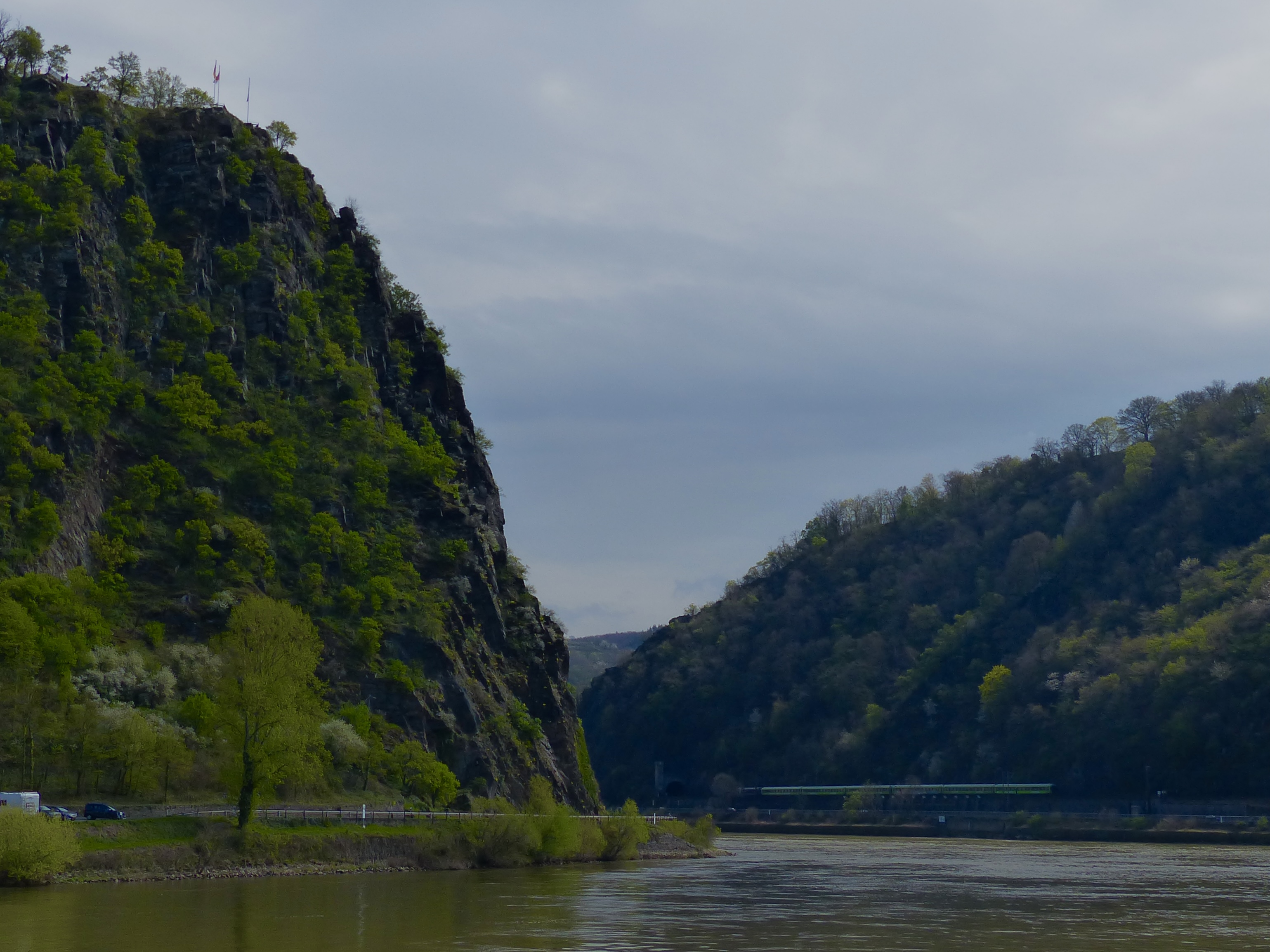
The stretch of the Rhine between Koblenz and Miltenberg is a highlight of the trip. For more than two hours of steady cruising the Rhine squeezes between forested hills broken by outcroppings of ruddy granite. Where the land slopes to gentle bottomlands there are charming villages. Vineyards climb up steep terraces. Orderly caravan parks expand the local population in riverside fields while every picture-worth building seems to be a hotel. At one dramatic point, the Lorelei Rock, the river here is particularly narrow, deep, and … before modern navigation aids … dangerous. Winds around the rock murmur and sigh, and the area is laden with legends.

Whether cruising or staying, visitors undoubtably enjoy the pastoral views, but it’s the castles that pull people in. It seems like a new one comes into view each time an old one disappears to your stern. And there’s a reason for that. The owners of these castles maintained commerce on the river. You can think of them as servants of the people or owners of a brutal protection racket, but whichever way you fall you’ll admit the architecture of their fortresses makes this a special part of the world. 

Ironically, most were just mouldering ruins until the 19th century, when the Romantic movement coincided with all those German states jockeying for power in a Germany on its way to unification. They look like something out of storybooks because that’s the way they were designed. At their most picturesque there are castles on the heights and at the riverside, presumably once working together. The most picturesque is Burg Pflazgrafenstein on an island in the river with Burg Gutenfels looming above. 

The lower could be a jewelled charm in a medical monarch’s cabinet of wonders; the upper is the kind of brooding ruin worthy of gothic horror.  The progression of castles on this stretch runs the gamut in between. Unsurprisingly, many now operate as luxury hotels. If you live in Europe, we’ve realised you could book into one of those hotels for a long weekend, take a day cruise and re-create this part of our journey fairly easily.

BAROQUE PALACES

Catholic Germany had a tradition of strong prince bishops who had both secular and religious authority and a taste for grandiose architecture. While they rolled out lavish Baroque architecture in their churches to assert the appeal of their religion over dour, ascetic Protestantism, they used the architectural style at home to demonstrate their political heft. Just like Louis XIV, father of the movement, they equated architecture with power.

The biggest of these examples in the first week is the episcopal palace in Wurzburg, a hefty block of golden stone that would make the French king feel at home. These places have a pattern across Germany: a porte cochere that allows carriages to unload their passengers at the bottom of a grand staircase. 

Shallow treads ascend to a landing, divide and continue up on either side. Statuary ornaments the railings, there’ll normally be some massive architectural statement on the landing and it will all be covered with a tromp l’oeil ceiling full of Greco-Roman deities frolicking their way across the heavens. Wurzburg looks like all the rest, with the exception that its ceiling is by Tiepolo so far better than most. A series of state rooms always follows, dripping with ornamental plaster work. Wurzburg is unusual in its embedding of mirror fragments into the swirls of the plaster, no doubt adding an exceptional glow to candlelit events. The best site here is a mirrored room, larger than these things usually are and unusual in that the mirrors are over-painted with scrolls and scenes. What you see today is a post-war recreation of what was destroyed by WWII bombs; even in modern incarnation it’s magnificent but a bit too much to live with.

Grand as Wurzburg is, I far preferred the smaller palace, its accompanying hunting lodge and the grotto-style chapel at Brühl. 

They’re all the creation of Clemens Augustus of Wittelsbach, a young man who had no interest in the church … he was forced in by his power-seeking family … but a great passion for hunting and showing off. The lodge, Falkenlust, celebrates falconry in its interior decor, complete with a blue-and-white tiled staircase hall with hand-painted tiles showing stages of his birds’ lives. Blue and while tiles (the Wittelsbach family colours) also clothe a delightful dining room in the main palace. 

The mirrored room in the lodge, though only a fragment of the size of the Wurzburg room, is much nicer, and more traditional with its writhing gilded wooden frames with little plinths occupied by china birds.

Back at the main palace, the artists behind the staircase might not be as famous as in Wurzburg, but I found the colours fresher and the architecture … complete with giant figures holding up the columns … altogether lighter and more fun than other examples. The chapel, created as a fashionable shell grotto in the ever-present blue and white, has the same effervescence. August Clemens was doubtless a terrible representative of the Catholic Church but as a builder and part host, he was my kind of guy.


WINDMILLS

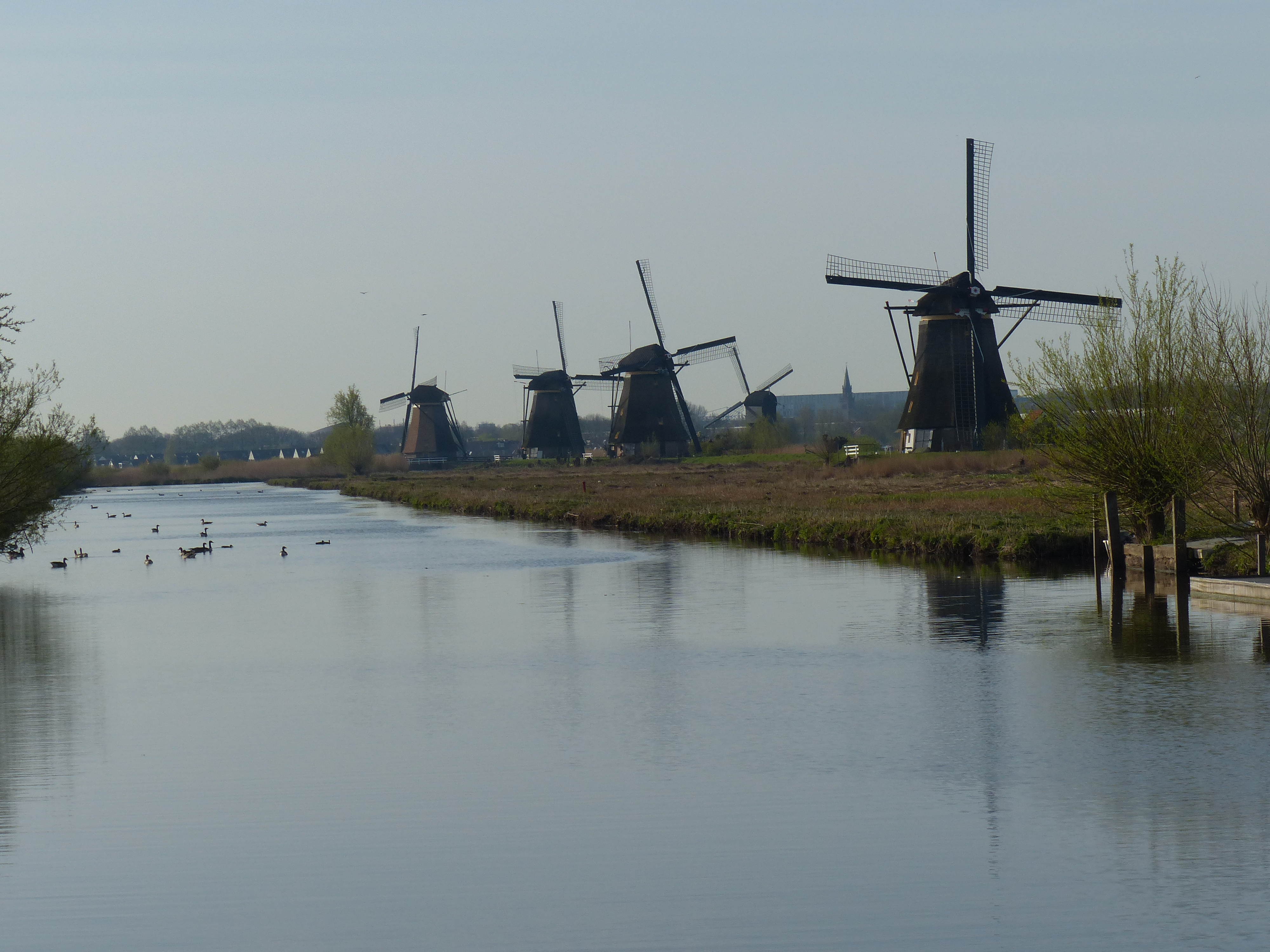
This falls into one of those pleasant surprises. Never in 20+ years of regular visits to Amsterdam has it ever occurred to me to travel to the windmills at Kinderdijk. I’ve been to individual Dutch windmills. I’ve seen them in the landscape. We have similar in Norfolk. What’s the big deal?

Well … UNESCO knows what they’re doing when they hand out those World Heritage Site designations. Kinderdijk isn’t just a bunch of windmills. It’s the largest concentration of these historic buildings … 19 from the 18th century or before … in the world, and demonstrates a unique ecosystem. The mills pumped water from one holding area to another, ever upward and to the sea. The “polder” is the cleared area left behind; a peat-rich, below-sea-level area of rich, green fields perfect for dairy farming. Windmills in such profusion are remarkably picturesque, and worth the visit to see whether you’re on a ship or in Amsterdam.


 * Viking runs this itinerary back and forth all season. If you start in Budapest, then what’s described here will be week one