The tour my husband and I took with her last year (described here) opened our eyes to the charisma of a city we hadn't yet warmed to. Having spent an evening following Marta around town, I was certain she had the depth of knowledge, sense of fun and appreciation of the good things in life to match our girls' trip style. One of the cornerstones of our trips has become investing in private guides; split between the four of us they turn an invaluable investment into memorable experiences.
Though she's a guide to all aspects of life in and history of Granada, Marta's specialist subject is food and drink. Her tours include consuming a variety along the way, covered in their price. The idea: understanding what people put on their table helps you truly understand a culture. It's certainly true of Granada's mash-up of cultures, wrapped up in pork-eating protestations of Catholic faith. (Neither Jews nor Muslims eat pork thus, Lord Inquisitor, if I'm eating it daily I must be on the right side of God. So please don't arrest me.)
 We arranged two half-day tours with Marta. The first wound us through the Albaicin to cover the town's ancient and medieval history; seven centuries of Romans and another seven of Moors before Ferdinand and Isabella incorporated the region into a united, Catholic Spain by conquest. The second was a morning in the lower town exploring history since that Reconquista and accumulating enough snacks to banish any need for lunch. Together, they covered most of the history and cultural highlights I wrote about last year; I'll let you read the basics here rather than covering them again.
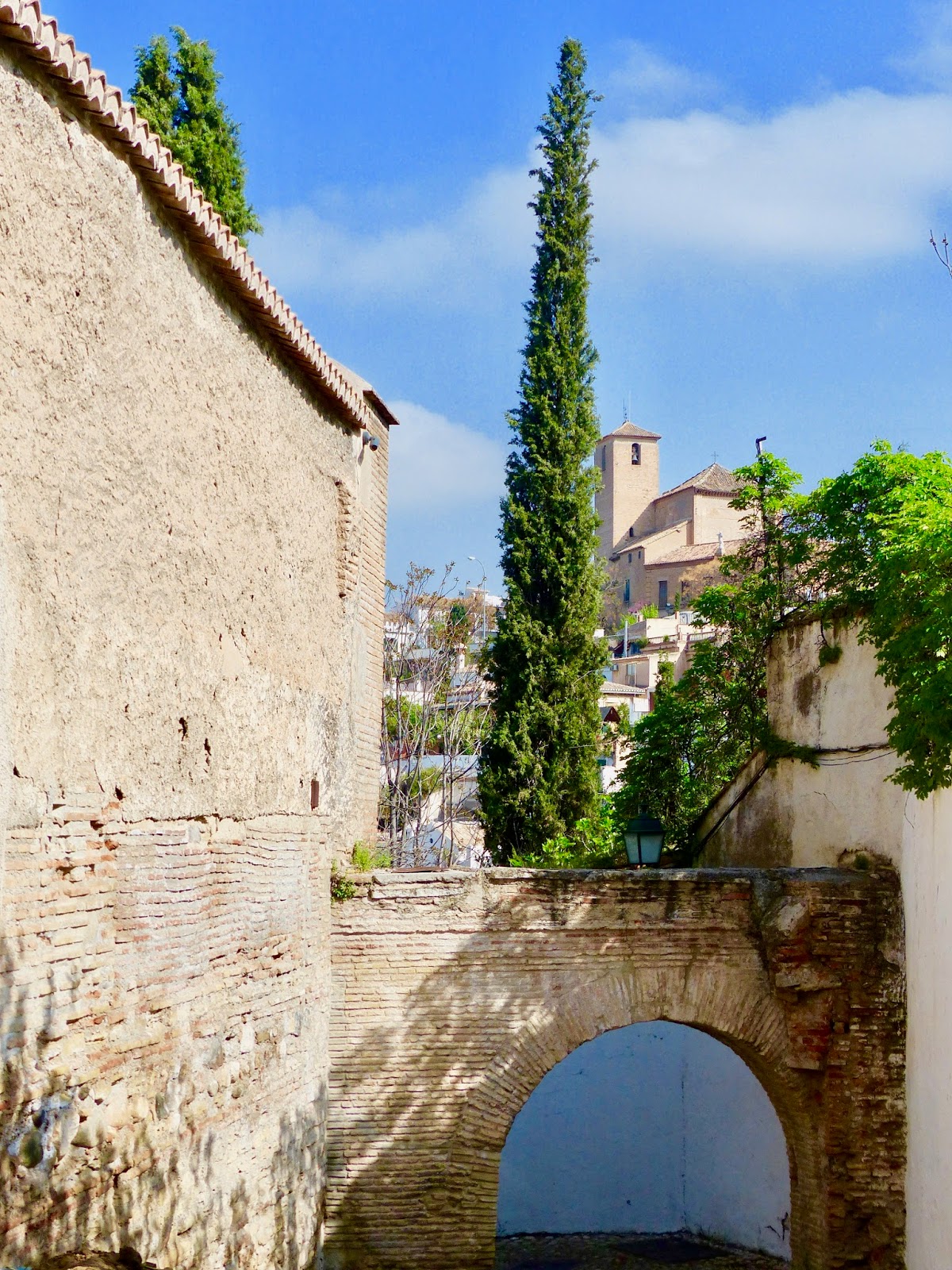
Having a local guide in the Albaicin meant cutting up the hill through quiet, narrow lanes rather than jammed tourist tracks. We appreciated dozy courtyards, historic facades and almost-empty plazas from which to snap photos of the Alhambra on its hill across the Darro river valley below. Marta brought us up to the Plaza Aliatar, the Plaza Larga and a network of bustling lanes between filled with intriguing shops and restaurants. I thought I'd explored the Albaicin thoroughly last year, but this section ... though only a stone's throw from the blockbuster site of the Palacio Dar al-Horra, had completely evaded my discovery. Not returning here for a leisurely wander was probably the greatest regret of our trip, but we simply ran out of time.
Winding through the Albaicin in this way means you come out onto the scenic overlook of the Placeta Cristo de las Azuzenas and the Mirador de Santa Isabel la Real (essentially giant stair-steps of public plazas coming down the crest of the hill) from the back, through narrow lanes with short perspectives, and are completely surprised by the magnificent vista suddenly spread before you. The Alhambra in all its glory, the snow-capped mountains behind it, the city sloping down to miles of fertile valley before more mountains contain the scene. As urban vistas go, there are few better.
This area is full of bars and restaurants obviously convenient for tourists. But the reason you book Marta is to find something more local. Winding down a few lanes brought us to the Balcón de San Nicolás. Just four metres above us, scores of tourists crowded against the top of a wall to watch sunset over the Alhambra from the famous viewpoint of the Mirador de San Nicolás. We had the exact same view, but from a quiet, covered patio shared with gently-murmuring people "in the know" and looked after by an attentive staff.
 Whether the bartenders always pour such strong gin and tonics or if you have to be a friend of Marta's I can't tell you, but I will say we could have happily sat here all night and had some regrets that we'd booked pre-booked dinner elsewhere. But we needed to keep moving and let Marta go home, since another big day of sightseeing, food and drink followed.
The next day, at a hangover-friendly 10:30 (another benefit of private guides being the ability to set your own schedule) we started chatting about the Reconquista, Columbus' discovery of the new world and the fabulous fusion of styles and flavours those things brought together under the statue of the explorer and Queen Isabella. Then it was off to Pasteleria Lopez-Mezquita for second breakfast.
It was a delight to learn that Tolkein's hobbits aren't the only characters in love with this extra morning meal. Likely to have started their day with just a quick coffee and small bite, the people of Granada traditionally take a break at mid-morning to enjoy a more leisurely café con leche with a pastry and some civilised conversation. We can vouch for the veracity of this tale, since we returned to Lopez-Mezquita every morning for the rest of our trip. From its wooden panelling, marble and brass to its grand dames and waiters who look (and perform) like they've been behind the counter since Franco was in charge, this place screams venerable institution. Despite the fact that it's on the main tourist flight path, you'll hear few foreign accents. It can be a bit intimidating without local knowledge and the ability to speak Spanish, but dive in, point at what you want and enjoy. You won't regret it.
 Marta introduced us to two local specialities here. Piononos are little rolls of sponge cake, soaked in a faintly alcoholic syrup, topped with a cap of flame-toasted custard (above left). They're supposed to evoke papal costume, and were originally made to commemorate a visit of Pius IX to Granada. I found the pastela moruna more intriguing. Light, sweet pastry filled with stewed chicken and dusted with confectioner's sugar, these have the classic sweet/savoury combo so typical of Arab cooking and are a lighter, sweeter version of Moroccan pastilla (above right). The Arab/European cross-over in Granada frequently reminds me of Sicily. Another delicacy Marta introduced us to the day before, pestiños, are like thick, unfilled cannoli shells.
After a bit of strolling around the Plaza de Bib Rambla (where Inquisitors were once happy to incinerate Moorish descendants suspected of religious backsliding, even while stealing their pastry recipes) we transitioned solidly from sweet to savoury at a tiny grocer specialising in jamon. There we learned, and tasted, the difference between the standard and the more prized Iberico (also called pata negra or black leg; they're all the same) before meandering on to the Mercado San Agustin. While not as comprehensive or as gourmet as Barcelona's famous Boqueria, this has the same delightful mix of proper local market and buzzing spot for casual dining.
 Having circled the cathedral and heard stories of the Catholic monarchs and its dramatic construction, and popped briefly into the cultural centre where we checked out some dramatic Moorish interiors, then stopped for a drink in a classic, bustling bar near Plaza Nueva. Bodegas Casteneda is well known for its home-made vermu. This is not the vermouth you put into martinis but a sweet, herbal mixture that's a bit like a highly-alcoholic, but not-as-sugary-as cola.
It's worth noting that, once you dip into the alcoholic drinks, Granada is one of the few cities in Spain that still follows the original tradition of a free tapa with each round. Here it was a plate of paella. Bonuses at other places included a mound of fried potatoes with slices of roast pork, croquettes and a pile of fried squid. These are usually generously-proportioned snacks that stretch the budget and can stand in for dinner if you bar hop across an evening. (Perhaps one of the reasons we saw no public drunkenness despite throngs of young Spaniards across the weekend. I can't imagine the same when combining Brits and cheap beer.)
Then it was time to head for a different neighbourhood. One that would become our regular evening haunt for the rest of the trip. The Calle Virgen del Rosario is a three-block lane packed with trendy bars and restaurants. On a Saturday afternoon it was heaving with locals of all ages, and liberally laced with Spanish hen dos. These are not the brazen, intoxicated raves of the British version, but almost charmingly innocent packs of girls in matching costume ... Minnie Mouse is popular ... who break into the occasional group dance routine.
 Our objective was Taberna La Tana, a small but perfectly-formed wine bar once lauded by
American celebrity chef and food pundit Anthony Bourdain. This place is a gem. Towering shelves packed with beguiling varieties of Spanish wines, a dark and mellow interior and a landlady who looks like she's just stepped out of a Caravaggio painting. Though you'll hear foreign voices it's mostly Spanish-speakers here, catered for by substantial regional tapas that are not for the faint hearted: scoops of home-made black pudding, lightly-grilled fresh sardines on thick slabs of bread and the simply glory of locally grown tomatoes bursting with acidic punch. We would have come back every night left to us, but they close on Sundays. I wouldn't visit Granada without a return here. I might even book my holiday accommodation to be near it.
La Tana is the kind of place I'd be unlikely to find without a local guide. And we would have been unlikely to develop the confidence to plunge into similar places without Marta's coaching on the local form. After she left us, we honed our skills around town for the rest of the trip. Check out my next entry for the best dining and drinking spots we went to without our trusty escort.
Marta's company is called Bite Granada. Follow or contact them via Facebook and Instagram.
 We arranged two half-day tours with Marta. The first wound us through the Albaicin to cover the town's ancient and medieval history; seven centuries of Romans and another seven of Moors before Ferdinand and Isabella incorporated the region into a united, Catholic Spain by conquest. The second was a morning in the lower town exploring history since that Reconquista and accumulating enough snacks to banish any need for lunch. Together, they covered most of the history and cultural highlights I wrote about last year; I'll let you read the basics here rather than covering them again.
Having a local guide in the Albaicin meant cutting up the hill through quiet, narrow lanes rather than jammed tourist tracks. We appreciated dozy courtyards, historic facades and almost-empty plazas from which to snap photos of the Alhambra on its hill across the Darro river valley below. Marta brought us up to the Plaza Aliatar, the Plaza Larga and a network of bustling lanes between filled with intriguing shops and restaurants. I thought I'd explored the Albaicin thoroughly last year, but this section ... though only a stone's throw from the blockbuster site of the Palacio Dar al-Horra, had completely evaded my discovery. Not returning here for a leisurely wander was probably the greatest regret of our trip, but we simply ran out of time.
Winding through the Albaicin in this way means you come out onto the scenic overlook of the Placeta Cristo de las Azuzenas and the Mirador de Santa Isabel la Real (essentially giant stair-steps of public plazas coming down the crest of the hill) from the back, through narrow lanes with short perspectives, and are completely surprised by the magnificent vista suddenly spread before you. The Alhambra in all its glory, the snow-capped mountains behind it, the city sloping down to miles of fertile valley before more mountains contain the scene. As urban vistas go, there are few better.
This area is full of bars and restaurants obviously convenient for tourists. But the reason you book Marta is to find something more local. Winding down a few lanes brought us to the Balcón de San Nicolás. Just four metres above us, scores of tourists crowded against the top of a wall to watch sunset over the Alhambra from the famous viewpoint of the Mirador de San Nicolás. We had the exact same view, but from a quiet, covered patio shared with gently-murmuring people "in the know" and looked after by an attentive staff.

The next day, at a hangover-friendly 10:30 (another benefit of private guides being the ability to set your own schedule) we started chatting about the Reconquista, Columbus' discovery of the new world and the fabulous fusion of styles and flavours those things brought together under the statue of the explorer and Queen Isabella. Then it was off to Pasteleria Lopez-Mezquita for second breakfast.
It was a delight to learn that Tolkein's hobbits aren't the only characters in love with this extra morning meal. Likely to have started their day with just a quick coffee and small bite, the people of Granada traditionally take a break at mid-morning to enjoy a more leisurely café con leche with a pastry and some civilised conversation. We can vouch for the veracity of this tale, since we returned to Lopez-Mezquita every morning for the rest of our trip. From its wooden panelling, marble and brass to its grand dames and waiters who look (and perform) like they've been behind the counter since Franco was in charge, this place screams venerable institution. Despite the fact that it's on the main tourist flight path, you'll hear few foreign accents. It can be a bit intimidating without local knowledge and the ability to speak Spanish, but dive in, point at what you want and enjoy. You won't regret it.

After a bit of strolling around the Plaza de Bib Rambla (where Inquisitors were once happy to incinerate Moorish descendants suspected of religious backsliding, even while stealing their pastry recipes) we transitioned solidly from sweet to savoury at a tiny grocer specialising in jamon. There we learned, and tasted, the difference between the standard and the more prized Iberico (also called pata negra or black leg; they're all the same) before meandering on to the Mercado San Agustin. While not as comprehensive or as gourmet as Barcelona's famous Boqueria, this has the same delightful mix of proper local market and buzzing spot for casual dining.

It's worth noting that, once you dip into the alcoholic drinks, Granada is one of the few cities in Spain that still follows the original tradition of a free tapa with each round. Here it was a plate of paella. Bonuses at other places included a mound of fried potatoes with slices of roast pork, croquettes and a pile of fried squid. These are usually generously-proportioned snacks that stretch the budget and can stand in for dinner if you bar hop across an evening. (Perhaps one of the reasons we saw no public drunkenness despite throngs of young Spaniards across the weekend. I can't imagine the same when combining Brits and cheap beer.)
Then it was time to head for a different neighbourhood. One that would become our regular evening haunt for the rest of the trip. The Calle Virgen del Rosario is a three-block lane packed with trendy bars and restaurants. On a Saturday afternoon it was heaving with locals of all ages, and liberally laced with Spanish hen dos. These are not the brazen, intoxicated raves of the British version, but almost charmingly innocent packs of girls in matching costume ... Minnie Mouse is popular ... who break into the occasional group dance routine.
 Our objective was Taberna La Tana, a small but perfectly-formed wine bar once lauded by
American celebrity chef and food pundit Anthony Bourdain. This place is a gem. Towering shelves packed with beguiling varieties of Spanish wines, a dark and mellow interior and a landlady who looks like she's just stepped out of a Caravaggio painting. Though you'll hear foreign voices it's mostly Spanish-speakers here, catered for by substantial regional tapas that are not for the faint hearted: scoops of home-made black pudding, lightly-grilled fresh sardines on thick slabs of bread and the simply glory of locally grown tomatoes bursting with acidic punch. We would have come back every night left to us, but they close on Sundays. I wouldn't visit Granada without a return here. I might even book my holiday accommodation to be near it.
La Tana is the kind of place I'd be unlikely to find without a local guide. And we would have been unlikely to develop the confidence to plunge into similar places without Marta's coaching on the local form. After she left us, we honed our skills around town for the rest of the trip. Check out my next entry for the best dining and drinking spots we went to without our trusty escort.
Marta's company is called Bite Granada. Follow or contact them via Facebook and Instagram.