Showing posts with label Granada. Show all posts

Monday, 8 April 2019

Hammam al Andalus plunges you into hot water and Arabian Nights

Some spas are memorable for the quality of their treatments or the skill of their therapists. Others celebrate their link to a luxury brand. Some stand out for their unique locations, while others tout the source and health-giving qualities of their water. Most, these days, strive for luxury. But none, in my experience, does atmosphere like the Hammam al Andalus in Granada.

If Disney ran a spa inside an Aladdin-themed hotel, it would be like this. Except more crowded. By my count the Hammam limits each two-hour slot to about 30 people, meaning that while you're sharing the baths with others it never feels jammed (except in the changing rooms) and you have a fair chance of finding yourself alone occasionally in any of the four pools. (Photos borrowed from their web site.)

The Arabs were just as mad about bathing for cleanliness and pleasure as the Romans, building opulent, heated aquatic complexes in most of their cities. The Hammam presents itself as a luxurious bath from the time the Nasrids were living in their opulent palace on the hilltop immediately above. This isn't an original complex (it was a restaurant just a few years ago) but if your sightseeing took you to the medieval baths in either the Alhambra or the Albaicin you'll appreciate how carefully they've copied the original here. Opulent tiles cover the lower walls, plaster panels of intricate arabesques the upper. There are romantic scalloped arches, hammered silver tea sets laid out for your refreshment and those distinctive star-shaped openings punched through the ceilings and lit to give you the impression of sunlight filtering in, even though there's a building above you.

There are four different baths laid out along a corridor: One cold, two piping hot and the largest comfortable as a warm bathtub. On a floorpan this would look like a boring string of rooms along a single corridor, but they've used narrow archways, decorative columns, and pierced-metal lanterns make it into a mysterious warren. One of the hot pools is long and narrow, like an ornamental reflecting pool in a garden, and only about 16 inches deep; perfect for stretching out with your head on the lip and getting comatose. The other a much deeper rectangle with another, smaller rectangle leading off it. The smaller rectangle is shallower and has a screen at the back from which hot water appears to flow from the living rock. Sitting in the main rectangle, a tower stretches up at least three times the depth of the pool and is encrusted with ornate decoration to contemplate as you soak.

Health and safety regulations are clearly different here. My regular spa in the UK won't heat the water to these temperatures, in case bathers are too stupid to get out in time to protect their health. A good deal of the atmosphere comes from lighting far dimmer than any I suspect would be allowed in the UK, exacerbated by large groupings of flickering candles and mist that I'm fairly sure was occasionally pumped in. A gentle, Moorish take on spa music plays softly. You've definitely sunk into a world of exotic harems and Arabian Nights.

The largest pool was about the size of one you'd find in a domestic garden, but had columns springing out of it a bit like the famous cisterns in Istanbul.
So even with a larger group of people here, you could float into a dark corner behind a column and be lulled by the sound of water trickling in from a fountain in the wall. Talking is discouraged; this place is all about quiet contemplation. There's a steam room and sauna behind this which I didn't check out. (After thirty years of surviving St. Louis summers I've never been able to grasp the point of intentionally making yourself hot and sticky.)

Steps lead down from this main pool to another corridor forming the bottom of an "L" with the one that runs along the pools. Down here you'll find showers, a series of alcoves where therapists deliver treatments and a square room at the end where people can lie on marble slabs around another fountain post massage. I just went for the pool time (about £35 for two hours) but reports back on the massage indicate I missed a good one.

The two-hour time limit and the request for near-total silence are both unusual for a spa, but essential given the size of the place and the desire to maintain the atmosphere. And there's no wiggle room on that time. If you book for 10 am, that's your entire slot from check in to departure, including your time in the changing room. Get there 10-15 minutes early so check in doesn't eat into your pool time, and you'll be able to enjoy some tea in the spa's beautiful atrium before being escorted to the changing rooms. Then don't dawdle; get into your swimming costume and get to what you've paid for. If you're just doing the pools, two hours is an ample time slot. If you have a massage as well, you might find the pool lounging time a bit curtailed. The joy of these short slots is that they fit easily as a break in a longer day of sightseeing. The Hammam even offers sessions at 10 pm and midnight, for the real night owls.

With their limited capacity, I got the impression that most sessions are sold out. Pre-booking on their web site is essential, particularly for any treatments. There's no sense playing a guessing game over which days and times would be less crowded, because they're all pretty much the same. Just pick what's best for you. On a return visit, I might go for the 4pm siesta slot. Relax, re-energise and clean up before discovering more of Granada's wonderful bars and restaurants.


Friday, 5 April 2019

Dazzling Cartuja is Granada's hidden gem (and crowd-free)

The combination of anguish and triumphalism in the art of Catholic Spain always leaves me uncomfortable in the country's churches.

I find it neither surprising nor alien ... I am, after all, the product of 14-years of convent education ... but it’s still disturbing. The gory martyrdoms, wailing virgins and brooding colour schemes speak of a faith that’s all about guilt and pain. The ridiculous amounts of gold and silver are, to anyone moderately familiar with history, a reminder of the rape of the Americas. The infidels being vanquished beneath the swords, spears and hooves of the Reconquista make me think of the outsiders who went to their deaths on the bonfires of the Inquisition, and wonder if our current battles with Islamic fundamentalism would be quite so bad had the Spanish Catholics been more gracious in victory.

That’s why I find Granada’s cathedral and, to a lesser extent, its famous royal tombs, difficult to love. And why, surprisingly, I discovered my favourite post-Reconquista sight in the city’s Carthusian monastery (photo above). Both are masterpieces that deserve a visit, but neither should be approached lightly.

The cathedral was a monumental political statement from its inception. The conquering Catholics tore down the city's main mosque and covered it with this. Considering the wonders of the palaces of the Alhambra and the mosque-turned-cathedral in Cordoba, I shudder to imagine the beauty destroyed to make a political statement. It might have been worth it had the replacement been better, but Granada's cathedral is more concerned with power than aesthetics. The front is a triple triumphal arch, squat, graceless and far too heavy for the space it occupies. Inside, the white interior and the vaults decorated with swirls of tracery could be delicate, were it not for the disproportionate supporting columns. These things are huge bundles of columns that block views and dominate the scene. Was it intentional that they reminded me most of the fasces, the bundle of rods that indicated a magistrate's power in ancient Rome and has often been used as a symbol for domination?

I've never seen anything quite like the space behind and above the high altar. Circular galleries rise in successive stories, showing off paintings of saints and martyrs. Interesting as an art gallery, but it didn't really work for me in a sacred space. The altar itself was dominated by a solid silver tabernacle almost the size of a garden folly. A lovely classical temple beneath which crouching angels held up the container for the host. In a simpler environment it would have been the masterpiece around which the whole church was built; here it was almost lost amidst visual shouting from all the competing elements. The compulsory religious gore included a life-sized, anatomically perfect, recently removed head of St. John the Baptist bleeding out onto a silver platter, and a shrine of Santiago de Compostela with the saint ... live-sized again ... in combat armour on horseback, his steed about to kill the Muslim knight below with a hoof to the throat. (How Saint James, a Judean who died soon after Jesus, ended up dressed for and involved in a 15th century battle is one of those inexplicable mysteries of Catholicism.)

There are, naturally, little moments of magnificence throughout. In front of the altar there's a twin pair of organs built between columns, facing each other over the main aisle. They're white and gold, light and festive, and I'd love to hear them duel it out. A monumental door frame capped with Moorish-style woodwork nods to history. In the ambulatory (the semi-circular aisle fringed with side altars that circles the main altar and forms the back of the church) glass cases display exquisite illuminated manuscripts. And one side altar, a baroque symphony of rose, black and white marble with a poignant, but not gruesome, pieta is the best thing in the cathedral.
The royal tombs next door are a more satisfying ensemble, thanks to their earlier Gothic architecture, though they still have their frightening martyrdoms. (Don't miss Saint Vitus placidly enduring his boiling cauldron.) You can read what I wrote about them last year here. The cathedral and the tombs cost £5 each; if strapped for time or cash prioritise the tombs. But if you're really working to a short list, skip them both and head to the Cartuja de Granada.

One of the girls on the trip had a hot tip from people who used to live here that this was the most amazing thing in town and must be seen. How could it be, if none of us had ever heard of it? But our sources were quite passionate in their endorsement, so we hopped a taxi and investigated. Initial impressions were underwhelming.

The church sits in a commanding position on a hillside, its architecture stolid and a bit grim. (The view from the plaza outside the front door, however, is remarkable.) You'll start in the cloisters. Standard layout, minimal decoration, basic garden with some pretty patterned pavements. In to the refectories; long, plain white halls with gracious Gothic vaults where monks (in one hall) and affiliated lay brothers (in another) would eat a basic meal without conversation while they listened to scripture and contemplated paintings of martyrs. It appeared there was no escaping. The set of canvasses on English martyrs in the monk's hall was particularly horrific. Who knew Henry VIII and Cromwell had tortured with such creativity? There are priests being dragged behind teams of horses, taking axes in the head, having their hearts ripped out and in one particularly gruesome scene, being hung from a tree and butchered into halves like a pig. All this in the dining room. While it does put the Anglo-Hispanic tensions of the 16th and 17th centuries in context, it's hard going. I was afraid the horror show would continue in the church, but there things quickly started to improve.

The nave is a festival of white with gold accents, three-dimensional with statues, ornate plaster cornices and foliate decoration. It's like a wedding cake turned inside-out, designed on a religious theme. A painting of Mary triumphant over an intricately-carved wooden door starts to add colour, and there's more in the choir screen. It's a pastiche of paintings, multi-coloured marble, gold and a striking pair of wooden doors in the geometric inlay that is the Granada style. You get a peek at an even more ornate high altar through them. Had we been visitors to an active monastery, this is as close as we would get. But old divisions don't exist for tourists.

Once in the choir you can fully appreciate the explosion into the fantastical that is the high altar. A life-sized-Mary rules the heavens from her perch on the crescent moon, framed by barley-twist gold columns inset with lozenges of crystal to add a star-like glimmer. Putti frolic everywhere. The ornate decoration on the walls above and beside her, rather than the white of the rest of the church, is now drenched in cheerful pastels. Directly behind her is a wall of glass ... is it mirrors? ... that adds to the glitter. This is the 17th century equivalent of coming out of the dark into a room of strobe lights. Everything is intended to dazzle you into a state of awe.

Just off to the left, you'll find the sacristy, where sacred vestments were stored and priests got dressed for mass. It's big and ornate enough to be a church in its own right, and the decoration is so opulent it takes your brain some time to process it. Every white plaster column is encrusted with swirls, curlicues, flares and pinnacles.  The ceiling writhes with decorated coffers and swags of flowers. The crazy density of the decoration reminded me of a Hindu temple though, looking closer to home, one suspected these artisans were trying to meet and out-do the effect of the Halls of the Two Sisters and the Abencerrajes in the Nasrid Palaces.
And this is all just background. Add multi-coloured inlaid marble cladding to the first five feet of the room, then extend it up into a complex masterpiece of an altar. Add a few paintings on the walls, and a dome above the altar painted with a heavenly scene. Then, just to make sure there are no undecorated spaces, bring in more geometric inlay to cover the chests where you keep the robes (a masterpiece on their own), and the doors in and out. The only plain thing in the room is the glass in the mirrors above the chests, angled down to help the priests' dress. But, of course, they just reflect the surroundings.

Neither altar or sacristy, however, are the most magnificent part of this place. Move behind the altar to check out that wall of glass. They aren't mirrors, but clear, beveled panes that have refracted and broadcast the magnificence of what stands behind. All churches have a tabernacle to house the communion bread and wine, usually a model of a temple sat on the high altar. Here, the tabernacle has its own chapel. And it's a blockbuster.

It's a testament to the marble-worker's art; a score of different colours and patterns carved into exuberant shapes and fitted together seamlessly. There's a heavenly host of near life-sized saints and angels. No martyrdoms depicted here (though there are martyrs); everyone is in a mood of joyous celebration. Gold encrusts frames and column capitals. Fat putti dart in and out of every decorative element. The dome and pendentives above are painted in a blaze of yellows, pinks and blues, inviting you to a heaven of eternal joy and sunlight. Ironically, only Saint Bruno, the founder of the Carthusian order, looks unhappy in the heavenly scene. It's as if all the happiness is too much for him.

This room is on par with the greatest masterpieces of Baroque art and reminds me most of the joyous madness of the Asamkirche in Munich, my favourite thing in that whole city. It is awesome, in its original awe-inspiring, knock-you-to-your knees meaning.

The Cartuja is likely to strike the modern mind as a monument to hypocrisy. How unfair that the common folk and lesser monks lived on a diet of martyrdom, fear and inferior decorative schemes, while the guys in charge got to get close to, and enter, some of the most beautiful rooms in the city? How could they preach a life of austerity, yet build this for themselves? This is where Catholic education becomes useful, because it all makes perfect sense to me.

The architecture is a metaphor for life. The outer bits are our everyday striving. The closer we get to the altar, the closer we are to heaven. In a religion that believes literally that the consecrated bread and wine is the body and blood of Jesus, the tabernacle becomes the space where God lives. That chapel is, literally, heaven. The artists and architects who built it were doing their best to bring it to life on earth, and to give anyone who saw it a taste of the reward they were working for. This is what the Baroque movement was all about. And why I'd never make it as a protestant.

Wednesday, 3 April 2019

Homey private dining and other top picks for Granada restaurants

I’ve seen lots in the media about the trend of pop-up restaurants and private dining, but hadn’t tried it myself until Granada. If Francisco Lillo Roldán is anything to go by, this is definitely an option worth searching out when visiting a new place.

Francisco cooks and serves out of a building along the Calle Virgin del Rosario, just across from the noteworthy La Tana wine bar. (We were introduced to both by Marta Sanchez of Bite Granada.) La Oliva’s sign suggests a public venue, and its interior tells the tale of a former olive oil shop, but today it’s a very private domain. There are no menus, most of the views to the street are screened and you won’t get in without making arrangements in advance.

This is not a restaurant and Francisco is not a chef. Most of the food is assembled on a counter next to the table and the hot stuff comes off a burner closer to a camping stove than a professional range. Rather than getting formal, multi-layered courses ... for example a main of protein, starch, two veg and sauce on one plate ... you’ll get a progression of small dishes with just one thing in them. A single meatball with a bit of sauce. A generous spoon of the new season’s broad (fava) beans. There’s no high end presentation here. It’s the simple dishing up of the home cook.

And that’s the beauty of it. An evening at La Oliva feels like you’ve been invited into the home of a local who’s turning out his cupboards to give you as many tastes of local specialties as they’ll yield, all with running commentary.

You're a guest, and payment is simply a sordid little inconvenience at the end. And even that is unconventional. You’re presented with an envelope and invited to slip in whatever cash you feel would be appropriate for the evening. Francisco let us know in advance that the value of what he was serving would be at least €40 in a restaurant; what we left was up to us. Given that this was our last night in Spain, this was a better experience than our most expensive meal (e85 at Mirador de Morayma, discussed below), and we drank a lot of Francisco’s wine, we contributed far over his base cost.

I assume every evening will be different at La Oliva, depending on what’s in the market that day and how many people have booked in advance. There were five of us (the girls’ trip four plus one adventurous lone traveller) and the menu was surprisingly vegetal for Spain, reflecting the lush abundance of the local spring harvest. We’d lost count, and notes had become sketchy, by the time we were nursing our Pedro Ximénez, but photos attest to at least a dozen rounds of tasting flowing across the table before us. With wines starting with a dry sherry, progressing through white and rose before big reds and that final glass of sweet stuff. Abstemious diners should steer clear.

In line with tradition, we’d started with a range of charcuterie, olives, fresh bread and three types of olive oil. Francisco certainly knows his olive lore, explaining that there are 263 acknowledged varieties and so many different ways of preserving and pressing them that the variety of consumables to emerge at the end of the production process is almost infinite. Certainly the three oils he poured for dipping were radically different. Pigeon and mushroom pates followed.

As we started to move into first course territory, there was a pair of prawns on wilted spinach, a deliciously innovative mix of salt cod, radish and spring onion dolloped on orange slices and drizzled with olive oil, cod in saffron sauce and a dish of quickly pan-fried fresh asparagus tossed with olive oil, crushed almonds and lemon rind. I was so pleased to have the last; watching beautiful two-kilo bunches of pinkie-thick stalks being piled high in the markets earlier in the trip was the one time I'd had the urge to use our flat's kitchen. I will definitely be trying this flavour combo at home when English asparagus comes into season; in at least another month.

Next was a bit of tuna lightly fried with herbs, then a small bowl of chickpeas with onions and green
pepper in a few spoonfuls of broth, then broad beans with onions. If this had been a "proper" restaurant I'd have said too much repetition on the fish and the pulses, but in this environment it was instructive of what the locals would do with seasonal produce, so bring it on.  And if this is representative of what the Spanish eat at home, then it was far lighter on the meat than your average restaurant meal. Our only taste was the aforementioned meatball. Two simple sweets followed: a bowl of macerated strawberries and a plate of fried pastries and biscuits a bit like Italian cantucci. 

If you have only had one or two nights in Granada, I'd recommend a regular restaurant. But if you have more, this is a memorable alternative that gives you a distinctive local twist. Here are some other local dining options.

Mirador de Morayma Disappointing. My visit with my husband a year ago was magical, the service memorable and the food magnificent. It was almost a different restaurant this time. It took four contacts starting months in advance to get them to acknowledge my reservation (that should have been a clue), they didn't acknowledge me as anything but a walk-in despite the advance planning and my positive blog article, we were tucked in a poky upstairs room, the service was shoddy (the private event downstairs was clearly consuming all the attention), and we think we were probably charged for a bottle of wine we didn't consume (but recognised that we were tipsy enough that we didn't have the credibility to argue the bill. Most shocking was the emergence of two solomilio (beef tenderloin) well done when we'd asked for them medium rare. I didn't think it was even possible for a blood-loving Spaniard to cook meat that thoroughly. All we could think of is that they'd heard American accents and decided to cook meat the way they thought Americans liked to eat it. It's one of the few times in my life I've sent a dish back to the kitchen. It took so long for fresh steak to come out that the other half of our party had finished their mains, and though done properly this time it wasn't warm.

The starters had been much more successful, including a lush plate of jamon Iberico and wild boar croquetas. As it had been last year, the suckling pig was a triumph, and had we all gone for that we would have been happier diners. I'd still recommend Morayma, but only if you can sit in its romantic gardens with their incredible views, and only if you have the pig. 

La Vinoteca did manage to live up to last year's positive review. The almost-secret dining room behind the front bar still mixes classics and seasonal specials in a cool, modern interior. Plates edge towards fine dining presentation but at moderate prices. Squid, octopus and pork (below) were all memorable here, as was a decadent ... but totally un-Spanish ... chocolate brownie dessert. Good regional wine list.

Monje Taberna Espirituosa was an accidental find and a real delight. We'd been heading for the much-recommended Cunini fish restaurant, but even at 9:30 at night there was a 45 minute wait.  Espirituosa had one cozy table in the back corner, which we grabbed hungrily. This place has quite a modern vibe, with an open, airy decor that feels almost like someone's garden room. Plus tremendous  and very genial service from the very clued-in Jorge and Javier, who reminded us to fill out that Trip Advisor review even as they talked us through their menu. More beautiful Iberico and some classically grilled padron peppers, plus a chance to introduce the girls to the Granadan classic of fried aubergine with a drizzle of molasses. This is where we opted for the ubiquitous paella and we were rewarded with some of the best I've ever had, gorgeously presented and heavily studded with a variety of seafood including tiny crabs and a wealth of mini-marshmallow sized scallops. It broke our heart to send some back to the kitchen, but we were stuffed.
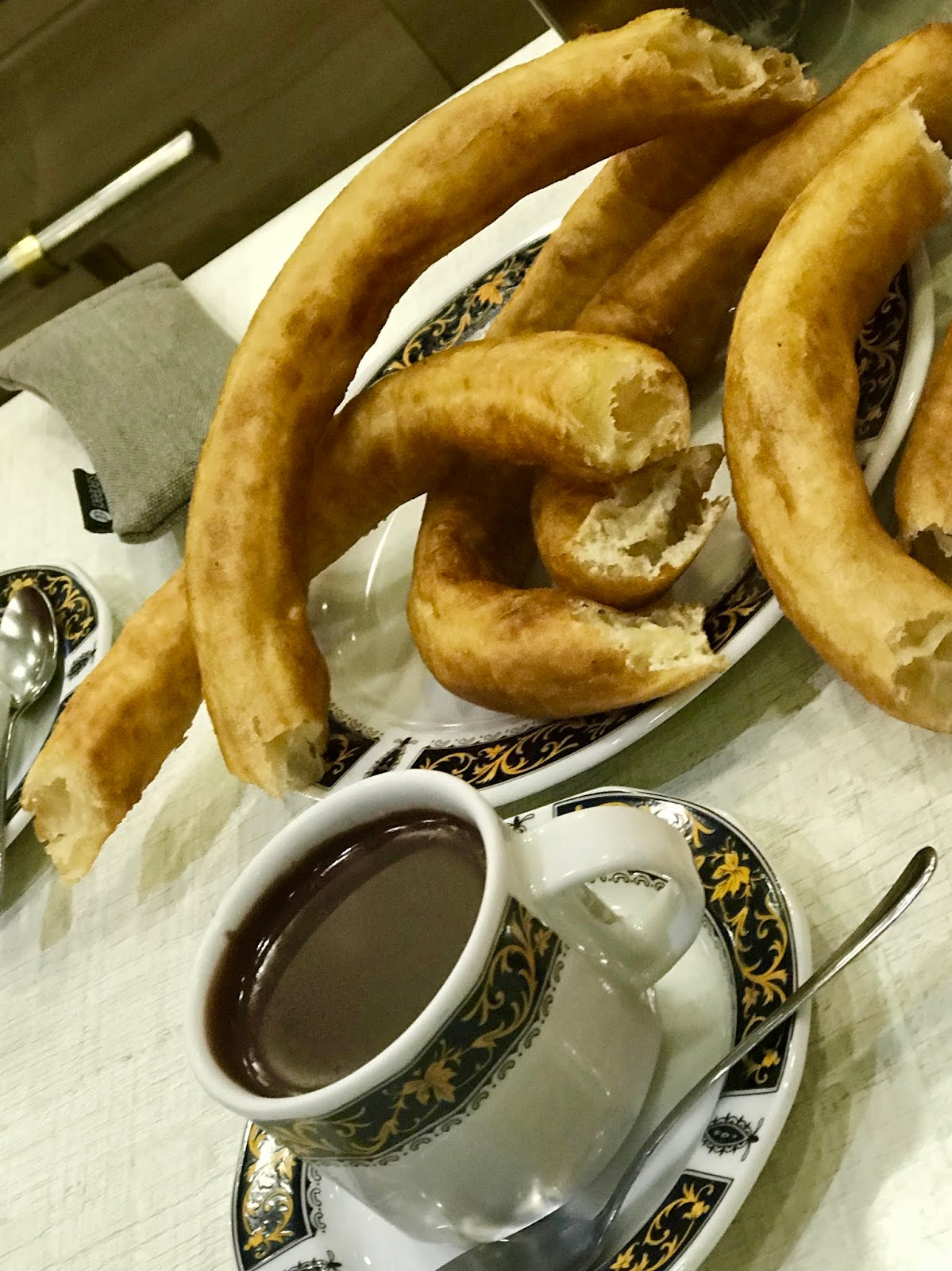
Churrería Alhambra Cafeteria Chocolatería proves that looks can be deceiving. This spot on the southwestern corner of the Bib Rambla looks about as touristy as it is possible to be, complete with "pizzeria" emblazoned on its awnings. But according to tour guide Marta Sanchez, they make the best churros in Granada. Naturally, we had to test that claim. And though we have no other Granadan examples for comparison, they were certainly the best any of us had ever had. Crisp, light, flavourful batons of fried dough, curving gently on the plate and served with a coffee cup of dark chocolate sauce. On its own, this chocolate was unpleasantly bitter. When used as a dip for the churros, however, the bitterness melds with the pastry's sweet to bring flavours into perfect balance. If we hadn't fallen so deeply in love with Pasteleria Lopez-Mezquita, we would have returned here for future breakfasts. So many pastry shops, so little time...


Monday, 1 April 2019

Through bites and sips, Granada shows off the glories of fusion

If my burning need to get inside the Nasrid Palace was my first reason for promoting Granada for the 2019 girls’ trip, Marta Sanchez was my second.

The tour my husband and I took with her last year (described here) opened our eyes to the charisma of a city we hadn't yet warmed to. Having spent an evening following Marta around town, I was certain she had the depth of knowledge, sense of fun and appreciation of the good things in life to match our girls' trip style. One of the cornerstones of our trips has become investing in private guides; split between the four of us they turn an invaluable investment into memorable experiences. 

Though she's a guide to all aspects of life in and history of Granada, Marta's specialist subject is food and drink. Her tours include consuming a variety along the way, covered in their price. The idea: understanding what people put on their table helps you truly understand a culture. It's certainly true of Granada's mash-up of cultures, wrapped up in pork-eating protestations of Catholic faith. (Neither Jews nor Muslims eat pork thus, Lord Inquisitor, if I'm eating it daily I must be on the right side of God. So please don't arrest me.)

We arranged two half-day tours with Marta. The first wound us through the Albaicin to cover the town's ancient and medieval history; seven centuries of Romans and another seven of Moors before Ferdinand and Isabella incorporated the region into a united, Catholic Spain by conquest. The second was a morning in the lower town exploring history since that Reconquista and accumulating enough snacks to banish any need for lunch. Together, they covered most of the history and cultural highlights I wrote about last year; I'll let you read the basics here rather than covering them again.

Having a local guide in the Albaicin meant cutting up the hill through quiet, narrow lanes rather than jammed tourist tracks. We appreciated dozy courtyards, historic facades and almost-empty plazas from which to snap photos of the Alhambra on its hill across the Darro river valley below. Marta brought us up to the Plaza Aliatar, the Plaza Larga and a network of bustling lanes between filled with intriguing shops and restaurants. I thought I'd explored the Albaicin thoroughly last year, but this section ... though only a stone's throw from the blockbuster site of the Palacio Dar al-Horra, had completely evaded my discovery. Not returning here for a leisurely wander was probably the greatest regret of our trip, but we simply ran out of time.

Winding through the Albaicin in this way means you come out onto the scenic overlook of the Placeta Cristo de las Azuzenas and the Mirador de Santa Isabel la Real (essentially giant stair-steps of public plazas coming down the crest of the hill) from the back, through narrow lanes with short perspectives, and are completely surprised by the magnificent vista suddenly spread before you. The Alhambra in all its glory, the snow-capped mountains behind it, the city sloping down to miles of fertile valley before more mountains contain the scene. As urban vistas go, there are few better.

This area is full of bars and restaurants obviously convenient for tourists. But the reason you book Marta is to find something more local. Winding down a few lanes brought us to the Balcón de San Nicolás. Just four metres above us, scores of tourists crowded against the top of a wall to watch sunset over the Alhambra from the famous viewpoint of the Mirador de San Nicolás. We had the exact same view, but from a quiet, covered patio shared with gently-murmuring people "in the know" and looked after by an attentive staff.
Whether the bartenders always pour such strong gin and tonics or if you have to be a friend of Marta's I can't tell you, but I will say we could have happily sat here all night and had some regrets that we'd booked pre-booked dinner elsewhere. But we needed to keep moving and let Marta go home, since another big day of sightseeing, food and drink followed.

The next day, at a hangover-friendly 10:30 (another benefit of private guides being the ability to set your own schedule) we started chatting about the Reconquista, Columbus' discovery of the new world and the fabulous fusion of styles and flavours those things brought together under the statue of the explorer and Queen Isabella. Then it was off to Pasteleria Lopez-Mezquita for second breakfast.

It was a delight to learn that Tolkein's hobbits aren't the only characters in love with this extra morning meal. Likely to have started their day with just a quick coffee and small bite, the people of Granada traditionally take a break at mid-morning to enjoy a more leisurely café con leche with a pastry and some civilised conversation. We can vouch for the veracity of this tale, since we returned to Lopez-Mezquita every morning for the rest of our trip. From its wooden panelling, marble and brass to its grand dames and waiters who look (and perform) like they've been behind the counter since Franco was in charge, this place screams venerable institution. Despite the fact that it's on the main tourist flight path, you'll hear few foreign accents. It can be a bit intimidating without local knowledge and the ability to speak Spanish, but dive in, point at what you want and enjoy. You won't regret it.
Marta introduced us to two local specialities here. Piononos are little rolls of sponge cake, soaked in a faintly alcoholic syrup, topped with a cap of flame-toasted custard (above left). They're supposed to evoke papal costume, and were originally made to commemorate a visit of Pius IX to Granada. I found the pastela moruna more intriguing. Light, sweet pastry filled with stewed chicken and dusted with confectioner's sugar, these have the classic sweet/savoury combo so typical of Arab cooking and are a lighter, sweeter version of Moroccan pastilla (above right). The Arab/European cross-over in Granada frequently reminds me of Sicily. Another delicacy Marta introduced us to the day before, pestiños, are like thick, unfilled cannoli shells.

After a bit of strolling around the Plaza de Bib Rambla (where Inquisitors were once happy to incinerate Moorish descendants suspected of religious backsliding, even while stealing their pastry recipes) we transitioned solidly from sweet to savoury at a tiny grocer specialising in jamon. There we learned, and tasted, the difference between the standard and the more prized Iberico (also called pata negra or black leg; they're all the same) before meandering on to the Mercado San Agustin. While not as comprehensive or as gourmet as Barcelona's famous Boqueria, this has the same delightful mix of proper local market and buzzing spot for casual dining.

Having circled the cathedral and heard stories of the Catholic monarchs and its dramatic construction,  and popped briefly into the cultural centre where we checked out some dramatic Moorish interiors, then stopped for a drink in a classic, bustling bar near Plaza Nueva. Bodegas Casteneda is well known for its home-made vermu. This is not the vermouth you put into martinis but a sweet, herbal mixture that's a bit like a highly-alcoholic, but not-as-sugary-as cola.

It's worth noting that, once you dip into the alcoholic drinks, Granada is one of the few cities in Spain that still follows the original tradition of a free tapa with each round. Here it was a plate of paella. Bonuses at other places included a mound of fried potatoes with slices of roast pork, croquettes and a pile of fried squid. These are usually generously-proportioned snacks that stretch the budget and can stand in for dinner if you bar hop across an evening. (Perhaps one of the reasons we saw no public drunkenness despite throngs of young Spaniards across the weekend. I can't imagine the same when combining Brits and cheap beer.)

Then it was time to head for a different neighbourhood. One that would become our regular evening haunt for the rest of the trip. The Calle Virgen del Rosario is a three-block lane packed with trendy bars and restaurants. On a Saturday afternoon it was heaving with locals of all ages, and liberally laced with Spanish hen dos. These are not the brazen, intoxicated raves of the British version, but almost charmingly innocent packs of girls in matching costume ... Minnie Mouse is popular ... who break into the occasional group dance routine.

Our objective was Taberna La Tana, a small but perfectly-formed wine bar once lauded by
American celebrity chef and food pundit Anthony Bourdain. This place is a gem. Towering shelves packed with beguiling varieties of Spanish wines, a dark and mellow interior and a landlady who looks like she's just stepped out of a Caravaggio painting. Though you'll hear foreign voices it's mostly Spanish-speakers here, catered for by substantial regional tapas that are not for the faint hearted: scoops of home-made black pudding, lightly-grilled fresh sardines on thick slabs of bread and the simply glory of locally grown tomatoes bursting with acidic punch. We would have come back every night left to us, but they close on Sundays. I wouldn't visit Granada without a return here. I might even book my holiday accommodation to be near it.

La Tana is the kind of place I'd be unlikely to find without a local guide. And we would have been unlikely to develop the confidence to plunge into similar places without Marta's coaching on the local form. After she left us, we honed our skills around town for the rest of the trip. Check out my next entry for the best dining and drinking spots we went to without our trusty escort.

Marta's company is called Bite Granada. Follow or contact them via Facebook and Instagram.

Sunday, 31 March 2019

Once is not enough for otherworldly Nasrid Palace

I once knew a man who was a firm believer in reincarnation, and was convinced that the passions of your current life reflected what you wanted most … but had been deprived of … in your last. I can't comment on my cosmic rebirth, but I do know there’s nothing like denial to sharpen my appetite, be it for high-fat foods or high culture.

Which is pretty much how we ended up touring the Alhambra's famous interiors twice in 36 hours.

Keen readers of this blog will remember that, last year, my long-anticipated pilgrimage to Granada's masterpiece of Moorish style was thwarted by my ignorance of its popularity. Attempting to source tickets three weeks in advance was laughable; three months is wise. I satisfied myself with some gorgeous secondary sites but the Nasrid Palace … what everyone wants to see … hovered tantalisingly beyond my reach.

The need to complete that sight-seeing mission plagued me, and no doubt drove my suggestion that our 18th annual Northwestern Girls’ Trip head for Granada. Fortunately, the other three travelers were enthusiastic, too. Thus, a year after my first attempt, I finally made my way into this fairy tale of arabesques and arches, shadow and light, water and air.

It deserves every accolade it's collected over the centuries. The building is encrusted with decorative detail. Tiles gleam. Arabic script dances. Vines and flowers twine. Plaster stalactites drip from the ceiling. Scallops edge arches. It should be a train wreck of conflicting pattern, and yet all this lavish detail comes together in such harmony that the whole building feels like a series of soothing, meditative spaces. That's surprising, given the crowds that surge through. And ironic, given the back-stabbing, internecine scheming that characterised the Nasrid rulers. But the Spanish have, thankfully, avoided greed and limited crowd numbers to a level that gives you a chance to find quiet moments and, if you pace your visit between bus tours, the occasional people-free photo. 

The palace is technically three complexes, built successively by a father, son and grandson in the 14th century. Each is anchored by an open courtyard with adjacent reception rooms, all very much built for outdoor living and filled with the sound of running water from the fountains in each courtyard. Even 500 years after their move to Spain, the Moors couldn't put aside their origins as a desert people and their extreme veneration for water.

You enter through the oldest bit, and while there are beautiful spaces here, it's no more than an amuse bouche for what's to come. The central complex spreads out from the stately Courtyard of the Myrtles, where a long, elegant reflecting pool bordered by austere clipped hedges and plain walls is a rare bit of austerity. This forms an effective counterpoint to the ornate ante-rooms through which you pass in to a throne room of epic proportions.

The Hall of the Ambassadors' 12 metre-square footprint isn't particularly large by palatial standards, but the height is extraordinary. Walls dense with complex pattern extend up through the full 23 metre height of the tower above. (Interestingly, this is not only beautiful but practical. In the blazing summers, the tower functions as a giant extractor fan, sucking hot air up through the windows placed around its top.)  The ceiling is an intricate patchwork multi-coloured wooden parquetry intended to represent the journey through Islam's seven heavens. What the average tourist is most likely to notice ... beyond its rare beauty ... is that there's a long historic precedent for all those inlaid wooden trinkets in the gift shops here.

But even the Hall of the Ambassadors fades in comparison the glory of the Courtyard of the Lions and its adjacent halls. If you've ever seen a picture of the Nasrid Palace, it was probably this: a courtyard of pristine white marble; a circle of 12 near life-sized white lions spouting water from their mouths and holding a huge bowl fountain on their backs, channels of water running away from them to the centre of each side of the courtyard, a cloister of delicate columns and arches dripping with decoration around and pavilions behind with pointed roofs to mimic desert tents. On a hot, sunny day you step from the dark, narrow, winding passageway between palaces into this, and you are almost blinded by the glare of vivid white. (Those small, zig-zagging halls separate each palace, and you'd be forgiven for thinking they're a design trick to boost your awe when you get to the "reveal" of the next grand space. In part, yes. But they're also defensive. Nasrid history rivals Game of Thrones and the Wars of the Roses for familial brutality.)
The rooms on every side of the Courtyard are exquisite, but it's the ceilings in the Halls of the Abencerrajes and the Two Sisters that will have you forgetting to breathe. These are the famous stalactite domes, densely encrusted with pinnacles that hang down into the void below. It's hard to believe they are man made; it seems more likely you've stumbled onto some planet where giant wasps or bees have expanded their architectural repertoire. They are some of the most beautiful, and completely unique, structures I've ever seen.

There's more to the Nasrid Palaces, including the baths and some lovely courtyard gardens, but once you've seen these highlights and their densely-packed decorative schemes your brain probably won't be able to cope with much more. It's one of the reasons I thought a second, nighttime visit would make sense. Such complexity demands repeated attention. What I hadn't appreciated is that the change of light creates an entirely new and different palace.

It may seem a lot to ask of your average tourist, but you simply haven't seen the Alhambra unless you've visited it both in the daylight and in dark.

This isn't just a scheme to extend opening hours. The curators have clearly thought through the experience, changing the route and carefully placing lights in places that pump up the drama and highlight particular features. Designers use the dark as well as the light, creating a mysterious journey though the blackness into puddles of illumination.

During the day, the stunning vista of river valley, old town and distant mountains draws your eye out the windows. At night all of your attention is constrained within the walls.  Illumination pulls the patterns in the walls into high relief and reveals just how much of the colour is intact. The day before, I would have told you that most of the interiors were white. How wrong I was! These walls blaze with colour. I found myself spending far more time in individual rooms at night than I had during the day, drinking in details that were now distinct and appreciating vast variety.

Once again, the most dramatic space is the Courtyard of the Lions and its side pavilions. The lions now stand in an isolated pool of light, the rest of the courtyard plunged into total darkness. Figures walking the cloisters recede to ghostly shadows. In the pavilions, walls and ceilings glow with jewel tones.

You have entered a fairy tale. It would be no surprise for Scheherazade to turn up and start spinning tales, or an old man to slide out of an alcove and offer you a strange lamp. At night, this is one of the most atmospheric and magical tourist attractions I've ever visited. Do your best to see it both ways but if you only have time for one ... embrace the darkness.


Sunday, 29 April 2018

Local food tour unlocks secrets of Granada's regional cuisine

As a general rule, the more popular a tourist destination becomes, the harder it is to find authentic local cuisine there. Tourist restaurants default to a generic national menu that satisfies the lowest common expectations, giving little insight into regional traditions. Turning to Trip Advisor rarely helps: its mass-market rating algorithms mean you're just as likely to find a coffee shop with great WiFi or a pile-em-high-sell-em-cheap buffet in the top-rated restaurants as a true culinary discovery.

Granada fit solidly into this model on a first wander through town. Menus all seemed to offer the standard array of dishes you'd find at any Spanish restaurant anywhere in the world; our first lunch of deeply average croquetas, fried squid and salad would have been just as good at our local La Tasca. I'd hoped for a unique melange of Arab and European similar to what you get in Sicilian cuisine, but on first glance the Islamic past's influence seemed limited to 27 Moroccan restaurants. I love Moroccan cuisine, but these are places run by immigrants who've parachuted in to take advantage of the cultural zeitgeist, not anything Granadan. 

The fusion is there, you just have to work hard to find it. There's a distinct willingness to mix sweet with savoury, a unique smoky bread, a love of flaky pastry, cinnamon popping up in unexpected places. And there are plenty of local specialties: goats' cheese (these mountains are made for it), the distinctive Jamón de Trevélez, blood sausage, a fondness for sherry. There are two routes to plug quickly into this food culture. Follow the recommendations of respected travel writers, or sign up for a food-focused tour with a local company. 

The first (thank you, Conde Nast Traveller) gave us Mirador de Morayma for our most exquisitely atmospheric evening. With great food, too. Devour Tours mixed history with stops in three local bars before sitting down to dinner, all with expert commentary on the food and drink. Finally, to give some credit to Trip Advisor, by our last night we knew what we were looking for and used their revues to find our way to one of our best meals of the trip at La Vinoteca.

Mirador de Morayma
Hiking up to this spot on the crest of the Albaicin's hill may not work off all the calories you're bound to consume, but you'll certainly be ready for some sustenance. Your efforts will be rewarded with an exceptional view: the Alhambra spreads from one edge of your visual horizon to another, as if it were built as one enormous folly to enliven the terraced gardens here. The restaurant is located in what's known locally as a carmén, the term for an aristocratic home complete with gardens and orchards, all hidden behind the walls of a tight urban space. This house, legend has it, was the residence of the Princess Morayma during the captivity of her husband Boabdil, the last King of Granada. (And a short walk from her mother-in-law's place at the Palacio Dar-al-Horra, which I wrote about last time.) Both interior and garden have now been turned into a restaurant, and though there's a warren of interestingly decorated rooms inside (wooden beams, tiles, artwork), as soon as it's warm enough most punters spill outside onto three terraces of shady gardens. It's a lush space with patterned cobbles, gently-murmuring fountains, towering evergreens and rambling roses. As if trying to exorcise the Moors, the garden has its own chapel and an exquisite tile mural of St. Anthony beams down from the side of the house.

The menu was full of regional specialties, which sadly I didn't appreciate as such until our tour the next night. On a more informed visit I would have tried the remojón salad (salt cod, oranges, black olives and spring onions), the salmorejo (cold tomato soup with garlic, thickened with bread and emulsified with olive oil), or the codfish with almonds. Despite guidance, we did well. A starter of asparagus spears and goat's cheese wrapped in local dried ham, then lightly grilled, may seem ordinary but the core ingredients were of exceptional quality and the whole thing was elevated by a sauce of reduced Pedro Ximénez that left us momentarily speechless. (Pictured at top.) We both opted for the suckling pig as our main. Succulent and rich, undeniably porky with exquisite crackling. It didn't beat my world's best suckling pig in San Sebastian ... the fat here could have been rendered a bit more ... but it was close.

Morayma adds to its attractions with house wines produced on their country estate, though they were sadly out of the white that night. The waiter made an excellent pick from a list studded with interesting local options. He ended our evening with glasses of complimentary licor de hierba and a move to a recently-vacated table with a better view. We ended up in a corner loggia overlooking both the gardens and the Alhambra. Under the pergola below, a large gathering of locals sang traditional songs as a couple who were clearly the centre of celebrations did a bit of informal flamenco. Magic.

Devour Tours
They're my fantasy tour company: devoted to the intersection of food and history, offering tours to small groups led by expert guides. Guide Marta Sanchez joins the rarified ranks of Sicilian oenologist Valeria Carastro and Omani guardian angel Yousuf as a local able to take your whole experience to another level through knowledge, experience and a genuine love of their home town.

After a short stroll through the lower reaches of the Albaicin and a chat about the history of the place, we got down to serious business at La Bodeguilla de al Lado, a tiny place specialising in local wines with a proprietress who's acknowledged as one of the town's great experts on flamenco. No dancing here, but the decor is a temple to the art form. We matched a dry but lightly fruity Xate-O ... one of those grape varieties that never gets out of Spain ... to an aged goat’s milk cheese from Granada. (Goats are far more practical than cows in these mountains.) Though Lado is near the Cathedral, it's down an unremarkable side street a tourist would never bother to traverse.

We were in a higher-traffic area at Casa Julio, just off the Plaza Nueva. The bar was packed three deep; all that could fit in to the narrow room. The rest spill out into the pedestrian lane outside. A bit of a shame, as all those people obscure the gorgeous tile murals that cover the walls. Forget the sightseeing, however, and go for the atmosphere. Despite the touristy location, it's an obviously local crowd. Tourists are probably put off by the jam. But, as Marta advised, Granadans rarely stay at any place for longer than the space of one drink and tapa. Squeeze in, order, and space will come free. The specialty here is lightly battered and fried local hake. Despite my perception that this mountainous region was deep inland, it's a quick run to the sea less than 50 miles away. Natives talk about local seafood and discuss their favourite beaches. A cold, crisp cerveza (beer) was the logical match here. 

The most bizarre introduction of the evening was El Tabernáculo. I thought I'd experienced every aspect of Southern European Catholicism: guilt, ecstasy, pathos, competitive placement at papal events. But I'd never put festive drinking on that list. This bar is a celebration of the fraternities that parade various religious statues during Holy Week. It's wallpapered with posters and holy cards of Jesus, Mary and the saints, hung with rosaries and medals, adorned with statues of penitentes (the pointy-hooded ceremonial participants who look like, but have nothing to do with, Ku Klux Clan members).They even play their distinctive parade music on a continuous loop. The religious atmosphere puts nobody off but the tourists; the place was packed and merry. Another new experience here was sweet artisan vermouth, which was not the stuff you drip out of a bottle to flavour a martini but its own distinct cocktail. Herby and slightly medicinal, it's probably a bit of an acquired taste but went perfectly with the grilled pork loin ​‘Montadito’.

We ended up at the Bar Patio Braserito, one of those places that was indistinguishable from scores of other restaurants on the outside but was packed with locals within. Here I discovered perhaps my favourite dish of Andalucia: lightly battered, fried aubergine (eggplant) drizzled with dark honey. Exceptional. On to artichokes with creamy Torta del Casar cheese sauce, a fish course of fresh cod in an obviously made-from-scratch tomato sauce and the local pork ‘​secreto’​, grilled with Pedro Ximénez sauce. We tried this with two versions of ‘Cerrojo’ red wine from the area before rolling into the inevitable Pedro Ximénez as a dessert wine.

In addition to ending the evening with both brains and bellies full, we walked away with a list of Marta's fabulous recommendations for more to see, do and eat in Granada. Sadly, their was just one day left. This is really an ideal tour to do on your first night.

La Vinoteca
As the name implies, this place is serious about local wines. It looks like it's had a recent remodelling and is run by people who want to appeal to those serious about their food and wine but disenchanted by the fussiness of fine dining. The staff is young, devoted to their menu and more conversant about it in English than anywhere else we went. There's a dark, trendy front end dedicated to tapas and wine consumption, with restaurant rooms behind for those who want a full meal. The restaurant section had the occasional open table (we hadn't booked and got a good one by the window) but the tapas bar was heaving throughout.

A tempting menu made our choice hard, but the word solomillo stood out. I had brilliant memories of sirloin from past Spanish trips, but Piers had yet to try the classic cut here. Would it live up to the meat eater's expectations? Absolutely. Beautiful beef, simply and lightly grilled (you never have to ask for rare here) with a few potatoes and a wedge of grilled red pepper. This is nowhere-to-hide cooking, entirely dependant of the quality of the ingredients and the fire, and they had both sorted here. The waiter knew his wine list well and introduced us to several of his favourites before we ended the evening with a surprise. The Spanish do baked cheesecake. None of this fluffy, gelatinous, flavour-free set stuff so common across Europe but proper, weighty, taste the cheese, baked cake. Here served as four small squares with different fruit toppings. I was happy.

And sad. Because that was my last meal in Granada, and after three days I felt that I had just begun to experience a distinctive regional cuisine. But it was time to go. Cordoba was calling.

Friday, 27 April 2018

From Moorish mystery to Catholic bombast, Granada has an exotic charm worth an extended stay

There's much more to Granada than the Alhambra.

It's not something I was convinced of when I discovered we couldn't get tickets to the main attraction. I'd booked us for three nights. Would there be enough to keep us busy without the hilltop palaces? Had I made a mistake? No. It's a city of various pleasures that deserves time to explore.

First, appreciate the magic of the physical setting. You're 738 metres above sea level ... almost 300 metres higher than Annecy, France, the mountain town I know best ... with the old city tucked into the sides of the Sierra Nevada mountains. Snow-covered peaks tower overhead, often still white even when it's high summer in the valley below. While the sprawling, post-Napoleonic new town is mostly flat, older bits are a warren of steep lanes, most-often cobbled with fist-sized river-polished stones in fanciful black and white designs. Come with good walking shoes and be ready to climb.

There's enough architectural variety and quaint scenes to keep a lover of the picturesque wandering happily for days. The medieval splendour of the Alhambra dominates many views; the hill facing it is dotted with small parks that seem contrived just to give you a chance to sit and glory in the architectural wonder across the way. That hill is the Albaicin, the old Arab neighbourhood that formed the town beyond the Alhambra in its glory days. It still retains a whitewashed ancient feel; more Sidi Bou Said than other Spanish towns I've visited. And yet, descend to the bit where the Albaicin meets the Darro River and you'll find a cluster of Renaissance palaces that would make you swear you're in Florence. Main boulevards in the newer town are closer to Madrid or Barcelona, while the cathedral is an architectural mishmash unlike anything I've ever seen.

The cathedral's stop-start construction over multiple centuries created an awkward hotch-potch that doesn't gel and is completely at odds with the buildings around it, but it's a cheerful mess. Down on the valley floor you'll find the 21st century in gleaming glass and stone, surrounded by sprawling car parks, in what they claim is Europe's biggest shopping mall. A university district sprawls to the north, while marvellously grand houses climb the Alhambra's southern flanks. Monasteries, nunneries and churches dot the place with a profusion that rivals Rome. One wonders if, once they kicked the Moors out, they were all protesting a bit too much...

The Moors are back in a big way, of course, now that the legacy of their glory days here has become the focal point of the city's tourism. Start by exploring the Albaicin to drink in that heritage. Some of it isn't particularly authentic: a fairly-new Moroccan community is supplying restaurants, hookah bars and shops that have little to do with the Nasrid's Granada. But they do give the whole place a charming, souk-like atmosphere, there's some fun shopping on offer and landlords deserve credit for kitting out their modern buildings in Mudejar style.

I started early one morning and avoided the winding commercial streets for a direct, steep route up Palacio Dar-al-Horra. Follow the little alley that leads off the Placeta to find it, rather than the tourist maps that imply it's in the convent next door. This is the pocket-sized palace of the mother of the last Nasrid king of Granada; from the tower room at its top she could look across the Albaicin to see her son's spread on the next hill. The architectural decoration is similar to the Nasrid palaces, but it's little known and if you wait for the occasional bus tour to clear out you can have it almost to yourself. The empty rooms host rotating exhibitions; at the moment they're full of tools and instruments exploring the scientific talents of the Moors. This was one of my favourite places in Granada.
the Albaicin's hill via lots of stairs. I ended up in a residential section with hardly a car or person in view, just lots of cascading bougainvillea and remarkable vistas below. On a return visit I'd consider looking for a hotel in the charming district around the Placeta de San Miguel Bajo. (We stayed in a practical but unremarkable Ibis on the outskirts.) I got there hunting for the woefully signposted

A bargain-priced entry ticket (less than €6) gets you into several other Moorish monuments across the Albaicin, most notably the Banuelo. You'll probably have to wait a bit to get into this one, as it's in the more touristy part of the Albaicin along the river Darro. But it's worth the wait, and the staff limits entry numbers so that once you're inside it's not too crowded. This is the best-preserved of what were once 21 different neighbourhood bathing complexes with hot, tepid and cold rooms, plus ante-rooms for relaxation and business. The layout is preserved today because it had been turned into a house. Now the modern layers are stripped away so you can see the elegant procession of rooms through Arabic arches. Brick vaults are pierced with hexagons and stars, allowing sunlight to dapple the space below. Even without its water and glazed tiles, it's a magnificent space.

At this point you're close to the Plaza Nueva, sightseeing Ground Zero as it sits between the Albaicin, the Alhambra and the Cathedral district. Time to consider some shopping: something I didn't do enough of in this city. Tourist shops are jammed with Arab-inspired slippers, mouse pads, fridge magnets, pashminas, etc. ... probably mostly made in China but even in the tacky shops there's some pretty stuff. Happily, there's plenty of real craftsmanship along with the mass-produced stuff and for every five tourist shops you'll find something that has a more artisan feel to it. Leather goods, jewellery and ceramics are all worth checking out. The main streets of the Albaicin, the road that runs along the valley of the Darro and the 19th century imagining of a medieval Arab souk near the cathedral are all good for browsing. Granada is particularly known for a distinctive style of inlaid-wooden box. You'll see them everywhere, but the best and most authentic range we saw was in a dedicated shop directly across the street from the Casa del Arte Flamenco on the Cuesta de Gomerez.

Speaking of flamenco, Granada is mad for it. Legend says the art form arose in the 16th century when jews and Moorish "conversos", not yet kicked out of the country but relegated to second-class citizenship, worked out their frustrations with heart-rending music and angry dancing. (Explaining why flamenco tunes often echo the pathos of Eastern-European jewish music, or the wails of Arab women at funerals.) The traditional district for Granada's flamenco is Sacromonte, once an under-class ghetto outside the city walls. It now hosts an array of flamenco venues, many in caves, where tourist buses disgorge large groups for the nightly show and dinner. Local aficionados are dismissive of most of them as being neither serious about dancing or food. Instead, they directed us to the Casa del Arte Flamenco. This small (only about 50 seats) venue stages a concentrated, one-hour experience with a rotating line-up of performers who are all well-known on the flamenco scene. Our show included a guitarist, singer, male and female dancers, each given the solo spotlight in addition to performing as a group.

This was unlike any flamenco I'd seen, either live or on television. The passion was raw and visceral. The intimacy of the venue meant we could see every drop of sweat and feel the shudder of the floor under the dancers' pounding heels. The speed and power of movement was jaw-dropping (and that included the flying fingers of the guitarist). An hour was perfect; any more would have been emotionally draining. And the beauty of this venue is that you spill out into a district full of restaurants in time for dinner.

The last must-see on even a short trip to Granada is the burial chapel of the Catholic Monarchs. Had the entire cathedral been constructed in this lace-like, triumphant gothic, it would have been a masterpiece. Instead, it's as if all the beauty has been concentrated in this small appendage. The focal point is the tombs themselves: full-size marble effigies of Ferdinand and Isabella, their daughter Juana and her husband Philip, lying on marble biers encrusted with carved figures, foliage and architectural elements. In a poignant contrast, you can descend and peer into the crypt where they actually lie in stark,  unembellished lead coffins. The main altarpiece which their effigies face is
considered one of the biggest and most lavish in Spain, a towering concoction of carved saints and angels who are painted and gilded to a life-like sheen as they go through their stories as if acting in a three-dimensional cartoon strip.

Several side chapels have altars and other works of art almost as intriguing. The most significant masterpieces, however, are probably in the arched room beyond the tombs, now used as a museum. Queen Isabella had a penchant for Flemish Renaissance art, and her collection on display here is better than most of the world's great museums: Roger Van Der Weyden, the Master of the Legend of St. Catherine, Dieric Bouts, Hans Memling. Seeing these paintings alone would be worth the admission price.

I worried that three nights in Granada would be too much. I thought I would like Cordoba better. I was wrong on both counts. We easily could have used another day. My only complaint? It's a city so swamped with tourists it can be hard to find a local experience. We beat that challenge by investing in a top-quality food and history tour led by a local. For that story, see my next entry.

Thursday, 26 April 2018

Secrets of the Alhambra: ticketing, crowds and alternative entry options

There is one vital piece of information that neither travel writers, web sites or Trip Advisor reviews seem to get across about tourism in Granada: Getting tickets to see the Nasrid palaces within the Alhambra is as challenging as snagging a table at a prized Michelin-starred restaurant.


A limited number of tickets go on sale every day exactly three months before entry. A large chunk of those are snapped up by tour companies. The rest go quickly to individuals, selling out in weeks for off-season slots and days for peak times. Pricier packaged tour options take a little longer to sell out. But if, oblivious to the scarcity of tickets, you decide about 10 days in advance to buy your tickets online to get a bit of holiday admin out of the way, you will be out of luck. Which is how I ... the architecture and history geek, the holiday advance planner who's been dreaming of seeing this paragon of Moorish architecture for decades ... ended up spending three days in Granada without getting in to its No. 1 tourist attraction.

The Alhambra is now Spain's No. 1 tourist attraction. And last year Spain jumped over the USA to become the world's second-most visited country by tourists (France is No. 1). While I'm frustrated by the general failure to communicate the scarcity of entry, I applaud the Alhambra's attempt to limit and better organise the 2.7 million people flowing through their doors every year. They're trying to prevent something I've discussed before on this blog when writing about Venice, Versailles and Mont Saint Michel: the world's great sites are becoming so over-crowded with tourists that we are destroying the experience of seeing them ... and, in some cases, the sites themselves.

The fact that the Nasrid palaces exist at all is a miracle. The interiors represent the height of Islamic architecture, complete with Koranic verses flowing through the ornate geometric and foliate wall panels. Legend has it that it was all so beautiful that even when the Spanish establishment was stooping to mass deportation and genocide to get Muslims out of their country, they couldn't bear to destroy their craftsmanship. By the time Washington Irving wrote his classic Tales from the Alhambra in the 19th century, however, the buildings were all but abandoned after sustaining bad damage in the Napoleonic wars, mouldering into ruin in a disorganised, increasingly impoverished country. Irving's writing, arguably, started their restoration and climb towards tourist super-stardom.

These days they're a must see for anyone beguiled by pattern, architecture, courtyard gardens and stunning views. (The complex tops a promontory at the foot of the Sierra Nevada mountains, with dramatic vistas spreading out in every direction.) Increasing Asian and Oriental tourist numbers are adding to the crowds. But I think there are some other factors at work here. So much of the Islamic world is now considered unsafe for travel that this is one of the few easily accessible spots to revel in the glories of the architecture of its Golden Age. And the Spanish ... perhaps in penance for the Inquisition and all those centuries of being one of the most xenophobic countries on the planet ... are now playing up the wonders of Moorish Spain as a useful ideal for our own days. A time when Muslims, Christians and Jews lived and worked side-by-side, freely practicing their religions while also engaging in remarkable scientific discovery and thoughtful philosophy. This is the cultural zeitgeist that both Granada and Cordoba are promoting hard in their tourism. It's a comforting message in our increasingly polarised world. Even if it does ignore a great deal of political dirty dealing, internecine warfare and intolerance on both sides, even in the glory days. The Nasrids might have lived in exquisite splendour; their track record as rulers isn't so beautiful.

Turns out that you can still get a hearty taste of this splendour without getting into the Nasrid masterpieces. The Alhambra rambles over 26 acres on two hilltops linked by a bridge. Far more than a royal palace, it was a walled city-within-a-city embracing all the critical functions of government: administrative offices, military housing, reception rooms, bath houses, markets, craft workshops and housing for everyone who worked there from high to low. It's so big that the Generalife on the second hilltop was actually a garden palace where the kings of Granada could retreat to escape from their official, more centrally-located residences on the other hilltop.

Enter the Alhambra through the Gate of Justice and you can wander around through the site and look at all the buildings from the outside for free. You'll get stunning views and can see some of the better gardens from a distance. The ruins of the old city now feature a monastery and a couple of hotels. Lunch of traditional Spanish classics in the pretty, vine-covered courtyard of the Hotel America could make for a pleasant day out up here without doing any additional sightseeing.

For a bargain €7 you can buy a ticket that gets you in to all the buildings and gardens besides the three main Nasrid Palaces: notably the Generalife, the Alcazar, the Partal gardens and the palace of Charles V. Discovering this on your own, however, is unlikely. Google searches, Trip Advisor discussion groups and the Alhambra's own web site were no help; it took the city's tourism office to point me in the right direction. (The ticket booking page for this option is within the Alhambra's main web site, but not obvious to find.)

The Generalife is, at least judging from pictures of the Nasrid Palace interiors, a representative slice of both the architecture and the gardens you'd find in the main attraction. The gardens leading up to, and within the courtyard of, the residential villa overflow with colour in late April. Wisteria, iris, snapdragons, salvia, poppies and more are laid out to imitate the colour patterns of oriental rugs. At the end of a long courtyard with a water channel down the centre, flowers on each side and an arched arcade to the left giving dramatic views over the valley below, stands a pavilion covered with stone so intricately carved it's almost writhing. Indeed, it is partially alive as small songbirds live in and on the screen, piping a merry tune as you explore. The hall, niches, windows and ceiling beyond offer so much decorative detail to study it would take you a lifetime to properly see it all.

The Alcazar, at the other end of the Albambra complex, is the oldest part and was the military bit. What it lacks in decorative detail it makes up for in views from its towers.

In between, the Partal Gardens are similar to the Generalife (more gardens with water features terminating in a screen of ornamental architecture with views over the valley below), though the gardens here at this time of year are less impressive; mostly box-hedged parterres filled with plants that will be at their height later in the summer. At the bottom of this garden is the oratorio, a small chapel built into the outer walls with a jaw-dropping interior (below).

The Nasrid Palace tours end in this garden, while above it looms the much later palace of Charles V.Sitting on the streets of Madrid, Florence or Vienna it would be a gem: all Late Rennaisance bulk, elegance and classicism, the exterior cube made interesting by a massive, round internal courtyard with a double colonnade. Here, the Western style feels a clumsy, oversized interloper against the Islamic flights of fancy. Inside, there's an art collection upstairs and a museum of Nasrid finds below. Even without entry to the Nasrid Palaces, however, we had run out of the energy needed to explore these.

The decorative density of both the architecture and the gardens is so overwhelming up here that it burns your brain energy quickly. We just couldn't take in any more and appreciate it properly. I can't imagine that many of those who manage to get the Nasrid Palace tickets have both the time and the concentration to fully appreciate the rest of the site. Based on what I know now, I would book one of the organised evening tours to the palace and book the ticket for the Generalife et al as a second, daytime visit. If you're not that serious about the architecture, the sample you get in the €7 ticket may be enough for you.

From a visitor experience point of view, the Alhambra's ticketing strategy does seem to be working. Though the main Generalife garden and the courtyard outside the Nasrid Palaces were packed, we only waited in a few queues and the crowds were never so big as to destroy the experience. In most cases, stepping aside and waiting a few minutes would give me a clear, people-free shot of most things I wanted to photograph. This may be the future of all Tier 1 tourist sites. Thoughtful planning and advance booking will become essential. It will be helpful, of course, if attraction web sites make that clear.