Showing posts with label Caribbean. Show all posts

Sunday, 6 January 2019

Welcome to Paradise. Just £1,500 a night. (Or a grounded flight.)

My mother, who's raison d'être was travel, had two firm rules.

Joanlee's Rule No. One: Always be kind to travel and tourism staff
It's shocking how awful tourists can be, often ranting at airline employees or hotel workers for things
that are entirely out of their control. And yet these are the people who control room assignments, upgrades and the quality of your whole experience. Like any human, they're more inclined to favour people who've treated them with respect.

Joanlee's Rule No. Two: Always dress presentably enough to look like you might be in first class
Travel staff are all about protecting their brand. They don't want anyone in the premium sections who can't act like they belong there. For your best chance of an upgrade, look and act worthy of one.

I don't know if following these rules was the direct cause, or if we just won a lottery, but we ended up spending our last night in Antigua in one of the island's most expensive and exclusive resorts. We weren't supposed to be on the ground at all, but local engineers needed more than two hours to figure out how to remove our plane's engine casing to replace a part, and by the time they had us ready to fly, the pilots had gone over the limit of time they're allowed to work at a stretch. So we were stuck for the night on a Caribbean island in high season, in need of approximately 170 rooms to hold exhausted and hungry passengers who'd boarded the plane at 3pm and been released back into the terminal four hours later. I honestly thought we might be sleeping at the airport.

Another two hours passed. The Virgin Atlantic flight crew rolled trolleys off the plane to do what they could for us. Unfortunately, health and safety rules had demanded the trashing of all the hot food, and customs restrictions prevented the serving of alcohol, but they were there for us. The captain, who had given us regular status updates throughout the attempted repair, was working the crowd. He stood stoically as people complained, and greeted each new passenger with a smile and heartfelt concern. I told him this was the best management of a significant flight delay I'd ever experienced. A PR triumph. I meant it.

Around 9pm, they allowed anyone who had somewhere to go to reclaim their luggage and head off until summoned by text message to return. Those of us without options waited in the terminal while Virgin Atlantic and the airport's information desk searched for housing options. An hour later, we were invited to grab our luggage and then queue up for room assignments. Piers went for the bags while I headed for the queue; confident I'd spot him in the crowd thanks to height, double-breasted blue blazer, old school rugby shirt and panama hat. Eventually at the desk, a member of the flight crew smiled at us, said she thought we would enjoy ourselves, and sent us to Hermitage Bay.

We had another 40 minutes to wait for a taxi, since, unsurprisingly, few of the island's force were on duty by this time. Which gave me time to search the internet and quickly see that the lady at the desk wasn't kidding. The number of "best" lists this 5* hotel appears in boggles the mind, most notably Conde Nast Traveller's Best All Inclusives in the World.  Another quick search told us the room rate ... had we walked up on our own ... would be £1,500 a night. Their web site also informed us that "while the hotel is close enough to accommodate day trips into town or excursions around the island, a private, unmade road separates Hermitage Bay from the rest of the world, contributing to its seclusion." Translation: you will have a bone-shattering journey from the airport before you even pull off the main roads, then be subjected to two miles of slow navigation and jarring bumps over perilous terrain in near complete darkness before you reach our heavily-guarded gate, where a sleepy security guard may be a bit slow to respond to your presence.

Once in, however, we glided down a verdant lane between lush tropical gardens to arrive at a Polynesian-style, open-sided welcoming pavilion, where I almost expected Mr Roarke and Tattoo to be waiting. (If that's a cultural red card, read more here.) Instead, a small team was still awake in the otherwise silent resort to guide three lucky couples to our destiny in swift, silent golf carts. Alighting onto gravel paths and surrounded by a concert of chirping crickets, singing frogs and the murmur of the sea somewhere nearby, we wound up some stone stairs ... staff carrying luggage, of course ... to end up at the front door of our villa.

It was a lot to take in, at nearly 1 am and after the madness of the day. A free-standing, Asian-style
pavilion built into a jungle-covered hillside. Our own generously-sized plunge pool, part of a wide verandah that wrapped around two sides of the building and featured a collection of cushioned sofas, chairs and tables. We could have comfortably hosted a cocktail party for a dozen. Inside, in an interior of black ebony and billowing white draperies, a towering four poster, looking towards a wall of plantation shutters that could be opened completely to take in the view. Through a door, the bathroom ran the width of the building, with an enormous free-standing tub. Beyond that, an outdoor shower allowing you to wash while communing with the flora and fauna. And, making no distinction between airline refugees and real guests, there was a club sandwich and a plate of exquisitely carved fruit waiting to banish memories of airline snacks.

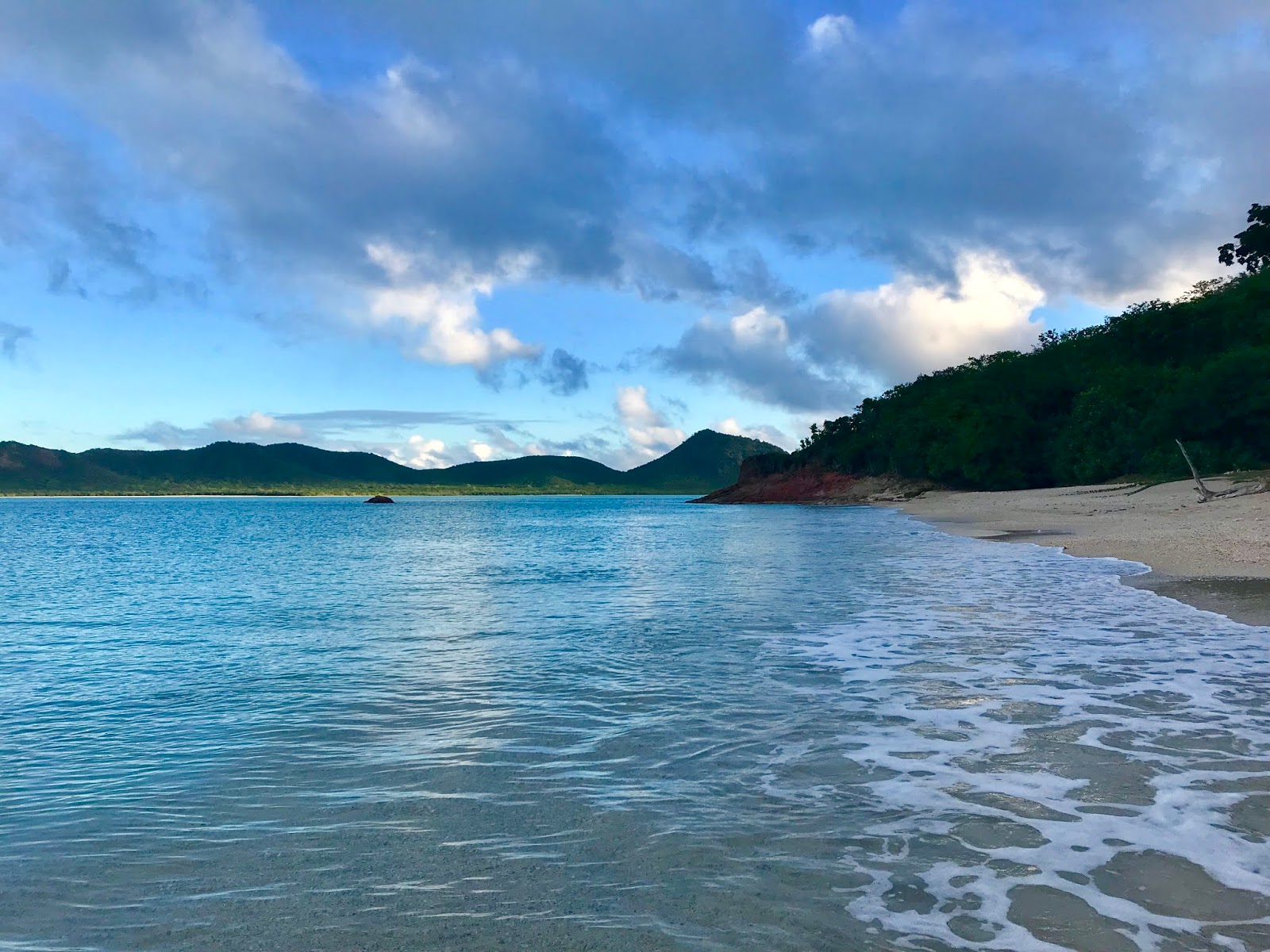
We had just 12 hours to enjoy this paradise. I hated to waste time sleeping. (Even though the thread count on the sheets and the feather density of the pillows was exquisite.) By 6am I was back on our verandah, listening to the birds wake up and watching dawn's fingers paint the sky. I headed for the sea, which was close enough to hear but obscured by vegetation. The beach here is a wide, gentle curve of powdery sand stretching at least 300 metres. On the western, Caribbean, side of Antigua and sheltered by hilly promontories, embraced by the arms of a broader bay, this is the stuff of dreams. Unlike our original hotel, there was no sea grass here. I waded out more than 50 metres and was still waist-deep with smooth sand beneath my feet. And I was entirely alone.

Like all of Antigua's beaches, Hermitage Bay is technically public. But getting here, if you weren't a guest of the hotel, would necessitate either a very strenuous hike or drop-off by boat. Thus even when people started coming onto the beach mid-morning, the ratio of empty sand to human being was impressive.

Eventually I climbed back up to our jungle eyrie to entice my husband to breakfast. This took place in   the rambling, open-sided, beach-side, Asian-style pavilion at which we'd first arrived the night before. Hermitage Bay is all-inclusive, but you won't find any buffets here. Meals are in a full-service restaurant, served by gracious locals who look to be wearing couture designed specifically for the hotel. Our waitress encouraged us to sample a range of delights from Caribbean eggs to French toast. A side of avocado was a must; they'd just ripened and been plucked from the garden. The pastry basket was tempting, but was it too much? No, she insisted. And, sure enough, the pastries were bite-sized miniatures of all the classics, flaking to buttery shards on our tongues.
We retreated to our villa for the rest of the morning. Lounging on sofas, soaking in the plunge pool, watching birds flit from one colourful bloom to another. All accompanied by gentle music floating over from the spa next door. Our return to the airport came far too quickly, but the hours of the delay will live in memory forever. Poor Ocean Point. Twelve hours at Hermitage Bay became our headline experience on Antigua, despite nearly two weeks at the other resort. Which raises an interesting question.

Is it actually worth spending three times as much, but going for 1/3 of the time, to have a more exceptional experience? I'm not sure. And I can't imagine ever feeling that I could justify a rack rate of £1,500 a night. But if Virgin Atlantic ever wants to disrupt my travel again for such an experience, I'm in.


Tuesday, 25 December 2018

A perfect setting for Caribbean R&R, but Ocean Point's Italian soul can wear a bit

Companies talk a lot about exceeding expectations. The older I get, the more I'm convinced that the secret to success lies in setting them properly in the first place.

For exhibit A, I give you Ocean Point, Antigua.
The 69-room resort hotel on the North coast of this Caribbean island provokes a variety of reactions (both on Trip Advisor and during chats at the bar) ranging from delight to disappointment. Our expectations were modest. We were looking for a quiet place that offered complete relaxation. We were operating on a budget big enough to get us some winter sun, but not luxurious enough to reach 5 star. (Given that our beach holidays since marriage have been a Viking Cruise, the Maldives and Mauritius, we were tightening our belts significantly.) Given all of the options that fell out of my spreadsheet as too expensive, I thought Ocean Point looked the best for our budget at offering the R&R we wanted, but I expected it to fall below those other beach holiday experiences. And that's pretty much what we got.

Ocean Point is a small, adults-only property with pretty gardens, an enormous pool and two small, essentially private beaches. (Technically, all beaches in Antigua are public. But because access to both of these is through private property, you're unlikely to see anyone but your fellow guests here.) It's owned and run by an Italian family; in this lies both strength and weakness. The constant presence of the owners and their drive for quality ensures that the place is spotless, the service is cheerful and the whole experience has a cozy, personal feel. But Italian-run also translates to 50% or more Italian guests who are organised, Butlin's style, by perky and ever-present tour operators. Insipid Italian pop blares too loudly and too often from the bar's audio system, English is definitely the second language and the buffet is unremittingly Italian ... which may sound great but gets boring quickly.

If you believe, as I do, that a perfect beach holiday is built around working your way through a large stack of paperbacks, alternating your reading location from pool to beach to the porch of your room, with opportunities for view-filled swims between chapters, a source of rum-based cocktails nearby and ... of critical importance ... minimal noise to interrupt your contemplation, you will be happy here. Even though they were operating at full capacity throughout our stay, you could always find empty sun loungers (though the five umbrellas near the pool were always snapped up by 9am). Two beaches, neither more than 50 metres long, each curve behind breakwaters that calm the sea. There's no snorkelling off the beach and the sand gives way to see grass pretty quickly, but these are nice areas if you want a quick dip. I preferred the smaller crescent to the West of the bar and restaurant, its
20(ish) loungers rarely more than half full.

I was often one of only three or four people on the beach, and got into the habit of pulling a lounger right into the surf to let the waves lap at me while I read. Bliss. There's a third beach area that juts out into the water like a small peninsula between the two, amusingly decorated with three cannon facing out to sea. Given that the name of the bar behind is The Black Pearl, topped by a skull and crossbones and a cheerful statue of Long John Silver, one suspects they're meant to keep authorities away rather than pirates. The restaurant is also on this beach level, two of its sides open to the air.

Climbing a ramp, or taking a staircase through the open-air spa, brings you to the pool deck at the heart of the hotel, with an arched bridge across the water. The main hotel buildings curve around this space, recessed balconies gazing down like boxes in an old-style European opera house. The buildings wear bright Caribbean colours and are fronted by climbing bougainvillea, rambling hibiscus bushes, palms and other tropical delights. The gardens are exceptionally well maintained, with the crew amongst them constantly to trim aggressive ramblers and remove dead leaves and branches.

The main check-in area, rising once again to road level, is built around an old sugar mill. These round stone towers are a constant in Antigua. Most have been left to go to ruin but some, like this one, have been given a new life. The ample lobby behind this is full of comfortable bamboo furniture with beautiful tropical fabric-covered cushions; it's almost a shame that it sees so little use. People wait here for taxis or excursion pick-ups, but the real focus is the water, bar and restaurant beyond.

The rooms are basic, in a pleasant beach style. Tile floors, double bed, desk and chair of traditional style in pale wood, TV. Nothing special but the bed is comfortable, the air conditioning works well and the wi-fi, though not great, was good enough to stream Netflix for after-dinner entertainment. Most importantly is a balcony with a table, two chairs, a drying rack and a lovely view of the pool and the sea beyond. Unless there was a live band or a big party (which only happened once or twice a week), our room didn't pick up any sound from the restaurant or bar below. Prohibiting children helps to keep things quiet, but I think having the only bar next to the beach ensures it. The noise stays with the alcohol.

Our biggest frustration was probably the food. Which we expected. "All inclusive" often means low-end mass catering, and buffets naturally limit the quality of what you can serve. Trip Advisor reviews indicated Ocean Point's buffet would be better than average, and it was. But it could have been so much better. I had two main issues.

First, very little variety. Every lunch and dinner had the same range of make-your-own-salad components on one side, mixed cold salads on the other, two "pasta of the day" options prepared fresh at a hatch that led to the kitchen and a couple of steam trays full of protein and hot veg options. One was always a white fish fillet (though toppings would change), another a thinly-sliced meat in some sort of sauce. With the exception of one day of our 12, when someone went wild with some sweet and sour pork, there was no budging from Italian classics with some Caribbean additions. In frugal Italian style, one day's rice, vegetables or pasta ended up as the next day's arancini, fritters or salad. I love roast aubergine (eggplant), but if I don't see any for a month I'll be content. My husband, who can't see the point of cooking veg and then allowing them to go cold, found at least 20% of the offerings to be unappealing. (Though, happily, his tomato allergy proved much less of a problem than I'd feared.)

We've been on holidays where we've enjoyed buffets (admittedly at a higher price point) but they've alternated cuisines to keep things exciting. Indian night, Mexican, Southeast Asian, etc. Without that mix, by day 7 we'd tried everything in the chef's repertoire and by day 10 were bored silly. I understand that Italian is Ocean Point's "thing", and perhaps the Italian guests want the regularity, but the lack of variety is the main reason we wouldn't return to this resort.

New Year's Eve buffet
Getting really picky, I'd also point out that once you get past the cold salads, Italian isn't a cuisine that works naturally with buffets. The best Italian food is cooked quickly and goes from preparation to plate in seconds. It doesn't sit around. So while they tried their best, the reality is that mass-cooked pasta re-heated before serving is never going to taste as it should, and scallopini cuts of meat with sauce, while delicious straight out of the pan, turn into shoe leather when lingering on a steam table all night. The latter, sadly, meant that most of the meat and fish was pretty tasteless. Our first meal upon returning home will be a rare steak.

The irony of these culinary quirks is that I probably ate more healthily here than on any holiday inyears, with a daily diet heavy on roast aubergine, roast courgette and heart of palm salads. Whatever benefit I gained there, however, I suspect I lost at the bar. The all-inclusive wine was average and unmemorable (again, to be expected at this price point), but easily quaffable and the bartenders soon came to anticipate our nightly request of two plastic pint glasses of white wine to take to our room fridge, along with our full dinner glasses, to libate our evening's in-room entertainment. More notable for its flavour profile was a wide-ranging cocktail menu, all made fresh with generous pours from the alcohol bottles.

And what was the price point for this experience? Approximately £500 per day per couple. (It's hard to break out exactly, since we bought a package and Ocean Point doesn't publish a standard "rack rate".) Seeing that in cold print makes me wince, as that seems a lot for what we got. A Viking Cruise, however, is more like £750, while five-star resorts like those in Mauritius and the Maldives hover around £1000. We probably could have found more various food and a more central location but, at least on Antigua, that means being in enormous resorts that lack the quiet intimacy so essential to getting rest. Hiring a holiday home would no doubt be cheaper (and was an excellent option for us two years ago in Puerto Rico), but Antigua's not a great island for that and daily cooking and cleaning takes away from the R&R. There's always skipping the all-inclusive for restaurants, but ... again ... Antigua doesn't appear to be a great island for this and Mr. B and I can quickly destroy budgets when menus and wine lists get into our hands.

In summary: Sun, quiet, attractive surroundings, decent if unremarkable food, free flowing alcohol. For Brits, it also features the convenience of direct flights from London. If you're looking for a lazy retreat, Ocean Point is a decent option for Christmas sun and relaxation at a moderate price point.

A more pertinent question is probably: would we return to Antigua. Thoughts on that in my next article.


Saturday, 7 January 2017

Beware: Viking is still trying to figure out the Caribbean

We quickly noticed an impressive pattern on board our cruise ship. Well over half the people we spoke to were repeat Viking customers. Some had been travelling with the company for decades, and were well into double-digits on past cruises. Marketers would place everyone I spoke to solidly into the "advocate" column. That's incredibly impressive, and rare.

Most of that experience had been gained on Viking's established river cruises. This is Viking's first year in the Caribbean on their ocean-going vessels and, sadly, they have a long way to go to meet the expectations established by their original fleet.

Tours, in general, under-delivered. Aside from our magnificently-named guide "Mirage" on Antigua, all of the guides on the included tours had a set patter and couldn't go much beyond it to answer questions about history, economics, government, etc. Indeed, in most cases their English wasn't good enough to understand what was being asked. In our worst case, our guide in Guadeloupe seemed more like a local plucked off the street than a travel professional, going on endlessly about the rivalries between the locals of La Moule and Pointe-a-Pitre, or telling us where her family's favourite picnic spots on the island were, rather than giving us the expected tour. For example, an overview of what the island's typical products were, what to look for when buying local spices and whether or not bargaining was appropriate would have been just the thing before getting dropped off at a local market. Harsh? Perhaps. But Viking differentiates themselves on "enrichment", helping you to delve deep into a destination's history and culture. Their delivery in our Caribbean destinations was well below expectation.

It may be that Viking's model is not an easy fit with the Caribbean. It's easy to load people onto a bus in Prague, Bordeaux or Copenhagen and blow their minds with history, architecture and culture for four hours. While the Caribbean has similar highlights, they're fewer and further between. Thus we inevitably spent hours driving around looking at spectacular views, vegetation and ramshackle villages. Nice, but if I had it to do over I would have skipped most of the included tours and done my own thing. When you consider that those included tours are part of why you're paying a premium price ... not good.

Even when we got to something meaty, the destination had been woefully oversold. Stony Hill
was not the "resplendent estate" promised in the tour literature (at least not for any Brit with a National Trust membership); it was the lovely home of a prosperous professional with one hell of a view and a garden that, while nice, was mare national gardens scheme open day than what you'd expect from that "resplendent estate" billing. The much-lauded cemetery in La Moule was, indeed, impressive; but having driven by two almost identical ones en route, everyone on the bus wondered why we needed to drive an additional hour each way to see wasn't this one?

When it came to the not-included, additional fee excursions, I had other disappointments. Having paid the premium for a ship that markets itself in a different league, I expected similarly differentiated shore options. In every case we bought into, they were standard mass-market offerings, with passengers from Carnival or Princess embarking for the same things at the same time. (Though in different groups.)

The biggest debacle was the St. John's Swim and Snorkel. Our last day of the cruise. Our last opportunity to snorkel. We made a choice based on the title, and the promise of snorkelling. We passed up an alternative trip to snorkel with turtles, based on the reputation of St. John's reefs. Once on the boat, the captain made it clear that it was not a snorkelling excursion. (Though it was printed on our tickets.) And even though she had the equipment on board, health and safety wouldn't allow her to let us use it. (I, fortunately, had my own mask with me.) The same guidelines for some reason meant that, because it wasn't a snorkel tour, we had to take rubber rafts to the beach rather than just swimming the 100 yards from the boat. Perplexing, as clambering off and on a rib (rubber dingy) from a catamaran when both are bobbing about is a hell of a lot more dangerous than descending the cat's stairs and swimming off.  Everyone on the tour was irritated, and we made a point of registering our complaint in person as soon as we got back. Given Viking's marketing skill, I expected an apology at the minimum, and a refund as best practice. There was no reply. This, on our last day, left an unfortunately sour taste in my mouth.

I was surprised at how unhelpful the staff on the Explorers' Desk (the concierge service) was. Every time I asked for any information on shore excursions or a destination, they turned to the same web pages I already had access to. They didn't seem to have any personal experience of the islands or knowledge beyond what was in the brochure, thus were unable to make useful recommendations. We did have a great conversation with the customer services manager earlier in the cruise, who explained that they were still learning the Caribbean and encouraged our feedback. When I asked one of the desk guys for an email address, rather than their printed forms, so I could give them mine in detail, he promised to get back to me. Then never did. If you don't take the offer of my private constructive criticism, then I'm afraid you default to this public space...

Our final issues came around the unique circumstance of cruising at Christmas. Lessons learned for next time, should we ever do this again.

As I wrote earlier when I discussed what exceeded expectations, we loved the heavy Scandinavian influence on food and drink. My half-Danish husband pointed out that this was the reason that all the traditional holiday dishes were served on Christmas Eve. Fair enough, but they probably should have warned the primarily American and English customers of the fact. I overheard many disappointed diners on Christmas night, who'd not ordered the turkey and Christmas pudding the night before, or even worse had gone to the buffet, saving themselves up for the traditional meal on the 25th. A meal that wasn't on offer.

Worse for us was the celebration of Christmas itself. We'd decided not to go to a Christmas Eve mass in St. Kitts because a midnight service with readings and carols was on offer on the ship. We were expecting something gentle and serious, presumably with the captain doing the readings. (Commanding officers can double as religious authorities at sea, right?) Instead, we got the same entertainment team who'd just finished the all-singing, all-dancing holiday show leading a happy-clappy, evangelical style production that wasn't that different from the earlier razzle-dazzle. We lasted five minutes. Granted, we're perhaps in the minority as traditionalists who wanted something more solemn. My criticism of Viking here is only that I wish they would have been clearer about what was actually on offer so we could have made it to that mass on shore. (I was seriously tempted to join the Jewish passengers' DIY Hanukkah service, which I suspect would have been much closer in spirit to what I was after that the televangelist party in the main theatre.)

Viking charges more than the mass market cruise lines, and sets the bar much higher in their marketing. Surprisingly, they delivered the inverse of my expectations. Experiences on board were superlative; on shore deeply average. This won't stop me from booking with them again; their Viking Homelands cruise is solidly on our bucket list. But I'd steer well clear of any new destination and, if returning to the Caribbean, would think hard about arranging my own itinerary on land.

Wednesday, 24 March 2010

Hawai’i vs. The Caribbean: Pleasant battlegrounds for tropical supremacy

After my fourth cruise, I think I can confidently embrace the word “veteran” when it comes to this style of vacation. It’s still not my personal preference, lacking the local colour and off-the-beaten-track charm I usually seek out. But if you’re catering to older and less agile relatives, or if you’re looking to control costs with a package that includes lodging and food, it’s not a bad option.

The novelty this year is not the cruise (we’re on Princess once again) but the destination: Hawaii. The 14-day journey departs Los Angeles, spending four days crossing the Pacific before reaching America’s distant 50th state. The next four days are spent visiting the chain’s four most popular islands: Hawai’i (aka “the Big Island”), Oahu, Kauai and Maui. Then it’s a four-day crossing back to Mexico, because American shipping regulations mysteriously require a foreign stop (for this cruise, at Ensenada) before returning to Los Angeles on day 14. It’s quite a different experience, in many ways, from the Caribbean option. How do they stack up? Let’s look at a side by comparison.

Beaches: As one of the most isolated bits of land on the planet, there’s a lot of ocean for waves to build across before hitting the Hawaiian coast. This generates the surf for which the islands are famous, and it is fun to watch the kids on the boards. The volcanic origin of the land makes a wide range of colours of beaches, from classic pale sand to black or green. Pretty and dramatic. But not great swimming beaches. This is the Pacific, and it’s cold. From almost every Caribbean island you can walk across flour-fine sand into tepid, gentle surf glimmering with various blues, so clear and calm you can often snorkel off the beach. We didn’t see a single beach of this quality in Hawai’i. The Caribbean is the stand out winner here.

Culture: The Caribbean is a microcosm of European culture, filtered by former empires and given a dark edge by a brutal history of slavery. But these days the dominant cultural element seems to be the golden age of piracy, never far from a boat trip, dinner or walking tour near you. Hawai’i has its own distinctly Polynesian culture, which flourished for a thousand years and had about a century of recorded history under local monarchs before commercial pressures saw it sucked into the United States. Today there’s an active movement to resurrect the native culture, from hula and luau to a deep respect for the land very much in tune with modern society. For its uniqueness, rather than being such a derivative of other cultures, a narrow advantage goes to Hawai’i.

Weather: I’m writing this swaddled in a jacket, sheltered behind the ship’s windscreens, looking out at cloudy skies. All four of our days in Hawai’i featured clouds, on two days the skies never turned blue. Hilo, the residents inform tourists with a gentle irony, is the wettest city in the United States. Not even a contest. If you want guaranteed heat and sun, go to the Caribbean.

The locals: Both places depend on tourists for their livelihoods, and the natives work hard to make you feel welcome. But in the Caribbean, as this blog has attested in past entries, it’s not unusual to come across the stroppy girl who can’t be bothered or the gruff local who resents the foreigners. Given issues with drug trafficking, there’s a rough element on some of the islands about which you need to be wary. Hawai’i, on the other hand, could teach the rest of the world how to do tourism. You get the feeling every local wants to hug you, drape a lei around your neck and take you home for a bit of poi and spam. (Of that, more later.) This is a culture that has an extreme esteem for hospitality, and it’s obvious. Not only from the natives. Plenty of white folk … obvious immigrants from the mainland … are chatty and helpful. Every time we appeared to be lost or perplexed, some local popped up to offer advice on buses, the best beaches, where to eat, etc. Hawaiians win, hands down.

The Food: Both fusion cultures, one mixing the tastes of Asia and Polynesia, the other a mélange of Europe and Africa. Both are blessed with a profusion of fresh fruits and seafood. Both have bartenders skilled at creating wicked concoctions with fruit juice, coconut milk and deceptively tasteless alcohol. Although only in Hawai’i are they served in gloriously tacky Tiki god heads. The vast variety of Hawaiian food is impressive, especially if you’re up for sushi, Thai, Chinese or any kind of tropical fruit. (My most exotic foray was a Durian smoothie. This legendary fruit of Southeast Asia smells vile but tastes of creamy vanilla. Not sure I’ll go out of my way to have one again, but exciting to sample.) Classically Hawaiian food is, truth be told, a bit odd. It’s a carb-heavy culture where a “plate lunch” of meat, a scoop of rice and another of macaroni salad is a staple, and Spam is favourite consumed in mass quantities. You’re probably more familiar with the Caribbean staples: red beans and rice, jerked meats, callalou, washed down with a Red Stripe. The Caribbean also has the advantage of growing many of its own spices, most notably cinnamon, nutmeg, pepper and vanilla. I’m a happy omnivore and have to call a tie here.

The music: Little Grass Shack, Aloha Oe and the gentle sound of steel guitar or ukulele are instantly evocative of hula girls, surfing natives and Pacific sunsets. Hawai’i has a lovely, evocative soundtrack that wraps itself around you while you’re here. But once home, where do they feature on the iPod playlist? This stuff just doesn’t have the staying power of Bob Marley, Jimmy Buffett or UB40, all regularly heard beyond their native tropic zone. Advantage Caribbean.

Overall it’s close, but I give the edge to the Caribbean. (That’s probably also influenced by the fact that it’s a lot easier to get to.) Had the weather been better, the scales would have tipped in Hawai’i’s favour. I’m not going to turn down a free trip to either place, but when voting with my own vacation time and money, I’d rather be paddling off Virgin Gorda than Maui.

Tuesday, 20 January 2009

Musical discovery is the highlight of our cruise

Though this was our third mother-daughter cruise, we'd never really exploited the amenities on the ship beyond the standard restaurants and the pools. Mom usually tucks in early, so I'd spend evenings reading. This year's circumstances, however, called for a good deal more sucking the marrow out of life, and Mom rose admirably to the challenge. Teaching both of us a lesson: You can have almost as much fun on the ship as you have on shore.

Cruise aficionados will be astounded that it took me three years to get to the blindingly obvious. I shrug and admit guilt. I never really wanted to cruise and, even after being talked into it, never saw the ship as much more than a floating hotel to get me to the "real" holiday. I now appreciate the ship as a destination in itself, especially as an entertainment venue.

My nautical Damascus moment came thanks to a remarkable entertainer named Bryant
Olender, who performed nightly in a sophisticated, Italian-themed lounge high in the aft of the ship. He is your perfect piano bar entertainer: honeyed, resonant voice; a masterful skill at the keys that belied his classical training; an impressive ability to improvise and create lovely transitions between songs; a delightful personality, building a rapport with his regulars and playing your favourite tunes for and to you; a capacious memory that could play most requests without ever referring to the music. He reminded me of Michael Buble with added maturity and a master's piano skills. A logical association, it seems, as I learned post-cruise from his website (www.bryantolender.com, from where I also pinched his photo) that he was Buble's musical director. Which leads you to ask, what the hell is a guy this good doing entertaining on a cruise ship? Because, frankly, he's better than Buble ... and the play record on my iPod would prove how much I like that kid.

Whatever the answer, we reaped the benefit of Bryant's career choices, settling into the lounge on most nights for a show I would have happily paid for. If you're a fan of mellow jazz and old standards, do check out Bryant's web site or download him off iTunes.

We did take in a few other entertainments, including a couple of comics and one of the ship's Broadway-style musical numbers. The quality here wasn't nearly so high. In the musical performances, particularly, you could see why these people were performing here. Very good, but not professional quality yet. Still, there was a lot to keep you engaged, and all of it free, so who's complaining? I was also intrigued, as I paid a bit more attention, to the way the ship seemed to organise tracks of entertainment. While we were indulging in the more classic end of the range, I appreciated that there was a heavy drinker track, a country western route, a pop/nightclub stream, etc. There is, undoubtedly, an art to keeping a few thousand people of diverse background engaged and happy, and the people at Princess seem to have cracked it.

This year we also tried the "added fee" restaurants. I had resisted them on principle the first two years. The included food is supposed to be one of the highlights of a cruise, and I resented the suggestion that you should then have to pay something more. But to someone who lives in a culinary capital and eats out as much as I do, Princess' food isn't that impressive. Good, but beyond its staggering quantity, nothing extraordinary. So we went for the upgrade.
Was the approximately $20 each worth it? In both cases, there was an obvious leap forward in both quality and presentation from the standard dining room food. The Crown Grill offers steak and lobster in a rather strange environment that is half posh American steakhouse and half Aurthurian legend stage set. It was as if the pre-Raphaelite brotherhood had moved to New York and gone into catering. (That's a copy of the famous Round Table from Winchester behind us in the photo.) The service here was a bit spotty ... too slow, mixed up orders, but genial ... but the food was excellent.

The real value for money came from the Italian Sabatini's, where we dined on our last night. The decor here was tasteful, posh Italian, in seamless company with the food. The food was authentic and you were left in the hands of the chef for multiple courses (having to choose only your main and your dessert). A procession of cold antipasti and warm appetisers reminded me of one of my favourite places in Rome, and getting to try two small portions of pasta rather than settling for one was a happy bit of hedonism. The wine list was particularly good, stunning me with the inclusion of a schioppetino. This dry, complex red, made from a grape variety almost driven to extinction and now unique to the Northeast of Italy, was one of the big discoveries of the Northwestern girls' trip to Venice in 2001. The name means "little explosion", and that's exactly what happens to your tastebuds when you drink it. I've only seen it on two winelists since discovering it (Kemoll's in St. Louis, Locanda Locatelli in London), so finding it here was like hitting the jackpot.

We consumed this perfect meal sitting against the windows at the back of the ship, looking out at a full moon gilding the serene sea. Stuffed to the gills, we wandered over to the cocktail lounge next door for a few last requests from maestro Bryant. And then, sadly, it was time to retire and prepare for the return of reality.

I really must find a bottle of schioppettino somewhere. Next full moon, perhaps I can head to the garden, have a glass, put on Bryant's CD and channel myself back to the Caribbean.

Thursday, 15 January 2009

Virgin Islands are jewel in bright crown of Caribbean destinations


The northeastern Caribbean is easy on the brain and the eye. It lacks the variety of last year's southern destinations. No dramatic volcanoes, no lush rain forest, and the natives seem a little less exotic. But it delivers the stunning beaches and breathtaking blue expected in the region, and it's blessed to be within easy striking distance of Florida so requires little logistic effort. Our seven-day cruise combined the convenience of a Ft. Lauderdale departure with four ports of call: the Bahamas, St. Maarten, St. Thomas and and Grand Turk.

This was my fourth visit to St. Thomas, so perhaps I am artificially pre-disposed to like it, but I have to say that the Virgin Islands (British or American) remain my favourite destination in all of the jewels in this shining sea. Mostly because they look so good. There are scores of Virgins; the big ones you know about (St. Thomas, St. John, Tortola, Virgin Gorda), surrounded by little ones. Almost any vista here takes in beaches and numerous islands and coastlines. All of which gives the water an incredible range of colour as the depths vary from beach to channel to beach to deep sea. European discoverer Columbus was clearly impressed by the beguiling number of islets as well, since he named the chain after St. Ursula's legendary 11,000 virgin companions. The vegetation here admittedly isn't lush, but when you can tear your eyes away from the sea you'll find it's green enough for a nice juxtaposition, and the hills add to the view.

On the convenience front, St. Thomas also comes with the added benefit of being an American territory. While it's still a bit ramshackle and laid back, on the whole this place is freshly painted, solidly built and humming with American efficiency and cheerful customer service. While there are other candidates for best shopping in the Caribbean, I will cast my vote for Charlotte Amalie with its helpful sales people, well-maintained shops and efficient shuttles going to and from the cruise port. (Though I, needing exercise, opted for the very pleasant two-mile walk.)

We spent the afternoon on an expedition to Turtle Cove aboard the sailing ship Doubloon (see www.doubloon.com), probably the best Caribbean tourist excursion I've experienced. The two-masted sailing ship offered the romance of pirate legend, but was fitted out for modern comfort. The crew was wildly entertaining as well as being very knowledgeable about the area; one was a marine biologist. We motored three nautical miles out to the cove, dropped anchor and snorkeled in a protected area where green sea turtles graze contentedly on a field of sea grass about 15 feet below. If you get tired of the turtles (which would be difficult as they are endlessly diverting) a reef populated with a wide variety of life, including some magnificent black spiny sea urchins, curves around one side of the snorkel area. It was heavenly. Even better was the cruise back to the ship under full sail, rum punch flowing and Jimmy Buffett tunes on the sound system as the exquisite shorelines around Charlotte Amalie slipped past. Life doesn't get much better than this.

In second place on this year's destination rankings comes Grand Turk. We had a great time here last year and then heard with dismay of its battering by two hurricanes last fall. Reading of almost complete devastation, I thought we might be diverted elsewhere. But rebuilding carried on at high speed and the giddily-painted cruise centre looked just as festive and well maintained as last January. Only a few roofs still to be completed hinted at all the rebuilding that had taken place. Otherwise the place was pristine and so new the paint was hardly dry. A collection of shops curve around a series of courtyards leading to a giant Jimmy Buffett's Margaritaville bar, which overlooks one of those massive, winding pools you find in luxury resorts. Well-maintained beaches fringed with palm trees (newly-planted) and featuring startlingly blue water edge the whole complex. It's one of those delightful ports where you can get off the cruise ship and find all you need within walking distance. Which is exactly the Princess corporation's intent, of course, since they own the whole place.

We bought into some more snorkeling, however, so left the Princess oasis for a drive through the real Grand Turk. And here the hurricane damage was still intense, with perhaps half the homes roofless and derelict and lots of people still living in tents. Not surprising, but perhaps a fine testimony to the long-term thinking of the natives, the cruise centre and the hospital got rebuilt first, now it's the school's turn. Individual housing is taking a back seat to general employment and welfare. Our snorkeling here wasn't as good as on St. Thomas, though it's hard to say if that was because of reef damage, because we were out in the slanted light of late afternoon, or because it just wasn't as good a snorkel site. I did see some particularly impressive tiger fish, so that made my afternoon.

Third favourite comes Princess Cays, the cruise operator's private resort area in the Bahamas. There's little here besides the beach ... but a lovely beach it is. Four artificially scalloped bays are separated by the dock at which the tenders from the ship land, and by little outcroppings of stone manned by lifeguards. On shore there are abundant beach chairs and umbrellas, a few shops, bars with wait staff ambitiously patrolling the beach chairs for orders, snorkel rental, a live band doing the expected mix of steel drum classics, Buffett and Marley, and an outpost of the ship's restaurant that serves up a big beach barbecue. The weather was perfect, the colours intense and the novelty of the ship in the distance at anchor, rather than at a land-based dock, made for a pleasant view. My only complaint? We pre-booked snorkel hire for $35 per person and really shouldn't have wasted the money. There's a limited reef here and few fish. We should have just soaked up the free amenities and the sun. That said, I was perfectly happy to substitute a "real" port for Princess Cays. It was a beautiful, hassle free day at the beach.

Coming in a distant fourth was St. Maarten, which I have no desire to ever set foot upon again. I think of the Caribbean as a region characterised by cheerful, laid back people dedicated to customer service. The denizens of St. Maarten make the worst New York stereotype look pleasant. They are truculent, disinterested, silent and seem incapable of cracking a smile. I thought this might have only been the guy who handled wheelchair assistance from the boat. But upon my fifth native who refused to make eye contact or engage in anything resembling conversation, I had to conclude there was something going on with the whole population. That was reinforced when we were ripped off royally on beach chair rental. Mom, close to exhaustion, really needed to get off her feet. So we headed for the first spot on the beach and the attendant told us $20 for two chairs for the afternoon. Cushions extra. That seemed ridiculous, but I needed to get Mom settled so I payed up. Later in the afternoon I saw the sign that said $20 for two chairs, two pina coladas and two cushions. I had to chase the attendant mercilessly to get the drinks, and then he expressed his irritation when I didn't tip him. (The $20 was all I had.) Despite multiple requests he never did bring the cushions, so I finally liberated two from their premises myself.

They might be excused, or at least forgiven, if they lived in some sort of paradise. Sorry. The beach near the port was good, but the shopping street behind it was a run down, tacky version of St. Thomas filled with rude shop keepers. Clearly, if there is a God he is paying no attention to the Caribbean, because nobody with any sense of justice could have let a hurricane wipe out the lovely people of Grand Turk and leave these hostile natives untouched to rip off every visitor. If I ever cruise back here, I will take a tour to the French side of the island, where the welcome HAS to be better. And that, coming from someone who is not often a fan of our Gallic cousins, is saying a lot.

Tuesday, 12 February 2008

Caribbean offers more variety than you'd expect: Additional highlights from the cruise

Diversity is not a term I would have instictively given to the Caribbean before visiting the region. We've all drunk enough from the well of popular culture to think we know what to expect: tropical islands, colourful buildings, great beaches, a population primarily of African descent, a bit of piracy and a lot of sugar cane. And yes, that's all there. But the impression I'm left most strongly with, after two cruises through the region, is the broad variety.

Caribbean islands are disinctly different in their topography, populations, culture and offerings to the tourist. I've spent so little time in each place that I can't claim much expertise in defining those differences, but it's obvious they're there. This is probably the best excuse possible for opting for a cruise. Whilst you could spend an idyllic fortnight on any one island, you'd miss the heady variety the region offers.

So, in addition to the favourites cited in the past two blogs, here are a few other highlights, notes and tips from this trip's ports of call.

Developing v. Developed World
Travellers should remember that the Caribbean, although long the playground of wealthy nations, is actually made up by a bunch of developing economies. The commercial centre of Charlotte Amalie, St. Thomas, and the new cruise port in Grand Turk disguise that with their well maintained, upscale tourist areas. Port of Spain, Trinidad, is a major metropolis dotted with shiny glass office buildings at its core, where St. John's Antigua (at left) is filled with weathered buildings that look like they've been gently collapsing of a century. But in many other places you get the sort of good natured chaos, litter-strewn byways, potholed roads and ramshackle buildings I've seen on my visits to Africa. Grenada is particularly poignant, with so many buildings still standing roofless due to hurricane damage. This chaotic shabbiness is nothing to be scared of; use common sense and I think you're as safe here as in any big city in the world. You do, however, need to adapt your expectations. This is the real Caribbean, not the Disney version.

Shopping Mecca
These people take "duty free" seriously. Alcohol and tobacco abound at every port. But the real buy here is jewelry, and the place to buy it is St. Thomas. When I visited here more than a decade ago, I remembered a main street with a variety of shops. No longer. Clearly, the jewelry sells. Because Charlotte Amalie must be 90% jewelry shops, a quantity and density I've never seen before. I'm sure there are more than 100 outlets. Although, like the tiny shops on Florence's Ponte Vecchio, it seems that some people own multiple shops. Like traps spread to catch animals in the forest, it's pretty tough to run this gauntlet for more than a couple of hours without finding yourself reaching for a credit card you had no intention of using. I ended up buying a Philip Stein watch at about 15% below American prices and half of what I would have paid in the UK. Of course, I had no intention of buying a new watch, but these things happen...

The Island of Pearls
Isla Margarita is part of Venezuela, and instantly feels culturally different from the rest of the Caribbean. This is definitely South America, from the Spanish faces to the latino beats coming out of every radio. Known as the island of pearls because those gems were so abundant in colonial days you could pick them up on the beaches where they washed up, and the natives draped themselves with strands of them. While not quite so prolific today, the pearl beds still yield a lot of jewellry for sale all over the island. Again, my credit card made an unscheduled appearance. But the multi-layered strand of multi-coloured, small, irregular pearls I purchased was too unique to pass up.

No Need for Tours
The cruise companies are relentless at selling day excursions for each port of call. And in most cases, it's a good idea. Most cruise ports project from urban areas. While you might get shopping within an easy walk, beaches usually require some transport. Two notable exceptions: Grand Turk and Isla Margarita. In both cases, I had pre-booked excursions and was then rather irritated to see exquisite beaches a few hundred yards from the ship. In both places, there's absolutely no need to plan for anything but a short walk. And both have shopping as well, Isla Margarita in a long line of thatched booths, Grand Turk in a shining new mall. That said, the tours I took in both places were fantastic, so I have no regrets. But it would have been nice to know in advance that I had the nearby option.

The New Florida
The charming, and still fairly undeveloped, island of Bonaire seems to be becoming a haven for American retirees. The guides on our snorkelling tour were Americans who had come to the island to enjoy the weather, and stretch their budgets. One of them told me his government pension didn't stretch to survival up north, but worked well down there. There are signs everywhere for new housing developments. A small place a mile or so from the beach, evidently, can be had for US$120,000. The island is far enough south that it's out of the main hurricane belt, so probably not a bad investment. Bonaire is not an attractive place if your back is to the coast. It's a scrubby, flat sand spit of an island with little vegetation, though flamingos dabbling in inland pools add colour. But turn your face to the sea, and you're drenched with beauty. I certainly wouldn't mind spending my golden years here.

There's a small bar in the main town, really just a bunch of thatched huts at the end of a pier, at which I can envision myself becoming a regular as I write my memoirs and entertain tourists with tales of my colourful life. Sadly, I suspect that by the time I'm ready to retire, Bonaire will be built up, no longer a deal, well populated and looking a lot like its neighbour Aruba. Which is a bit too much like Dallas on the Caribbean for my tastes.


Wednesday, 6 February 2008

Caribbean Week 2 completes line up of fantasy beaches

Growing up in the United States, I always figured there were beach families or mountain families. With only 10 or 15 vacation days a year, busy parents could really only take one major family holiday. If you grew up in a family fortunate enough to travel, the choice of the year's big holiday typically seemed to come down to skiing, or sand. My family was solidly in the latter camp. I spent most summer holidays in the picturesque resort of Lauderdale-by-the-Sea, Florida, and learned to swim in the Atlantic at such a young age that I have no memory of ever NOT being at home in the waves.

To me, therefore, a good beach is synonymous with all things restful and calming. The better the beach, the more soothed the soul. My second week in the Caribbean took me to three beaches, in rapid succession, that transported me direct to the heaven foreshadowed on the best beach in Week 1.

These four pieces of perfection were: the Baths at Virgin Gorda; Windsock Beach, Bonaire; Playa del Agua, Isla Margarita; and, Maracas Bay, Trinidad.

The Baths remain my favourite. Like other spectacular beaches in the Virgin Islands, they benefit from the fact that they're set within an island chain, with other islands clearly visible from the beach. Vivid green hills loom above waters striped with a crazy variety of blues and greens, the colours all so vivid they almost hurt your eyes. The defining element of the Baths is volcanic rubble. Giant boulders, some the size of small houses, litter the beach and the sometimes-steep path to it. The boulders create a series of intimate pools for bathing. It might be a bit challenging in high surf, but was sheer perfection on a calm day like the one on which we visited.


On to Windsock Beach on Bonaire, so named because it's right next to the airport. As the little island only has a handful of flights a day, this is not a problem. All of Bonaire is known for beaches; it's not much more of a sand spit itself. The physical beach itself isn't that magnificent here -- too rocky for perfection -- but it wins top honours as a snorkelling beach. It's surrounded by coral reefs that start immediately off shore. Perhaps 20 yards from the beach, the shallows fall over a cliff that plunges 6000 feet into the depths. It's lovely to hang there observing the difference between the bright shallows and the darkness below, while large schools of colourful fish drift across the top of the cliff. Windsock is a lovely little stretch of white sand with sheltering trees to provide some shade. It's easy to get to, and provides a great view back towards the rest of the island and the cruise port. But best of all is the "walk in" snorkelling. It's unusual to be able to stroll off a beach and immediately be able to indulge in an underwater show. Particularly good for people who aren't powerful swimmers; you can see lots while having the confidence that you can put your feet on solid ground without too much trouble.
Playa del Agua perhaps seemed more exciting than it really was simply because I was, technically, on a new continent. Isla Margarita is in the Caribbean, but it's also part of Venezuela, so I could rejoice that I was on a South American beach. It is certainly one of the longest strips of sand I've ever seen. Two full miles of wide, smooth, clean, white, powdery sand. As you'd expect from the gentle slope of the sand, the walk into the waves is equally gentle. A wonderful swimming and lounging beach. The swimming reminded me a bit of Lauderdale, to be honest, except that the sand is fringed with huge palm trees and behind them loom mountains. A bit more picturesque! Playa del Agua is like a European beach in that the beach front is lined with restaurants and bars. They don't own the beach, but they do own the deck chair concession on their strip of it. So the best option here seems to be to form a relationship with a good bar.

Our tour took us to Bar Marlin, a lovely place almost exactly in the centre of the beach. It's a large restaurant, thatched with palm and open to the air across its front. I would have liked to stay there; I bet dining here while looking out at the beach would be fantastic. The biggest drawback of this beach is the beach vendors. It's rare to have more than 5 minutes' peace before someone is offering you beach towels, jewellry, sunglasses, fresh oysters, etc. While it's initially interesting to watch this mobile mall, it gets irritating quickly. At least they do take no for an answer, so it's the irritation of waving flies away rather than dealing with their bites.


Our final beach of the cruise, and my favourite after Virgin Gorda, was Maracas Beach on Trinidad. This is your classic tropical beach, the mental postcard in everyone's mind. A mile of white sand, perhaps 50 yards wide, encircled by forested mountains that reach out into the sea, providing a sheltered bay. Palm trees provide shade along the full length of the beach. There are only a handful of bars and restaurants; this is primarily nature in its simplest beauty, with the car parks positioned far enough back to recede from consciousness. For the first time in my experience in the Caribbean, we also encountered life guards.
This is a well patrolled and beautifully maintained beach. The surf was a bit rough when we were here, so no surprise. Weaker swimmers would be better off at Virgin Gorda. But for people who wanted to throw themselves into the waves, this beach was great fun. I imagine it gets quite crowded on holiday weekends, but it is ... at least at this writing ... remarkably unspoiled and pristine. There's just one hotel, at one end of the beach where a small fishing village nestled. Very, very tempting to check out for a future visit.

Saturday, 26 January 2008

Dominica and Grand Turk take first prize amongst Week 1 cruise destinations

Half-way through a two-week Caribbean holiday, the mind turns to fantasy. Relaxed, free of work stresses, at peace with the world, you start to contemplate: If I liquidated all my assets, would I have enough to buy that beach bar? Perhaps I could be the owner and captain of a little snorkelling excursion boat? Just how much money would you really need to spend the rest of your life hanging out on a beach, listening to Bob Marley and Jimmy Buffett, watching sunsets and coral reefs for entertainment?

More cash than you’d think, no doubt. Especially when hurricanes rip through the islands or no tourists show up at your bar. But it’s a pleasant little fantasy in which to indulge as you hang suspended in turquoise waters, letting the sun dapple your back as a neon contingent of fish darts in and out of the reef below.

We are cruising, a circle tour of the Caribbean from Barbados on the Sea Princess. Destinations thus far: Dominica, Antigua, the British Virgin Islands, St. Thomas, Grand Turk and Jamaica. Cruising is, of course, an odd way to see a place. You’re in port for six or eight hours, generally allowing a choice of one excursion. What you choose to do colours your whole perception of the place, whether or not it’s actually representative. That said, favourites so far have been Dominica and Grand Turk.

Dominica
Dominica is a wild, mountainous place, still covered with rain forest and dotted with active volcanoes. It’s no wonder Disney set much of the second Pirates of the Caribbean film here; the whole place is an adventure movie set. In the morning I set off with a group in a mini-bus into the mountains, a nail-biting slalom up and down badly paved roads with hairpin turns, little passing room and precipitous drops. About 40-minutes from port we arrived at a little parking spot above a small hydro-electric power station and set off on foot. The rocky path cut up through a jungle of banana and coconut palm, wild fig and climbers, following the big wooden pipe that was channelling water down to the station. Over a river, up a further hill, and we’d arrived at our destination: Ti Tou Gorge. Steps lead down to a clear, triangular pool with a rocky bottom, formed by a restraining wall that’s holding back the river. Over the wall is a valley, and a facing wall of jungle across it. The other two sides of the pool are hemmed in by cliff faces, rising and pushing closer together at the far end. At the back, an opening about 10 feet wide leads back into a passage between cliff walls perhaps 30 feet high.

I was furious at myself for not bringing the waterproof camera, as this was one of the most beautiful places I’ve ever been. (Thanks to Dominica's web site for the picture.) The water remained crystal clear, but grew much deeper. The cliff walls waved in and out, sometimes forming peaceful little alcoves. About 20 yards in the current picked up, we came around a bend, and found a waterfall crashing down the ravine that formed the back of the gorge. We swam left, approaching the waterfall to the side of the powerful current it created, then were handed from guide to guide across the foaming white cauldron at the fall’s base. To the right of the falls was an alcove with a ledge; guides helped us to scramble up here, from where we could dive into the base of the falls. Still crystal clear, but now 20 feet deep from the force of the pounding water. After the dive, you could just relax and let the current sweep you back toward the starting pool.

After the gorge, we zigged and zagged around more mountains to get to a hot spring, where steaming, sulphurous water pours from the volcanic strata below. Cooled to tolerable temperatures by other springs, channelled into smooth sided pools, it was a heavenly place to relax. I felt my muscles unwinding in the moist heat as I looked up into the rain forest canopy, contemplating a few wild cocoa pods and a hummingbird hanging above my head. It was hard to imagine how my holiday could get any better than its first morning.

And that wasn’t even all Dominica had to offer. Later that afternoon Mom joined me (the early tour would have been a bit too active for her) and we boarded a boat for a spot of whale watching. After two hours of fruitless but picturesque searching, we finally found a pod of three sperm whales relaxing on the waves. We saw two more groups before heading back to shore.

Grand Turk
The largest island in the Turks and Caicos, couldn’t have been more different. Where Dominica is towering volcanic mountains clothed in rain forest, the Grand Turk cruise ship terminal area is a flat, scrubby sand spit barely higher than the tourmaline waters surrounding it. A classic coral reef island, the waters are shockingly vivid, clear and various in their colour. Until, not too far off shore, the shallows abruptly fall over a 7,000 foot cliff into inky, blue-black depths. (I need to fact check the locals’ depth claim, as it seems extraordinary, but there’s no doubt the water is very deep.) The port here is a couple of years old, at most, and purpose-built for the cruise ships. The buildings are festive, brightly coloured and filled with the usual dazzling array of duty free luxuries. Unusually, however, exquisite white beaches stretch along just a stone’s throw from the port, with a resort style pool and a gathering of bars behind them. This is one of the few destinations in the Caribbean where you can walk off your ship and into the water.

We, however, had decided to go snorkelling, and so boarded a waiting boat to head towards some reefs slightly off shore. Like the buildings at the cruise terminal, the boat was new and sparkling with lavish maintenance. The crew was exceptionally attentive, keeping a close eye on Mom and helping her to paddle around more distant parts of the reef. At our second stop, we encountered one of the rays that are so abundant in these waters. The guide was able to bring her up with a handful of squid, then keep her near the surface while we stroked her. Down below, a rather frightening but benign barracuda, at least four feet long, circled, followed by a whole gang of colourful, smaller fish.

The extreme helpfulness and good nature of the snorkel boat crew was matched by every individual we encountered in Grand Turk. Almost everyone you meet in the Caribbean is cheerful, helpful and attentive to tourists, but on Grand Turk this good nature reached a universality and an extreme beyond the other islands. There seemed to be an honest pride in their island and a delight in the enjoyment of visitors. It reminded me a bit of the people of Botswana, who seemed that little bit more welcoming and enthusiastic than those of the other countries we visited in Africa. Services were abundant, including wheelchairs to ferry tired tourists out the long dock to the ships, and a prohibition against receiving tips.

 All part of the Grand Turk experience. And all, clearly, about encouraging visitors to come to this lesser known Caribbean destination. I’d suspect their plan will bear fruit, as long as hurricanes refrain from knocking this exquisite destination from its perilously flat, yet beautiful, location.