Showing posts with label English Gardens. Show all posts

Sunday, 23 April 2023

Gardens, food and architecture vie for perfection at The Newt

The Newt in Somerset is a legend on the English luxury hotel scene, but one I hadn’t experienced yet despite its embodiment of things I love: great locally sourced food, historic houses, impressive gardens, cider, and the Chelsea Flower Show. That changed this week when I joined friends for an indulgent lunch and a wander around the property. 

One of the first warm and cloudless days of the year made the journey there as lovely as the event itself. While driving 90 minutes for a lunch date may seem mad, the southwest’s A303 is one of the loveliest roads in the country, starting with the sweeping vistas of the Wiltshire downs and a drive by Stonehenge before the hills start to close in and you’re winding through the picturesque coombs of the West Country. Hilltops offer spectacular views over undulating countryside luxuriating in the spring palette of newly lush green fields, speckled white with sheep and this year’s newborn lambs, and the shocking yellow of oilseed rape just coming into bloom. Often the 303 is made miserable by slow traffic, but I was blessed with a smooth run. At xxx you peel off onto smaller roads. More bends, more climbs and plunges, but now with the occasional character cottage or venerable old barn at the roadside. It’s not a drive I’d want to do at night, or in bad weather, but in good conditions it’s glorious.

The final approach to the hotel seems calculated more for great views and building anticipation than for speed. You’ll need 10 minutes more from the time your satnav tells you that you’ve arrived before you are finally parked up. You’ll skirt the estate walls, catching enticing glimpses of the hillside gardens, and go by multiple gate houses and entrances before finally reaching the main gate and essentially doubling back on yourself to get to the house. There’s even a view from the drive carefully placed to show off the house in all its glory, across a field inhabited by rare English white cattle. Parking is out of view of the house and its guest accommodation, cleverly hidden behind high hedges and spreading along some modern barns that serve as the administrative hub of the estate. A cheerful lad in a striped jacket, dressed more like he was heading to Henley than working in Somerset, sat in a shepherd’s hut, greeting guests and directing them to the house.

While we’re not in the Cotswolds here, the golden stone, 17th century architecture and cosy sprawl of adjoining farm buildings is much the same as you’d find in any small estate in neighbouring Gloucestershire. There’s something about the architecture and feel of the exteriors that reminds me of Snowshill Manor. But there are no crowds of tourists here. Only hotel and restaurant guests enter this way, and there are few enough of those to make it quite likely you’ll be on the approach on your own.

You work your way up a stone path lined by old outbuildings now restored to a level of perfection their original builders couldn’t have imagined. An old barn has had one wall replaced by a seamless sheet of glass, showing off a gym with equipment overlooking a small formal garden ablaze with spring bulbs. A granary, still perched on its rat-defying pillars, offers detached accommodation. Places once used for brewing, baking, laundry and storage become hotel rooms and a luxury spa wrapping around an outdoor pool. At the end of this tiny agrarian complex, two pillars mark the transition to “the big house”, in truth the kind of modestly-sized place that would have been occupied by the gentry who show up in Jane Austen novels, not the aristocracy.


Interiors are traditional with enough modern twists to make it clear they’re catering to a clientele that has both money and a taste for the latest trends. Like any self-respecting luxury hotel these days there’s no obvious check in desk, just a staff member or two popping up to enquire into your business on property. On this ground floor there are several lovely sitting rooms, each with a different vibe (drawing room, library, garden room), one of the best boot rooms I’ve ever seen kitted out with Barbours and wellies for all, a magnificent floor-to-ceiling diorama of a riverbank teaming with taxidermised wildlife and a restaurant of two halves. Part is all panelling, fireplaces and tradition, while the bit next to it is an old yard now glassed over, kitted out with orange and lime trees and with a view of the open kitchen. It was in the latter that we settled for our lunch.

The Newt is one of those places that’s deadly serious about local sourcing and, like Raymond Blanc’s Le Manoir or California’s French Laundry, makes a big deal of its vegetable gardens. Which means that the whole menu skews towards the vegetarian, with three of the five starters and three of the five mains being virtually meat free. Where proteins looked to the animal, they were pork or beef raised on the estate or fish landed that morning on the nearby coast. It’s probably the first time in my life I went for two vegetable-based courses not because I was watching calories, or trying to save the planet, but because they appealed the most from what was on offer. It’s hard to beat just-cut, early season English asparagus, of course, especially when paired with a fresh egg topped with just a bit of crispy bacon. (There’s the “virtually” on the meat free front.) My main was a buttermilk-fried celeriac, essentially treating the humble root vegetable like southern fried chicken. It was probably the best meat-free main I’ve ever had; you had no feeling that you were sacrificing anything. The celeriac really was just as good as chicken would have been. Then we split some ricotta and olive oil cake, puncturing a big hole in the local sourcing story with its side of plum compote from fruit brought up from the owner’s estate in South Africa.

We walked off our relatively virtuous lunch with a stroll through The Newt’s famed gardens. I now understand why they’ve put their money behind Chelsea Flower Show sponsorship, even though they’re not a proposition that markets to the masses. These are people who are serious about gardening, and want a place in Britain’s highly competitive horticultural firmament. 

A series of terraces leads down from the house, the direct eyeline taken up with sloping lawns and fountains while over to one side a series of garden rooms are stuffed with perennials and, at this time of the year, a broad range of tulips. Whatever path you follow, you end up in the vegetable garden that just supplied most of your lunch, as much of a work of art … though not quite as large … as the famous vegetable parterres at Villandry. This ruthlessly traditional garden is left by a radically modern, undulating metal pergola that my friend, a local, told me drips with squash in the late summer. Above it is the real treasure of The Newt: the national apple collection.

There are a lot of magnificent apple orchards in England, and I never thought I’d see one to beat the wonderful walled garden at Houghton Lodge, Hampshire, with its centuries-old apples. But The Newt may just beat it. Apples from every county in the country are laid out in ascending terraces, all of them artistically shaped. There are diamond, diagonal and low-fence espaliers, goblets, spirals and pyramids. It’s a tour de force of artistic mastery over nature; the closest the English get to the Japanese obsession with bonsai. It’s easy to imagine how glorious this place is when all of those artistically-placed branches are laden with fruit, but late April as the blossom started to come out was magnificent. I suspect two more weeks will see this unique orchard at its peak.

The South African owners made their money in their Babylonstoren vineyard, and they’re taking the same fruit-to-bottle approach with the apple collection here. The Newt is becoming increasingly known for its high-end ciders, and cider-making time here is quite the event. Even now, in the off season, the equipment for the harvest and making is impressive.

A spring afternoon at The Newt was a beautiful connection with all that’s best in the English countryside. But I suspect it’s even better in the autumn, when the fruits of the harvest are rolling in and making what fills the table and the glass even more glorious. Looks like I have yet another item for the bucket list.


Tuesday, 4 May 2021

Englefield House gardens mix English romance with Italian formality

When I last told you about the 5th Marquess of Winchester (in my article on Old Basing), he'd just seen his spectacular mansion destroyed by Cromwell and its bricks offered to the villagers to enhance their cottages. Poor John Paulet spent the rest of the Civil War, and the Interregnum, paying for his allegiance to the king in various forms of incarceration, with the threat of execution and the sale of his lands hanging over him. It's no wonder that, with the freedom and restored fortune brought by Charles II, the marquess decided not to return to Basingstoke’s bad memories.

He retreated, instead, to an estate 20 miles to the northwest called Englefield. Though the current house has been much expanded and remodelled since his time, it still stands. And though most of the exterior you see today is 19th century, its "Jacobethan" pinnacles, cupolas and lace-like stonework would have made Paulet feel right at home.

The house isn’t open to visitors, but the gardens welcome them on Mondays throughout the year. Admission is free to members of the Royal Horticultural Society, the National Gardens Scheme and the Historic Houses Association. It’s one of those places I’ve driven by scores of times over the years but never managed to prioritise. In this time of staycations, it finally got my full attention this bank holiday weekend.

These are Victorian gardens, reflecting the age’s twin obsessions with plant hunting and Italy. The formal parts of the garden, stretching to one side of the house, are comprised of three enormous terraces bounded by stone balustrades, arches, urns and other bits of architectural framing.

A team of Italian craftsmen took up residence to build them; one can only imagine how exotic they must have seemed in rural Berkshire in the 1860s. The result is something that would fit naturally beside a Baroque Roman palace, softened by the lush colours of traditional English planting schemes and gentle views over the adjacent valley. The polo team practicing below added to the slightly odd Anglo-Italian mash-up.

I assume these terraces blaze in mid-summer with beds of bright annuals. But I suspect my early May  visit saw the garden at its best. A hillside above the house is covered with a lightly-planted woodland carpeted in bluebells.

A broad, grassy path runs along the woodland to the top of the hill, where there's a thoughtfully-placed bench from which to contemplate house, garden and the wide valley stretching beyond. The other side of the path gives way to thickets of azaleas and rhododendron, most at the peak of their bloom.

The hill on which they're planted slopes gently, arriving in a grassy valley bordered by a stream that comes through a vaguely Japanese rockery. At this time of year it's awash with forget-me-nots.

From here, the grass leads to the top of the terraces, where everything goes from informal to rigid, sinuous to dead straight. But even here there's plenty of colour, with Japanese maples putting out their bright early leaves, bulbs blooming in pots and borders, and a profusion of flowering fruit and magnolia trees. From the edge of the terrace in front of the house there's a lovely view down towards the estate village and its parish church.

Though it was my first time at Englefield House, it all felt quite familiar. The answer came when I got home and a bit of research revealed it's a wildly popular filming location. (An hour out of London, just off the M4, tourists only on Mondays. Perfect!) The King's Speech, X-Men, and Black Mirror are just a few of its more recent film credits and it's a regular background for luxury brand photo shoots. But I recognised it from something much older: it was the setting of the the first-ever episode of the Jeeves and Wooster television series. It's also a high-end conference and wedding reception venue. Recent brides include Pippa Middleton.

Wander down towards that church and you'll find an old-school estate village. A small shop, a junior school, a row of charming cottages in matching architecture. It's all within the estate so there's no incursion from the outside world; it reminds me of the enclaves you find within Windsor Great Park. Unsurprisingly, this slice of old-word cosiness supports an estate that hasn't left the family since the John Paulet with whom we started our story. The title has gone, and the family name has changed multiple times following descent through female lines, but the tie remains. The current owner is Lord Richard Benyon, a conservative politician who's had long involvement with the Department of Environment, Food and Rural Affairs. His financial affairs ... more public than most stately home owners because of his political life ... make it clear he has no need of the tourist pounds that the Monday garden visitors bring in. I'm delighted the family is happy to share just for the joy of it. It's a garden that deserves an appreciative public.


Saturday, 15 August 2020

Alnwick, Harlow Carr celebrate garden innovation in England’s Northeast

England’s most famous gardens tend to be long-established. Sissinghurst, Hidcote and the famous planting schemes of Gertrude Jekyll have roots in the Edwardian era. Visitors flock to see landscapes designed and planted by the Georgians. At places with layered histories like Hampton Court, you can see gardens stretching back to the Tudors ... though the plants have been refreshed in modern times. English garden tourists are likely to tell you, with grave sincerity, that a really great garden needs many decades to sink its roots into the must visit list.

It’s quite a surprise, therefore, that the two most noteworthy gardens in England’s Northeast are newcomers. The Alnwick Garden (above) only opened its first phase in 2001, with its core complete less than 15 years ago. The RHS gardens at Harlow Carr are similarly young; though there had been gardens here for years, the RHS only took over the site and started its redevelopment in 2001. Both places, therefore, benefit from the kinds of conveniences many older gardens don’t have: ample parking and dining facilities, digital guides, modern shops and learning centres and adventurous approaches to design.

Given that the Royal Horticultural Society is best known for its flower shows at Chelsea and Hampton Court, where designers magically create pop-up show gardens that look like they’ve been in place for decades, I suppose it’s no surprise that Harlow Carr, just west of Harrogate, appears far more established than its years. The site is a long, gentle, rectangular valley, once the spa gardens for a now defunct hotel and later trial gardens for the Northern Horticultural Society. The topography means you can stroll along the brow of the hill where the entrance is located, looking down into most of the gardens and taking in long vistas without much exertion. This is unlike the main RHS garden at Wisley where, though there are grand spaces, they tend to be separated into more distinct sections by hedges or architecture. Harlow Carr serves up most of its delights in one extraordinary panorama. 

Those who know Wisley will find the main elements of its Northern sister familiar. There are deep, long perennial borders, alpine houses, rock gardens, demonstration fruit and vegetable sections, shade beds and an arboretum. I didn’t have time to explore it all, but I loved what I saw.

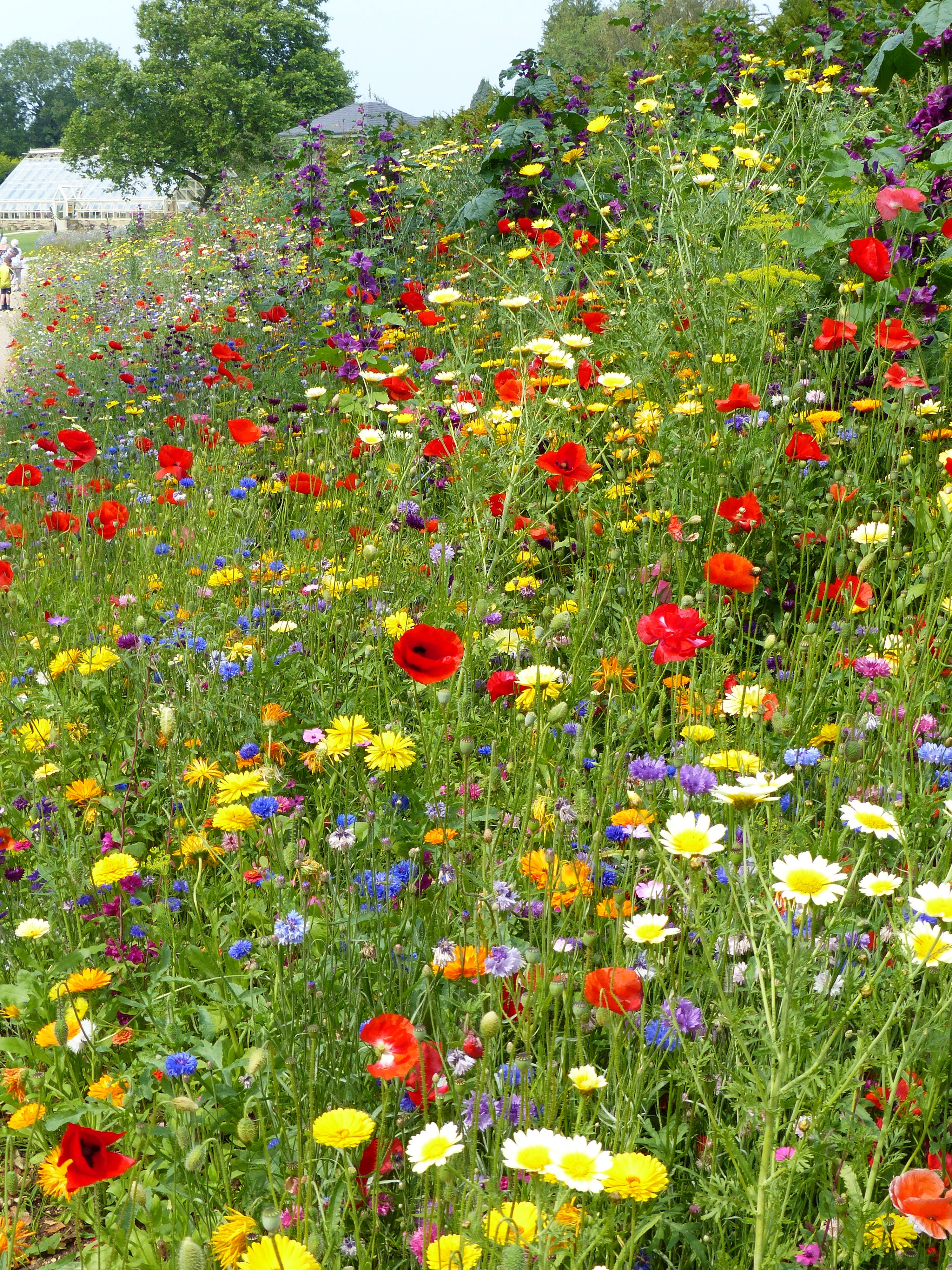
I have a theory that Northern gardeners like a brighter colour palette than Southerners ... perhaps building on a legacy of vivid Victorian annual beds in public parks that didn’t go out of fashion here as they did down South. Harlow Carr certainly supports my theory, particularly in its “sun border” planted meadow-style with poppies, cornflowers and other semi-wild favourites in a density that recalls the “mille fleurs” style of Medieval tapestries.

Elsewhere, abundant dahlias in bright purples, reds, yellows and oranges .... and shocking combinations thereof ... were often planted side-by-side with equally bold canna lilies, reinforcing a love of colour. Things are a little calmer along the stream that runs through the valley bottom, where my favourite section mixed hostas with a variety of Japanese maples. Though the palette was more muted, there was still a vast variety of leaf colour.

Like Wisley, this is a vast, diverse garden that would reward multiple visits. And like all RHS gardens this is a place for learning, full of interesting plants to inspire horticultural experimentation. Unlike Wisley, it’s also the home to branches of Harrogate’s famous Betty’s Tea Rooms, so you can break your wandering with a hot drink and one of Betty’s famous “fat rascals” purchased from a hut in a woodland dell at the far end of the valley. There’s also a full tea room and a take-away bakery counter outside the paid entry point, the former with views over some of the gardens, so there’s a shortcut for killing two Harrogate tourism birds with one stone.

The Alnwick Garden has less horticultural variety and less interest in its planting schemes, but is far showier in its hard landscaping. This is, fundamentally, a water garden, with an enormous cascade at its heart. Jets put on a Vegas-style “dancing waters” show roughly every half hour, with wide lawns at the bottom intended for families to lounge, picnic and watch the show. Children are encouraged to splash and paddle, whether in the corridor through the middle of the cascade where you’re never sure when plumes and jets will come on to drench you, or in gentler streams and fountains to the side and top of the cascade. Locals clearly know this and treat the garden like a water park, with cautious parents kitting their kids out in wellies and waterproofs while others let their progeny strip down to a bathing costume and get drenched.

I couldn’t help thinking with wry amusement of the Princess Diana memorial in Hyde Park, which was designed for children to play in its streams but changed its rules soon after opening due to Health and Safety fears. The Northerers are clearly made of sterner stuff.

This all provides for much spectacle and amusement, but it inevitably means that this isn’t a particularly calming garden. Even at the very top, in a walled garden divided into grids of different colours and plant types, where serious gardeners will find the greatest horticultural interest, you’ll also find children stomping down cobbled rills of flowing water and reacting with gleeful delight to the central water feature that bubbles intermittently, like a pond in a geyser field. 

Water features sprinkled around the garden all have different points of interest, from one that seems to drain like a sink from its centre to another that’s reminiscent of a giant water clock and sends jets up and out when its reservoir fills. Many of these are in, or led to by, towering walls of hedges that give much of the garden the feel of a giant maze.

Two areas offer a respite from aquatic merriment. There’s a large and diverse rose garden, dominated by David Austin varieties, planted in a spiralling pattern in a walled corner of the garden behind more screening hedges. It’s not at its best in August, though I enjoyed the secondary bloom on some varieties, highlighted by clematis planted throughout to add late summer colour. In late May and early June, however, it must be spectacular. 

The other “quiet” area is the poison garden, for which Alnwick is probably most famous.

Though the link isn’t made overtly, most people will associate the poison garden with the Harry Potter franchise and its potions classes, given that the neighbouring Alnwick Castle stood in for Hogwarts in the first two films. The concept stands on its own, however, and is a fascinating exploration of plants that can do harm. Many are obvious: there’s hemlock, henbane, monkshood, deadly nightshade and others that fans of Poirot, Miss Marple or Brother Cadfael will recognise as devious paths to murder. There’s also a wide variety of plants common to many gardens, and only dangerous if treated in certain ways or exposed to specific types of people (like pregnant women). These include rosemary, hellebores, foxgloves, lily of the valley and daffodils. Perhaps most interesting are the plants that can be used for medicinal purposes but are often abused to the detriment of our health, or lethal overdose. The coca plant, khat, hemp, marijuana, tobacco and the opium poppy all grow here, and are the focus of a local programme encouraging teenagers not to do drugs.

Access to the poison garden is limited, you’re not allowed to touch or smell anything and it’s small enough for the guides working there to keep an eye on everyone. The only negative? It’s not actually a very attractive garden. Many of these plants look like struggling weeds; or at least they did in August. The garden scores high on intellectual interest but low on visual appeal. 

Alnwick and Harlow Carr were created for two very different purposes, and they serve them beautifully. As the RHS anchor in the North, Harlow Carr carries on its organisation’s wider mission of education while giving members an HQ for horticultural events in the region. The current duchess of Northumberland created Alnwick (despite sceptical criticism) as a major tourist attraction that would draw visitors North and as a community garden with a variety of outreach programmes for locals. In both cases, it’s great to see England’s grand old tradition of gardening being used to bring new, fresh and exciting life to the areas these gardens beautify.

Saturday, 31 August 2019

Avebury, HMS Belfast and Glyndebourne show the diversity of English attractions

The plunging pound may be killing my holiday spending power, but it's drawing foreign tourists to British shores like bees to a spring orchard. We've seen more American guests this summer than the total for several previous years. Before each arrives, I ask them about sightseeing preferences. The variety of answers illustrates why England has such broad appeal.

Culture vultures are ecstatic at the density of museums, theatres and galleries. The history nerds head to castles, country houses and re-enactments. Americans are particularly keen on Downton Abbey and royals, and there's still a surprising amount of Diana-themed tourism. Fashionistas, foodies, landscape painters, hikers, surfers and music lovers can all easily craft itineraries focused on their specific interests.

A surge in my own sightseeing levels over the past fortnight drove this point home. Three destinations with three different companions. All radically different. All wonderful.

AVEBURY: For the new age spiritualist and the countryside lover
More than 1.5 million people flock to Stonehenge every year. It's one of those Top 10 "must sees" that a lot of foreign visitors feel they need to check off their list to claim that they've "done" England. Yes, it's impressive. And a much better experience these days thanks to the 2013 addition of museum and visitors' centre. But it's also one of the most expensive tourist attractions in England (£19 for an adult entry), packed with jostling hoards of bus tours, and you can only stand at a distance and gaze respectfully at the stones. Venture 24 miles further northwest and you'll be in the middle of the world's largest megalithic stone circle, without a group tour in sight. At Avebury you can actually touch the stones, see much more of the original monumental landscape and have a charming old-world village thrown in as a bonus.
And you don't even have to give up Stonehenge to visit. Though there's always talk of running the road through a tunnel, for now the A303 passes within a few hundred metres of the more famous henge, giving passengers a chance to have a good look from the roadside without paying for admission. (There's no stopping on this stretch of road, but there's inevitably traffic that slows things down.) The additional half hour's drive takes you through some striking landscapes. Dramatic, broad sweeps of Salisbury Plain's vast rolling fields alternate with small wooded valleys and charming villages with a tourist-pleasing percentage of thatch. You might even see a tank: besides being a picturesque landscape, the army uses much of it as a practice range. Look carefully as you pass through and you'll realise many hills and ditches are too regular in shape to be natural; Stonehenge was just one monument in a massive complex of henges, tombs and ceremonial sites that spread across this area between 4,000 and 5,000 years ago. (Roughly the same time as the great pyramids were built and people were making legends in Troy.)

Avebury has three stone circles: the gigantic outer one that's more than 1000 metres around and 347 across, once made up of almost 100 massive blocks, and two circles sitting side-by-side within. All of this was surrounded by a deep ditch with a high bank on the outer side, and a single ceremonial avenue cutting through it into the main circle. You can make out most of this today, though at least half the stones are gone and there's a village tucked into half the circle. The remaining stones stand like ancient, petrified giants, twisted by eons of weather into fantastic shapes. Touch them, stand beside them in communion, picnic in their shadow; there's no one to stop you here. In fact, there may well be more sheep in the fields in which you're standing than fellow tourists. The views from the top of the encircling mound are fantastic and the walk around the half of the circle standing in splendid isolation is one of the best in England. You can even bring your dogs.

The village itself sits in the other half of the circle, perhaps most distinctive for its handful of "New Age" shops. Avebury, even more than Stonehenge, is the emotional home of modern paganism and those who seek to connect with an earthy spirituality. If you're in to wicca, crystals, animism, Tarot or anything along those lines, the small shops here are a treasure trove. The less spiritually inclined can enjoy The Red Lion, the kind of thatched, traditional pub that's everyone's fantasy of ye olde England. Nearby Avebury Manor is one of the most unique houses in the National Trust's care. An exquisitely mellow 16th century stone pile on the outside, its interiors weren't significant so the NT offered it up for a posh reality show in 2011 where academics and designers re-created rooms in five different historic styles. Thus you can sit on chairs, touch stuff and have a play at being lord of the manor.

There's no charge to wander the stones, but you'll need to pay for the car park. It's £5.60 for admission to the small museum and £12.30 for the manor; all free for NT members.

HMS BELFAST: For the WWII and nautical history buff
She's been moored on the South side of the Thames, just upriver from Tower Bridge, since 1971 and draws about a quarter million visitors a year. The Royal Navy cruiser has been preserved much as she was when in service, and makes a fascinating counterpoint to anyone who's scrambled around HMS Victory in Portsmouth. Though the technology is vastly different and they're separated by 200 years, there are striking similarities in their layout and the way they functioned.
Belfast shares a name with the city where she was built, in the famous Harland and Wolff yards that also turned out the Titanic. She launched in 1938, just in time for the WWII North Sea service that made her famous, later transferring to Asia and playing a big role in the Korean War before being decommissioned in the 1960s. The way she spans eras of technology makes her particularly interesting. Some of her "bones" are charmingly old-school, like the wooden main deck, the ship's bell and the elegant patterned weave of the sick bay's blankets. But the red-and-white checkered lino flooring throughout is pure 1950s, and her navigation and weapons technology was incredibly advanced for the '60s. (If you're at all interested in the history of communications technology the areas on display here are particularly fascinating.)

This is a magnificent venue to expend the energy of restless children and a no-go area for the disabled, since seeing the ship properly demands scrambling up and down at least a score of ladders. The highlights for me were the two bridges in the front of the ship (one for the captain of the Belfast herself, and another on the deck below from which the admiral of the fleet could command accompanying ships) and the gun experience aft, where you can climb into a gun turret to get a sense
of what working there in battle would have been like thanks to a dramatic film using interviews with real sailors, and some simple but dramatic effects like gun smoke and a rumbling deck beneath your feet. I was shocked to learn that the men working the guns had no sight of the outside world. More than 20 of them were essentially packed into a dark, heaving metal box, taking aiming and firing instructions from elsewhere in the ship. It must have been horrifying.

The Belfast's location means she also benefits from some of the best views in London, which she makes the most of with a cafe up top and lots of places to stroll, linger and look. Wandering amongst bristling guns makes for an odd pleasure garden, but that's what her decks can be on a sunny day.

Admission is £18 at the door (less when purchased online in advance) or free for Imperial War Museum members. That includes an audio guide. Or you can just wander and benefit from informative displays throughout.

GLYNDEBOURNE: For the gardener and opera aficionado
You'll need connections or deep pockets to get into this one. (I, thankfully, have the former.) Tucked into the rolling chalk downs above the Sussex Coast, Glyndebourne is the mother of the whole English Country House opera tradition. Given our regular involvement with Longborough (most recently covered here) I was fascinated to take a peak into these sacred grounds on a members' open garden day.
The lovely manor at the centre of things looks venerable, but is actually a "Jacobethan" shell built around an older house and its additions early in the 20th century. The open day included access into "the organ room" where Glyndebourne's love affair with opera started. Its enormous windows, wood paneling and blue-and-white ceiling make it a treat to get inside.

Owner and music lover John Christie built this barrel-vaulted, 80-foot long room to house one of the largest organs in the country outside of a cathedral, then started hosting opera evenings here.  Originally amateur affairs with friends, he decided to get more sophisticated by hiring a professional troupe, then fell in love with and married the soprano. Eventually a purpose-built theatre sprang up next door to show off her talents. That original was replaced by a 1,200-seat, four-level, horseshoe-shaped auditorium in 1994 with state-of-the-art acoustics and all the backstage sophistication needed for what, by then, had become one of the country's leading opera companies. This space was open as well, allowing us to appreciate the light wood paneling in thin, vertical strips which is both dramatic and elegant and, I suspect, great for sound quality.

The real purpose of this day, however, was what lay outside. Glyndebourne is surrounded by glorious gardens that are now famous as a venue for posh pre-operatic picnicking. Given the age of the house, it's no surprise to find lush, romantic borders of mixed perennials in a style similar to contemporaries at Sissinghurst and Hidcote. There's an aromatic rose garden that spins around a fountain memorable for a bronze of one of the founder's pugs taking a nap. Broad lawns sweep down from the house to a ha ha, that marvelous English invention of a sunken wall and ditch that keeps sheep off the lawns, beyond which the woolly flock grazes in pastoral scenery. Elsewhere there's a long reflecting pool dotted with lilies and a productive bit of the grounds with greenhouses, orchards and vegetable beds maintained with Chelsea Flower Show-worthy precision.
There's plenty of modernity and innovation here as well. The grounds are dotted with sculpture, the most striking pieces made of rusted iron sheets of  geometric shapes that contrast beautifully with the greens and blues in which they're set. The most surprising bit of the garden is a bit wedged into a slope between the old, formal gardens and the opera house. Part jungle, part fernery, it has an enchanted "secret garden" feel about it that makes it feel like something very alien and exotic has been hidden in the landscape. A bit like the opera itself...

Glyndebourne isn't open to the general public but it's a great reminder of the stunning gardens found throughout Sussex. Check out Great Dixter, Hever Castle or Parham House for some gardens with equal appeal in the same area.