Showing posts with label luxury hotels. Show all posts

Sunday, 23 April 2023

Gardens, food and architecture vie for perfection at The Newt

The Newt in Somerset is a legend on the English luxury hotel scene, but one I hadn’t experienced yet despite its embodiment of things I love: great locally sourced food, historic houses, impressive gardens, cider, and the Chelsea Flower Show. That changed this week when I joined friends for an indulgent lunch and a wander around the property. 

One of the first warm and cloudless days of the year made the journey there as lovely as the event itself. While driving 90 minutes for a lunch date may seem mad, the southwest’s A303 is one of the loveliest roads in the country, starting with the sweeping vistas of the Wiltshire downs and a drive by Stonehenge before the hills start to close in and you’re winding through the picturesque coombs of the West Country. Hilltops offer spectacular views over undulating countryside luxuriating in the spring palette of newly lush green fields, speckled white with sheep and this year’s newborn lambs, and the shocking yellow of oilseed rape just coming into bloom. Often the 303 is made miserable by slow traffic, but I was blessed with a smooth run. At xxx you peel off onto smaller roads. More bends, more climbs and plunges, but now with the occasional character cottage or venerable old barn at the roadside. It’s not a drive I’d want to do at night, or in bad weather, but in good conditions it’s glorious.

The final approach to the hotel seems calculated more for great views and building anticipation than for speed. You’ll need 10 minutes more from the time your satnav tells you that you’ve arrived before you are finally parked up. You’ll skirt the estate walls, catching enticing glimpses of the hillside gardens, and go by multiple gate houses and entrances before finally reaching the main gate and essentially doubling back on yourself to get to the house. There’s even a view from the drive carefully placed to show off the house in all its glory, across a field inhabited by rare English white cattle. Parking is out of view of the house and its guest accommodation, cleverly hidden behind high hedges and spreading along some modern barns that serve as the administrative hub of the estate. A cheerful lad in a striped jacket, dressed more like he was heading to Henley than working in Somerset, sat in a shepherd’s hut, greeting guests and directing them to the house.

While we’re not in the Cotswolds here, the golden stone, 17th century architecture and cosy sprawl of adjoining farm buildings is much the same as you’d find in any small estate in neighbouring Gloucestershire. There’s something about the architecture and feel of the exteriors that reminds me of Snowshill Manor. But there are no crowds of tourists here. Only hotel and restaurant guests enter this way, and there are few enough of those to make it quite likely you’ll be on the approach on your own.

You work your way up a stone path lined by old outbuildings now restored to a level of perfection their original builders couldn’t have imagined. An old barn has had one wall replaced by a seamless sheet of glass, showing off a gym with equipment overlooking a small formal garden ablaze with spring bulbs. A granary, still perched on its rat-defying pillars, offers detached accommodation. Places once used for brewing, baking, laundry and storage become hotel rooms and a luxury spa wrapping around an outdoor pool. At the end of this tiny agrarian complex, two pillars mark the transition to “the big house”, in truth the kind of modestly-sized place that would have been occupied by the gentry who show up in Jane Austen novels, not the aristocracy.


Interiors are traditional with enough modern twists to make it clear they’re catering to a clientele that has both money and a taste for the latest trends. Like any self-respecting luxury hotel these days there’s no obvious check in desk, just a staff member or two popping up to enquire into your business on property. On this ground floor there are several lovely sitting rooms, each with a different vibe (drawing room, library, garden room), one of the best boot rooms I’ve ever seen kitted out with Barbours and wellies for all, a magnificent floor-to-ceiling diorama of a riverbank teaming with taxidermised wildlife and a restaurant of two halves. Part is all panelling, fireplaces and tradition, while the bit next to it is an old yard now glassed over, kitted out with orange and lime trees and with a view of the open kitchen. It was in the latter that we settled for our lunch.

The Newt is one of those places that’s deadly serious about local sourcing and, like Raymond Blanc’s Le Manoir or California’s French Laundry, makes a big deal of its vegetable gardens. Which means that the whole menu skews towards the vegetarian, with three of the five starters and three of the five mains being virtually meat free. Where proteins looked to the animal, they were pork or beef raised on the estate or fish landed that morning on the nearby coast. It’s probably the first time in my life I went for two vegetable-based courses not because I was watching calories, or trying to save the planet, but because they appealed the most from what was on offer. It’s hard to beat just-cut, early season English asparagus, of course, especially when paired with a fresh egg topped with just a bit of crispy bacon. (There’s the “virtually” on the meat free front.) My main was a buttermilk-fried celeriac, essentially treating the humble root vegetable like southern fried chicken. It was probably the best meat-free main I’ve ever had; you had no feeling that you were sacrificing anything. The celeriac really was just as good as chicken would have been. Then we split some ricotta and olive oil cake, puncturing a big hole in the local sourcing story with its side of plum compote from fruit brought up from the owner’s estate in South Africa.

We walked off our relatively virtuous lunch with a stroll through The Newt’s famed gardens. I now understand why they’ve put their money behind Chelsea Flower Show sponsorship, even though they’re not a proposition that markets to the masses. These are people who are serious about gardening, and want a place in Britain’s highly competitive horticultural firmament. 

A series of terraces leads down from the house, the direct eyeline taken up with sloping lawns and fountains while over to one side a series of garden rooms are stuffed with perennials and, at this time of the year, a broad range of tulips. Whatever path you follow, you end up in the vegetable garden that just supplied most of your lunch, as much of a work of art … though not quite as large … as the famous vegetable parterres at Villandry. This ruthlessly traditional garden is left by a radically modern, undulating metal pergola that my friend, a local, told me drips with squash in the late summer. Above it is the real treasure of The Newt: the national apple collection.

There are a lot of magnificent apple orchards in England, and I never thought I’d see one to beat the wonderful walled garden at Houghton Lodge, Hampshire, with its centuries-old apples. But The Newt may just beat it. Apples from every county in the country are laid out in ascending terraces, all of them artistically shaped. There are diamond, diagonal and low-fence espaliers, goblets, spirals and pyramids. It’s a tour de force of artistic mastery over nature; the closest the English get to the Japanese obsession with bonsai. It’s easy to imagine how glorious this place is when all of those artistically-placed branches are laden with fruit, but late April as the blossom started to come out was magnificent. I suspect two more weeks will see this unique orchard at its peak.

The South African owners made their money in their Babylonstoren vineyard, and they’re taking the same fruit-to-bottle approach with the apple collection here. The Newt is becoming increasingly known for its high-end ciders, and cider-making time here is quite the event. Even now, in the off season, the equipment for the harvest and making is impressive.

A spring afternoon at The Newt was a beautiful connection with all that’s best in the English countryside. But I suspect it’s even better in the autumn, when the fruits of the harvest are rolling in and making what fills the table and the glass even more glorious. Looks like I have yet another item for the bucket list.


Wednesday, 28 October 2020

The focus shifts to luxury hotels as the annual Girls’ Trip stays home

 I should have been reporting from Krakow.

Over the years my annual girls’ trip, now in its 19th year with the original trio of Northwestern University friends at its core, has brought this blog to some of Europe’s most intriguing vineyards, historic townscapes and magnificent dining experiences. We’ve even stretched to the beaches of Florida and the vast drama of Iceland. Not this year.

Once our flights to Poland cancelled, we decided that the combination of shifting COVID-19 regulations with the scheduling pressures of (now) four intensely busy professional women made foreign travel impractical. It was time for a staycation. Devon and Cornwall beckoned. Fortunately, though diagnosed illnesses were rising across the UK and much of the country was heightening restrictions as the trip approached, the infection rate in the West Country remained low. And with the money we’d save on that cancelled travel, we could splash out on some properly luxurious hotels.

Our destinations: two nights at the Bovey Castle Hotel in the windswept drama of Dartmoor National Park and three at British hotelier and designer Olga Polizzi’s famed Tresanton in the achingly charming Cornish fishing village of St. Mawes. The first was a triumph on every front, including an unexpectedly lavish seven-course tasting menu. The second, though a tour de force of location and exquisite interior design, fell down on enough basic service points to leave me questioning the value I got for my money. I’d happily return to Bovey Castle, but another trip to St. Mawes would see me trying other options in the village.

BOVEY CASTLE

Arts and Crafts designer Detmar Blow created the neo-Jacobean pile for the W. H. Smith family in 1907. Though it looks a thoroughly aristocratic establishment, the architecture doth protest too much. Blow’s traditional designs were countering the very new money that came from the owner’s stationery business. The property’s old-world scale quickly proved impractical and by 1930 it was already being run as a hotel, a status the castle has retained ever since through a procession of owners. 

The original country house is still very much at the heart of the experience. Guests have the run of a variety of aristocratic settings for genteel relaxation, from a dark-panelled bar that could be a Shakespearean stage set to a towering great hall with minstrels gallery and enormous oriel window taking in the moor. 

There’s a whole sitting room’s worth of overstuffed sofas beneath the grand staircase with its hunting lodge-style chandelier of stag’s antlers, a library that feels like Jeeves and Wooster just popped out, and a brighter, more delicate Georgian-inspired drawing room no doubt designed for the ladies to withdraw into after dinner. We lounged in front of at least three live fires across our two-night stay, with tweed-clad staff members regularly nipping by to add logs and see if we needed more drinks. 

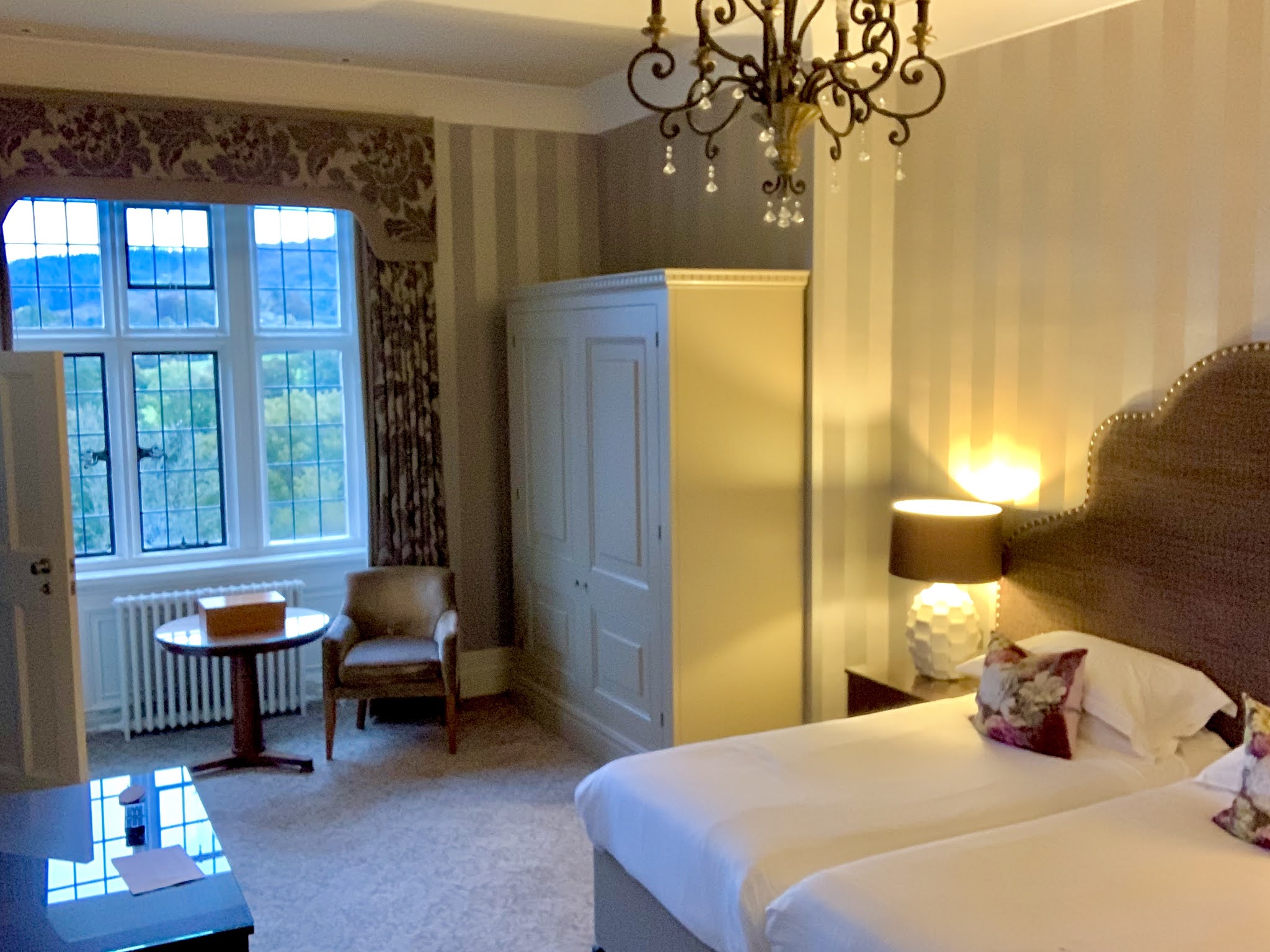
Our rooms were all on the first floor of the main house with high ceilings and atmospheric leaded window frames, but the lower key decor that went for a more modern elegance. Extensions and subsidiary buildings bring the number of rooms to 60. There are also self-catering lodges in the grounds, which include beautiful gardens and an award-winning golf course. Even though the place seemed to be operating at or near full capacity, we never felt crowded by others and could always make enough space not to hear other group’s conversations. That’s always a bonus but feels particularly relevant when trying to holiday during a pandemic.

Dartmoor is one of the few places that feel like real wilderness in England. The landscape is vast, rugged and sparsely inhabited. This is Hound of the Baskervilles country. Storms crash across the moors with little to stop them and the few roads that traverse the national park are either lonely ribbons disappearing into miles of fern- and heather-covered grazing land, or narrow tracks sunk between hedgerows with limited visibility. In short: it’s not the kind of place you want to go driving around in at night. We ate both dinners in.  

There’s a modern brasserie at one end of the main building and a warren of more formal, inter-connected dining rooms forming the Great Western restaurant at the other. Limited pandemic options mean pre-booking is essential and fine dining is only available Friday and Saturday nights, limited to a seven-course tasting menu. This was no sacrifice, dear reader. We could have easily grazed across the brasserie’s menu multiple nights, and the culinary extravaganza on Friday was on par with any of the fancy nights out we’ve enjoyed over years of Girls’ Trip culinary excess. The hotel had only recently re-opened the Great Western so the staff was positively giddy with enthusiasm. By the end of the evening we were on first-name terms with our sommelier Richard, whose wine flights were well judged and inventive, and our lead server Emma. We were delighted by the local sourcing of the food and the time the team took to tell us about it. Autumnal liver and mushroom pate, a creamy artichoke veloute, and the estate’s own venison in a velvety red wine sauce are, frankly, exactly the kinds of things you should be eating in a firelit castle while the wind howls outside.

The weather isn’t always frightening on Dartmoor and there’s a wealth of things to do here, including hiking across dramatic views, villages with a high proportion of interesting gift shops and galleries and a vast number of tourist attractions from worthy National Trust houses to child-pleasers like Pixieland and the House of Marbles. We ventured out briefly but spent most of our visit simply enjoying the facilities. This includes a beautiful Art Deco-style pool with deep blue tiles, a built-in jacuzzi and a glass wall taking in more of that sweep of moorland. Access to that and the gym is included with your room, though these days must be pre-booked. The castle also has a range of country activities including shooting, archery, fishing and carriage rides that can be booked for an additional fee.

We were all sorry to leave, but the promise of an even more lavish experience lay ahead.

TRESANTON

Hotel Tresanton is one of those places that’s acquired the status of legend amongst affluent London executives. Spoken of with the same reverence people lavish on the Soho House properties, the members’ club at Skibo or the Ivy’s private dining room back when there was only one “The Ivy” in the UK, designer and hotelier Olga Polizzi’s laid-back beach club in Cornwall has been a go-to choice for the great and the good’s seaside holidays since it opened in the late ‘90s. Its exquisite interiors have probably featured in every British design magazine and it regularly turns up in the luxury escapes features of publications like the Financial Times’ “How to Spend It” or Country Life’s travel supplements. 

We were expecting a lot. 

We were disappointed.

Tresanton is nearly 40% more expensive than Bovey Castle and yet the Dartmoor hotel beat it on every front; most particularly on service and on pandemic management that made us feel safe. Tresanton has the feeling of a place resting on its laurels, so sure of the adulation of fashionable London that it doesn’t have to try very hard. That may be the case at the moment, when pandemic-constrained people are dying to get back to familiar places, foreign travel is curtailed and executive home workers are flush with the cash they haven’t spent on commuting and foreign holidays. But it’s a dangerous strategy for a travel industry in crisis. All four of us left with the same conclusion: we’d return to St. Mawes but not to Tresanton, and we’d warn people away from repeating our mistake.

Let me start with the positives. Location. Location. Location. St. Mawes is the kind of adorable fishing village that feels like it’s been cooked up to stage an Agatha Christie detective story or charming little film scripted by Richard Curtis. It snakes around a small, peaceful inlet like an inverted question mark near the entrance to the Fal estuary. A Tudor castle guards one side of the inlet, a lighthouse the other. A jumble of houses ring the harbour and run up the hills behind it, almost all of architectural merit and as pristine as a Disney park. Pastel walls are freshly painted, thatch roofs fairly new, pristine pots spill over with flowers and clean windows sparkle. Tresanton’s windows, balconies and terraces take all of this in. At the edge of the village by the castle, the hotel is far enough away from the centre of things to enjoy the quiet, but a 10 minute stroll will take you to the bustling little harbour with two excellent pubs, a wind-sheltered beach, gift shops and a regular ferry service to Falmouth. There’s loads to do in the surrounding area but you can easily sink into the local scene and abandon your vehicle in the hotel’s hidden car park until it’s time to leave.

Tresanton lives up to its design icon status. Polizzi won plaudits for mixing casual and formal, antique and modern, print with pattern. Most of the place feels like an eclectic and tasteful private home assembled over generations rather than a commercial establishment. There are sisal carpets, slouchy overstuffed down sofas and chairs, piles of intriguing holiday reading and eclectic mixes of art, from African tribal masks to local legend Barbara Hepworth's prints. The restaurants is a cheery blend of blues and whites with aquatic mosaics on the floor and sea shell shaped lighting giving the room a grotto feel. Polizzi arguably established what’s now the standard for high-end boutique hotels. Alnwick’s Cookie Jar, my favourite boutique hotel of recent years, is a direct descendant of what started here. 

The design ethos wasn't uniform, however. Though our twin-bedded room had a glorious bathroom with marble tub and glass shower cube, the girls in the singles reported "identikit Hilton bathrooms with cheesy plastic shower curtains." Loos off public spaces had high end toiletries to wash your hands but cheap paper towels to dry them. Rooms had toilet paper but no tissue. A wall unit in a downstairs hall offered Wellington boots to borrow for tramps along the beach, but some had been put away muddy so were hardly enticing. The longer we stayed, the more we noticed these little gaps in attention to detail.

Our biggest problem with the hotel came from the lack of indoor space, however, exacerbated by a cavalier attitude toward the pandemic. Tresanton is a complex of multiple buildings climbing a hill, with exquisite courtyard gardens and balconies framed by sub-tropical gardens. There was only one indoor sitting room available for 30 guest rooms. Bovey Castle has double the rooms but probably 10 times the indoor lounge space. Tresanton's sitting room (below) is clustered tightly with sofas and chairs and fully packed at meal times when the restaurant adds outside diners to residents. Though staff wear masks the guests can remove theirs as soon as they order drinks. None of us had been with this many strangers in such close proximity since the pandemic started, and we were distinctly uncomfortable. 

The dining room was also packed tight without any of the now-standard Perspex screens to offer some protection when tables are too close for comfort. The food is certainly not worth the sacrifice. Though pleasant, it was inferior to, and more expensive than, meals we had in the village.


The crowding sent a clear message: making money took priority over guest safety.

Even without a pandemic, at this lofty price point you expect more public space to lounge. There was an additional function room behind the lounge and a secondary bar at beach level that could have made extra room, but they were shut tight. Tresanton hadn't adapted any of the outdoor spaces to inclement weather use. No marquees, no canopies. We saw heaters and umbrellas but they weren't deployed. Excusable if we were in Greece but this is Cornwall, where changeable weather should be factored into any plan.

Service was average to indifferent, an impression exacerbated by just how exceptional it had been at Bovey Castle. Interaction was pleasant but perfunctory. There seemed to be no real interest in how we were enjoying our stay (until we checked out) and no desire to chat with us to discover our plans and suggest recommendations. An offer of drinks once settled in the only lounge could take up to an hour. There were no tea and coffee making facilities in the room and a delivery of the request took 40 minutes one morning. When assembled as a foursome we'd ask for water or coffee and it would come with a drinking vessel only for the requestor unless we specified for all of us. Little things, but things that a top boutique hotel hosting our group in the past would figure out after the first interaction. 

We were also intrigued that other than the front desk staff most of the service team seemed to have originated from either Eastern or Southern Europe. While we're used to that in London, it seemed odd in a distant county where employment is so heavily dependant on tourism. Boutique hotels usually put local staff front and centre to show off the nature of the place and provide those insider tips only the natives know. You'll get none of that here.

In reflection, I realise that what bothered me most about Tresanton was the feel it wasn't Cornish at all, but a seaside-themed bubble transported intact from Knightsbridge with all the capital's quirks. The not-quite-on-their-game-yet staff of young immigrants, the crowding, the aloof urban attitude. 

At a lower price point we could have let the irritations ... other than feeling unsafe ... slide in favour of enjoying the views. But let's lay it on the line here: our spacious double with a sea view was £370 per night.  In any circumstance I expect a flawless experience for that price. These days, I also want excessive care of my health and a feeling that the establishment isn't resting on its laurels, but finding ways to innovate and excel through changing times.