Showing posts with label Game of Thrones film locations. Show all posts

Wednesday, 14 November 2018

Seductive Split brings history alive

Dubrovnik interested me, but Split seduced me.

If Venice and Florence had a secret love child, then abandoned it to grow up in the ruins of ancient Rome, you'd get Split. It's gorgeous and haunting. Compact. Beautiful and mysterious. A place where the margins between the present and the distant past seem very slim indeed.

This magical time-shifting is most obvious in the peristyle, a rectangular public space at the heart of the old palace that forms the historic town centre. (I hadn't fully appreciated the reality until I got here. I knew the palace of Diocletian was in Split; I didn't grasp that the old town was actually in the palace.) In the peristyle, the Emperor Diocletian's visitors would have found a magnificent garden surrounded by a colonnade of towering columns of various colours, assembled to show the rich variety of empire. The greatest glories of the palace connected here. To the right, the temple of Jupiter (whose incarnation Diocletian claimed to be on Earth). To the left, the magnificent octagonal mausoleum that would someday take his earthly body. Straight ahead, a round vestibule where Diocletian would receive visitors, draped in imperial purple and haloed by light that came in from windows aligned to the sunrise and sunset, then bounced off gold-leaf covered walls.

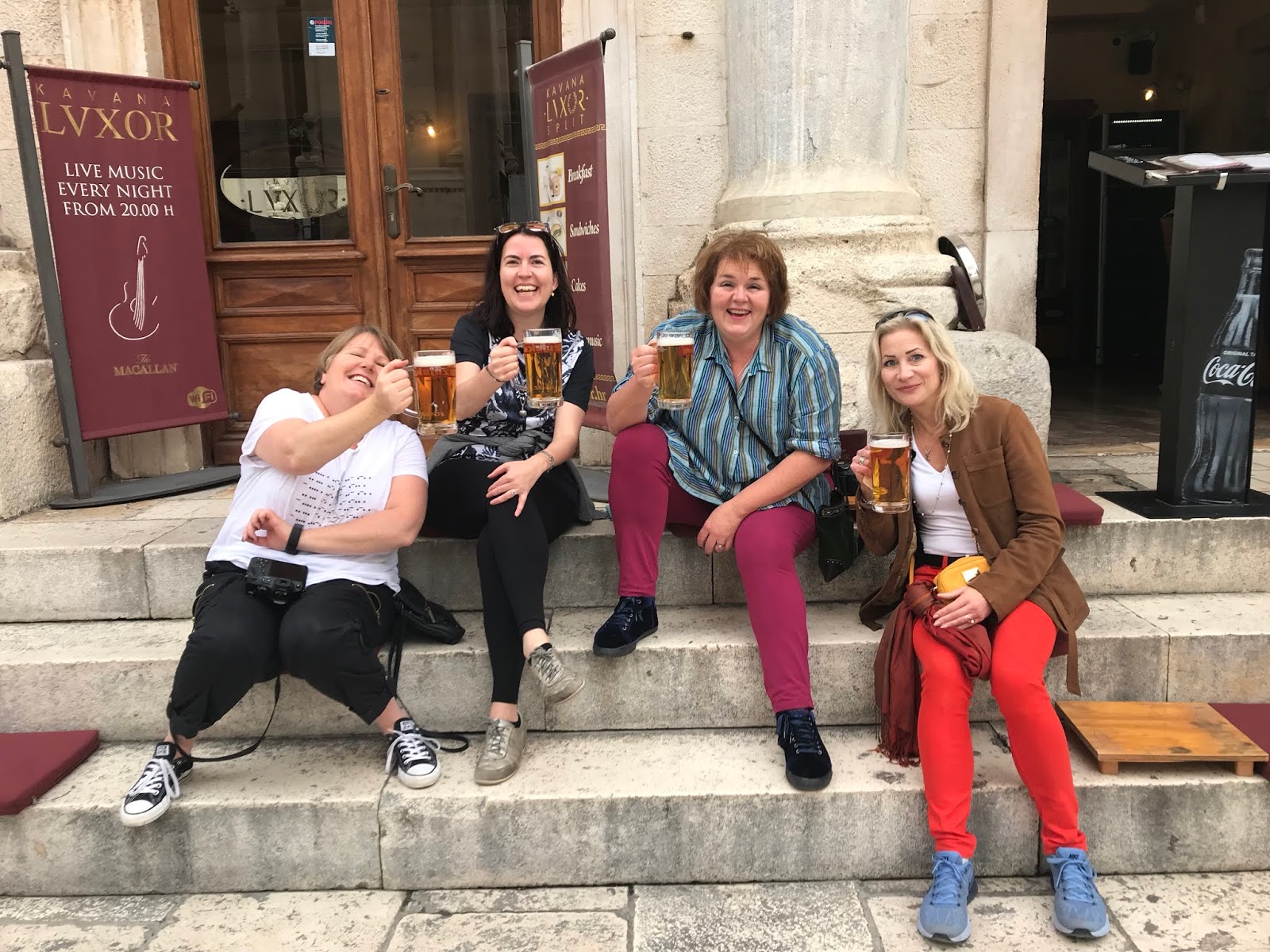
It's a little less showy these days, but all those elements survive. The peristyle is now a rectangular piazza known as Split's living room. The garden is long gone, now paved with white stone buffed to a mirror-like sheen by centuries of foot traffic. The mausoleum now stands, but as what must be one of the world's smallest cathedrals. The vestibule is an echoing ruin, now often occupied by musicians entertaining tourists and flogging CDs. Buildings have completely filled in the West side of the peristyle's colonnade, dominated by a bar and restaurant called Luxor. Their cushions cover the stone steps. While most visitors followed their guides through here, stopping, snapping photos, then moving on, we settled here at least once a day for cold beer and hot people watching. As dusk falls and the tour groups disappear, it's a magical place to while away the hours.

Tours aren't a bad idea, however. Beautiful as the old town is, it can be hard to piece its story together from your own observation. Informative guidebooks are remarkably absent. You can by a copy of Diocletian's palace modelled in white chocolate, but good luck finding one of those books that superimposes a coloured acetate onto a modern photo to give you a picture of then and now. There are a handful of plaques up on buildings, but nobody has bothered with a city trail that allows you to navigate around the old town's lanes understanding how they started. We hired history teacher Dino Ivancic to make it real for us. (Approx. £95 for two hours.)

Dino is either a remarkably good judge of character or an acquired taste to be approached with caution. I'm going to guess it's the former; he figured we already had a good understanding of basic history, were comfortable with wry wit and a bit of ribald humour. The resulting tour was half serious explanation, half history-based stand-up routine channelling Monty Python and Blackadder. So I didn't get quite the level of Roman history and architecture I would have liked (probably to the relief of my friends) but we were richly amused.

After a short walk out to the harbour to get a look at the full span of the palace walls, we plunged into its most remarkable feature. The basement. Yes, really. In order to level a sloping site, and put Diocletian's private apartments safely above sea level, the architects built an impressive sub-structure of lofty arched and domed rooms that matched the pattern of the palace above. The "barbarians" who moved in after the fall of empire couldn't figure out the underfloor heating, and thought the subterranean spaces would be more useful as cesspits. Their shocking mis-use of the space led to its preservation; the rooms weren't dug out by archeologists until the late 20th century, providing new understanding of the palace above and lots of museum-worthy artefacts that had been entombed in the mire.

All visitors get some exposure to these cellars as they walk from the main harbour-side entrance up to the peristyle. Craftspeople have set their stalls up here to form a picturesque shopping mall on the main tourist route. But for a small fee you can ramble though the whole atmospheric complex. Game of Thrones fans will get an extra thrill discovering the sets where Daenerys incarcerated her dragons and Barristan Selmy met his death.

Back up top, guides like Dino help you to decipher what the place looked like in the 3rd century and how it would have functioned in Diocletian's time. For example, standing us at the Iron (Western) gate today the path narrows quickly into a lane between shops. He pointed out the telltale marks in walls that reveal the width of the original road; the decumanus, where ten soldiers could walk abreast. Dino showed us how more modern centuries layered onto the Roman world, borrowing walls and integrating bits of ancient sculpture into their decor. He also exposed us to the historic Jewish quarter, not much mentioned in official guides. Similar to stories we heard in Dubrovnik, the people of Split didn't care much about religious differences as long as everyone made a good profit. This was a point of refuge for Jews getting kicked out of Spain at the time of the Inquisition, and Split boasts one of Europe's oldest continuously operating synagogues.

After leaving Dino we looped back to go inside the cathedral and the temple of Jupiter (joint admission ticket). Both are magnificent buildings. I found the cathedral both amusing and fascinating for its layering of the pagan and Christian. The frieze around the top, thankfully far too lofty for iconoclastic early Christians to do damage, has a shockingly profane theme of putti enjoying earthly delights of drinking and hunting. No doubt exactly what Diocletian planned to be doing in the afterlife. Successive generations have added a magnificent pulpit (very medieval Tuscan in style); pointy gothic side altars, a wildly opulent baroque altar that's a masterpiece of marble inlay work and a rather distracting choir. Despite all of this, it's still a resolutely Roman interior.
The temple of Jupiter, now the Baptistry, has seen less tampering. Other than a baptismal font cobbled together from gorgeous early Christian altar panels (almost Viking in their sinuous abstraction) and a hideous modern sculpture of John the Baptist, the space has been left bare. All the better to appreciate one of the most magnificent ceilings still intact from the ancient world. It's a coffered barrel vault, each coffer with a different decorative element at its centre and glorious foliage around its edges, held up by a ridiculously ornate, multi-levelled cornice. (Photo above) It was so magnificent I paid to see it twice.

For a separate fee you can clamber up the bell tower outside the cathedral. If its lines look a bit sleek, despite its Romanesque design, you're right to spot an aberration. It's one of the most modern things inside the place walls, being a 1908 reconstruction of an earlier tower that came down in an earthquake. I thought about this a lot as I made the vertigo-inducing climb. Pierced by stories of arched windows and entirely empty inside, the tower is ascended by metal stairs bolted to the interior walls. With nothing between the stair treads. Climbing feels like you're hovering in mid air. Descending is even worse. And I don't have an issue with heights. The view from the top is worth it. Be brave.

Streets immediately outside the palace walls are a pleasing melange of Medieval, Renaissance, Baroque and Neo-Classical. Many old palaces have a decidedly Venetian feel about them, with twisted columns and fanciful pointed windows. There's even an enormous piazza loosely based on St. Marks, with one side open to take in sea views. (Locals tend to drink here rather than in the peristyle). Other bits feel like you're deep in Tuscany (particularly the decidedly un-Italian sounding Narodni Trg square). There's a magnificent fruit and veg market out the Eastern gate and a fish market out the West; both will make foodies wish they had a kitchen.

Despite the antiquity, Split feels like a vibrant, modern town. Squares and restaurants are full of locals. Children play ball in the streets. There are trendy wine bars with rooftop gardens. We found restaurants we'd welcome, and repeatedly visit, if they existed in London. (Of that, more in my next story.) The shopping scene goes far beyond the expected tourist items; Split is packed with boutiques with locally designed clothes, dramatic jewellery and stand-out accessories. Most were a bit too high fashion for my style, but window shopping was a joy and we all agreed that the women of Split were some of the most fashionable of any city we'd ever visited. People watching was a catwalk show with good architecture.

There's no doubt this is a living city, not a stage set for tourists. That was obvious when we got out of town for our wine tour at Kovac. From Anton's vineyards we could see the sprawl of a very big, very busy place. "All the creative industries are here," our tour guide Andrea told me. "Government and the law are in Zagreb. Dubrovnik lives on tourists. We make things."

It's also a jumping off point for additional exploration. We gazed enviously at the day trips we wouldn't have time to take. Excursions inland to a national park famed for waterfalls. Jaunts to islands with exquisite beaches and picturesque towns. Winery tours (we'd done one, but there were more to be sampled.) The Medieval town of Mostar, just over the border in Bosnia, with its legendary bridge. Even Dubrovnik was accessible from here. The more I learned of Split, the more I marvelled that Dubrovnik is the go-to destination for most visitors to Croatia. This is the place I'd want to come back to, and use as a base for a longer holiday.

One of my great heroes felt the same way. If we dropped back two centuries ... still fairly modern for Split ... we'd find it a star on an extended Grand Tour trail thanks to now-legendary architect Robert Adam. In 1764 he'd printed a lavishly illustrated guide to the Ruins of the Palace of the Emperor Diocletian at Spalatro in Dalmatia. The first few pages are packed with the names of the aristocrats who subscribed to fund its production, topped with the king and queen. Thanks to a digitisation project at the University of Wisconsin, you can follow the preceding link to look at the whole thing online. Exquisite drawings go into obsessive detail showing architectural features that are, for the most part, still there and on regular view. He includes more "modern" fortifications and neo-classical buildings as well. Though scholarship has moved our understanding on since Adam's time (he believed the Mausoleum was the Temple of Jupiter, and the Temple of Jupiter one to Aesculapius) the  power and the beauty of the architecture hasn't changed.

And it will all look very familiar. Because this was one of the source books Adam used in his designs for the grand buildings of London and aristocratic country houses across Britain. Which were then copied across the world in government buildings, museums and grand residences. The creative spark we found in Split has travelled the world; most people just aren't aware of it. I'd encourage anyone who enjoys history and architecture to spend time here. They'll fall in love.


Thursday, 8 November 2018

There's more to Dubrovnik than Game of Thrones, but it's a great prism for seeing the city's history

One of the great joys of small group travel is the affordability of a dedicated guide. Funding a day of exclusive attention when travelling as a couple, or on your own, rarely makes financial sense. When you're splitting fees by four, it becomes logical.

While still a bit more expensive than standard group tours you can pick up on Trip Advisor, a little more money spent by our foursome on a dedicated guide inevitably returns enormous benefits. We get excursions crafted to our interests, form great relationships with our guides and have the flexibility to go off piste, whether in topic or locations. And we inevitably walk away with top tips for bars, restaurants and shopping. I'm convinced that our increasing use of private guides is one of the reasons that our annual girls' trips seem to get better every year.

It's probably impossible to tour Dubrovnik these days without talking about Game of Thrones. Croatia's not just a filming location; the show has spawned a whole new industry here. Shops bristle with themed items, costumed mannequins put characters on the street and dedicated boutiques will snap your photo on a full-size copy of the iron throne if you buy something. With three of the four of us being devoted fans of the fantasy epic, a dedicated tour was a must. But how to choose from the more than 25 options on Trip Advisor? Fortunately, one of us had past experience and hooked us up with Magnus Regis, a small company of locals who are all qualified guides, only do private tours and add professional backgrounds in history and archaeology to their passion for GOT.

Dubrovnik's walled centre is one of those places, like Venice and Bruges, that was once hugely prosperous but then forgotten by history.  There's little in your immediate view more modern than the 17th century. The most glorious buildings have the pointed windows and sinuous stone carving of those high Gothic merchant empires who linked East and West. Centuries of traffic have polished the white limestone streets to a brilliant shine like marble. The city insists that all signage must be worked into glass panels on uniform lanterns that hang above all the doorways, giving a pleasing uniformity to the streets.

No wonder directors love the place as a film set; It takes very little to conjure up another world. In addition to GOT, Dubrovnik has been the location for a soon-to-be-released version of Robin Hood, was the casino city of Canto Bight in Star Wars: The Last Jedi, hosts the currently-running Templar drama Knightfall and stood in for Venice in David Tennant's version of Casanova.  The Croats are also very canny business people. They scooped GOT off Malta at the end of Season 1, undercutting Maltese pricing, offering cheap and enthusiastic extras and massive additional support to the production team. They played the long game. They believed they didn't need to make money off the shoots themselves. The cash would come from the tourism that followed. They were right.

HALLOWED SPOTS AND HOT HISTORY
We started in the old town with Magnus Regis owner and founder Tom Matana. At the heart of the tour is a simple but effective strategy: you walk around, your guide gets you to a particular point, then holds up the appropriate page from a book of laminated scene shots from the show that are taken from the exact spot at which you're standing. He reminds you which season the action took place in, what's going on, and often gives you some insight into the movie magic that finished the transformation from modern Croatia to fantasy Westeros.

Good news for the GOT uninitiated: the last bit is fascinating even for people who have never seen the show. Look at how carefully this shot was framed to cut out the Christian imagery above the building's doors. (Even if there had been saints in Westeros, it's doubtful there'd be one above the door of Littlefinger's brothel.) Check out the artful addition of ivy and potted plants to cover those modern drainpipes and power lines. Look carefully here to see how the same guy appears in this scene multiple times; they filmed it with a much smaller group and duplicated it to form a crowd. Yes, those are the stairs Cersei descended in her walk of shame, but this is how they used giant green screens to block out the Jesuit church and university building at the top, and replace them with a painted version of the great sept.

Also good for non-viewers, the GOT sets are a prism through which you can explore all of this city's history, and because it's a private tour your guide can give you as much or as little as you're interested in. Standing on the old town's western heights (the walled centre is essentially a v-shaped cleft with the main business district on the flat bottom and steep, stair-stepped residential streets rising on either side) you can see by colour which tile roofs were replaced after bombing in the Bosnian war, and how terrifyingly close the ridge is from which the Serbs were attacking the town. Almost 300 Croatians died and more than 50% of the buildings in the old town were damaged (including the burning of seven Baroque palaces) and yet many visitors ... particularly non-Europeans under 35 ... are so totally unaware of the history that they think HBO paid for all those red roofs to give Kings' Landing a more uniform look. I was delighted to see so little evidence of conflict just 23 years after the end of a horrific war, particularly in a population far more interested in making a prosperous future than in re-hashing the offenses of the past. But as America descends into increasing factionalism, I couldn't help hearing Tom's stories about young tourists' ignorance and remembering that phrase about those who don't know history being doomed to repeat it. But I digress...

You'll learn why the broad, straight main street of the Stradun is so uniform: it had been the moat of an earlier, smaller version of the walled town, then was filled in and built on when the town expanded. The soft substructure made everything above it collapse in the calamitous earthquake of 1667, after which the town fathers mandated that everything be replaced to a master plan. Christopher Wren and London, eat your heart out. The number of showy churches and monasteries seems out of proportion to the place; we learned that the merchants of Dubrovnik were always flying close to the edge of Papal tolerance as they put friendly, business-enhancing relationships over religious disputes with their Islamic neighbours. Thus the church kept installing officials to keep an eye on them. The Croat's claim to have invented the cravat ... and through that, the necktie ... as tokens lovers tied around each others' necks before one went away to war. There's a museum here on the topic and shops selling gorgeous modern interpretations. Given the town's roots in trade, it's probably not
surprising that it also boasts one of the world's oldest continuously-operating pharmacies, from which you can still buy luxurious creams made with local roses and herbs.

And, of course, you'll also see the entire route of Cersei's walk of shame, the location of numerous street scenes and the exquisite little harbour that turns up in poignant moments of arrival and departure. We skipped the Red Keep (aka Lovrijenac Fort) because, this being the worst weather day of our trip, we were all soaked to the skin and the rain-slicked ascent looked dangerous. Time to switch to part two of the tour, which featured a handoff to driver/guide Neno and the comforts of a warm, dry car to explore some sets on the outskirts.

BEYOND THE WALLS
If you're only visiting Dubrovnik, it's possible that you'll never leave the walled old town except for airport transfers. This would be a mistake. The GOT extended tour is an excellent way to get a taste of the broader countryside.
Your first stop is the Trsteno Arboretum, 12 miles Northwest up the coast. The drive gives you a chance to appreciate Dubrovnik's impressive commercial and cruise ports, wisely screened by a line of hills from the old town, and a dramatic modern suspension bridge from which you can bungee jump if you're keen on adventure sports.

But the real attraction is the coastline itself. While the views from the walled town are fantastic, it's only by driving for a while that you appreciate just how expansive and beautiful the string of islands lying off the coast is. You don't get anywhere fast; this coastline could have been a piece of aluminium foil crumpled in a giant's hand, so deep and irregular are its bays. Rounding each gives different views of small villages and rocky hills covered with grape vines, olives, pomegranate trees and bougainvillea. You don't have to go many miles from Dubrovnik for the country to feel sparsely populated.

The Trsteno Arboretum was the country estate of a wealthy merchant family from Dubrovnik's glory days. In the middle 16th century, as a passion for exploring swept around Europe, the family's garden-mad patriarch asked his sea captains to return from trading missions with plants and seeds. Instead of the usual ballast, they filled their holds with topsoil from rich destinations so the boss could improve the poor base of his garden. Thus, despite years of neglect under the communists and a couple of disastrous fires, the garden is packed by an unusual number of exotic plants, from Asian bamboo to South American agaves. The place sprawls down a steep hill, with an aqueduct bringing water through an impressive fountain at the top, what's left of a summer palace in the middle and a private dock along the rocky shore below. A seasoned British garden and country house explorer is likely to be a bit underwhelmed; original planned beds and borders have lapsed into a benign neglect and the house is a mouldering ruin after the double hit of communist rule and war damage. Presumably the laid-back attitude to maintenance and conservation was an attraction for HBO, who were even allowed to gouge out part of the cliff face along the coast road to get their supply trucks in.

The production team certainly got their money's worth. An area not much bigger than a square mile shows up as the Tyrell family seat of High Garden, the gardens of the royal palace in King's Landing, some harbour scenes and even as the majestic seaside promontory on which Bron taught Jamie to fight again after losing his hand. (The latter was a perfect example of why you need a guide. Even standing 50 yards from the spot, you'd never discover it on your own as it meant climbing up a weed-pocked flight of steps, cutting through a yard of decaying boating equipment and slipping through a break in a wall and down some steps cut into the sea-side boulders to discover this dramatic scene.) Most memorable to many viewers will be the gazebo and another patio, both hanging over the sea, with remarkable views. Diana Rigg, who dominated most of the scenes filmed here, certainly pulled one of the better assignments by doing a lot of her shoots here. I didn't remember just how much nefarious plotting took place in the calming surrounds of gardens until we wandered Trsteno. It's no doubt a riff of the theme of beautiful-on-the-outside-rotten-within that shows up so often in GOT.

UP ON THE ROOF
Our penultimate stop required a return to Dubrovnik and the ascent of a series of hairpin turns cut into limestone cliffs to reach a high promontory that stretches above the old town. These are the heights from which the Serbs bombarded town, and the Croats tried to stop them ... with a few hundred yards of no man's land on the ridge between. It's one of the few places you'll still see war damage, as little has been rebuilt up here and the pockmarked land between is still rubble overgrown with weeds. We walked out to the edge of the cliff for an extraordinary view; it's as if you're hovering over the walled town and its bay like a gliding falcon. On a sunny day this would be one of the world's great picnic spots, but on our visit it was dangerously windy and lashing with rain. We beat a quick retreat.

Part of the ridge is covered by a long, straight bit of road bordered by a formal allée of trees. It's an oddly aristocratic touch to a fairly desolate area. Running beside it is a long, now-ruined complex of Napoleonic stables (different century, different invaders).  This area provided the backdrop for lots of travel scenes and meetings outside of Kings' Landing, including that touching moment when Brienne of Tarth and Podrick set off on their quest to help the Stark girls.

The final site was another proof point as to why a guide is essential. At the end of a long string of hotels and holiday villas along Dubrovnik's Eastern Bay, inaccessible except from a footpath behind a shuttered church, is a derelict hotel. The Belvedere was, for a just six years, the poster child for Yugoslavia's attempt to be an outward-facing, attractive, commercially savvy face of communism. The five-star luxury resort was an early casualty of the war and has been a hulking ruin since 1991, now overgrown with plants and its crumbling walls covered with graffiti. Part of the hotel's luxurious set up was a series of terraced patios flowing down the hill to a round arena hanging above the water of the Adriatic, with a clear view of the walled town across the bay. It must have been remarkable in its day.
And it was indeed remarkable as the setting for the trial by combat between Oberyn Martell and the Mountain. This is the place least likely to interest someone who hasn't seen the series. But for those of us who had, it wasn't hard to let your imagination return you to the majesty and the horror of that moment.

How long the arena will be on the GOT tour is an interesting question. The old Belvedere complex is now owned by a Russian oligarch who wants to tear the whole thing down and build a palace of opulence to match Dubai's bid for seven-star luxury. The problem: Croatian law demands public access to the seashore. Until the oligarch can assure his guests of complete privacy, he won't break ground. So the old Belvedere continues to crumble, and with a knowledgeable guide you can sneak  in to see one of GOT's most iconic film sets.

Note: You can also customise your full day trip with a boat ride to Lokrum Island, doppelgänger for the city of Qarth and reputed to be a place with excellent beaches for summer swimming. As it was a sodden day in November, we passed on this option.


Thursday, 16 November 2017

Bilbao & the Basque coast is a tour that will leave you wanting more

It was a travel company's mistake in Iceland that first opened my eyes to the exquisite treat of travelling with a private guide. Since that adventure with the stalwart Viking Halle, the annual girls' trip has splurged where possible on local experts to give us deeper, more meaningful experiences than we can create ourselves ... even with our prodigious combined travel experience.

Mikel and Ikusnahi Travel now join our list of precious memories. If you are heading to the BasqueCountry and are up for investing in something beyond the ordinary, these are the guys to call.

In Basque, the company name means a desire or willingness to see; a perfect summary of the ethos of this born-and-bred locally team. We peppered Mikel with questions all day, ranging across areas as diverse as modern politics, geology, religious history, architecture, food and art, and he never missed a beat. Once he realised we were curious about pretty much everything, he was a steady font of information. In fact, had we booked Ikusnahi for Day 1, instead of Day 3, I suspect we might have been trying to arrange a second session in the same trip. We all came away with loads of ideas for the next excursion.

The one we booked, however, is probably the most obvious for the first-time visitor to San Sebastián (Donostia in the native Basque): A visit to the Guggenheim in Bilbao, plus a few charming villages along the coast.  Sure, you can do that on your own, but you'll have to get to the bus terminal, take the long and tedious bus ride, make your way to the museum, deal with the ticket queue and then make your way home. Without any picturesque coastal drives.

Instead, Mikel picked us up from our hotel in a generously sized van that gave the four of us room to sprawl. He filled the hour to Bilbao with fascinating overview information about Basque history and culture, noted points of interest along the way, and prepared us for the striking first sight of the museum as you emerge from a tunnel. It's one of the most photographed buildings in the world, but nothing can really prepare you for the outrageous, awe-inspiring statement it makes, dominating the scene like some alien princess' castle.

Guggenheim Bilbao
We hopped out right in front and had our first look while Mikel parked the van. I knew that architect Frank Gehry chose the undulating shapes and metal scales to mimic the fish that made Bilbao's fortune. It's one thing to know, another thing to experience. As the clouds scud across the sky, they
reflect on the metal and the whole building seems to writhe like a school of cod dancing away from Basque fishermens' nets. It's extraordinary. Mikel walked us around the outside while explaining the history of the town, the building, and how they influenced each other. Today, it's hard to imagine that this vibrant, art-filled riverwalk, enlivened by clarinet-playing buskers and within view of a long line of gracious mansions, offices and public spaces, was once a derelict industrial district. And then, though the magic of Ikusnahi, we slipped in the riverside group entrance ... skipping a queue that stretched at least 500 metres by the time we left.

To my great surprise, the inside is just as good as the outside. Not just architecturally. This is a joyous, fascinating and carefully curated collection, presented in a way to make it accessible to all.

Frequent readers will be dropping their jaws in shock at this point. Yes, I dislike modern art. I've never been to a modern art museum that filled me with anything but a desire to leave quickly. (Unless I'm heading to the Tate's restaurant. Excellent views.) Until now. I could have stayed for at least another hour. For me, that's a revolutionary statement.

To read more about why the Guggenheim is so magical, check out the next story, when my guest blogger Suzy Christopher will offer her take.

But we couldn't stay. We had a date with a movie set.


Zumaia
Turns out Dragonstone is on the Basque coast. Game of Thrones fans (three of the four on our trip) will swoon with jealousy. The familiar set is actually a pastiche of two sites. Gaztelugatxe, a small islet off the coast, is connected to the mainland by a madly-winding stone bridge that ... on television ... leads up to the brooding castle and has been the site of so many dramatic conversations in Season 7. The atmospheric, cliff-lined beach lying at the foot of those stairs that is home to the cave with the White Walker paintings and the dragon glass hoard is actually in Zumaia. It would have been impossible to do both and our final destination for the day, as they're separated by about 80 kilometres of coast with no fast road connections. So we headed for Zumaia.

The reason the producers picked this place is immediately obvious. It's a geological blockbuster. Famous for a particular rock formation called flysch, these layers of compacted sediment were pushed upwards in a violent meeting of continents millions of years ago. The result is other-wordly, jagged strips of the rock, as if the cliffs had been constructed of giant sheets of blackened, upthrust mille feuille pastry. Horizontal lines of stone continue out to sea and cut back from the cliff tops. On the heights, however, they're softened by rich green grasses and shrubs. The tiny, ancient chapel of San Telmo perches on the headland, a waypoint on the ancient pilgrimage route to Campostella.

This was the second place we had to leave too soon. Zumaia deserves a day. A morning to scramble down onto that magnificent beach. Time to poke around the shops in the charming town below the cliffs before a lingering lunch. Then an afternoon's hike along the cliff tops.

But there was more to do. We headed east on the N634: a beautiful, winding thread suspended between cliff base and water. I suspect you could spend many happy hours simply driving this coast. We stopped half an hour later in Getaria, where a picture-postcard medieval village clambered up a hillside above a sheltered harbour.

Getaria
There's a unique Romanesque church here, built so that the whole place slopes precipitously back and down from the altar. Legend has it that the ruling nobles, parachuted in from Spain, insisted on the unusual architecture so that they'd always be physically above everyone else. I've never seen another church like it. Nor have I seen another place where the church actually bridges the main street: you walk through a tunnel beneath it towards the harbour, able to peer through grates into the crypt.

Cobbled streets wind past shops, prosperous old merchants' houses and nobles' palaces. This was the home town of Juan Sebastián Elcano, the first ship's captain to circumnavigate the globe, and they've honoured him with two statues. One stands proudly above the harbour, looking out to sea. Another stands before the town hall, looking South towards Spain. Is that a smirk of superiority the sculptor crafted into his face? Probably. The town's other famous son is fashion designer Cristobal Balenciaga. There's a museum to him here. Yet again, a place that could have beguiled us for hours.

The real point of our visit, however, was a late lunch. (The exploration came after.)

On a coast already famous for its cuisine and its seafood, Getaria is where the locals come to eat fish. It's also known for some of the finest txakoli, the gently sparkling local white wine. (Indeed, the Txomin Etxaniz we had here was the best of the trip.)

We ate at Kaia Kaipe, where the highly-polished wooden panelling and the expansive views over the harbour made it feel like we were inside a luxury super yacht rather than an ancient stone building. For the first, and only, time on our trip we were entirely surrounded by locals ... including a family group of about 30 around one enormous table, celebrating a couple's anniversary with gifts and songs.

Two decades ago, when I was still a full-blooded American pursuing high-intensity tourism, I couldn't have imagined taking two hours out of the heart of a sightseeing day to linger over lunch. Nor paying for a private guide to share than down time. Now, I see it as an essential part of the experience. Mikel knew the menu and the owners. Explained the local nuances. Ordered stuff that was off the menu, including an enormous whole turbot the five of us shared as our main course. We'd been doing a great job exploring local cuisine, naturally. But eating with a local made the experience that much richer. And the turbot ... which had doubtless still been swimming happily the day before ... was exceptional.

By the time we finished our stroll around town and stopped in a gourmet shop to buy txakoli and some of the famed local salt, it was time to head back to Donostia. One last advantage of our own guide: he could drop us wherever we wished. The day had been so wonderful we weren't ready to head home. So Mikel dropped us at the Gintoneria (already covered here), where we plunged into another round of exotic cocktails and reviewed the wonders of our day.

Mikel gave us a glimpse of a whole new world. Every one of us agreed we're keen to return and discover more.