Showing posts with label Split. Show all posts

Wednesday, 10 April 2024

The annual Northwestern Girls' Trip marks 25 years of marvellous adventures & priceless friendship


In October of 1999, three American expats living in England answered Northwestern University’s call to represent the institution at London’s Fulbright College Fair. They hadn’t known each other on campus, but the girls had all graduated within four years of each other and quickly hit it off. All eager to take advantage of the opportunities for tourism offered by life in England, they thought they might be good travel companions. In March of 2000 they put their suspicion to the test.

The rest is history.

Tomorrow, it’s officially 25 years of gloriously entertaining, adventurous, relaxing, story-spinning history. Our annual Northwestern Girls’ Trip hits the milestone when we board our British Airways flight to Naples.

There have been changes over the years. In the early days we were more likely to do multiple, short trips across the year. As we settled in to life in the UK and our jobs got progressively bigger, we focused on just one significant, annual journey. We’ve never missed a year, though parental illnesses, work travel, breast cancer and Covid all proved challenging. In 2020 we slipped a glorious road trip to Devon and Cornwall in between lockdowns but in 2021, despite two attempts, we only managed one day as a complete group due to positive Covid tests amongst us. Over time, our working lives became so busy we learned to compare diaries and pencil in the date for the next year as we were wrapping up the current trip. Once the dates are resolved, girls' trip is sacred.

In 2017, we expanded our trio to a quartet. It was a big decision, given the perfect balance we’d established, but we’d all known Suzy almost as long as we’d known each other. And though she hadn’t graduated from Northwestern, she’d worked for me twice … the first time straight out of uni … and I’d taught her much of what Medill taught me … so we granted her our special girls’ trip honorary degree. 
Finding ideal travel companions is no easy task. People like to move at different paces, do different things, and have different price points. Learning to go on holiday together was, by far, the biggest challenge of my marriage and one that took years to sort comfortably. From that first trip with the girls, however, it was clear that we were naturally in tune with each other’s preferences. 

The ideal girls’ trip should have a near-perfect balance of history, culture, fabulous food, vineyards, shopping, and indolent self-indulgence. We are all naturally curious and love to learn. We sightsee in high-energy bursts, then collapse happily into spas, wine bars or quiet spaces with a good book. We love an off-the-beaten-path experience. We’re also a gregarious bunch, and we’ve talked our way into a notable number of upgrades and remarkable extra treats. Perhaps the most extraordinary example took place in a forgettable town in central Spain. We were the only foreigners in the restaurant during a local festival. Our enthusiasm so charmed the waiters that they gave us a tour of their extraordinary wine cellars, dating back to Roman times, while we were waiting for a table. They lovingly described every course of the festival menu as we ate, then cracked out their home-made post-prandial firewater and invited us to drink with them after the restaurant closed. (Hillary will never let us forget she was the designated driver that day.) The older we get, the more we’ve noticed that young waiters rather enjoy a bit of mild flirtation from a group of women who could be their mothers. Though none have yet equalled those grizzled old Spaniards. 

Though we didn’t set out to define our journeys this way, they’ve become characterised by affordable luxury and often being just ahead of the curve of travel trends. Many places … most notably Speyside, Spain’s Duero wine road, Porto, and Split in Croatia … enjoyed time in the spotlight of the travel press just after we visited. We are the best travel documentary the BBC hasn't made. 

The affordable tag, of course, depends on your point of view, and our price point has crept up over the years with incomes and stress levels. But we’ve always focused on finding special places that are excellent value for money rather than just opting for whatever gets written up in a glossy magazine. These days we tend to look for four-bedroom apartments to rent rather than heading for upscale boutique hotels, and we’ve discovered the value of pooling our resources to hire private guides for outings.  

A set of girls’ trip guidelines took shape over the years. We travel over a long weekend, generally Wednesday or Thursday to the following Monday or Tuesday. It’s the least interruption to busy work schedules. Travel time should be no more than four hours. If you are celebrating a decade birthday (40, 50, etc.) then the destination is your choice alone. In other years, it’s a group decision based on a shortlist, with the final call made by vote or … in one memorable year … Lisa’s mother pulling the winning name on a slip out of a bowl after a Michelin-starred dinner. 

Combining resources to hire private guides has led to some of our most memorable experiences. These include a day wandering the slopes of Mount Etna with an oenologist who specialised in Sicilian wine and got us behind the scenes at several remarkable vineyards. 
A proud Basque showed us the little-visited seaside glories and Game of Thrones filming locations of the coast between Bilbao and San Sebastián
When a travel agent messed up our reservation in Iceland, a strapping Viking who usually only did high-end tours and had recently hosted Tom Hiddleston stepped in to drive us up to the glacier and take us spelunking in an Icelandic lava tube

This Friday, we'll be making new memories as a working archeologist leads us around the ruins of Herculaneum.

Vineyards have been high on the agenda over the years for this wine-loving quartet. Our intense interest in wine, thoughtful questions, focused tasting and … we like to think … tremendously genial personalities have often seen us invited by winemakers into their private cellars to taste stuff they usually don’t open and drinking with them well after official tours have ended. 

We haven’t always followed our own Girls’ Trip guidelines. Two of our journeys stretched over a week and one of those smashed through our 4-hour travel time limit. Lisa’s brief flirtation with moving back to the States meant that she was joining the 2007 trip from New York, so we turned it into a full-scale holiday in Tunisia. This was before terrorist incidents endangered tourism there. Even so, crowds were light outside of the main tourist resorts. Wandering virtually alone through the sprawling Roman ruins at Dougga is one of the great memories in the Girls’ Trip archives. 

Eight years later, when Hillary’s father was coping with an Alzheimer’s diagnosis, we travelled to the family home in Florida to revel in the warmth of his larger-than-life personality while he was still with us. 

Sharing parents has indeed become one of the hallmarks of the original trio. As women living thousands of miles from our families we all had a larger-than-average appreciation of time spent with parents. Over the years, a habit grew up of visiting parents including the other girls in a family meal whenever they were in London. All but two of those parents have left us now, but we have the memories forever. (And hope my dad and Hillary’s mum are with us for many years to come.) 

And so … older, wiser, and in need of a lot more down time than when we started … the girls are off to Naples. This year is a significant decade birthday for me, so the location, lodging and itinerary were mine to call. Culture abounds. I get to try to knock the rust off my very rusty Italian. Food here is lauded as amongst the best in a country already famous for its cuisine. And there’s a four-bedroom apartment with a roof garden waiting for us.  

La vita è bella. 

Here’s hoping for another 25 years. And here’s thanking my friends, God and good luck for the extraordinary adventures behind us. Great times with beloved friends are one of life’s most precious treasures on this endlessly diverting journey through life.


Sunday, 18 November 2018

Croatia: The Restaurant Roundup

Dubrovnik: The Taj Mahal, Forty-Four
Split: Bokeria

Will you eat well in Croatia? Yes. Is it a foodie destination? I'm skeptical.

This is contradicting the much-missed American food journalist Anthony Bourdain who, on a visit here in 2012, exclaimed "Croatia is the next big thing!" Perhaps, based on endorsements like that and on rising tourist numbers, they're just trying a bit too hard. Because while we found plenty of beautiful restaurants, revelled  in excellent service and ate well, I still can't tell you what on the food front makes Croatia unique. Nor did I see much evidence of the passion for seasonal eating and local produce that usually characterises great local cuisine.

Take, for example, the pomegranate. We saw them growing everywhere and it was obviously harvest time; tables in Split's market were groaning with them. I thought either the kernels or the syrup would  feature strongly but we never saw a mention on menus. Same for the exquisite cabbages (Diocletian, after all, famously retired here to grow them) and the huge numbers of oranges for sale on roadside stands between Dubrovnik and Split. We heard many boasts about the world-leading qualities of Ston oysters and the unique flavour of its sea salt, but didn't encounter either in restaurants. Given Dalmatia's historic role keeping trade open between the Islamic east and the Christian west, I thought we might find heavily spiced fusion dishes like those that turn up in Lebanon or Sicily. Nope. And considering the preponderance of big, bold zinfandels on the wine lists, I expected more spicy lamb dishes or rich beef stews, but most restaurants defaulted to local seafood and lighter dishes (most of which risked being overwhelmed by the fruity reds.)

Every restaurant we entered, with one exception, featured a menu that could have been designed by an international culinary consultant asked to create a generic Mediterranean experience to please all diners. All the meals we had were delicious. They just weren't distinctive.

The one exception wasn't Croatian at all, but Bosnian. You'll assume it's a curry house when you see its name, but the Taj Mahal draws from traditions much closer. Bosnia is only about an hour from Dubrovnik and, with the exception of a tiny piece of coastline, is mostly inland and mountainous. The Taj Mahal delivers all the exoticism of mountain dwellers existing between empires to the centre of old Dubrovnik. Here are the strongly-flavoured, smoky meats that paired perfectly with giant Zinfandels. Sensing our openness to new things, our waiter laid on a combination menu so we could try a little bit of everything. Bamija (a veal stew simmered with okra, tomatoes and garlic) fought with the house special (veal and turkey with mushrooms and cheese, baked in a pastry case) for dish of the evening. The sweets are familiar in description but distinctive in taste. Numerous people on Trip Advisor claimed their baklava was the best ever. It managed to preserve the honey, nuts and layered pasty of the familiar dish but somehow deliver it as something far lighter, more delicate and not so overpoweringly sweet; certainly worth ofthe superlatives. Half an apple, baked until soft then stuffed with a fine mince of walnuts, chocolate and honey was another winner.

Servers wear loose trousers and short, open-front waistcoats giving them a look somewhere between I Dream of Jeannie and Lord Byron's famous Albanian costume. The music is vaguely Arabic, but also reminds you of a Southern Italian tarantella or Spanish flamenco. The walls are covered with colourful Moorish tiles. It's all delightfully exotic yet comfortingly cosy, particularly on the sodden night from which we sought shelter. Even better, it was about half the cost of the meal the night before.

Forty-Four delivered our most expensive meal of the trip, and the one that felt closest to that design-
by-food-consultant concept. Which might not be too far off the mark, given that the place is owned by a professional athlete. Bojan Bogdanovic is a local boy made good in America's NBA, currently playing small forward for the Indiana Pacers. He wears No. 44, thus the restaurant's name. The place is blessedly free of sporting memorabilia, but in the premium priced-menu of steaks, lobster and fine wines it follows the template of sporting stars' restaurants around the world.

On Halloween night we were the only ones in the place, so maitre d' Goran (photo, top) made us the centre of his existence. And he delivered a memorable experience. We started with a platter of local seafoods ... most notably slightly pickled fish roe, otherwise a straightforward array ... with fresh breads dipped in local olive oil. While the menu felt generically Mediterranean, the producers of all the olive oils and wines seemed to be either Goran's cousins or neighbours. Croatia, he reminded us, is a small place.
The accompanying white Pošip wine came from Grgić, perhaps Croatia's most internationally famous winery. Croatian-American maker Mike Grgić shot to fame when his Napa Valley Chardonnay beat the French in the blind tasting now known as the Judgement of Paris in 1973. He went on to notable success in the States and in 1996 decided to return to the "old country" to invest in wines there with his daughter. His endorsement has been a shot in the arm for the wine industry across Croatia. Naturally, we had to try their Plavac Mali with the main course. This big, fruity descendant of Zinfandel probably overpowered the seafood that came next, but was delicious.

Or was the lobster, plucked from its tank and prepared just for us, overwhelmed by the sweet tomatoes, cognac or truffle that accompanied it in the home-made pasta? The dish, finished table-side by Goran, was an indulgent mix of pricey ingredients. Delicious but, truth be told, the delicacy of the lobster was wasted. The prawns that filled out the dish's protein profile and would have made more sense as the sole fishy ingredient. (Wild boar, which we were told roamed the wooded hills but never appeared on any menus, would have been even better.)

Without dessert, the two courses and two bottles of wine cost us £100 each, by far our worst value-for-money meal of the trip. I suspect this is a place crafted to appeal to the growing influx of wealthy visitors, especially the super-yacht passengers that tie up here every summer. It's clearly popular, pulling down five stars on Trip Advisor. We enjoyed it, but this wasn't the authenticity I look for.

Bokeria in Split came closer, and had the rare distinction of enticing us into a return visit. On short trips we like to try as many places as possible, but the meal, experience and price were such a good combination on our first visit we decided to make our farewell dinner a sure thing by returning here.

You can certainly make the generic Mediterranean, designed-by-consultant accusation here as well. You could pick Bokeria up and drop it easily in London, New York or Rome. There was nothing particularly Croatian about it. The name is a give-away; it's inspired by the famous market in Barcelona.

But it was good. Great, in fact. The kind of modern bistro with a rotating menu and exceptional service you dream about finding in your local neighbourhood. Given the enormous number of locals enjoying themselves here, they appreciate their luck. (This was the biggest difference between Dubrovnik and Split. In the former, all the restaurants seemed to exist solely for the tourist trade. In Split, we were appreciating places that succeeded or failed based on repeat local trade.) Our waiter insisted that this was the place that had transformed Split's whole food scene. Before its opening in 2014, everything was heavy and uninspiring; now, everyone else is chasing Bokeria's star. That may be another example of Croatian elasticity of truth, but it's great to see staff so enthusiastic about the place they work.
Over the course of our two visits we managed to sample a gazpacho everyone proclaimed was amongst the best we'd ever had, beef carpaccio, a heritage tomato salad and burrata that was a work of art on the plate. Our favourite mains were a thick, hand-rolled pasta with a creamy mushroom and truffle sauce that could be the definition of comfort food, a much healthier swordfish on a roasted red pepper sauce and a classic gourmet burger. Delicious desserts included a cake and ice cream dome rich with pistachios and a moreish chocolate eclair. The most Croatian thing about Bokeria is an extensive wine list that covers all the growing regions of the country. The waiters know their stuff, giving good advice and offering tastes to get us to the right choices.

Perhaps what's truly Croatian is an extreme elasticity to deliver what sells. We saw that characteristic in every tour guide, hotel and shop. Why not in restaurants, too? Croatia may not send you on an exotic journey of culinary discovery, but it will please your palate. And if trends change in years to come, I rather suspect that Croatian menus will change with them.


Wednesday, 14 November 2018

Seductive Split brings history alive

Dubrovnik interested me, but Split seduced me.

If Venice and Florence had a secret love child, then abandoned it to grow up in the ruins of ancient Rome, you'd get Split. It's gorgeous and haunting. Compact. Beautiful and mysterious. A place where the margins between the present and the distant past seem very slim indeed.

This magical time-shifting is most obvious in the peristyle, a rectangular public space at the heart of the old palace that forms the historic town centre. (I hadn't fully appreciated the reality until I got here. I knew the palace of Diocletian was in Split; I didn't grasp that the old town was actually in the palace.) In the peristyle, the Emperor Diocletian's visitors would have found a magnificent garden surrounded by a colonnade of towering columns of various colours, assembled to show the rich variety of empire. The greatest glories of the palace connected here. To the right, the temple of Jupiter (whose incarnation Diocletian claimed to be on Earth). To the left, the magnificent octagonal mausoleum that would someday take his earthly body. Straight ahead, a round vestibule where Diocletian would receive visitors, draped in imperial purple and haloed by light that came in from windows aligned to the sunrise and sunset, then bounced off gold-leaf covered walls.

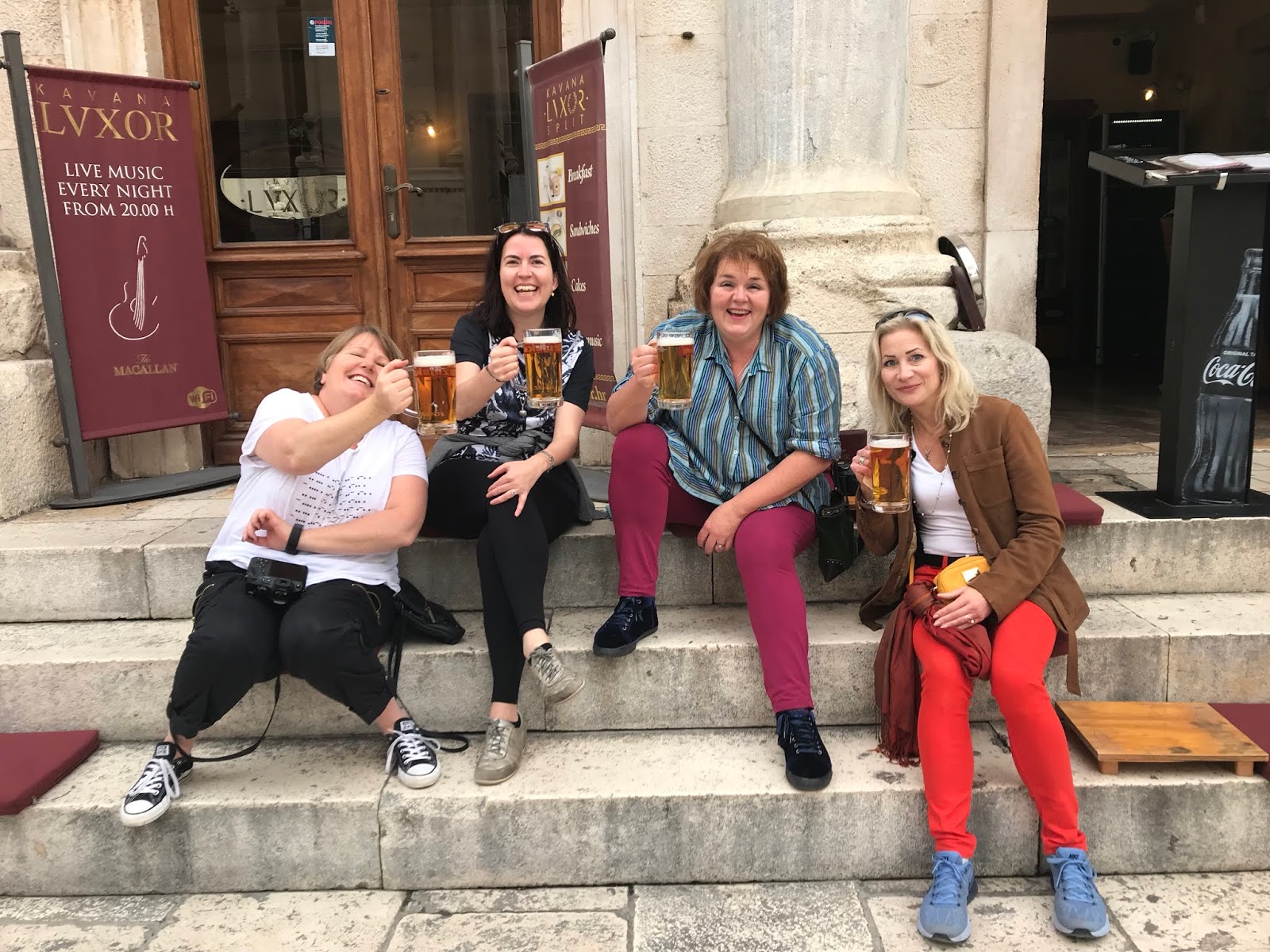
It's a little less showy these days, but all those elements survive. The peristyle is now a rectangular piazza known as Split's living room. The garden is long gone, now paved with white stone buffed to a mirror-like sheen by centuries of foot traffic. The mausoleum now stands, but as what must be one of the world's smallest cathedrals. The vestibule is an echoing ruin, now often occupied by musicians entertaining tourists and flogging CDs. Buildings have completely filled in the West side of the peristyle's colonnade, dominated by a bar and restaurant called Luxor. Their cushions cover the stone steps. While most visitors followed their guides through here, stopping, snapping photos, then moving on, we settled here at least once a day for cold beer and hot people watching. As dusk falls and the tour groups disappear, it's a magical place to while away the hours.

Tours aren't a bad idea, however. Beautiful as the old town is, it can be hard to piece its story together from your own observation. Informative guidebooks are remarkably absent. You can by a copy of Diocletian's palace modelled in white chocolate, but good luck finding one of those books that superimposes a coloured acetate onto a modern photo to give you a picture of then and now. There are a handful of plaques up on buildings, but nobody has bothered with a city trail that allows you to navigate around the old town's lanes understanding how they started. We hired history teacher Dino Ivancic to make it real for us. (Approx. £95 for two hours.)

Dino is either a remarkably good judge of character or an acquired taste to be approached with caution. I'm going to guess it's the former; he figured we already had a good understanding of basic history, were comfortable with wry wit and a bit of ribald humour. The resulting tour was half serious explanation, half history-based stand-up routine channelling Monty Python and Blackadder. So I didn't get quite the level of Roman history and architecture I would have liked (probably to the relief of my friends) but we were richly amused.

After a short walk out to the harbour to get a look at the full span of the palace walls, we plunged into its most remarkable feature. The basement. Yes, really. In order to level a sloping site, and put Diocletian's private apartments safely above sea level, the architects built an impressive sub-structure of lofty arched and domed rooms that matched the pattern of the palace above. The "barbarians" who moved in after the fall of empire couldn't figure out the underfloor heating, and thought the subterranean spaces would be more useful as cesspits. Their shocking mis-use of the space led to its preservation; the rooms weren't dug out by archeologists until the late 20th century, providing new understanding of the palace above and lots of museum-worthy artefacts that had been entombed in the mire.

All visitors get some exposure to these cellars as they walk from the main harbour-side entrance up to the peristyle. Craftspeople have set their stalls up here to form a picturesque shopping mall on the main tourist route. But for a small fee you can ramble though the whole atmospheric complex. Game of Thrones fans will get an extra thrill discovering the sets where Daenerys incarcerated her dragons and Barristan Selmy met his death.

Back up top, guides like Dino help you to decipher what the place looked like in the 3rd century and how it would have functioned in Diocletian's time. For example, standing us at the Iron (Western) gate today the path narrows quickly into a lane between shops. He pointed out the telltale marks in walls that reveal the width of the original road; the decumanus, where ten soldiers could walk abreast. Dino showed us how more modern centuries layered onto the Roman world, borrowing walls and integrating bits of ancient sculpture into their decor. He also exposed us to the historic Jewish quarter, not much mentioned in official guides. Similar to stories we heard in Dubrovnik, the people of Split didn't care much about religious differences as long as everyone made a good profit. This was a point of refuge for Jews getting kicked out of Spain at the time of the Inquisition, and Split boasts one of Europe's oldest continuously operating synagogues.

After leaving Dino we looped back to go inside the cathedral and the temple of Jupiter (joint admission ticket). Both are magnificent buildings. I found the cathedral both amusing and fascinating for its layering of the pagan and Christian. The frieze around the top, thankfully far too lofty for iconoclastic early Christians to do damage, has a shockingly profane theme of putti enjoying earthly delights of drinking and hunting. No doubt exactly what Diocletian planned to be doing in the afterlife. Successive generations have added a magnificent pulpit (very medieval Tuscan in style); pointy gothic side altars, a wildly opulent baroque altar that's a masterpiece of marble inlay work and a rather distracting choir. Despite all of this, it's still a resolutely Roman interior.
The temple of Jupiter, now the Baptistry, has seen less tampering. Other than a baptismal font cobbled together from gorgeous early Christian altar panels (almost Viking in their sinuous abstraction) and a hideous modern sculpture of John the Baptist, the space has been left bare. All the better to appreciate one of the most magnificent ceilings still intact from the ancient world. It's a coffered barrel vault, each coffer with a different decorative element at its centre and glorious foliage around its edges, held up by a ridiculously ornate, multi-levelled cornice. (Photo above) It was so magnificent I paid to see it twice.

For a separate fee you can clamber up the bell tower outside the cathedral. If its lines look a bit sleek, despite its Romanesque design, you're right to spot an aberration. It's one of the most modern things inside the place walls, being a 1908 reconstruction of an earlier tower that came down in an earthquake. I thought about this a lot as I made the vertigo-inducing climb. Pierced by stories of arched windows and entirely empty inside, the tower is ascended by metal stairs bolted to the interior walls. With nothing between the stair treads. Climbing feels like you're hovering in mid air. Descending is even worse. And I don't have an issue with heights. The view from the top is worth it. Be brave.

Streets immediately outside the palace walls are a pleasing melange of Medieval, Renaissance, Baroque and Neo-Classical. Many old palaces have a decidedly Venetian feel about them, with twisted columns and fanciful pointed windows. There's even an enormous piazza loosely based on St. Marks, with one side open to take in sea views. (Locals tend to drink here rather than in the peristyle). Other bits feel like you're deep in Tuscany (particularly the decidedly un-Italian sounding Narodni Trg square). There's a magnificent fruit and veg market out the Eastern gate and a fish market out the West; both will make foodies wish they had a kitchen.

Despite the antiquity, Split feels like a vibrant, modern town. Squares and restaurants are full of locals. Children play ball in the streets. There are trendy wine bars with rooftop gardens. We found restaurants we'd welcome, and repeatedly visit, if they existed in London. (Of that, more in my next story.) The shopping scene goes far beyond the expected tourist items; Split is packed with boutiques with locally designed clothes, dramatic jewellery and stand-out accessories. Most were a bit too high fashion for my style, but window shopping was a joy and we all agreed that the women of Split were some of the most fashionable of any city we'd ever visited. People watching was a catwalk show with good architecture.

There's no doubt this is a living city, not a stage set for tourists. That was obvious when we got out of town for our wine tour at Kovac. From Anton's vineyards we could see the sprawl of a very big, very busy place. "All the creative industries are here," our tour guide Andrea told me. "Government and the law are in Zagreb. Dubrovnik lives on tourists. We make things."

It's also a jumping off point for additional exploration. We gazed enviously at the day trips we wouldn't have time to take. Excursions inland to a national park famed for waterfalls. Jaunts to islands with exquisite beaches and picturesque towns. Winery tours (we'd done one, but there were more to be sampled.) The Medieval town of Mostar, just over the border in Bosnia, with its legendary bridge. Even Dubrovnik was accessible from here. The more I learned of Split, the more I marvelled that Dubrovnik is the go-to destination for most visitors to Croatia. This is the place I'd want to come back to, and use as a base for a longer holiday.

One of my great heroes felt the same way. If we dropped back two centuries ... still fairly modern for Split ... we'd find it a star on an extended Grand Tour trail thanks to now-legendary architect Robert Adam. In 1764 he'd printed a lavishly illustrated guide to the Ruins of the Palace of the Emperor Diocletian at Spalatro in Dalmatia. The first few pages are packed with the names of the aristocrats who subscribed to fund its production, topped with the king and queen. Thanks to a digitisation project at the University of Wisconsin, you can follow the preceding link to look at the whole thing online. Exquisite drawings go into obsessive detail showing architectural features that are, for the most part, still there and on regular view. He includes more "modern" fortifications and neo-classical buildings as well. Though scholarship has moved our understanding on since Adam's time (he believed the Mausoleum was the Temple of Jupiter, and the Temple of Jupiter one to Aesculapius) the  power and the beauty of the architecture hasn't changed.

And it will all look very familiar. Because this was one of the source books Adam used in his designs for the grand buildings of London and aristocratic country houses across Britain. Which were then copied across the world in government buildings, museums and grand residences. The creative spark we found in Split has travelled the world; most people just aren't aware of it. I'd encourage anyone who enjoys history and architecture to spend time here. They'll fall in love.


Monday, 5 November 2018

N.U. Girls Trip No. 17: The lure of the undiscovered in Croatia

In a world of Bucket List-fuelled tourism, where ever more people are crowding in to the same hot spots to tick off their "must sees", Croatia appears regularly as an alternative for the savvy traveller.
It has historic towns with the architectural appeal of more famous Mediterranean cities. A string of more than 1000 islands scattered off its 2,500-mile coastline makes this bit of the Adriatic resemble the Virgin Islands, while inland there are dramatic limestone peaks that make the landscape a dead ringer for Provence. Local seafood, olive oil, figs, citrus, wine, meat and mountain herbs come together in food markets and dishes reminiscent of Barcelona or Sicily. In fact, Croatia is a bit like the whole Mediterranean in miniature. No wonder film makers take advantage of it so regularly as a stand-in for other locations. With the exception of Dubrovnik hotels, prices here are cheaper than the Med's usual hot spots, while personal guides and luxury experiences are particularly good value for money. Add a population so committed to tourism as a dominant part of their economy that they’re relentlessly service-oriented and ... if under 50 ... almost universally proficient at English and you have a winning combination.

Of course, by the time we got around to agreeing on Croatia as a destination for a Northwestern Girls’ trip, it was hardly a fresh discovery. The jet set has been infiltrating boutique hotels and yacht harbours, while a fleet of cruise ships brings in the mass market. Regular herds of Chinese and Korean group tours validated the much-written-about rise of East-to-West travel. In addition, serving as a regular filming location for Game of Thrones has created a whole new sub-genre in tourism as fans from around the world flock to see the "real" Kings’ Landing, Qarth and Meereen. 

Dubrovnik, better known a decade ago for the drubbing it took during the Bosnian war of the '90s, now runs a real risk of becoming like Venice; a tourists' amusement park devoid of real life. Very sensitive to the possibility of killing the goose that’s laying their golden eggs, local government is starting to limit cruise ships and considering cracking down on air B&B-style apartment rentals that are stripping the walled city centre of regular residents. Tour guides and waiters regaled us with stories of how horrible the summer season had become, but by our 31 October arrival we were rambling around often-quiet urban spaces with plenty of room in bars and restaurants and a fair chance of taking photos free of people.

While it would have been nice to sail through those islands and beaches in the balmy, light-drenched days of summer, I think we made the right choice. At least for an initial introduction to the country. Temperatures hovered in the mid-20s (mid- to high-70s F) with a fair amount of sunshine. We only suffered one day of rain; though we did suffer. Most sightseeing and dining is open air, long views are part of the appeal and the polished limestone streets of the old cities become hazardous when wet and pocked with deep puddles. As long as you anticipate the possible need for rain gear, I'd recommend our timing and this four-and-a-half day itinerary as an excellent introduction to the country.

START IN DUBROVNIK
We arrived around lunch time and had a driver take us from airport to old town. With four of us splitting the bill, it was by far the cheapest and most direct route and meant we were handed direct from informative guide to hotel manager who was waiting at the gate to take some of our luggage and walk us in to the pedestrianised city. The old town is mostly on a grid pattern so once you get your bearings it's not that hard to figure out, but the very narrow, architecturally consistent lanes and steep inclines make an initial guide very useful.

We stayed at the St. Joseph's hotel, a luxurious collection of six rooms in a 500-year old house. The Croatian owners are a brother-and-sister team, also British nationals with a base in London, so they're well used to English speaking guests. There are no communal spaces, which can be a bit frustrating if you're travelling with a group and want to spend some indoor R&R time together, but fortunately we were in the only two rooms on the top floor so we could keep our doors open and use the space like a two-room apartment. A lavish continental breakfast with a spread of bakery goods, fruit and home-blended smoothies, served with remarkably good coffee, comes to you in your room when you're ready. The location is perfect, in the middle of everything and no more than five minutes from top wine bars, the city walls, the harbour and a range of fabulous restaurants. There's always someone on the door to arrange whatever you need.

It's worth emphasising that Dubrovnik is no bargain. Queen rooms at the St. Joseph, even in this off season period, were £310 per night, a fairly consistent price for well-rated small hotels inside the city walls. Prices drop when you go beyond, of course, but then you're giving up atmosphere and adding transport hassles. You'll walk a lot in Dubrovnik, and do a leg-punishing number of steps. Stumbling to a nearby hotel when you hit the exhaustion point is wonderful. We splurged but kept our visit to two nights. If I returned I'd probably consider one of the rental apartments that seem to make up a big percentage of the old town. 

On our first afternoon we wandered around the walled city and did some shopping. Dubrovnik is packed with small, independent boutiques and is particularly known for its jewellery (especially silver filigree work and red coral) and its silks (the cravat originally comes from Croatia). We spent most of the next day on a Game of Thrones tour and on our last morning walked the walls. The towering medieval comprise a complete circuit of battlements and towers, all with astonishing views and all in excellent condition ... no doubt helped by the approx. £18 per person each tourist pays for access. We took an hour getting two-thirds of the way around from the Pile Gate to the Ploce Gate at a fairly brisk pace on this one-way (anti-clockwise) route, but you could easily spend a whole day up here since many of the towers are conveniently occupied by cafes and pop-up booths of local craftspeople.

ENJOY THE TRANSFER
There is, surprisingly, no direct and easy train route to Split, the other tourist blockbuster along the coast. During the summer season the best way to cover the 158 miles between Dubrovnik and Split is by ferry up the coast. By road, it takes about four hours, mostly because the first half of the drive is by a winding but spectacularly beautiful coast road that ... reminiscent of a past girls' trip to Iceland ... spends a lot of time going around big, deep bays.
We decided to make a day of the journey and, on the recommendation of our hotel in Split, hired a combined driver/and guide, the stalwart and exceptionally kind Boris, to take us. We stopped on the way at Ston, a beautiful small town famous for its walls (the Croats claim they are the longest continuous stretch after the great wall of China), its salt and its oysters. More more on this, see my coming article on food and wine experiences.

We also asked Boris to stop in Bosnia, which one must traverse for about 10 minutes due to old border debates. None of us had ever been to Bosnia before, and we didn't want to miss the opportunity to add a country to our travel collection. But we have a rule that to count as a real visit, you must stop somewhere to have at least one drink. Boris was both amused and a bit skeptical, but as he was at our command for the day he honoured our wishes, stopping at what he apologetically said was about the best he could do on the short stretch of coast.

Neither Dubrovnik nor Split show much evidence of the communism that once prevailed in Yugoslavia. Both feel affluent and modern. Not so for Neum, Bosnia, a string of ugly '70s- and '80s- era concrete block buildings that clearly stem from that time when communists were trying to convince the rest of the world that they could do fashion and holidays, as well as five-year plans. They couldn't.

They also don't seem to be able to do wine, despite the fact that the Croatian stuff on either side of
them is glorious. We should, of course, be grateful that we got any at all, Bosnia being a primarily Muslim country. But Neum is heavily populated by Roman Catholic Croats and the restaurant was a major stopping-off point, so white wine was available. With a beer-bottle top. And a label that looked like someone had designed it on an early Macintosh. It was thin, acidic and dirt cheap. Ironically, if you ignored the brutal architecture and the nasty wine (which, admittedly, got better by the second glass) you could drink in a vista of water, mountains and islands on par with the best seascapes in the world. Someone would charge you €10 on the Italian Riviera just to sit here.

After the Bosnian interlude the coast road returns to Croatia and dips into an enormous, fertile agricultural plain. Local farmers' booths line the road selling strings of oranges and garlic, and pyramids of precisely-piled vegetables in a scene that reminded me of Florida's US1 when I was a kid. Beyond that, you pick up a major highway and soon come into the outskirts of Split.

WHAT DID THE ROMANS EVER DO FOR US?
It's obvious from its furthest suburbs that Split is a very different kind of place from Dubrovnik. Its 178,000+ population is almost four times that of its southern cousin. People here obviously do a lot more than tourism; the approach is lined with warehouses, factories and office parks. There are enormous shopping malls and modern tower blocks. But there's history, too. Much older than Dubrovnik's.

Split started life as the Roman Emperor Diocletian's heavily fortified retirement complex. A local boy done good, he chose a beautiful and easily-defended bay near his home village and built essentially a walled town that was half palace, half administrative offices and all luxury. He even included a grand mausoleum at the centre, so he could go on occupying the place after his death. Given that he was the only emperor across more than four centuries to successfully retire, and one of the few to die in his bed at a fairly advanced age (mid-60s), the strategy seems to have worked.

The empire collapsed. The local economy crashed. The palace sat empty. Eventually, locals saw the merit of using the old walls for defence and built a new town within the ruins. More than 1,700 years on, Split's centre is a magnificent jumble of medieval, Renaissance and Baroque buildings wedged around the original architecture. Most structures have obvious borrowed elements ... columns, arches, decorated doorways, bits of sculpture ... while some classical spaces have been left to stand intact. The latter includes the famous peristyle, a town square in what was once Diocletian's colonnaded garden, and a warren of enormous, vaulted cellars. They're not only a treasured resource for Roman archeologists but provided another stage set for Game of Thrones.

By the late Middle Ages the town had spread beyond the palace. The districts immediately outside have a strongly Venetian feel about them, unsurprising since Split was officially part of the Venetian empire for more than 400 years. (Dubrovnik, on the other hand, was an independent republic only under Venetian domination for about a century, making the towns old rivals and adding to the differences in culture. Overall, Split feels much more Italian.

There's a long, grand seafront promenade where you can stroll, lap gelato, watch the ferries come in and out and get enough distance to appreciate the original walls of the palace. In the 19th century the locals (presumably as an architectural insult to the then-ruling Austrians) built a grand square inspired by St. Mark's in Venice, but open on one side to take in the harbour. It's a must-visit for a relaxed drink with a view. Like Dubrovnik, shopping in Split is dominated by small boutiques rather than global chains. (They're all in the out-of-town mall.) Jewellery, art and craft are also on show here, and Split has an unusual number of high-fashion clothing boutiques, many of them full of creations from local designers. The natives are all remarkably fashionable, making us feel distinctly underdressed. There's also a rollicking local fish market on one side of town and an enormous fruit, veg and local food producers' market on the other; it's the kind of place that makes foodies wish they had access to a kitchen.

We stayed at the Heritage Hotel Antique, another boutique choice in a medieval tower block built onto the wall of one of the palace's administrative buildings. In a breathtaking difference between "discovered", trendy Dubrovnik and slightly less on-the-beaten track Split, the hotel had dropped to off-season prices and put us up for just under £80 per room, per night. For less than a third of the price of Dubrovnik we had slightly smaller rooms with the same (and possibly even better) service; they even sent us away with both a packed breakfast and lunch when we started our journey back to the UK at 5 am. Beds were the same high quality with good mattresses, down pillows and high thread-count sheets. The decor was similar, the finish slightly less luxurious. (Not quite so deep a pile on the carpet, high-end linoleum flooring in the bathroom rather than marble ... though the exact same rain shower and a slightly better pile of toiletries.) Breakfast was in a breakfast room, rather than served by a uniformed maid. Not quite so much pampering, the pastries more mass production than hand-crafted and coffee was from a machine rather than silver urns, but you had the choice of a range of fresh-cooked egg dishes from an adjacent kitchen. Quite simply, the Antique was one of the best value-for-money deals we've snagged on any girls' trip and, on that front, far outstripped the St. Joseph.

While both cities were remarkable, Split seemed to have a vibrancy and a creativity that Dubrovnik lacked. We all agreed we were glad we spent three nights here (not just for the bargain hotel), and the Northern city has left me more intrigued than the Southern for further exploration. With nearby national parks, holiday islands and local wineries, we left feeling that there were plenty of depths in Split still to plumb, while two days in and around Dubrovnik felt about right.

In coming days I'll write more about each town, including our Game of Thrones tour, Diocletian's palace and ... of course ... fabulous food and wine experiences.