Showing posts with label Basque Country. Show all posts

Wednesday, 10 April 2024

The annual Northwestern Girls' Trip marks 25 years of marvellous adventures & priceless friendship


In October of 1999, three American expats living in England answered Northwestern University’s call to represent the institution at London’s Fulbright College Fair. They hadn’t known each other on campus, but the girls had all graduated within four years of each other and quickly hit it off. All eager to take advantage of the opportunities for tourism offered by life in England, they thought they might be good travel companions. In March of 2000 they put their suspicion to the test.

The rest is history.

Tomorrow, it’s officially 25 years of gloriously entertaining, adventurous, relaxing, story-spinning history. Our annual Northwestern Girls’ Trip hits the milestone when we board our British Airways flight to Naples.

There have been changes over the years. In the early days we were more likely to do multiple, short trips across the year. As we settled in to life in the UK and our jobs got progressively bigger, we focused on just one significant, annual journey. We’ve never missed a year, though parental illnesses, work travel, breast cancer and Covid all proved challenging. In 2020 we slipped a glorious road trip to Devon and Cornwall in between lockdowns but in 2021, despite two attempts, we only managed one day as a complete group due to positive Covid tests amongst us. Over time, our working lives became so busy we learned to compare diaries and pencil in the date for the next year as we were wrapping up the current trip. Once the dates are resolved, girls' trip is sacred.

In 2017, we expanded our trio to a quartet. It was a big decision, given the perfect balance we’d established, but we’d all known Suzy almost as long as we’d known each other. And though she hadn’t graduated from Northwestern, she’d worked for me twice … the first time straight out of uni … and I’d taught her much of what Medill taught me … so we granted her our special girls’ trip honorary degree. 
Finding ideal travel companions is no easy task. People like to move at different paces, do different things, and have different price points. Learning to go on holiday together was, by far, the biggest challenge of my marriage and one that took years to sort comfortably. From that first trip with the girls, however, it was clear that we were naturally in tune with each other’s preferences. 

The ideal girls’ trip should have a near-perfect balance of history, culture, fabulous food, vineyards, shopping, and indolent self-indulgence. We are all naturally curious and love to learn. We sightsee in high-energy bursts, then collapse happily into spas, wine bars or quiet spaces with a good book. We love an off-the-beaten-path experience. We’re also a gregarious bunch, and we’ve talked our way into a notable number of upgrades and remarkable extra treats. Perhaps the most extraordinary example took place in a forgettable town in central Spain. We were the only foreigners in the restaurant during a local festival. Our enthusiasm so charmed the waiters that they gave us a tour of their extraordinary wine cellars, dating back to Roman times, while we were waiting for a table. They lovingly described every course of the festival menu as we ate, then cracked out their home-made post-prandial firewater and invited us to drink with them after the restaurant closed. (Hillary will never let us forget she was the designated driver that day.) The older we get, the more we’ve noticed that young waiters rather enjoy a bit of mild flirtation from a group of women who could be their mothers. Though none have yet equalled those grizzled old Spaniards. 

Though we didn’t set out to define our journeys this way, they’ve become characterised by affordable luxury and often being just ahead of the curve of travel trends. Many places … most notably Speyside, Spain’s Duero wine road, Porto, and Split in Croatia … enjoyed time in the spotlight of the travel press just after we visited. We are the best travel documentary the BBC hasn't made. 

The affordable tag, of course, depends on your point of view, and our price point has crept up over the years with incomes and stress levels. But we’ve always focused on finding special places that are excellent value for money rather than just opting for whatever gets written up in a glossy magazine. These days we tend to look for four-bedroom apartments to rent rather than heading for upscale boutique hotels, and we’ve discovered the value of pooling our resources to hire private guides for outings.  

A set of girls’ trip guidelines took shape over the years. We travel over a long weekend, generally Wednesday or Thursday to the following Monday or Tuesday. It’s the least interruption to busy work schedules. Travel time should be no more than four hours. If you are celebrating a decade birthday (40, 50, etc.) then the destination is your choice alone. In other years, it’s a group decision based on a shortlist, with the final call made by vote or … in one memorable year … Lisa’s mother pulling the winning name on a slip out of a bowl after a Michelin-starred dinner. 

Combining resources to hire private guides has led to some of our most memorable experiences. These include a day wandering the slopes of Mount Etna with an oenologist who specialised in Sicilian wine and got us behind the scenes at several remarkable vineyards. 
A proud Basque showed us the little-visited seaside glories and Game of Thrones filming locations of the coast between Bilbao and San Sebastián. 
When a travel agent messed up our reservation in Iceland, a strapping Viking who usually only did high-end tours and had recently hosted Tom Hiddleston stepped in to drive us up to the glacier and take us spelunking in an Icelandic lava tube. 

This Friday, we'll be making new memories as a working archeologist leads us around the ruins of Herculaneum.

Vineyards have been high on the agenda over the years for this wine-loving quartet. Our intense interest in wine, thoughtful questions, focused tasting and … we like to think … tremendously genial personalities have often seen us invited by winemakers into their private cellars to taste stuff they usually don’t open and drinking with them well after official tours have ended. 

We haven’t always followed our own Girls’ Trip guidelines. Two of our journeys stretched over a week and one of those smashed through our 4-hour travel time limit. Lisa’s brief flirtation with moving back to the States meant that she was joining the 2007 trip from New York, so we turned it into a full-scale holiday in Tunisia. This was before terrorist incidents endangered tourism there. Even so, crowds were light outside of the main tourist resorts. Wandering virtually alone through the sprawling Roman ruins at Dougga is one of the great memories in the Girls’ Trip archives. 

Eight years later, when Hillary’s father was coping with an Alzheimer’s diagnosis, we travelled to the family home in Florida to revel in the warmth of his larger-than-life personality while he was still with us. 

Sharing parents has indeed become one of the hallmarks of the original trio. As women living thousands of miles from our families we all had a larger-than-average appreciation of time spent with parents. Over the years, a habit grew up of visiting parents including the other girls in a family meal whenever they were in London. All but two of those parents have left us now, but we have the memories forever. (And hope my dad and Hillary’s mum are with us for many years to come.) 

And so … older, wiser, and in need of a lot more down time than when we started … the girls are off to Naples. This year is a significant decade birthday for me, so the location, lodging and itinerary were mine to call. Culture abounds. I get to try to knock the rust off my very rusty Italian. Food here is lauded as amongst the best in a country already famous for its cuisine. And there’s a four-bedroom apartment with a roof garden waiting for us.  

La vita è bella. 

Here’s hoping for another 25 years. And here’s thanking my friends, God and good luck for the extraordinary adventures behind us. Great times with beloved friends are one of life’s most precious treasures on this endlessly diverting journey through life.


Sunday, 5 November 2017

An introduction to San Sebastián: So much more than food and beach

San Sebastián started its journey to fashionable acclaim when 19th century Spanish royals adopted it as their summer beach resort. Early this century, a little restaurant in the nearby hills called El Bulli was named the best in the world, and its chef, Ferran Adrià, spearheaded a movement to make this bit of Northern Spanish coast a culinary capital.

And that's pretty much what I was expecting on our 17th annual girls' trip: a Spanish version of Cannes with more innovative food and drink. I found so much more.

Deep and varied history. Fascinating architecture. Dramatic landscape. A tradition of craftsmanship that goes beyond the food to clothing, accessories and home decor. The hip edginess of a youthful surfing culture blended with the sophisticated elegance of ancient traditions. A surrounding region stuffed with things to see and do. Fiercely independent shops and restaurants keeping global brands at bay. Game of Thrones filming locations. All connected by highways, WiFi and 4G availability that put England to shame.

The delight of new discovery filled our days. Here are six reasons San Sebastián exceeded my basic expectations, and a tip for a fabulous boutique hotel from which to enjoy it all.

This is a different country
I'd heard of the Basque Country, but I hadn't appreciated its uniqueness. For all that I understand the factors driving the desire for Catalan independence, I have to confess that Barcelona feels like Spain to me. San Sebastián and its surrounding coastline does not. I quickly appreciated that we shouldn't even be talking about San Sebastián. Donostia is its real, Basque name.

Thickly forested hills proclaim a climate closer to Wales than sunny Iberian holiday spots. Much of the architecture ... peaked rooflines, half-timbering, broad, square farm houses ... feels almost Germanic. You hear a lot of Basque being spoken and it's on all the street signs. (I don't recall noticing significant Catalan conversation in previous Barcelona visits.) There's a vibrant community spirit obvious on even a short visit as you notice community dining clubs and musical groups gathering in public spaces for spontaneous performances. They even have their own unique sports traditions; it turns out the Jai Alai I know from Miami started here. It's a place that feels familiar yet totally alien at the same time, and the uniqueness of Basque origins ... oldest indigenous people in Europe, language related to no other ... adds to the mystery of the place.

You can get an excellent introduction to Basque history and culture at Donostia's San Telmo museum, of which I'll write a bit more later. It's also worth getting a local guide to understand more of the nuances. We used Ikusnahi (more coming on their wonderful tour, too.) Savvy travellers (I was not) will read Mark Kurlansky's Basque History of the World before going.

So much more than food
Architecture fans will be entranced. Donostia is a city of grand apartment blocks; the architects here were obsessed by rooflines and corners. Fanciful spires, balconies, turrets and windows span everything from gothic to art deco to brutalist modernism. There's a preponderance of Belle Epoque, that golden age between the 1870s and World War I when buildings and wedding cakes seemed to converge. The opera house looked promising; I'd consult the schedule before another visit.

There's a rich and complicated history (queue the Basques again) to delve into that stretches back long before the royal beach holidays. That patronage, however, has left a top quality spa that any fan of a soak in bubbling hot water needs to check out. (Story to come.)  Meanwhile, sporty types will welcome hiking trails, cycle paths and surfing beaches. While our four days in town was enough to cover the basics, there's more here to keep your attention.

Pintxos are not tapas
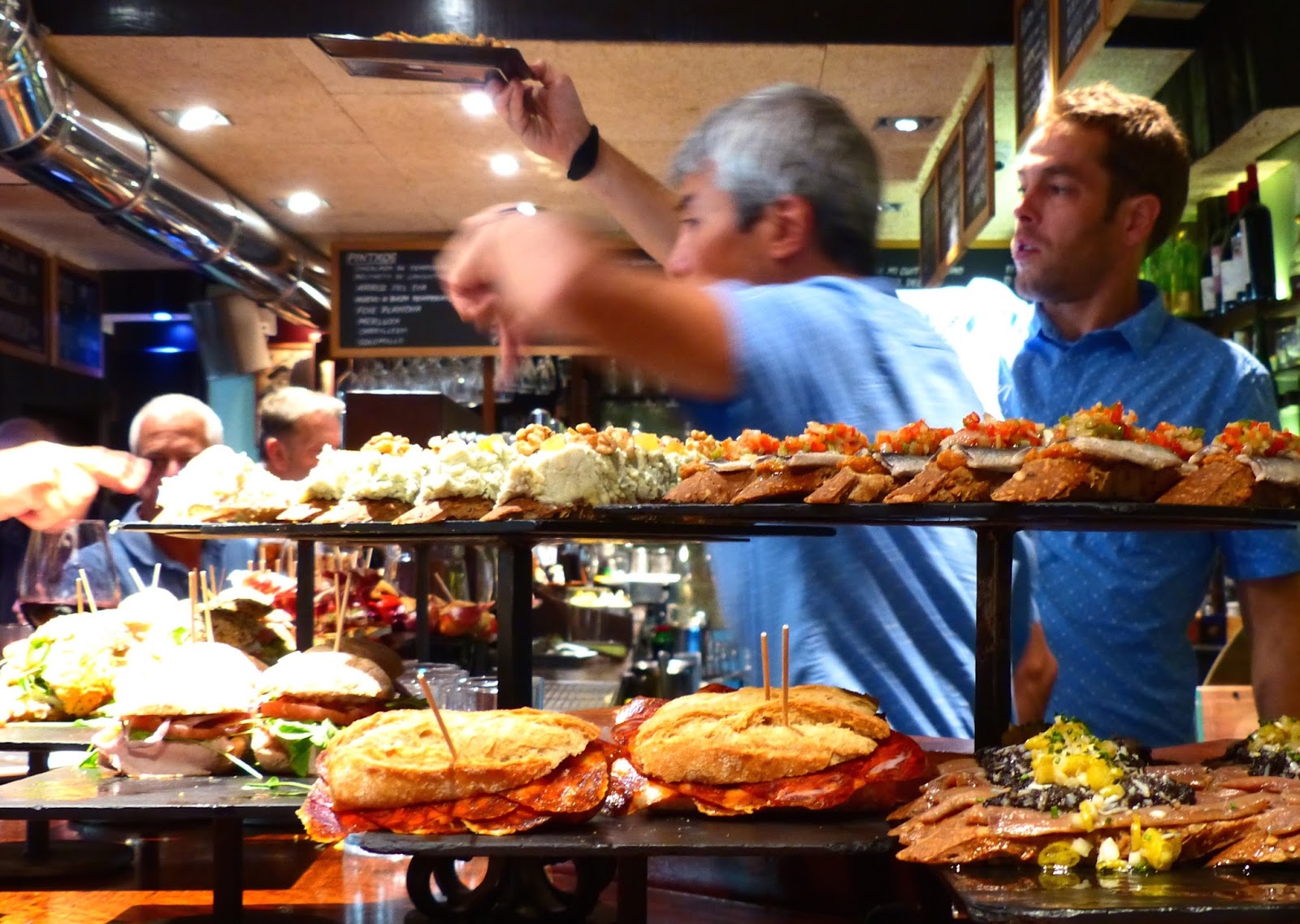
If you're at all into your food, the word you'll hear time and again in relation to Donostia is pintxos. (Pronounced peen-chos) People typically describe them as "Basque tapas" but they are far more sophisticated. Cold pintxos are much closer to the Danish smørrebrød; artfully prepared, open-faced, finger-sized sandwiches that are a work of art on their own. Hot pintxos require a bit more bravery as you actually have to order rather than self-serving from the bar, but reward you with a lesson in the locals' mastery over beef and pork.

It's no wonder that Adrià was at the forefront of the revolution that turned fine dining plates into works of art; many individual pintxos are as beautiful to look at as they are to eat. Forget the tapas comparison. Pintxos are closer to fine dining in miniature.

But a word of warning: vegetarians need not apply. This is a land in love with protein, whether from land or sea. Vegetables exist to supplement those glories, not to stand alone. If you don't at least eat fish, you're going to be reduced to plain bread, tortilla and plates of mushrooms. Though you'll have to specify the preparation on the latter, because they're likely to wrap a few in bacon and throw them in the deep fryer. Everything is, after all, better with bacon.

Dramatic landscape
The green, misty mountains come right to the sea. It's easy to see how right up until modern times there was little transit between towns unless you went by water. It's an hour's drive from the airport in Bilbao, and I spent most of the journey marvelling at the feat of building a highway through this landscape. The tough terrain breeds both tough, practical people and magnificent sailors. Who was the first ship's captain the circumnavigate the globe? You may remember the name Magellan, but he doesn't count as he didn't live to complete the journey. It was Basque Juan Sebastián Elcano, born just up the coast from Donostia.

And what an exquisite coast it is. Golden beaches alternate with dramatic cliffs of striated rock thrust heavenward by continental drift. Unsheltered beaches see dramatic waves and violently churning surf. The glory of Donostia, however, is a crescent-shaped beach called La Concha with an island blocking part of the entry from the sea. Bathers come here, while surfers head for the more agitated waters on the city's second beach to the east.

Not fussy
Given the legacy of the 19th century beach resort, I was prepared for something like Cannes. And though I've had a lot of fun in that city over the years, you can never shake off that feeling that it's the creation of supercilious French snobs who take vast pride in two centuries of over-charging the English for their holidays. Donostia's only real resemblance to the French Riviera is the Belle Epoque architecture. The natives are gracious, cheerful and delighted to be helpful. Though they will make it clear that they have their own way of doing things. Trying to take a Kindle into the spa or being too creative with a pintxos order may earn you a firm but polite rebuke.

Though both the people and the architecture are fantastically elegant, there's a laid-back, casual vibe to the place. You get the feel of a practical people who take life as it comes and enjoy every day. Our guide explained that the Basques have a long history of both egalitarianism and women's rights; the class system and excessive formality are things that came with Castilian nobles parachuted in by a distant government.

Shopping
In a planet marching towards the uniformity of global brands, Donostia is a delight. For every logo you recognise, there are two or three independent boutiques. Clothing boutiques are elegant little collections of individual taste, usually hung by colour so you can get a sense of how to put an outfit together. In these shops I saw no recognisable brands, and several boasted of clothes designed and made in the region. The clothing was beautifully constructed, often with distinctive design elements and gorgeous fabrics. They even ... quite remarkably for the Iberian peninsula ... had some sizes for the generously proportioned. We found sales people who were wonderfully skilled at quickly figuring out your taste, then pulling stuff out that would look great on you. For the best example of this, check out Minimil.

Small jewellery stores featured makers at work benches and one-of-a-kind creations in the windows. Bookshops basked in Art Nouveau splendour, bristling with hand-written recommendations on shelf fronts. The fish market will make you weep that you don't have a kitchen. Home stores and galleries are filled with quirky decorative items and beautiful works of craftsmanship. And, even with the abysmal Euro-to-Pound exchange, prices weren't excessive. The combined forces of the annual girls' trip haven't done this much shopping in many years.

WHERE TO STAY

We splurged on the Hotel Villa Soro, a boutique hotel in a converted 19th century mansion about a mile and a half from the heart of the old town. This delivered exactly what we were looking for: extreme comfort, attentive staff and plenty of cozy public spaces to lounge around when we weren't sightseeing. There's a main house and a modern block across a small courtyard behind it. We upgraded to the house and I suspect it was that plus our five-night stay that saw us in what must be the two best rooms in the house. Rooms 12 and 14 are at the front corners, with 18-foot ceilings and grand windows overlooking the front lawn. 14 has a large patio we put to good use on sunny days.

The decor is a gentle mix of Spanish late-19th century (there's a stained glass ceiling above the entry hall and a stained glass holy family illuminating a little room I assume was once a chapel on the landing of the grand stair), English country house and modern (striking abstract sculpture in key locations). The enormous sitting room could comfortably seat three to five distinct groups without crowding, though we were almost always on our own there. While we settled in, other guests ... mostly American and a few Germans ... tended to stay for only a night or two. Villa Soro provides limited restaurant facilities, but acknowledges that in a town with such good food you're probably only going to bother with them if you're simply too tired to go out. They put on a fine breakfast in their two-room dining area, including plenty of cooked options. However, the quality of bread (the tumeric-flavoured was fantastic), pork products, local cheese and fresh fruit meant that we skipped the cooked options most mornings.

The staff came through with excellent restaurant recommendations and managed to get us a table at one well-known spot that was booked up through regular channels. Taxis arrived quickly, there were bicycles to borrow, the barman made top gin and tonics and the bathroom was stocked with Molton Brown products. It's worth noting that the photos on the web site have been artfully shot to disguise the fact that the house is in a densely-packed area on a main road. I was initially worried about traffic noise but outside of rush hour all was quiet. Getting to the centre of town is a 20-minute walk or a 10 euro taxi ride; we tended to walk in (it's a gentle slope down) and taxi back. The steep hills behind the house held my favourite restaurant of the trip, Zelai Txiki, and closer than the Old Town is the trendy Gros district and the pounding breakers of Zurriola beach, the surfers' favourite.