Showing posts with label San Sebastián. Show all posts

Saturday, 23 September 2023

Kookin Donosti shows off Basque culture through the kitchen

There are lots of lovely things to see and do in San Sebastián (Donostia in Basque), but let’s be honest. This place is all about the food. It has the highest concentration of Michelin stars per head of population in Europe. Even if you’re not eating at any of those revered institutions, the commitment to fine food cascades down. In many bars the once-humble pintxo, originally just a snack on a skewer or tasty bits on a piece of bread, has become a miniature masterpiece. People come here from all over the world to learn to cook. Everyone is obsessed by food. The only place in Europe with a similar culinary vibe is Copenhagen.

So it’s no surprise that I’ve been wanting to bring my half-Danish, fully epicurean husband to this culinary capital since my first look at a proper array of pintxos. The exquisite care taken with these small plates was a direct equivalent to Danish Smørrebrød. I knew he’d be a fan.

We did, indeed, have great fun following a trail of pintxo bars through the old town, hitting several favourites from my last trip. But our best culinary experience was a day at cooking school.

We find that there are few things better for getting a proper local understanding of a place than learning about its cuisine. Not just eating it, but shopping for it, getting your hands on the raw ingredients, and actively preparing it with someone who has a deep understanding of the intersection between food and people. Kookin Donosti, and chef Carlos Hurtado, are proof points validating the theory. We’ve taken a lot of cooking courses in our travels, and this was definitely one of the best.

We started with a tour of the market. This is a place in transition and will soon be a much better experience. As its economy shifted away from fishing, San Sebastián let its local market wither, allowing the grand old market building to stand empty while a reduced collection of market stalls moved to an uninspiring  basement next door. Barcelona’s Boqueria it is not. But a renovation of the old market building is under way, with plans to move the existing vendors and bring in more food-related diversions, bringing San Sebastián on par with famous markets like the Boqueria, Torvehallerne in Copenhagen or Borough in London. Until then, the stalls here are more than sufficient to meet Carlos’ teaching needs.

First came a vendor of nothing but salted cod, a staple of Iberian cuisine and a driver of European economies for centuries. There’s an enormous variety of options here, and we learned about different levels of quality, and re-hydration techniques, as Carlos bought what we were going to need for our first course. Moving on to a fresh fish stall to buy the hake for course two, we had a long conversation about what fish was local, what came in from elsewhere, and how to judge quality of different species. He’d already procured the beef for course three, but we paused in front of a butcher’s stall to talk all things pig and cow.

Then it was off for a 10 minute stroll to the kitchen classroom, one of the best-equipped we’ve experienced. It was obviously purpose built, with plenty of room for individual workstations and good quality pots and hobs. Though knives were just Ikea basics, they’d been carefully maintained and had an excellent edge. We retired to a table a few feet from the demonstration area to eat each course together with other students; just four in total for our session on Basque classics. I loved the alternating back and forth between cooking and eating. At other classes we’ve cooked everything and sat down at the end for multiple courses at once. This set up seemed much more entertaining and built the appetite for each new dish, while Carlos cleaned our cooking areas as we ate. (Cooking while someone else cleans up for me is almost worth the price of admission.) The close proximity of the dining table means we could also watch demonstrations as we ate and drank. Admittedly, we did less cooking and more watching as the day progressed and the drinks poured, with Carlos doing all the work for the pudding but the orange peels we'd prepped earlier. 

Our Basque menu started by using the re-hydrated salt cod in a tortilla with onions and green peppers. I wouldn’t have thought of fish in an omelette, but this was fantastic. Carlos demonstrated the classic Spanish flipping technique (using a plate to take the omelette completely out of the pan and put the wet side back on the bottom), but the best tip here was simply making sure the pan is piping hot before the eggs go in, then turning down the heat. 

Next came hake in a green sauce. Lesson: it’s really not that time consuming to make a sauce that transforms your dish. (Though stripping the leaves off the parsley stems is a bit fiddly.) And that a handful of steamed clams scattered atop a fish dish can elevate it to the next level. IF you can find fat and juicy fresh clams, of course. Few of us have a fish market like San Sebastián’s at hand, even in its currently humble state. 

The main course was a simple but magnificent ribeye (above, with chef Carlos), a testament to the beauty of great ingredients cooked well. We were familiar with all be basics of cooking beef but it’s good to get some key reminders. Let your meat sit out for a minimum of two hours to come up to room temperature. Render that fat to imbue flavour. Don’t salt ‘til it’s done. A single, large piece, cooked and shared, is easier to keep moist and succulent than individual steaks. This course also gave me a fresh appreciation for piquillo peppers. They ARE different, and worth finding and buying in their jars, for a perfect accompaniment to beef. 

The most revelatory course for me, however, was dessert. Every European culture has recipes to use up stale bread. Here, hunks of stale brioche … hard to go wrong when starting with that … are caramelised in sugar then soaked in a combination of milk and cream that’s been infused with orange skins and cinnamon. I was blown away by how much flavour the liquid took on, and how such simple ingredients combined into an elegant whole. This one is going straight on the dinner party roster. (Though finding whole loaves of un-sliced brioche may prove challenging.)

All that great food was complemented by Carlos’ commentary, and by matching drinks for each course. Basque cider made its second appearance on our trip, and this time we got to try the elongated pouring technique ourselves. I’m still not a fan. 

Once again, we found that the company of our fellow students was part of the appeal. People enthusiastic enough about local cuisine to spend half a day getting their hands on it tend to be great company. 

Kookin Donosti would be the first thing I’d book on a return trip to San Sebastián. They do a pintxos class that’s calling my name. In fact, this is a town that’s screaming out for something like the week-long residential class we did in Gascony. Kookin is still a young company. If they expanded in that direction, it would be on our bucket list. 

Wednesday, 15 November 2017

Snacker's paradise: Donostia's pintxos are worth a culinary trip

A friend told me that San Sebastián ... Donostia in the local Basque language ... has more bars per square foot than anywhere else in the world. I haven't been able to verify that, but it seems perfectly credible. In many streets in the Old Town bars out-number shops, and while they're not quite so profuse in other districts, you're never far from some convivial R&R.

This is not because Donostia is some boozy capital of the party world, but rather because of the delightful local tradition of pintxos.

These gourmet snacks, available in every bar, make drinking here a voyage of culinary discovery. Whether you partake as a filler to get you through to those famously late Spanish dinners, use them as a buffet lunch or snack the day away, pintxos have become a reason to visit San Sebastián/Donostia in their own right. I've encountered nothing else quite like them in my travels.

Pintxo bars come in a bewildering variety. Many are classic Iberian watering holes: wood panelled, slightly-battered furnishings, hams hanging from the ceiling. Others are pictures of modern design, with sleek glass, marble and artsy lighting. Some have quirky themes. A few have the look of uninspiring fast food restaurants, and some are so bare of décor you feel like they're simply allowing you to queue up in a corner of their industrial kitchen. Get away from the profusion of tourists in the Old Town and you'll start to pick up a feel similar to a good British pub: these are watering holes for locals, far more about conviviality and community than alcohol.

The variety of atmosphere made our wandering more interesting, but had nothing to do with the quality of the food. It's uniformly good. I didn't taste a think I didn't like: although I'm content to let sea urchins lie un-harvested, and I don't see the point of deep frying foie gras. To have a more expert opinion on the food, however, let's here from someone more experienced with the Iberian peninsula.

Hillary Berger, fellow traveller on our Northwestern Girls' Trips for 17 years, spent a year of university in Seville and has been all over Spain and Portugal in the years since for both work and play. Here's her take on our pintxo experience:

Donostia is rightly known for its gastronomy, including one of its local specialties: the "pintxo" (pronounced "peen-cho"). But what exactly does it mean to eat pintxos? I have travelled many times to Spain, and assumed it would be similar to a pub crawl where you order tapas at each place. It turns out in some ways it is, but in many ways it's not.

First, a little history from our tour guide Mikel. A pintxo is a Basque speciality, originating from the area's fishermen. Their work fishing meant they would keep odd hours, and would often find themselves celebrating the end of their working day in the local bar ... at 11am. To ensure they weren't drinking on an empty stomach, these bars started preparing small snacks to accompany their libation of choice. These snacks typically consisted of food cooked in the kitchen and served on a slice of bread, held together with a toothpick. The toothpick "pierced" the food, hence the name "pintxo" which is a take on the Spanish verb pinchar - "to pierce".

In San Sebastián, pintxos appeared to be served everywhere but our tastings were primarily in the Old Town. On walking into our first bar we were in equal parts amazed and confused. Amazed because before us on the bar countertops were plates and plates piled high with delicious-looking pintxos. Confused because how on earth would we choose, and also how do you go about ordering these tasty morsels?

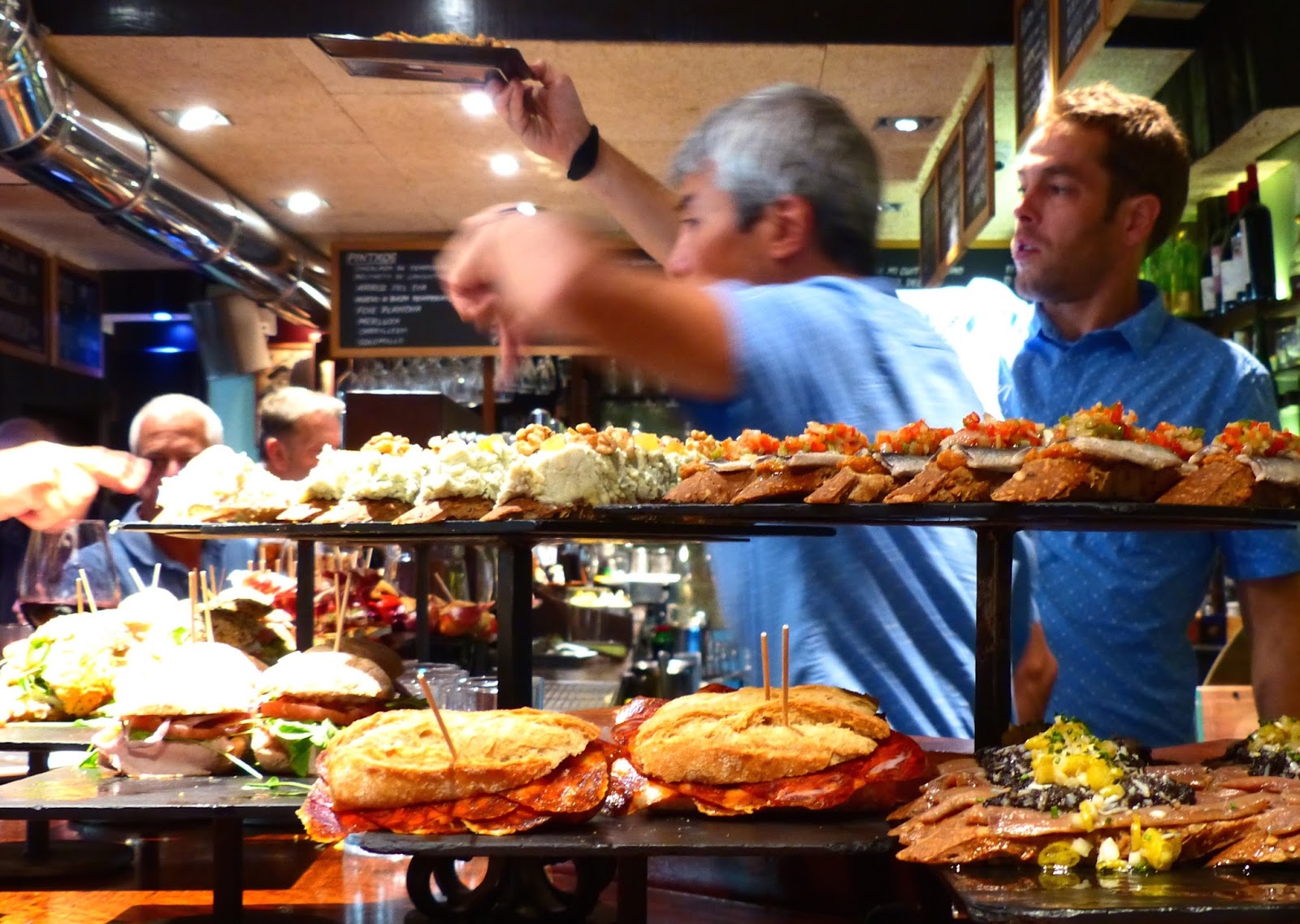
We started off focussing on the pintxos we could see, typically called pintxos frios or cold pintxos. These are piled high with various combinations of local delicacies like shrimp, ham, crab, eggs, peppers, anchovies, tortilla, cheese, sardine, mayonnaise, etc. Some are open-faced sandwiches and others are in a small baguette (the latter are also called bocadillos).

Next step is to work up the courage to approach the bar and order, as very few of these bars have table service. First order a glass of wine or a cerveza, then ask for a plate. (The local wine, traditional with pintxos, is a lightly sparkling white called txakoli.) On receiving the plate, essentially you help yourself! Take as many as you want, the bar staff have some magical power that allows them to track how many you take.

Once you are comfortable with that, the critical next step is to upgrade to pintxos calientes, or hot pintxos. In some establishments they will give you a menu, in others the menu is on the wall in Spanish, in others there is no menu and you point at uncooked food asking them to grill or fry it for you.

If you speak no Spanish, remember only one word: solomillo.

Unanimously our favourite pintxo from Bar Gandarias in the Old Town, solomillo is a succulent
morsel of sirloin, simply cooked, served medium rare, with olive oil and sprinkled with sea salt. A bite of heaven.

Other favourites were: the racion of Iberian charcuterie from La Cepa, the brochette of cooked prawns from Goiz Bargi, grilled octopus (aka polpo) from Bardulia, another version of solomillo called solomillo a lo pobre (sirloin topped with a fried egg and served with shoestring fries) from Casa Duran in the Gros district near our hotel, and a mushroom, mayonnaise and ham treat from Bergara (also in Gros).

If you want to settle in to graze in one place, we found the bar-top spreads to be most impressive at Bardulia , Bar Martinez, Atari and Gandarias. (The last also has an excellent restaurant, which Ellen's already written about here. Reservations essential.)

We ate pintxos on each of our five days in Donostia and left still wanting more.

Saturday, 11 November 2017

Meat or Fish? It's all about succulent protein in Donostia's restaurants

You could spend a week in San Sebastián (Donostia in the local Basque language) and never bother with a "proper" restaurant meal. The region's exquisite pintxos tradition means you can snack your way through days without repeating a bar, while each venue entices you with different two- and three-bite finger foods. On that, more in the next story.

But that would be doing Donostia a disservice. In the best tradition of "amuse bouche", the snackable pintxos are merely mouth-watering preludes to the main event. Dining here lives up to the area's lofty culinary reputation, and yet ... even with the currently horrific pound-to-euro exchange rate ... prices are under London equivalents. There are a staggering nine Michelin-starred restaurants in this medium-sized town, holding the highest number of stars per square meter of any place in the world other than Kyoto.

We didn't bother with the stars. (Though an article filled with tips from Elena Arzak, chef at the eponymous three-star restaurant, directed a lot of our sightseeing and shopping.) Instead, we chose two fine-dining local favourites just below star level, and one of Arzak's favourite casual spots.

First, a few trends across all of our experiences: Culinary traditions here are protein-heavy. Unsurprisingly, fish is exceptional; you'll probably be offered off-menu options fresh from the harbour. I expected that, but I was surprised by the quality of the meat. Those green hills produce succulent beef, pork and lamb. The quality makes for a tough choice. Main plates have little garnish and few sides: it's all about the star attraction and a bit of sauce. Unless something was billed as a salad, veg was a secondary consideration. Except for boletus mushrooms, with which the locals are obsessed. Also known as ceps or porcini, we were there in season and found them everywhere. On the desert front, we encountered variations on a theme: pastry, cream and red fruit. Nothing to complain about there!

Before dinner, however, head out for a cocktail. Donostians are as obsessed by gin as they are by mushrooms ... though a local assured us that the gin passion was a recent evolution. It's certainly the first town I've ever visited where a bar makes the top 10 sights on Trip Advisor. The Gintoneria is in the trendy yet relaxed Gros district and, despite its fame, was busy but not packed. The menu offers the biggest selection of gins I've ever seen, and each one is prepared with its own customised array of accompaniments (peppercorns, flower petals, chili peppers, citrus wedges, etc.) and scented mists. Preparation in a big, stemmed bowl is a spectacle, complete with tea balls of dry ice to send smoke creeping across the bar. I suppose you need to do something special to justify the roughly €11 a drink in a town where an excellent glass of wine can be had for €2.70. We found enough value for money to head there twice, and became great fans of a Spanish gin called Port of Dragons.

And then on to dinner.

Zelai Txiki served up my favourite meal of the trip, for the lowest price. (Three courses, one shared side dish, two excellent bottles of shared wine, £66 each including service.) We discovered it thanks to our hotel's recommendation; it's nestled into the steep hillside above the Villa Soro with spectacular views, but seems completely off the tourist track. Chef Patron Juan Carlos Caro welcomed us and showed off a gorgeous sea bream landed that morning, ready for our enjoyment. Not following his recommendation was probably my biggest mistake of the trip, especially now that Mark Kurlansky's Basque History of the World has informed me that this is a local speciality. There was fresh tuna on the menu, however, and we get so few quality cuts of that fish in London I had to go for it. It was excellent, but I'll always wonder how that bream would have tasted.

First, however, we started with a different round of seafood. Octopus with beetroot for me: a bizarre sounding combination that was delicious, and big enough it should have been a main course. Raves around the table came for local oysters, barely-cooked red prawns and grilled squid. We did follow Chef Caro's recommendation for the local mushrooms: an extraordinarily rich dish in which the grilled, herbed porcini came out on a thin bed of mashed potatoes, then had an egg yolk mixed in before hitting our plates.

There's a weighty wine list here, and if you're as keen as we are then you might even be invited for a quick tour of the glass-walled wine room where they store the goods. We matched our main course tuna with a light Mallorcan red called 4 Kilos, an exemplary red wine and fish combo.

Pudding was my introduction to the Gateau Basque: pastry wrapped around a traditional cherry jam. Stunning stuff. The only thing that could have made the meal better was warm weather and sunshine: there's a wide terrace here with a great view; a lingering dinner on a summer evening here would be bliss.

Rekondo was a bit more formal and solidly on the tourist track, with a lofty reputation that suggests they're nipping at the heels of one of those coveted Michelin stars. We only got in here because our concierge snagged us a table with his local connections. A similar amount of food and wine here cost almost £20 per person more than at Zelai Txiki. I would head there again without a second thought, however, simply for the chance to have their suckling pig again. I love pork, and have had a lot of fine examples in my life, but this was the single best plate of porcine cookery I've ever tasted. The intensely-flavoured meat practically collapsed on my tongue it was so tender; the perfectly-seasoned and cooked crackling was moulded around it like a turtle's shell.

My starter of piquillo peppers stuffed with stewed oxtail was almost as extraordinary, with its powerful flavours and one of those sauces that demands extra bread so you can mop up every drop. My desert of pastry cones stuffed with cream was as beautiful as it was tasty. (Top photo)

Rekondo is as famous for its wine list as its food; it's one of those weighty encyclopaedias of world wine you could peruse for an hour. They can offer this variety because a basement below the restaurant is one big cellar, with multiple rooms crammed with the owner's prized collection. Show interest in the list and the sommelier will invite you on the end-of-service tour. We stayed Spanish and reasonably-priced, but you could drink your way around the planet here while dropping some significant cash. (I suspect the high-rolling bon vivant from Lichtenstein at the next table, who we chatted with during our wine cellar tour, was doing just that.)

Gandarias is all about the beef. This is one of the Old Town's best known pintxos bars, famous for a bite-sized morsel of rare sirloin called a solomio. It also has a sit-down restaurant through some dividing screens at the back, where it's essential to reserve a table.

We were here for a full-sized serving of that sirloin. Rare, with a caramelised bark on the outside, a
sprinkle of sea salt on top and a glass of rioja on the side ... a pean to the idea that simplicity is all you need when quality and cooking combine perfectly. We went for more porcini here, grilled simply with fresh herbs and served as a side. Just to balance out the beef, we started with a platter of mixed charcuterie served with piles of fresh bread, and ended with a thin, sweet cheese tart topped with a layer of jellied, dark red fruits. It all worked well with that rioja. I think we might have had a third bottle amongst us that evening, though the bill still only came in within a pound of Zelai Txiki.

Our other two nights in Donostia we skipped the restaurants and enjoyed progressive pintxos tasting. Of that adventure, read the next story.


Wednesday, 8 November 2017

Three essentials for a Donostian weekend

While you could easily spend a week or two in San Sebastián ... especially for a summer beach
holiday ... we headed there for a long weekend. This seems a typical time frame for many visitors. With just a few days on your hands, what should you do? (Other than eat, of course, which will be the topic of stories to come.)

Three things: walk around a lot, delve into the San Telmo Museum, and relax in La Perla spa.

Walk
19th century beach resorts were all about promenading, and it's worth planning plenty of long, leisurely walks around Donostia ... to use its Basque name. This is a town that rewards pedestrians. The views are magnificent, combining the glories of raw nature (surf, sand, hills) with artfully planned gardens and impressive architecture. You can walk almost anywhere you'd want to go in under a mile, though we were clocking five to seven a day cumulatively. Fortunately, this is a town laden with interesting bars and coffee shops when you need to rest your feet.

The most obvious walk is around the crescent moon-shaped La Concha beach, as anticipated by 19th century town planners who created a tidy embankment risen high enough above the beach to give you sweeping views. There are broad pavements, ornate street lamps and some suitably frivolous Belle Epoque architecture. Surprisingly, there's little shopping on this stretch. Unlike Cannes' Croisette, which rings the beach with back-to-back posh shops and cafes fronting the hotels behind, La Concha's seafront is quiet and heavily residential. On the east side, closer to the Old Town, there's a lovely garden in front of the Town Hall.

I'd suggest deferring La Concha, however, to walk around the headland of Mount Urgull first. Start in the northeast corner of the old town, by the San Telmo museum, head out to the Paseo Nuevo and turn left. The steep hill with the fort on it will be to your left, and the sea to your right. There's nothing to break the waves between here and Nova Scotia, so even on a relatively mild day the surf crashes with some spectacular spray against the walls below. There's a plaza at the northeast corner of the peninsula you're circling (look for the roundabout with bus stop) that offers hypnotic wave watching. To your right, watch the breakers roll onto Zurriola beach, and the show of surfers atop them. To your left, look down on a roiling cauldron of water surging around giant blocks of stone. Keep circling the hill and you'll come to another sharp turn, marked by sculptor Jorge Oteiza's Construcción Vacía, a wonderful illustration of how bold, abstract art can add drama when it's in the right place.

From there, you turn back towards town and the whole sweep of La Concha hits you, with fanciful towers and rooflines rising up the hills behind. At the same time you're getting a great view of the little Santa Klara island that sits in the middle of the bay and is responsible for calming the surf on the beach beyond. A bit further on and you're now looking down into the old harbour, and scrambling down steps to return you to the Old Town. You can continue onto the more genteel circuit of La Concha from there. Although I'd nip into a bar for a drink and some pintxos first.

Walking through the urban centre can be just as spectacular, thanks to Donastia's eclectic and highly decorative architecture. The biggest attraction in the Old Town is the remarkable density of pintxos bars. But there's also a pleasing jumble of venerable buildings, a noble rectangular plaza that used to be the setting for bull fights, and a couple of churches worth popping your nose into. (San Vincente, free, is all brooding, dark Romanesque lines and glowering, martyr-driven Catholicism; Santa Maria, €3, is a more cheerful, light-touch baroque building with a museum and some interesting modern art amongst more suffering saints.) Don't miss the exceptional fish market, now in modern quarters down an escalator beneath the grand old building that once held it. You'll weep that you don't have a kitchen.

Drift south from the Old Town into the Centro, a bonanza for shopping in independent boutiques
while gazing up in appreciation at the architecture. No two buildings are the same. As you near the cathedral the neighbourhood gets more residential. Mums with prams, grandparents with toddlers and youngsters fresh out of school played around fountains or along tree-lined streets. Meanwhile, lots of grown ups seemed to be enjoying the freedom of flexible working from WiFi enabled cafes on Reyes Católicos, the street that runs straight from the back of the cathedral. (Don't miss Old Town Coffee, the kind of independent cafe most of us can only fantasise about calling our local.)

San Telmo Museum
Start your trip here, if you can, and plan for two or three hours at the beginning of a day when you're still full of energy. There's a lot to see.

Spread through an old Dominican convent and a modern addition, this museum is tucked in a corner of the Old Town hard against the wooded hillside of Mount Urgull. It covers the history of the area but ... more specifically ... the history of Basque culture. It's an unabashed celebration of a people who are, lest you forget, not Spanish.

Spend some time admiring the haunting collection of pre-historic grave markers in the cloister before you delve into Basque co-existence with the Romans and the stresses of the Middle Ages. This was the closest the Basques ever came to having their own country, but the Kingdom of Navarre eventually got sucked in to Castilian Spain.

There's a theory that the lack of a political identity at home sparked the Basques to great things abroad; the galleries on the Age of Discovery are where you'll really start to be impressed. The Basques were master ship builders and explorers who gave us salt cod (a food that transformed the modern economy), long distance travel (the first captain to circumnavigate the globe was not Magellan, who died en route, but Basque Juan Sebastian Elcano) and the rubber-cored ball (transforming tennis and many other sports). Back home, women ran things in a society that had been matriarchal since pre-history. Basque women were known for their assertive, showy nature and my favourite display in the place was of traditional headwear, arranged by modern Basque designer Balenciaga. And in turns out Saints Francis Xavier and Ignatius Loyola were Basques. Suddenly, I understood the Jesuits a lot better.

Historical galleries proceed through the industrial revolution, where Basques punched above their economic weight once again, and on to the civil war, where the Basques suffered horribly. (Can we talk about Guernica?) The modern galleries leave you with an upbeat sense of a people who are grabbing every opportunity for success. Specialist galleries offer collections of Basque art, looks at folkloric traditions and an introduction to a unique set of Basque sports. The convent's church was closed when we visited, but is set to re-open with a new exhibit on local hero Balenciaga.

Your €6 admission fee includes an audio guide with detailed English commentary.

La Perla Spa
If your idea of a great spa is torrents of hot water pounding you in a dazzling variety of ways, La Perla is for you. Four main pools offer jets, bubbles, waterfalls and whirlpools directed at every body part imaginable.

This being a continental European spa, it's more about health than R&R. La Perla offers serious thalassotherapy, trumpeting the positive effects of sea water. One of the main pools takes you down a line of jets, each one with specific instructions for how to relieve stress in the targeted part of the body. In another, you can push through a waterfall to lie on a row of beds frothing with bubbles. Fancy something less exotic? There's a plain-old whirlpool bath, but it's big enough to seat 20 comfortably and sits in the middle of the central pavilion with a sweeping circle of windows looking out over beach and bay.

Another level down you'll find a grotto-style area with cool blue lights and a pool with special aqua gym equipment. Bicycles, cross-trainers, weight machines, all used under water for a joint-friendly experience. It's my dream gym! This level also has saunas, a cold sea water plunge pool and a relaxation room. There's even a bizarre but amusing twisting, tiled corridor you explore while intermittent jets of hot and cold water surprise you from different directions while the lights shift from blue to red to total darkness. (Clearly, health and safety rules are different here.)


Add fantastic views and great architecture: the original building forms part of the seaside embankment, with a grand central rotunda and two wings ending in matching pavilions. On the main floor, everything is flooded with light and looks out over the beach and the water. You can descend from one of those wings onto the sand and head out for a dip in the bay, which I did despite the bracing temperatures of late October.

While the exterior has changed little from its 1912 opening photos, inside you're in state-of-the-art health club territory. Entering from the street, you're actually at the top of the building. Descend one floor for the gym and regular members' entry, and two for the spa visitor area.

La Perla is surprisingly good value for money: Five hours in the spa and a one-hour full-body massage was £87. (The equivalent would be around £150 in the UK.) That's probably because of some important cultural differences. Knowing about them in advance is key to really enjoying your time here.

The locals use this as a health and fitness facility. They go in, do their aqua workouts and leave. There is no tradition here of lounging around with books and magazines, or taking long naps on heated loungers. I counted only 16 places to sit down in the whole facility, and the "relaxation room" (eight elevated beds with water mattresses) features disturbingly loud spa music that discourages lingering. Which also explains why the girl showing us around was so discouraging about us bringing in kindles, books, glasses, etc.

To enter, you have to put your dressing gown and other items through a chute while you walk through a shower lane. You also have to keep your La Perla swimming cap on the whole time. We were amused that they were so obsessive about cleanliness in those ways, but insisted everyone leave their flip flops outside and walk around barefoot ... something you'll get reprimanded for in British spas. They also don't provide towels, presumably because they think you're going to get into the water, stay in until you're ready to leave, then go shower. There's no drinking water anywhere in the spa, much less a restaurant or bar. That's all outside, for afterwards.

Armed with the knowledge of experience I would have skipped the massage, which was perfectly pleasant but nothing special. (And lost any lingering benefits the moment I was forced to put a sodden dressing gown on to return to the dressing room.) I definitely recommend the pools, but treat them like locals do. Go for a two-hour slot for €27. Bring a water bottle. Skip the reading material. And pinch a towel from your hotel.


Sunday, 5 November 2017

An introduction to San Sebastián: So much more than food and beach

San Sebastián started its journey to fashionable acclaim when 19th century Spanish royals adopted it as their summer beach resort. Early this century, a little restaurant in the nearby hills called El Bulli was named the best in the world, and its chef, Ferran Adrià, spearheaded a movement to make this bit of Northern Spanish coast a culinary capital.

And that's pretty much what I was expecting on our 17th annual girls' trip: a Spanish version of Cannes with more innovative food and drink. I found so much more.

Deep and varied history. Fascinating architecture. Dramatic landscape. A tradition of craftsmanship that goes beyond the food to clothing, accessories and home decor. The hip edginess of a youthful surfing culture blended with the sophisticated elegance of ancient traditions. A surrounding region stuffed with things to see and do. Fiercely independent shops and restaurants keeping global brands at bay. Game of Thrones filming locations. All connected by highways, WiFi and 4G availability that put England to shame.

The delight of new discovery filled our days. Here are six reasons San Sebastián exceeded my basic expectations, and a tip for a fabulous boutique hotel from which to enjoy it all.

This is a different country
I'd heard of the Basque Country, but I hadn't appreciated its uniqueness. For all that I understand the factors driving the desire for Catalan independence, I have to confess that Barcelona feels like Spain to me. San Sebastián and its surrounding coastline does not. I quickly appreciated that we shouldn't even be talking about San Sebastián. Donostia is its real, Basque name.

Thickly forested hills proclaim a climate closer to Wales than sunny Iberian holiday spots. Much of the architecture ... peaked rooflines, half-timbering, broad, square farm houses ... feels almost Germanic. You hear a lot of Basque being spoken and it's on all the street signs. (I don't recall noticing significant Catalan conversation in previous Barcelona visits.) There's a vibrant community spirit obvious on even a short visit as you notice community dining clubs and musical groups gathering in public spaces for spontaneous performances. They even have their own unique sports traditions; it turns out the Jai Alai I know from Miami started here. It's a place that feels familiar yet totally alien at the same time, and the uniqueness of Basque origins ... oldest indigenous people in Europe, language related to no other ... adds to the mystery of the place.

You can get an excellent introduction to Basque history and culture at Donostia's San Telmo museum, of which I'll write a bit more later. It's also worth getting a local guide to understand more of the nuances. We used Ikusnahi (more coming on their wonderful tour, too.) Savvy travellers (I was not) will read Mark Kurlansky's Basque History of the World before going.

So much more than food
Architecture fans will be entranced. Donostia is a city of grand apartment blocks; the architects here were obsessed by rooflines and corners. Fanciful spires, balconies, turrets and windows span everything from gothic to art deco to brutalist modernism. There's a preponderance of Belle Epoque, that golden age between the 1870s and World War I when buildings and wedding cakes seemed to converge. The opera house looked promising; I'd consult the schedule before another visit.

There's a rich and complicated history (queue the Basques again) to delve into that stretches back long before the royal beach holidays. That patronage, however, has left a top quality spa that any fan of a soak in bubbling hot water needs to check out. (Story to come.)  Meanwhile, sporty types will welcome hiking trails, cycle paths and surfing beaches. While our four days in town was enough to cover the basics, there's more here to keep your attention.

Pintxos are not tapas
If you're at all into your food, the word you'll hear time and again in relation to Donostia is pintxos. (Pronounced peen-chos) People typically describe them as "Basque tapas" but they are far more sophisticated. Cold pintxos are much closer to the Danish smørrebrød; artfully prepared, open-faced, finger-sized sandwiches that are a work of art on their own. Hot pintxos require a bit more bravery as you actually have to order rather than self-serving from the bar, but reward you with a lesson in the locals' mastery over beef and pork.

It's no wonder that Adrià was at the forefront of the revolution that turned fine dining plates into works of art; many individual pintxos are as beautiful to look at as they are to eat. Forget the tapas comparison. Pintxos are closer to fine dining in miniature.

But a word of warning: vegetarians need not apply. This is a land in love with protein, whether from land or sea. Vegetables exist to supplement those glories, not to stand alone. If you don't at least eat fish, you're going to be reduced to plain bread, tortilla and plates of mushrooms. Though you'll have to specify the preparation on the latter, because they're likely to wrap a few in bacon and throw them in the deep fryer. Everything is, after all, better with bacon.

Dramatic landscape
The green, misty mountains come right to the sea. It's easy to see how right up until modern times there was little transit between towns unless you went by water. It's an hour's drive from the airport in Bilbao, and I spent most of the journey marvelling at the feat of building a highway through this landscape. The tough terrain breeds both tough, practical people and magnificent sailors. Who was the first ship's captain the circumnavigate the globe? You may remember the name Magellan, but he doesn't count as he didn't live to complete the journey. It was Basque Juan Sebastián Elcano, born just up the coast from Donostia.

And what an exquisite coast it is. Golden beaches alternate with dramatic cliffs of striated rock thrust heavenward by continental drift. Unsheltered beaches see dramatic waves and violently churning surf. The glory of Donostia, however, is a crescent-shaped beach called La Concha with an island blocking part of the entry from the sea. Bathers come here, while surfers head for the more agitated waters on the city's second beach to the east.

Not fussy
Given the legacy of the 19th century beach resort, I was prepared for something like Cannes. And though I've had a lot of fun in that city over the years, you can never shake off that feeling that it's the creation of supercilious French snobs who take vast pride in two centuries of over-charging the English for their holidays. Donostia's only real resemblance to the French Riviera is the Belle Epoque architecture. The natives are gracious, cheerful and delighted to be helpful. Though they will make it clear that they have their own way of doing things. Trying to take a Kindle into the spa or being too creative with a pintxos order may earn you a firm but polite rebuke.

Though both the people and the architecture are fantastically elegant, there's a laid-back, casual vibe to the place. You get the feel of a practical people who take life as it comes and enjoy every day. Our guide explained that the Basques have a long history of both egalitarianism and women's rights; the class system and excessive formality are things that came with Castilian nobles parachuted in by a distant government.

Shopping
In a planet marching towards the uniformity of global brands, Donostia is a delight. For every logo you recognise, there are two or three independent boutiques. Clothing boutiques are elegant little collections of individual taste, usually hung by colour so you can get a sense of how to put an outfit together. In these shops I saw no recognisable brands, and several boasted of clothes designed and made in the region. The clothing was beautifully constructed, often with distinctive design elements and gorgeous fabrics. They even ... quite remarkably for the Iberian peninsula ... had some sizes for the generously proportioned. We found sales people who were wonderfully skilled at quickly figuring out your taste, then pulling stuff out that would look great on you. For the best example of this, check out Minimil.

Small jewellery stores featured makers at work benches and one-of-a-kind creations in the windows. Bookshops basked in Art Nouveau splendour, bristling with hand-written recommendations on shelf fronts. The fish market will make you weep that you don't have a kitchen. Home stores and galleries are filled with quirky decorative items and beautiful works of craftsmanship. And, even with the abysmal Euro-to-Pound exchange, prices weren't excessive. The combined forces of the annual girls' trip haven't done this much shopping in many years.

WHERE TO STAY

We splurged on the Hotel Villa Soro, a boutique hotel in a converted 19th century mansion about a mile and a half from the heart of the old town. This delivered exactly what we were looking for: extreme comfort, attentive staff and plenty of cozy public spaces to lounge around when we weren't sightseeing. There's a main house and a modern block across a small courtyard behind it. We upgraded to the house and I suspect it was that plus our five-night stay that saw us in what must be the two best rooms in the house. Rooms 12 and 14 are at the front corners, with 18-foot ceilings and grand windows overlooking the front lawn. 14 has a large patio we put to good use on sunny days.

The decor is a gentle mix of Spanish late-19th century (there's a stained glass ceiling above the entry hall and a stained glass holy family illuminating a little room I assume was once a chapel on the landing of the grand stair), English country house and modern (striking abstract sculpture in key locations). The enormous sitting room could comfortably seat three to five distinct groups without crowding, though we were almost always on our own there. While we settled in, other guests ... mostly American and a few Germans ... tended to stay for only a night or two. Villa Soro provides limited restaurant facilities, but acknowledges that in a town with such good food you're probably only going to bother with them if you're simply too tired to go out. They put on a fine breakfast in their two-room dining area, including plenty of cooked options. However, the quality of bread (the tumeric-flavoured was fantastic), pork products, local cheese and fresh fruit meant that we skipped the cooked options most mornings.

The staff came through with excellent restaurant recommendations and managed to get us a table at one well-known spot that was booked up through regular channels. Taxis arrived quickly, there were bicycles to borrow, the barman made top gin and tonics and the bathroom was stocked with Molton Brown products. It's worth noting that the photos on the web site have been artfully shot to disguise the fact that the house is in a densely-packed area on a main road. I was initially worried about traffic noise but outside of rush hour all was quiet. Getting to the centre of town is a 20-minute walk or a 10 euro taxi ride; we tended to walk in (it's a gentle slope down) and taxi back. The steep hills behind the house held my favourite restaurant of the trip, Zelai Txiki, and closer than the Old Town is the trendy Gros district and the pounding breakers of Zurriola beach, the surfers' favourite.