I’m not sure the expansion has been for the better.
The explosion in cooking experiences brings a host of instructors who may or may not have any real credentials, demonstrating a few recipes in spaces that may or may not be appropriately kitted out for a lesson. Many classes appear pitched to people who don’t cook much, and offer the same handful of dishes that everyone knows for the country in question. You’ll find the same pizza and tiramisu-making combo across Italy, for example, even though the first is a Neapolitan dish, the second from the northeast, and passionate locals would much rather have you eating their regional specialties. Despite the proliferation of options, I think it’s harder these days to find a really excellent experience than it was when cooking classes were relatively rare.

This isn’t just a cooking class but an all-around experience. You start with a stroll through the market as the duchess explains the deep traditions of shopping here. Then it’s back to her family palazzo by the sea, a setting which immediately elevates this above your standard class. After a morning of cooking together you sit down to eat what you’ve produced in the palace’s dining room. The delights don’t end there. You’ll walk off some of that lunch touring the palazzo, once the home of Prince Giuseppi Tomasi di Lampadusa, author of what’s arguably the greatest of all Italian novels, The Leopard. Food, literature, elegant dining, art and architecture all in one day. I was in heaven.
The day starts in the courtyard of the palazzo on the edge of the Kalsa district. The impressive line of palaces of which this is one were built on old Spanish defensive walls facing the sea, stretching south from the famous Porta Felice. (Comprised of two baroque gatehouses, on either side of a road that forms the main spine of old Palermo and famously frame the setting sun, the Porta is amongst the most iconic symbols of Palermo.) You don’t linger long there, however, as you’ll be bundled into cars and whisked to Capo market. While Palermo’s other markets, Vucciria and Ballarò, have skewed more towards street food stalls and bars, Capo is still pretty much exclusively a functioning market for the locals with stall owners selling fruit, veg, fish, meat, and specialty ingredients. The duchess explained how there’s a sense of ownership between stall holders and their customers. In the Sicilian language you would say that you belong to each other. Vendors get to know you and your needs, and … once you become a regular customer … they would be mortally offended if you shopped anywhere else. You don’t handle the wares here; you tell the vendors what you want and they select for you. Meaning, of course, the regular customers will get the best.

Capo lies along a fairly dingy street overhung by 18th century buildings, their balconies festooned with laundry, football flags, plants and whatever doesn’t fit into the flats inside. Even on a sunny day, it feels like most of the light radiates from the beauties for sale, not from the sun above. Luscious shades of pink glowing atop bright white beds of ice in the fish stalls. Jars of honey catching and reflecting light like golden lanterns. Fruit and veg in every colour of the rainbow, all seeming far larger and more vibrant than what finally makes it to supermarket shelves in England.
Ingredients procured, we were bundled back into the cars waiting at the end of the street and returned to the palace. We went in a side door (the grand staircase was saved for our exit) and followed the Duchess through a warren of rooms. Some were small and functional, others more generously-proportioned sitting rooms. None particularly palatial in size but all furnished … elegantly but with a casual feel … with layers of art and antiques you only get from the accretion of many generations. There’s a passage in The Leopard where the young lovers go exploring in the family’s old palace and lose themselves in the bewildering labyrinth of rooms. I felt like I’d stepped not just into the author’s house, but into his novel.
 We’d taken this route to get to the garden, a terrace about 50 feet wide and stretching the whole length of the palace, so densely planted with semi-tropical trees and vines it seemed impossible that we were in a big city. It also helps, of course, that the views from here are of the seafront and the mountains framing the northwest of Palermo’s bay. Traditional Sicilian tiles marked paths between the beds and water splashed into fountains occupied by rather majestic tortoises.
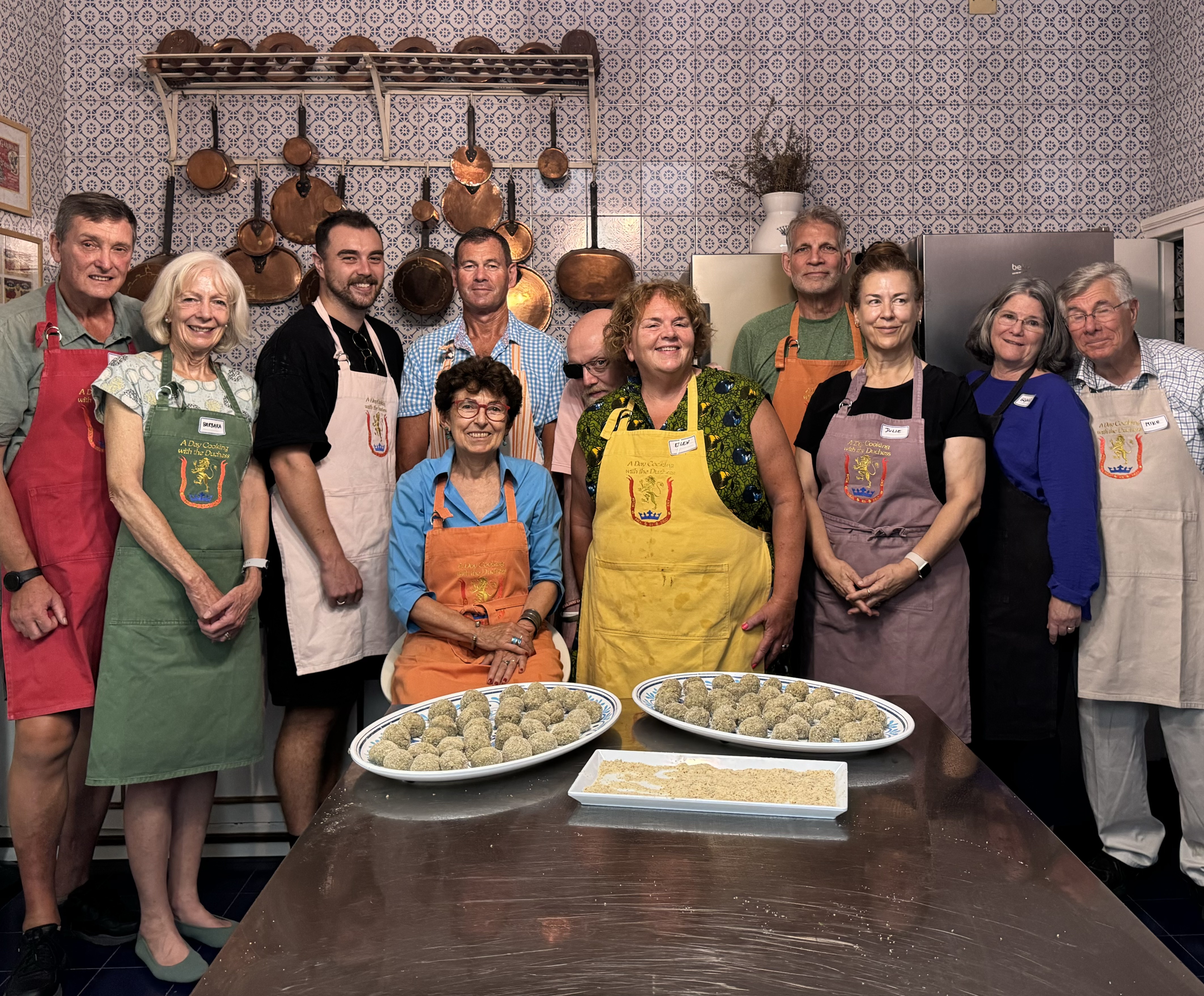
You could very happily curl up here with a good book for hours. But we were here to harvest herbs and edible flowers for lunch. The duchess established the format for the cooking session here, assigning different roles to individuals so the whole group was multi-tasking. It’s worth noting here that this is not a cooking class where each student does everything at his or her own workspace under the instruction of the leader. You may be in one room juicing oranges while someone else is peeling potatoes and another classmate is browning off onions. You’ll get recipes at the end, but if you’re looking for the kind of class that gets you “hands on” with every step of a recipe, this may make you a bit anxious.
The menu was seasonal (more aubergines, naturally) and of the region, though it turns out the duchess is originally from Venice. This made her stories even more interesting to me, as she reflected on the dramatic differences from her native region that she discovered when she first arrived here.
We started with polpette di melanzane, an aubergine-based take on meatballs perfect if you have an abundance of that purple vegetable … which seems to include everyone in Sicily in September … and an excellent vegetarian starter. You simply roast the whole aubergines until they go soft, scoop out the flesh, combine with herbs, seasoning, cheese, egg and breadcrumb. Then shape into balls, roll in bread crumbs and fry. I think this could also make an excellent side to simple preparations of meat or fish. The pasta course featured a sage and almond pesto; a useful reminder that you can play around with a lot more than basil here. Top tip: don’t add the oil until the very end, so you use only what the mixture needs get to the right consistency.
 The main was stuffed calamari, something I’d done before but it was useful to get professional tips. Formal instruction showed me that I’d been over-stuffing my version. I also learned that salted capers, rinsed and dried, are much nicer than the usual ones in brine if you can find them, and that sanding your pan with bread crumbs before frying the calamari helps them not to stick. We wandered south from Sicily to the island of Pantelleria for the inspiration for the accompanying potato salad; a sharp, vinegary version with red onions and more of those gorgeous salted capers.
Desert was a “gelo” of melon. Gelo is simply fruit juice and sugar, heated and thickened with corn flour (corn starch if you're speaking American). It’s presumably what inspired the American brand Jell-o, as the texture is almost identical. Rather stupidly, it never occurred to me that my recipe for watermelon gelo could be used for any fruit, and made into an elegant sweet. Here, we poured the thickened mixture into coup-style glasses that had been dusted with powdered cinnamon and then dressed the tops with edible flowers before putting the glasses in the fridge to set. The order of cooking, of course, was not necessarily the same as of eating, depending on the times needed to prepare. Dessert, for example, was the first thing we tackled because of the setting time.
 One of the joys of these experiences is sitting down your classmates to share the fruits of your efforts. I’ve never had more fun with the eating part of a cooking class, because I’ve never wrapped one up in such lavish interiors. We sat down at a table set for 12 under impressive Venetian glass chandeliers. Proper china, glassware and cutlery had been laid out and the duchess’ assistant had changed into an old-style black and white maid’s uniform to serve. French doors stood open on either side of the room, the exterior ones showing off the sea view while interior faced a courtyard draped with plants. The furniture was grand, 19th-century stuff at home in the architecture, with silver gleaming from the sideboard and big display cabinets showing off an impressive array of glassware marked with the family crest. Landscapes and family portraits looked down on us. I felt distinctly under-dressed.


The day starts in the courtyard of the palazzo on the edge of the Kalsa district. The impressive line of palaces of which this is one were built on old Spanish defensive walls facing the sea, stretching south from the famous Porta Felice. (Comprised of two baroque gatehouses, on either side of a road that forms the main spine of old Palermo and famously frame the setting sun, the Porta is amongst the most iconic symbols of Palermo.) You don’t linger long there, however, as you’ll be bundled into cars and whisked to Capo market. While Palermo’s other markets, Vucciria and Ballarò, have skewed more towards street food stalls and bars, Capo is still pretty much exclusively a functioning market for the locals with stall owners selling fruit, veg, fish, meat, and specialty ingredients. The duchess explained how there’s a sense of ownership between stall holders and their customers. In the Sicilian language you would say that you belong to each other. Vendors get to know you and your needs, and … once you become a regular customer … they would be mortally offended if you shopped anywhere else. You don’t handle the wares here; you tell the vendors what you want and they select for you. Meaning, of course, the regular customers will get the best.

Capo lies along a fairly dingy street overhung by 18th century buildings, their balconies festooned with laundry, football flags, plants and whatever doesn’t fit into the flats inside. Even on a sunny day, it feels like most of the light radiates from the beauties for sale, not from the sun above. Luscious shades of pink glowing atop bright white beds of ice in the fish stalls. Jars of honey catching and reflecting light like golden lanterns. Fruit and veg in every colour of the rainbow, all seeming far larger and more vibrant than what finally makes it to supermarket shelves in England.
Ingredients procured, we were bundled back into the cars waiting at the end of the street and returned to the palace. We went in a side door (the grand staircase was saved for our exit) and followed the Duchess through a warren of rooms. Some were small and functional, others more generously-proportioned sitting rooms. None particularly palatial in size but all furnished … elegantly but with a casual feel … with layers of art and antiques you only get from the accretion of many generations. There’s a passage in The Leopard where the young lovers go exploring in the family’s old palace and lose themselves in the bewildering labyrinth of rooms. I felt like I’d stepped not just into the author’s house, but into his novel.

You could very happily curl up here with a good book for hours. But we were here to harvest herbs and edible flowers for lunch. The duchess established the format for the cooking session here, assigning different roles to individuals so the whole group was multi-tasking. It’s worth noting here that this is not a cooking class where each student does everything at his or her own workspace under the instruction of the leader. You may be in one room juicing oranges while someone else is peeling potatoes and another classmate is browning off onions. You’ll get recipes at the end, but if you’re looking for the kind of class that gets you “hands on” with every step of a recipe, this may make you a bit anxious.
The menu was seasonal (more aubergines, naturally) and of the region, though it turns out the duchess is originally from Venice. This made her stories even more interesting to me, as she reflected on the dramatic differences from her native region that she discovered when she first arrived here.
We started with polpette di melanzane, an aubergine-based take on meatballs perfect if you have an abundance of that purple vegetable … which seems to include everyone in Sicily in September … and an excellent vegetarian starter. You simply roast the whole aubergines until they go soft, scoop out the flesh, combine with herbs, seasoning, cheese, egg and breadcrumb. Then shape into balls, roll in bread crumbs and fry. I think this could also make an excellent side to simple preparations of meat or fish. The pasta course featured a sage and almond pesto; a useful reminder that you can play around with a lot more than basil here. Top tip: don’t add the oil until the very end, so you use only what the mixture needs get to the right consistency.

Desert was a “gelo” of melon. Gelo is simply fruit juice and sugar, heated and thickened with corn flour (corn starch if you're speaking American). It’s presumably what inspired the American brand Jell-o, as the texture is almost identical. Rather stupidly, it never occurred to me that my recipe for watermelon gelo could be used for any fruit, and made into an elegant sweet. Here, we poured the thickened mixture into coup-style glasses that had been dusted with powdered cinnamon and then dressed the tops with edible flowers before putting the glasses in the fridge to set. The order of cooking, of course, was not necessarily the same as of eating, depending on the times needed to prepare. Dessert, for example, was the first thing we tackled because of the setting time.


After an unhurried lunch, the duchess rose from the table and invited us to tour the palace. (You take your things with you at this point, as the tour also leads you out.)
As you wander through the ballroom, the library, a sitting room and several more streamlined, museum-like rooms, the duchess explains the history of the building, its connection to the famous author and how her husband ended up as the heir. Tomasi di Lampedusa didn’t have children, but adopted the younger son of some equally aristocratic cousins to ensure he had someone to pass his legacy on to. The adopted Gioacchino Lanza Tomasi would go on to marry Nicoletta, your host for the day, and was a giant in the cultural world. He ran several orchestras and opera houses, led the Italian Cultural Institute in New York and wrote several books. Back in Palermo, he restored this palace … heavily damaged in WWII … and helped to promote his adopted father’s legacy.
Here, you can see the original manuscript of the book, first editions, notes and excerpts that weren’t used, and the library where he did most of his work. There’s a portrait of the author’s father, who was the model for the prince who is the main character in the book. If you’ve read The Leopard, everything in these rooms will remind you of some aspect of the story. If you haven’t read it, don’t even dream of setting foot in Sicily without doing so. It unlocks the soul of this island. It also turns Cooking with the Duchess into the most unique culinary workshop I’ve ever experienced.
I predict that a day cooking with the duchess in The Leopard’s lair will become a much hotter ticket next year after Netflix brings out its new adaptation of the novel. So if you’re interested in joining her, get in touch well in advance.
As you wander through the ballroom, the library, a sitting room and several more streamlined, museum-like rooms, the duchess explains the history of the building, its connection to the famous author and how her husband ended up as the heir. Tomasi di Lampedusa didn’t have children, but adopted the younger son of some equally aristocratic cousins to ensure he had someone to pass his legacy on to. The adopted Gioacchino Lanza Tomasi would go on to marry Nicoletta, your host for the day, and was a giant in the cultural world. He ran several orchestras and opera houses, led the Italian Cultural Institute in New York and wrote several books. Back in Palermo, he restored this palace … heavily damaged in WWII … and helped to promote his adopted father’s legacy.

Here, you can see the original manuscript of the book, first editions, notes and excerpts that weren’t used, and the library where he did most of his work. There’s a portrait of the author’s father, who was the model for the prince who is the main character in the book. If you’ve read The Leopard, everything in these rooms will remind you of some aspect of the story. If you haven’t read it, don’t even dream of setting foot in Sicily without doing so. It unlocks the soul of this island. It also turns Cooking with the Duchess into the most unique culinary workshop I’ve ever experienced.
I predict that a day cooking with the duchess in The Leopard’s lair will become a much hotter ticket next year after Netflix brings out its new adaptation of the novel. So if you’re interested in joining her, get in touch well in advance.
An additional note: The duchess also offers rental apartments within the sprawling palace for tourists. I loved our B&B for its proximity to the opera but I'd be very tempted to try this on my next visit to Palermo,


