Showing posts with label Palermo. Show all posts

Sunday, 17 November 2024

Palermo’s Teatro Massimo is an ideal place to see opera on a grand scale, at modest prices

Opera is a global art form, with more than 1,000 major companies around the world and grand opera houses scattered across every continent but Antarctica. These days the lead singers are as likely to be from Africa or China as Europe. Italy, however, still has quite a proprietary relationship with opera.

It was invented here, after all, and many of the favourites in the repertoire are sung in Italian. Italians feel a sense of ownership when it comes to the most popular arias; my grandfather used to belt out Puccini like other people did pop songs. Even small towns in Italy have opera houses. In the cities, they’re usually an architectural centrepiece, on par with … and often next to … palaces. The biggest of them all is in Palermo.

The Teatro Massimo is the largest opera house in Italy, and the third largest in Europe after Paris and Vienna. When it opened in the 1890s it was intended to hold up to 3,000 people in its seven tiers and ground floor. Despite the cavernous proportions, it’s reckoned to have perfect acoustics. These days a desire for more personal space and fire safety has reduced audience size to just 1,381. That’s 875 fewer than London’s Royal Opera house.

The smaller audience lets you luxuriate in more elbow room, and the company here still puts on productions on a traditionally grand scale. Yet tickets at Teatro Massimo are far cheaper than in London. We splurged on £120 a ticket for amazing seats in the stalls (the ground floor of the auditorium). We were on the horizontal aisle that divided the front and back blocks of seating, so had no heads in front of us for 10 feet and the ability to stretch our legs full length during the production. Instead of your typical flip-bottom theatrical seating, the stalls are all individual bucket-shaped arm chairs in classic style with generous upholstery. I’ve never been more comfortable, and rarely had a better view, in an opera house. The same location in London would cost more than £250, and in our recent experience any seats cheaper than £170 put your so high up, or give you such restricted sightlines, they’re not worth buying. At Teatro Massimo, had we wanted to spend less, I could have bought seats with clear views in the lower tiers for £60.

It’s the escalating price of London tickets, paired with the increasingly streamlined sets and choruses there, that has us looking to the continent for more of our opera experiences. The Teatro Massimo didn’t disappoint. In addition to those comfy, excellent value seats we got an excellent production of Turandot. None of those modern, cost-slashing stagings here. We were served up architecturally impressive sets, dazzling costumes and a full chorus.

Admittedly, I was somewhat perplexed by the set design. Turandot is set in Ancient China, something conveyed perfectly in this production by a chorus in identical, earth-coloured uniforms standing in seried ranks in pits built into the stage floor. Just like the terra cotta warriors. But the architecture told us we were in the ancient Middle East, with double-bull columns framing the palace. The Emperor was dressed as the Shah of Iran, circa 1950, while the bloodthirsty princess rocked a Grace Kelly in ballgowns vibe. Our victorious prince at least dressed Chinese, though more Kyng Fu monk that romantic hero. Oddest of all were the three advisors, each wearing a different shockingly bright primary colour and dressed in a series of hip hop mogul designs.

Some little girls turned up occasionally, obviously projections of Turandot’s memories, implying that her willingness to send all of her failed suitors to execution was the result of childhood sexual abuse rather than Puccini’s story of some wronged ancestress. Later, the production had Turandot seeing a vision of the slave girl she’d tortured to death as a trigger point to her character transformation at the end of the opera.

I don’t think this mash-up of concepts was entirely successful. They were just trying too many disparate things and probably would have delivered a stronger whole if they’d stuck to one big idea. But it was great to look at, all of the performers were solid and it’s always a thrill to hear “Nessun Dorma” performed live, in its original context. Most memorably in this production, the little girls and the ghost suggested what was going on in Turandot’s head, thereby giving some sort of logic to one of the most ludicrous endings in all of opera. Puccini might not have written it, but it worked.

Beyond the production itself, part of the fun of going to a new opera house is exploring the building. While its amphitheatre is a classically grand space .. all white and gold with plush red upholstery and frolicking gods painting on the ceiling … the foyers are actually a bit gloomy. The colour schemes out here are browns, beiges, dusky pinks and dark greys. The great hall you enter upon coming through the front doors actually feels like they’ve brought Palermo architecture in, but toned down the colours. The marble walls, with their engaged columns and architectural details, felt like the exteriors of the city’s palazzi, and this enormous space like a piazza between them. A browse through online photos indicates there are lots of interior spaces we didn’t see, including a rather spectacular rotunda that I suspect may be under the dome up top. In hindsight, it’s probably worth taking one of the tours of the building during the day to see more than you do as an audience member.


Downstairs is a brighter, more modern and very elegant cocktail bar, but by the time you get served you won’t have long to enjoy the atmosphere before you have to swig your drink and return to your seats. Locals clearly knew the fastest route to the bar and headed there the moment the curtain fell for intermission. Next time, so will we.

We discovered there’s also a restaurant outside, but within the area closed off from the piazza beyond by ornate railings. On a return visit, I’d go early and enjoy my aperitivo there before the show.

The neighbourhood around the opera is highly attuned to the crowds pouring in and out of here every night, with scores of cafes facing the building and lining the little lanes leading away from it. Our B&B, L’Olivella, was just 200 metres down one of these … the Via Bara All’Olivella. It’s a great place to stay for the opera and the street between it and Teatro Massimo is lined with restaurants.

At less than three hours’ flight time from Heathrow, Palermo offers opera lovers an easy weekend alternative to London. While flights will add to your costs, opera tickets and food will be less expensive and accommodation is reasonable. Head to their website for a long-range view of productions and get planning.

For another operatic excursion in Italy, see my article about our visit to the Verona Opera Festival last summer. It was a much weirder performance, but still a great experience.

Tuesday, 12 November 2024

To see Palermo’s greatest treasures, go to church

Palermo is a terrible city for ABC Tourists.

The letters stand for “another bloody church”. Back when my mother worked in travel as a sideline to teaching art history, tour guides used the label to describe an impatient sightseer who, having seen one example of one type of thing, ticked it off his to do list and was bored to see any more. Anyone satisfied with a single church may want to give the Sicilian capital a wide berth. Not only do religious buildings dominate the city, but many of the greatest artistic and architectural treasures are within them. Indeed, if you really want to see the best of Palermo, you’ll be spending more time in front of altars than a priest during Holy Week.

Any first-time visitor should prioritise the Palatine Chapel within the Royal Palace and the Cathedral at Monreale. Both are jaw-dropping masterpieces that mash-up Byzantine Christian mosaics with Arabic architecture. I’d seen them (and written about them) before, however, and wanted to dig into the next tier of masterpieces.

The most memorable from my long list was the Chiesa del Gesù, more frequently called the Casa Professa by locals. In Dr. Who there’s an ongoing gag about newcomers being in shock when they realise how much bigger the hero’s ship is on the inside than out. There’s a similar sort of disconnect here, but the shock comes between the extremely plain exterior and the eye-wateringly opulent interiors. Anyone who’s visited a few Italian Jesuit churches knows that when you combine those priests with Baroque architecture you usually end up with something completely over the top. This may be the most outrageous I’ve seen yet.

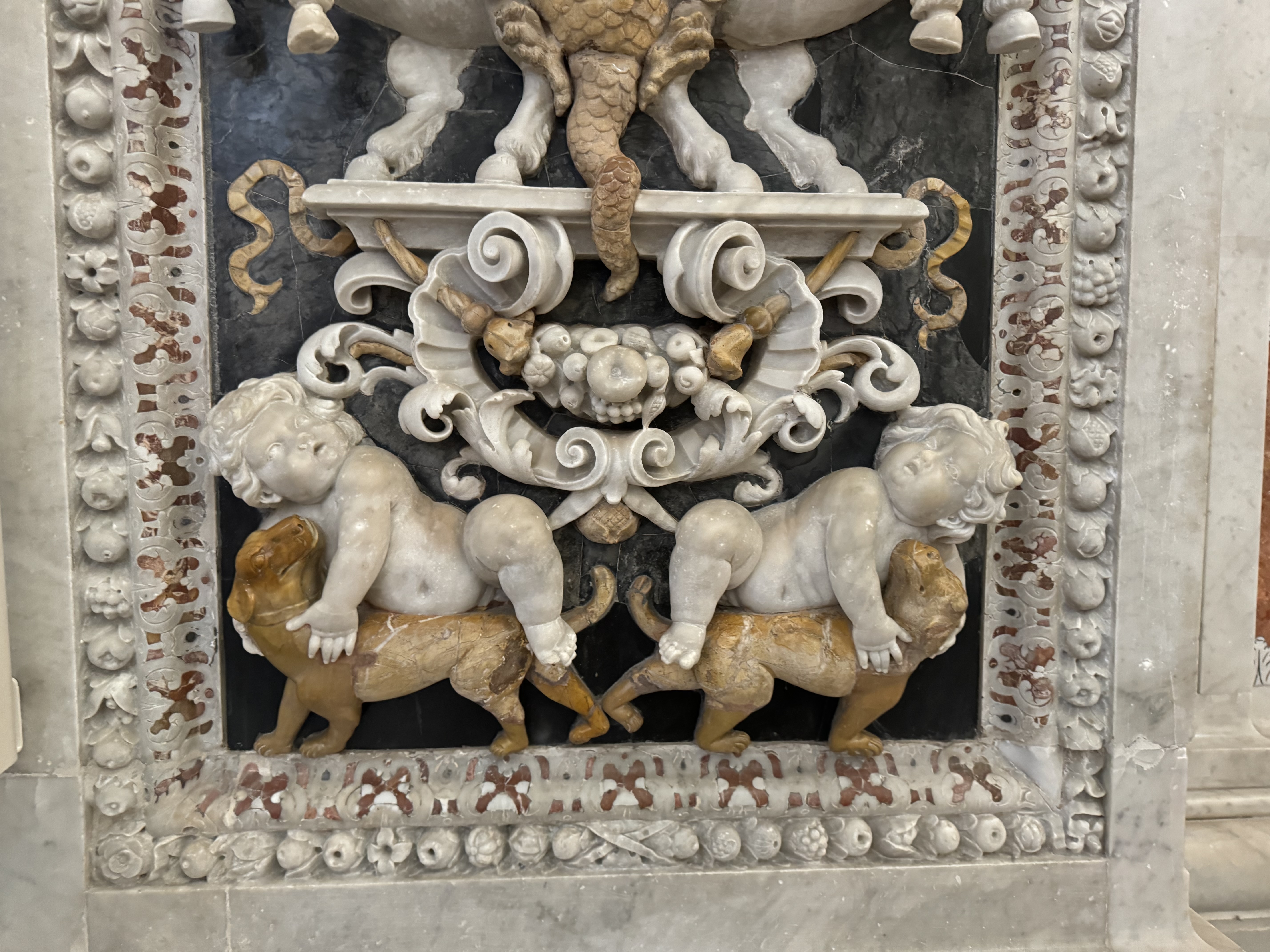
The church’s interiors are encrusted with multi-coloured marbles. They aren’t just inlaid. Many project from the walls’ surfaces. Fruit cascades in abundance. Birds and animals stick body parts out, putti (baby angels) cavort everywhere. At higher levels, near life-sized plaster figures act out scenes from the bible. Or just swan about joyously. This isn’t a place for quiet contemplation or gloomy thoughts. This decorative scheme provokes a giddy, overwhelmed joy.
I found myself wandering about giggling with nervous laughter as one viewpoint became more outrageous than the next. This place makes St. Peter’s look like streamlined Scandì design. Let your eye rest on a single square meter … a border of three-dimensional fruit in semi-precious stone, the face of a loving angel, the lush explosion of a vase of flowers rendered in inlaid marble … and you’ll marvel at the craftsmanship. Taken all together, it’s almost too much. Despite the risk of overdose, don’t miss the particularly opulent scenes in the tight space behind the main altar, which would have been for the eyes of priests alone, or the treasures kept in the museum though the door there. Sumptuous altar cloths encrusted with tiny red coral beads are almost as three dimensional as the church outside. You’d need to layer on a lot of bling not to get upstaged by your surroundings while saying mass here. The sparkling array of religious accessories here shows how they attempted it. 

The extraordinarily lifelike plasterwork here is by the Serpotta family, a name that will dominate your experience of Baroque churches in Palermo. Giacomo is probably Sicily’s greatest sculptor. He appears to have never left the island, but rather asked travellers to bring back books and sketches of what was happening in Rome and beyond. He, with brother and son, then interpreted them for his local market. His versions are not just better than anything in Sicily, but on par with anything Bernini created in Rome or the virtuoso Asam family produced in Munich

To get the full impact of his talent you need to seek out his oratories, smaller private chapels where his plasterwork dominates the decorative scheme rather than just enhancing it. The most famous is the Oratorio di Santa Cita. Here’s another mismatch of inside and out. The small road to the chapel is dingy. The building’s exterior … like so much of Palermo … is covered in graffiti. To get to the chapel you climb a plain flight of steps with a quiet, peaceful courtyard garden to your right. Even the anti-room where you buy your ticket is fairly plain. Then you duck through a curtain and, bam!, you’re smacked upside the head with the sheer force of art.

The walls are crowded with impressive figures, from flocks of those trademark Serpotta putti to statuesque women embodying the mysteries of the rosary. Exquisitely rendered cascades of fruit, foliage and flowers surround them. It’s as heavily decorated as the Casa Professa, but it’s all white and flooded with light from big windows two thirds of the way up the walls, which makes it a more soothing place. 

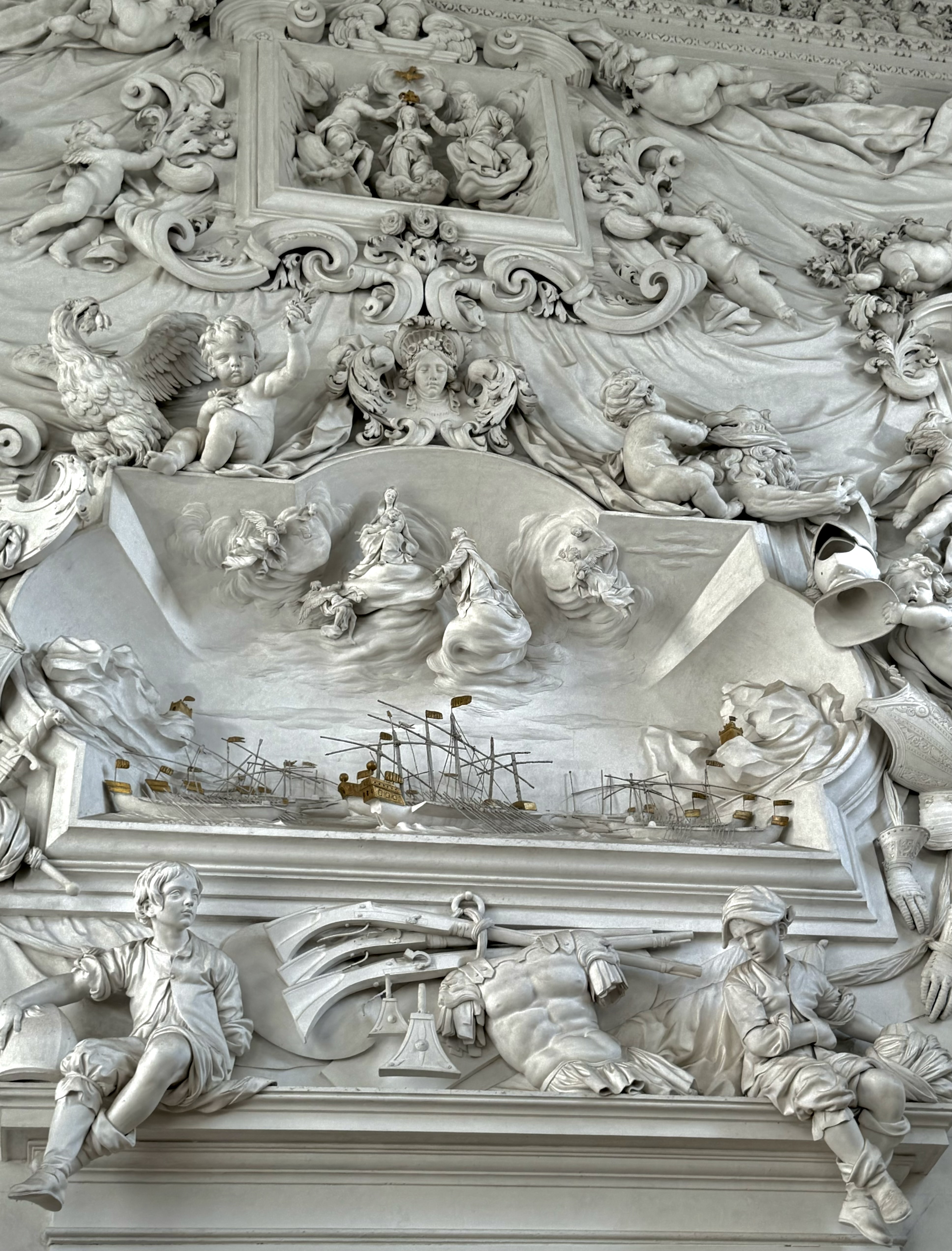
Until you turn around and check out the back wall. It’s hard to feel soothed when confronted with a detailed recreation of the naval battle of Lepanto so lifelike you can practically hear the cannon fire and men screaming as they tumble overboard. Here, the putti swarm around piles of armour and weapons. It seems an unusual motif for a religious building unless you know that Lepanto was the point at which European powers definitively stopped Islamic expansion into Europe. It was also considered a specifically Catholic victory at a time when the wars of the Reformation were raging, so a nice bit of one-upsmanship against those irritating Protestants. Many consider this to be the Serpotta family’s masterpiece.

A short stroll down a nearby cross street brings you to the Oratory of San Domenico. (You can buy a combination ticket to see both, and they’re so close to each other it’s foolish not to.) Though the room is almost the same size as Santa Cita, and it also features life-sized plaster women representing various religious ideas around its walls, San Domenico has an entirely different feel. The plasterwork is broken up by moody paintings. There are more distinctive architectural features in the plaster like towering columns and great swags of drapery, and there’s a fair amount of gold gilding. It’s heavier, more serious and more masculine than Santa Cita, and feels more like something out of the English Baroque than the Palermitan. That may have something to do with the altarpiece, which isn’t an ornate tower of carved marble but a painting. A painting by Sir Anthony Van Dyck … someone so completely embedded in the story of English art it came as a real surprise to encounter him here.
There are three more Serpotta oratories in Palermo and I could have happily continued my “compare and contrast” exploration across them all, but I needed to plunge backwards in time.

Though the Palatine Chapel and the Cathedral in Monreale are the greatest examples of this city’s unique Arab-Norman culture, there are two more churches a stones’ throw from the famous Quattro Canti that are worthy runners up. 

San Cataldo is tiny, and all about the architecture. It looks more mosque than church, with its three distinctive red domes and Arabic arches, but it never served an Islamic function. It was build after the Normans took over from the Arabs, but inspired by their style. It did host a post office in the 18th century, by which time almost all of its interior decoration had been stripped out. Though it’s been restored, it hasn’t been re-decorated, so you can fully admire its magnificent bones. Go here first, for a better appreciation of what happens when you put flesh on that infrastructure.
Just next door is Santa Maria dell’Ammiraglio. Its facade is a rather horrible hotch-potch of Arab-Norman, high gothic and Baroque, with none of the successive renovators making any attempt to integrate their work with the past. But, like so much in Palermo, it’s not the outside you’re here to look at. Inside, the Arab-Norman bones are intact and they retain most of their covering of magnificent mosaics. Angels and saints glimmer against an expanse of gold. The Virgin Mary dazzles in blue. Stars sparkle from a lapis night sky. Flowers and foliage twine across archways. Near the entrance, Roger II … the father of Sicily’s greatest age … has himself shown being crowned by Jesus. It’s an elegant bit of PR, considering that the pope was dragging his heels acknowledging Roger’s promotion from duke. When in doubt, go up the management chain.

The Admiral’s Church, as it’s known in English, didn’t manage to retain all of its original mosaics. About a third of the decoration, including the high altar, is Baroque. About the best you can say of it is that it isn’t intrusive. The colours and placement of figures work with what was there before so they fade into background. Though this isn’t a large church, plan on plenty of time here, moving from chair to chair to look up and appreciate the mosaic artistry.

A short stroll up the Via Vittorio Emanuele, one of the cross streets of the Quattro Canti, brings you to what you might think would be the most impressive church in town: the cathedral. It starts well. Unlike the Admiral’s bad exterior mash-up, the outside of this church is a wonderfully delicate blend of Arab-Norman features and later enhancements. That’s aided by an enormous piazza-cum-garden which sets off the architecture with swaying palm trees. Through the door, however, comes one of the few church interiors in Palermo that can actually be called boring. It’s big. It’s white. It has a bit of undistinguished statuary. There’s nothing memorable here and it looks like thousands of churches up and down the Italian peninsula.

Unless you turn left. A bit like heading that direction when boarding an airplane, all the important people are tucked away here. The cathedral houses the tombs of the Norman dynasty that made Sicily the artistic and intellectual showplace of Europe in the 12th and early 13th centuries. 

Here’s Roger II, the one you just saw being crowned by Jesus, and his grandson Frederick II. The younger man was known in his lifetime as stupor mundi, or wonder of the world, and was also Holy Roman Emperor. Here you’ll also find Frederick’s mother Constance, who did a remarkable job holding her father’s empire together … including abandoning the peaceful convent life she preferred to marry the German ruler, buried here beside her, and give birth to an heir when she was almost 40. Frederick’s wife, also a Constance, rounds out this fascinating group. Older than her superstar husband, Constance ruled Sicily for years while Frederick sorted out his more troublesome German inheritance. 

Given the lavishly decorated churches and palaces these people left behind, their tombs are almost austere. Massive dark marble sarcophagi sit beneath canopies held up by gracious columns. There’s a bit of mosaic work beneath the canopies and on the columns to add some colour but it’s mostly austere and august. Very ancient Roman, actually. That seems appropriate for people who thought they were establishing an Italian empire that would last generations. Sadly, it didn’t make it past Frederick’s children. But the tombs remain as a somber testament to the glories of Sicily’s greatest age.

There are 84 churches in Palermo before you dip into oratorios, private chapels and other religious architecture. It’s enough to overwhelm even the biggest architecture nerd, much less the ABC tourist. If you can get to these four examples, however, plus the Palatine Chapel and the Cathedral at Monreale, I promise you variety, beauty and wonder that will captivate anyone.

Sunday, 3 November 2024

Sicilian Food Part Three: A mash-up of cooking school, palace peeping and literary greatness

My husband and I have been including cooking classes in our holidays since our second trip together. We both love food, and have always found cooking workshops a fantastic way to understand more about a place while honing our culinary skills. It seems we’ve been trend setters. What was once a relatively scarce option has moved on to the must-do list of modern travellers. Travel sites now overflow with options.

I’m not sure the expansion has been for the better.

The explosion in cooking experiences brings a host of instructors who may or may not have any real credentials, demonstrating a few recipes in spaces that may or may not be appropriately kitted out for a lesson. Many classes appear pitched to people who don’t cook much, and offer the same handful of dishes that everyone knows for the country in question. You’ll find the same pizza and tiramisu-making combo across Italy, for example, even though the first is a Neapolitan dish, the second from the northeast, and passionate locals would much rather have you eating their regional specialties. Despite the proliferation of options, I think it’s harder these days to find a really excellent experience than it was when cooking classes were relatively rare.

Extensive web research, however, can still reveal real jewels. This year it led me to the Duchess of Palma, Nicoletta Lanzi Tomasi, and her remarkable day of instruction, stories and good food in Palermo. 

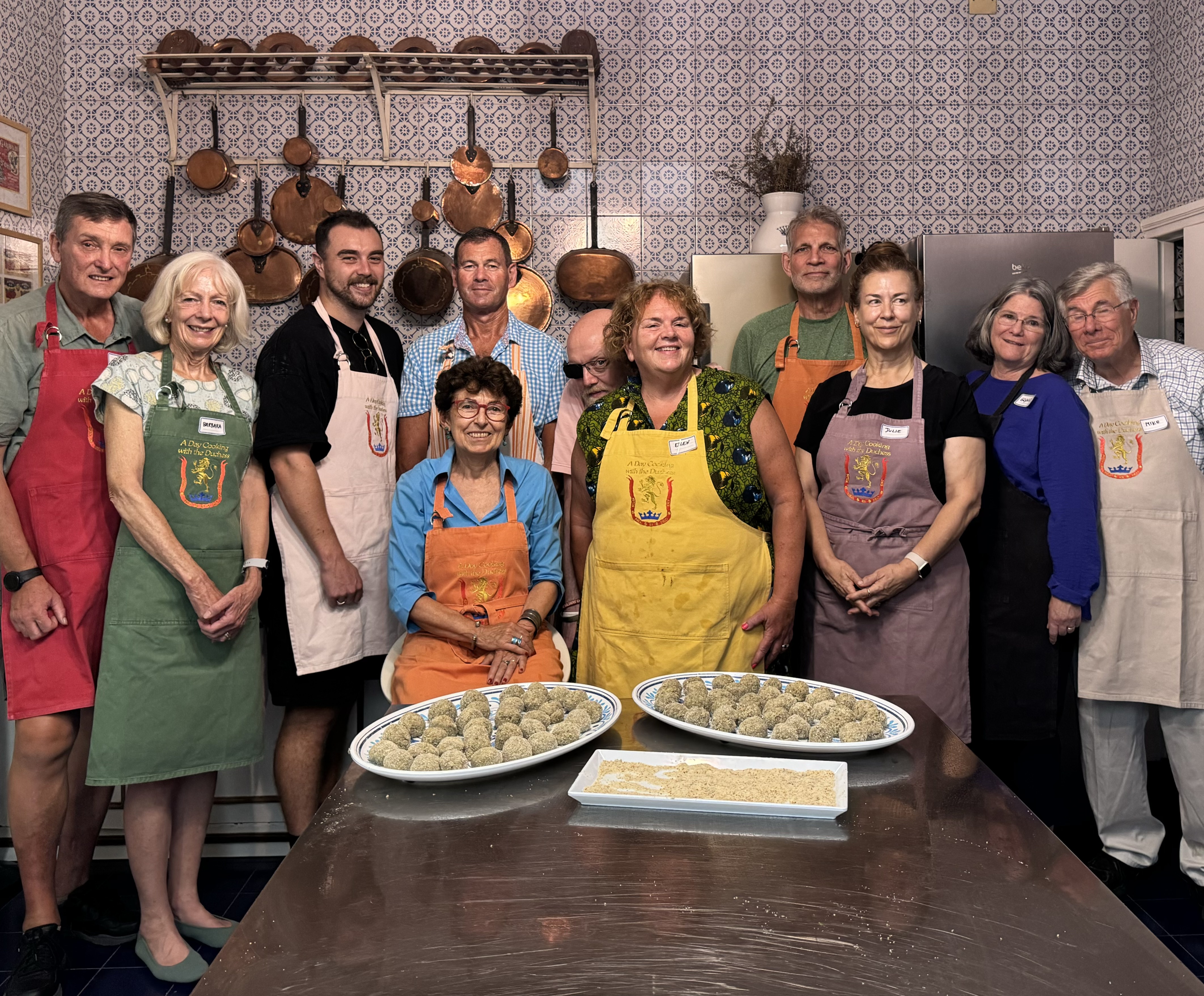
This isn’t just a cooking class but an all-around experience. You start with a stroll through the market as the duchess explains the deep traditions of shopping here. Then it’s back to her family palazzo by the sea, a setting which immediately elevates this above your standard class. After a morning of cooking together you sit down to eat what you’ve produced in the palace’s dining room. The delights don’t end there. You’ll walk off some of that lunch touring the palazzo, once the home of Prince Giuseppi Tomasi di Lampadusa, author of what’s arguably the greatest of all Italian novels, The Leopard. Food, literature, elegant dining, art and architecture all in one day. I was in heaven.

The day starts in the courtyard of the palazzo on the edge of the Kalsa district. The impressive line of palaces of which this is one were built on old Spanish defensive walls facing the sea, stretching south from the famous Porta Felice. (Comprised of two baroque gatehouses, on either side of a road that forms the main spine of old Palermo and famously frame the setting sun, the Porta is amongst the most iconic symbols of Palermo.) You don’t linger long there, however, as you’ll be bundled into cars and whisked to Capo market. While Palermo’s other markets, Vucciria and Ballarò, have skewed more towards street food stalls and bars, Capo is still pretty much exclusively a functioning market for the locals with stall owners selling fruit, veg, fish, meat, and specialty ingredients. The duchess explained how there’s a sense of ownership between stall holders and their customers. In the Sicilian language you would say that you belong to each other. Vendors get to know you and your needs, and … once you become a regular customer … they would be mortally offended if you shopped anywhere else. You don’t handle the wares here; you tell the vendors what you want and they select for you. Meaning, of course, the regular customers will get the best.

Capo lies along a fairly dingy street overhung by 18th century buildings, their balconies festooned with laundry, football flags, plants and whatever doesn’t fit into the flats inside. Even on a sunny day, it feels like most of the light radiates from the beauties for sale, not from the sun above. Luscious shades of pink glowing atop bright white beds of ice in the fish stalls. Jars of honey catching and reflecting light like golden lanterns. Fruit and veg in every colour of the rainbow, all seeming far larger and more vibrant than what finally makes it to supermarket shelves in England.

Ingredients procured, we were bundled back into the cars waiting at the end of the street and returned to the palace. We went in a side door (the grand staircase was saved for our exit) and followed the Duchess through a warren of rooms. Some were small and functional, others more generously-proportioned sitting rooms. None particularly palatial in size but all furnished … elegantly but with a casual feel … with layers of art and antiques you only get from the accretion of many generations. There’s a passage in The Leopard where the young lovers go exploring in the family’s old palace and lose themselves in the bewildering labyrinth of rooms. I felt like I’d stepped not just into the author’s house, but into his novel.

We’d taken this route to get to the garden, a terrace about 50 feet wide and stretching the whole length of the palace, so densely planted with semi-tropical trees and vines it seemed impossible that we were in a big city. It also helps, of course, that the views from here are of the seafront and the mountains framing the northwest of Palermo’s bay. Traditional Sicilian tiles marked paths between the beds and water splashed into fountains occupied by rather majestic tortoises.

You could very happily curl up here with a good book for hours. But we were here to harvest herbs and edible flowers for lunch. The duchess established the format for the cooking session here, assigning different roles to individuals so the whole group was multi-tasking. It’s worth noting here that this is not a cooking class where each student does everything at his or her own workspace under the instruction of the leader. You may be in one room juicing oranges while someone else is peeling potatoes and another classmate is browning off onions. You’ll get recipes at the end, but if you’re looking for the kind of class that gets you “hands on” with every step of a recipe, this may make you a bit anxious.

The menu was seasonal (more aubergines, naturally) and of the region, though it turns out the duchess is originally from Venice. This made her stories even more interesting to me, as she reflected on the dramatic differences from her native region that she discovered when she first arrived here.

We started with polpette di melanzane, an aubergine-based take on meatballs perfect if you have an abundance of that purple vegetable … which seems to include everyone in Sicily in September … and an excellent vegetarian starter. You simply roast the whole aubergines until they go soft, scoop out the flesh, combine with herbs, seasoning, cheese, egg and breadcrumb. Then shape into balls, roll in bread crumbs and fry. I think this could also make an excellent side to simple preparations of meat or fish. The pasta course featured a sage and almond pesto; a useful reminder that you can play around with a lot more than basil here. Top tip: don’t add the oil until the very end, so you use only what the mixture needs get to the right consistency.
The main was stuffed calamari, something I’d done before but it was useful to get professional tips. Formal instruction showed me that I’d been over-stuffing my version. I also learned that salted capers, rinsed and dried, are much nicer than the usual ones in brine if you can find them, and that sanding your pan with bread crumbs before frying the calamari helps them not to stick. We wandered south from Sicily to the island of Pantelleria for the inspiration for the accompanying potato salad; a sharp, vinegary version with red onions and more of those gorgeous salted capers.

Desert was a “gelo” of melon. Gelo is simply fruit juice and sugar, heated and thickened with corn flour (corn starch if you're speaking American). It’s presumably what inspired the American brand Jell-o, as the texture is almost identical. Rather stupidly, it never occurred to me that my recipe for watermelon gelo could be used for any fruit, and made into an elegant sweet. Here, we poured the thickened mixture into coup-style glasses that had been dusted with powdered cinnamon and then dressed the tops with edible flowers before putting the glasses in the fridge to set. The order of cooking, of course, was not necessarily the same as of eating, depending on the times needed to prepare. Dessert, for example, was the first thing we tackled because of the setting time.
One of the joys of these experiences is sitting down your classmates to share the fruits of your efforts. I’ve never had more fun with the eating part of a cooking class, because I’ve never wrapped one up in such lavish interiors. We sat down at a table set for 12 under impressive Venetian glass chandeliers. Proper china, glassware and cutlery had been laid out and the duchess’ assistant had changed into an old-style black and white maid’s uniform to serve. French doors stood open on either side of the room, the exterior ones showing off the sea view while interior faced a courtyard draped with plants. The furniture was grand, 19th-century stuff at home in the architecture, with silver gleaming from the sideboard and big display cabinets showing off an impressive array of glassware marked with the family crest. Landscapes and family portraits looked down on us. I felt distinctly under-dressed.
After an unhurried lunch, the duchess rose from the table and invited us to tour the palace. (You take your things with you at this point, as the tour also leads you out.)

As you wander through the ballroom, the library, a sitting room and several more streamlined, museum-like rooms, the duchess explains the history of the building, its connection to the famous author and how her husband ended up as the heir. Tomasi di Lampedusa didn’t have children, but adopted the younger son of some equally aristocratic cousins to ensure he had someone to pass his legacy on to. The adopted Gioacchino Lanza Tomasi would go on to marry Nicoletta, your host for the day, and was a giant in the cultural world. He ran several orchestras and opera houses, led the Italian Cultural Institute in New York and wrote several books. Back in Palermo, he restored this palace … heavily damaged in WWII … and helped to promote his adopted father’s legacy.

Here, you can see the original manuscript of the book, first editions, notes and excerpts that weren’t used, and the library where he did most of his work. There’s a portrait of the author’s father, who was the model for the prince who is the main character in the book. If you’ve read The Leopard, everything in these rooms will remind you of some aspect of the story. If you haven’t read it, don’t even dream of setting foot in Sicily without doing so. It unlocks the soul of this island. It also turns Cooking with the Duchess into the most unique culinary workshop I’ve ever experienced.

I predict that a day cooking with the duchess in The Leopard’s lair will become a much hotter ticket next year after Netflix brings out its new adaptation of the novel. So if you’re interested in joining her, get in touch well in advance.
An additional note: The duchess also offers rental apartments within the sprawling palace for tourists. I loved our B&B for its proximity to the opera but I'd be very tempted to try this on my next visit to Palermo,

Tuesday, 1 October 2024

Extreme Sicily can challenge and delight: here’s an itinerary to balance the wonder with R&R

Someone once explained to me that Italy gets more extreme the further south you go. If, by Rome, your nerves are a bit on edge from the noise, the traffic and the queue cutting, if the contrast between opulence and grime is grating, if you’re feeling over-stuffed by food and wine … it might be time to stop. If, however, life is just seeming brighter, the sights more magnificent and the dinners ever better, press on. On until, as far south as you can go before you hit Africa, you reach Sicily.

Sicily feels like everything Italian … the good and the bad … distilled to its most powerful essence.

It is incredibly ancient compared to the rest of Italy: the Phoenicians, Carthaginians and Greeks all lived here. Want to see some of the best Greek ruins in the world? Forget the Acropolis, come here. Every building in Sicily is built on the bones of past ages, and most of them seem to be crumbling. Even the new ones.

Other than for a few hundred years of glory in the early Middle Ages, the island has been a colony rather than its own boss. The nationalities of the absentee landlords might have changed, but in turns they abused, ignored and siphoned off resources. (Very occasionally, as with whoever built the Villa Romana del Casale, they fell in love with the place and ploughed their own resources into improving it. But this was the exception.) Many Sicilians, including my ancestors, argued that Italian unification was simply another foreign invasion; now the abuse came from Savoy, then Rome, rather than Madrid. Colonial overlords … and the mafia brutes that took advantage of their distance … drove Sicily to such a state that when emigration became a viable possibility for the average person, vast numbers of its people went elsewhere. An empty countryside scattered with abandoned houses is a vision of modern Sicily.

Extremes, age and colonial exploitation have created a place that’s both Italian and distinctly alien. Many places in Sicily remind me more of Tunisia or South Africa than Tuscany or the Veneto. Tourism in Sicily can be challenging. While gleaming new motorways are a testimony to EU improvement projects, local roads can be an adventure. Visual clues that usually tell you “turn around, you’re in a dangerous neighbourhood” don’t work the same way here; a dark alley full of graffiti and rubbish can host upscale jewellery shops or magnificent Baroque oratories. UNESCO heritage town centres are surrounded by hideous, often collapsing post-war housing. Cultural attractions can be light on English explanations; my basic Italian gets used here far more than in the north. And yet, if you love culture, history and food … the foundations of this blog … Sicily delivers rewards out of all proportion to the effort you put in. There is no place else in Europe quite like it.

I decided on two weeks here to celebrate my 60th birthday and our 13th wedding anniversary. (Marrying on your birthday is an excellent way to ensure neither of you ever forget your anniversary.) I wanted something indulgent and celebratory. Something that offered loads of top quality sightseeing with proper R&R and tremendous food. Opera at Palermo’s Teatro Massimo and cooking class with a Duchess in her palazzo was the icing on the cake.

Our itinerary went like this:

Days 1 - 5: Almar Giardino di Costanza, near Mazara del Vallo
The idea was to start the holiday with some restorative pamper time. We flew into Palermo and picked up a car at the airport. Unfortunately, our 90-minute queue at Avis/Budget/Maggiore took only a little less time than our whole drive south. The delay was so extreme we had to modify our plans to visit the Greek ruins at Segesta and content ourselves with a drive by. Which, to be honest, is still quite impressive and offers great photo opportunities without paying for admission.

The hotel is one of those Sicilian contrasts: a lush and luxurious walled complex surrounded by the dry, dusty, ruin- and rubbish-filled agricultural outskirts of Mazara. The few miles between motorway and hotel will make you wonder what you’ve gotten yourself into; once you’re through the gates you’re in another world. An old agricultural estate has been repurposed as luxury hotel and spa. The building is a big white and yellow “U” surrounding gardens, pools and fountains. We upgraded to a pool/garden view, which gave us an enormous balcony with table, chairs and sun loungers. 

The bedroom featured towering ceilings, an enormous television, arm chairs for watching, and a cheerful bouquet springing from a traditional Sicilian head vase to wish me happy birthday and anniversary. (A cake with burning candle also showed up on the actual day.) The basement … part of it opening onto the lowest level of the garden … features an upscale restaurant and a high-end spa. There’s an indoor swimming pool, hot and cold bathing tubs, saunas, steam rooms, and relaxation rooms all designed in a modern take on Arab-Norman architecture.

In short, it’s the kind of place you don’t really have any need or desire to leave. Even the private beach, accessible by hotel shuttle for morning or afternoon stints, didn’t seem worth the effort. Lots of things on my local possibilities list fell to the competition of napping to spa music and lounging in hot water, namely Trapani and Erice. But a few sightseeing excursions did demand the effort: the Greek ruins at Selinunte, the Greek statue of “the dancing Satyr” in Mazara del Vallo, a look at the salt flats above Marsala and a tasting of that town’s eponymous wine at Florio.

Days 5 - 6: Villa Trigona, Piazza Armerina
The next major stop in the itinerary was the Val di Noto, which would have been a straight 4-hour drive along the southwest coast of Sicily had we gone direct. But a date with a bucket list item demanded a detour. About 40 years ago Professor Jim Packer beguiled me with his Art and Architecture of Ancient Rome class at Northwestern, and his descriptions of the Villa Romana del Casale in the Sicilian Countryside have haunted me ever since. It was worth the detour. (More to come on that in a future article.)

We spent the night at another old agricultural estate turned to tourism. The Villa Trigona isn’t as big or as high-end as the Almar, but it was correspondingly less expensive. The family still owns and runs the place and has done a major renovation in the past few years, so venerable architectural details sit comfortably with fresh plaster and sheet glass walls of modern extensions. Our room, however, was 19th century in all but its electrification: old school wooden furniture, beautiful bed linens, decorative floor tiles, whispy curtains screening french doors to Juliet balconies that looked out over the surrounding woodlands and mountains and down into the front courtyard of the estate house. Another set of French doors led out to our own roof terrace. It was almost a shame to only be here just one night. 

The family offers dinner in that modern extension. It was hearty and delicious if not memorable, but we were grateful to be able to eat in. Villa Trigona is off winding, mountainous roads 10 minutes from Piazza Armerina and I wouldn’t have enjoyed navigating after dark. There’s nothing in walking distance. 
Days 6 - 11: Melifra, Ispica
Next came five full days enjoying the Val di Noto, proclaimed a UNESCO world heritage site because of its baroque architecture. All the guidebooks will tell you about the 1693 earthquake that flattened southeastern Sicily, and how the towns in the area rebuilt in a florid Baroque style that makes them gems of the architectural world. What they probably won’t mention is that these exquisite town centres are ringed by large and unattractive sprawls of modern development, that the Val is thick with modern industry and commercial agriculture, and that it’s a harsh landscape of pockmarked limestone peaks and scrubby brush with lots of winding roads between points A and B. This is not the charming hill towns of Tuscany.

The towns, however, are worth the effort. Noto is the most famous and therefore the most crowded; I enjoyed Scicli and Ragusa Ibla (top photo) much more. The Baroque heart of Modica was much bigger than anticipated, and the large crowds socialising on the streets at 11 pm on a Saturday testified to the fact this is a modern, living town, not just a tourist destination. We were there not for the late-night passeggiata but for dinner at a Michelin-starred restaurant, Accursio, that was one of the highlights of the trip. If you get sick of Baroque towns, there are beaches and a nature reserve where migrating birds … notably flamingoes … pause during their spring and autumn migrations. There will be more all of that in articles to come. 

We stayed in an AirB&B rental called Melifra that was absolutely ideal. It’s on the edge of a modern development on the outskirts of Ispica (this one, unusually, rather attractive … though still cursed with the Sicilian plague of unfinished or unkempt properties, like rotting teeth in the middle of an otherwise gleaming smile). While not usually listed amongst the highlights of the Val di Noto, Ispica has the same baroque heart as its neighbours with a handful of standout buildings. For us, however, its greatest advantages were that it sat in the middle of everything we wanted to see, and the views to the sea are quite spectacular. Even more so when you’re sitting in the hot tub in the roof garden at Melifra, glass of cold local wine in your hand while watching the sunset.

Melifra occupies the top floor of a three-story townhouse at the end of a block; access is up a dramatic winding staircase with a glass roof above. There are two bedrooms, each en suite, and a combined sitting room/kitchen dining area, but the crown jewel is undoubtably that roof garden. In addition to the hot tub there’s a shower, two loungers, a sofa, coffee table and chairs, and a large TV pre-programmed with all the streaming services (you will need your own password to sign in). Someone with highly-attuned interior design sensibilities has been at work here; colour schemes, decorative items, rugs and art have all been selected to complement a single colour scheme.

It was as tasteful as a luxury hotel, but all ours. Hosts Gianfranco and Barbara were fantastic, establishing a WhatsApp group for us for the duration of our stay, flooding us with useful information and responding quickly when we needed more.

I soon got into the habit of sightseeing during the day, nice lunch out, then back to Melifra for a soak in the hot tub. We’d spend the evenings in the outdoor seating area, nibbling a light dinner, drinking local wine and working our way through “The Rings of Power”. The dramatic landscape here seemed to fit a foray into Middle Earth.

There were only two flies in the Melifra ointment. If you are very tall, this apartment built under the eves may present a hazard. It’s beautifully designed, with skylights with automatic blinds in the roof that can flood the space with sunlight, but my husband whacked his head multiple times before he got used to stooping at the sides of rooms. You’re also about 3/4 of a mile from the town centre so it’s not really easy walking distance for going out. We only went out for dinner once and we preferred the extreme quiet, but this might be an issue for others.

Days 11-15: L’Olivella B&B, Palermo
Palermo can be hard work: it’s magnificent and exciting, but also noisy and dirty. If Sicily is like the concentrated essence of Italy, Palermo is the further distillation of Sicily. I thought I’d put it at the end of our agenda for when we were well-rested and had grown accustomed to the pace of the island. I also opted for the humblest of our accommodations here, figuring we’d had our luxury and would spend less time “at home” in the city.

L’Olivella is closer to what used to be called a “pensione”: you take one of a suite of rooms let out in your landlady’s house, there’s a modest sitting room, all the guests sharing a table at breakfast and then you’re unlikely to get a glimpse of your host or the other guests until the next morning. The whole place has towering ceilings with a few retaining some lovely frescoes that look to be from the 1930s. The floors are tiled with a beautiful array of Liberty Style (the Italian take on Art Nouveau) patterns. Our bedroom, Lingotto, was generously sized with French doors letting in light from two sides of the building: one side with a tiny balcony just big enough for two chairs and a narrow table. The location is superb. From our balcony we looked into the windows of the archaeological museum. The opera house loomed above the end of the street, between us and its front door were 200 metres of restaurants and artisan shops. A 10 minute stroll took us to Quattro Canti, the sightseeing heart of town.

We had two prime objectives in Palermo: Turandot at the opera and a very special cooking class in a palace in the Kalsa district. We’d already seen the Palatine Chapel and the cathedral at Monreale on a previous trip, so we were free with the rest of our time to explore some of the “Tier Two” sites. I spent a lot of time drinking in outrageous Baroque religious interiors, notably the oratories of Serpotta and the Jesuit church known as the Casa Professoressa. Honouring that rare and wonderful period in Sicilian history when it was the intellectual and artistic heart of Europe, I revelled in the mosaics in La Martorana and the Arab-Norman lines of San Cataldo. Yes, it was very church heavy!

We also spent a very happy morning poking around the Archaeological Museum, which is mostly distinguished by having the best bits of Selinunte under cover. In many ways it’s a shame that this stuff isn’t on site there, as the displays here explain the ruins far better than anything in Selinunte, and the treasures they’ve preserved really bring the place to life. This museum experience towards the end of our trip made our explorations at the beginning even more meaningful.

I could have done so much more. There was a museum of Sicilian tiles on my list, and a day trip to Cefalù. I was disappointed to discover that the traditional puppet shows only happen on weekends, and we were only in town for weekdays. The weather was exquisite and we could have headed to Mondello beach. But it was the end of the trip and we were mindful that we wanted to head home relaxed and refreshed. So multiple-hour, multiple-course lunches with multiple bottles of wine featured more prominently than high-impact sightseeing. About all that food, of course, there are articles ahead.

In coming weeks I’ll cover key sites, food and experiences. This gives you context and big picture for a two-week Italian itinerary I’d happily recommend, and do again.

Monday, 2 May 2016

British Museum's new Sicily show is a compelling celebration of mixing cultures

The less you know about Sicily, the more extraordinary you will find the British Museum's new exhibition.

The British, on the whole, know the Mediterranean's largest island as a holiday destination. Dependable sun, good food, child-friendly hosts and reasonable rental apartments an easy flight away. They'll have seen a handful of mafia films, and they may have noticed that some of the most dependable value-for-money wines on supermarket shelves come from here. After that, their awareness may get fuzzy. The idea of Sicily as a melting pot of diverse peoples that has twice dominated the whole Mediterranean with the dazzling genius of its culture may ... unless you opted for some serious sightseeing on that beach holiday ... come as a surprise.

The British Museum's new show Sicily: Culture and Conquest aims to change that. It focuses on two periods in which Sicily was, arguably, the most dynamic, exciting and intellectually advanced place in the Western world. First, you'll explore the late Greek period, when a culture far older and more sophisticated than Rome's became the jewel in that empire's crown. Then jump forward a thousand years to the dazzling Norman court, always in my top three for time travel destinations if I ever get the chance.

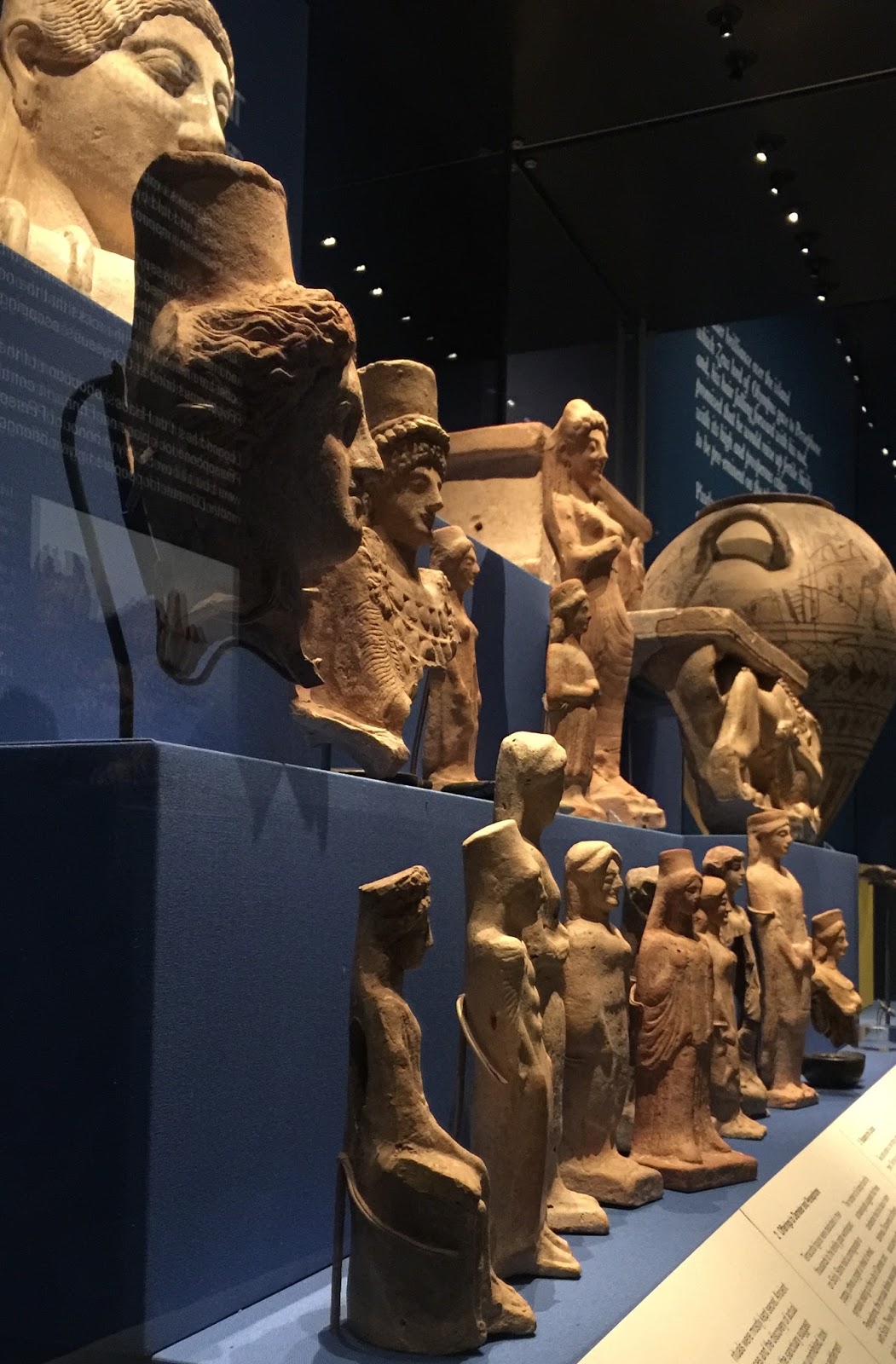
You're greeted not by artefacts, however, but by an enormous photo of a lush, green valley beneath warm blue skies and Etna's looming bulk. It's the kind of picture that draws you in, enticing you with beauty and reminding you of exactly why everyone was always conquering this place. First it was the Phoenicians, who also founded Carthage, then the Greeks. Their cultures merged here, evident in statues, altars and masks that aren't quite of one place or another. The altar held up by three alluring yet slightly alien maidens could be something dredged up from a mythical Atlantis. A stone slab with a dramatic, modern, spiralling design rewards study with shock when you realise it's obviously a man's organ penetrating a uterus topped by breasts.

Perhaps significantly, the female form is on top. This was the island where the goddess Persephone disappeared and her mother Demeter haunted the landscape searching for her. There's an evocative case of their devotional figures. Medusa contributes a slightly more threatening slice of femininity in a face that once served, gargoyle like, to decorate a temple's roofline. But she's more comic than threatening, picking up on a sense of fun that flows throughout the ages here. Further on, you'll see the first preserved use of paper in a European court, holding instructions written by the king's mother. Anyone familiar with Sicilian families will know that, however powerful the men seem to be, Mama calls the shots.

The show doesn't spend much time on the Arab era, using it as a transition between the ages rather than exploring it in any depth. Which is a shame, as I would have liked more. Instead, you can ponder an exquisite ivory casket, made by Arab craftsmen in Islamic style yet depicting Christian saints. Nearby is another enormous photo, this time of a sunny Palermo with the medieval Christian palace at the top and the towers of an ancient mosque (now a church) in the foreground. Both drive home the point that the melange of cultures here was a fruitful one for both the people, and the art.

The Normans took Sicily from the Arabs late in the 11th century. While they captured government, they let Islamic culture continue to flourish and bound it into their own ... leading to not only a model of productive tolerance, but one of the artistic triumphs of the Middle Ages. There's an exact replica of Roger II's magnificent coronation robe here (the original is too delicate to travel), on which Norman lions ... who look suspiciously like they've just come out of The Arabian Nights ... conquer placid camels while flowing Arabic script celebrates the regime.

The single most beautiful thing
in this section is a ceiling panel from Roger's palace, containing a whole forest of animals fleeing the hunt, framed by sinuous foliage inside precise Islamic geometry. Each animal is no more than a few inches high, and would have been completely invisible to people on the ground, yet the carving is a masterpiece. It shows the passion for beauty that permeated the island.

The most evocative piece, however, was a simple tombstone in four languages. Nothing else so powerfully evoked the multiculturalism the British Museum was celebrating here. I wonder, when they started putting the show together years ago, if they realised just how timely their message would be. In a world of growing xenophobia and factionalism, the brilliance of Sicily's melting pot is an uplifting message.

The Norman section has a challenge, however: the greatest glories of that age were architectural. The curators make noble attempts. There's a lovely mosaic of a madonna and child. They've made clever use of a light box to suspend a full-colour photo of the ceiling of the Palatine Chapel above you. But the photo lacks depth, thus you have no sense of the stalactites of ornamentation dripping towards you from heaven. And one small mosaic, no matter how fine, can convey the jaw-dropping awe that the golden jewel-boxes of the Palatine Chapel or the Cathedral at Monreale convey. (For more on the delights of seeing these things in person, read my take on Palermo here.)

This is probably the reason for my biggest disappointment with the show: it simply wasn't big enough. And that's inevitably because to really tell this story, you need to walk around inside it. See how the Christian church in Syracuse is built within the walls of the Greek temple. Marvel at the size of the complex at Agrigento. Wander around the crazy, compelling cultural mash-up that is the streets of Palermo. Maybe this show will inspire you to do that on your next holiday. Meanwhile, get to the British Museum for a taste.

PS. If you want to finish your day appropriately, then head off for dinner at Luce e Limoni, London's only properly Sicilian restaurant. Review here.