
Of all of the regional styles that conspire to make up Italian food as the world knows it today, Sicilian is my favourite. It’s no surprise that I default to cuisine of my childhood. (Although Sicilian-American food, as I explained in this article from my last trip to Sicily, is a different beast from what’s served on the beautiful island.) I’m not just voting for comfort and nostalgia. Sicilian is at the top of my list because it has a greater variety and is lighter than most other regions’ fare, and has by far the best deserts. Those superlatives are due to its tumultuous history and its extraordinary natural larder.
The Sicilians have been colonised by others for more than 4,000 years and all of those influences flow through their food. The Greeks, the Spanish, the French, the Arabs and more. Unusual spices, different ingredients, unique methods. The Arabs brought both sugar and pastry, laying the foundation for Sicily’s extraordinary pasticcerie today.
Fruit and vegetables benefit from almost consistent sun and, in much of the island, volcanic soil. Tomatoes, aubergines, figs, almonds, melons and more are all bursting with flavour. If you’re there in September, the first two will be on every menu in multiple incarnations.
Seafood is abundant and they eat many kinds in a variety of ways. But Sicilians know and respect what’s seasonal. Few restaurants would serve tuna in the autumn; everyone knows it’s a spring fish and any hitting a plate in September would have been frozen and flown in. There is meat, too. Beef, lamb and goat all inhabit the centre of the country. But even Sicily is regional and if you’re within 15 miles of the coast you’re not likely to find as much of it on your plate as things that swim.
Visitors imagine they’ll be constantly stuffed with carbohydrates but the reality isn’t so extreme. While a formal meal is four or five courses … antipasti, pasta, a main course, vegetables and salads, desserts … in reality Sicilians will graze across two or three courses and may split dishes with a companion. Serving sizes are appropriate, not excessive, and many pastas dishes feature as many vegetables as noodles. It’s rare to find a cream sauce, and cheese is used sparingly, almost as seasoning, rather than being at the centre of a dish. It is, in fact, probably one of the healthiest and most vegetarian-friendly places you can visit in Italy.
In Palermo, there were no set dining hours. Restaurants were lively and serving from noon until midnight. Out in the less-visited countryside things are more restricted, with lunch wrapping by 2:30 and dinner running from around 7:30 to 10:30. Other than Modica on a Saturday night, we didn’t go anywhere that followed Spain’s late hours. Many restaurants outside of Palermo were only open a few nights a week, and closed between lunch and dinner. While the food was universally delicious, limited hours and lots of empty tables suggest that the Sicilian restaurant scene is not as financially robust as owners would like it to be.
For more general observations on Sicilian food, see the article I wrote after my first visit. It all remains true except for my statement that cannoli at home were just as good as those in Sicily. I was in more touristy places that trip and had not discovered the fresh, sheep’s milk ricotta versions produced in the Val di Noto. They exist on another, higher culinary sphere.
I offer a roundup below of some of my favourite spots but, to be honest, I didn’t have a bad meal in two weeks. Even in Palermo, where we ate in obviously tourist-focused establishments where hawkers on the pavement pitched for our business. If anything, we turned that situation to our advantage, asking them what was fresh and best today. If they couldn’t give us details, and if there wasn’t a seasonal menu of the day to complement the printed menu, we steered clear. (We had several meals in the streets between our B&B and the opera house, a district heaving with restaurants. All good but interchangeable; none made the list below.)
 AquaMadre at the Almar Giardino di Costanza, Mazaro del Vallo
The fine dining restaurant within our hotel for the first four nights was the only gig in town, unless you wanted to drive 20 minutes into Mazara, so we ate there twice. (We had heavy snacks in the bar and did a light picnic in the room on the other evenings.) I’m not sure I’d go out of my way to dine here … I suspect there were restaurants in town that were almost as good and a lot cheaper … but if you’re going to be “stuck” somewhere this was no sacrifice. Standout dishes included a a bundle of red prawn carpaccio stuffed with local goats’ cheese (cheese and raw fish shouldn’t work, but it was fabulous); a lightly seared tuna with a pistachio crust (this was before I got the local tuna lecture, probably flown in from Asia but still delicious); caserecce with milk sausage ragout and local artichokes; and amberjack with pesto Trapanese (crushed almonds, tomato and basil). This was my first introduction to the noble Tropea onion, so sweet it might be classified as a fruit. It appeared here as an amuse bouche: gently cooked leaves around a choux pastry morsel stuffed with sharp goats cheese and topped with a variety of seeds. There was also an eye-wateringly delicious dessert that had taken the flavour profile of crema di pistachio and turned it into a ball of delight.
 A Cumacca, Caltagirone
Fruit and vegetables benefit from almost consistent sun and, in much of the island, volcanic soil. Tomatoes, aubergines, figs, almonds, melons and more are all bursting with flavour. If you’re there in September, the first two will be on every menu in multiple incarnations.
Seafood is abundant and they eat many kinds in a variety of ways. But Sicilians know and respect what’s seasonal. Few restaurants would serve tuna in the autumn; everyone knows it’s a spring fish and any hitting a plate in September would have been frozen and flown in. There is meat, too. Beef, lamb and goat all inhabit the centre of the country. But even Sicily is regional and if you’re within 15 miles of the coast you’re not likely to find as much of it on your plate as things that swim.
Visitors imagine they’ll be constantly stuffed with carbohydrates but the reality isn’t so extreme. While a formal meal is four or five courses … antipasti, pasta, a main course, vegetables and salads, desserts … in reality Sicilians will graze across two or three courses and may split dishes with a companion. Serving sizes are appropriate, not excessive, and many pastas dishes feature as many vegetables as noodles. It’s rare to find a cream sauce, and cheese is used sparingly, almost as seasoning, rather than being at the centre of a dish. It is, in fact, probably one of the healthiest and most vegetarian-friendly places you can visit in Italy.
In Palermo, there were no set dining hours. Restaurants were lively and serving from noon until midnight. Out in the less-visited countryside things are more restricted, with lunch wrapping by 2:30 and dinner running from around 7:30 to 10:30. Other than Modica on a Saturday night, we didn’t go anywhere that followed Spain’s late hours. Many restaurants outside of Palermo were only open a few nights a week, and closed between lunch and dinner. While the food was universally delicious, limited hours and lots of empty tables suggest that the Sicilian restaurant scene is not as financially robust as owners would like it to be.
For more general observations on Sicilian food, see the article I wrote after my first visit. It all remains true except for my statement that cannoli at home were just as good as those in Sicily. I was in more touristy places that trip and had not discovered the fresh, sheep’s milk ricotta versions produced in the Val di Noto. They exist on another, higher culinary sphere.
I offer a roundup below of some of my favourite spots but, to be honest, I didn’t have a bad meal in two weeks. Even in Palermo, where we ate in obviously tourist-focused establishments where hawkers on the pavement pitched for our business. If anything, we turned that situation to our advantage, asking them what was fresh and best today. If they couldn’t give us details, and if there wasn’t a seasonal menu of the day to complement the printed menu, we steered clear. (We had several meals in the streets between our B&B and the opera house, a district heaving with restaurants. All good but interchangeable; none made the list below.)

The fine dining restaurant within our hotel for the first four nights was the only gig in town, unless you wanted to drive 20 minutes into Mazara, so we ate there twice. (We had heavy snacks in the bar and did a light picnic in the room on the other evenings.) I’m not sure I’d go out of my way to dine here … I suspect there were restaurants in town that were almost as good and a lot cheaper … but if you’re going to be “stuck” somewhere this was no sacrifice. Standout dishes included a a bundle of red prawn carpaccio stuffed with local goats’ cheese (cheese and raw fish shouldn’t work, but it was fabulous); a lightly seared tuna with a pistachio crust (this was before I got the local tuna lecture, probably flown in from Asia but still delicious); caserecce with milk sausage ragout and local artichokes; and amberjack with pesto Trapanese (crushed almonds, tomato and basil). This was my first introduction to the noble Tropea onion, so sweet it might be classified as a fruit. It appeared here as an amuse bouche: gently cooked leaves around a choux pastry morsel stuffed with sharp goats cheese and topped with a variety of seeds. There was also an eye-wateringly delicious dessert that had taken the flavour profile of crema di pistachio and turned it into a ball of delight.
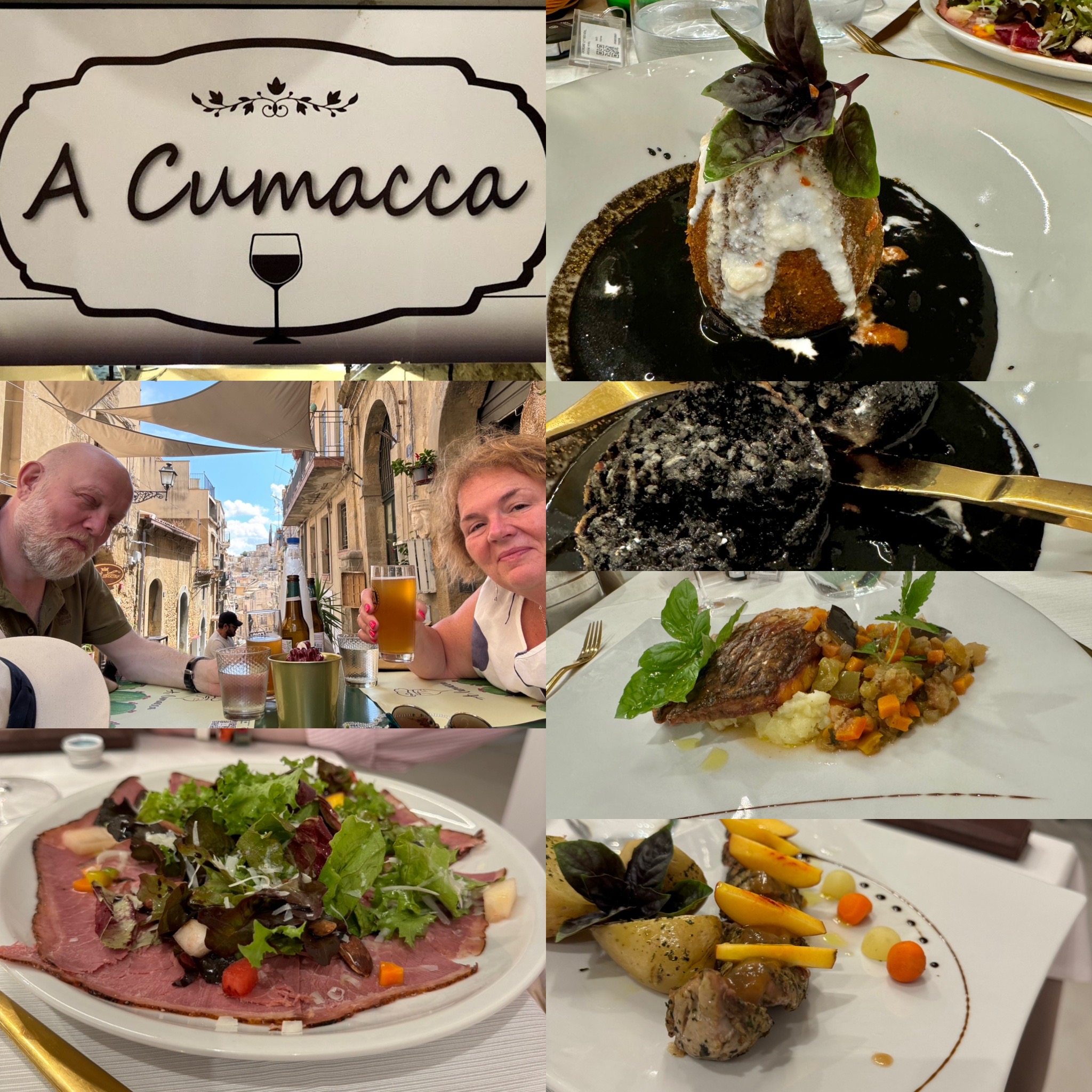
With outdoor tables charmingly perched on the broad treads of one of this town’s many enormous staircases, A Cumacca benefited from exceptional views. Up and to the left one of the town’s main squares, down to the right the stairs falling away into a valley before the lower half of town reared up to fill the horizon on its other hill. It was a tiny place that hardly seemed to have more than a galley kitchen and appeared to be more of a bar than a restaurant, but appearances deceive. This was a delicious and substantial meal, so filling that desserts were impossible. Given that this was as far away from the coast as we got, it’s no surprise that we encountered more meat here. My husband started with beef carpaccio and moved on to pork tenderloin prepared with the season’s fresh nectarines. (Another habit the Sicilians picked up from the Arabs is mixing sweet and savoury.) I tried a black arancino made with cuttlefish ink (interesting, but it didn’t beat more traditional styles) and went on to some red snapper. Even here the coast is only 25 miles away, so the fish is fresh.

In addition to being my favourite town in the Val di Noto, Ragusa Ibla delivered my best moderately-priced meal of the whole trip. The tiny restaurant sits in the shadow of the bombastic facade of the church of San Giuseppe, with more tables outside than in. The sinuous lines and bold statues of the church and the other magnificent architecture around you will give you plenty to look at while you eat. The restaurant drew me in with a bold chalkboard that said “We are against war and tourist menus” and they were as good as their word. Daily specials augmented the printed menu, something I always look for in any restaurant here. All of the dishes were simple and traditional, but cooked to perfection. You’ll get caponata in pretty much every restaurant on the island and everyone’s take will be slightly different. Here, the individual vegetables held their own shape and taste, the dominant notes were tomato and aubergine and the balance of sweet and sour was perfect. Comforting cavati (a small, shell-shaped pasta) Norma with aubergine, tomato and ricotta (what my mother used to call pink sauce) followed. An elegantly simple, obviously fresh cannolo crowned the meal. All consumed while sketching the church across the way, with a friendly waiter on hand when I needed him. Perfetto.

Ristorane Baqqalà, Scicli
Another Val di Noto restaurant with a view, this fish-heavy spot has a triangular outdoor deck dining area looking over the outrageously over-the-top Palazzo Beneventano. You are literally just a stone’s throw from the town’s biggest public space, the Piazza Italia, but few tourists seem to wander here. It’s a blissfully quiet spot to explore traditional Sicilian food with some innovative twists while surrounded by the architecture that makes this area so famous. I didn’t bother with a starter but got served a basket of soft rolls fresh out of the oven with local olive oil. (Much of the bread in central Italy is made without salt, exceptionally plain and doesn’t have much taste on its own. That is not the case in Sicily.) The daily pasta special was freshly-caught amberjack quickly cooked with just-picked tomatoes and aubergines and a hint of spice. To follow, the only place in Sicily that dared to play with the sacred cannoli. Here, a cannolo verticale. Instead of the usual tube, they’d cooked the shell as round disks and layered it with the cannoli creme. Basically a Sicilian take on a mille feuille. It tastes pretty much the same as the standard cannolo but is a fun variation and, given how fiddly cannoli shells are to make, might be one to try at home. 
 Salina, Palermo
Head towards the opera house from the Quattro Canti, rather than towards I Cucci and the cathedral, and you’ll come to an upscale fish restaurant on the corner of Via Maqueda and Via Bari called Salina. It’s one of the few restaurants we ate in that had a generous dining space inside as well as out, suggesting a year-round crowd. It was also unusually high-end on the decor, with elegant black and silver interiors and modern murals. Prices and dishes were a little closer to fine dining than some of the other spots on this list, but it still had a casual atmosphere and a variety of price points. We, unsurprisingly, drifted upwards on that scale, especially when presented with an interesting wine list with lots of local options and helpful descriptions. More variations on the same seasonal themes here: tartare of the island’s famous red shrimp, sesame-seed crusted amberjack on a bed of aubergine with a topping of sweet Tropea onion, both from the specials board. We seriously considered going back another night, but Palermo is so swollen with tempting restaurants it seemed wrong to eat at the same place twice.
Next time, I move on to our Michelin-starred experience in Modica, one so extraordinary it demands its own article.

I Cucci, Palermo
Sicily is one of the few places I’ll break my tourist rule of never eating in a high-traffic area overlooking major tourist spots. In Paris, Venice or Barcelona you’re likely to get overpriced food that’s deeply average, since the owners don’t have to worry about repeat trade. Here, you get places like I Cucci, owned by two brothers who moved away to make their living as so many Sicilians do, then decided to move home and open this place. While Italian food is notoriously regional, it is possible to get great interpretations of one place’s dish somewhere else. Ten years before we had the best bistecca fiorentina of our lives just outside of Palermo, up in Monreale. It was on the menu here. Could we be lucky again? Yes. Once again, a better quality steak, better grilled, than I’ve had on many attempts in and around the dish’s home in Florence. That was preceded by some exceptionally cooked octopus for me … crispy and smoky on the outside, tender and full of flavour inside … on a bed of hummus with roasted tomatoes. Here’s that eastern Mediterranean influencer again. My husband started with inspiration from another direction; a roast beetroot and almond salad on a goat’s cheese cream that would have been at home in a French cafe. Dessert was another in a procession of fabulous cannoli. When you know you won’t get anything like it at home, it’s hard to order anything else. The restaurant is on the Palazzo Bologni, just off the Via Vittorio Emanuele about 100 metres up from the Quattro Canti.

Head towards the opera house from the Quattro Canti, rather than towards I Cucci and the cathedral, and you’ll come to an upscale fish restaurant on the corner of Via Maqueda and Via Bari called Salina. It’s one of the few restaurants we ate in that had a generous dining space inside as well as out, suggesting a year-round crowd. It was also unusually high-end on the decor, with elegant black and silver interiors and modern murals. Prices and dishes were a little closer to fine dining than some of the other spots on this list, but it still had a casual atmosphere and a variety of price points. We, unsurprisingly, drifted upwards on that scale, especially when presented with an interesting wine list with lots of local options and helpful descriptions. More variations on the same seasonal themes here: tartare of the island’s famous red shrimp, sesame-seed crusted amberjack on a bed of aubergine with a topping of sweet Tropea onion, both from the specials board. We seriously considered going back another night, but Palermo is so swollen with tempting restaurants it seemed wrong to eat at the same place twice.
Next time, I move on to our Michelin-starred experience in Modica, one so extraordinary it demands its own article.


