Showing posts with label Sicily. Show all posts

Saturday, 26 October 2024

Sicilian Food Part One: Consistently delicious dining in a land of diversity, tradition and seasonal obsession

Italian food is regularly rated the world’s favourite national cuisine. Recent reports have revealed that there are more than 470,000 Italian restaurants around the world, more than any other nation’s culinary style. Globally, the Italian food industry is worth more than €228 billion. The irony, of course, is that if you really understand Italian food, you know there’s no such thing.

Italy as a modern country only dates back to 1861 and what we call “Italian” food is profoundly regional. Sure, everyone eats pasta … except the people who prefer risotto … but the shape of the pasta, whether it’s wet or dry, stuffed or sauced, with egg or without, varies widely. Before you even start down the path of what to put on it. There may be a pizzeria on every corner, but the thin, crispy pinsa you’ll get in the Dolomites and the thick, tomato-drenched sfincione of Sicily are completely different beasts from the Neapolitan classic. I remember celebrating a Ferrara family Easter at which a cousin excitedly shared that she was trying a “foreign” recipe. It was from Calabria.

Of all of the regional styles that conspire to make up Italian food as the world knows it today, Sicilian is my favourite. It’s no surprise that I default to cuisine of my childhood. (Although Sicilian-American food, as I explained in this article from my last trip to Sicily, is a different beast from what’s served on the beautiful island.) I’m not just voting for comfort and nostalgia. Sicilian is at the top of my list because it has a greater variety and is lighter than most other regions’ fare, and has by far the best deserts. Those superlatives are due to its tumultuous history and its extraordinary natural larder.

The Sicilians have been colonised by others for more than 4,000 years and all of those influences flow through their food. The Greeks, the Spanish, the French, the Arabs and more. Unusual spices, different ingredients, unique methods. The Arabs brought both sugar and pastry, laying the foundation for Sicily’s extraordinary pasticcerie today.

Fruit and vegetables benefit from almost consistent sun and, in much of the island, volcanic soil. Tomatoes, aubergines, figs, almonds, melons and more are all bursting with flavour. If you’re there in September, the first two will be on every menu in multiple incarnations.

Seafood is abundant and they eat many kinds in a variety of ways. But Sicilians know and respect what’s seasonal. Few restaurants would serve tuna in the autumn; everyone knows it’s a spring fish and any hitting a plate in September would have been frozen and flown in. There is meat, too. Beef, lamb and goat all inhabit the centre of the country. But even Sicily is regional and if you’re within 15 miles of the coast you’re not likely to find as much of it on your plate as things that swim.

Visitors imagine they’ll be constantly stuffed with carbohydrates but the reality isn’t so extreme. While a formal meal is four or five courses … antipasti, pasta, a main course, vegetables and salads, desserts … in reality Sicilians will graze across two or three courses and may split dishes with a companion. Serving sizes are appropriate, not excessive, and many pastas dishes feature as many vegetables as noodles. It’s rare to find a cream sauce, and cheese is used sparingly, almost as seasoning, rather than being at the centre of a dish. It is, in fact, probably one of the healthiest and most vegetarian-friendly places you can visit in Italy.

In Palermo, there were no set dining hours. Restaurants were lively and serving from noon until midnight. Out in the less-visited countryside things are more restricted, with lunch wrapping by 2:30 and dinner running from around 7:30 to 10:30. Other than Modica on a Saturday night, we didn’t go anywhere that followed Spain’s late hours. Many restaurants outside of Palermo were only open a few nights a week, and closed between lunch and dinner. While the food was universally delicious, limited hours and lots of empty tables suggest that the Sicilian restaurant scene is not as financially robust as owners would like it to be.

For more general observations on Sicilian food, see the article I wrote after my first visit. It all remains true except for my statement that cannoli at home were just as good as those in Sicily. I was in more touristy places that trip and had not discovered the fresh, sheep’s milk ricotta versions produced in the Val di Noto. They exist on another, higher culinary sphere.

I offer a roundup below of some of my favourite spots but, to be honest, I didn’t have a bad meal in two weeks. Even in Palermo, where we ate in obviously tourist-focused establishments where hawkers on the pavement pitched for our business. If anything, we turned that situation to our advantage, asking them what was fresh and best today. If they couldn’t give us details, and if there wasn’t a seasonal menu of the day to complement the printed menu, we steered clear. (We had several meals in the streets between our B&B and the opera house, a district heaving with restaurants. All good but interchangeable; none made the list below.)
AquaMadre at the Almar Giardino di Costanza, Mazaro del Vallo

The fine dining restaurant within our hotel for the first four nights was the only gig in town, unless you wanted to drive 20 minutes into Mazara, so we ate there twice. (We had heavy snacks in the bar and did a light picnic in the room on the other evenings.) I’m not sure I’d go out of my way to dine here … I suspect there were restaurants in town that were almost as good and a lot cheaper … but if you’re going to be “stuck” somewhere this was no sacrifice. Standout dishes included a a bundle of red prawn carpaccio stuffed with local goats’ cheese (cheese and raw fish shouldn’t work, but it was fabulous); a lightly seared tuna with a pistachio crust (this was before I got the local tuna lecture, probably flown in from Asia but still delicious); caserecce with milk sausage ragout and local artichokes; and amberjack with pesto Trapanese (crushed almonds, tomato and basil). This was my first introduction to the noble Tropea onion, so sweet it might be classified as a fruit. It appeared here as an amuse bouche: gently cooked leaves around a choux pastry morsel stuffed with sharp goats cheese and topped with a variety of seeds. There was also an eye-wateringly delicious dessert that had taken the flavour profile of crema di pistachio and turned it into a ball of delight.
A Cumacca, Caltagirone
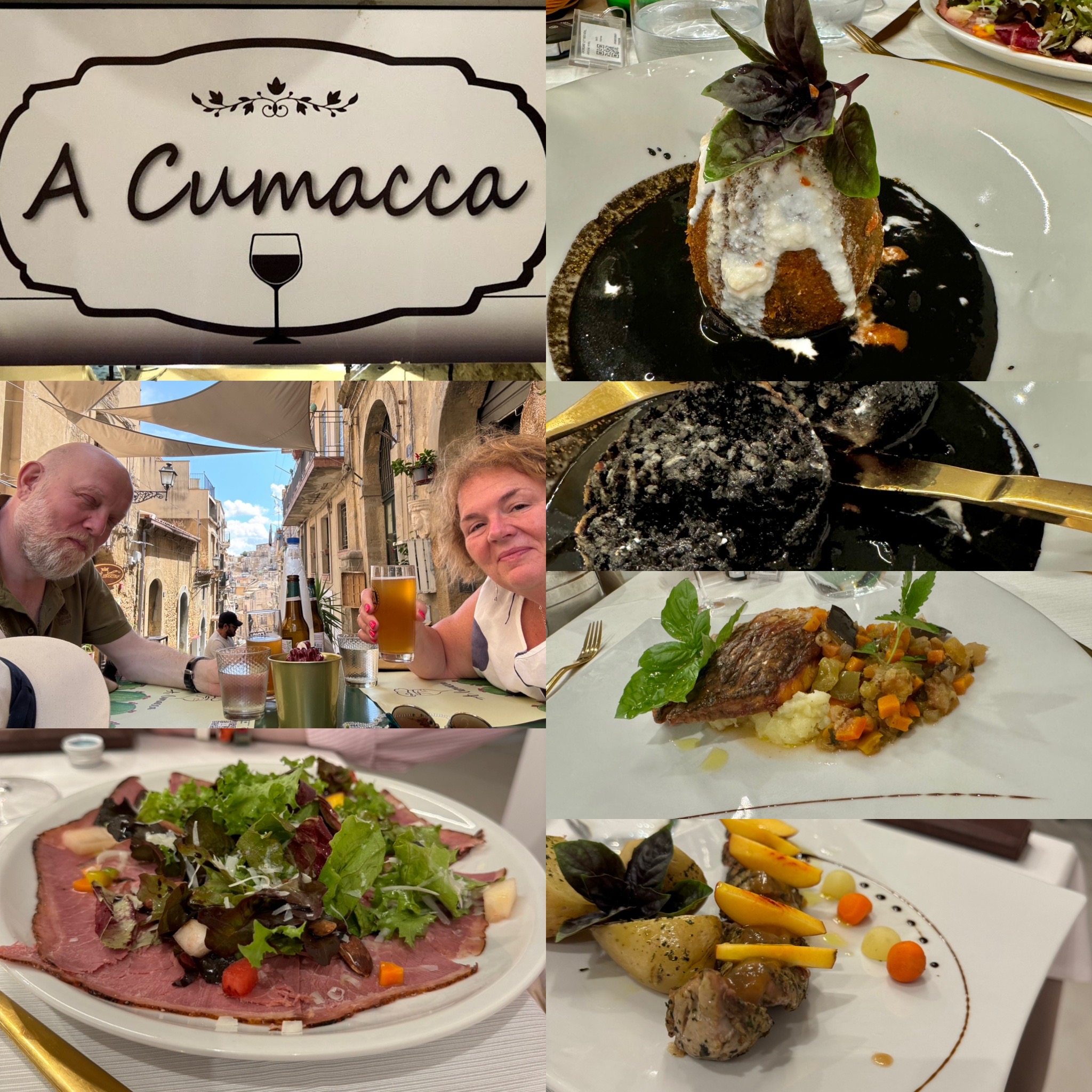
With outdoor tables charmingly perched on the broad treads of one of this town’s many enormous staircases, A Cumacca benefited from exceptional views. Up and to the left one of the town’s main squares, down to the right the stairs falling away into a valley before the lower half of town reared up to fill the horizon on its other hill. It was a tiny place that hardly seemed to have more than a galley kitchen and appeared to be more of a bar than a restaurant, but appearances deceive. This was a delicious and substantial meal, so filling that desserts were impossible. Given that this was as far away from the coast as we got, it’s no surprise that we encountered more meat here. My husband started with beef carpaccio and moved on to pork tenderloin prepared with the season’s fresh nectarines. (Another habit the Sicilians picked up from the Arabs is mixing sweet and savoury.) I tried a black arancino made with cuttlefish ink (interesting, but it didn’t beat more traditional styles) and went on to some red snapper. Even here the coast is only 25 miles away, so the fish is fresh.
Cucina Sincera, Ragusa Ibla
In addition to being my favourite town in the Val di Noto, Ragusa Ibla delivered my best moderately-priced meal of the whole trip. The tiny restaurant sits in the shadow of the bombastic facade of the church of San Giuseppe, with more tables outside than in. The sinuous lines and bold statues of the church and the other magnificent architecture around you will give you plenty to look at while you eat. The restaurant drew me in with a bold chalkboard that said “We are against war and tourist menus” and they were as good as their word. Daily specials augmented the printed menu, something I always look for in any restaurant here. All of the dishes were simple and traditional, but cooked to perfection. You’ll get caponata in pretty much every restaurant on the island and everyone’s take will be slightly different. Here, the individual vegetables held their own shape and taste, the dominant notes were tomato and aubergine and the balance of sweet and sour was perfect. Comforting cavati (a small, shell-shaped pasta) Norma with aubergine, tomato and ricotta (what my mother used to call pink sauce) followed. An elegantly simple, obviously fresh cannolo crowned the meal. All consumed while sketching the church across the way, with a friendly waiter on hand when I needed him. Perfetto. 
Ristorane Baqqalà, Scicli
Another Val di Noto restaurant with a view, this fish-heavy spot has a triangular outdoor deck dining area looking over the outrageously over-the-top Palazzo Beneventano. You are literally just a stone’s throw from the town’s biggest public space, the Piazza Italia, but few tourists seem to wander here. It’s a blissfully quiet spot to explore traditional Sicilian food with some innovative twists while surrounded by the architecture that makes this area so famous. I didn’t bother with a starter but got served a basket of soft rolls fresh out of the oven with local olive oil. (Much of the bread in central Italy is made without salt, exceptionally plain and doesn’t have much taste on its own. That is not the case in Sicily.) The daily pasta special was freshly-caught amberjack quickly cooked with just-picked tomatoes and aubergines and a hint of spice. To follow, the only place in Sicily that dared to play with the sacred cannoli. Here, a cannolo verticale. Instead of the usual tube, they’d cooked the shell as round disks and layered it with the cannoli creme. Basically a Sicilian take on a mille feuille. It tastes pretty much the same as the standard cannolo but is a fun variation and, given how fiddly cannoli shells are to make, might be one to try at home. 
I Cucci, Palermo
Sicily is one of the few places I’ll break my tourist rule of never eating in a high-traffic area overlooking major tourist spots. In Paris, Venice or Barcelona you’re likely to get overpriced food that’s deeply average, since the owners don’t have to worry about repeat trade. Here, you get places like I Cucci, owned by two brothers who moved away to make their living as so many Sicilians do, then decided to move home and open this place. While Italian food is notoriously regional, it is possible to get great interpretations of one place’s dish somewhere else. Ten years before we had the best bistecca fiorentina of our lives just outside of Palermo, up in Monreale. It was on the menu here. Could we be lucky again? Yes. Once again, a better quality steak, better grilled, than I’ve had on many attempts in and around the dish’s home in Florence. That was preceded by some exceptionally cooked octopus for me … crispy and smoky on the outside, tender and full of flavour inside … on a bed of hummus with roasted tomatoes. Here’s that eastern Mediterranean influencer again. My husband started with inspiration from another direction; a roast beetroot and almond salad on a goat’s cheese cream that would have been at home in a French cafe. Dessert was another in a procession of fabulous cannoli. When you know you won’t get anything like it at home, it’s hard to order anything else. The restaurant is on the Palazzo Bologni, just off the Via Vittorio Emanuele about 100 metres up from the Quattro Canti.
Salina, Palermo
Head towards the opera house from the Quattro Canti, rather than towards I Cucci and the cathedral, and you’ll come to an upscale fish restaurant on the corner of Via Maqueda and Via Bari called Salina. It’s one of the few restaurants we ate in that had a generous dining space inside as well as out, suggesting a year-round crowd. It was also unusually high-end on the decor, with elegant black and silver interiors and modern murals. Prices and dishes were a little closer to fine dining than some of the other spots on this list, but it still had a casual atmosphere and a variety of price points. We, unsurprisingly, drifted upwards on that scale, especially when presented with an interesting wine list with lots of local options and helpful descriptions. More variations on the same seasonal themes here: tartare of the island’s famous red shrimp, sesame-seed crusted amberjack on a bed of aubergine with a topping of sweet Tropea onion, both from the specials board. We seriously considered going back another night, but Palermo is so swollen with tempting restaurants it seemed wrong to eat at the same place twice.

Next time, I move on to our Michelin-starred experience in Modica, one so extraordinary it demands its own article.

Friday, 25 October 2024

Val di Noto Part 2: My Tier 2 choices demonstrate the diversity of this fascinating region

If the whole glorious UNESCO World Heritage site takes its name from the town of Noto, and Noto is the No. 1 place in the region that most day trippers head to when they leave Sicily’s eastern shore, what’s it doing at No. 3 on my list? In a word: overtourism. 

I’m all about finding the authentic, tapping in to quiet moments of wonder and discovering something
new. Those are hard things to do when you hear more American accents than local, and the whole place is so curated for day trippers you feel more like you’re at the Italian pavilion in Disney’s Epcot than in an historic Sicilian town.

That’s not to say you should skip Noto. It’s gorgeous. Just not as wonderful as the towns I told you about in the first part of this report. Let’s move on to my “best of the rest” across this fascinating region cum World Heritage Site.

AN OVER-CROWDED THIRD: NOTO
Noto is a monumental piece of planned cityscaping, on par with the Champs d’Elysee in Paris or The Mall in Washington D.C. When the town planners went to work here, they decided to organise the city by social class and function. Magnificent went high, practical and utilitarian got a space down the hill. A wide strip down the middle hosted the civic buildings and spaces where everyone met. The whole place is built into a hillside facing due west, turning its honey-coloured stone face even more golden in the afternoon light and treating everyone to blockbuster sunsets. That’s the Instagram moment for modern sightseers, and one I skipped after seeing the crowds on a morning visit. (I also had the advantage of a private, rooftop hot tub with its own sunset view back at our apartment, Melifra.)

The Corso Vittorio Emanuele is the spine that separates high and low. It hosts churches, government buildings, theatres and some of the biggest palaces. There are more grand homes and monasteries above, with lots of showy staircases the locals have painted to promote upcoming events or simply as vertical murals. The commercial part of town is below; both elegant 18th century buildings and a sprawl of modern ones. Driving into Noto was the worst traffic I encountered in Sicily outside of Palermo; it took me more than half an hour to get from the main road through this bit to the main tourist car parks up by the municipal playing field.

The effort is worth it, especially if you arrive on the Corso at the right place. If you’ve parked near the sports field, find the Via Vincenzo Gioberti. Come down it and you emerge out of a small, dark lane onto an elevated piazza with the whole town spread beneath you. This is “the money shot” of the Val di Noto, with stairs and formal gardens ahead of you, the cathedral atop its massive flight of stairs below and to your right, the elegant town hall across from it and magnificent buildings stretching away. It’s no wonder a Sotheby’s Real Estate sign is the first bit of branding you see here. What appealed to rich people at the turn of the 18th century still appeals today.

Descend onto the Corso and you’ll find a variety of churches, small museums and shops to poke around in. It’s the same mix as the other towns in the Val: pottery, luxury foodstuffs, clothing, jewellery. But it feels like there’s a higher percentage of those tourist tat shops where you can be fairly sure the cheap magnets, colourful dish towels and miniature versions of Sicilian pots were made in China.

One spot stands above the rest and deserves your attention. Yes, Cafe Sicilia is exactly as delicious as you thought it would be when you watched the wonderful Chef’s Table documentary about it on Netflix. Yes, theirs are the best cannoli I’ve ever had in my life. (And trust me, this child of the Ferraras of Novara di Sicilia has consumed a lot of cannoli in her life.) 

I suspect it was because they use sheep’s milk ricotta rather than cow’s to create a cannoli cream that’s silky smooth yet not too sweet and has just a touch of sharpness to it. There’s no additional flavouring. No added chocolate chips. No ends dusted in crusted pistachios or anything else. Just cannoli cream in a light, perfectly crispy shell. The simplest of incarnations, and the most perfect. I tried that in house, in a dining area that feels like it hasn’t changed since the ‘60s despite the place’s recent fame, and got a box to take away with a variety of other goodies we sampled across the next few days. Their single-serving Cassata Siciliana was so amazing I may never attempt to make one again, so inferior are my efforts. If the traffic wasn’t so bad, and the crowds so thick, I would have probably returned to Noto several times just to continue working my way through Cafe Sicilia’s menu. 

Leave the architecture. Take the cannoli.

A FOURTH FOR THE CRAFTY: CALTAGIRONE
A profound danger of the combination of social media and digital photography is that certain things can be made to look dramatically grander than they actually are.

The 430-foot long staircase of Santa Maria del Monte is the most frequently shared photo of this town. It’s famous for the front of each step being tiled with a different pattern, representing the output of this legendary centre of ceramic production. Once a year, it’s decked out with an amazing floral festival. I knew I wouldn’t see that. But many other pictures show plants and pottery spilling out onto the length of the staircase, plants cascading from the balconies above and everything drenched in bright colour. The truth? The buildings on either side are a bit grungy, few shops extend their wares onto the steps and the patterns on the tiles are so small, and so subtle in their colouring, that the whole thing just appears grey from any distance. The Spanish Steps, it’s not.

Caltagirone sprawls a long way. It’s definitely worth hopping a ride on the little motorised train that tells you about the town while driving you around the highlights. You’re at the northwest tip of the region here and you’ve lost the golden stone of Ragusa, Scicli and Noto. The buildings are grey. Fewer have been restored and cleaned. There’s far less flamboyant Baroque architecture here.

So why bother? This is the centre of ceramics production in Sicily. You’ll find plenty of shops in every town in the Val di Noto selling interpretations of the classics, particularly pots shaped like the heads of kings and queens and the three-legged “trinacria” with Medusa’s head at the centre. Here, however, you’ll find them in bewildering abundance. 

If you like to see craftspeople at work, it’s great fun to wander down back lanes and look into studios where people are shaping or painting the clay. If you were a collector, this is the place you come for the new and different. It’s obvious that modern artists have their studios here beside the traditional producers and are creating stuff closer to Grayson Perry than the decor in every restaurant. I found it fascinating to wander shop-to-shop to see the differences, and to see how certain producers reacted to interiors trends or found a specific niche. One place leaned into African motifs and animal prints, another into a dark, spooky Goth vibe. Same basic shapes, radically different interpretations.

Pottery fans will find this all great fun. But Caltagirone is a bit of a one-trick pony. If you aren’t into the nuances of ceramics, you’re likely to poke your head into a few shops and then … as my husband did … retreat to a bench on a piazza with your Kindle while the pottery fans keep wandering. Even if you do love the art form, you may find the sheer abundance too overwhelming to make any choices. I did buy a piece of pottery, but not until later in Scicli, where I actually found having less choice helped me to hone in on a style I liked. There is no monetary advantage to coming to Caltagirone; I found prices fairly consistent across the whole region. So I’d advise that this is a town for the specialist rather than the casual tourist.

If you do find yourself here, however, make time for an al fresco lunch at A Cumacca. Its outdoor tables are beautifully located on a staircase … less famous than the one mentioned above but with the advantage of being in the middle of the upper town. Part of town, including the tiled staircase, stretches above you while more stairs plunge downward. The “lower town” rises from below and fills the other horizon. You can enjoy a lazy meal contemplating the workout anyone who lives here must get while walking around. No wonder they can pack away the pasta.

The best place to park for sightseeing is along the Viale Regina Elena at the top of town. Walk across the road to where the hilltop falls away beneath you to be treated to a spectacular view of the hills and plains of central Sicily, with Etna looming in the distance. When you consider that the volcano is more than 40 miles away from this point, you start to grasp just how big it is.

AN UNFAIR FIFTH? MODICA
Fair disclosure: We spent less than an hour nosing around Modica in advance of dinner at Accursio, a Michelin-starred restaurant there. (Report to come.) The meal was one of the highlights of the trip. The town, we could take or leave.
It has the requisite grand architecture: showy churches sitting atop mountainous staircases, extravagant palaces with ornate balcony braces and door and window surrounds. But it also has a major road making a dogleg right through the centre of town, and with that a feeling of almost big-city scale and modern usage. Modica felt a bit closer to Palermo or Catania than to its Val di Noto sisters.

Its biggest claim to fame is a distinctive kind of chocolate, which is sold in many specialist shops throughout town. Modica’s cioccolato is a PR and messaging triumph. You will read, hear and watch the same story repeated: this is special because it’s closer to the chocolate first brought over by Spaniards. It’s truly artisan. It’s unique. Connoisseurs appreciate its grainy nature. 

Let’s be honest, people. Sometimes “original” is not better. 

Chefs have been improving and perfecting chocolate for centuries. I prefer their innovations. We tried Modica’s speciality at multiple shops, from multiple makers, in multiple flavours. Uniformly, it tasted like chocolate that had gone wrong in the tempering process. The overwhelming top note is raw sugar, not cacao in any form. The fact that the chocolate presented by the local Michelin-starred chef was not grainy Modica stuff but the smooth, tempered, cocoa-forward version most of us know and love says it all.

Modica may possibly win the prize for best Val di Noto nightlife, though we didn’t go out enough to do a fair compare-and-contrast. We left the restaurant around 10:30 to find the streets heaving with people. Not tourists, but Italians, disproportionately under 40. There were so many people the main street had been shut down and pedestrianised to facilitate socialising. (This necessitated a long, dark, twisting, sometimes white-knuckle reroute home that would not have been for the faint-hearted driver.) The crowds were not out for a festival or anything special, this was just the Saturday night passeggiata in Modica. Grab a drink, take a stroll, celebrate life with your friends. Impressive.

BEYOND ARCHITECTURE…
The reason for the Val di Noto World Heritage listing is Baroque buildings. But if you’ve had enough, there’s also a lovely coastline dotted with small fishing villages, beaches (mostly empty during our September visit) and the wonderful Vendicari Nature Reserve. There are more than 3,700 acres of protected landscape along the coast in this reserve. Well-maintained hiking trails take you through lagoons, grasslands, salt marshes, beaches and some picturesque ruins. The latter includes an impressive old tuna production facility, or tonnara, making a statement as romantic as any castle on the coast.

Information boards throughout tell you about the flora and fauna, explaining that more than 180 species of birds visit the reserve on their annual migratory paths. This makes spring and autumn the best times to wander here. In late September we were lucky enough to see the beginning of the flamingo migration. Numbers would have increased in the coming month but there were still about 50 on the lagoon we hiked to. These were nowhere near the vivid pink of the genus lawnus plasticus, but rather a rose-tinted cream. They are marvellously odd-looking creatures whose long-legged marsh wading and angular bending for feeding is incredibly entertaining. We completely lost track of time perched in the bird-watching hides taking in their antics.

There are a variety of different beaches along the shore here, some smooth and powdery, others rockier and with more waves. The reserve web site has clear descriptions. In a country where “beach” usually means serried ranks of chairs and umbrellas hired from beach clubs who control patches of sand, this is where you’ll find the wilder, more natural coasts common in other parts of the world.

Not far off this shore, but outside the reserve, is the Villa Romana del Tellaro, which is your best chance to see spectacular ancient mosaics in the region if you don’t have time to get all the way to the Villa Romana del Casale.

We drove the coast road from Vendicari down to Portopalo di Capo, Sicily’s southeastern tip. It’s 12 miles of vineyards, commercial tomato farms, still-working fishing communities, quiet coastal roads and small pockets of beach. 
I saw a lot of signs for agrotourismi … the Italian take on farm-based B&Bs … and I suspect there’s an entirely different sort of tourist that fills this coast in high summer. You could do a moderately priced beach holiday here with plenty of activity, local colour in the port villages of Marzamemi and Portopalo, without ever bothering with the architecture-rich World Heritage Site.

Whatever your preferred holiday, my experience made it clear that the Val di Noto is worth more than a day trip. This is a place to sink in, go local and enjoy.

Saturday, 12 October 2024

Mosaic Madness: The Roman villas around the Val di Noto are beyond compare

I went off to university with strict instructions: no easy classes, and everything should directly support a prosperous career. I put two full academic years behind me before I could get my mother be at peace with me braking those rules to take Roman Art and Architecture.

It was the most effortless “A” I ever earned at Northwestern. Not because the course was easy, but because I treasured every minute spent with Professor Jim Packer, consumed every bit of course material with enthusiasm and found the artistic observation and analysis required of me to be something my mother had baked in to my character. I loved that class, and it laid down a bucket list of sites I’ve spent my life working through. Of those not in danger zones, the most significant left was the Villa Romana del Casale in the Sicilian countryside.

This trip, I finally got there, and it lived up to 40 years of dreaming expectations.

The Villa Romana del Casale is one of the great sights of Sicily. It’s just outside Piazza Armerina, a Baroque hill town on the edge of the Val di Noto Unesco World Heritage site. The Villa is a World Heritage Site on its own. It’s hard to throw a cannolo in heritage-laden Sicily without hitting one.

“Villa” is a bit of a misnomer. This is more of a palace, with the latest scholarly opinion thinking it may have belonged to Maximian, one of four emperors splitting ruling responsibilities in the late 3rd century. (He shared power with Diocletian, whose enormous retirement villa evolved into the town of Split.) Some sort of governmental function would explain the almost ludicrous scale here. You just can’t imagine private citizens having a complex this large and reception rooms on this scale, no matter how wealthy they were.

But you’re not here for the size. You come for the mosaics and, to a smaller extent, the preserved frescoes on the remaining walls. This is a place to be captivated by details. I have marvelled at a lot of Roman mosaics in my life, but have never seen so many wonders in one place. (The Bardo Museum in Tunis is the only thing that comes close.)

Room after room of floors surge with life. People, animals and plants are hemmed in my colourful geometric borders. If you couldn’t clearly see the lines, you’d swear they were paintings. It’s hard to get your head around the idea that all of these extraordinary scenes are comprised of tiny squares of glass and stone.

The place proclaims it’s not your average “villa” from the very first room, a massive chamber that spills out into a covered walkway like a cloister that goes around a square almost the size of a football pitch. The reception room you can see beyond that is the shape and size of a full Roman basilica rather than a domestic space. You see it all from raised walkways because nobody is allowed to tread anymore on what were made as floors. Even the most casual observer will need at least 45 minutes to walk through all of the rooms. I needed more than two hours.

There’s a wide variety of scenes and styles here; so many a modern interior designer would probably criticise the lack of consistency across the complex. These days, that’s what makes it fun. The Villa is most famous for a long, wide hallway showing the hunting for, capture and transport of wild African animals who were to be used in shows in the Colosseum and other Roman arenas. 
There’s another animal-themed room off the main quadrangle where Orpheus is charming scores of wild beasts with his songs. And another hunt. It’s a good hint that was what rich people came to the forests around here to do. The level of detail is extraordinary, though there are times you suspect the artists had never seen some of the more exotic beasts they were called upon to depict. There are some decidedly dodgy crocodiles and hippopotami. But when the artists bring hunters face-to-face with lions or wild boar they’re at their best, showing the raw emotions of both combatants.

Elsewhere, there’s an elliptical room where the floor has been turned into a chariot-racing arena, with the contestants going hell-for-leather mid race. One is even caught taking a spill, with the drivers behind him pulling hard on reigns to avoid him. 

In the family’s private rooms, as a send-up to that impressive racing art, is a room where cherubs contest each other in little carts tied to birds. Elsewhere in the private rooms, life-sized women engage in various workouts at the gym; this is the other particularly famous bit of the Villa, renown for their classical-era bikinis. 

At the entrance to the baths, a regal woman thought to be the lady of the house greets visitors with her staff behind her. There’s another set of reception spaces off to one side of the main building where the mosaics show scenes of the gods and Hercules battling across the room at a scale about twice life-sized. To be honest, if you were trying to do business in here when the floor was complete I think it might make you a bit queasy, so crazy are the proportions.

My favourite mosaic was in a semi-circular room approaching the kitchens with what would have been a fountain at its centre. Here, in one of the best places in the world to eat seafood, is an aquatic scene of a staggering variety of fish and waterfowl, interspersed with playful cherubs swimming, fishing and sailing in a seascape with exquisite colonnades of classical architecture framing the shore. 
Too much pattern can make your head spin, so I also enjoyed quieter spaces where the floors are mostly geometric designs, sometimes standing alone and sometimes framing details of plants or animals. Another of the kitchen rooms, with braids and wreaths around seasonal fruits and vegetables at their peak, would work in a home today. 

The Villa Romana del Casale was the single most crowded attraction we went to in Sicily. (Remember we skipped highly-trafficked Cefalù, Taormina and Ortigia.) Though there’s nothing but farmland for several miles around, the Villa has an enormous pay-to-exit car park in a deep valley and there’s a small mall of tourist booths on the way to the Villa from there full of pottery and other Sicilian crafts. This is definitely bus tour territory. Curiously, most of the tourists were continental Europeans. We heard only one English-speaking group come through. Though there were at least 20 individual cars there, the majority of visitors definitely came off buses. The secret, we learned, was to take your time, stand still and admire details while the bus tours flowed around you. In between them, you were often almost alone.

To be truly alone with Roman antiquity, however, you can head to another villa with murals on the other side of the Val di Noto. The Villa Romana del Tellaro was much smaller than Casale. Only the partial remains of four rooms’ floors and a hallway remain today, but the quality here is almost as good as the more famous villa. The intricately patterned hallway suggests that oriental carpets form a direct line of descent from Roman mosaics. There are more impressive hunting scenes here, a delightful vignette of lovers and a particularly fabulous tiger strolling through acanthus leaves. 

This is relatively new as a tourist site. For much of the 20th century this was an abandoned farmhouse, like so many that dot the Sicilian countryside. At some point in the ‘60s, someone discovered ancient mosaics here and started selling them out of the country on the black market. Customs officers discovered the scheme, then the government bought the house and excavated the ruins. Despite the fact it’s just a stone’s through from immensely popular Noto, this feels very undiscovered.
The Villa Romana del Casale is definitely worth a special trip. (Try Villa Trigona, as described in my introductory article, for a place to stay.) But if you can’t get that far and are in Ortigia or Noto, then at least do yourself the favour of getting to Tellaro. Both of these villas show off the incredible opulence of Sicily in the late Roman Empire. Particularly if you happened to be a Roman overlord. They created a feast for the eyes that, thanks to durable building materials, is still truly wondrous.

Tuesday, 8 October 2024

The Greek Pompeii? Selinunte is a lesser-known wonder on Sicily’s southwest coast

It doesn’t take much browsing through online travel forums to realise that the vast majority of tourists go to a tiny number of places ordained as “must sees”. In Sicily, the default itinerary is Cefalù, Taormina, and Ortigia. If you’re up for some Greek ruins you’ll throw in a day trip to Agrigento. In a search for a more authentic, less crowded Sicily, we avoided all of these spots.

When it came to the island’s Greek roots, we headed for Segesta and Selinunte and were richly rewarded.

Selinunte was one of our favourite experiences of the whole trip, and we both enjoyed it even more than Agrigento, which we explored thoroughly and loved on a visit a decade ago. (We actually drove right underneath the ridge of temples at Agrigento this time on our way to Piazza Armerina, but didn’t stop.)

There are three reasons Selinunte had such an impact: the vast scale of the place, its striking location, and the relative absence of tourists.

First, some context: With its strategic position right in the middle of the Mediterranean, Sicily was a prize colony from the moment the first gang with boats and swords came up with the idea of an overseas pied a terre. Phoenicians, Carthaginians and Greeks all sunk roots, creating colonial city states rather than taking over the whole island. Ortigia/Siracusa and Agrigento were such entities, Selinunte another, lying 58 miles west of Agrigento along the same coast. Greeks founded it in the 600s BC as their westernmost colony. The Carthaginians took it over in the 400s BC and it later became a battleground in the wars between Rome and Carthage. By 200 BC it was already a ruin.

While Agrigento remained a population centre with layers of successive building repurposing and layering over its Greek foundations, Selinunte mostly lapsed back into countryside. When people got interested in classical antiquity and started digging stuff up, they could easily unearth the enormous sprawl of the city beneath olive groves and pastures. Today’s site spreads over about two square miles with three distinct areas for exploration: The East Hill, with the most complete temple ruins (this is what you see in most photos of the place), the Acropolis (essentially the city centre, with housing and public buildings), and Gaggera Hill in the west, with another big temple complex. Unless you want to hike miles through arid, coastal scrubland, buy the ticket that includes shuttle services. Oversized golf carts will whisk you between the main areas while giving you some excellent views.

The entry building is the only place you’ll encounter a crowd; once people get their tickets and set off to explore the landscape everyone fans out. The first thing you’ll see on entering is the most-reconstructed of the temples on the East Hill, with the Acropolis to your left and the sea beyond it. It’s a stunning introductory view. 

Everyone naturally makes for the almost complete building, Temple E, first. It is in as good a shape at the temples at Agrigento but unlike the more famous site you can walk inside these. It’s a real thrill and puts the monumentality of these structures in a whole new light. Temples F and G next door are essentially just piles of rubble, but rubble you can touch, wander amongst and scramble over. Standing next to a column capital that’s wider across than you are tall gives you profound respect for ancient builders. The back temple, G, was the largest in the world when it was under construction, and a walk around its remaining platform is awe inspiring. Sadly, this potential wonder of the world was destroyed before it was ever completed thanks to those invading Carthaginians.

From there, we took the golf carts over to the other end of the site to see more clusters of temples on Gaggera hill. You need a bit of imagination to get a sense of the glory of the place, but the descriptive panels and the audio guide (an extra charge but worth it) help you to pick out the sacrificial altar, spot the sluices where water ran through the site and the channels on which the temples’ massive bronze doors slid. Only people who’ve bought into the transport tend to get this far and we were alone in the complex for quite a while, no sound except the crashing of the surf on the beach below.

Then we came back to what was the city’s acropolis, sitting high on a hill that had been sheathed in stone walls. Several still exist. There, you’ll see more temples … the central one features an impressive set of standing columns, though isn’t a complete rectangle … plus the remains of theatres, shops and houses. Architectural historians believe they’ve found evidence of the world’s first circular staircase here. There are some boards in Italian and English but if you want to really grasp subtle points like that it’s best to add the audio guide onto your entry ticket.

For the best understanding of the site, however, you’re going to have to add on a visit to the Palermo Archaeological Museum 75 miles away. The best preserved temple sculptures and hundreds of artefacts unearthed in excavations are stored here, as well as some excellent models, graphics and descriptions that bring Selinunte at its height to life. 

In one of the courtyards they show off a row of lion’s head waterspouts from one temple and also feature several copies painted as they would have been when the temple was in use. 
There’s also an excellent AI headset you can try on to take a walk through the complete temples at their height. There’s only one, but as almost nobody goes to this museum it’s unlikely you’ll have to wait. It’s a shame this stuff isn’t in an interpretive centre down in Selinunte, as it would make a visit even more meaningful and I suspect few tourists actually do both. But those who make the effort to see both will come away with something similar to seeing Pompeii or Herculaneum in conjunction with the archaeological museum in Naples

I had also planned a wander around Segesta, conveniently located between Palermo Airport and our hotel outside of Mazara del Vallo. A 90-minute queue to pick up the hire car (Avis/Budget in Palermo Airport NOT recommended) ate into our sightseeing time. When we got there … further off the highway and down far more winding roads that you’d think from the map … we realised that there would be a hefty hike involved to get up to the temple. But there was a rather brilliant view from the car park. And so, dear readers, your reporter failed you, opting for cocktails at the hotel rather than in depth sightseeing. The theatre here, further up the hills and not visible from the road, will have to remain a mystery. 

Our short excursion allows me to observe three things. If you’re basing yourself out of Palermo and want to get a taste of the Sicilian Greek world, this is the most logical day trip and the temple here is impressive enough to satisfy most people. The view from the road is dramatic enough that it’s worth the half hour detour off the motorway to take a look; you can get some great photos without going in. If you are going to explore, however, this is a place for stout walking shoes and lots of energy.

Whichever you opt for, seeing some Greek ruins is an essential part of touring Sicily. They’re an important part of the island’s history and one of the many factors that make it different from the rest of Italy.

Tuesday, 1 October 2024

Extreme Sicily can challenge and delight: here’s an itinerary to balance the wonder with R&R

Someone once explained to me that Italy gets more extreme the further south you go. If, by Rome, your nerves are a bit on edge from the noise, the traffic and the queue cutting, if the contrast between opulence and grime is grating, if you’re feeling over-stuffed by food and wine … it might be time to stop. If, however, life is just seeming brighter, the sights more magnificent and the dinners ever better, press on. On until, as far south as you can go before you hit Africa, you reach Sicily.

Sicily feels like everything Italian … the good and the bad … distilled to its most powerful essence.

It is incredibly ancient compared to the rest of Italy: the Phoenicians, Carthaginians and Greeks all lived here. Want to see some of the best Greek ruins in the world? Forget the Acropolis, come here. Every building in Sicily is built on the bones of past ages, and most of them seem to be crumbling. Even the new ones.

Other than for a few hundred years of glory in the early Middle Ages, the island has been a colony rather than its own boss. The nationalities of the absentee landlords might have changed, but in turns they abused, ignored and siphoned off resources. (Very occasionally, as with whoever built the Villa Romana del Casale, they fell in love with the place and ploughed their own resources into improving it. But this was the exception.) Many Sicilians, including my ancestors, argued that Italian unification was simply another foreign invasion; now the abuse came from Savoy, then Rome, rather than Madrid. Colonial overlords … and the mafia brutes that took advantage of their distance … drove Sicily to such a state that when emigration became a viable possibility for the average person, vast numbers of its people went elsewhere. An empty countryside scattered with abandoned houses is a vision of modern Sicily.

Extremes, age and colonial exploitation have created a place that’s both Italian and distinctly alien. Many places in Sicily remind me more of Tunisia or South Africa than Tuscany or the Veneto. Tourism in Sicily can be challenging. While gleaming new motorways are a testimony to EU improvement projects, local roads can be an adventure. Visual clues that usually tell you “turn around, you’re in a dangerous neighbourhood” don’t work the same way here; a dark alley full of graffiti and rubbish can host upscale jewellery shops or magnificent Baroque oratories. UNESCO heritage town centres are surrounded by hideous, often collapsing post-war housing. Cultural attractions can be light on English explanations; my basic Italian gets used here far more than in the north. And yet, if you love culture, history and food … the foundations of this blog … Sicily delivers rewards out of all proportion to the effort you put in. There is no place else in Europe quite like it.

I decided on two weeks here to celebrate my 60th birthday and our 13th wedding anniversary. (Marrying on your birthday is an excellent way to ensure neither of you ever forget your anniversary.) I wanted something indulgent and celebratory. Something that offered loads of top quality sightseeing with proper R&R and tremendous food. Opera at Palermo’s Teatro Massimo and cooking class with a Duchess in her palazzo was the icing on the cake.

Our itinerary went like this:

Days 1 - 5: Almar Giardino di Costanza, near Mazara del Vallo
The idea was to start the holiday with some restorative pamper time. We flew into Palermo and picked up a car at the airport. Unfortunately, our 90-minute queue at Avis/Budget/Maggiore took only a little less time than our whole drive south. The delay was so extreme we had to modify our plans to visit the Greek ruins at Segesta and content ourselves with a drive by. Which, to be honest, is still quite impressive and offers great photo opportunities without paying for admission.

The hotel is one of those Sicilian contrasts: a lush and luxurious walled complex surrounded by the dry, dusty, ruin- and rubbish-filled agricultural outskirts of Mazara. The few miles between motorway and hotel will make you wonder what you’ve gotten yourself into; once you’re through the gates you’re in another world. An old agricultural estate has been repurposed as luxury hotel and spa. The building is a big white and yellow “U” surrounding gardens, pools and fountains. We upgraded to a pool/garden view, which gave us an enormous balcony with table, chairs and sun loungers. 

The bedroom featured towering ceilings, an enormous television, arm chairs for watching, and a cheerful bouquet springing from a traditional Sicilian head vase to wish me happy birthday and anniversary. (A cake with burning candle also showed up on the actual day.) The basement … part of it opening onto the lowest level of the garden … features an upscale restaurant and a high-end spa. There’s an indoor swimming pool, hot and cold bathing tubs, saunas, steam rooms, and relaxation rooms all designed in a modern take on Arab-Norman architecture.

In short, it’s the kind of place you don’t really have any need or desire to leave. Even the private beach, accessible by hotel shuttle for morning or afternoon stints, didn’t seem worth the effort. Lots of things on my local possibilities list fell to the competition of napping to spa music and lounging in hot water, namely Trapani and Erice. But a few sightseeing excursions did demand the effort: the Greek ruins at Selinunte, the Greek statue of “the dancing Satyr” in Mazara del Vallo, a look at the salt flats above Marsala and a tasting of that town’s eponymous wine at Florio.

Days 5 - 6: Villa Trigona, Piazza Armerina
The next major stop in the itinerary was the Val di Noto, which would have been a straight 4-hour drive along the southwest coast of Sicily had we gone direct. But a date with a bucket list item demanded a detour. About 40 years ago Professor Jim Packer beguiled me with his Art and Architecture of Ancient Rome class at Northwestern, and his descriptions of the Villa Romana del Casale in the Sicilian Countryside have haunted me ever since. It was worth the detour. (More to come on that in a future article.)

We spent the night at another old agricultural estate turned to tourism. The Villa Trigona isn’t as big or as high-end as the Almar, but it was correspondingly less expensive. The family still owns and runs the place and has done a major renovation in the past few years, so venerable architectural details sit comfortably with fresh plaster and sheet glass walls of modern extensions. Our room, however, was 19th century in all but its electrification: old school wooden furniture, beautiful bed linens, decorative floor tiles, whispy curtains screening french doors to Juliet balconies that looked out over the surrounding woodlands and mountains and down into the front courtyard of the estate house. Another set of French doors led out to our own roof terrace. It was almost a shame to only be here just one night. 

The family offers dinner in that modern extension. It was hearty and delicious if not memorable, but we were grateful to be able to eat in. Villa Trigona is off winding, mountainous roads 10 minutes from Piazza Armerina and I wouldn’t have enjoyed navigating after dark. There’s nothing in walking distance. 
Days 6 - 11: Melifra, Ispica
Next came five full days enjoying the Val di Noto, proclaimed a UNESCO world heritage site because of its baroque architecture. All the guidebooks will tell you about the 1693 earthquake that flattened southeastern Sicily, and how the towns in the area rebuilt in a florid Baroque style that makes them gems of the architectural world. What they probably won’t mention is that these exquisite town centres are ringed by large and unattractive sprawls of modern development, that the Val is thick with modern industry and commercial agriculture, and that it’s a harsh landscape of pockmarked limestone peaks and scrubby brush with lots of winding roads between points A and B. This is not the charming hill towns of Tuscany.

The towns, however, are worth the effort. Noto is the most famous and therefore the most crowded; I enjoyed Scicli and Ragusa Ibla (top photo) much more. The Baroque heart of Modica was much bigger than anticipated, and the large crowds socialising on the streets at 11 pm on a Saturday testified to the fact this is a modern, living town, not just a tourist destination. We were there not for the late-night passeggiata but for dinner at a Michelin-starred restaurant, Accursio, that was one of the highlights of the trip. If you get sick of Baroque towns, there are beaches and a nature reserve where migrating birds … notably flamingoes … pause during their spring and autumn migrations. There will be more all of that in articles to come. 

We stayed in an AirB&B rental called Melifra that was absolutely ideal. It’s on the edge of a modern development on the outskirts of Ispica (this one, unusually, rather attractive … though still cursed with the Sicilian plague of unfinished or unkempt properties, like rotting teeth in the middle of an otherwise gleaming smile). While not usually listed amongst the highlights of the Val di Noto, Ispica has the same baroque heart as its neighbours with a handful of standout buildings. For us, however, its greatest advantages were that it sat in the middle of everything we wanted to see, and the views to the sea are quite spectacular. Even more so when you’re sitting in the hot tub in the roof garden at Melifra, glass of cold local wine in your hand while watching the sunset.

Melifra occupies the top floor of a three-story townhouse at the end of a block; access is up a dramatic winding staircase with a glass roof above. There are two bedrooms, each en suite, and a combined sitting room/kitchen dining area, but the crown jewel is undoubtably that roof garden. In addition to the hot tub there’s a shower, two loungers, a sofa, coffee table and chairs, and a large TV pre-programmed with all the streaming services (you will need your own password to sign in). Someone with highly-attuned interior design sensibilities has been at work here; colour schemes, decorative items, rugs and art have all been selected to complement a single colour scheme.

It was as tasteful as a luxury hotel, but all ours. Hosts Gianfranco and Barbara were fantastic, establishing a WhatsApp group for us for the duration of our stay, flooding us with useful information and responding quickly when we needed more.

I soon got into the habit of sightseeing during the day, nice lunch out, then back to Melifra for a soak in the hot tub. We’d spend the evenings in the outdoor seating area, nibbling a light dinner, drinking local wine and working our way through “The Rings of Power”. The dramatic landscape here seemed to fit a foray into Middle Earth.

There were only two flies in the Melifra ointment. If you are very tall, this apartment built under the eves may present a hazard. It’s beautifully designed, with skylights with automatic blinds in the roof that can flood the space with sunlight, but my husband whacked his head multiple times before he got used to stooping at the sides of rooms. You’re also about 3/4 of a mile from the town centre so it’s not really easy walking distance for going out. We only went out for dinner once and we preferred the extreme quiet, but this might be an issue for others.

Days 11-15: L’Olivella B&B, Palermo
Palermo can be hard work: it’s magnificent and exciting, but also noisy and dirty. If Sicily is like the concentrated essence of Italy, Palermo is the further distillation of Sicily. I thought I’d put it at the end of our agenda for when we were well-rested and had grown accustomed to the pace of the island. I also opted for the humblest of our accommodations here, figuring we’d had our luxury and would spend less time “at home” in the city.

L’Olivella is closer to what used to be called a “pensione”: you take one of a suite of rooms let out in your landlady’s house, there’s a modest sitting room, all the guests sharing a table at breakfast and then you’re unlikely to get a glimpse of your host or the other guests until the next morning. The whole place has towering ceilings with a few retaining some lovely frescoes that look to be from the 1930s. The floors are tiled with a beautiful array of Liberty Style (the Italian take on Art Nouveau) patterns. Our bedroom, Lingotto, was generously sized with French doors letting in light from two sides of the building: one side with a tiny balcony just big enough for two chairs and a narrow table. The location is superb. From our balcony we looked into the windows of the archaeological museum. The opera house loomed above the end of the street, between us and its front door were 200 metres of restaurants and artisan shops. A 10 minute stroll took us to Quattro Canti, the sightseeing heart of town.

We had two prime objectives in Palermo: Turandot at the opera and a very special cooking class in a palace in the Kalsa district. We’d already seen the Palatine Chapel and the cathedral at Monreale on a previous trip, so we were free with the rest of our time to explore some of the “Tier Two” sites. I spent a lot of time drinking in outrageous Baroque religious interiors, notably the oratories of Serpotta and the Jesuit church known as the Casa Professoressa. Honouring that rare and wonderful period in Sicilian history when it was the intellectual and artistic heart of Europe, I revelled in the mosaics in La Martorana and the Arab-Norman lines of San Cataldo. Yes, it was very church heavy!

We also spent a very happy morning poking around the Archaeological Museum, which is mostly distinguished by having the best bits of Selinunte under cover. In many ways it’s a shame that this stuff isn’t on site there, as the displays here explain the ruins far better than anything in Selinunte, and the treasures they’ve preserved really bring the place to life. This museum experience towards the end of our trip made our explorations at the beginning even more meaningful.

I could have done so much more. There was a museum of Sicilian tiles on my list, and a day trip to Cefalù. I was disappointed to discover that the traditional puppet shows only happen on weekends, and we were only in town for weekdays. The weather was exquisite and we could have headed to Mondello beach. But it was the end of the trip and we were mindful that we wanted to head home relaxed and refreshed. So multiple-hour, multiple-course lunches with multiple bottles of wine featured more prominently than high-impact sightseeing. About all that food, of course, there are articles ahead.

In coming weeks I’ll cover key sites, food and experiences. This gives you context and big picture for a two-week Italian itinerary I’d happily recommend, and do again.

Monday, 2 May 2016

British Museum's new Sicily show is a compelling celebration of mixing cultures

The less you know about Sicily, the more extraordinary you will find the British Museum's new exhibition.

The British, on the whole, know the Mediterranean's largest island as a holiday destination. Dependable sun, good food, child-friendly hosts and reasonable rental apartments an easy flight away. They'll have seen a handful of mafia films, and they may have noticed that some of the most dependable value-for-money wines on supermarket shelves come from here. After that, their awareness may get fuzzy. The idea of Sicily as a melting pot of diverse peoples that has twice dominated the whole Mediterranean with the dazzling genius of its culture may ... unless you opted for some serious sightseeing on that beach holiday ... come as a surprise.

The British Museum's new show Sicily: Culture and Conquest aims to change that. It focuses on two periods in which Sicily was, arguably, the most dynamic, exciting and intellectually advanced place in the Western world. First, you'll explore the late Greek period, when a culture far older and more sophisticated than Rome's became the jewel in that empire's crown. Then jump forward a thousand years to the dazzling Norman court, always in my top three for time travel destinations if I ever get the chance.

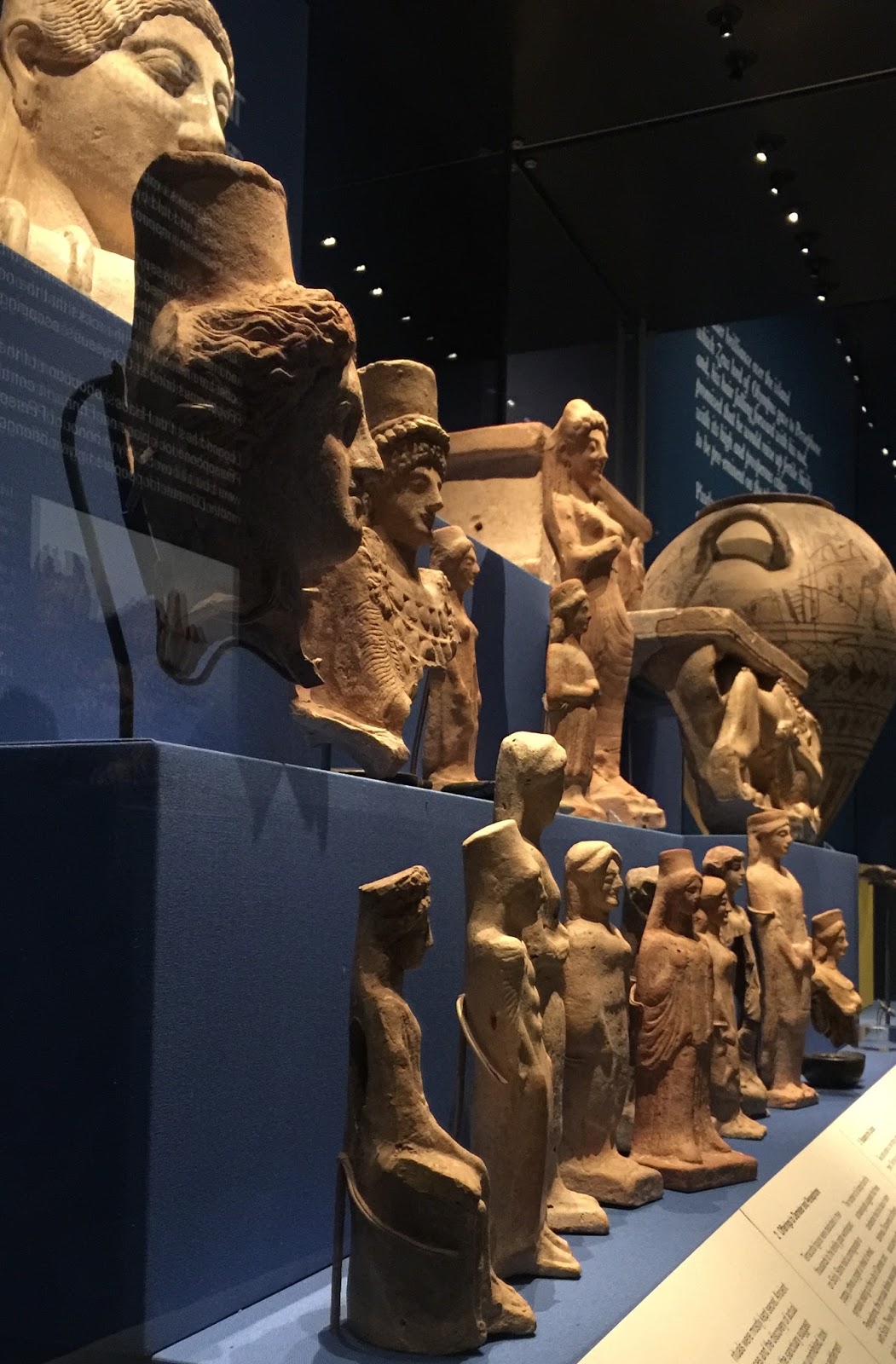
You're greeted not by artefacts, however, but by an enormous photo of a lush, green valley beneath warm blue skies and Etna's looming bulk. It's the kind of picture that draws you in, enticing you with beauty and reminding you of exactly why everyone was always conquering this place. First it was the Phoenicians, who also founded Carthage, then the Greeks. Their cultures merged here, evident in statues, altars and masks that aren't quite of one place or another. The altar held up by three alluring yet slightly alien maidens could be something dredged up from a mythical Atlantis. A stone slab with a dramatic, modern, spiralling design rewards study with shock when you realise it's obviously a man's organ penetrating a uterus topped by breasts.

Perhaps significantly, the female form is on top. This was the island where the goddess Persephone disappeared and her mother Demeter haunted the landscape searching for her. There's an evocative case of their devotional figures. Medusa contributes a slightly more threatening slice of femininity in a face that once served, gargoyle like, to decorate a temple's roofline. But she's more comic than threatening, picking up on a sense of fun that flows throughout the ages here. Further on, you'll see the first preserved use of paper in a European court, holding instructions written by the king's mother. Anyone familiar with Sicilian families will know that, however powerful the men seem to be, Mama calls the shots.

The show doesn't spend much time on the Arab era, using it as a transition between the ages rather than exploring it in any depth. Which is a shame, as I would have liked more. Instead, you can ponder an exquisite ivory casket, made by Arab craftsmen in Islamic style yet depicting Christian saints. Nearby is another enormous photo, this time of a sunny Palermo with the medieval Christian palace at the top and the towers of an ancient mosque (now a church) in the foreground. Both drive home the point that the melange of cultures here was a fruitful one for both the people, and the art.

The Normans took Sicily from the Arabs late in the 11th century. While they captured government, they let Islamic culture continue to flourish and bound it into their own ... leading to not only a model of productive tolerance, but one of the artistic triumphs of the Middle Ages. There's an exact replica of Roger II's magnificent coronation robe here (the original is too delicate to travel), on which Norman lions ... who look suspiciously like they've just come out of The Arabian Nights ... conquer placid camels while flowing Arabic script celebrates the regime.

The single most beautiful thing
in this section is a ceiling panel from Roger's palace, containing a whole forest of animals fleeing the hunt, framed by sinuous foliage inside precise Islamic geometry. Each animal is no more than a few inches high, and would have been completely invisible to people on the ground, yet the carving is a masterpiece. It shows the passion for beauty that permeated the island.

The most evocative piece, however, was a simple tombstone in four languages. Nothing else so powerfully evoked the multiculturalism the British Museum was celebrating here. I wonder, when they started putting the show together years ago, if they realised just how timely their message would be. In a world of growing xenophobia and factionalism, the brilliance of Sicily's melting pot is an uplifting message.

The Norman section has a challenge, however: the greatest glories of that age were architectural. The curators make noble attempts. There's a lovely mosaic of a madonna and child. They've made clever use of a light box to suspend a full-colour photo of the ceiling of the Palatine Chapel above you. But the photo lacks depth, thus you have no sense of the stalactites of ornamentation dripping towards you from heaven. And one small mosaic, no matter how fine, can convey the jaw-dropping awe that the golden jewel-boxes of the Palatine Chapel or the Cathedral at Monreale convey. (For more on the delights of seeing these things in person, read my take on Palermo here.)

This is probably the reason for my biggest disappointment with the show: it simply wasn't big enough. And that's inevitably because to really tell this story, you need to walk around inside it. See how the Christian church in Syracuse is built within the walls of the Greek temple. Marvel at the size of the complex at Agrigento. Wander around the crazy, compelling cultural mash-up that is the streets of Palermo. Maybe this show will inspire you to do that on your next holiday. Meanwhile, get to the British Museum for a taste.

PS. If you want to finish your day appropriately, then head off for dinner at Luce e Limoni, London's only properly Sicilian restaurant. Review here.