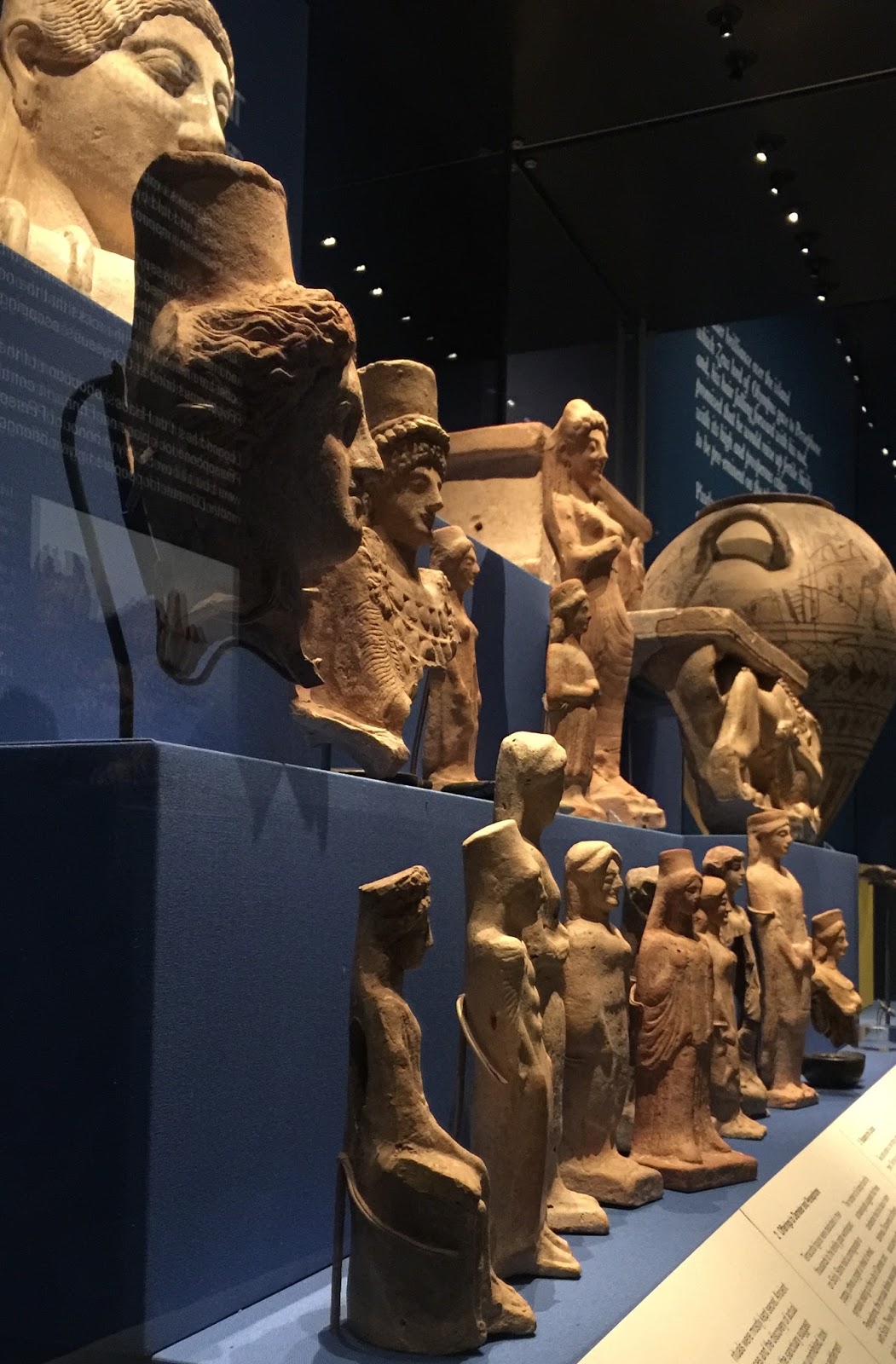
Any first-time visitor should prioritise the Palatine Chapel within the Royal Palace and the Cathedral at Monreale. Both are jaw-dropping masterpieces that mash-up Byzantine Christian mosaics with Arabic architecture. I’d seen them (and written about them) before, however, and wanted to dig into the next tier of masterpieces.

The most memorable from my long list was the Chiesa del Gesù, more frequently called the Casa Professa by locals. In Dr. Who there’s an ongoing gag about newcomers being in shock when they realise how much bigger the hero’s ship is on the inside than out. There’s a similar sort of disconnect here, but the shock comes between the extremely plain exterior and the eye-wateringly opulent interiors. Anyone who’s visited a few Italian Jesuit churches knows that when you combine those priests with Baroque architecture you usually end up with something completely over the top. This may be the most outrageous I’ve seen yet.
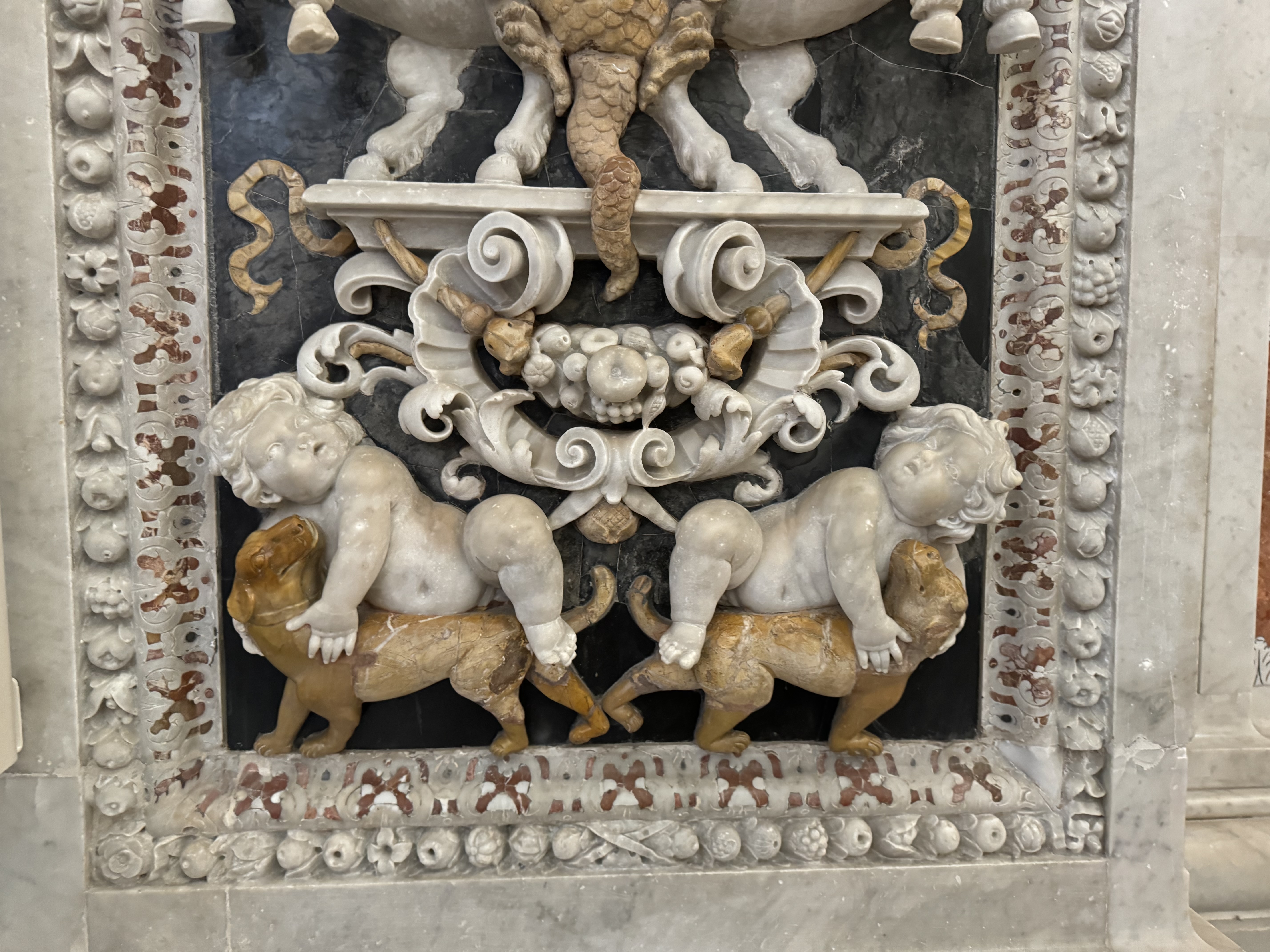
The church’s interiors are encrusted with multi-coloured marbles. They aren’t just inlaid. Many project from the walls’ surfaces. Fruit cascades in abundance. Birds and animals stick body parts out, putti (baby angels) cavort everywhere. At higher levels, near life-sized plaster figures act out scenes from the bible. Or just swan about joyously. This isn’t a place for quiet contemplation or gloomy thoughts. This decorative scheme provokes a giddy, overwhelmed joy.

The most memorable from my long list was the Chiesa del Gesù, more frequently called the Casa Professa by locals. In Dr. Who there’s an ongoing gag about newcomers being in shock when they realise how much bigger the hero’s ship is on the inside than out. There’s a similar sort of disconnect here, but the shock comes between the extremely plain exterior and the eye-wateringly opulent interiors. Anyone who’s visited a few Italian Jesuit churches knows that when you combine those priests with Baroque architecture you usually end up with something completely over the top. This may be the most outrageous I’ve seen yet.
The church’s interiors are encrusted with multi-coloured marbles. They aren’t just inlaid. Many project from the walls’ surfaces. Fruit cascades in abundance. Birds and animals stick body parts out, putti (baby angels) cavort everywhere. At higher levels, near life-sized plaster figures act out scenes from the bible. Or just swan about joyously. This isn’t a place for quiet contemplation or gloomy thoughts. This decorative scheme provokes a giddy, overwhelmed joy.
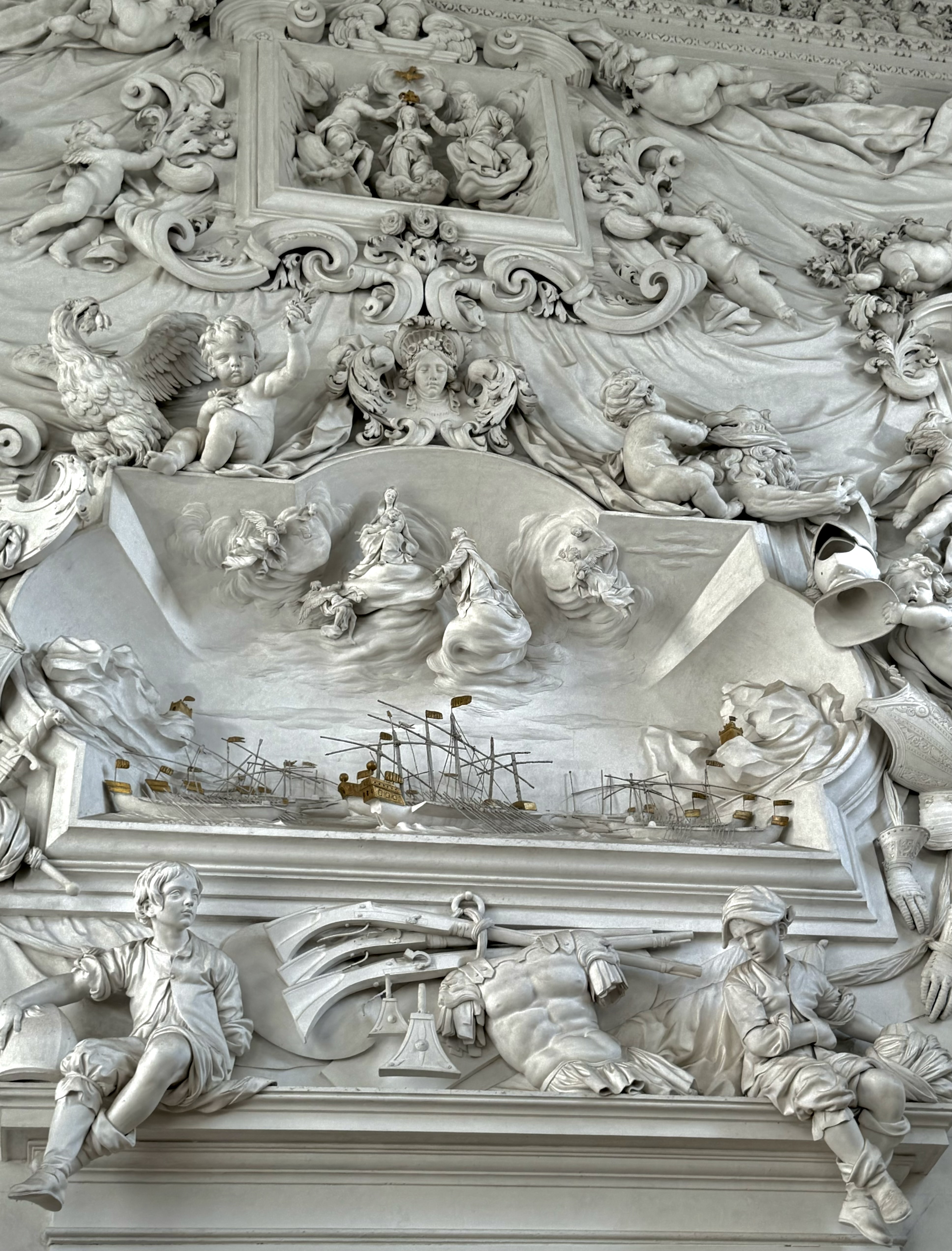
The extraordinarily lifelike plasterwork here is by the Serpotta family, a name that will dominate your experience of Baroque churches in Palermo. Giacomo is probably Sicily’s greatest sculptor. He appears to have never left the island, but rather asked travellers to bring back books and sketches of what was happening in Rome and beyond. He, with brother and son, then interpreted them for his local market. His versions are not just better than anything in Sicily, but on par with anything Bernini created in Rome or the virtuoso Asam family produced in Munich.

To get the full impact of his talent you need to seek out his oratories, smaller private chapels where his plasterwork dominates the decorative scheme rather than just enhancing it. The most famous is the Oratorio di Santa Cita. Here’s another mismatch of inside and out. The small road to the chapel is dingy. The building’s exterior … like so much of Palermo … is covered in graffiti. To get to the chapel you climb a plain flight of steps with a quiet, peaceful courtyard garden to your right. Even the anti-room where you buy your ticket is fairly plain. Then you duck through a curtain and, bam!, you’re smacked upside the head with the sheer force of art.
 Until you turn around and check out the back wall. It’s hard to feel soothed when confronted with a detailed recreation of the naval battle of Lepanto so lifelike you can practically hear the cannon fire and men screaming as they tumble overboard. Here, the putti swarm around piles of armour and weapons. It seems an unusual motif for a religious building unless you know that Lepanto was the point at which European powers definitively stopped Islamic expansion into Europe. It was also considered a specifically Catholic victory at a time when the wars of the Reformation were raging, so a nice bit of one-upsmanship against those irritating Protestants. Many consider this to be the Serpotta family’s masterpiece.


To get the full impact of his talent you need to seek out his oratories, smaller private chapels where his plasterwork dominates the decorative scheme rather than just enhancing it. The most famous is the Oratorio di Santa Cita. Here’s another mismatch of inside and out. The small road to the chapel is dingy. The building’s exterior … like so much of Palermo … is covered in graffiti. To get to the chapel you climb a plain flight of steps with a quiet, peaceful courtyard garden to your right. Even the anti-room where you buy your ticket is fairly plain. Then you duck through a curtain and, bam!, you’re smacked upside the head with the sheer force of art.
The walls are crowded with impressive figures, from flocks of those trademark Serpotta putti to statuesque women embodying the mysteries of the rosary. Exquisitely rendered cascades of fruit, foliage and flowers surround them. It’s as heavily decorated as the Casa Professa, but it’s all white and flooded with light from big windows two thirds of the way up the walls, which makes it a more soothing place.
A short stroll down a nearby cross street brings you to the Oratory of San Domenico. (You can buy a combination ticket to see both, and they’re so close to each other it’s foolish not to.) Though the room is almost the same size as Santa Cita, and it also features life-sized plaster women representing various religious ideas around its walls, San Domenico has an entirely different feel. The plasterwork is broken up by moody paintings. There are more distinctive architectural features in the plaster like towering columns and great swags of drapery, and there’s a fair amount of gold gilding. It’s heavier, more serious and more masculine than Santa Cita, and feels more like something out of the English Baroque than the Palermitan. That may have something to do with the altarpiece, which isn’t an ornate tower of carved marble but a painting. A painting by Sir Anthony Van Dyck … someone so completely embedded in the story of English art it came as a real surprise to encounter him here.

There are three more Serpotta oratories in Palermo and I could have happily continued my “compare and contrast” exploration across them all, but I needed to plunge backwards in time.
Though the Palatine Chapel and the Cathedral in Monreale are the greatest examples of this city’s unique Arab-Norman culture, there are two more churches a stones’ throw from the famous Quattro Canti that are worthy runners up.
Though the Palatine Chapel and the Cathedral in Monreale are the greatest examples of this city’s unique Arab-Norman culture, there are two more churches a stones’ throw from the famous Quattro Canti that are worthy runners up.
San Cataldo is tiny, and all about the architecture. It looks more mosque than church, with its three distinctive red domes and Arabic arches, but it never served an Islamic function. It was build after the Normans took over from the Arabs, but inspired by their style. It did host a post office in the 18th century, by which time almost all of its interior decoration had been stripped out. Though it’s been restored, it hasn’t been re-decorated, so you can fully admire its magnificent bones. Go here first, for a better appreciation of what happens when you put flesh on that infrastructure.
 Just next door is Santa Maria dell’Ammiraglio. Its facade is a rather horrible hotch-potch of Arab-Norman, high gothic and Baroque, with none of the successive renovators making any attempt to integrate their work with the past. But, like so much in Palermo, it’s not the outside you’re here to look at. Inside, the Arab-Norman bones are intact and they retain most of their covering of magnificent mosaics. Angels and saints glimmer against an expanse of gold. The Virgin Mary dazzles in blue. Stars sparkle from a lapis night sky. Flowers and foliage twine across archways. Near the entrance, Roger II … the father of Sicily’s greatest age … has himself shown being crowned by Jesus. It’s an elegant bit of PR, considering that the pope was dragging his heels acknowledging Roger’s promotion from duke. When in doubt, go up the management chain.
 The Admiral’s Church, as it’s known in English, didn’t manage to retain all of its original mosaics. About a third of the decoration, including the high altar, is Baroque. About the best you can say of it is that it isn’t intrusive. The colours and placement of figures work with what was there before so they fade into background. Though this isn’t a large church, plan on plenty of time here, moving from chair to chair to look up and appreciate the mosaic artistry.
A short stroll up the Via Vittorio Emanuele, one of the cross streets of the Quattro Canti, brings you to what you might think would be the most impressive church in town: the cathedral. It starts well. Unlike the Admiral’s bad exterior mash-up, the outside of this church is a wonderfully delicate blend of Arab-Norman features and later enhancements. That’s aided by an enormous piazza-cum-garden which sets off the architecture with swaying palm trees. Through the door, however, comes one of the few church interiors in Palermo that can actually be called boring. It’s big. It’s white. It has a bit of undistinguished statuary. There’s nothing memorable here and it looks like thousands of churches up and down the Italian peninsula.


A short stroll up the Via Vittorio Emanuele, one of the cross streets of the Quattro Canti, brings you to what you might think would be the most impressive church in town: the cathedral. It starts well. Unlike the Admiral’s bad exterior mash-up, the outside of this church is a wonderfully delicate blend of Arab-Norman features and later enhancements. That’s aided by an enormous piazza-cum-garden which sets off the architecture with swaying palm trees. Through the door, however, comes one of the few church interiors in Palermo that can actually be called boring. It’s big. It’s white. It has a bit of undistinguished statuary. There’s nothing memorable here and it looks like thousands of churches up and down the Italian peninsula.

Unless you turn left. A bit like heading that direction when boarding an airplane, all the important people are tucked away here. The cathedral houses the tombs of the Norman dynasty that made Sicily the artistic and intellectual showplace of Europe in the 12th and early 13th centuries.
Here’s Roger II, the one you just saw being crowned by Jesus, and his grandson Frederick II. The younger man was known in his lifetime as stupor mundi, or wonder of the world, and was also Holy Roman Emperor. Here you’ll also find Frederick’s mother Constance, who did a remarkable job holding her father’s empire together … including abandoning the peaceful convent life she preferred to marry the German ruler, buried here beside her, and give birth to an heir when she was almost 40. Frederick’s wife, also a Constance, rounds out this fascinating group. Older than her superstar husband, Constance ruled Sicily for years while Frederick sorted out his more troublesome German inheritance.
Given the lavishly decorated churches and palaces these people left behind, their tombs are almost austere. Massive dark marble sarcophagi sit beneath canopies held up by gracious columns. There’s a bit of mosaic work beneath the canopies and on the columns to add some colour but it’s mostly austere and august. Very ancient Roman, actually. That seems appropriate for people who thought they were establishing an Italian empire that would last generations. Sadly, it didn’t make it past Frederick’s children. But the tombs remain as a somber testament to the glories of Sicily’s greatest age.
There are 84 churches in Palermo before you dip into oratorios, private chapels and other religious architecture. It’s enough to overwhelm even the biggest architecture nerd, much less the ABC tourist. If you can get to these four examples, however, plus the Palatine Chapel and the Cathedral at Monreale, I promise you variety, beauty and wonder that will captivate anyone.
Given the lavishly decorated churches and palaces these people left behind, their tombs are almost austere. Massive dark marble sarcophagi sit beneath canopies held up by gracious columns. There’s a bit of mosaic work beneath the canopies and on the columns to add some colour but it’s mostly austere and august. Very ancient Roman, actually. That seems appropriate for people who thought they were establishing an Italian empire that would last generations. Sadly, it didn’t make it past Frederick’s children. But the tombs remain as a somber testament to the glories of Sicily’s greatest age.
There are 84 churches in Palermo before you dip into oratorios, private chapels and other religious architecture. It’s enough to overwhelm even the biggest architecture nerd, much less the ABC tourist. If you can get to these four examples, however, plus the Palatine Chapel and the Cathedral at Monreale, I promise you variety, beauty and wonder that will captivate anyone.