Showing posts with label Crete. Show all posts

Sunday, 31 October 2021

This bechamel recipe is my prize Cretan souvenir

 Farmers looking for ways to diversify their revenue streams should take a look at the Cretan Olive Oil farm. I have rarely seen a better example of milking a property for all it's worth.

This relatively compact grove of trees between the main coastal road and the water just outside of Agios Nikolaos offers tourists a number of distractions. You can wander through their gardens to learn about Cretan herbs and their affect on health. You can sign up for a traditional Cretan pottery making workshop. In the shade of an old, open-sided barn, you can learn all about olive oil production, even helping to turn the original 19th-century olive press or raking olive pulp before the advance of the crushing millstone. If you're like us, of course, you'll be heading for the cooking class.


This is a homespun, informal session with a local who demonstrates the classics of the Greek home kitchen, There's no "chefiness", no written instructions and not a great deal of organisation. The instruction reminded me of Italian relatives handing down their techniques: nothing is measured, there are no specific recipes. There's only a general framework of a dish, which may change based on the availability of ingredients or your mood. Those who like to follow recipes line by line may find themselves a bit discombobulated, but the instructor is always at your elbow to assist. It's a great journey through the basics, you'll end up eating a massive lunch and for any like us whose resort package includes dining, it may be the closest you get to culinary authenticity on your whole trip. At 48.00€ per person it's also great value for money.

We took the meat course, which runs every Wednesday at 11:30. (There's a fish option on Mondays.) The centrepiece of the Wednesday class is traditional Cretan Moussaka, a Cretan salad with smoked pork, tzatziki, and sausage and onions. The web site also listed a cheese  pie with honey which we didn't do, thank heavens, because the waste was already epic. Each individual will be cooking a dish that serves four, and the salad and sausage dishes are as worthy of being a main course as the moussaka. When you sit down to eat at the end of the course you can hardly make a dent in what you've prepared, and they have no take-away containers. (If you're staying in the area and not on a dining package, bring materials to take away what you've cooked and you'll have at least three additional meals.)

The crazy abundance, as well as the recipe-free coaching, took me back to the Italian-American kitchens of my youth.

Our most valuable lesson of the day turned out to be an unusual, and promised to be foolproof, approach to bechamel. The difference is starting with something like a batter before engaging with any heat.

  • Start by whisking together a half litre of milk and a whole egg
  • Add 3/4 of a cup of butter, a good glug of olive oil and a cup and a half of strong white flour. Continue to whisk until reaching batter consistency
  • Season to taste with salt, pepper and plenty of nutmeg
  • Only now do you put it on the heat. Whisk while cooking until it thickens to something like stiff porridge
  • Add about two cups of grated cheese. In Crete we used kefalotiri, a semi-dry goat’s cheese. Back home I used a mix of shredded mozzarella and pecorino

The other essential tip of the day: grate (rather than slicing) the cucumber for you tzatziki. Then salt it and let it sit for a while. Once the seasoning has had its water-extracting effect, squeeze the heck out of the veg, one handful at a time, before putting it into the yogurt. The drier you can get the cucumber, the thicker and more unctuous the sauce will be. I was interested to see her finish it off with a glug of balsamic vinegar and well as one of olive oil. This dish, and the sausage and peppers, shared a love of the agrodolce technique common in Sicilian cuisine.

One of the joys of cooking classes is often the company with whom you are dining at the end. People interested enough in food to spend part of their holiday on it tend to share other interests, and our conversation flowed merrily down diverse paths. The group was split between Germans and Brits, from young backpackers to mature travellers. 

I tried several of the recipes after returning home and they were just as good, and easy to produce, in my kitchen as in a balmy Cretan olive grove. While holiday is now a memory, the food can bring some of the atmosphere back at will.

Wednesday, 6 October 2021

Domes of Elounda delivers 5-star rehab from a stressful life

One person’s luxury is another’s outrageous excess. One’s necessity another's luxury. Some save for years to book a five-star hotel for a special occasion. Others treat them as standard. You can spend a fortune to be disappointed, or find that a modest place with personalised service is actually more luxurious than famous brands. Luxury is tough to define and tricky to deliver.

Two weeks ensconced at the five-star Domes of Elounda firmed up five of my own opinions about luxury:

  1. Great design and beautiful surroundings are the “table stakes” in this game, but it’s small touches and personal interaction that provide the winning hand.
  2. Luxury resorts are perfect for the exhausted seeking a revival of body and soul, but do put you at a distance from the local experience … and edge into a waste of money if you’re going to spend much time away from them. (We didn't, extracting full value from our investment.)
  3. From what we saw of the hotel-filled coastline from Heraklion east, the immediate environ of Domes is the only place I’d want to holiday in Crete. 
  4. Given the hours they work and the range of challenges they face, the jobs of customer-facing staff at places like Domes of Elounda make my work look easy.
  5. When you love the sun but your husband is practically allergic to it, a suite with its own sun lounging area and plunge pool may be edging towards necessity.
I have rarely occupied a more spectacular living space in a hotel, and our suite will go down in memory as the highlight of our stay at Domes. Modern, airy, and almost Scandinavian in its clean lines, it featured a large, high-ceilinged sitting room adjoining a bedroom with an enormous bed dressed superbly (Domes is part of the Marriott family and the brand’s famous pillows are always a delight). Off that was a bathroom with separate shower and toilet rooms, a bathtub and a double sink so big you could have put a toddler to bed in it. The floor was cool grey stone, the fixtures and fittings sleek crome or chocolate-coloured wood. Both rooms had large televisions that … in anticipation of what I suspect will be the future … didn’t actually have a content feed. It’s assumed you come with your own devices and will cast whatever you want to watch onto the screens via the hotel’s high-speed broadband and an app you download. (Such fiddling fell outside of the total relaxation remit for the trip and I was feeling stubborn about paying for an app I wouldn’t use again, so we left the TVs blank and watched the iPad.) 

The spectacle, however, comes from what’s outside. Three long rows of suites march across the top of the hill occupied by Elounda, built from local stone so that their grey, rust and charcoal almost fades into the landscape. The simple cubist architecture mimics fishing huts in the town of Plaka below, but those clean lines, sharp angles and prominent lintels would make an ancient Minoan feel right at home. Both sitting- and bedroom had glass walls opening onto a patio running the length of the suite, and then a long pool stretching along the border of that. Immediately beyond, a bank of local flowers (newly-planted, but destined to be lushly beautiful) sloped down to the row of suites below before the spectacular panorama of Mirabello Bay stretching towards Elounda and Agios Nikolaos. Mountains reared up sharply to the right and formed a misty horizon line to the left. We could enjoy the view from two outdoor loungers with cushions as thick as bed mattresses, or a table that sat four beneath a canopy of wooden slats casting dappled shade.  

Curiously, an outdoor kitchen ran down one side of the patio. Curious because there’s no cookware or utensils, so not really anything you can do with it. The pool was long enough to do a bit of swimming, with shallow entry steps that also make a comfortable seat for semi-submerged reading. Being locked down here for months wouldn’t have been an effort, and we spent a lot of time in our cozy eyrie. 

There was plenty within the resort to tempt us out, however. 

On the north side of the suites, the hill fell away towards the main reception area, featuring a buffet restaurant, bar, spa, the adult pool and the path to the beach. Everything here is designed to take in the spectacular view of the island of Spinalonga with its Venetian fort and ruins across the water. 

The adult pool is an enormous oval, little populated when we were there and enormously quiet. 
The beach below is one of the highlights of the resort and, I suspect from what I could see of others, is one of the best in Crete. You hike down quite a steep path, over-run with bougainvillea and other flowering tropical bushes, cross under the main road and come out on a long beach, divided into distinct terraces and thickly planted with olives and greek pines. While there are patios and decks jutting over the water that offer full sun, there are more options for dappled or full shade ... by far the better choice under the intense Greek sun. The sand here is paler and finer than the compacted, mud-like stuff we saw on many of the other beaches on our excursion day to Knossos, and the swimming area protected by buoys is enormous. You can swim about 100 metres out into the bay and perhaps 200 up and down the beach. 

The water isn't quite Caribbean or Maldivian, but there's plenty of variation from deepest cobalt to glittering turquoise and it's a comfortable swimming temperature, particularly in the shallows. Because you're in a such a sheltered area, with other islands forming a massive breakwater against the main Cretan Sea, the water can be calm as a lake, with almost no waves. The only adverse conditions we experienced were in the second week, when strong autumn winds blew up a vigorous chop on the water's surface. The beach has a bar at its centre, a gift shop for beachwear and one of the hotel's a la carte restaurants at its southern edge. To the north, it's overlooked by a picturesque little domed church, while Spinalonga dominates the view across the water. And, of course, it's all ringed with the ubiquitous mountains.

The bulk of Domes' hotel rooms cling to the side of the hill between the reception centre and the suites at the hill crest, arranged in clusters of buildings and traversed by a winding stone path. The design here switches from Minoan cubist to a more exotic Arabic vibe with domes, narrow windows and fretwork screens, all painted a uniform dark coral and lushly landscaped. The hilltop suites may draw their architecture from the vernacular, but this part of the resort looks more exotic ... like a stage set for the Voyages of Sinbad.

The other side of the hill, falling south from the suites, features parkland, an outdoor gym, tennis courts, the kids' and teenagers' clubs and a plateau housing "The Core". This area is the resort's internal village high street, with free-standing shops along a promenade leading to a square surrounded by food trucks. This may sound quite rustic but the shop buildings are high-design concepts in glass and geometry, the merchandise is more art gallery gift shop than beachfront souvenirs and the music played when the food trucks are serving leans to 21st century clubbing rather than Zorba the Greek. There's also a fun outdoor gallery here where a modern artist has re-imagined the monsters of Greek mythology. The Core space had a lot of potential but seemed fairly new and without an established identity yet. The food trucks only serve two nights a week and the shops are only open when the trucks serve, so most of the time this whole area is empty.


Just below is the enormous family pool, a football pitch -length strip of water crossed by four high, arching bridges, feeling a bit like a Venetian canal. (But one that's pristinely clean and available for swimming.) Pergolas on either side offer dappled shade, with a bar on one side and a restaurant on the other. While the adult pool only featured about 10 pairs of lounges, this enormous pool deck has scores of them. The "family" designation meant that this pool was louder than the others; our preferred September holiday time eliminates school-age children but Domes was awash with toddlers. But the family pool wasn't as bad as I'd feared. It's so big you're likely to be able to find a quiet patch, even if a pack of little people is staging pirate battles at one end. One drawback: this pool closes at 6pm so swimmers won't disturb the poolside restaurant. (The adult pool closes early, too.) Though that's great for dining, I did think it was a shame there were no possibilities for a moonlight dip. Unless, of course, you had your own private plunge pool...


We had unlimited access to the "Haut Living Room", a lounge next to the family pool. It features a concierge desk staffed with an enthusiastic and cheerful team who feel more like friends than staff by the end of a two-week visit. Coffee, soft drinks, beer and wine are available all day, while a full bar makes an appearance at 6pm. A small buffet of savouries and desserts is available throughout the afternoon, switching to cheese plates, olives and nuts at 6pm. While we still added a healthy amount to our bill with a bottle of wine each night with dinner, this set-up meant we could manage other drinks costs by confining them to cocktail hour in the lounge each night. We rarely hit the buffet during the day, given our preference for quieter pool areas and the fact that we rarely ate breakfast before 10:30. 

Our package included breakfast ... buffet style in one of two restaurants ... and dinner in one of three. (With the addition of the food trucks as options two nights a week, once for Greek street food and once for burgers.) After trying all three restaurants, we started alternating between the two a la carte places. While the buffet was tasty and changed key dishes nightly, it lacked the atmosphere of the other two, was far more attractive to the toddler brigade (thus much louder), and came with the inevitable dangers of eating far too much. 

My husband and I were split on our favourite from there. Always a sucker for views and seashores, my pick was Topos, the open-aired restaurant at the south end of the beach. If you request far enough in advance, you can get one of the tables on the pier, enjoying the exceptional panorama of the bay at night, the mountains across the water and the cheerful conviviality of the restaurant itself. Dining here under a full moon was one of the highlights of my stay.
There's a mix of live entertainment here which can actually be a bit distracting if you're under the restaurant's roof; another reason we preferred the pier. (The night with traditional Cretan music was fantastic. The one with Greek pop/club tunes mixed by a DJ significantly decreased our enjoyment of that evening, particularly because we were between the DJ and the kitchen in maximum volume range.) Topos felt a bit more "local" with a fantastic variety of Greek starters ... one night we went double on these and skipped mains completely ... and fresh seafood. 

Blend, next to the family pool and the Haut Living Room, won my husband's vote. The views are fabulous here, too (nowhere in the resort suffers on that front), but the modern surroundings and the sleek restaurant design aren't quite as quiet and romantic as the beachside restaurant. The menu here is, like the architecture, a bit more modern and cosmopolitan: an upscale grill focusing on excellent cuts of meat and a bit of fish. I was surprised ... and, in these days of concern about climate change, concerned ... about how far the meat had travelled. English pork, American beef, New Zealand lamb. Casting your eyes to the dry landscape with its scrubby vegetation, it's easy to imagine the locally sourced options for meat are sparse. I will confess, with guilt, that those American steaks were tasty. 

Dishes in both restaurants were beautifully presented and cooked with care. In two weeks we tried most of the items on both menus and only hit a few things we'd dismiss as average. The pork belly should have stayed in England, where they understand how to render that fat and crisp the crackling. Food was at its best when it edged into the local: grilled sea bass, anything with aubergines, tzatziki and hummus, calamari. We particularly enjoyed sampling local Greek wines, expertly guided by the manager of Blend and our regular waiter at Topos. They, plus the concierge team at the Haut Living Room, will be amongst our fondest memories of the place. 


One slight frustration with the meal plan was the amount of surcharges. If you wanted the nicer cuts at Blend, you paid an additional fee. Same with the array of fresh fish of the day at Topos. And these fees, I suspect, added up to a meal much pricier than the local restaurants. You were welcomed to shift your dinner credit (€50) to lunch and go out for the evening, but if you weren't having your generous breakfast until 10:30 that was just too much food. 

Domes of Elounda was exactly what we needed this holiday. We were exhausted. It revived us. If I wanted to do more sightseeing, or get a more local experience, this might not have been the best option. If, like us, you don't have any children you'll want to consider booking very carefully. With both kids' and teenagers' clubs, plus multiple pools and food all within its boundaries, this is an excellent choice for families. Which means those seeking peace and quiet should avoid school holidays at all costs. And even outside of those holidays, should consider the suites with the private pools for perfect calm. 

The older I get, the more "peace and quiet" factors in to my definition of luxury. At Domes of Elounda, sitting beside my private pool hearing nothing but the Cretan wind whistle around the buildings, I found that in abundance.


Thursday, 30 September 2021

Europe’s oldest town and its treasures are Crete’s must-see attraction

Twenty years ago, when my energy levels were higher and my sightseeing philosophy more American, I was appalled when friends came back from Crete without visiting any of its cultural attractions. How could you travel to the birthplace of European civilisation and not pay homage to its remains?
Now, drained by exhaustion, deprived for too long of sun and sand, and ensconced in a luxury resort to fix both, I had a bit more empathy for those I once condemned. But only a bit. No matter what else happened … or didn’t … on this holiday, I had to make it to Knossos.

For those less enchanted by the ancient world than I: Knossos was the capital of ancient Crete and a civilisation we call the Minoans. We don’t know what they called themselves, because we still haven’t deciphered their writing. But archaeology tells us they were remarkably sophisticated, building cities that were not only lavishly beautiful but precision-engineered with running water, complex architecture and efficient food storage facilities. Evidence of international trade and influences in their art tells us they were cosmopolitan types who did business across, and welcomed citizens of, the known world. And they appear to have been, if not entirely matriarchal, a society that respected and treated women similarly to men.

No civilisation in Europe would reach such glory for 1000 more years. (And it would take everyone a lot longer on the female empowerment front.) Which is perhaps why Crete shows up so often in Greek myth. The birthplace of Zeus. Honeymoon spot of Zeus and Europa and home to their descendants. Home of the Minotaur, the Labyrinth and the world’s first super-inventor, Deadalus, who built the maze beneath the palace to keep the bull-headed monster restrained. The ruins of the palace at Knossos are so labyrinthine that archaeologists point to them as proof of some historical reality in the tales.

Today’s Knossos is a 1,400 square metre archeological site five kilometres outside of Heraklion, the island’s capital. Admission is €15 (€20 for a combined ticket that also gets you into the Heraklion Archeological Museum) and you are free to wander on your own, though I would highly recommend a guide to help you understand what you are looking at.


We travelled with “Get Your Guide” on their tour from Agios Nikolaos. I had hoped to find the sort of combination driver and guide, hireable on a day rate, I once used in Athens. But equivalent services aren’t available here and a taxi for the day would have been exorbitant. The tour, officially originating in the town 20 minutes from our resort but picking you up at your hotel, had the disadvantage of a two-hour meander through resort areas before and after, since our starting point of Domes of Elounda was furthest away. But we rode in comfort, the six hours spent touring were expertly guided and we got in to Heraklion as well as Knossos. It’s a bargain at £31 per person; admission to the attractions is separate..


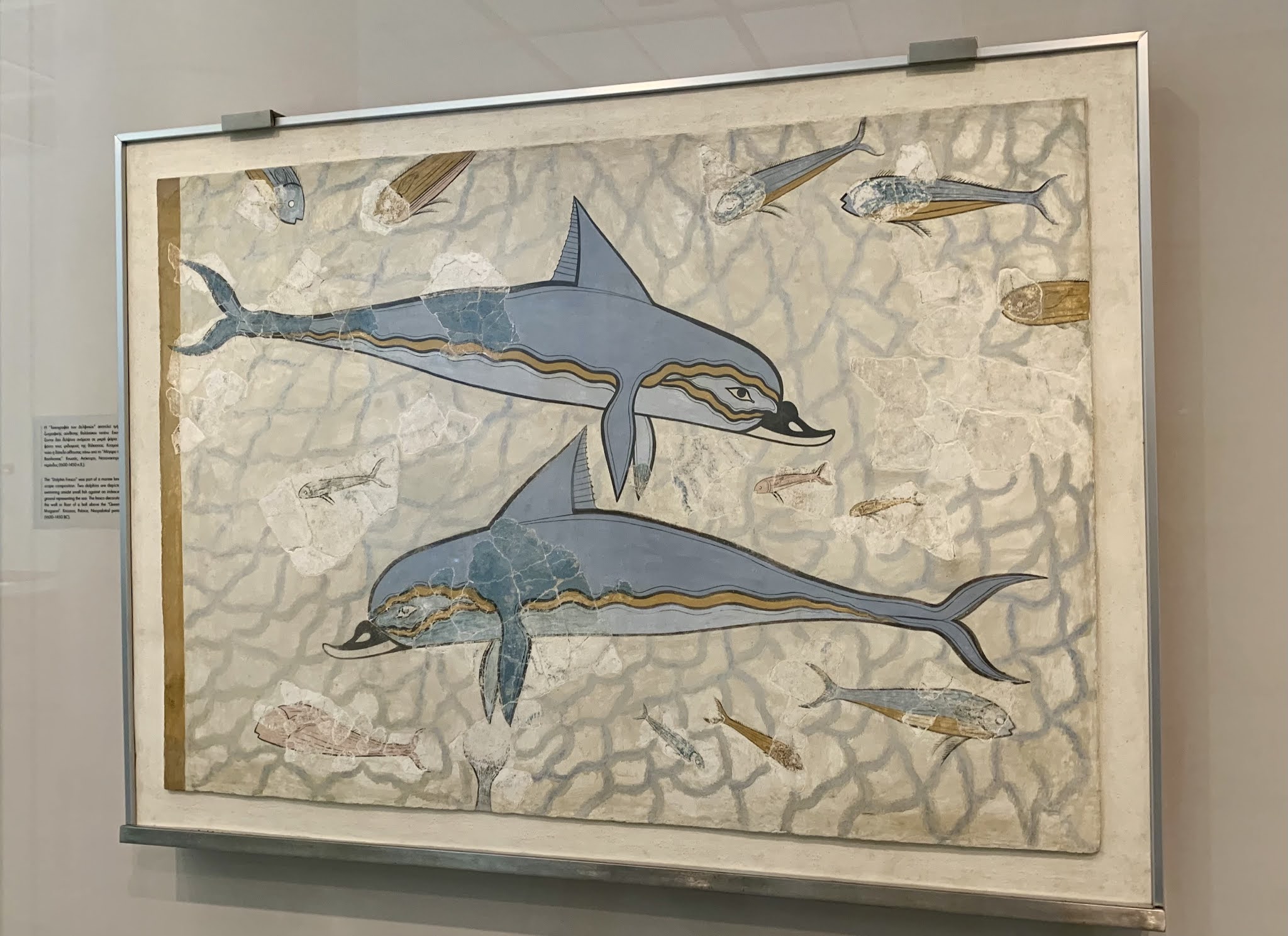
The ruins at Knossos are so magnificent because of an early 20th century preference for putting things back together. The practice is much frowned upon these days, and there’s a suspicion amongst modern scholars that the legendary archaeologist Arthur Evans might have been a bit overly imaginative with his reconstructions, but his efforts bring the site to life. Distinctive Minoan columns, wider at the top than at the bottom and painted a striking oxblood red, hold up lintels and walls. Murals are re-created in all their opulent, vivid glory. Processional staircases descend in stately grandeur. Enormous, highly decorated storage jars stand ready for wine or olive oil. Some of the most important rooms (at least, the ones Evans thought were most important) have been almost completely reconstructed and furnished, though sadly the queen’s apartments with their famous dolphin murals were closed due to the inability to ensure social distancing in cramped spaces.


The Minoans preferred small rooms, but plenty of them, connected by doors and transoms that could be shuttered for privacy or opened to let air and people flow. Knossos contained multiple levels of these cubist warrens, rising around a massive central courtyard now flooded with tourists. (Given that visitor numbers are still down due to COVID, it’s frightening to imagine how packed this site must be in a normal high season.) While it’s known as a palace, it’s much more like a small town and probably housed an equivalent population.


One of the best places to see the sophistication of the site is from the top of a heavily reconstructed light well, where a broad staircase descends through three stories of colonnaded loggias. To one side, you can appreciate the grandeur of the central court, while on the other you see the palace’s excavated levels, falling away down the hillside like the open face of a doll’s house. It’s not hard to see why anyone would associate this with the labyrinth.


Just a few decades ago, our guide Poppy told me, all areas of the site were open for visitors to just wander at their leisure. Global tourism numbers don’t allow that any more. This is the second-most visited attraction in Greece after the Parthenon and crowds were starting to do damage, so these days you explore a set tourist path with many avenues blocked so you can only look from a distance. What those blocked passageways took away, Poppy gave back with her clear explanations of what happened where, how the Minoans lived, the story of the site’s rediscovery and reconstruction, and the latest theories about this still-mysterious ancient society.

As magnificent as it is, the palace at Knossos is an unfurnished shell of a building. For the complete picture, you need to get to the museum in Heraklion. Where you’ll also see the magnificent wooden model of the palace at its height. (It’s a shame there’s not a version of this on the actual site, for those who don’t have time to do both.) Just to complicate things … the museum holds artefacts from across all of Knossos’ 7,000-year history and treasures from other palaces around Crete. So don’t imagine these galleries as exact furnishings of the place at one point in time. But what you see here, in a way the ruins only hint at, is staggering sophistication, joyous use of colour and an exuberance for life.


Pottery, jewellery and murals last in regular use 3,500 years ago seem comfortingly modern. The enormous jar with the cheerful, writhing octopus would look magnificent in my garden. The famous dolphin mural would fit right onto the wall of any beach resort (and no doubt does in a thousand copies). The magnificent turquoise and cobalt pattern in that Minoan’s kilt would make a mouthwatering dress. All those examples of the goldsmith’s art would grace any modern neck or hand. And, thanks to plenty of jewellers in town turning out reproductions, they do. I had always been an admirer of Minoan art, but seeing it gathered in such profusion makes me think they just might have had the best design sensibility of any civilisation in the ancient western world.


Beyond the museum, Heraklion is a sometimes charming, often undistinguished sprawl. (Nothing I saw in Crete persuaded me away from an opinion formed on an early trip to the mainland that, for such a historic country, Greece is sadly dominated by ugly, run-down 20th century buildings.) The most noteworthy site in Heraklion is the old Venetian fort, sitting at the end of a long causeway guarding the harbour. It’s particularly beautiful on a sunny day when its white stone gleams against the blue of sea and sky. There’s a Venetian lion fountain in the centre of the shopping district that would be more magnificent it it weren’t wedged in between cafes, mobile phone shops and tourist tat vendors. A couple of historic churches offer themselves up for exploration, but centuries of use as mosques under the Ottomans before they were re-purposed for the modern age left neither the glories of Islamic nor Byzantine art. There’s nothing here worth going out of your way for.


Heraklion does have a good range of shops, from big names and luxury brands to market traders, jewellers and local crafts. All of which confirms that if you can only bother to leave your resort once, this is the tour to take. You get all the culture and history of the Minoans, plus the chance to pick up any souvenirs and gifts you might need. Just make sure you have a good book for that long bus ride on either side of the tour.


Speaking of books … if you’re heading to Crete and want a list of relevant reading, I highly recommend the following:
Mary Renault’s The King Must Die. The story of Theseus and the Minotaur, told as a ripping and plausible adventure by one of the greatest interpreters of the ancient world in fiction. A particularly fabulous imagining of what all the tributes and bull leaping might have been about. I had to read this in high school and was delighted to find an audio version from BBC Radio 4 before the trip.Jodi Taylor’s Plan for the Worst. I adore the time travelling historians of the Chronicles of St. Mary’s and couldn’t believe my luck when the next one on my reading list (no. 11 in the series) reached its climax in Knossos on the day the volcano at Thera blew apart Minoan society. Tour guide Poppy explained that modern theories think the immediate devastation and tidal wave wasn’t as bad as described in the book, but the imagined cataclysm makes for one hell of a page turner.Stephen Fry’s Mythos and Heroes. The first covers foundation stories and a basic who’s who in the Olympian world, the second … as its name implies … tells the adventurous tales of big names like Heracles and Jason. In classic Stephen Fry style, he mixes delightfully every day language and plenty of humour with insightful observations that will have you pondering deeper issues.Everyone in the tourist industry on Crete recommends Victoria Hislop’s The Island. Even though I spent every day of my holiday looking out at the former leper colony and Venetian fort of Spinalonga that’s at the heart of the novel, it’s set in modern times. And anyone who knows me knows that I’m not going to waste my precious holiday reading time on anything set after 1815. When she does a prequel about what happened on the Island when the Ottomans wrested it from the Venetians, I’ll check it out.

Monday, 27 September 2021

Luxury and lethargy in a land of legend

Anyone who knew me at age 10 would be astonished that it has taken me nearly five additional decades to get to the Greek islands. I was obsessed with Greek myths as a child.

At the age of eight I had stumbled across my mother’s high school textbook: Myths and their Meaning. This worthy, old-fashioned little book should have been well above my reading level. But the magic of the stories triumphed over the lack of pictures and the academic writing. I was hooked. I gobbled up stories of gods and heroes, their adventures, temples and cities, until I knew the details the way other children knew the names of dinosaurs or kept track of Barbie’s friends and accessories.

Children without siblings often have imaginary friends; that mine were demigods, fauns, nymphs and priestesses of Athena was no doubt decidedly odd. Had my older self not been distracted by journalism and English history, I like to think I might have come up with Percy Jackson and the Olympians before Rick Riordan. But life intervened, other passions entered my life and other holiday destinations clamoured for attention.

This year, The Fates intervened. Not the traditional Clotho, Lachesis and Atropos, but the British government, the Greek tourism board and employers who’d had us both at Sisyphean tasks throughout the pandemic. Finding a holiday destination that was open to British travellers and met our dual needs of complete relaxation and a memorable 10th wedding anniversary trip was fiendishly difficult. Six other options had failed to clear the Olympic hurdles. So here we were.

“Here” is a magical bit of Mirabello Bay in northeastern Crete. Sheltered by the islands of Kalydon and Spinalonga, this long, narrow inlet is framed by steep hills; like a fjord that’s drifted into hot and sunny seas. These hefty breakwaters mean this bit of the bay is calm and ideal for swimming, and the view in every direction is spectacular. And I mean jaw-dropping, heart-stoppingly spectacular. Glittering cobalt and turquoise waters. Majestic mountains. The romantic ruins on Spinalonga. Luxury villas built into the hillside with more than a touch of Bond villain lair about them. All shifting constantly as the light changes throughout the day.
This is all much easier to appreciate, of course, from the welcoming luxury of a five-star resort. Our home for 13 nights is Domes of Elounda, an Autograph Collection (Marriott) property that’s actually … despite its name … in easy walking distance of Plaka. I’ll do a full review in a later entry; this story is simply meant to set the scene.

The resort climbs up two sides of a steep hill beside the bay, sprawling through several sections with a variety of pools, restaurants and styles. Our room is at the crest of the hill, in one of three long, low lines of stone buildings that channel the simple square huts along Plaka’s harbour, but descend in a straight architectural line from the bold yet simple squares and rectangles of ancient Minoan ruins. Built from the local stone, they merge organically into a landscape of rust, ochre, gray and olive.

Their interior, however, is a very long way from the simple structures they mimic. Ours has a private patio and plunge pool, perfect for the initial rest and recovery mission of this trip. In our first few days, we barely had the energy to leave the room. And we didn’t need to. Sleep. Stagger to private pool. Turn face to sun. Drink in landscape. Heal me, Gaia and Helios.

The silence is extraordinary. Though the resort was full in our first week and at more than 80% for our second, the design and the hilltop position whisks sound away. At least human sounds. The wind is a different matter.

Our first few days were hot and still. Not a cloud drifted over the sky. Nothing moved. The heat, when not enjoying the benefits of cool water, was intense. The bay was a placid lake. How did Odysseus spend 10 years blundering through this? Even becalmed and rowing couldn’t have been that tough. And then the winds started.

Our fourth day was cloudy day with a bit of rain, a much appreciated pause from the sun. The wind swept the heat haze away, gave us even better views and stayed with us even when the sun returned. I’ve never experienced anything quite like it. It will be still, and then a gust will hit you with force, then disappear as fast as it came. On the beach, the breeze is mostly gentle. But gusts will dive into the bay, driving geysers of spray before them and whitecaps below. For the first time I understood why the horse was associated with Poseidon. These strange effects on the bay were positively equine.

On our hilltop, the gusts are fierce. And puzzling. I’m used to ripping gales on Dartmoor or Chicago’s skin-shredding winds. I associate wind with bad weather. Here, the sun is shining and the sea is turquoise. The wind seems contrary. Odysseus, forgive me for underestimating you. There’s no way I’d want to sail in this. Most interestingly, the Cretan winds make different noises. Some howl mournfully. Some sing in a comforting bass. They have personality. No wonder the Greeks had four different and distinct gods of the wind. (I’m hoping for a little more Zephyros and a bit less Boreas in our final days.)

I’m not sure the rest of Crete is so magical or mythic. An excursion to Knossos (which I’ll write about next) took us through beach resorts on the north coast between Malia and Heraklion to pick up fellow travellers, and confirmed that our little it of the island is quite exceptional.

The destination might have been accidental, but the results are just what Aesculpius ordered. My 10-year-old self isn’t surprised. If Crete was good enough to host the birth and early years of Zeus himself, why wouldn’t it offer a healing, memorable holiday. Pass me the cornucopia along with a bit more sun cream, please.