Showing posts with label Knossos. Show all posts

Saturday, 15 April 2023

One of the greatest stories ever told beckons all ages at the Ashmolean

I was obsessed by Greek and Roman mythology as a child. While my peers delighted in Barbie dolls, dinosaurs or Matchbox cars I could recite the 12 labours of Hercules and pretended to be a priestess of Vesta with my imaginary sisters. As you can imagine, this was not a recipe for childhood popularity, though I’m pretty sure it did lay the foundations for a career that turned out to be, ultimately, all about story telling. 

One of the greatest of those Ancient Greek stories is that of the Minotaur, the fierce half-man, half-bull creature imprisoned in a maze in Crete and fed on the war booty of young Athenians until the hero Theseus navigates the Labyrinth and kills the man eater. The brilliance of the current exhibition on the topic at the Ashmolean Museum in Oxford is that it’s all about the story. 

An unprecedented loan from the museum at Heraklion, modern capital of Crete near the ruins of Knossos, means you’ll probably never see this many top-quality Minoan artefacts in one place without getting on a plane to Greece. One hundred of the objects on display have never left the country before. And I doubt anyone has done a better job of untangling the fact and fiction archaeologist Sir Arthur Evans twined together early in the 20th century. There are even arresting video installations that pull parts of the show into the realm of modern art. But the Ashmolean doesn’t major on any of this highbrow stuff. Labyrinth: Knossos, Myth & Reality pulls you in with the legend and keeps visitors of all ages interested with solid story telling. The art, history and learning come by osmosis.

You’re plunged into the story from the ticket desk, when designs covering the walls and a dog-legged path to the exhibition’s start make it feel like you’re in the labyrinth itself, stepping through a door and into a dark room to be confronted by the monster himself. This version is a near life-sized statue, a Roman copy of a Greek original. 

Over his shoulder runs a series of films that tell the whole set of stories surrounding the Knossos monster, with typography, graphics and pacing that will satisfy even the shortest attention span. Dig deeper, and this room emphasises the tale’s enduring grip on the imagination, from ancient vase decoration through a Picasso print and a labyrinth-inspired London Underground art installation, with plenty of detours into early Christian maze design, Renaissance painting and Baroque gardens. 

Like Troy, one of the most compelling features of Knossos was a “real or imaginary” debate. Did the cities actually exist, are had they simply been made up as settings for fantastical tales. Both showed up in ancient writings, but there was no trace of them in the modern world. After Heinrich Schliemann found and excavated Troy in the 1870s, the archaeological world fixated on Knossos, and found it soon after. Up until very recently, you would have learned that it was discovered and excavated by an Englishman named Arthur Evans. He’s still the first answer Google gives you to the “who discovered Knossos” question.

But that’s not quite right. The appropriately named Minos Kalokairinos should have the credit. The wealthy businessman and Knossos enthusiast, whose family owned part of the site suspected to hold the lost city, did the first excavation in 1878 and was confident of what he’d found. But politics got in the way. At the time, the Ottoman Turks owned Crete and treated the locals poorly. Any treasures unearthed would probably get transported to museums in Istanbul. 

But the Turks liked the English, and were happy to do a deal with Evans, who was the curator of this same Ashmolean Museum. As concerned as the locals by the possible removal of treasures, he didn’t start digging until after the Ottomans left in 1898. That, and the fact that Evans made sure a museum in nearby Heraklion was built to house the greatest of the treasures he unearthed, is probably why the Greeks don’t hate him in the way they loathe Lord Elgin for his legal (at the time) purchase and transport of the Parthenon marbles. 

But whether he meant to or not, Evans did steal something from Greece: Kalokairinos’ credit for discovering Knossos. Which is why it’s particularly appropriate that the museum he once directed is the one putting on this show, and working so hard to set history straight.

Once we clear up those details, it’s into the main gallery where a treasure trove of artefacts from the palace site unfurls. There are architectural fragments, wall paintings, pottery, furniture, jewellery and ceremonial axes. While Evans might have left most of the artefacts on Crete, he brought home what’s probably the best archive of documentation on the excavations in the world. So this exhibition is possibly even better than a trip to Heraklion when it comes to putting the artefacts in context, complete with beautifully drawn maps and cut-always from the exhibition.

Just as when I saw these treasures for the first time in Heraklion, I was stunned by a mastery of colour and design which makes these 3000+ objects almost modern. Colours and patterns might comfortably grace a set of linens today. The octopus and other sea life swirling across pottery wouldn’t look out of place in a chic kitchen store. The wall painting of olive trees is so close to William Morris’ willow pattern you have to wonder if the late Victorian designer saw and copied. 

And then there are other things that are profoundly alien. While the naked bull jumpers might just turn up in a death-defying YouTube stunt, and beg a connection to Spanish bull fighters, the bare-breasted priestesses holding wriggling, live snakes aloft in their gripped hands are undoubtably from a very different world.

There’s enough of the odd and the exceptional here to keep viewers of all ages interested. Unusually for me, I was in the company of three young people, all of whom found items to interest them here. The curators’ most obvious play for that audience, beyond the focus on storytelling itself, is to include one of the Assassin’s Creed games. Designers Ubisoft included a quest through the ruins of Knossos to slay the Minotaur in their Odyssey installment. In the exhibition, an enormous screen follows an ancient Greek heroine through the ruins to her confrontation with the monster while a display panel explains just how seriously the designers took the history and architecture, actually working with the Ashmolean to get things right.

Not only is this gallery a compelling and vivid bit of world building after seeing all the bits and pieces that would have furnished it, but it’s a real talking point for families. This was the part of the exhibition where my 13-year-old godson was most engaged, showing off his knowledge of the Minotaur and explaining details he’d taken in while playing the game. His mother had the revelation, for the first time, that gaming might be educational and not a complete waste of time. A win for everyone.

While the curators don’t pound the point home, the Ubisoft inclusion is also appropriate because this mix of history and imagination, with some artistic liberties taken to engage audiences, is exactly what Evans did 120 years ago. He rebuilt and restored the site in ways modern archeology would no longer tolerate, and made conclusions about the people and functions of the palace that were based as much on guesswork and personal preference as fact. Even the name we give to this culture … the Minoans … was made up by Evans rather than drawn from history. In my experience, one of the reasons that Knossos is so spectacular to visit is precisely because Evans’ world building gave us a colourful, tangible portal to a vividly imagined past. Whether it’s any more accurate than wandering through in Assassin’s Creed is still a matter of hot debate.

The final parts of the exhibition contain a gallery on newer discoveries in areas around the original excavation, and a video installation inspired by Evans’ fanciful restorations. The 18-minute ramble by Elizabeth Price is narrarated by imaginary, robotic curators who have been asked to clear up the hard drives of the Ashmolean and the neighbouring Pitt-Rivers museum. They draw unexpected, beautiful but often completely wrong conclusions from their mash up. Though meant, at its 2016  creation, to be a comment on what the restoration may have gotten wrong in Knossos, the automated voice prompted me to think about how AI might interpret and curate our artefacts of a world suddenly stripped of humans. It was very weird, but it’s now the thing from the exhibition I’d be most keen to see again.

I suspect I may indeed get back for a second viewing. While Labyrinth was great for a family outing, there’s a second layer of discovery I’d like to make with a longer, quieter visit. Like all great stories, multiple tellings reveal new things.

Labyrinth: Knossos, Myth and Reality is on at the Ashmolean until 30 July. 

Thursday, 30 September 2021

Europe’s oldest town and its treasures are Crete’s must-see attraction

Twenty years ago, when my energy levels were higher and my sightseeing philosophy more American, I was appalled when friends came back from Crete without visiting any of its cultural attractions. How could you travel to the birthplace of European civilisation and not pay homage to its remains?
Now, drained by exhaustion, deprived for too long of sun and sand, and ensconced in a luxury resort to fix both, I had a bit more empathy for those I once condemned. But only a bit. No matter what else happened … or didn’t … on this holiday, I had to make it to Knossos.

For those less enchanted by the ancient world than I: Knossos was the capital of ancient Crete and a civilisation we call the Minoans. We don’t know what they called themselves, because we still haven’t deciphered their writing. But archaeology tells us they were remarkably sophisticated, building cities that were not only lavishly beautiful but precision-engineered with running water, complex architecture and efficient food storage facilities. Evidence of international trade and influences in their art tells us they were cosmopolitan types who did business across, and welcomed citizens of, the known world. And they appear to have been, if not entirely matriarchal, a society that respected and treated women similarly to men.

No civilisation in Europe would reach such glory for 1000 more years. (And it would take everyone a lot longer on the female empowerment front.) Which is perhaps why Crete shows up so often in Greek myth. The birthplace of Zeus. Honeymoon spot of Zeus and Europa and home to their descendants. Home of the Minotaur, the Labyrinth and the world’s first super-inventor, Deadalus, who built the maze beneath the palace to keep the bull-headed monster restrained. The ruins of the palace at Knossos are so labyrinthine that archaeologists point to them as proof of some historical reality in the tales.

Today’s Knossos is a 1,400 square metre archeological site five kilometres outside of Heraklion, the island’s capital. Admission is €15 (€20 for a combined ticket that also gets you into the Heraklion Archeological Museum) and you are free to wander on your own, though I would highly recommend a guide to help you understand what you are looking at.


We travelled with “Get Your Guide” on their tour from Agios Nikolaos. I had hoped to find the sort of combination driver and guide, hireable on a day rate, I once used in Athens. But equivalent services aren’t available here and a taxi for the day would have been exorbitant. The tour, officially originating in the town 20 minutes from our resort but picking you up at your hotel, had the disadvantage of a two-hour meander through resort areas before and after, since our starting point of Domes of Elounda was furthest away. But we rode in comfort, the six hours spent touring were expertly guided and we got in to Heraklion as well as Knossos. It’s a bargain at £31 per person; admission to the attractions is separate..


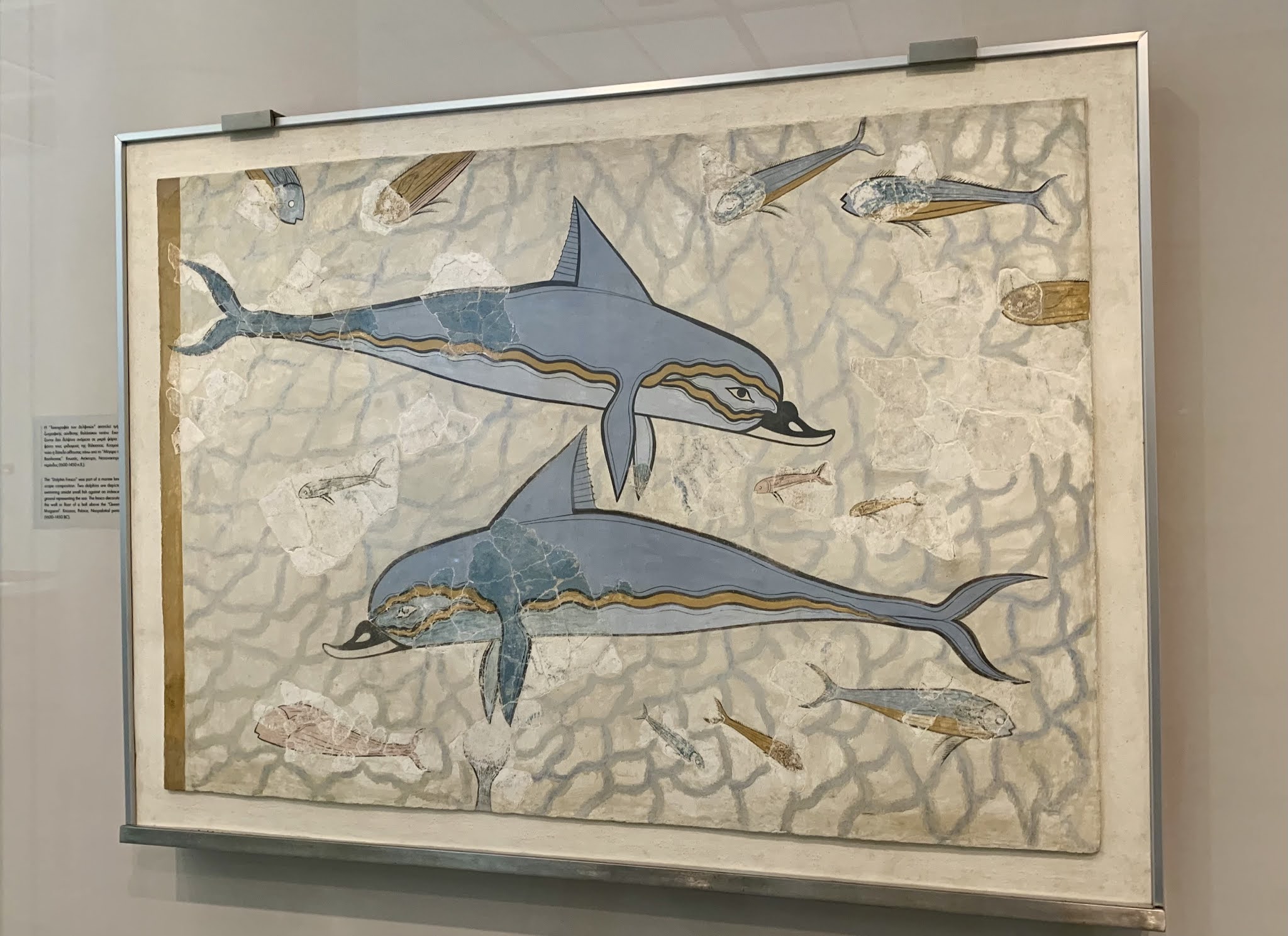
The ruins at Knossos are so magnificent because of an early 20th century preference for putting things back together. The practice is much frowned upon these days, and there’s a suspicion amongst modern scholars that the legendary archaeologist Arthur Evans might have been a bit overly imaginative with his reconstructions, but his efforts bring the site to life. Distinctive Minoan columns, wider at the top than at the bottom and painted a striking oxblood red, hold up lintels and walls. Murals are re-created in all their opulent, vivid glory. Processional staircases descend in stately grandeur. Enormous, highly decorated storage jars stand ready for wine or olive oil. Some of the most important rooms (at least, the ones Evans thought were most important) have been almost completely reconstructed and furnished, though sadly the queen’s apartments with their famous dolphin murals were closed due to the inability to ensure social distancing in cramped spaces.


The Minoans preferred small rooms, but plenty of them, connected by doors and transoms that could be shuttered for privacy or opened to let air and people flow. Knossos contained multiple levels of these cubist warrens, rising around a massive central courtyard now flooded with tourists. (Given that visitor numbers are still down due to COVID, it’s frightening to imagine how packed this site must be in a normal high season.) While it’s known as a palace, it’s much more like a small town and probably housed an equivalent population.


One of the best places to see the sophistication of the site is from the top of a heavily reconstructed light well, where a broad staircase descends through three stories of colonnaded loggias. To one side, you can appreciate the grandeur of the central court, while on the other you see the palace’s excavated levels, falling away down the hillside like the open face of a doll’s house. It’s not hard to see why anyone would associate this with the labyrinth.


Just a few decades ago, our guide Poppy told me, all areas of the site were open for visitors to just wander at their leisure. Global tourism numbers don’t allow that any more. This is the second-most visited attraction in Greece after the Parthenon and crowds were starting to do damage, so these days you explore a set tourist path with many avenues blocked so you can only look from a distance. What those blocked passageways took away, Poppy gave back with her clear explanations of what happened where, how the Minoans lived, the story of the site’s rediscovery and reconstruction, and the latest theories about this still-mysterious ancient society.

As magnificent as it is, the palace at Knossos is an unfurnished shell of a building. For the complete picture, you need to get to the museum in Heraklion. Where you’ll also see the magnificent wooden model of the palace at its height. (It’s a shame there’s not a version of this on the actual site, for those who don’t have time to do both.) Just to complicate things … the museum holds artefacts from across all of Knossos’ 7,000-year history and treasures from other palaces around Crete. So don’t imagine these galleries as exact furnishings of the place at one point in time. But what you see here, in a way the ruins only hint at, is staggering sophistication, joyous use of colour and an exuberance for life.


Pottery, jewellery and murals last in regular use 3,500 years ago seem comfortingly modern. The enormous jar with the cheerful, writhing octopus would look magnificent in my garden. The famous dolphin mural would fit right onto the wall of any beach resort (and no doubt does in a thousand copies). The magnificent turquoise and cobalt pattern in that Minoan’s kilt would make a mouthwatering dress. All those examples of the goldsmith’s art would grace any modern neck or hand. And, thanks to plenty of jewellers in town turning out reproductions, they do. I had always been an admirer of Minoan art, but seeing it gathered in such profusion makes me think they just might have had the best design sensibility of any civilisation in the ancient western world.


Beyond the museum, Heraklion is a sometimes charming, often undistinguished sprawl. (Nothing I saw in Crete persuaded me away from an opinion formed on an early trip to the mainland that, for such a historic country, Greece is sadly dominated by ugly, run-down 20th century buildings.) The most noteworthy site in Heraklion is the old Venetian fort, sitting at the end of a long causeway guarding the harbour. It’s particularly beautiful on a sunny day when its white stone gleams against the blue of sea and sky. There’s a Venetian lion fountain in the centre of the shopping district that would be more magnificent it it weren’t wedged in between cafes, mobile phone shops and tourist tat vendors. A couple of historic churches offer themselves up for exploration, but centuries of use as mosques under the Ottomans before they were re-purposed for the modern age left neither the glories of Islamic nor Byzantine art. There’s nothing here worth going out of your way for.


Heraklion does have a good range of shops, from big names and luxury brands to market traders, jewellers and local crafts. All of which confirms that if you can only bother to leave your resort once, this is the tour to take. You get all the culture and history of the Minoans, plus the chance to pick up any souvenirs and gifts you might need. Just make sure you have a good book for that long bus ride on either side of the tour.


Speaking of books … if you’re heading to Crete and want a list of relevant reading, I highly recommend the following:
Mary Renault’s The King Must Die. The story of Theseus and the Minotaur, told as a ripping and plausible adventure by one of the greatest interpreters of the ancient world in fiction. A particularly fabulous imagining of what all the tributes and bull leaping might have been about. I had to read this in high school and was delighted to find an audio version from BBC Radio 4 before the trip.Jodi Taylor’s Plan for the Worst. I adore the time travelling historians of the Chronicles of St. Mary’s and couldn’t believe my luck when the next one on my reading list (no. 11 in the series) reached its climax in Knossos on the day the volcano at Thera blew apart Minoan society. Tour guide Poppy explained that modern theories think the immediate devastation and tidal wave wasn’t as bad as described in the book, but the imagined cataclysm makes for one hell of a page turner.Stephen Fry’s Mythos and Heroes. The first covers foundation stories and a basic who’s who in the Olympian world, the second … as its name implies … tells the adventurous tales of big names like Heracles and Jason. In classic Stephen Fry style, he mixes delightfully every day language and plenty of humour with insightful observations that will have you pondering deeper issues.Everyone in the tourist industry on Crete recommends Victoria Hislop’s The Island. Even though I spent every day of my holiday looking out at the former leper colony and Venetian fort of Spinalonga that’s at the heart of the novel, it’s set in modern times. And anyone who knows me knows that I’m not going to waste my precious holiday reading time on anything set after 1815. When she does a prequel about what happened on the Island when the Ottomans wrested it from the Venetians, I’ll check it out.