Showing posts with label Hampshire. Show all posts

Sunday, 22 August 2021

Treasure house or treasure garage, Beaulieu is a great day out

In 1985 the National Gallery of Art in Washington DC hosted what's since become known as one of the most influential exhibitions of modern history. "The Treasure Houses of Britain: 500 years of Private Patronage and Art Collecting" fanned the flames of American anglophilia, established "country house studies" as a discipline in British universities and super-charged the transition of the British stately home from aristocratic playground to heritage enterprise. At the show's heart was the argument that British country houses, though often heavily foreign in their architectural influences, furnishings, art, and even the craftsmen who built them, came together to create something entirely unique to Britain.

At the time, I was a senior at Northwestern University, majoring in journalism but minoring in history and studying the British past with renown Tudor specialist Lacey Baldwin Smith. Journalism would give me a career, but Smith's classes were my passion. He'd been to the exhibition, of course, and sang its praises. I was dying to go. But I was a poor student, about to graduate into a tough job market with $55k in student loans hanging over my head. (More than $131,000 at today's value.) No matter how badly I wanted to get to Washington that year, I just couldn't make it happen.

My interest in the show and its exhibitions didn't fade, however, so in the years to come when I finally got to the UK ... first as tourist, then on work assignments, and finally as immigrant and naturalised citizen ... I followed the trail of what I'd missed back to the sources. In England, a group of 10 privately-owned houses formed a marketing consortium off the back of the show called "The Treasure Houses of England" and I visited them all. Some multiple times. 

All but one. Beaulieu remained a mystery.

Given that I have shared a county with the place for a decade and have driven by the entrance multiple times, this may seem unbelievable. But for me, Beaulieu had one significant problem: it was best known … and priced … for its motor museum. The Victorian Gothic house had little to recommend it by way of architecture or interiors. So I never went out of my way. All that changed with the need to entertain and impress a 12-year-old godson.

He was impressed. And, I admit, even I enjoyed the cars. I have pragmatic view of motoring. One car is much like the other, they exist to get you from point A to point B, and as long as it’s comfortable enough for a road trip and big enough to pick up visitors with luggage from the airport, I’m not bothered about make or model. I am puzzled by the whole obsession with“driving experience”, think people spending vast amounts on performance cars are idiots, and have been delighted with the idea that electric cars will silence all that silly engine noise. But I do love design, appreciate anything handcrafted, and I am intrigued by how things are marketed. And there is enough of all of that at the National Motor Museum to keep even this autophobe intrigued.

Early motor cars have more in common with horse-drawn carriages than the things we drive today, and Beaulieu has a hefty collection from the late 19th and early 20th century. Most are rich with gleaming bronze, polished wood, and hand stitched leather. One quirky example had a round driver’s windscreen like a giant monocle, and a horn-shaped basket on the side for umbrellas and walking sticks. 

Best of all from that era, the film version of Chitty Chitty Bang Bang sits in the centre of the museum on its own plinth. There are also race cars, motorcycles, James Bond cars and super-fast prototypes. Those who want to dive deep can pop into smaller galleries on everything from tyres to how engines work to green motoring. There’s an early 20th century street with old shop fronts and commercial vehicles, campervans, an amphibious car, and even a whole section on car-inspired children’s toys. Yes, it was good fun.

But as the boys started to linger in a car park filled with vehicles brought by enthusiasts (it was Aston Martin day) I started to get anxious. The day was spinning away and I had yet to lay eyes on any art or architecture. Is the house worth the effort? If that is all you come to look at, probably not. It is an attractive place with mediaeval roots, though most of what you see today is a Victorian reinterpretation and expansion of the abbey gatehouse that once stood here. There’s lots of wallpaper of the type Burgess put into the Houses of Parliament. Some beautiful rooms with vaulted ceilings and atmospheric Gothic windows. But you only see about five historically-furnished rooms along the public route, best among them a great Hall, a sitting room, and a dining room. Nothing particularly noteworthy on the art and furniture front.At least, not in the traditional sense.

The most interesting things in the house, to me, were the artworks of the current owner’s mother. Belinda Crossley is a well-known artist working in tapestry and embroidery. Rooms here show wall hangings as well as paintings, panels and clothing design. There were some spectacular things on display, my favourite being a wall hanging somewhere between Klimt and a Tolkien book illustration. 

One assumes her artistic flare has flown down to her son, the fourth Baron Montagu, who works as a graphic designer and had turned both house and grounds over to a massive display of modern sculpture all up for sale. From abstract to traditional, small pieces for a tabletop to massive items for the garden, there was something for everyone here. (Though most of it at hefty prices.) Had I been on my own, I would have cut the cars short and spent much more time on the sculpture trail.

There is more to see in the grounds than most people could race through in a day. The ruins of the original Abbey are worth exploring. They are both picturesque and historically noteworthy for being the only abbey in England founded by King John. There are some pretty long borders … exploding with a fantastically colourful range of dahlias at the moment … and  several garden “rooms” walled by hedges. These run the gamut from working vegetable plots to a romantic rose garden to a delightful topiary garden on the theme of Alice in Wonderland. There’s a monorail you can ride around the grounds to view everything from on high. 

A small display in one of the garden buildings tells the house’s story in training intelligence officers during World War II. If you haven’t had enough cars, there’s a “World of Top Gear” section (I avoided that, but the boys liked it.) and a separate exhibition on cars in the movies (that I might have checked out if it hadn’t been hidden behind the testosterone-drenched Top Gear franchise,) There’s a playground area full of climbing frames and zip wires targeted at younger guests. There are falconry exhibitions and a proper hunting mews; logical since from its entry into private hands at the Dissolution of the Monasteries to relatively recent times, Beaulieu was used more as a hunting lodge than a main home. Much of the charm of the place comes from the fact that nobody has ever done the kind of massive remodelling that would have wiped away the past for something new.

At £16 per adult (more if special events like the Aston Martin day are on), it’s good value for money for a family day out. But if all you’re interested in is the house, gardens and ruins, it would be a pricey visit. Beaulieu is a member of the Historic Houses Association but doesn’t allow members to use benefits on pre-booked tickets. Which are currently necessary given the pandemic and the crowds caused by all the “staycations”. If I can use my membership to drop in at some future date, I would like to spend more time exploring the ruins, and pay more attention to the falconer. 

Beaulieu’ s not a traditional “treasure house” of Britain, but it did give us a family day that we each treasured for different reasons.


Thursday, 8 April 2021

Old Basing's been forgotten by time ... to its modern benefit

Almost everywhere in and around Basingstoke is bigger and more significant today than it was in the past. Old Basing is a notable exception.

For a little over a century after 1531, Basing (the "Old" came later) snuggled against one of biggest aristocratic palaces in the country. In ornate red brick accented with stone, Basing House resembled Hampton Court and sprawled over two separate but interconnected buildings with more than 360 rooms. The village beyond its walls would have been a bustling place, ready to spring into action to support regular royal visits (Henry VIII and all his reigning children came here) or simply to take care of the resident Paulet family and their entourage. 

The grandeur was a statement of success by the man who became the first Marquess of Winchester. William Paulet was Lord High Treasurer of England for more than 20 years and served in major government roles under Henry VIII, Edward VI, Mary I and Elizabeth I. He must have been an extraordinary diplomat to remain in favour through those tumultuous administrations, particularly since he remained Roman Catholic throughout. 

The site where the house once stood is now a pleasant place to stroll around ruins, earthworks and gardens while you contemplate how the mighty can fall. The best time to come is when historical re-enactors are encamped to commemorate Basing's role in the Civil War. (I wrote about that here.) The site was closed due to COVID precautions when I had a recent ramble, but you can see the original castle mound which held one of the palace's two main buildings from certain spots in the village.

The old gate lodge offers some picturesque (and free) sightseeing just next to the village pub.
But the only significant building still standing from those glory days is the enormous tithe barn.
Paulet family diplomacy couldn't carry them through the Civil War, however. I suspect the 5th Marquess' overt Roman Catholicism and close friendship with the French Catholic Queen Henrietta Maria made him a particularly juicy target for Cromwell. The Parliamentary leader was so irritated by two failed sieges of Basing House he came to Basingstoke to direct the third personally. 

So eager was Cromwell to destroy the Paulets and their cause that, once he'd taken the house, he not only destroyed it but encouraged villagers to re-use its materials to enhance their own homes. Thus fuelling a bit of a building boom in Old Basing in the 1640s. (While I can't be certain these particular buildings were part of the post-war boom, they certainly look the part.)


Basing House was destroyed, but its owner lived on and his son's political choices were luckier. He supported the import of William and Mary from Holland (The Glorious Revolution) and they rewarded him with a new title: Duke of Bolton. He rebuilt a very grand hunting lodge next to the old tithe barn (another memory long torn down, sadly) and chose to be buried in the village church. By this point both he and the parish church had converted to Church of England, reputedly much to the locals' dismay.
Villagers also were doubtless irritated that Charles removed himself from cheek-by-jowl proximity to the village by building the new family seat within a buffer zone of hundreds of acres of enclosed parkland. His new neoclassical pile was equidistant between Basing and the flourishing market centre of Basingstoke. Thus began Basing's slide toward's backwater-dom.

About a mile's walk from Old Basing's village centre you'll find the main gateway to the estate he built, called Hackwood Park.

Hackwood Park is no longer in the family and ... thanks to the M3 motorway ... could no longer be considered a part of Old Basing since the massive, always-bustling highway now cuts through the old estate and forms an impressive barrier between its old village and the house. Though you once might have walked easily from village to house, today the new gates are on the other side of Basingstoke and it's a drive of several miles to reach them. (The house isn't open to the public.)

The land between the arch and the motorway became a public park called Crabtree Plantation after the M3's construction. The views are spectacular, though the constant whir of traffic undermines the bucolic scene.

A long, narrow strip on the north side of the park is woodland, however, which muffles the traffic noise. It's a popular local spot to exercise both dogs and children, and can seem almost Tolkeinesque is certain lights.

Meanwhile, back in Old Basing, nothing much happened. Following the trajectory of places like Bruges and Venice, with its main claim to fame gone the village sank into quiet obscurity. Though people added houses in the 19th and 20th century, the place retains the feel of the 16th - 18th, and is one of the loveliest places to ramble around Basingstoke. 
There's a beautiful walk along the river Loddon ... and an unusual one, since so much of the river's access is privately controlled because of conservation and fishing rights.

Sitting alongside the river is one of the prettiest pubs in the area, Barton's Mill:

And the village remains full of picturesque houses to appreciate:


Though the modern-day Paulets have decamped to South Africa, the original ones sleep soundly in the parish church.

The fifth marquess, who fought Cromwell and lost, had grander ambitions and had built a lavish mortuary chapel on a hill above Basingstoke. But it was destroyed in the Civil War and is now just a picturesque ruin. (See this story for more.) His ancestor's tombs frame the high altar in Old Basing's parish church, and his son's tomb (pictured above) is in a side chapel.


Old Basing seems to be working on a new claim to fame. Last autumn catering veteran Tim Goodwin opened The Street Bakeshop, an old-fashioned bakery where everything is done on-site, by hand. Their sourdough is the best I've had outside of Michelin star restaurants, and their pastries on par with anything the Danes could crank out.


Fortunately bread and cake fall into the "essential" category so the shop has been able to remain open for take-away though lockdowns two and three. It's rare to see the place without a queue outside, and it's quickly become a local legend. 

So for what's probably the most picturesque walk in the Basingstoke area: start at The Street for coffee and pastries, take a long ramble around the village and perhaps even around Crabtree Plantation, then collapse at the soon-to-be-reopened Barton's Mill for a pub lunch beside the Loddon. 


Sunday, 4 April 2021

Sherfield-on-Loddon retains its village charm despite shadow of Basingstoke's hyper growth

Anyone who's read the last article and knows where I live may be calling my a hypocrite. 

Our house, though Georgian in its inspiration, sprang from historic farmland in 2012. No matter how
beautifully designed or carefully landscaped, our neighbourhood could be a proof point in the over-expansion of Basingstoke that I just bemoaned. Even though the modern incomers are more likely to be seeking escape from London's crazy housing prices than its grinding poverty, the village of Sherfield-on-Loddon still objected strenuously in 2004 when bulldozers prepared to replace ploughs on Taylor's Farm.

These days the re-christened "Sherfield Park" has more people (about 2,000) than the village it lies beside. The people of Sherfield-on-Loddon have grown accustomed to us, and no doubt appreciate the income flowing in to local services. What other village of 1,500 people do you know that can support three pubs?

In the heart of the village you'll find the White Hart (above) and the Four Horseshoes (below). 

Across the busy road to Reading (the A33) is the Longbridge Mill. Though architecturally the most interesting, housed in a rambling and well-preserved Georgian mill complex, it's actually the one with the least character given its chain pub, "family-friendly" atmosphere. 
The Horseshoes is the only pub I know to retain its original "skittle alley", while the Hart is probably winning the stakes at the moment on the culinary front. This can change every time someone gets or loses a chef, of course. The Horseshoes made a past appearance here as a proper gastropub celebrating local provenance; these days they do Thai take-away. 

The trio forms a picturesque architectural centrepiece of a village six miles northwest of Basingstoke. For most residents these days it's a quick hop into town for shopping or the train station, but for much of the village's long history residents' lives would have been anchored here, with only the occasional trip to sell produce at Basingstoke's weekly market or interact with local magistrates. 

For most of its long history, it would have been a farming village benefiting from the rich clay soils next to the exquisitely pretty river Loddon. They no doubt would have enjoyed its trout, too ... though these days fishing rights are fiercely protected and access is limited.
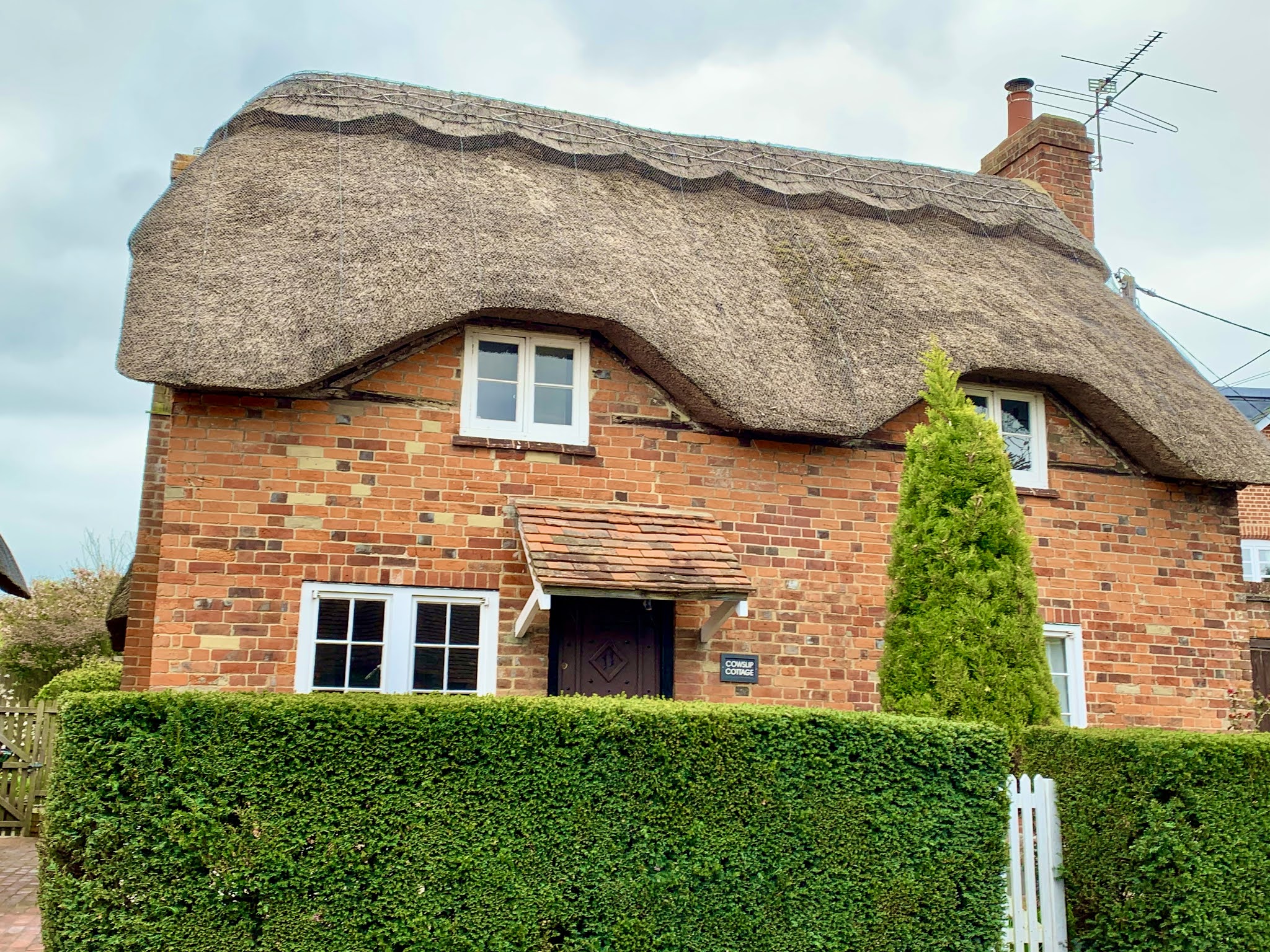
The village's houses would have been scattered around a series of fields held in common for grazing. Though most of Sherfield-on-Loddon's housing these days was is less than 100 years old, the thatched cottage below gives an idea of how most of the village might have looked in 1838 when the Duke of Wellington bought the "lord of the manor" title to go with his new estate just up the road at Stratfield Saye. (Check out an earlier piece on Stratfield Saye here.)
Some of that old communal green space is now two picturesque duck ponds.


Some has been set aside for recreational space ... there's a cricket pitch and tennis courts. And some remains a slightly wild green area for rambling. Though the only grazing animals you're likely to meet are these friendly wild boar.
Another striking feature of the Sherfield-on-Loddon is its Victorian village hall.
Up through Victorian times, there were probably only 40 homes scattered around all this green space. Things changed in 1917 when the Ministry of Defence purchased land next to the village for an enormous ordnance depot. It boosted employment possibilities and numbers in the village. 

The most visible sign of WWI, however, is the inevitable war memorial. It wasn't until I really started paying attention to these memorials in every village, looking at the number of names and thinking about the percentage of population that they probably represented, that I truly understood why that war still looms so large in British memory.
Here are some of more charming village houses.


And though modern developments (like mine) are eating up the farm fields surrounding the village, you can still get lost down leafy back lanes and discover scenes like these:

Sherfield-on-Loddon has its share of grand houses, too. The showiest is Buckfield, a grand Victorian mansion sitting on Medieval foundations. It became a school after WW2.

More my style is the Georgian Sherfield Court, still in private hands and sitting next to the parish church.
The parish church of St. Leonards is unusual in being a mile outside of the main village, rather than at its centre. It's a lovely Victorian building with Medieval roots.

We were house hunting in the village proper before settling in Sherfield Park, but the real irony of Basingstoke's hyper-growth is that historic properties ... and let's call that anything before WW2 ... have become highly desirable and go for a premium. Most of the housing on the market is from the '70s through the early part of this century, lacking character and reaching the age where things need to be replaced. Our best option was to buy new, in a place inspired by the old. At least in our corner of the county, we can rest assured that local councils and residents alike are fighting to maintain the charm we've managed to retain.