Showing posts with label Highclere Battle Proms. Show all posts

Sunday, 15 August 2021

Booms, The Bard and Bach herald the return of live audiences in England

Domestic restrictions regarding COVID-19 ended in England on 19 July, pretty much in line with the traditional start of the summer school holidays. Most of the events of “the season” … the Chelsea Flower Show, Henley, Glastonbury, etc. … were either cancelled or curtailed, but the ability to welcome crowds again ushered in a high summer that felt almost normal.

For us, the first two weeks of August brought a welcome return to the Highclere Battle Proms, Shakespeare at our local pub and our first foray into a London theatre for 16 months.
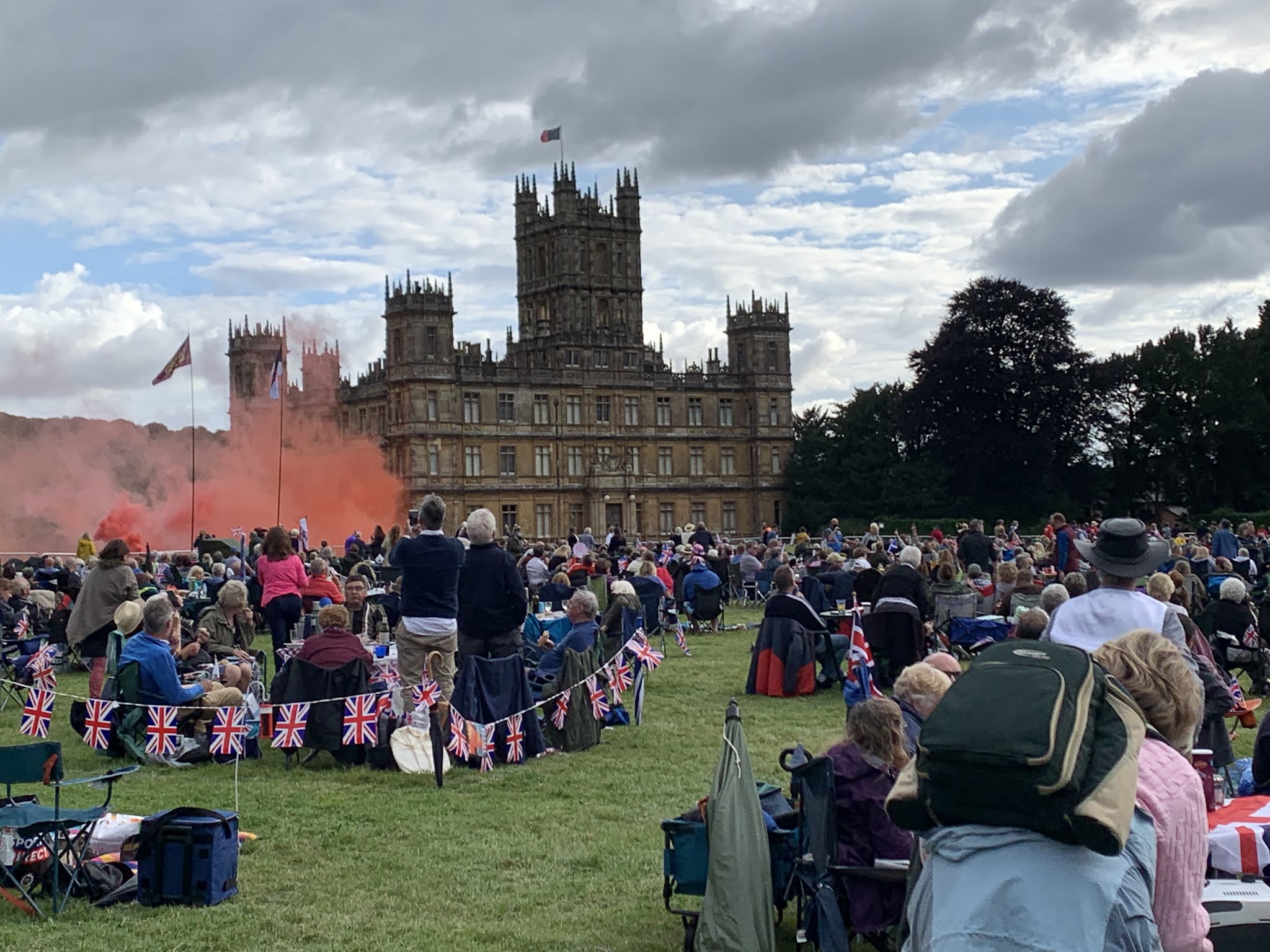
I’ve written of the Battle Proms here multiple times over the years. Its unchanging features have never been more comforting than after our long, forced separation from normality. The Regency cavalry display. The opening act of WW2 classic songs. The Red Devils parachute display drop. The Spitfire flyover. The classical music concert with the rousing programme of patriotic tunes and fireworks that never varies.  

There were two new elements for us this year. We chose to hire a marquee rather than bringing our own. It was supposed to simplify the organisation of a large family group, though five of our planned eight were stuck on the continent due to continuing quarantine rules for foreign travel. At £122 is was a humorously palatial splurge for the three remaining ticket holders, but we realised it came with distinct advantages. A guaranteed spot meant we didn’t have to arrive early and join the mad scramble to claim a space. We could turn up at leisure and set up in the first row of marquees with a straight view to the stage. None of the hassle of pitching our tent or, even better, trying to strike it and find all the tent pegs and ropes in the dark.

Second, since our last Battle Proms we’ve met the Earl and Countess of Carnarvon. I wrote about the surprisingly intimate cocktail party on their lawns here, which gave us the familiarity to say hello. They didn’t remember us, of course, but the earl returned our greetings and the countess stopped for a lengthy chat. As ever when exposed to the modern aristocrats running the enterprises built around England’s stately homes, I’m amazed by their easy familiarity and ease with “the people”. Highclere’s owners floated amongst the crowds like any other attendee, looking and interacting like the people next door. You can’t run a hospitality business without that talent, of course, but it always amuses me to imagine what the founders of these dynasties would think of the way “aristocracy” has evolved. 

The event could have been concocted by the English tourism board to give life to the fantasy most foreigners have of this country. A benevolent lord and lady welcoming the locals into their grounds. Genial, well-behaved crowds spreading lavish picnics on the sloping lawns of a stately home, flags fluttering in a gentle breeze, a view of picturesque countryside stretching for miles and the slowly setting sun turning a world of green and blue into gold and dark purple. 

English tourism would also do well to celebrate Fuller’s “Shakespeare in the Garden” series. Growing up in America, my early exposure to The Bard was all high culture to be slaved over at school and given worthy respect in serious theatres. That happens here too, of course, but in the land of Shakespeare’s birth there’s enough familiarity to bring a more casual treatment, plus more actors trained in his works. Thus we get David Mitchell and Ben Elton’s Upstart Crow on screen and stage, and a hefty schedule of outdoor performances throughout the summer by small companies in the grounds of stately homes. Fuller’s pubs make things even merrier with their “Open Bar” company.

These talented young actors know their Shakespeare, but they’re also skilled at improv, physical comedy and audience interaction. We saw them put on The Merry Wives of Windsor at The Calleva Arms in Silchester in 2019 and were curious to see what they’d do with the much more challenging Love’s Labour Lost. They updated bits of the text with contemporary humour, added music and slipped in and out of character and gender. We watched just four of them take on a story about of trio of men wooing another trio of women, who interact with at least five significant secondary roles. With basic costume changes, a couple of dummies assembled from balloons and a tremendous amount of skill, the company managed to tell a complex story and keep us entertained.

That’s no mean feat for what I consider to be one of Shakespeare’s most difficult comedies. It’s an early one, much in need of editing … no surprise it holds both Shakespeare’s longest scene and longest soliloquy … and the characters are neither particularly memorable nor loveable. It’s a romantic comedy without a resolution or a happy ending. But its biggest challenge is being laden with rapid-fire wit and pedantic word play at a pace that would be familiar to fans of Hamilton.  As with that modern musical, I suspect contemporary audiences would have needed to see Labours three or four times to digest all the dialogue. With more than four hundred years of linguistic evolution since then, it’s hard for even well-read Shakespeare fans to follow. The fact that four young actors could transform it into a jolly, comprehensible romp in a pub garden was truly amazing. 

Our theatrical outing a week later was much more serious. Bach and Sons explores the difficult relationship between the magnificently talented Johann Sebastian and his two eldest sons. Firstborn Wilhelm was reportedly a prodigy, but frittered his life away in drink and undemanding jobs. Carl Friedrich lacked his father’s spark, but hard work sharpened his proficiency enough to become a court musician to Frederick the Great and a composer whose work is still played. (I was a bit disappointed that the much younger sibling, Johann Christian, who went on to be known as “the English Bach”, didn’t feature.) 

Written by award-winning Nina Raine, directed by London theatre giant Nicholas Hytner and starring the wonderful Simon Russell Beale, you’d think there would be enough talent here to create something as memorable as Amadeus. No such luck.

Bach and Sons can’t decide what it wants to be. On one side, it’s an exploration of J.S.’s  music and genius. On the other, it’s the story of parental favouritism and the trauma that fault inflicts on a family. Amadeus offered a similar mix of genius profile and everyman story (in that case, professional jealousy), but did it much better. With Bach and Sons, I think people without a solid background in the music and the history might struggle to keep up. And while the family dynamics delivered enough melodrama to bring tears to sensitive eyes at the end, the whole thing was entertaining rather than profound. Good, but not great. I suspect the flaws are most evident in the fact that the relatively small role of Frederick the Great (played with a masterful mix of vulnerability, megalomania and charm by Pravesh Rana) stole the show comprehensively. I left the theatre thinking a play about him, starring Rana, would have been far more exciting than the time I’d just spent with the Bachs. 

All that said, if you’re a fan of Bach and his music I’d still recommend this as an excellent night out. If you don’t have that foundation as a starting point, I’d pass. Bach and Sons is on at The Bridge Theatre through 11 September.

Despite my joy of being in public at these three events, the spectre of COVID-19 still haunts us, of course. Even though it was an outdoor activity, Highclere reduced ticket sales by 40% to ensure plenty of room between family groups, and it was fascinating to watch how strangers … even in the most gregarious circumstances … now instinctively give each other a wider berth. Staff at all the concession booths wore masks and guests were respectively asked to do so while moving around the festival grounds.  The same mask protocol was in place at our pub. The Bridge, more sensitive because they’re indoors, kept buffer seats between booked groups, asked everyone to remain masked throughout, kept their coat check closed, didn’t serve food and requested that people pre-book interval drinks online to reduce the potential contact that comes with queuing. These are tolerable irritations for guests but must be cutting into producers’ profit margins severely. So while life is starting to appear normal, we have a long way to go.

Wednesday, 8 August 2018

Oxford's Tolkien exhibition reveals a man as fascinating as his books

On the surface, the people of the United States and England seem remarkably similar. It takes actually living in the opposite country for the deep divisions to surface. Public expressions of patriotism are a classic example.

An American will fly, wear, sing to or otherwise publicly celebrate their flag at the slightest provocation. There are multiple patriotic holidays decked out with the Stars and Stripes. In England, overt displays of flag waving beyond sporting events or royal occasions are regarded with suspicion. Though this has changed a bit since Queen Elizabeth's Jubilee year and recent Olympic successes, there's still a sense of discomfort amongst many that too much flag waving indicates an affinity with fascism and racism. True English patriotism, I've found, is quieter ... and most likely to be  found outside of the cities.

It's the fierce competition of villages battling it out for Britain in Bloom awards. Intense pride in the local bluebell woods. Generations coming together, dressed in white, to play village cricket. The 2014 government survey found that 83% of the English now live in urban areas, but our sense of patriotism still seems to be indelibly bound up in the countryside.

Perhaps that's why J.R.R. Tolkien is so fiercely beloved by the English. Many readers, after all, see the Shire as a vision of the best of rural England, Sauron and his forces of evil as the opposing troops of rampant industrialism, and hobbits as the stout yeomen of Britain's good old days. You can test that relationship for yourself in an intriguing little exhibition at the Bodleian Library in Oxford. And while a deep knowledge of Middle Earth isn't required ... the notes, charts and maps displayed there give a fascinating insight into how an author constructs a plot, and thus would captivate anyone interested in the art of story telling ... true Tolkien aficionados will be delighted.

Tolkien: Maker of Middle Earth takes a hard look at the man behind the legend. Most people know the basics: Oxford professor of Anglo-Saxon and English literature, fanatical about detail down to creating his own languages, father of the whole genre of epic fantasy fiction. Here we learn about his childhood, education, military years, family life, sparkling sense of humour and creativity far beyond his writing.

I had not realised that Tolkien was a talented artist who created the instantly-recognisable original cover for The Hobbit. His artwork was my favourite part of the show. There's a gorgeous set of scenes from the Lord of The Rings that clearly influenced Peter Jackson. Wonderful designs for Elvish jewels and writhing dragons. Illustrations from a series of Christmas stories on the wanderings of Santa that he wrote for his children. Doodles scrawled on newspaper margins and over crosswords that show how he never stopped creating. I'm amazed that some design house hasn't picked up on his work for a range of wallpapers and decorative fabrics; there's luscious stuff here.
And there are maps. Lots of maps. With all this evidence of how visual a person he was, it makes even more sense that the map ... now a cliche of fantasy epics ... was a beautifully detailed foundation stone of Middle Earth. Some here are finished products meant for readers, some working documents, all beautiful. If you have any doubt about the professor's obsession with detail, witness the rigorous creation, on graph paper, of exact scales drawn from a measurement system based on the length of a hobbit's toenail. No distance traveled in a day in the books will ever be further than the creatures he created could actually go. In addition to the Tolkien-drawn originals, there are a couple of digital maps that let you explore different characters' journeys in the different books. The best takes advantage of video projection to cast the landscape in 3D and have shadows shrink and grow off the mountain ranges as time passes.

There's also a fun, life-sized projection of the gates of Moria at the entry to the show, setting the mood that you're about to enter a world of magic, and a big, projected Smaug dancing across the floor once you're in the gallery. Several sound stations invite you to don headphones to explore details like getting your Elvish pronunciation right. But most of the exhibitions are quite old school: peering through glass at preserved documents. It's also remarkably small: just one gallery. I would have loved more. A gallery, for example, on the cultural influences (old Anglo-Saxon, Icelandic, Medieval, etc.) that Tolkien drew on, another on the vast cultural impact that his creations have sparked.

But that's not the point here. As you would expect from a combination of the rigorously controlled Tolkien Trust and the university associated with the author for most of his adult life, everything here is tightly focused on the man and his creative processes, and drawn from the two organisations' archives. In a world where so many blockbuster exhibitions overwhelm you with their scope, I suppose it's no bad thing to visit one that leaves you hungry for more. And, delightfully, it's free. You just need to pre-book tickets here.

For a more overt display of patriotism, we were back at the Highclere Battle Proms the next weekend. They were celebrating their 100th concert that night (they do about five a summer). It was only our sixth. The formula doesn't change much. People queue up from about 2:30 for gates to open at 4, then it's a mad rush to claim a spot on the broad lawns in front of the house the world knows better as Downton Abbey. In addition to flag-waving patriotism, the English get to display their flair for competitive picnicking: there are a lot of tablecloths, candelabras and fine food and wine coming out of well-stocked hampers. Over the years my husband has been bitten by the competitive bug, steadily upgrading our kit so that we look like traders setting out to conquer the Silk Road as we queue up for entry. Though he's generally happy with the set up, I suspect our two poles with their English, British Army, Danish and American flags will be tweaked before next year. They weren't flying highly or proudly enough.

The show doesn't change much. Historical re-enactors (usually Regency) set up at the far corner. There are some cavalry displays in the late afternoon. Music starts with a WW2-era group. There's a rousing Spitfire flyover. Then a two-part classical concert that's always much the same. But who ever really tires of the 1812 Overture with real cannon, Beethoven's Battle Symphony with fireworks and mass sing-alongs of Jerusalem and Land of Hope and Glory?

A groaning buffet and bar kept people going throughout the afternoon and evening. Pork pies, sausage rolls and crisps. Coronation chicken, chicken and wild mushroom terrine, roasted carrot salad, potato salad, insalata caprese. (Potatoes and tomatoes all from my garden.) Key lime cheesecake and cheese board. Free-flowing wine, and blackcurrant squash for the designated drivers and children.

It was a spread that would gain even a hungry hobbit's approval. I suspect Tolkien would have enjoyed the whole evening. And I'd love to see how he would have painted it.

Monday, 7 August 2017

Elegant Orfeo, rousing Proms wrap up our musical summer

Between our Longborough Opera patronage and our annual trip to the Highclere Battle Proms, our summers always have lashings of live music woven through them. This year, additional events have made it feel like we've been in a continuous whirl of wonderful performances. We've loved every minute, though we admit we're ready for a bit of peace and quiet.

Our summer of music wrapped up with back-to-back performances that were both, in their own ways, rigorously traditional. (Opera Friday, Proms Saturday)

Orfeo ed Euridice was Longborough's final opera of their 2017 season. Their baroque operas are reserved for their young performers and are usually where they take their big creative risks. Xerxes as nightclub owner. Rinaldo as a circus. Nothing so avant garde here. The set might have been stripped down to a clean set of stairs topped by a circular gateway, and the costumes vaguely Middle Eastern, but overall it was a performance that the Austrian royal court for whom this was composed would have found recognisable. The dancers came in for their stately intermezzos. The story proceeded in a straightforward, uncomplicated way. The orchestra and singers were top notch ... though the traditional castrato lead was played by a woman rather than a counter-tenor.

Given the rarity of men able to hit the high notes, turning baroque heroes into "breeches roles" is fairly common, but Longborough had avoided it in both Xerxes and Rinaldo. Mezzo soprano Hana-Lissa Kirchin was completely convincing, however, and did a phenomenal job in an opera where her character is centre stage and singing for the lion's share of the production. Nazan Fikret's Euridice was as beautifully acted as sung, from her delight at being awoken in the underworld to her confused, hurt anger when Orpheus won't speak to her.

If you don't know the plot: the gods allow Orpheus to descend to the underworld to bring his beloved, pre-maturely dead wife back to life, on condition that he doesn't speak to her or look back at her until they return to the land of the living. In myth, they almost make it when Orpheus turns to check she's following, and he loses her forever. Composer Gluck gives us an American-style happy ending, with the gods interceding to bring Euridice back to life ... even though Orpheus has broken the rules ... as a reward for their true love. With its exquisite music, group dances and happy ending, this is another excellent introduction opera for those wanting to ease into the genre.

Twenty four hours later we were, admittedly, paying more attention to the food and company than to the music. The casual, outdoor, picnic-as-you-listen nature of the Battle Proms means the music is always a bit more background entertainment than the main event. When you choose to set up a marquee you're stuck at the back of the field, where distance exacerbates the divide. But given the day's earlier weather ... torrential rains and beating hail ... we didn't want to risk attending without cover.

It was much the same as previous years, with a few tweaks. The Andrews Sisters-style Rockabellas were replaced by a ragtime band. A few new pieces swapped into the first half of the classical concert. But the same Regency military re-enactment troupe performed in the adjacent field and the same Spitfire did its rousing flyover. The same canons thundered to the 1812 Overture, the same fireworks punctuated Beethoven's Battle Symphony, the same patriotic medley had several thousand people singing along to end the evening.

The most distinctive part of this year's Battle Prom will live in our memories as the introduction of three young British expats to this aspect of their national heritage. My godson was born in Luxembourg and has never lived here. His brother and sister have lived overseas for half their lives. Introducing them to this rousing part of their national heritage was magical. Their assignment before next year's event? Learn the words to Jerusalem by heart.