Showing posts with label Tolkien. Show all posts

Saturday, 11 May 2019

Winchester, Kyoto and Tolkien combine for the perfect date night

Your sense of distance changes depending on your surroundings.

Growing up in St. Louis, pretty much every activity (including school) was half an hour away by car. Life was much the same in Dallas. Weekends regularly included two- or three-hour drives to local points of interest, and we thought nothing of a 300-mile weekend road trip to Chicago.

When I first started working in England, I brought that attitude with me. My first assignment came with a company car and a credit card for unlimited fuel. I used it. More than 500 miles a weekend wasn't unusual as I worked through every significant stately home, charming village, ruined abbey and dramatic landscape in reach.

More than 20 years on, and living permanently in the UK for 15, I've embraced a more British attitude. Infrastructure and expense are two culprits. Going anywhere in this country usually means sitting in traffic that will make the journey twice as long as it should be. Once you get there, parking will be hard to find, perilous to fit your car into and ridiculously expensive, and fuel is pricey. None of which, however, should deter me from weekend jaunts to our county town of Winchester, just 23 miles away.

Every time I go, I think to myself that I should go more. After this weekend, I'm making more of an effort to move our occasional "movie date nights" there. Winchester's Everyman Cinema is a marvellously sophisticated way to consume a film, and Kyoto Kitchen has been reviewed as one of the best Japanese restaurants in the country.

Each of the 28 Everyman cinemas in the UK is different, because they like to give new purpose to historic old buildings, but I think the ethos across all of them is the same. Intimate and sophisticated, they're more like some mogul's private screening room than a modern cinema. The manager gives a personal welcome and introduction to each film. Premium seats are oversized armchairs and sofas, and the lobby is a cocktail bar. They even deliver freshly-made pizzas to the seats. Clearly, this appeals to a rather niche target market: the pre-film advertising was for Sipsmith Gin, Hermes scarves and Green and Black chocolate. The only drawback is availability. With just two screens (in Winchester) rotating an handful of films, plus theatrical, operatic and ballet live broadcasts, you need to work to their schedule and booking in advance is usually a requirement.

We were there for Tolkien, the new biopic looking at how the youth of the master of epic literature shaped his writing. The difference between the mainstream reviewers' reactions (lukewarm to aggressively negative) and ours (highly positive) shows why I pay little attention to professional critics. I am clearly not their target market. Most of them griped about the film lacking daring or innovation, or how it was too pedestrian in its pacing. I saw an old-fashioned (in the best possible way) tale of love and friendship, and of dreams overcoming adversity. Set ... aside from the expectedly grim WW1 bits ... in a particularly easy-on-the-eye bit of English history. If you're a fan of Downton Abbey, or that elegiac twilight of British Empire, this film is for you.

The lush Arts and Crafts interiors, in fact, were almost a character in their own right. As well as I know that stylistic movement, and the tales of Middle Earth, I had never put two and two together.  Tolkien spent his childhood surrounded by a cultural zeitgeist that celebrated myth, legend and fairy tale. Of course that influenced his writing. If you know anything about the professor's life, the other influences ... the horrors of industrial Birmingham after a childhood in the countryside, the majesty of Wagner, the nightmare and loss of WWI ... won't be a surprise. But it's great to see them put together into a story both sad and joyous and, ultimately, inspiring.

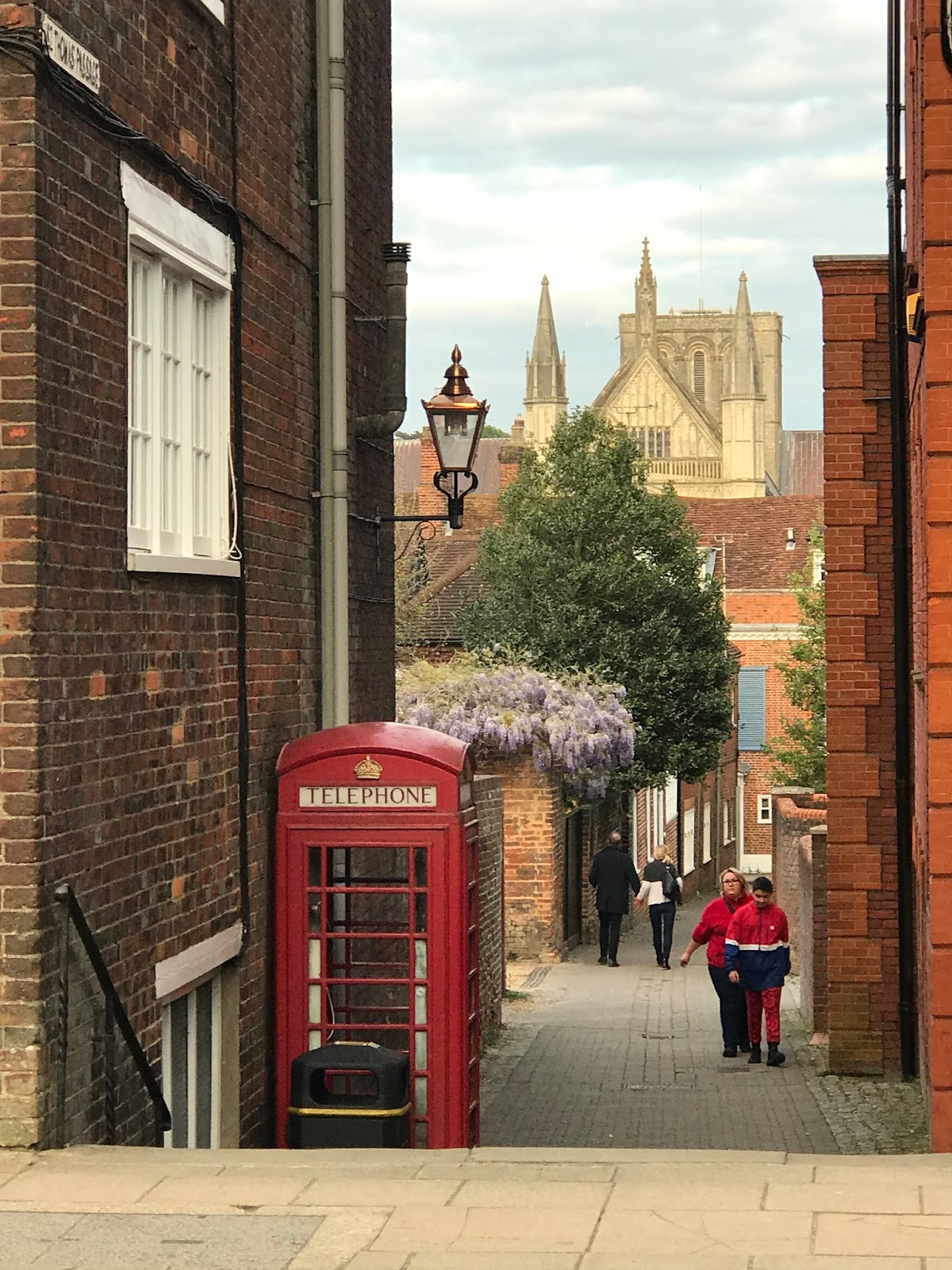
Afterwards, it was a short walk through Winchester's picturesque Georgian and Victorian streets (Tolkien would have approved) to the Kyoto Kitchen.
This small (no more than 40 covers) restaurant in the repurposed ground floor of an Edwardian house in a row just off the high street was considered one of the best Japanese restaurants in the country by the late, great critic A.A. Gill. (I often quibbled with his film reviews, but almost never with his much-missed food writing.) It's also been awarded a plate in the Michelin-guide, one step below the star system. Kyoto Kitchen has, therefore, been on our "must do" list for years but, embarrassingly, we never managed to make it there. Now that we have, I suspect we'll be back soon.

The menu features a broad range of sushi, sashimi and tempura, plus main courses like grilled black cod, duck breast with raspberry teriyaki sauce and lamb chops with white miso. Thus you can assemble your meal as you wish: feast on raw fish, graze on a succession of small plates or assemble a more traditional European three courses. Since it was our first visit, we left ourselves in the kitchen's hands and went for the chef's menu. This featured a procession of nine exquisite plates, all shared between us, for the astonishing price of £34.95 per person. Here's another reason to love Winchester. I haven't seen a tasting menu in a Michelin-noted restaurant inside the M25 for any less than £70 in years. But even outside of London, we'd have been likely to spend as much at the functional, food-court style sushi place in our local mall. Kyoto Kitchen is a remarkable bargain.
We liked every dish, but thought some were particularly stellar. Tori Kara Agè combine the moreishness and comfort of chicken nuggets with gourmet spicing and light-touch frying. This is why panko bread crumbs exist. Their tempura is excellent, though don't dawdle. Every second it cools is a step away from perfection. In a world where sushi and sashimi have become commonplace lunch take-aways, this was a reminder of the vast differences you can find in fish. Itsu's boxes are excellent, but Kyoto Kitchen's sashimi was noticeably different: more delicate, yet at the same time more packed with flavour. We were less keen on the ume-shiso roll, where we thought the sea bass was overwhelmed by the shiso leaf and plum dust, but we appreciated the gourmet twist. Mochi ... glutinous rice parcels filled with azuki bean paste ... were far better than their description and opened my eyes to the fact that desserts may be my greatest leap into the unknown when we explore Japan later this year.

The restaurant decor says Japanese with a sparse elegance: light wooden floors, black ebony-style chairs, white tablecloths graced with an exquisite variety of pottery and kimonos and obi (wide belts) hanging on the walls. More essential to the properly Japanese experience is the staff. I've written before of the odd-but-typical experience of dining in London where the staff doesn't match the cuisine. Polish waitresses serving up Scandinavian, Australians presenting gourmet French, etc. While I don't have any problem with this, it certainly adds to the authenticity when the people taking care of you come from the same place as the recipes. Especially when your lead waitress takes the time to give you sightseeing tips from her home town and teach you some new Japanese words. We have now, usefully, mastered "oishī" with a big smile. That means "tasty". I suspect I'll be using it a lot when we reach Japan, and predict a few more practice sessions at Kyoto Kitchen in the mean time.

It is, after all, only 25 minutes away. And now, having scouted out exactly how far Kyoto Kitchen is from the train station ... just one stop past our own ... we can make the next trip by public transport, freeing us up for the matching 5-cup sake menu for an additional £20. Yes, that's right. A Michelin "plate" chef's menu, five courses with matching alcohol flight for less than £55. Londoners, eat your hearts out. Winchester is where it's at.

Wednesday, 8 August 2018

Oxford's Tolkien exhibition reveals a man as fascinating as his books

On the surface, the people of the United States and England seem remarkably similar. It takes actually living in the opposite country for the deep divisions to surface. Public expressions of patriotism are a classic example.

An American will fly, wear, sing to or otherwise publicly celebrate their flag at the slightest provocation. There are multiple patriotic holidays decked out with the Stars and Stripes. In England, overt displays of flag waving beyond sporting events or royal occasions are regarded with suspicion. Though this has changed a bit since Queen Elizabeth's Jubilee year and recent Olympic successes, there's still a sense of discomfort amongst many that too much flag waving indicates an affinity with fascism and racism. True English patriotism, I've found, is quieter ... and most likely to be  found outside of the cities.

It's the fierce competition of villages battling it out for Britain in Bloom awards. Intense pride in the local bluebell woods. Generations coming together, dressed in white, to play village cricket. The 2014 government survey found that 83% of the English now live in urban areas, but our sense of patriotism still seems to be indelibly bound up in the countryside.

Perhaps that's why J.R.R. Tolkien is so fiercely beloved by the English. Many readers, after all, see the Shire as a vision of the best of rural England, Sauron and his forces of evil as the opposing troops of rampant industrialism, and hobbits as the stout yeomen of Britain's good old days. You can test that relationship for yourself in an intriguing little exhibition at the Bodleian Library in Oxford. And while a deep knowledge of Middle Earth isn't required ... the notes, charts and maps displayed there give a fascinating insight into how an author constructs a plot, and thus would captivate anyone interested in the art of story telling ... true Tolkien aficionados will be delighted.

Tolkien: Maker of Middle Earth takes a hard look at the man behind the legend. Most people know the basics: Oxford professor of Anglo-Saxon and English literature, fanatical about detail down to creating his own languages, father of the whole genre of epic fantasy fiction. Here we learn about his childhood, education, military years, family life, sparkling sense of humour and creativity far beyond his writing.

I had not realised that Tolkien was a talented artist who created the instantly-recognisable original cover for The Hobbit. His artwork was my favourite part of the show. There's a gorgeous set of scenes from the Lord of The Rings that clearly influenced Peter Jackson. Wonderful designs for Elvish jewels and writhing dragons. Illustrations from a series of Christmas stories on the wanderings of Santa that he wrote for his children. Doodles scrawled on newspaper margins and over crosswords that show how he never stopped creating. I'm amazed that some design house hasn't picked up on his work for a range of wallpapers and decorative fabrics; there's luscious stuff here.
And there are maps. Lots of maps. With all this evidence of how visual a person he was, it makes even more sense that the map ... now a cliche of fantasy epics ... was a beautifully detailed foundation stone of Middle Earth. Some here are finished products meant for readers, some working documents, all beautiful. If you have any doubt about the professor's obsession with detail, witness the rigorous creation, on graph paper, of exact scales drawn from a measurement system based on the length of a hobbit's toenail. No distance traveled in a day in the books will ever be further than the creatures he created could actually go. In addition to the Tolkien-drawn originals, there are a couple of digital maps that let you explore different characters' journeys in the different books. The best takes advantage of video projection to cast the landscape in 3D and have shadows shrink and grow off the mountain ranges as time passes.

There's also a fun, life-sized projection of the gates of Moria at the entry to the show, setting the mood that you're about to enter a world of magic, and a big, projected Smaug dancing across the floor once you're in the gallery. Several sound stations invite you to don headphones to explore details like getting your Elvish pronunciation right. But most of the exhibitions are quite old school: peering through glass at preserved documents. It's also remarkably small: just one gallery. I would have loved more. A gallery, for example, on the cultural influences (old Anglo-Saxon, Icelandic, Medieval, etc.) that Tolkien drew on, another on the vast cultural impact that his creations have sparked.

But that's not the point here. As you would expect from a combination of the rigorously controlled Tolkien Trust and the university associated with the author for most of his adult life, everything here is tightly focused on the man and his creative processes, and drawn from the two organisations' archives. In a world where so many blockbuster exhibitions overwhelm you with their scope, I suppose it's no bad thing to visit one that leaves you hungry for more. And, delightfully, it's free. You just need to pre-book tickets here.

For a more overt display of patriotism, we were back at the Highclere Battle Proms the next weekend. They were celebrating their 100th concert that night (they do about five a summer). It was only our sixth. The formula doesn't change much. People queue up from about 2:30 for gates to open at 4, then it's a mad rush to claim a spot on the broad lawns in front of the house the world knows better as Downton Abbey. In addition to flag-waving patriotism, the English get to display their flair for competitive picnicking: there are a lot of tablecloths, candelabras and fine food and wine coming out of well-stocked hampers. Over the years my husband has been bitten by the competitive bug, steadily upgrading our kit so that we look like traders setting out to conquer the Silk Road as we queue up for entry. Though he's generally happy with the set up, I suspect our two poles with their English, British Army, Danish and American flags will be tweaked before next year. They weren't flying highly or proudly enough.

The show doesn't change much. Historical re-enactors (usually Regency) set up at the far corner. There are some cavalry displays in the late afternoon. Music starts with a WW2-era group. There's a rousing Spitfire flyover. Then a two-part classical concert that's always much the same. But who ever really tires of the 1812 Overture with real cannon, Beethoven's Battle Symphony with fireworks and mass sing-alongs of Jerusalem and Land of Hope and Glory?

A groaning buffet and bar kept people going throughout the afternoon and evening. Pork pies, sausage rolls and crisps. Coronation chicken, chicken and wild mushroom terrine, roasted carrot salad, potato salad, insalata caprese. (Potatoes and tomatoes all from my garden.) Key lime cheesecake and cheese board. Free-flowing wine, and blackcurrant squash for the designated drivers and children.

It was a spread that would gain even a hungry hobbit's approval. I suspect Tolkien would have enjoyed the whole evening. And I'd love to see how he would have painted it.