Showing posts with label Italian Food. Show all posts

Thursday, 26 December 2024

The Feast of Seven Fishes for Two? Here’s how.

Like spaghetti with giant meatballs and snowy excesses of cheese topping, the Feast of the Seven Fishes on Christmas Eve is not an Italian tradition. It’s Italian-American, which is quite a different thing. Yes, Italians do traditionally eat fish on Christmas Eve, and they like to set a festive table. But pushing yourself to seven dishes is considered a bit over-the-top in the Mother Country.

Like so many Italian-American traditions, I suspect the Seven Fishes swam out of the giddy immigrant delight of cheap, easily available food. Families who, in their native land, could only afford animal proteins a few times a year could now have them every day. They celebrated and showed off their wealth. Food writers have traced the generous excesses of Italian-American cuisine back to this fact. (Given that most 19th century immigrants shared that reality, whatever their country of origin, I’ve always suspected it’s at the root of America’s gargantuan portion sizes in comparison to the rest of the world. But, admittedly, the Italian-American table does groan a little more heavily than most.

To be honest, our family didn’t really do the Seven Fishes. In the Missouri of the 1960s and ‘70s, a 12-hour drive from the nearest ocean, fresh fish was unknown at all but the priciest of restaurants and frozen food … while becoming more common … tended to offer only breaded fish fingers. I suppose someone could have come up with a muddy catfish, but seven fish dishes would have been ludicrous. My Sicilian grandfather honoured his piscine traditions with a bit of pickled herring out of a jar while the family sat down to something meaty; usually an enormous lasagne.

As an adult living on an island on which the most inland point is only 70 miles from the sea, however, I liked the sound of the Feste. More accurately, I liked the challenge. We never entertain at Christmas Eve. We’re either out, or it’s just the two of us. Would it be possible to prepare seven distinct fish dishes in one meal, in portion sizes that didn’t overwhelm?

I’ve played around with the challenge in years past, but 2024 is the year I got closest to acing this conundrum. My pasta serving should have been a bit smaller … we were too full to properly enjoy the course after … and I spent so much time getting portion sizes right that I fell down a bit on seasoning and small touches. Much of this tasted good, but a bit of attention to detail would have made it great.

Still, I have a template for future years. If you want to try the Feast of Seven Fishes for a small group, here’s a workable menu. I split the seven into four courses.
First Course: Amuse Bouche. These were three single bites, presented on special serving spoons. My bites were an anchovy wrapped around green olives, tuna (high-quality Sicilian, in a jar) stuffed into a peppadew pepper, and bit of avocado covered with crab meat. I could have added one more here and taken one off the next course to make life easier on myself, as the squid could have been served hot or cold.
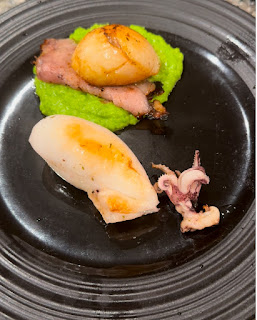
Second Course: Warm Appetisers. I put two on a plate. A griddled stuffed squid was easy, coming already prepared from the deli at Italian Continental Stores. Left cold, this could have joined the amuse bouche. That sat next to a single scallop on pea puree and a bit of grilled ham. It’s normally done on black pudding but I’d already roasted a ham for other holiday meals and wanted to re-use ingredients.

Third Course: Pasta. I made three tactical errors with my Linguini Vongole, which I haven’t made in a very, very long time. First, lacking a linguini option on my pasta maker I opted for spaghetti rather than fettuccini. The thicker noodle would have worked better. Second, I dumped the liquid from the jar of clams when I should have used it to flavour the pasta. Third, I forgot how important really good olive oil is to this dish. Essentially, it’s really delicate and easy to create something extremely bland. I rescued it with a last-minute addition of the Sicilian olive oil our landlords from Ispica sent us home with earlier this year, but it could have been better out of the pan.

Fourth Course: From the Grill. Whole sea bass done “en papillote” with fennel, lemon and dill. Another tactical error … I didn’t open the packet from the fishmonger to see that my husband had bought a whole bass instead of fillets until an hour before serving. The papillote was a last-minute rescue because I didn’t have the time or confidence to fillet the fish myself. Had I realised I had a whole fish to work with I would have gotten supplies in to bake it in sea salt, but the only sea salt in the house was fancy stuff I’d purchased in Sicily and i wasn’t going to use that as a cooking medium.
Dessert: I made a simple lime posset, which is the kind of light, citric option perfect for ending this menu. We were so stuffed that we split one and only managed half of it, but it did wrap things up nicely.

And thus ended my culinary efforts on Christmas Eve. My lovely husband took over the kitchen the next day and switched the influences from Italian to Danish. (Crab salad, roast duck with red cabbage, Christmas pudding). Followed by the traditional Danish lunch of open-faced sandwiches, beer and snaps with friends on the 27th. Those feasts gave us enough leftovers to weather the rest of a quiet holiday season. Outside, it was grey, windy and wet. Indoors, we snuggled up with good books, good video, and good food. After a busy year, it was exactly the holiday season we needed.

Wednesday, 8 May 2024

Beyond pizza: Extraordinary seafood and vegetables make Neapolitan food special

You could easily spend an entire holiday in Naples eating nothing but pizza, pastries, and street food and still come home raving about the quality of the food. This, however, is a city that delivers on every culinary level, and its proper restaurants deserve some attention, too. Especially if you love fresh produce and seafood. 

Like the rest of Italy, Neapolitan food favours simple preparations of top quality ingredients. plenty of pasta, which you can have the traditional way as a starter before your meat, or as a main course. Vegetables tend to come as side dishes, not assembled onto a main course plate with multiple elements. Neapolitans join their fellow Italians in preferring what’s local, and seasonal.

Like most Italians, they’ll tell you that THEIR local ingredients are better than other regions … and here they may have a point. Abundant sunshine, gentle breezes and the notoriously fecund volcanic soil produce exquisite fruit and vegetables. Stop to admire a greengrocer’s stand here and you’ll be gazing at something just as worthy of veneration as the city’s art. They grow varieties distinctive to the area, San Marzano tomatoes being the most well known. We were visiting in high season for friarelli (known as broccoli rabe in the States), a green somewhere between tender-stem broccoli and cavolo nero, and some gorgeous, red-tinged artichokes I’d never seen before. All this fabulous fruit and veg doesn’t mean, however, that you’ll always be eating healthily. The Neapolitans are so fond of deep frying things you’d think they were twinned with Glasgow.

This is also the point on the Italian peninsula where people start to get really serious about desserts. Omnipresent Italian gelato and tiramisu has competition here from mouth-watering cakes, pastries, tarts, and biscuits. We can thank medieval Arab occupation for the love of pastry, and centuries under Spanish rule for easy access to sugar and chocolate coming in from the new world.

In fact, many argue that the magnificence of Southern Italian food is a direct consequence of thousands of years of imperialist foreigners running the place, going all the way back to Greek merchants and then to Romans established the whole coast as a destination for luxury dining.

When it came to booking restaurants in modern Naples, we had a secret weapon named Nicola. A colleague of one of the girls on our trip, he was excited to arrange bookings for us at a series of restaurants over the course of our visit so that we could try all aspects of Neapolitan dining: the pizzerias (already covered here), the trendy spots, the humble local joints and the elegant retreats. I doubt you’ll get a bad meal anywhere in Naples, but Nicola ensured that we saw all sides of this vibrant city’s food scene. My only regret? Large portions and travelling companions who were all avoiding desserts meant I left sweets unexplored at our restaurant choices.

It was the humble neighbourhood restaurant that stole my heart, and it’s the first one I’d return to. Locanda Monacone is deep inside Rione Sanità, the former rough neighbourhood now rehabilitated into a popular residential area for creative types. It’s the destination for visitors who want a more local experience. The restaurant is proud to be a long-standing occupant of the neighbourhood; contributing to its revival with local employment. Its small, ground-floor dining room is dominated by a tile mural of Catholic saints under a barrel vault. It looks like it’s been unchanged for centuries.

Our expectations were low when we arrived, however, because that charming space was taken by a private party and we were ushered to a tiny landing upstairs with three tables outside of the kitchen. We feared the staff would ignore us and we’d be wildly irritated by the noises below and the traffic of servers from the kitchen. Not at all! The staff seemed to redouble their efforts, really making a fuss over us. By the end of the evening we were dancing with them and the downstairs party-goers to the birthday boy’s live band. And the food! Weeks later, I’m still dreaming about the plate of fritto misto (a range of deep-fried delights) followed by linguini with fresh artichokes and chunks of sweet, crispy pancetta that practically brought tears of joy to my eyes. There was an exceptional local wine list and the waiters here seemed better informed about, and more willing to discuss, options than the servers at most of the more expensive places we went. I hope that somewhere in my family history there’s a link between my line and Benito Ferrara, whose label served up a wonderfully crisp, lively Greco du Tufo to perfectly counter that rich food. 
Our most elegant experience was at TransAtlantico, a hotel and restaurant nestled beneath the Castel dell’Ovo with harbour-side tables looking over yachts and the Naples seafront with Vesuvius hanging in the background. The decor is all inspired by trans-Atlantic liners of the ‘20s and ‘30s, so there’s a lovely atmosphere inside. But for most of the year you’ll want to reserve one of those outside tables. This is the kind of place designed for that romantic dream date, but it’s pretty darned good with your girlfriends, too.

As appropriate to its location, TransAtlantico is all about the seafood. Prawns in tomato sauce, tuna tartare and a dish of lemon-laced courgettes all won raves, but I’m confident my octopus on a bed of caponata was the dish of the night. Each component part … octopus, aubergine, onion, tomato … seemed the exemplar of its individual taste, yet married together for a coherent whole. If there was one dish the whole trip that made me sigh “you just don’t get fresh tomatoes like this anywhere else” it was this one. (Top photo)
It’s here that I also got to try a white wine I’ve been reading about for years: lacryma christi. If you love both wine and history, it’s hard to resist the idea that this is as close to the wine preferred by the Ancient Romans as you can get, and that it’s been praised in literature for centuries by writers as diverse as Voltaire, Hawthorne and Marlow. I wasn’t disappointed. It’s a rich, heavy white … along the same lines as a well-aged Burgundian Chardonnay … but has a distinctive flavour profile of grass, white peach and a hint of almond. I was planning to bring some bottles home but the wine shop in Rione Sanità was closed on our departure day.

If you want to feel part of the hip and trendy scene in Naples, head to Cap’Alice. Like TransAtlantico, thisis in the upscale part of town along the coast, west of the historic centre. But where TransAtlantico’s position on the water looking toward all the great 19th century hotels speaks of a history of grand tourism, this place is on a small lane that rises through the Chiaia neighbourhood and screams “local”. You wouldn’t find without looking for it.

The food and wine was good, the people watching better. The fried calamari we shared as a starter was excellent. My tuna crusted in almonds was beautiful, but the report back on the other mains was competent, not exceptional. The wine list was interesting and the bottles we sampled were top-notch, but given that the place is known as a wine bar we were disappointed not to get more insight and guidance from the staf. Overall, service was really stretched and I suspect we did not get the best from the place because it was Friday night. The compensation was watching a parade of well-dressed locals demonstrating the Neapolitan exuberance for life. I’m not sure this was worth the effort to go all the way across town, but if I were staying in this neighbourhood I would try Cap’Alice again, on a weeknight, as well as sampling other places on this bustling little lane.

For dining with beautiful foreigners, of course, it was off to Capri. We enjoyed a long, relaxing lunch at Capanna in the main town, one of those understated but classic stalwarts plastered with photos of all the famous people who have eaten there. The interior is a cool, elegant mix of white walls, painted tiles, and potted plants, with tropical-themed plates hand-painted for the restaurant. Temperatures were mild when we visited but I can imagine what a refugee this would be from the blazing heat of high summer.

La Capannina is on a quiet lane a bit back from the main tourist drag; out taxi driver had tipped it to us when we asked him for food the locals really rated, then validated by the fact that one of the girls had an excellent meal ere on an earlier trip. It’s no bargain … at €71 each it was our most expensive meals on our trip … but that’s Capri. And our love of good wine means we’re inevitably spending as much on drinks as food.

For the premium price you get gracefully attentive service, an elegantly peaceful environment and glorious food. Their specialty of bufala mozzarella-stuffed ravioli earned eye rolls of appreciation around the table. The girls thought the Loggia della Sera Greco di Tufo was the best example of this local variety that we drank. I, however, was most impressed by a spaghetti dish with prawns in a lemon sauce. According to the waitress, the secret is lemoncello kneaded into the pasta. The flavour profile was so impressive I tried to make it as soon as I got home. My pasta was pretty good, but my sauce came nowhere near the light creaminess of theirs. The dish was memorable enough that I’ll keep trying. Perfecting the recipe is more likely than a quick return to Capri.

Honorable mentions:

Caffetteria Tonya: While I wouldn’t go out of my way to get here … I am sure there are thousands of places like this across Naples … Tonya was a great example of the neighbourhood Italian cafe. This is also why breakfast is so often optional in Italian lodging. Culturally, people prefer having their coffee and cornetto (the Italian version of a croissant) in public. I went here every morning, often sitting for an hour reading or sketching with my coffee. By the third day the two guys who worked there knew my order (cappuccino, cornetto filled with crema di pistacchio). It was fascinating to see the regular parade of locals, and how the barman took trays of coffee up and down the street for other shopkeepers. No paper cups here: proper glass and china even though he was crossing uneven paving stones and dodging speeding scooters. The guys knew the names not just of the locals, but of their dogs. Every day we saw these pillars of the community open up at 8am and roll up the shutters around 8pm. 
Tesoreria: This exquisite cocktail bar in the Galleria Principe di Napoli is worth a special trip, so beautiful are its interiors and so skilled its bartenders. The restaurant in its atmospheric, groin-vaulted cellars looked intriguing and I would have loved to try it, but all of our dining opportunities were booked up. Here’s yet another excuse to consider a return trip to Naples.

Saturday, 27 June 2015

The new Cafe Murano lets down the Hartnett brand

I desperately wanted to like Cafe Murano.  I'm a huge fan of chef patron Angela Hartnett.  Her original, Michelin-starred restaurant Murano has given me some wonderfully memorable meals (story here). I was excited and honoured to be on the invitation list for the soft launch week of this new, more casual venue in Covent Garden, and had been boasting to friends all week that we were going to be amongst the first to sample Hartnett's latest.

Sadly, reality fell far short of expectations.

The Tavistock street location (there's another branch in St. James) doesn't officially open until Monday, so we knew they'd still be working through details.  And, indeed, on the service side there's still a lot to do.  We waited ages to order, even though our 6:45 booking made us one of the first tables seated.  By the end of the meal, we figured this was actually a "small plates" restaurant, like a tapas place or Maze, where we were supposed to order four or five options per person, share and nibble.  But nobody explained that, leaving us to figure it out when much smaller-than-expected dishes hit the table.  Dishes came randomly: one first course ages before the other two; the missing two arriving almost at the same time as the second course; one of us getting her second course well after the other three; wine glasses and cutlery cleared at points when we weren't finished with them.

All of this is excusable for a soft launch week, and practice will no doubt get things running smoothly soon.  We were ready to ignore such hiccoughs.  But we expected the food itself to be much better.

Regular readers of this blog will know that as a descendant of food-obsessed Italian immigrants and a serious cook myself, my evaluation of any Italian restaurant is quite simple.  If I'm paying for it, it should be better than I could produce at home.  Hartnett's flagship Murano delivers food that leaves mine ... and pretty much everyone else's ... in the dust.  In inspiration, technique and presentation, she starts with Italian classics and takes them to a whole new level.  Cafe Murano is supposed to be a more casual, everyday restaurant, so we didn't think we'd be getting exactly the same here.  But I still thought the food would be something special.  With the exception of two dishes, it was basic stuff I'd expect at any mid-market Italian, or produced without much difficulty in my own kitchen.

Let's start with the exceptions.  There's a crab salad, its salty/savoury tang cut with tiny diced bits of sweet/tart apple, lightly dressed to add just a bit of additional flavour, that we all agreed was the dish of the evening.  At the other end of the night, they delivered one of the best tiramisus I've ever had.  Though the dish seems to be on most Italian menus, it's rarely done properly, often lacking balance and going too heavy on the cream.  This was a dish of subtle elegance, with the cream, cake, coffee and chocolate all weaving in a graceful culinary minuet.

Everything else, sadly, was just average. Grilled baby artichokes were pleasant, but that's more down to sourcing the veg than any great skill.  Octopus salad tasted little different from the version I can buy at my local Italian deli.  Ditto the bresaola.  Having been treated to some exceptional gnocchi the day before at The Vineyard, I thought I'd have another go; these suffered in comparison, having less taste and none of the lightness of the earlier offering.  Farfalle with giroles and peas and rabbit leg were pleasant enough, but nothing memorable.  Pigeon came to the table charred almost black, with little attempt at presentation and no sauce.  The hungriest amongst us ordered the lamb shoulder, expecting a manly, substantial dish, and got a few strands of meat atop a plate of beans.  After three courses, he admitted he was still hungry enough to pick up a snack on the way home.

In exchange for being guinea pigs during soft launch week, we got to try the food for half price.  That made the experience palatable.  But don't make the mistake of thinking this simple food is going to come at a simple price.  Checking out the existing Cafe Murano's menu, and assuming you're going to order four small plates per person to make a full meal (and you might need a side vegetable as well, since the main courses come with little accompaniment) you'll easily be at £50 per person before you start into drinks.  And there are few bargains on the wine list.  It's an intriguing one, with many tempting Italian varieties rarely seen in London, but the cheapest bottles were in the £30s and the average price looked at least a tenner higher.

Murano St. James gets consistently good reviews.  It may be that we just suffered a series of mishaps, or that we ordered badly at this new sister.  All I know is that I went in needing to book a spot for dinner with two friends next week, and thought I might try to nab a table for a quick return.  By dessert, I'd dismissed the possibility.  The quality of the food just doesn't justify the cost.  If I wanted Italian small plates, I'd return to Ciccheti on Piccadilly (review here), where we had similar food with better presentation and more reasonable prices last December.  Ultimately, I'd rather save up my money and return to the Murano mothership.  Its magic simply didn't translate into its more casual spin-off.