Showing posts with label food. Show all posts

Thursday, 26 December 2024

The Feast of Seven Fishes for Two? Here’s how.

Like spaghetti with giant meatballs and snowy excesses of cheese topping, the Feast of the Seven Fishes on Christmas Eve is not an Italian tradition. It’s Italian-American, which is quite a different thing. Yes, Italians do traditionally eat fish on Christmas Eve, and they like to set a festive table. But pushing yourself to seven dishes is considered a bit over-the-top in the Mother Country.

Like so many Italian-American traditions, I suspect the Seven Fishes swam out of the giddy immigrant delight of cheap, easily available food. Families who, in their native land, could only afford animal proteins a few times a year could now have them every day. They celebrated and showed off their wealth. Food writers have traced the generous excesses of Italian-American cuisine back to this fact. (Given that most 19th century immigrants shared that reality, whatever their country of origin, I’ve always suspected it’s at the root of America’s gargantuan portion sizes in comparison to the rest of the world. But, admittedly, the Italian-American table does groan a little more heavily than most.

To be honest, our family didn’t really do the Seven Fishes. In the Missouri of the 1960s and ‘70s, a 12-hour drive from the nearest ocean, fresh fish was unknown at all but the priciest of restaurants and frozen food … while becoming more common … tended to offer only breaded fish fingers. I suppose someone could have come up with a muddy catfish, but seven fish dishes would have been ludicrous. My Sicilian grandfather honoured his piscine traditions with a bit of pickled herring out of a jar while the family sat down to something meaty; usually an enormous lasagne.

As an adult living on an island on which the most inland point is only 70 miles from the sea, however, I liked the sound of the Feste. More accurately, I liked the challenge. We never entertain at Christmas Eve. We’re either out, or it’s just the two of us. Would it be possible to prepare seven distinct fish dishes in one meal, in portion sizes that didn’t overwhelm?

I’ve played around with the challenge in years past, but 2024 is the year I got closest to acing this conundrum. My pasta serving should have been a bit smaller … we were too full to properly enjoy the course after … and I spent so much time getting portion sizes right that I fell down a bit on seasoning and small touches. Much of this tasted good, but a bit of attention to detail would have made it great.

Still, I have a template for future years. If you want to try the Feast of Seven Fishes for a small group, here’s a workable menu. I split the seven into four courses.
First Course: Amuse Bouche. These were three single bites, presented on special serving spoons. My bites were an anchovy wrapped around green olives, tuna (high-quality Sicilian, in a jar) stuffed into a peppadew pepper, and bit of avocado covered with crab meat. I could have added one more here and taken one off the next course to make life easier on myself, as the squid could have been served hot or cold.
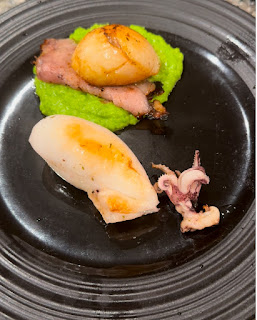
Second Course: Warm Appetisers. I put two on a plate. A griddled stuffed squid was easy, coming already prepared from the deli at Italian Continental Stores. Left cold, this could have joined the amuse bouche. That sat next to a single scallop on pea puree and a bit of grilled ham. It’s normally done on black pudding but I’d already roasted a ham for other holiday meals and wanted to re-use ingredients.

Third Course: Pasta. I made three tactical errors with my Linguini Vongole, which I haven’t made in a very, very long time. First, lacking a linguini option on my pasta maker I opted for spaghetti rather than fettuccini. The thicker noodle would have worked better. Second, I dumped the liquid from the jar of clams when I should have used it to flavour the pasta. Third, I forgot how important really good olive oil is to this dish. Essentially, it’s really delicate and easy to create something extremely bland. I rescued it with a last-minute addition of the Sicilian olive oil our landlords from Ispica sent us home with earlier this year, but it could have been better out of the pan.

Fourth Course: From the Grill. Whole sea bass done “en papillote” with fennel, lemon and dill. Another tactical error … I didn’t open the packet from the fishmonger to see that my husband had bought a whole bass instead of fillets until an hour before serving. The papillote was a last-minute rescue because I didn’t have the time or confidence to fillet the fish myself. Had I realised I had a whole fish to work with I would have gotten supplies in to bake it in sea salt, but the only sea salt in the house was fancy stuff I’d purchased in Sicily and i wasn’t going to use that as a cooking medium.
Dessert: I made a simple lime posset, which is the kind of light, citric option perfect for ending this menu. We were so stuffed that we split one and only managed half of it, but it did wrap things up nicely.

And thus ended my culinary efforts on Christmas Eve. My lovely husband took over the kitchen the next day and switched the influences from Italian to Danish. (Crab salad, roast duck with red cabbage, Christmas pudding). Followed by the traditional Danish lunch of open-faced sandwiches, beer and snaps with friends on the 27th. Those feasts gave us enough leftovers to weather the rest of a quiet holiday season. Outside, it was grey, windy and wet. Indoors, we snuggled up with good books, good video, and good food. After a busy year, it was exactly the holiday season we needed.

Tuesday, 5 July 2016

Seven top spots for exploring the Bay Area's food obsession

I have visited regions where the food is as good. There are many places where the cuisine is better value for money. (Unexpectedly high prices will be a feature of many articles from this holiday.) But I've never been anywhere with as rabidly enthusiastic a food culture as the Bay Area and its neighbouring wine region.

Farmers markets have produce of astonishing quality, displayed with the care given to precious gems.  Menus at even basic restaurants go into specifics about ingredients and where they come from; local and organic are common standards. Waiters and waitresses can dive to copious detail about their food and talk intelligently about wine and beer pairing. Groceries and small shops stock gourmet ingredients; the fresh morels and other exotic mushrooms I saw stacked in a shop in the Ferry Building were only equalled in my experience by high-end food markets in Barcelona and Paris. Food trucks and corner delis can be as fancy as high-end restaurants, and often have people queuing around the block. They take allergies seriously here; it's never been so easy to get around my husband's tomato allergy, despite the frequency of that ingredient on menus. (And of servers having difficulty catching his English pronunciation the first time around.) Yelp and OpenTable show that consumers are as passionate as providers; reviews are copious, frequent and serious.

In short, as long as you budget for it, this is an amazing place for a culinary holiday.

Is there a San Francisco cuisine? A handful of things stand out. Unsurprisingly for its bayside location, top-quality seafood turns up everywhere. The sourdough lives up to its reputation; its tangy zing incorporated into almost all baked goods. And they're obsessed with tri tip, a cut of beef I'd never heard of until this trip. (It's the triangular end of the sirloin, usually cut into steaks or ground for mince but here, elevated to a bbq art form.) Sadly for any American who grew up in the '70s, there was no sign of Rice-a-Roni, "the San Francisco treat". Whatever they're serving, everyone is obsessed by quality and trying to be out at the front of the next trend. I saw a bewildering number of unique cocktails.

After that, there's little commonality. San Francisco is an immigrant city, thus a place of ethnic cuisines and fusions. (A Scandi-French place was probably our best meal there.) Up in the wine country, it was all about the quality of ingredients and earning the adjective "gourmet", whether you're cooking for a Michelin star or assembling two-inch-high sandwiches with catchy names, served on luxury breads holding artistic combinations of meats and vegetables melded with complex home-made condiments.

From simple lunches to the most sophisticated dinners, the prices were as gourmet as the food. A sandwich and a drink could be as much as $25, a nicer lunch more than $50 per person, and dinners (with alcohol, of course) regularly approached $100 each. And that's before the tip, which Americans now recommend at between 18% and 20%. It takes a lot to give a Londoner sticker shock, but the facts spoke for themselves: we could eat and drink cheaper almost anywhere in Europe. (And that's before our currency tumbled by 30%. But we won't talk politics here...)

With the exception of our monumental blow-out at The French Laundry, which will get its own entry, here are the places I'd tip for a visit.

IN SAN FRANCISCO
Volta - Start with an experienced management team, infuse a French brasserie with Scandinavian influences, design a bright, modern space, then staff it all with friendly servers who can offer top wine picks, and you get the best meal we had in San Francisco. The dishes were all fresh interpretations of familiar classics, presented beautifully. I started with the skagen, a delicious Scandinavian take on prawn salad, spiked with tangy dill and horseradish sauce, given added depth with white fish roe and crunch with white radish. On to Swedish meatballs, given an elegant presentation and gourmet sides. I was excited to see princess cake on the dessert menu (pictured above), something I've made from recipe but never had from a professional kitchen. This was a deconstructed version, giving a radically modern appearance to the old-world combo of vanilla cake, marzipan and raspberry.

One Market - An upscale grill featuring top quality fish, meat and fresh produce in an early 20th century office building at the start of Market Street facing the Ferry Building. I'd guess the high ceilings and broad, arched windows once belonged to a bank. Now it's an elegantly-designed space where diners get plenty of room at big tables with comfortable leather chairs, and lots of stimulation from the piano player and the flames of the charcoal grill visible in the open kitchen. My husband clearly won the starter round with a lightly-smoked trout on a fluffy potato rosti, topped with a gently poached egg. But both of our fish dishes (scallops, sea bream) paled in comparison to our friend's pork tenderloin across the table. I should have paid more attention to their web site. When a restaurant leads with the image of one dish, it's a good hint to order it.

Tartine Bakery - Given its lofty reputation (Tartine is often credited with sparking the current craze for home-made sourdough) and the number of people who told me I must eat here, I was shocked at
how tiny this place is. It's a simple corner bakery in the Mission District, with about eight tables inside and a handful more on the pavement outside. No alcohol is allowed on the street, however, so if you want beer with your lunch you'll have to be patient. Given that you've probably already stood in a 30- to 40-person queue just to order something, you've proven that trait before you order.  Things move fast, and at least half the customers are clearly locals coming in for bread, cakes and breakfast pastries to take away. This is the place that introduced us to the Bay Area's fascination with the gourmet sandwich. The $14 average price seems steep, but they're enormous and could easily be shared by two. My pastrami, piled thick on buttery grilled sourdough with spicy mustard and horseradish, oozing with grilled gruyere, was exquisite. And the other half made a fine breakfast the next morning. We split a lemon meringue tart with delicate, crisp pastry, explosively flavourful filling and a showy top. It's obvious why the locals queue up.

Sears Fine Foods - Evidently, this place is a San Francisco institution that's been famous since the 1930s. We had no idea ... everyone was jet lagged and it appeared the most practical choice with available tables near our hotel. The cavernous interior does indeed have an old world family restaurant feel, and the menu is one of those broad, bit-of-everything crowd pleasers. I'd classify it as "generic American favourites," but they had a few San Francisco specialties. Most notably Cioppino, the Italian "classic" mix of fish in a spicy tomato stew. Turns out it's not Italian at all, but invented by San Francisco fishermen who would whip up a communal feast from their scraps, inviting everyone to "chip in". Sung out, in their heavy Italian accents, that became "Chee-oh-peen-oh".

IN THE WINE COUNTRY
Sunflower Caffe - One of the many gastronomic options along the large square known as Sonoma
Plaza, order at the counter from chalked up menu and head for the shady courtyard with the splashing fountain to await your food. The menu is a gourmet take on salads and sandwiches, changing regularly to take advantage of local produce. My perfectly-seared Ahi tuna was a Californian version of a salad Nicoise; a friend had an imaginative take on hot dogs served with home-made kimchee. Nice house wines, of course.

Zazu Kitchen - We had a lot of fine meals on this trip, but if there's ONE restaurant I wish we had back home, it's this one. We'd be regulars. Zazu is a temple to pork. From sides of bacon on view in a glass cabinet to succulent burgers cut with ground pork to a wickedly satisfying bacon Bloody Mary, this place is a pig-lover's fantasy. Everything was lip-smackingly good. The waitress was deeply knowledgeable about their farm-to-table policies and clever with matching food to very local wines and artisan beers. The space is modern and functional, crafted from an old warehouse building and flooded with light. Zazu is located in a district of Sebastopol, California called The Barlow. Once a cluster of industrial buildings given over to fruit packing and shipping, it's been re-developed as an upscale dining and shopping district. If I were back in this area I'd make a beeline here; everything looked worthy of further exploration. (Head across the street to Woodfour for a fantastic variety of artisan beers. You can sample a five-beer flight for $10, one of the few deals of our trip.)

Friday, 26 June 2015

Newbury's Vineyard is a food and wine revelation

Given the passion I share with my husband and friends for combining fine food with just the right wine, it's amazing that it's taken me this long to discover The Vineyard. This is, no doubt, because it's on the outskirts of Newbury, well out of any of our regular routes and a town not really known as either a cultural or dining destination.

"Discover" isn't quite the right word.  I encountered The Vineyard by association five years ago when I was treated to dinner at Coworth Park created by chef John Campbell, who'd just been lured from The Vineyard ... where he'd gained two Michelin stars ... to run the kitchens at the new Dorchester property (story here).  The Vineyard's loss of its two stars after he left was big news on the foodie scene. And current head chef Daniel Galmiche turns up occasionally on Saturday Kitchen.  So I knew about it, but had never made the effort to get there.

It's a worthy destination.  The food is classic, elegant Continental cuisine.  Exquisite tastes, delicate portions, artful presentation. This is, admittedly, like many fine dining establishments.  The differentiator is the wine ... and the puzzle that they haven't re-gained at least one Michelin star.

Proprietors the Michael family also own the Peter Michael Winery in Sonoma, and there's no doubt they're serious about their craft.  The 30,000 bottles in their cellar here are used as a design element, with long walls of wine tempting you to exploration.  Their award-winning wine list looks more like a soft-bound version of Larousse's wine encyclopaedia, with comprehensive global coverage and choices from classic to quirky. They offer an unparalleled (in my experience) 100 wines by the glass.  A large mural of The Judgement of Paris ... that famous blind tasting that saw California beat France and inspired the film Bottle Shock ... is the first thing your eye sees when you enter the lobby.  The interiors have a Californian vineyard feel about them, all stone-washed elegance, big windows, tasteful modern art and exquisite wrought iron grape vines providing balustrades, balconies and handrails.

As this was a serious business lunch, we had a glass of wine each, with pre-printed discs placed beneath each glass to tell us what we were drinking.  I immediately wanted to collect a set.  The menu was full of enticing wine flights and special offers for tastings and classes.

The classic chablis chosen by our host was a multi-functional crowd pleaser well suited to stretching across the variety of two courses.  But the menu's tempting variety offered a range to spur the imagination.  How would they pair with the ever-tricky artichoke?  How to counter the bitterness of that endive?  Would you honestly put that upstate New York wine with anything?

Having just had a rotten weigh-in at Weight Watchers, I attempted to go light on my choices.  I avoided the bread-crumbed ball of foie gras on pickled red onions in a pond of creamy sweet onion volute, though the look of satisfaction on my colleagues faces told me I would have loved it.  My more virtuous pressed rabbit terrine with confit and pickled heritage carrots was delicious, though I could have used a bit more savoury balance to the very sweet veg.  The presentation, however, was perfect.  Thanks to our ridiculously cold spring, I could still indulge in seasonal asparagus for the main; thin, grilled shoots served here with some light-as-air parmesan gnocchi and morels.  My only complaint? More morels, please.  But who wouldn't say that?  Virtue, however, collapsed in the face of dark chocolate and salted caramel.  This combo has been overdone of late and can easily fail if you don't get the ingredients in balance.  Here, the dark chocolate was both bitter and sweet, the caramel layered more sweetness with just a hint of salt, biscuit bits gave texture.  A masterful marriage, and a small enough portion that I like to think I didn't do too much damage.

The dining experience closest to The Vineyard?  Le Manoir au Quat'Saisons.  (My review here.) The same elegance, the same quality of food.  Similarly assured staff, assuming that you share their passion for food and wine and guiding you through the experience with insight.  Both attached to luxurious Relais & Chateaux hotels (though The Vineyard has a far more modern vibe and a big spa).  Both surrounded by lovely gardens allowing for pre- and post-prandial al-fresco drinking (though the Manoir's gardens are far more extensive).  The Vineyard has earned plenty of accolades, but at this point it has still failed to re-gain any Michelin stars.  Which, especially given the similarity to the Manoir, I find deeply puzzling.

The advantage to that lack, however, may be price.  The luncheon menu is £29 for three dishes, £39 for four. Dinner is £65 for four, £75 for five, and the pull-out-all-the-stops eight-course tasting menu is £99.  All significantly less than the Oxfordshire venue. Gardens aside, I confess I'm far more intrigued by the possibility of a return to The Vineyard.  With wine flight, of course.