
As a case in point I give you my home state’s administrative HQ: Jefferson City, Missouri. Its population is 42,772. That’s roughly the same size as Harlow, Essex (England) or Chalon-sur-Saône in Burgundy (France). The people who live there … including my father … are almost all here because of state government, whether that’s to do it, or to serve the people who do. Not much besides government goes on here. The state’s biggest university is an hour north. Missouri’s two biggest cities are two hours in either direction. But, critically, Jefferson City is almost exactly in the middle of the state. It sits beside the massive Missouri River, which formed a navigable east/west highway long before paved roads were possible. Like so many American state capitals, it was purpose built for legislative convenience. Cosmopolitan culture and business evolved elsewhere.
That doesn’t mean there’s no reason to visit. Even though you’d be hard pressed to find a European who’s set a tourist foot here in decades. (One notable exception is former British politician and train spotter Michael Portillo, who came through while filming his Great American Railway Journeys.) In fact, it’s quite a charming little town with some interesting architecture, fascinating history, good and affordable restaurants (see my last article), and gorgeous countryside spreading along the river valley. It also has quite a remarkable capitol building, punching far above its weight compared to the significance of the state in just about any league table. I’ve been inside palaces of government across much of Europe and I can honestly say that Missouri’s magnificent capitol building can hold its own against any of them.
Just like the nation’s capitol, Missouri’s is dominated by an enormous dome springing from a rectangular block channelling Ancient Rome with its columns, porches and decorative detail. It is bigger and brighter than anything else in town, entirely gleaming white Missouri marble except for a few delicate pink lozenges set into the dome. The pleasant park around it is studded with memorials, most notably to the Lewis and Clark expedition that came through here while exploring routes west in Thomas Jefferson’s recently acquired Louisiana Purchase.
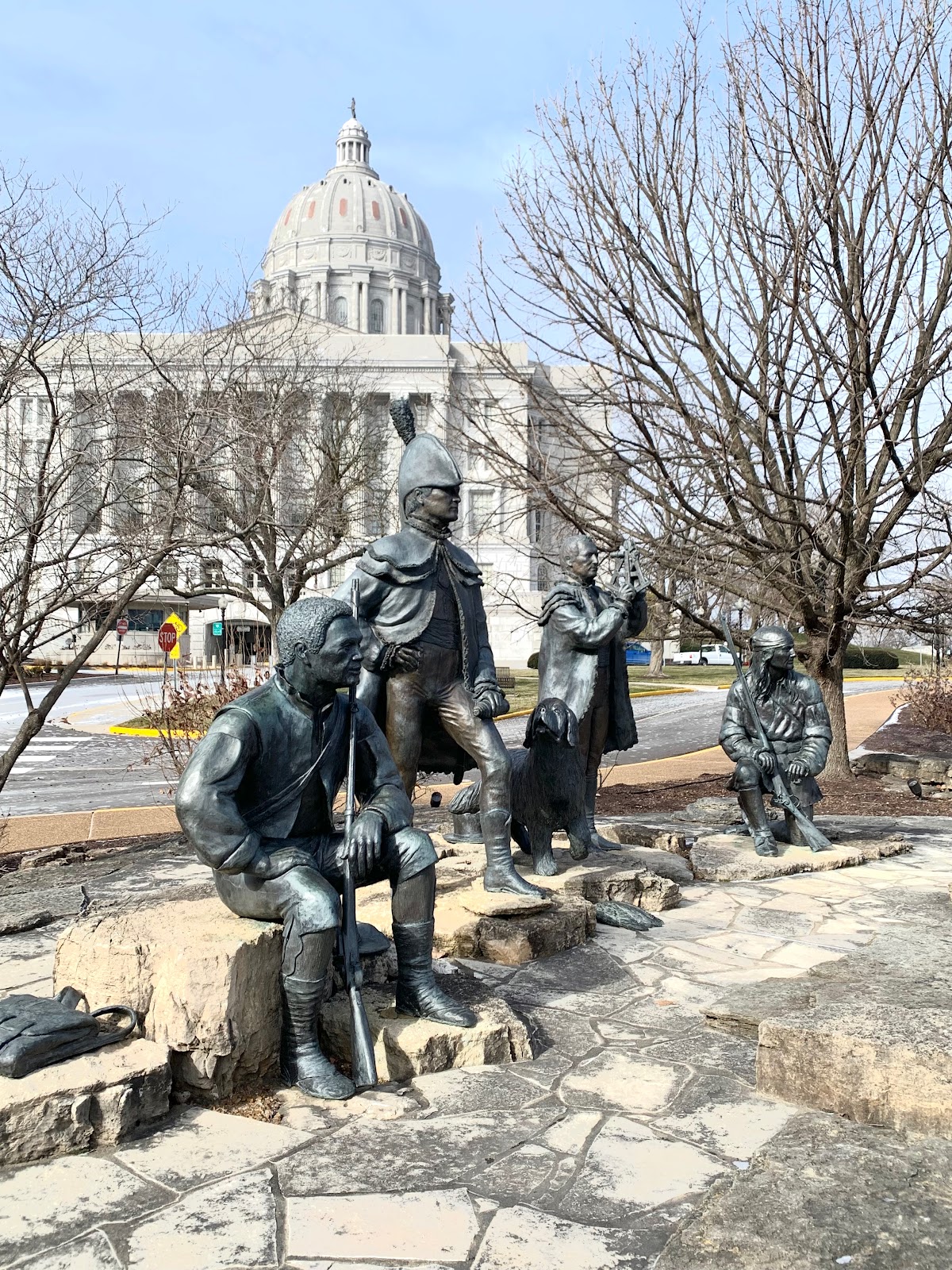
Posing amongst the explorers is probably the best photo opp in town. Sadly there are no women to share the fame as Sacagawea didn’t join the expedition until further up river. Locals tell me that Seaman the Newfoundland, the only animal to complete the 3-year journey, is the favourite to get your photo snapped with. Get close enough and you’ll spot the sculptor Sabra Tull Meyer’s brilliant touch of a dead mallard the dog has just laid at Merriweather Lewis’ feet.
The other “must shoot” external photo is the enormous statue of Thomas Jefferson, looking sagely to the west below a pediment emblazoned (in Latin) with Cicero’s noble principle: Let the welfare of the people be the supreme law. It’s the dream of American democracy realised in bronze and stone. The third president’s reputation might have taken a knock in the musical Hamilton, but his popularity remains high here in a state that his policy literally created, and one that comes down hard on his side of the states rights v. Federalism debate. (And if you think that got resolved by the Founding Fathers, you have a lot to learn about America.)
Inside, the resemblance to the national capitol goes on with an impressively decorated rotunda beneath that dome. British visitors … were there any besides me and Portillo … might think the murals look a bit familiar, and they’d be right. Though he’s faded from general awareness, Welshman Sir Frank Brangwyn was an apprentice of William Morris. He became one of the most famous muralists of the early 20th century and sent canvases around the world to decorate grand buildings like this one.
Posing amongst the explorers is probably the best photo opp in town. Sadly there are no women to share the fame as Sacagawea didn’t join the expedition until further up river. Locals tell me that Seaman the Newfoundland, the only animal to complete the 3-year journey, is the favourite to get your photo snapped with. Get close enough and you’ll spot the sculptor Sabra Tull Meyer’s brilliant touch of a dead mallard the dog has just laid at Merriweather Lewis’ feet.
The other “must shoot” external photo is the enormous statue of Thomas Jefferson, looking sagely to the

Inside, the resemblance to the national capitol goes on with an impressively decorated rotunda beneath that dome. British visitors … were there any besides me and Portillo … might think the murals look a bit familiar, and they’d be right. Though he’s faded from general awareness, Welshman Sir Frank Brangwyn was an apprentice of William Morris. He became one of the most famous muralists of the early 20th century and sent canvases around the world to decorate grand buildings like this one.
Missouri’s Capitol would have shared an artistic link with the British House of Lords had the peers … a third of the way through their commission … not decided to fire Brangwyn because his work was “too colourful and lively for the location”. Swansea Council bought and installed the panels. Learning this finally gives me a reason to stop rather than driving past on the way to Britain’s best beaches.

A House and Senate chamber take up the bulk of the building on each side. Some sort of tiff between the tour guides and the senators has taken the Senate Chamber off the tour. A shame, since the gorgeous room is probably the closest you’ll get to a grand Roman bath complex in the Midwest. A glass dome, enormous Diocletian windows and column-bedecked loggias look down on 34 senator’s desks, rather than on the jolly tepidarium the architecture was originally designed for. You could have a robust debate on whether the desks or the pool would facilitate getting more work done. With a membership almost four times the size of the house, it’s unsurprising that the House Chamber is an even grander room of epic proportions. There’s lots more neoclassical architecture here, mixed up with some lovely Arts and Crafts windows and a vast mural of Missouri regiments in WWI that’s an unusual nod to American participation in that conflict. (Given that this capitol was built in the 1920s, the scene would have been depicting almost-current events.)

If you really want to dive into Missouri lore, however, you’ll need to devote at least an hour to the grand hallways that run off each side of the rotunda and beneath the debating chambers. These now hold a museum of Missouri state history.

The governor has the best real estate in the building. Right in the centre, behind the rotunda, his office gives him beautiful views out over the Missouri, the sprawling farmlands of its flood plain and the distant limestone cliffs that mark the other side of the river valley. It’s not open to the public; I know the room because last time I was here my dad was still in state government and he got us into the boss’ office. I even got a photo sitting behind his desk. Sadly, because this was the world before digital photography, that’s lost to history.
The most culturally significant thing in the building, and indeed in Mid Missouri, is Thomas Hart Benton’s Social History of Missouri mural covering the walls of the House Lounge with exuberant colour and movement. It’s an adventure story, from the early explorers to brave farmers and striving industrialists. But urban life in St. Louis and Kansas City takes a back seat here to Huck Finn and Jim, hound dogs and hogs, family farms and towering stalks of corn. Painted in the 1930s, Hart Benton gives a wonderfully louche Jazz Age feel to these Missourians, yet the faces and the topics are timeless. While you can wander around the building on your own, you can only get into the House Lounge with a tour guide, so signing up for the tour is a must.

As magnificent as that room is, my favourite part of the capitol is the Hall of Famous Missourians. In the centre of the building, a round balcony looks down on the rotunda, and stands in the centre of a cathedral-like space beneath the dome. All along its walls are plinths topped with busts of the state’s great and good. With a population of about 6 million (similar to Denmark) there are only a few degrees of separation between most of those commemorated here and the population wandering amongst them. I contemplated those who’d had a major impact on my life. Rose Philippine Duchesne, the sainted nun whose legacy gave birth to my high school. Stan Musial, one of the greatest baseball players of all time and one of the dads at school. Walter Cronkite, inspirer of early career ambitions and someone I was lucky enough to share a dining table with in journalism school. It was like meeting God. Walt Disney, author of so much childhood joy. I doubt I’ll ever have a bust here. If T.S. Elliott, another St. Louisan who moved to England and took British citizenship, isn't here, I'm doomed. But I love how wandering amongst these familiar faces reminds me how profound my Missouri roots are.

BEYOND THE CAPITOL BUILDING
While it’s the obvious blockbuster, the capitol building isn’t the only thing to give Jefferson City street cred on the sightseeing front. Here are some other things that could make a day or two in town worth while.
Immediately to the southeast of the capitol building you’ll find Jefferson Landing and the governor’s

There are a couple of blocks along High Street that make you wonder why local government isn’t pitching the town as a perfect location to film anything set in pre-1920s America. There are a handful of local restaurants and a few properly local shops. OK, you’d be hard pressed to while away more than a couple of hours here without eating or sitting down with a sketchbook, but it’s a charming bit of Americana that deserves to be enjoyed.
Locals tell me that the Old State Penitentiary is now the most popular attraction in town. Forget government, go for crime! I suppose I can see the appeal of this crumbling Victorian-era ruin. It certainly looks like the ghosts of gangsters and train robbers would be stalking its halls. But it’s not really my cup of tea. If you’re more interested in culture than criminals, skip the jail and head to Prison Brews for lunch instead.
Lincoln University is one of a handful of academically prestigious, historically-black colleges in the United States. (Howard in Washington DC is the one people are likely to have heard of.) The hilltop campus is pretty, if not spectacular, but it’s worth driving through to see the beautiful Civil War memorial on its central quadrangle. The 62nd and 65th Coloured Infantry Regiments were comprised heavily of Missourians and when they stood down after the war the soldiers raised money to start the school. The monument features life-size soldiers walking across the square towards a plinth on which the leaders of the regiments stand. Behind them, one soldier is helping another clamber up onto his higher ground, a beautiful metaphor for education. It is beautiful and moving in equal measures.

While English tourists aren’t thick on the ground these days, the most famous Englishman of the 20th century swung through in the 1940s and if you take a short trip to Fulton, you’ll find a shrine to him and his visit. Built beneath a re-constructed Christopher Wren church moved here stone by stone from London, the Churchill museum might be a bit underwhelming if you’ve been to Churchill’s house at Chartwell or to the excellent museum in the Imperial War Rooms. But this is a remarkable collection, thoughtfully presented, to exist outside of the UK. It’s here to mark the spot where Churchill gave his “iron curtain” speech while visiting his fellow wartime leader, Missourian Harry Truman. The addition of St. Mary Aldermanbury will feel like some strange alternative universe to anyone who knows London churches. Assembled here from ruins left by the Luftwaffe in London, the church is now in far better shape than any of its fellows in The City, is sparklingly clean, has sunshine rather than the shadows of office towers flowing through its windows, and completely devoid of homeless people sleeping in its porch. Londoners won’t know what to make of it.


