Showing posts with label Missouri. Show all posts

Tuesday, 23 January 2024

Missouri's state capitol punches above its weight, and is just one of a list of reasons to see Jeff City

Europeans are regularly baffled by the seeming insignificance of American state capitals. They come from a world where capital cities have evolved naturally with history, almost inevitably becoming the biggest, most exciting place in their country, full of palaces and museums, corporate headquarters and sky-high housing prices. That American state capitals are often so little-known they become the stuff of pub quizes is perplexing.

As a case in point I give you my home state’s administrative HQ: Jefferson City, Missouri. Its population is 42,772. That’s roughly the same size as Harlow, Essex (England) or Chalon-sur-Saône in Burgundy (France). The people who live there … including my father … are almost all here because of state government, whether that’s to do it, or to serve the people who do. Not much besides government goes on here. The state’s biggest university is an hour north. Missouri’s two biggest cities are two hours in either direction. But, critically, Jefferson City is almost exactly in the middle of the state. It sits beside the massive Missouri River, which formed a navigable east/west highway long before paved roads were possible. Like so many American state capitals, it was purpose built for legislative convenience. Cosmopolitan culture and business evolved elsewhere.

That doesn’t mean there’s no reason to visit. Even though you’d be hard pressed to find a European who’s set a tourist foot here in decades. (One notable exception is former British politician and train spotter Michael Portillo, who came through while filming his Great American Railway Journeys.) In fact, it’s quite a charming little town with some interesting architecture, fascinating history, good and affordable restaurants (see my last article), and gorgeous countryside spreading along the river valley. It also has quite a remarkable capitol building, punching far above its weight compared to the significance of the state in just about any league table. I’ve been inside palaces of government across much of Europe and I can honestly say that Missouri’s magnificent capitol building can hold its own against any of them.  
 In the unlikely event you’re a foreign tourist in Mid-Missouri, start here. (And if you’re a Missourian who hasn’t toured this masterpiece, shame on you! Book your visit immediately.) Tours are free but must be pre-booked at least 24 hours in advance. 

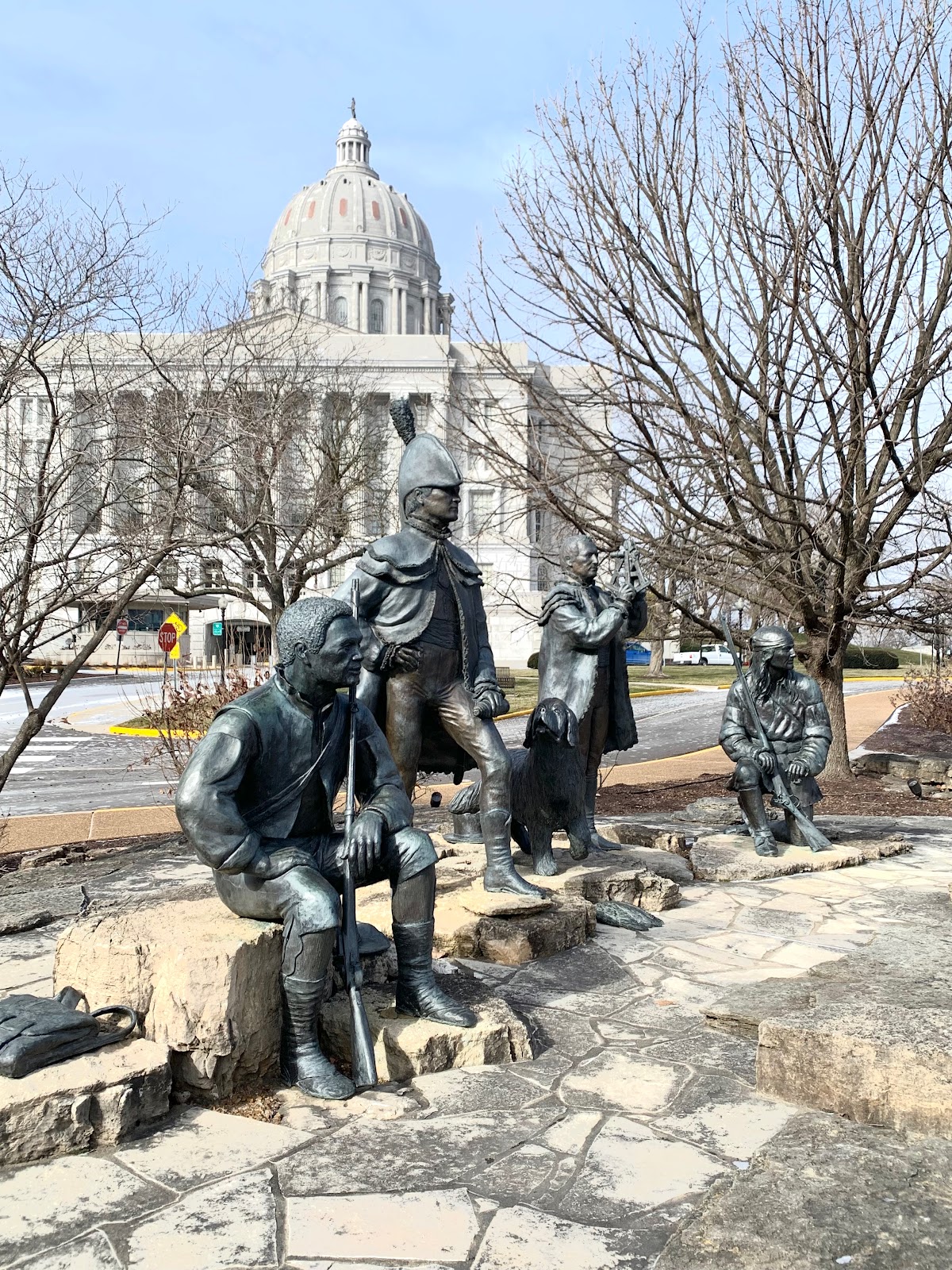
Just like the nation’s capitol, Missouri’s is dominated by an enormous dome springing from a rectangular block channelling Ancient Rome with its columns, porches and decorative detail. It is bigger and brighter than anything else in town, entirely gleaming white Missouri marble except for a few delicate pink lozenges set into the dome. The pleasant park around it is studded with memorials, most notably to the Lewis and Clark expedition that came through here while exploring routes west in Thomas Jefferson’s recently acquired Louisiana Purchase.

Posing amongst the explorers is probably the best photo opp in town. Sadly there are no women to share the fame as Sacagawea didn’t join the expedition until further up river. Locals tell me that Seaman the Newfoundland, the only animal to complete the 3-year journey, is the favourite to get your photo snapped with. Get close enough and you’ll spot the sculptor Sabra Tull Meyer’s brilliant touch of a dead mallard the dog has just laid at Merriweather Lewis’ feet.

The other “must shoot” external photo is the enormous statue of Thomas Jefferson, looking sagely to the
west below a pediment emblazoned (in Latin) with Cicero’s noble principle: Let the welfare of the people be the supreme law. It’s the dream of American democracy realised in bronze and stone. The third president’s reputation might have taken a knock in the musical Hamilton, but his popularity remains high here in a state that his policy literally created, and one that comes down hard on his side of the states rights v. Federalism debate. (And if you think that got resolved by the Founding Fathers, you have a lot to learn about America.)

Inside, the resemblance to the national capitol goes on with an impressively decorated rotunda beneath that dome. British visitors … were there any besides me and Portillo … might think the murals look a bit familiar, and they’d be right. Though he’s faded from general awareness, Welshman Sir Frank Brangwyn was an apprentice of William Morris. He became one of the most famous muralists of the early 20th century and sent canvases around the world to decorate grand buildings like this one. 

Missouri’s Capitol would have shared an artistic link with the British House of Lords had the peers … a third of the way through their commission … not decided to fire Brangwyn because his work was “too colourful and lively for the location”. Swansea Council bought and installed the panels. Learning this finally gives me a reason to stop rather than driving past on the way to Britain’s best beaches. 


A House and Senate chamber take up the bulk of the building on each side. Some sort of tiff between the tour guides and the senators has taken the Senate Chamber off the tour. A shame, since the gorgeous room is probably the closest you’ll get to a grand Roman bath complex in the Midwest. A glass dome, enormous Diocletian windows and column-bedecked loggias look down on 34 senator’s desks, rather than on the jolly tepidarium the architecture was originally designed for. You could have a robust debate on whether the desks or the pool would facilitate getting more work done. With a membership almost four times the size of the house, it’s unsurprising that the House Chamber is an even grander room of epic proportions. There’s lots more neoclassical architecture here, mixed up with some lovely Arts and Crafts windows and a vast mural of Missouri regiments in WWI that’s an unusual nod to American participation in that conflict. (Given that this capitol was built in the 1920s, the scene would have been depicting almost-current events.) 
Long hallways running around the debating chambers hold legislators’ offices, and I remember from my school days that it’s as easy to get an appointment here as with your local MP in England. This is the friendly, accessible face of government. Paintings along the hallways aren’t as luscious as Brangwyn’s work, but will hold more interest to locals in their depiction of the history of the state.

If you really want to dive into Missouri lore, however, you’ll need to devote at least an hour to the grand hallways that run off each side of the rotunda and beneath the debating chambers. These now hold a museum of Missouri state history.

There’s a little bit of everything here, from geology to displays on Missouri’s key industries to a diorama of the river with detailed models of all the craft that would have used it in the 19th century. Fans of innovative engineering will be fascinated by the snag boat purpose-built to pull treacherous branches out of the water. The labels next to the Civil War era portraits of governors tell a story like Game of Thrones … Coups! Duelling claimants! Scandal! … but they all look like Victorian church fathers. Which just proves you can’t judge a book by its cover. I particularly enjoyed the section on German immigration, and that community’s role in the Civil War, something that reflects my own family history. There’s an excellent timeline of the history of the whole state from dinosaurs to today, perfect except for its decision to highlight The Civil Rights Act for 1964 rather than my birth. Let’s get priorities straight, people! (Just kidding, obviously.)

The governor has the best real estate in the building. Right in the centre, behind the rotunda, his office gives him beautiful views out over the Missouri, the sprawling farmlands of its flood plain and the distant limestone cliffs that mark the other side of the river valley. It’s not open to the public; I know the room because last time I was here my dad was still in state government and he got us into the boss’ office. I even got a photo sitting behind his desk. Sadly, because this was the world before digital photography, that’s lost to history.

The most culturally significant thing in the building, and indeed in Mid Missouri, is Thomas Hart Benton’s Social History of Missouri mural covering the walls of the House Lounge with exuberant colour and movement. It’s an adventure story, from the early explorers to brave farmers and striving industrialists. But urban life in St. Louis and Kansas City takes a back seat here to Huck Finn and Jim, hound dogs and hogs, family farms and towering stalks of corn. Painted in the 1930s, Hart Benton gives a wonderfully louche Jazz Age feel to these Missourians, yet the faces and the topics are timeless. While you can wander around the building on your own, you can only get into the House Lounge with a tour guide, so signing up for the tour is a must. 

  As magnificent as that room is, my favourite part of the capitol is the Hall of Famous Missourians. In the centre of the building, a round balcony looks down on the rotunda, and stands in the centre of a cathedral-like space beneath the dome. All along its walls are plinths topped with busts of the state’s great and good. With a population of about 6 million (similar to Denmark) there are only a few degrees of separation between most of those commemorated here and the population wandering amongst them. I contemplated those who’d had a major impact on my life. Rose Philippine Duchesne, the sainted nun whose legacy gave birth to my high school. Stan Musial, one of the greatest baseball players of all time and one of the dads at school. Walter Cronkite, inspirer of early career ambitions and someone I was lucky enough to share a dining table with in journalism school. It was like meeting God. Walt Disney, author of so much childhood joy. I doubt I’ll ever have a bust here. If T.S. Elliott, another St. Louisan who moved to England and took British citizenship, isn't here, I'm doomed. But I love how wandering amongst these familiar faces reminds me how profound my Missouri roots are. 

BEYOND THE CAPITOL BUILDING 
While it’s the obvious blockbuster, the capitol building isn’t the only thing to give Jefferson City street cred on the sightseeing front. Here are some other things that could make a day or two in town worth while.

Immediately to the southeast of the capitol building you’ll find Jefferson Landing and the governor’s
mansion. There’s not a great deal of 19th century Jefferson City left, but here you get four excellent buildings (one currently closed for renovation). This is also where you get off and on the train to town, though the mobile-home-turned-waiting-room rather lets its neighbouring architecture down. There’s a museum inside the biggest of the riverside buildings but it wasn’t open when I visited. The governor’s mansion is, according to the web site, one of the few in the U.S. regularly open to the public and you can book free tours here. I didn’t get inside this time but a previous visit allows me to say that it’s a triumph of tasteful Second Empire style with a memorable flying staircase. The Christmas decorations are a real treat if you can get here in December.

There are a couple of blocks along High Street that make you wonder why local government isn’t pitching the town as a perfect location to film anything set in pre-1920s America. There are a handful of local restaurants and a few properly local shops. OK, you’d be hard pressed to while away more than a couple of hours here without eating or sitting down with a sketchbook, but it’s a charming bit of Americana that deserves to be enjoyed.

Locals tell me that the Old State Penitentiary is now the most popular attraction in town. Forget government, go for crime! I suppose I can see the appeal of this crumbling Victorian-era ruin. It certainly looks like the ghosts of gangsters and train robbers would be stalking its halls. But it’s not really my cup of tea. If you’re more interested in culture than criminals, skip the jail and head to Prison Brews for lunch instead.

Lincoln University is one of a handful of academically prestigious, historically-black colleges in the United States. (Howard in Washington DC is the one people are likely to have heard of.) The hilltop campus is pretty, if not spectacular, but it’s worth driving through to see the beautiful Civil War memorial on its central quadrangle. The 62nd and 65th Coloured Infantry Regiments were comprised heavily of Missourians and when they stood down after the war the soldiers raised money to start the school. The monument features life-size soldiers walking across the square towards a plinth on which the leaders of the regiments stand. Behind them, one soldier is helping another clamber up onto his higher ground, a beautiful metaphor for education. It is beautiful and moving in equal measures. 
In better weather, there are several lovely state parks with excellent hiking trails in easy striking distance. And the German immigrant tradition of wineries flourishes here. Neither are really appropriate for a January visit when the nation is having a record cold snap.

While English tourists aren’t thick on the ground these days, the most famous Englishman of the 20th century swung through in the 1940s and if you take a short trip to Fulton, you’ll find a shrine to him and his visit. Built beneath a re-constructed Christopher Wren church moved here stone by stone from London, the Churchill museum might be a bit underwhelming if you’ve been to Churchill’s house at Chartwell or to the excellent museum in the Imperial War Rooms. But this is a remarkable collection, thoughtfully presented, to exist outside of the UK. It’s here to mark the spot where Churchill gave his “iron curtain” speech while visiting his fellow wartime leader, Missourian Harry Truman. The addition of St. Mary Aldermanbury will feel like some strange alternative universe to anyone who knows London churches. Assembled here from ruins left by the Luftwaffe in London, the church is now in far better shape than any of its fellows in The City, is sparklingly clean, has sunshine rather than the shadows of office towers flowing through its windows, and completely devoid of homeless people sleeping in its porch. Londoners won’t know what to make of it.


Friday, 19 January 2024

Barbecue is the taste, and the culinary star, of my Midwestern roots

The restaurant scene in and around Jefferson City, Missouri

Brits often ask me if I miss anything about the States. My usual answer is “a can-do attitude, decent service in shops, tumble dryers and cheap petrol.” But here on the ground in mid-Missouri, a more basic, visceral answer rises to the top of the list. Great barbecue.

To be fair, Brits have come a long way on the BBQ front since I moved to a country that only fired up the grill for a few summer parties and proceeded to incinerate sausages. There are now top chefs who take outdoor grilling seriously. Trendy food trucks. BBQ classes at cooking schools. You can buy Webers and Green Eggs and their full range of accessories, including several varieties of wood chips for smoking. But for some reason I still can’t explain, no British attempt I’ve ever tasted can compare to the succulent perfection of your average BBQ joint in my home state. And certainly not to the price.

As a proof point I give you Sweet Smoke BBQ in Jefferson City, Missouri. Succulent rib meat collapsing off the bone; you wouldn’t need teeth if it weren’t for the chewy, smoky bark. Exactly the right balance of spices to bring depth of flavour while still letting the pork shine through. Bottles of four kinds of sauces on the table to allow you to drench your meat with the additional flavours of your choice. Enough meat on each single rib to probably qualify as a full portion of meat in a Weight Watchers’ allocation. Bowls of pickles to help yourself to; balancing sweet and vinegar in a way that European varieties rarely do since they tip more to the latter. A beguiling number of sides ticking comfort food boxes, including jalapeno grits that walk a perfect line between spicy and soothing and beans that have baked for hours with a range of additional ingredients. (It’s hard to fully express my shock the first time I watched a Brit eat so called “baked beans” directly out of a tin. More than 30 years later, I still can’t accept this culinary sin.) And then, naturally, there’s the mac and cheese. if you’re looking for something green, go somewhere else.

I have had ribs that come close to this in the UK, but only at higher-end restaurants charging a fortune. We simply don’t have informal, reasonably priced places in the UK. Nor does any place in my experience have the range of options. Sweet Smoke offers pork (ribs and pulled), beef brisket and chicken. You can have the meats as they come off the grill, or you can indulge in one of a variety of sandwiches that pile them with additional elements for sloppy indulgence. Even though it appears to be a simple place with menus on chalk boards, there’s a full bar dishing up cocktails and an impressive range of beers.

Given the absence of this level of smoky perfection in my English life, I insisted on dining here twice during my Jefferson City visit, trying both outlets. The one closer to the capitol building is in a shop front in the charming, early-20th century town high street. It’s a bit more basic, with almost a warehouse feel, yet packed with suit-wearing legislators and lobbyists at lunch time. The branch in the western suburbs is a free standing restaurant bringing in more of a family crowd. Both made me very happy. 

Why is there still this difference in quality between the UK and the American Midwest? It’s certainly not the quality of the meat; our local Hampshire hogs are justifiably famous as some of the best pork available in Europe. I suspect a combination of tradition and cut. On the tradition front, while BBQ has been establishing itself as a serious culinary option for only a couple of decades in the UK, it’s been a part of American life for generations. My people take it as seriously as Brits do their curries, pies or fish and chips. There’s also an almost sacred social ritual that comes with its preparation that makes it something more than just food; it’s part of the regional identity. But I suspect, at least on the ribs front, it’s more about cut. Traditionally, British butchers have cut meat off one side of the bone for bacon and off the other for pork belly, leaving as little meat behind as possible and considering the rib cage waste. Though that’s changing, and I have a great local butcher who will cut meat to my request, the “St. Louis style” rib cut that produces the meat-heavy ribs of Midwestern BBQ is unknown in England, where options all seem slimmed down.

This English style of butchery also produces very different cuts of bacon from the American. What most people in my adopted homeland put on their breakfast plate is what Americans consider “Canadian bacon” but with even more meat; not just the medallion but additional streaks of pork and fat to one side. From the other side of the rib comes what Americans would consider their standard meat but what the Brits categorise as “streaky” and tend only to use for cooking. Brits, in general, don’t think Americans can produce decent bacon.

To win that argument for the USA I’d direct people to a restaurant called The Barred Owl in Columbia, Missouri, which dishes up the best bacon I’ve had in either country. In cut it’s classically American or “streaky”, but each slice is a quarter inch thick, shining with a maple cure that adds sweetness while enhancing the essential piggy-ness of the taste.

This was a side to my Sunday brunch dish of shrimp and grits, accompanied by a Bloody Mary made with Parmesan vodka. Yes, Parmesan. Made by infusing vodka over Parmesan rinds. I’d adds a distinctive and highly pleasing cheesiness to the classic cocktail recipe.

The Barred Owl offers a proof point that even flyover country can offer up serious foodie destinations if you know where to look. It’s an unabashedly upscale, trendy concept restaurant in this university town. The decor is industrial warehouse with modern art, a massive bar dominating one end of the room. The Owl’s differentiator, however, is that it shares its space and name with an artisan butcher. While still fairly common in the UK, old-fashioned butchers have almost disappeared in the U.S., where almost all meat is sold in shrink wrapped packages in massive grocery store chains. The Owl bucks that trend, and its sister restaurant celebrates the meat that comes from its butcher’s counter.

My companions were delighted with the butcher’s breakfast (adding home-made sausage to those slabs of bacon, accompanied by eggs and sourdough) and the home fry poutine (elevated with locally made cheese curds and wagyu beef bacon). The quality and innovation here will convince even the most resistant European that Americans can do more than quantity-over-quality fast food.

While Sweet Smoke was fantastic, you can find similar quality at BBQ places throughout the Midwest. The Barred Owl is a destination restaurant worth making a special trip to try.

Three other destinations in Jefferson City deserve a mention:

El Espolon: Cheerful Mexican place in an industrial park not far from the Missouri state capitol. The food is good (if not great). The star for me was the chile relleno, and the quantities are obscenely enormous. My “little bit of everything” combo plate, priced around $17, not only provided me dinner, but lunch for the next two days. Excellent value for money, even before you opt in to the 88 ounce (roughly 2.5 litres) on-table margarita dispenser. Someone needs to import this gizmo to the UK. 

Prison Brews: One of Jefferson City’s main tourist attractions is the now defunct Victorian era state penitentiary. While I skipped that highlight, I was delighted when my dad introduced me to this jail-themed pub a stone’s throw from the site. (Fittingly, it’s a hang out for lawyers and cops. I bet there are some disreputable beat reporters, too.) Fabulous burgers, a wood-fired pizza oven and a tempting variety of loaded sandwiches served in a building decorated with bars, prison stripes and photos of the old penitentiary at work. The booths are placed inside prison cells. Best of all, this is also a microbrewery with a range of excellent seasonal brews. I enjoyed a peach-flavoured lager with a delicate and sophisticated flavour profile, though I almost ordered the “Misdemeanor Mailbock” just to honour the marketing brilliance of its name. 

Das Stein Haus: An alpine chalet tucked incongruously behind the modern gas stations and suburban retail sprawl along the highway heading west from town, Helmut’s place aims to bring some old world charm while connecting the region to its German immigrant roots. The interior is dark and candlelit, with long communal tables in the centre and old-fashioned leather-covered booths to one side. The menu features “fancy restaurant” classics of my youth: steaks, lobster, oysters, chicken cordon bleu. There’s even bananas foster and cherries jubilee. It’s like time travel to my 10th birthday. Though the atmosphere is still more casual roadhouse than fine dining, the food is amongst the most upscale in this town. As you’d expect, there’s a core of German classics including schnitzel, pork roast and Bratwurst. (My jaeger schnitzel special, with red cabbage and fried potatoes, was indistinguishable from the classics hitting tables in front of me in Munich last month.) The German beer menu doesn’t feature any of the usuals we’d expect to see in Europe, but there are a range of lesser-known imports including the tough-to-find smoked beer of Bamberg. There’s no wine list but the waitress produces German-produced bottles from behind the bar. There’s live music and dancing on the weekends which probably deserves a return visit when next I go to my dad’s place. Sadly, no dirndls or lederhosen in sight. Maybe I should wear mine to shake up the place a bit.


Friday, 28 October 2022

Add these extras to make a Big Cedar holiday even more memorable

My fondest memories of Big Cedar Lodge will be of doing nothing. Sitting in amicable silence on the porch with the people I love, rocking gently in the chairs and drinking in the fall colours. Or nodding off in communal peace in front of the fire, the scent of woodsmoke perfuming our cabin. But if that’s all you’re doing at Big Cedar you’re probably not getting your full value for money.

Part of that premium room rate is the exceptional range of activities and restaurants you can enjoy across the resort. Kayaks, canoes paddle boats, pools, beaches, putt putt and the fitness centre are all included. And, frankly, the whole place is so beautifully decorated and landscaped that simply walking around, pausing in picturesque spots and drinking it all in is an activity in itself. Our favourite outings added to the holiday’s bottom line … but I’d recommend all of these. In for the penny, in for the proverbial pound.

Lost Canyon Golf Cart Trail

If you do only one paid activity at Big Cedar, make it this. If you are anywhere in the area, make a detour to come here. This is a spectacular nature experience on par with any of America’s National Parks. OK, perhaps not the Grand Canyon. Put it’s pretty damned impressive.

Southern Missouri is rich in trees, limestone caves and springs, and this trail shows them all off to a ludicrously photogenic extreme. An early highlight is driving through a cave with a gushing waterfall in the back and many illuminated rock features. Suitably for this novel mode of rural transportation, there’s a drive-through bar on entry … the suitably named Bat Bar … so you can pick up canned beer or cocktails for your journey. The route continues over covered wooden bridges that cross gorges, along the side of ravines and through deep woodland. Waterfalls are spectacular and abundant, carving terraces and towers out of the limestone substrata while polishing the stone to a Carrara marble-like whiteness. Views stretch over vast miles where you see nothing but forest, even more beautiful when gilt by autumn colour. There’s even a viewpoint you can stop at and walk out onto an observation deck high above the valley floor. And though you only left the cave 20 minutes ago, there’s a mobile version of the Bat Bar here to top up your in-drive supplies.

The route is only 2.5 miles and in most countries would have been left to hikers. But this is the land of the automobile. And while the route shows off the best of nature, I suspect it’s not natural. Waterfalls have been helped along and the path determined for maximum impact. Keeping people to golf carts … even if you can pop out of them to explore, keeps people on track and limits the health and safety risks abundant in all those rocky inclines. It also makes the whole thing feel a lot more like a Disney attraction, which is helpful when justifying the approximately $40 per person to ride. That’s not per cart, but per rider. Yes, 4-person golf cart, $160. These people understand how to make money.

They also understand how to deliver value. There’s no time limit on cart rental. You could spin through the course in 30 minutes, or stop at every possible lay-by, do a bit of hiking and be out there for hours. (If I ever did it again I’d bring a picnic and art supplies.) The legal drinking and driving is inspired, giving a frisson of excitement without ever putting anyone in serious danger. Most impressive, from someone who’s starting to get old and creaky, is the accessibility. Nature’s greatest wonders are usually accessible only to those who are fit enough to hike to them. Or there are those few beside the road, so crammed with tourists you don’t feel you’re in nature at all. This is a brilliant compromise, crafted to feel like you’re in the deep wilderness but available to anyone who can climb into a golf cart.

Sunset at the Top of the Rock

The golf cart trail takes off from one end of the ridge called “Top of the Rock”. This is Johnny Morris’ culture and entertainment complex, part of Big Cedar Lodge but also open to the general public. Anyone can enter, but cars pay a $10 fee to do so, redeemable on food and drink bills. Residents skip this by taking resort transport. The main building here has several bars and restaurants plus a highly-acclaimed museum of local culture.Exhibitions include geology, fossils, modern wildlife and conservation and an excellent American Indian collection, all of which we sadly didn’t have time to consume this visit. We did manage to make it to one of the sprawling array of patios for the nightly sunset ceremony. 

The view is spectacular and everything is built to make nature a stage with the setting sun at its centre. Copious fire pits keep people warm on cool nights. Outdoor sofas and benches allow lounging. One large area is reserved for diners at the Buffalo Bar. The resort has created a nightly ceremony featuring a Scots piper laying on a few tunes before a Civil War cannon fires a salute as the sun breeches the horizon. It’s a lovely bit of communal merriment.

The night we attended, however, it was also terribly staffed. Staffing was obviously a problem throughout our visit to the States but this was the night it was at its worst, with only two bartenders and one server looking after several hundred people. Over the course of 90 minutes we waited more than half an hour for each round of beer and wine. Service was further slowed because Americans order so many cocktails and every credit card order goes back to the customer for a tip. If there is any point at which a British visitor will feel superior, it’s here. American bartenders also seem to lack the British publican’s uncanny knack of knowing who’s next, instead allowing customers to sort themselves out. Rather than thinking fondly of your local publican and getting angry as you wait with people who don’t understand queueing, I recommend turning up for the ceremony with some cold canned beverages in your bag. If you do the golf cart tour just before, you can bring drinks from the Bat Bar.

Shooting School

It should be no surprise that a place dedicated to hunting, fishing and shooting should have rather spectacular facilities for the last. The resort’s gun club, officially the Bass Pro Shop’s Shooting Academy, looks like something drawn from Teddy Roosevelt’s fever dreams. From the shotguns that form the door handles at the main entry to the massive log walls and stone chimneys, antler chandeliers, bronzes of wild animals and exquisitely taxidermised specimens of everything in those woods that might be pursued and eaten, this place is a palace of hunting and conservation. (Those who do the first, of course, understand that the two go hand in hand, or the first would soon be impossible.) The building is clearly designed with group outings and special events in mind (max capacity 600); there are loads of rooms that can be arranged for different purposes, all with magnificent views.Like the Top of the Rock, which is about a 15 minute drive away, this complex is built on another ridge with another magnificent view.

Much like our local Spitfire Shoot, people without their own guns can buy into a package that includes guns, ammunition, safety briefing, instruction and time in the field shooting at clays. (Yes, European readers, contrary to your expectations Americans do not just let people pick up guns and have at it. The safety briefing and instruction is essential.) The shooting stands are built into the hillside below on terraces, with woodland as far as you can see spreading below. Rather amusingly, where any British shoot would have you walking the perhaps 200 metres, including some stairs, that’s a straight shot from building to the stands, Big Cedar loads everyone in golf carts and has you drive the long way round. 

Our 1-hour package was $70. My only regret was that it was too short. Another half hour would have been perfect. Especially since our coach, Kennedy, wielded some sort of special magic. I have never shot better. 

Dining

Unsurprisingly, Big Cedar majors on American classics. Burgers, steaks, ribs and other tasty slabs of grilled meat. I’m sure they’d find you something if you were vegetarian, but this is carnivorous country. I confess to disappointment that there wasn’t more game on the menu. Given the location and the ethos of the place, we figured every menu would feature venison, game birds and maybe rabbit. But our American friends told us that game is rarely eaten here outside the hunting community. And while there are plenty of hunters staying here, there are many more who are just enjoying the hunting lodge ambiance. Having critters on the menu just wouldn’t be viable.

While the restaurants vie to differentiate themselves, the outdoor theme and the core idea of American classics stretches across them all. I wouldn’t waste my money returning to the Lodge’s fine dining option, the Osage Restaurant, where the bison fillets were overdone, the every-element-is-a-la-cart philosophy drove up the bill and the vegetables had more char than flavour. (Our friends, it must be noted, said their steaks were fantastic.) This is the most spectacular of all the restaurants’ settings, however. If I had it to do over again, I’d book a table 40 minutes before sunset, enjoy the ceremony from there and order the cheapest stuff on the menu.

The Devil’s Pool Restaurant and the Buzzard Bar are in the same building, the former over the latter. Both overlook one of the resort’s prettiest swimming pools and are right next to a wildly picturesque waterfall and ravine crossed by a covered bridge. We ate in both and enjoyed both these meals more than the Osage, with particular praise going to the ribs. I had them in the Buzzard Bar but can’t really remember much difference between the two menus. The bar’s biggest differentiator is artist in residence Clay Self, who’s half singing cowboy and half stand up comedian. Self was a bit too local for my English husband who, between the performer’s accent, the cultural references he didn’t get and background noise wrecking havoc with his tinnitus, could comprehend little of what was going on.

While the rest of us enjoyed Self enormously, Mr. B was particularly happy to get back to the companionable silence of our cabin. We soon warmed that by a fire, blazing to almost instant life thanks to the well-seasoned firewood and kindling that comes with every cabin. Enjoy those Big Cedar activities, but leave plenty of quiet time to simply enjoy the place with the people you love.


Wednesday, 26 October 2022

Big Cedar Lodge puts Missouri on a global map for luxury retreats

Thirteen years ago I fell in love with Wilderness Lodge at Disney World Orlando, captivated by the perfect fantasy of a simpler America. Here, hospitable folks in checked shirts went huntin', fishin' and shootin' before kickin’ back in log cabins heated by stone fireplaces, surrounded by broad porches where you could sit in rocking chairs and watch the sun go down on landscape unencumbered by humanity. A lot has changed since then. The kid I was dancing with at the Disney hoedown is about to graduate from university, I’ve added 739 fresh stories to this blog, and a little-known spot in the Ozarks has become America’s No. 1 wilderness resort. There's no need to pay Orlando imagineers to craft a fantasy. The real thing exists in my home state.

Big Cedar Lodge sprawls over 4,600 acres on Table Rock Lake, deep in the Missouri Ozarks almost at the Arkansas border. It boasts three lodges built on the picturesque model of the famous National Park hotels of the 1930s, 81 individual cabins, glamping tents and a handful of quirky accommodation for large groups. There are five golf courses and one mini putting option, two marinas, two different wedding chapels, at least four pools (one indoor), a spa, a shooting school, two different entertainment complexes, a museum of local ecology and native American history and 15 different dining options. All this is connected by ubiquitous WiFi and a fleet of transport vans ready to take you anywhere, summoned by a proprietary Uber-style app.

In my youth, the Ozarks meant The Lake of the same name and resorts like the Lodge of the Four Seasons, which I've mentioned in past coverage. I thought about heading back there, but the chorus from St. Louis friends was deafening: Big Cedar was far better. It was also two hours further away, but the corresponding distance in quality, my friends insisted, was vast. So, frankly, was the cost. Accommodation for two people averages between $600 and $800 per day, depending on type. (We split a cabin with friends, so it was a little less.) I'll admit that my perceptions since moving away had not kept up with developments in my home state; I hadn’t thought anything in Missouri could cost that much! The abysmal value of British Sterling didn't help. I kept thinking that for the same price I could be on safari at South Africa's extraordinary Chitwa Chitwa, playing the Japanese aristocrat at Kyoto's Yoshida Sanso, or snorkelling an Indian Ocean reef from my over-water villa at Constance Moofushi. Could a cabin in the Missouri woods possibly deliver a comparable experience to those luxurious blockbusters?

Yes. In its own American country style, Big Cedar has the stunning natural environment, magazine-worthy internal decor, creature comforts, thoughtful extras and magnificent service of all those other places. 

The Ozarks are an ancient mountain range, worn by time down to rolling hilltops covered with trees. Copious springs bubble through limestone and hydro-electric projects of the last century have created lakes that spread into long, winding valleys. A seemingly endless canopy of deciduous trees is always beautiful, but being here in October when the hillsides blaze with colour and the waters reflect them back to the skies is perfect. Deer wander across the road and graze on lawns. Canada geese forage for breakfast outside the window in the morning. A chipmunk scurried across the green and took the shortcut hole en route to his den while we were playing putt putt.

Every building on site has been designed with the same care those Disney imagineers give to creating their environments. You’re surrounded by natural materials, earthy colours, rustic but elegant accessories, Western and American Indian patterns.  Construction must have kept every taxidermist in middle America busy for years, because  animals are everywhere. Our cabin alone featured an antlered deer head, six ducks and a school of prize fish, all preserved at the height of their beauty. Blacksmiths also shine here, with wrought iron gates, fences and light fixtures throughout that incorporate flora and fauna. Comfort reigns supreme, from wide rocking chairs to deep beds to plush loungers by the pools. The staffers who make this work always have a smile on their faces and are quick to engage in conversation.   

To really understand this place, though, you have to understand Johnny Morris and his Bass Pro Shops. Local legend tells how Johnny’s dad fretted about him getting a real job back in the late ‘60s. But Johnny didn’t fancy traditional ideas of work. He liked being outdoors, fishing, drinking, and enjoying the world. So Johnny started selling fishing bait out of the back of his father’s liquor stores in nearby Springfield, Missouri. And other things. Lots of them. And then got his own shop. And then lots of them. There’s no better example of someone who’s successful because he did what he loves. Johnny’s now the richest man in Missouri. His bait business became Bass Pro Shops, now with 177 locations, more than 40,000 employees and a reputation as a destination in themselves for their amazing interiors. And the Lodge is his vision made manifest for others to enjoy; he’s personally involved, staff talk to him regularly and we spotted him one night in one of the bars, charisma radiating off him like heat off a bonfire. 

The Bass Pro website embraces his reputation as the Walt Disney of the natural world, and the association won’t be lost on anyone who enters a store through a three-story log-built atrium lit by glass and iron pendant lights that would meet Frank Lloyd Wright’s approval. An enormous fireplace welcomes you with the distinctive scents of burning wood and offers a place to sit on rocking chairs before it, while the chimney breast rising above you turns into a rocky, outdoor tableau. Full-sized taxidermised deer clamber up the slopes. A canoe on another wall overflows with equipment. Falling water forms a soundtrack. It’s not here, but at the other end of the store, where another wildlife tableau features more deer and wildcats as water cascades down a rock face into an enormous aquarium full of enormous bass and trout. A whole flock of ducks flies between that scene and the entry tower. Over by the gun section, it’s Canada geese on the wing. A mother bear and her cub keep people in line at the check out desk.  A wild turkey in radiant plumage taunts bow hunters shopping for their kit. The Las Vegas branch even has an aquarium with mermaids because, well, it’s Vegas…

Bass Pro isn’t a nature show but a retail emporium, of course, and ultimately people are here to buy their outdoor gear. Lots of it. There are vast clothing departments strong on comfort, quality and “American made” labels. The variety of rods, reels, guns, bows and nets for the pursuit of your own dinner is staggering. The variety of ammunition somewhat concerning. (Certainly nobody needs exploding bullets to bag their Thanksgiving Turkey?) Even if you consider camping to be a hotel that doesn’t provide toiletries, you’ll be intrigued by the ingenuity of the kit for outdoor living. 

There isn’t a better place to shop for patriotic American stuff, whether for everyday wear or your 4th of July table. I’m delighted with my new tee shirt depicting three Labrador retrievers at attention before the waving Stars and Stripes, looking like they’re about to bark out the pledge of allegiance while the words “Proud American” top and tail the scene. I was tempted by the edgy comedy value (in the UK) of a politically incorrect doormat, but space limitations stopped me.

By this point something is disturbing my British readers. Aren’t these Trump people? The ones who ban abortion, reject gun control and actually embrace religion, that out-dated opiate of the people? 

Quite probably. And that doesn’t make them the ignorant barbarians implied by British news coverage.

This is a culture blog, not a political one, and I’m not going to comment on the validity of anyone’s beliefs. But I can tell you that each one of those attributes has far more complexity than is reported in the British press, and that there are arguments for another side that can be introduced into thoughtful debate. (Not that much of that happens any more.)  There are well educated, affluent, caring and thoughtful people in each of those categories. And plenty of them have seen the wider world. Ironically, we probably met more people who’d been to England on this vacation in rural Missouri than on other American holidays, since levels of military service are much higher in the countryside. Many people we spoke to had been posted to bases near us, and took the opportunity to explore when they were overseas. 

As I have argued from the day I first moved to the UK, you simply cannot understand America without spending time between the Appalachians and the Rockies. (The aberration that is Las Vegas doesn’t count, even if it does have a Bass Pro Shop.) This is a different America to the one exported in mass media or portrayed by foreign reporters. It’s the America most Europeans just fly over. The bit they dismiss. But it’s just as valid as the more familiar culture of the coasts and I’ll bet you a Bass Pro Shop baseball cap that if you’re in proper trouble, these people are going to take you in and look after you a lot faster than most of their coastal brethren. 

Of course, there’s another truth to be confronted when you consider the world Johnny Morris has built. While Big Cedar Lodge might be full of good folk from flyover country, at an average cost per day that can easily hit $600 per person once you add in food and drink, the clientele are self-selecting. When the boys ran out of beer and left the resort to re-stock at Wild Bill’s, they found a lot less charm, a lot more grunge and people who appeared to be living much harder lives. I suspect Bill’s patrons would still help you out in a crisis, but they’d seem a lot more alien than the guys who’d just come off the golf course to quaff premium bourbon at the Buffalo Bar’s sunset ceremony. Even if those golfers did vote for Trump.

In this way, Big Cedar may be as much of a fantasy as Disney’s Wilderness Lodge. And that’s a big part of how it earns its luxury price tag. In my next article on the resort I’ll talk about activities and dining.