Showing posts with label London Restaurants. Show all posts

Friday, 1 April 2022

Caractère deserves a Michelin star. Try it before it gets one.

There was a moment, about half-way through the procession of perfectly plated, succulent dishes that made up our tasting menu, when something extraordinary yet strangely familiar sat before me. 

It was half an artichoke heart, turned to such perfection it might have been engineered on a lathe, stuffed with a layer of umami goodness that might have been mushroom duxelles, covered with a perfect dome of some sort of light mousse and adorned with tiny crouton and micro herbs. It was only the accompaniment to the magnificent bit of skate wing that was billed as the main event, but it was so striking it took my mind back to one of the best dishes of my life … the decadent artichokes Lucullus at London’s iconic Le Gavroche.

“Who’s in the kitchen?” I gasped to the friend who’d invited me to this amazing lunch. “Is it a famous chef?” My friend wasn’t sure but did a bit of surreptitious Googling beneath the marble table and discovered a proverbial apple that hadn’t fallen far from the tree. Caractère is the culinary love-child of Emily Roux, daughter of Michel and grand-daughter of Albert, and Diego Ferrari, former head chef at the Roux-owned Gavroche and now Emily’s husband as well as business partner. 

Their exquisitely-designed, smoothly-staffed Notting Hill restaurant is a beautiful fusion of Italy and France. Classics from both sides of the Alps dance together here, though a hard look at the menu shows that ingredients lean towards the Italian while preparation methods look to the French. The wine list, as pricey as you might imagine, tends to split right down the middle and does have some good value by-the-glass choices for those trying to stay on the right side of profligate. (Lesser-known wines from Southern Italy help there.) The menu organisation is a bit mystifying, offering two choices under each of a list of five adjectives (Curious! Subtle! Delicate! Robust! Greedy!). Plus a sixth, Strong, for the cheese course. 

Nor do those adjectives really fit the dishes beneath them. I'd never call barbecued octopus delicate, and the desserts were far too petite to satisfy a truly greedy sweet tooth. Though they were perfectly-sized for a multi-course extravaganza that also featured a pre-dessert and petit four.

The perplexing menu set up may just be a clever marketing ploy to push you into the tasting menu (five courses for £90), or you can decide between the adjectives and select three courses at lunch time for £40. We were in a celebratory mood and went for the tasting, particularly appealing as it allowed individual choice for each course rather than mandating the whole table have the same. Some sanity prevailed, however, and we went for glasses of wine rather than the £80 accompanying wine flight. Thank heavens. I barely avoided the post-prandial nap home on the train as it was; nodding off might have ended my day in Cardiff.

The amuse bouche set the scene, as beautiful and packed with flavour as the rest of the meal would be.


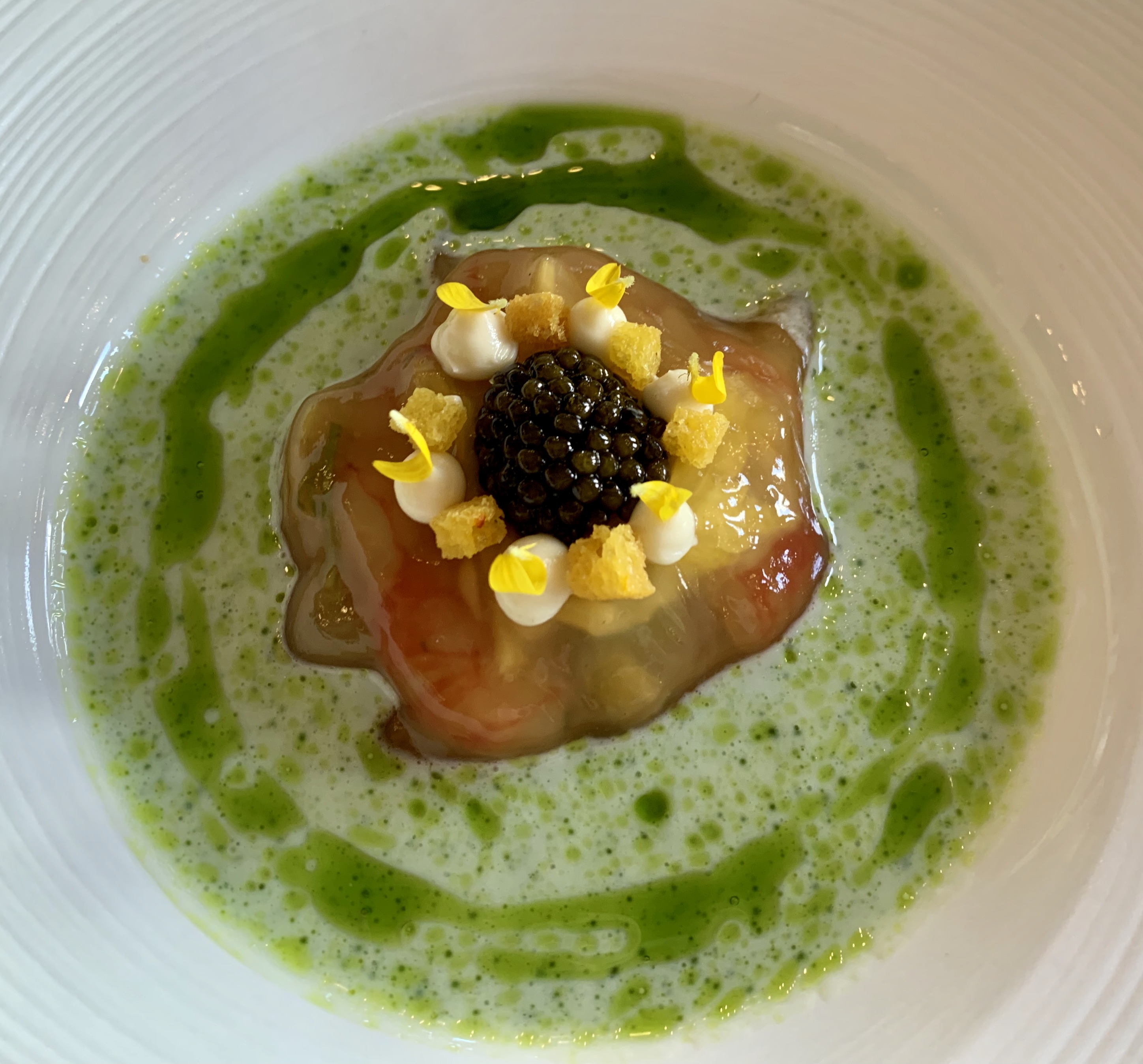
Then a Red Sicilian prawn tartare with tomato ponzu jelly and Kristal caviar.  Curious, evidently. I ordered it based on the memory of having those distinctive crustaceans in Sicily, where the natives all get very excited when fresh catches come in. The flavour, indeed, would have returned me to that magical island, had it not been for my fascination with what I could only call a blackberry of caviar on top of the jelly dome. Did they tweeze each egg into place? It was almost too beautiful to eat. I managed anyway.

Next came Caractère's trademark cacio e pepe, made with strips of celeriac rather than pasta. (That's subtle, evidently.) It sounds perverse, but is a substitute so perfect it's arguably better than the traditional tagliatelle. Lighter, a bit more bite, with just a hint of sharpness to balance the richness of the cheese. It is an almost laughable transformation of a humble peasant dish, and leaves you wanting more.

More comes not as pasta, but the exquisite skate and artichoke dish described above. aka delicate. Followed by a plate that deserved its robust description: roast loin of veal, layered potato, apple and smoked bacon, veal jus. I honestly can't tell you exactly what that triangle on top of the potato was. Presumably the apple and bacon pressed into a flat, crunchy delight. It tasted as good as it looked.

Greedy should have been applied to the cheese course, as anyone who moved on to that before the tripartite desert should consider a career in competitive eating. My oversized appetite is the bane of my existence ... or at least of my health ... but I couldn't have managed it. Although I would have loved to have seen what they did with it.

Beauty is an essential element of all fine dining; you eat with your eyes first. But that seems even more true at Caractère, where each plate did indeed seem like a little work of art. Did you spot the marbleised coating on those chocolate petit four above? The same attention is given to the dining room, all white marble, rich grey greens, terra cottas and burnished brass. The chairs are comfortable and the servers charming. Ours bore an almost-disturbing resemblance to Lin-Manuel Miranda, I wondered if we were going to end up in an Encanto flash mob as part of the soundtrack's Oscar bid. But the atmosphere remained quiet and peaceful throughout. They could cram more tables in here but I suspect have made a purposeful decision not to. It's a remarkably calming environment. 

For me, Caractère's only drawback is the challenge of getting to and from it; as it's not on our usual London flight path.  Which means, much as I'd love to try it again, I'm not sure when that will get into the diary. Though it should. Given that my husband and I have spent the entirety of our relationship bickering over whether French or Italian cuisine is better, Caractère feels like the ideal battleground to fight it out. Or exhaust ourselves trying.


Saturday, 19 September 2020

A famous gardener and a now-exotic London outing make this birthday/anniversary special

My husband is not typically a creative gift giver. Like many men, he likes the safety of working off a list provided by the recipient, and loved the efficiency of having something delivered direct from Amazon ... not minding if it’s sans card or gift wrapping. Thus it was quite a shock this year when, for my birthday and our anniversary ... which happen on the same day ... he came through with a customised surprise to make the most romantic gesture seem trivial: a 45-minute private garden consultation by Zoom with Alan Titchmarsh.

American readers may need some context here. Imagine hanging out with Martha Stewart to get home style tips, receiving batting coaching from Albert Pujols, or rap instruction from Lin Manuel-Miranda. Titchmarsh is the UK's favourite gardener, a humble, working-class lad from Yorkshire who went from flower beds to horticultural journalist to TV star. When I moved to the UK in the late '90s he was omnipresent, hosting the annual Chelsea Flower Show coverage, running a wildly-popular garden makeover show called Ground Force and hosting the weekly broadcast (and national institution) of Gardeners' World. Now 71, Titchmarsh has moved solidly into national treasure territory, and is in theory semi-retired though he still hosts a radio show on ClassicFM, writes garden columns, produces the occasional novel, pops up on TV and promotes charitable causes.

It's the combination of charity and ClassicFM that provided the opportunity for my birthday present. He'd donated the consultation to the station's charity auction and my husband spotted his opportunity to procure a gift to make his wife swoon.

My call was far more than just a brush with fame. Titchmarsh's experience is abundant and he delivers it with the skills of a master consultant. He manages to tell you what's wrong without implying an ounce of criticism to your gardening skills. In fact, his praise of my efforts thus far made me bloom with pride at the same time he was able to tell me exactly what I'd done wrong and how to fix it. It was all terribly appropriate, since much of the knowledge I used to design and take care of my garden has come from his broadcasts and columns over the years. He also radiates a genial kindness that marks him out as one of the true good guys in this world, a hunch confirmed by a friend who used to work with him at the BBC.

So what's wrong with my garden? The same thing I've been hired to fix at work. Too many things competing for attention. I need to do more with less. It's ironic that I can see and attack the problem so clearly in my professional life, but didn't spot it in my own herbaceous borders. But, as my new best friend and horticultural coach consoled me, when you truly love plants and don't have a lot of room, you try to pack in everything possible. 

This autumn will see me stripping out about a third of my plants and making a few tweaks to create bigger blocks of colour. The same applies to my pond, which already looks better after sending armloads of reeds, water lilies and oxygenating plants to the compost heap. My least successful bed (pictured below) lacks a strong focal point; I'll be digging the whole thing out, investing in the recommended Japanese maple and planting around it. And while there's no rescuing my espaliered apple tree (planted in too shady a spot and now too established to move), the west-facing wall I've ignored until now could support three carefully-chosen fruit trees.

My date with Alan Titchmarsh took place several weeks before my birthday, leaving the day itself for other treats. I went up to London for the first time since the world shut down in March to meet a friend for lunch (in a nice parallel, the same one who used to work with him at the BBC). The experience was a bit surreal, at once both familiar and alien. I long ago lost count of the number of times I’ve gone from Basingstoke to Green Park station, and the Wolseley is one of London’s most comforting, long-running, establishment venues for a business lunch. And yet the trains running 1/3 full, the empty, echoing corridors of Underground stations, the blank advertising spaces and the closed up shops felt like I was walking through the zombie apocalypse. London without foreign tourists is an oddly alien place and, frankly, glorious. But not economically sustainable; at least not as it was at the year’s opening.

The Wolseley, always a favourite with a traditional English crowd, was having no issues. Every table was packed, with a time limit to prepare for the flip to afternoon tea. They might have moved the tables a bit further apart, but one of the advantages of the Wolseley for business meetings has always been the generous space between tables so it was hard to tell. The most obvious signs of these plague times were an airport-security style contraption you had to face off to have your temperature taken before preceding to your table, and the individual portion of hand sanitiser waiting atop the crisp linen napkin. 

This is one of the grandest dining rooms in London. A glorious testimony to the madness of boom and bust cycles in the 1920s, it was originally built as a car showroom. The opulent Venetian/Florentine palazzo inspiration is a reminder that motor cars were originally the preserve of the super-rich. The black-and-white marble floors, black marble columns, white vaulted ceilings, shining brass railings and grand chandeliers are properly palatial. Wolseley Motors went bankrupt in five years, however, so Barclays took the building on as its Mayfair branch. The original architect returned to update the decor with Japanese lacquer and other Oriental gewgaws that were high fashion by the late ‘20s. It’s a bizarre but merry combination that works particularly well in the afternoon when the place is functioning as a high class tea room. 

Food here is inspired by the grand cafes of Europe, with a menu very similar to that of sister restaurant The Delauney. They’re particularly known for their oyster and shellfish bar and for having breakfast favourites like eggs benedict and kedgeree on the menu 24/7. My friend swears by their chopped salads (hers did look tempting), while I opted for a classic steak tartare. Schnitzel is always on the menu as is a proper baked cheesecake. 

One of the reasons the Wolseley has remained so popular with punters since it opened in 2003 is its pricing. The prix-fixe menu is only £19.95 for two courses and £24 for three, and main courses tend to be in the mid £20s. Sure, you can have a blow out with lobster, chateaubriand and champagne, but you can also enjoy grand elegance and feel like you’ve had proper value for your money with most choices. Which is actually far truer to the English establishment who once dominated Mayfair than the Ritz across the street, which has pumped up the gold gilt, escalated prices to the stratosphere and targets cash-splashing conspicuous consumers. Who are rarely English, and seldom old establishment.

Back home, my husband celebrated our anniversary by cooking dinner ... the next night. The breakfast bar in the kitchen where we normally eat might fall short of the Wolseley’s decor and our plating is too generous to be called fine dining, but I think our black and white granite counters are a bit grand and Mr. B’s salmon en croute with a lemon cream sauce wouldn’t be out of place in a grand European cafe. 

Yes, he’s a keeper. Even before the Titchmarsh consultation. Maybe I should take him to the Wolseley.


Saturday, 27 July 2019

Mayfair's Umu celebrates perfection in every element

Obsession is a necessity for Michelin-starred chefs. Nobody survives in a gruelling industry that robs you of your social life, rises above fierce competition and delivers perfection night after night without a bit of mania over what they do. In my reading about Japanese culture in advance of our trip later this year, I've seen something similar. The gardeners who groom every leaf on a tree to a painterly perfection, the generations of swordsmiths who hand down and hone their skills to create the ideal samurai blade, the calligraphers who strive for years to get a character just right ... there's plenty of obsession on display.
I began to suspect that fine dining and Japanese food would be an eminently logical match. An evening at Mayfair's Umu validates that suspicion.

Head Chef Yoshinori Ishii does more than deliver exceptional food. He matches a range of pottery (some of which he's designed) and lacquerware to the food and its position in the parade of dishes to make a visual statement. His biography tells us he's also a keen calligrapher, so no surprise that one of the courses is served on top of a poem, written in bold calligraphy by Yoshinori, illustrated by his own drawings. If that sashimi tastes fresher than any you've ever tasted, thank his love of fishing in the traditional Japanese style. Not only has he found his own Cornish suppliers; he's taught them the art of ikejime ... dispatching a fish quickly with a needle into the nervous system, curtailing the fright and struggle that releases meat-toughening hormones and acids. When that fish comes to you as a hand roll, it's presented by a Yoshinori-designed wire arm, symbolically from his touch direct to yours.

Umu specialises in kaiseki, the highly-ritualised, multi-course gourmet tradition of Kyoto. The biggest splurge during our upcoming trip involves an exclusive ryokan (inn) in the hills above the ancient capital where our courses will be brought to our rush-matted, paper-screen-walled room by our kimono-clad hosts. Before diving in at the deep end in a language we don't understand, I thought it made sense to get familiar with kaiseki on home turf. It was also my husband's birthday; a two-Michelin-starred Japanese restaurant was suitably celebratory. (And the price of a full kaiseki meal definitely needs to be reserved for a special occasion.)

Our eight course (but nine dish; one course had two parts) celebration started with "mukozuke." From what my post-meal research tells me, this is the word for a small, intriguing snack served in or on an interesting piece of pottery, often with a rough but beautiful finish and some kind of artful deformity. Here, a battleship grey bowl with a slightly pitted surface and a slightly shiny glaze would have been a perfect circle had the potter not bent one side in, forming a shape like an apostrophe. It was a quirky and beautiful piece that demanded inspection before you ever paid attention to the food. Inside was a lovely melange of gently-cured sea trout, wafer thin slices of turnip, pickles and caviar. Two generous bites or four dainty ones, it was an elegant foreshadowing of all to come.
"Nimonowan" is a simmered dish or soup cup, here titled "Ocean Breeze" and served in an exquisite lacquer bowl with lid that you remove to create your own little tabletop drama. Inside, a layered disc of Cornish lobster, abalone and nori seaweed sat in a broth so clear it almost disappeared. Later, we both agreed that the menu probably had one course more than it really needed, and this is the dish my husband would cut. He's never been a fan of lobster and thought the example here was slightly overcooked and too chewy. (Which is what he almost always says about any lobster.) I suspect the chewiness was the abalone. Whatever the truth, it was still one of the most exquisite interpretations of soup I've ever had and very tasty.
The next course was the double dish. "Tsukuri" is the set up to executing a Judo throw. One assumes that implies a partnership with the course to come, or maybe the first plate set up the second, but nobody told us. My only real complaint with Umu was that the serving staff (entirely European, heavy on Italians) doesn't really give you much information on your food beyond the basics, even though they knew we were interested. Many Michelin-starred places will go into detail about their supply chain, the inspiration behind the dish or even how you're supposed to eat something. We could have used more of that in this delightful, but very alien, environment. It seems that's simply not their style.

Tsukuri started with slices of raw turbot. People often claim "you can read through it" when describing  how thinly they've sliced something. Yoshinori plays with that idea by serving the slices on top of a poem he's written about the joy of food. Unless you can actually read Japanese characters, you can't test the "read through" claim completely, but it's a fun touch. Delicious as the turbot was, the highlight here was my first taste of real wasabi. The stuff you get in almost all sushi restaurants is an industrially-produced approximation made from horseradish, mustard and food colouring. Real wasabi is a root, notoriously difficult to grow, that releases a piquant kick when grated that fades within minutes. Obviously, most restaurants don't want to dabble with an ingredient with no shelf life after preparation, even if it doesn't cost £22 for a thumb-sized piece. The taste of the real thing, grated into a paste by moving in a circle on a piece of shark skin, is a mind-blowing blend of sweet and hot.
The sauces and the wasabi stayed around for part two: sashimi. This is probably the ultimate expression of the idea that the best ingredients don't need much done to them. Five pieces of top quality fish, incredibly fresh, taken from the best part of the fillet. I've had a lot of great sushi in my life, but the only time I've come close to this freshness was when we tried slivers of the fish we'd just caught off Puerto Rico before we left the boat. When fish is this fresh, it's almost a crime to cook it. And every kind tasted significantly different from the other. (Something, let's face it, you don't really get at Itsu.) The most fascinating morsels here were the back and belly tuna, side by side. Belly is a rare delicacy, and I've had it before ... but never this rich or pungent. We're talking the foie gras of the piscine world here. Honestly, the flavour was too much for me; I could have happily substituted another bite of back, but am glad I tried it.

Next came my dish of the day. "Agemono" means deep fried food in Japanese, and I suspect we were into the comfort food section of the menu. The description was sweetcorn three ways. I am from a corn state. I have an annual moan about the poor quality of the corn in the UK while I indulge in memories of buying sacks full fresh ears from the fields down the road from my childhood home and eating them before they'd been off the stalks for four hours. As glorious as those Missouri memories are, they couldn't touch the expressions of that noble vegetable here. There was a kernel-stuffed spring roll, a quarter of a grilled cob and a croquette I can only describe as deep fried creamed corn. We may have been in a Japanese restaurant, but it's as if the chef had distilled the essence of the best of an American midwestern summer onto a plate. I almost wept with joy. And if that wasn't enough, you unrolled the husk to find a line of perfectly popped and seasoned corn. Four ways! And each perfect.
"Hiyashimono" followed: smoked and cured mackerel with somen noodles and Japanese ginger. I couldn't find a translation for this title, but this was my husband's favourite dish. I suspect he was experiencing a similar cross-cultural childhood flashback, given how essential mackerel is to Danish cuisine. It is, however, the dish I would cut. Not that I didn't like it: the mash-up of sashimi and cold noodle salad would be a huge hit with me for a summer lunch. But at this point I'd reached satisfaction point on the raw fish and didn't need more.
"Yakimono" means grilled or pan fried and brought us out of the ocean for the first and only land-based meat dish: lamb two ways, with accompanying sweetbreads. Regular readers will know I'm not keen on lamb or offal, though I'll soldier through anything on a chef's tasting menu. (Which is how I got familiar with sweetbreads in the Loire Valley.) A benefit of the Japanese love of bite-sized morsels is that anything's tolerable this small. In fact, the rump and fillet were both rare and delicately spiced, avoiding the lamb-y flavours I dislike. This bit of sweetbread was more solid, chewy and unadorned than the heavily sauced French version. Not bad, but still not anything I'd order for myself.
Kaiseki traditionally ends with a bit of white rice, which explains the seemingly odd appearance of sushi hand rolls as the final savoury dish. The menu delivers up two per person which is, frankly, more than even the biggest appetites need at this point. But the options are so tempting it was a relief not to have to choose just between the smoked eel and the tuna. This was the dish that came out held aloft by the wire hand, or "gohan".
While I love Japanese food, I remain sceptical about the cuisine's ability to deliver on the dessert front. Umu didn't change my mind. Their offerings were beautiful ... we actually had two since my husband's tomato allergy precluded the dish included in the kaiseki ... but a bit too experimental for satisfaction. Both had vegetal elements, which I always find difficult in dessert. As a work of art, however, "ajisai", or hydrangea, was a wonder. Tiny cubes of blue and pink jelly, coloured naturally by butterfly pea flower and pink amber tomato, covered a mound of sweet white bean puree. This looked remarkably like a hydrangea flower head, with a smooth, creamy and mildly floral taste. Unfortunately the shiso sorbet beside it didn't work for me. Even though shiso is related to mint, it was too much like having a salad on the plate with my pudding.
I thought my husband's dish was more successful: mango with a panna cotta-like cream and a caramel sauce. The experimental element here came with more wasabi, served as a whole root as a side with the grater. You were supposed to grate your own and add it to the sweet for a flavour contrast. It was a bit like putting pepper with strawberries and worked to an extent, but my husband found it tough to get the wasabi / mango balance right.
As usual with a blow-out tasting menu, we went with the matching wine flight. Except that at Umu, a sake flight is an option. That seemed too experimental for my husband, so he stuck with the grapes while I threw caution to the wind with fermented rice. I was the clear winner.

By course three it was obvious that sake in your bog standard Japanese is restaurant is to the good stuff what a wino's rotgut is to Burgundy or Bordeaux. Every glass was balanced and nuanced, with a range of subtle tastes. Most, in a blind tasting, could easily have passed for wine. And unlike my husband's selections, mine came with a fascinating array of cups, from rough pottery to cut glass to fine porcelain that looked like a sea urchin. I learned from our sommelier (who got more chatty once we determined that he was from a Sicilian village in the same mountain range where my grandfather was born) that though rice has some aspect of "terroir", variations in sake flavour have much more to do with yeasts, fermenting processes and production decisions. The variety was exceptional, from a bone-dry, almost mushroomy offering to a slightly effervescent lemon treat that was like limoncello re-invented for sophisticated grown ups.

Most two-starred restaurants tend to steer everyone to the tasting menu, and if they have a la carte it's often more expensive than the chef's choice. That's actually not the case at Umu. You could pop in here at short notice, grab a seat at the sushi bar and get a couple of dishes and a glass or two of sake for something that approximates the cost of an average meal elsewhere in Mayfair. Not cheap, but a lot less than the full blow out.

Saturday, 2 March 2019

Quilon takes Indian food to a magical, exotic extreme

Indian is the UK's go-to casual comfort food, whether consumed as take-away, at the local curry house, as one of the inevitable options on the classic pub menu or knocked up with a jar of mass-produced sauce at home. It's usually humble, crowd pleasing and relatively cheap. But different types of  Indian chefs have been on the march for the past decade, working to show that food from the sub-continent can be sophisticated, elegant and complex. They've been rewarded: 10 of London's 70 Michelin-starred restaurants now come from an Indian tradition.

My first taste of Michelin-starred Indian ... woefully belated, I confess ... explained why critics have been so excited about this trend. Quilon, tucked into the Taj Hotel in the heart of Westminster, may share some menu items with your local curry house but it's unlikely that you'll recognise the presentation. Or the delicacy and layering of the spices. Most interestingly, Quilon focuses on a single region. In a world where "Indian" has come to mean a highly generic set of dishes, many of which were developed in England for English tastes, there's a specific focus here on Southwest coastal Indian cuisine. Quilon is exotic in a way that regular British Indian restaurants have ceased to be.

Given the regional focus, the logical choice would have been the seafood tasting menu. But we were keen to try as broad a range of flavours as possible so opted for both meat and fish. The fact that this choice is labelled the "non-vegetarian tasting menu" reminds you that this cuisine is culturally vegetarian to start out with. If you want to treat a friend who doesn't eat meat, the options here are vast.

The realisation that you're on a different culinary planet comes early on, with the papadums. (Photo above.) No pile of plate-sized crisps with the ubiquitous spinning server of condiments in silver bowls here. Instead there's a dish of bite-sized papadums of dazzling uniformity. An array of accompaniments goes from a brain-melting bowl of pickled chilis to a comfortingly mild coconut paste. The server arranges everything in spice order, so you can work from mild to hot or stay wherever you like on the journey.
Next came an artful rectangular plate adorned with three little cakes, each with an accompanying swoosh of bright sauce beneath. In the centre, a pale orange crab cake. To one side, vibrant green broccoli. On the other, ruby-rich beetroot. Each flavour was distinct and, like a fine wine, each taste started out as one thing and finished as another. The obvious hit of the crab or the vegetables came first, followed by waves of spice. Warming, but not hot.

The fish course brought one triumph and, surprisingly, the only disappointment of the night.
The lemon sole marinated with Goan spices and herbs was a bit overcooked and lacked any prominent taste. A single jumbo prawn masala carried enough flavour for both, perfectly cooked and dancing an energetic duet with a mix of tomato, onion and mustard. We must have been rolling our eyes with joy, because the server somehow knew to slip us another one on the side of our next course.

But first, a steaming glass of spiced tomato consume. I'm not sure you can call something that highly-flavoured a palate cleanser, but it was a fine set up for what was to come.
The main course was closest, both in presentation and taste, to curry as I already knew it. As many Masterchef contestants have learned to their frustration, it's tough to make stews elegant.

 Here, a dome of lamb biryani sat on an oversized white rectangle of a plate, with three square dishes arranged at the top. A Mondrian canvas of curry. The dishes held mangalorean chicken (a spicy curry to balance the milder lamb); a memorable melange of coconut, snow peas and asparagus shavings; and a thick yogurt dotted with pomegranate seeds and candied fruit (possibly pineapple?) to allow you to balance the heat to your preference. The most mind-blowing part of this course was malabar paratha. It was a flatbread, but as far from the standard curry house nan as your mass-produced white slice is from an artisan croissant. The croissant reference is intentional: paratha dough is beaten to a thin sheet and folded to form layered bread, then cooked on a skillet with pure ghee. The end result is light, both pillowy and flaky, and pulls apart in a spiral. Decadent.

Though Indian friends have assured me that their culinary heritage is obsessed by sweets, the curry houses of England would have you think kulfi and lassi are the only options. Quilon happily sets out to correct this idea.
The chef shifted our taste buds from savoury to sweet with a pre-desert mouthful of a warm jaggery fudge with a tart fruit sauce. You wouldn't want more than a taste of this overwhelming sweetness, but it was a pleasantly bold announcement of the dish to come.

Which was a celebration of all things pistachio.
Presented out of context, I would have called this plate Sicilian. I was delighted. Pistachio cake. Pistachio ice cream. Pistachio praline. Pistachio crumb. With a few small puddles of black sesame fondant to add an umami complement to the gentle green sweetness. I was in heaven. The place from where my Sicilian grandfather, who first taught me the joy of that nut, was no doubt smiling in benediction.

We were stuffed, but couldn't resist a nibble at the chocolate wafers that came out to end the meal. White chocolate infused with cardamom and dark with rose encapsulated the whole experience: familiar tastes elevated with delicate and surprising lashings of flavour.

If this is how they eat on the Southwest coast of India, then Karala just jumped onto my bucket list. By the end of the evening, the food had transported me to a holiday destination of warm breezes and swaying palms, foreign herbs and alluring spices. I almost expected to walk out the door to find the Arabian Sea lapping at a beach of powdery sand. Sadly, the spell was broken as I hit the cold drizzle of early March in London. But it was great while it lasted.

At just over £100 per person for the tasting menu with half a bottle of wine, service included, there's no denying this is a pricey meal. But for a magical evening that transports you body and soul into a luxurious and exotic beach holiday, it's not bad value for money.

Saturday, 14 April 2018

London's Fat Bear gives Southern American cuisine the respect it deserves

American food doesn't get the respect it deserves in London.

I'm not talking about the burger joints and diners that define foreigners' ideas of American food, but the stuff of family celebrations and prized local restaurants. A cuisine that treasures ingredients from a vast and varied country with deep agricultural roots. The place that embodied "fusion" before it was a trend, as immigrants from hundreds of culinary traditions lived side-by-side or married and merged kitchens. A country where the enduring tradition of "pot luck" parties and "family style" dining reminds us that sharing great food is at the heart of what's good in life. Hell, we have a holiday dedicated to the idea. (Thanksgiving, if you're planning, is 22 November this year.)

You can probably find more Nepalese or Ethiopian restaurants in London than you can places that celebrate this kind of American cuisine. The two old warhorses, Joe Allen and Christopher's, sit a stone's throw from each other in Covent Garden. They're excellent, but expensive and noisy. Proper barbecue has seen a welcome rise in respect in London, but menus are usually limited to a narrow off-the-grill-and-sauce-it niche.

My discovery of The Fat Bear has therefore filled me with delight. It makes no pretensions to cover the whole country ... an impossible task when New York, St. Louis and San Francisco are as culinarily diverse as London, Paris and Rome ... but picks The South as its niche. And delivers to a standard that any Southern Living subscriber would applaud before inviting y'all round for a bite. This despite the fact that chef Judy Ong is actually from New York. (Believe me, that's a big compliment coming from a St. Louisan.) Husband Gareth Rees anchors a bar that does cocktails properly. No Shoreditch trend chasing or Mayfair price extortion: just an encyclopaedic knowledge of the classics mixed with healthy experimentation and an impressive range of top-quality boutique American brands. (And a few European classics, if you must.) Menu pairings include cocktails as well as wines; an excellent call when your bar is this good.

Nestled in the warren of narrow, winding streets between St. Paul's and Blackfriars, it's an intimate two-room place above a pub. The wood-slat blinds on the windows, the enormous bar on one wall and the excellent mix of jazz and zydeco on the sound system set an atmosphere to match the food. And though it's been close to full all three times I've eaten there, it's a small enough place to never be too noisy. One of those rare, moderately priced spots in London where you can catch up with friends over dinner and have a proper conversation without shouting or straining to hear.

(A quick disclaimer to university friends. Despite the fact that you have known me as "Bear" since we were 17, the above adjective has applied most of my life and Chicago banking magnate Homer Livingston once said he'd fund my bar and restaurant if I ever wanted to open one ... I have no personal ties to this place.)

For Americans with connections to The South, the Fat Bear pushes the nostalgia buttons. One taste of the pimiento dip (a spreadable cheddar cheese spiked with bits of red pepper) pulled me back to neighbourhood Fourth of July picnics. Corn dogs take a direct line to the state fair. Braised brisket, slathered with sweet and spicy BBQ sauce, took me to the back deck of my family home; I could almost hear the crickets chirping and see fireflies dancing in the trees. Most importantly, it was done properly. Simple words, but perhaps the highest praise anyone from the barbecue belt can bestow.

But would the food hold up for Brits, or even American Northerners, who had no cultural identification with the menu? Yes. Corn dog neophytes proclaimed them delicious, if a bit daunted by the fiery sauce. The dips, while curious, were satisfying. Buffalo wings with blue cheese dip were a huge hit across the table.

Fried chicken, done as Southern grandmothers demand with the bite of buttermilk that's so often
lacking in British versions, is delicious. The waffles on the side are reassuringly traditional, the sriracha-spiked maple syrup an exciting innovation. Gumbo and jambalaya both come studded with quality ingredients, spices well-layered and hot but not overwhelming.

Room for improvement comes with the desserts, opinions about which split the table on my last visit. I, who normally won't touch set cheesecakes, think their Oreo version is an addictively more-ish wonder. My husband, who prefers set and isn't an Oreo fan, thought the balance of ingredients was off and that it lacked the light airiness he wants in a cheesecake. The Brits liked the lemon tart. I referred back to the menu description ... actually Key Lime pie ... which the low-slung square before me most definitely was not. Key Limes are a specific variety with a unique taste, and the Florida classic has a colour, shape and texture not achieved here. The nostalgia factor came into play with the 'Nilla Wafer pudding. I thought it was the best of the lot, a triumph of a classic recipe ... including the re-creations of the distinctive biscuits' flavour ... that brought back happy memories of childhood. Two Londoners and one Michigander, none of whom had ever been exposed to this particular dessert (essentially a vanilla-heavy biscuit layered with sliced banana and vanilla pudding/custard), thought it was a bit vile.

Bottom line, there's enough to tempt your sweet tooth here but nothing that truly evokes The South's impressive dessert tradition. Where are the classic pies? Towering chiffons, flaky peach, bourbon-spiked pecan? How about lofty angel food cakes ... unknown in the UK but sure to be loved ... frosted in pillowy icing (my grandmother always opted for strawberry)? Or ambrosia, with citrus slices dressed in freshly-ground coconut, swimming in whipped cream, marshmallows and maraschino cherries? Actually, forget the ambrosia, Judy. This is one of those nostalgia options that will puzzle, and possibly disgust, anyone who didn't grow up with it.

With its comforting combination of food, cocktails and atmosphere, The Fat Bear gives American cuisine the respect it deserves. They can keep working on the desserts. And if Judy wants my St. Louis Gooey Butter Cake recipe, then one generously-sized ursus stands ready to help another.


Friday, 28 July 2017

Asia de Cuba: Still exceptional after all these years

I'd like to say that I had put a lot of thought into the restaurant choice for my husband's birthday celebration. But that would be a lie.

The thinking went into Bat Out of Hell: The Musical. (see review here) The pre-theatre dinner was an afterthought. Asia de Cuba was the only event-worthy restaurant I could remember in close proximity to the London Coliseum. I'd been there for a work do and enjoyed it, though it didn't make the blog. Whether that was because I was having a really busy month, the food wasn't worth writing about or we enjoyed too much of the prodigious cocktail menu because the boss picked up the bill, I can't recall.

I won't forget this visit. The convenient afterthought delivered one of the best meals we've had this year.

A sunny fusion of tastes from warmer, more exotic places, the only thing wrong with the meal was our limited time. Those exquisite plates deserved to be lingered over. Instead, we rushed through the seven savoury plates of the chef's menu before we ran out of time. Fortunately, the cheerful and efficient staff let us pay our bill, dash to the theatre and return for post-show puddings. I didn't want to miss a bite.

When Asia de Cuba launched in 1999 it was not only one of the trendiest places in town ... located just off the lobby of the Philippe Starck-designed St. Martin's Hotel ... it introduced London to inter-continental fusion. Inspired by the great food to be had in Havana's Chinatown, the menu skittered off in bizzare directions. The menu is still a hotch potch of tempting possibility, though the influences seem to have expanded through all of Asia, the Caribbean and South and Central America. It can be difficult to find continuity between the dishes to construct a meal that hangs together.

Exactly the kind of place where a chef's menu works best. At £60, it's better value than assembling a meal a la carte and quite a deal when compared to tasting menu prices in similar London venues. Don't relax your guard, however: they recoup their margin on drink prices.

We started with grouper ceviche. The menu described its accompaniments as mojo amarillo, sofrito crudo and radish. My taste buds said a spicy mango sauce. Whatever ... it was exceptional and proved that the best quality fish needs very little to make it shine.

Asia de Cuba was one of London's original sharing restaurants, back when the "tapas" concept first extended beyond Spanish food, so it's no surprise the starters come as an array of small plates. There are two-bite-sized casava pancakes piled with exquisitely moist pulled pork tossed in a guava sauce. Eye-rollingly good tuna tartare comes as a taco (although to keep the fusion idea going, they call it a crispy wonton), elevated to excellence with a subtle balance of Spanish olives, currants, almond, toasted coconut and avocado ceviche. The dish of the night, however, was the crispy calamari salad with banana, chayote (a type of squash), cashews and hearts of palm tossed in an orange-sesame vinaigrette. Again, subtlety was critical to the dish. Without the help of the menu, I couldn't have picked out the individual ingredients beyond the squid and the lettuce, but the combination was exquisite. I would return simply to have this again.

Time for a palate cleanser: mojito sorbet. They really should market this commercially in groceries. Extraordinary stuff.

The main courses brought us more tuna. This time, the loin had been dusted with spices and grilled quickly to get a crust on the outside, leaving the center blissfully as the sea provided it. It came on a bed of white bean purée with chorizo salsa and tatsoi (an Asian green) with a garlic-sesame vinaigrette. A fine accompaniment, though the tuna was once again so exceptional we hardly noticed. The poor seven-spice chicken paled in comparison, though if it had appeared alone at any other time it would have been a star. This came with a Cuban version of rice and beans called congri that was more like a rich, creamy risotto, plus snow peas, shiitake mushrooms and plantains. It was a dish to remind you that a few changes can turn boring old roast chicken into something exotic and magical.

Back after the theatre for dessert, we had another triple play of sharing plates: a flan with tropical fruit salad, an exotic millefeuille and Mexican doughnuts with a drizzling of chocolate and caramel sauces. I have no idea what made them Mexican, I can only tell you that they were sinfully good. And that my normally ambivalent-to-puddings husband gobbled up three of the four. He says he was falling on his culinary sword to help my Weight Watchers results, but I think his motives were less altruistic. (Given the predominance of fish, vegetables and light preparations throughout the meal, however, Asia de Cuba is actually a good choice for those trying to keep the gluttony in check.)

All of this was delivered with exceptional service. It's not easy squeezing a multi-course chef's menu into a pre-theatre slot; they adapted admirably. Courses came with careful descriptions, recommendations on drinks were spot-on, wine and water were always topped up and the servers worked as a smooth team. They took careful note of my husband's tomato allergy and when the chicken's marinade had the offensive ingredient they brought out a second, specially-prepared serving just for him. We really appreciated the offer to return for dessert; they didn't have to do that.

All of this means that Asia de Cuba moves from a dim and undistinguished dining memory to a place on the short list of restaurants I'd like to return to soon. The next time English National Opera lures us through their doors, I know where we'll be first.

Wednesday, 12 April 2017

Fenchurch continues to delight on second visit

 I gave Fenchurch Restaurant (inside the Sky Garden at the top of London's "walkie talkie" building) a good review in a partial entry last year. A second visit confirms it: this is one of my favourite special occasion restaurants in London.

Great views come with inflated prices, and there's no doubt that maxim is in play here. You get spectacular vistas of London from here, made even more magnificent at sunset. A dinner reservation gets you in to the Sky Garden 45 minutes before your table time (even though it closes to day visitors at 6pm), so you can grab a drink and wander through the tropical vegetation taking in the city below.

Inside the restaurant, all remained as I wrote about it last time: warm, sophisticated, bending over backwards to be resolutely British. Even though our servers ... not a native-born Brit amongst them ... came from a bewildering variety of European locations. Though we only officially had the table for just two hours, if you order the chef's menu all such rules are suspended. Thereafter followed a luxurious procession of eight courses (£85) with matching wine flight (£65). Given that, in my earlier review, I warned that you should set aside £100 each for three courses and some drinks, the set prices of the chef's menu begin to look like good value for money ... if not a bargain.

In a sophisticated, international city awash with exotic restaurants, Fenchurch bends over backwards to be local. (Despite the accents of those who work here.) From the Goodwood Estate steak tartare, to the early asparagus and Devon crab, to the brill caught in English waters paired with buttery Jersey Royals to the Nyetimber sparking wine pairing an artichoke and ham dish early on. That artichoke isn't local, of course; April inevitably forces the chef to look abroad for some of his veg.

It is mostly, however, a testimony to just how good English ingredients can be. Even the lamb (a meat I generally detest) was tasty, served rare with rainbow chard, ewe's cheese and salsify. This was a meal, however, that built to a crescendo with its deserts. First, shortbread with lemon curd, passion fruit and buttermilk ice cream, served with a sweet Moscato d'Asti from northern Italy.  And then, as if the chef understood that our table was primarily female and would feel no meal was complete without chocolate ... a cold chocolate cake paired with piping hot chocolate sauce and vanilla ice cream. Simple comfort food if it hadn't been for the exotic Cypriot sweet wine that went along with it. And those views, of course. Now of a night-scape twinkling with lights to a distant horizon.

There are no Michelin stars here, despite the chef's menu and fancy menu items. I can't tell you why, as the tastes and presentation were on par with many a one-star spot I've been lucky enough to dine in. I suppose that's a good thing, as a star would inevitably bump up the price. For now, if you're looking for a good spot for a special event, Fenchurch delivers great food and wine, stunning views and a unique all-round experience that has a Michelin star feel, for marginally less ... and with tables much easier to book ... than an officially starred establishment.