Showing posts with label Luxembourg. Show all posts

Monday, 10 May 2010

Luxembourg lays out more foodie delights

Luxembourg has the highest GDP in the world, so it is perhaps not surprising that it also has the highest percentage of Michelin restaurant stars per inhabitant of any country. I have written often about the restaurants of this gastronomic paradise. One of our greatest foodie delights lay in doing it ourselves.

Chef Bertrand has gone the restaurant route, and now operates a kitchen, classroom and shop in a storefront a few miles west of Luxembourg city centre. The formula is a simple one: custom-designed cooking classes for small groups, ending in the eating of what you've made, complete with generous quantities of matching wines. A great way to get to know people, and a pleasant alternative to yet another night out in a restaurant.

Bertrand's place consists of a kitchen on one side, dominated by a large work island that comfortably fit the six of us that evening. All the necessary ingredients for the evening are artfully laid out, and the menu is written on a nearby chalkboard. The other side of the room is dominated by two large tables, at which you get to eat once you've put in a bit of hard graft.

Unlike most cooking schools, Bertrand doesn't demonstrate and then have each team repeat what he's shown. Instead, he sets each person to individual tasks, popping from one to another with instruction and weaving it all together with general descriptions for everyone. Thus the lesson part moves much faster than the usual cooking school, though you have to pay sharp attention if you're actually going to get the recipes written down. (I got the impression Bertrand wasn't keen to expose too many of his actual recipes.)

Our evening started with a simple appetiser of smoked salmon, laid over a mixture of ricotta and olive oil spooned atop a slice of baguette, then topped with sesame seeds. I'd never contemplated the combination. It was fantastic. We moved on to a Thai style dish of prawns in spicy coconut broth, then roast duck with oriental vegetables, ending with a sinfully rich, flourless chocolate tart.

Our other highlight was a return to La Distillerie, which was just as marvelous the third time as the first. Having already written about its delights in detail (see 5.2.10 and 19.7.08), I'll just say that chef René Mathieu continues to dazzle and innovate. Yet another splurge on the 11 course tasting menu, yet another delivery of seasonal treats without any revisiting of past dishes. Similar styles, of course, but a significantly different meal than the two I've had here before. It is so easy for top chefs to rest on their laurels and serve their signature dishes for years at a time. All credit to Mathieu for continuing to innovate when, arguably, he doesn't need to.

Later in the week we enjoyed an exceptional meal at the St. Martin winery in Remich, back on the Mosel but now on the Luxembourg shore. Another return visit for me, and one that didn't disappoint. The restaurant's massive salad platters, majoring on either meat or fish, make you feel healthy while also laying out a wealth of little luxuries. On the more substantive side, my partner's steak was some of the best beef I've had in a while.

With all that fine eating behind us, we spent the last day of our trip at the spa in Mondorf-Les-Bains, hoping that the pummeling of the water jets and sweating in the sauna would extract a bit of the fat and alcohol I'd consumed during the past week. Fat chance. But lying back in the hot bubble pool, watching the leaves dance on the trees in the open air above me, I didn't really care. Yet again, Luxembourg delivered a holiday big on gourmet delights and relaxation.

Friday, 5 February 2010

La Distillerie repeats magic to remain pick as ultimate restaurant

There's always an element of risk when you try to repeat a magical experience. Without the sparkling novelty of discovery, can a second time ever live up to the first?

Thus I approached dinner last Saturday at La Distillerie in Luxembourg's Bourglinster Castle with a bit of trepidation. This place amazed and delighted me on a magical afternoon 18 months ago (see my original review here) and has reigned as the supreme restaurant in my memory ever since. Would it be as good as I remembered?

Better.

Foodies of the world, listen up. Your correspondent has reviewed a healthy number of Michelin stared establishments in these posts. La Distillerie is better. I've been to the three-starred Fat Duck, which appears in most rankings as one of the top three restaurants in the world, and I promise you that chef René Mathieu will give you an equally extraordinary meal, with even better tastes, for £100 less. In a charming, small dining room that accommodates just eight or ten tables of unpretentious diners, in medieval architecture with lovely views of unspoiled countryside. Come hungry, and do the works. The "Poesie Culinaire" features 11 amazing courses, with a matching wine flight of seven well coordinated, interesting glasses. And, obviously, come here with people you like. Because you're going to be sharing this remarkable experience for at least four hours.

Chef Mathieu comes to Luxembourg via Belgium, and spent three years cooking for the grand duke before moving to this small castle half an hour outside of Luxembourg city. He combines an ardent passion for "terroir" and local, seasonal food with an artistry once deployed to delight diplomats and crowned heads of Europe. He changes his menu with the seasons; our winter meal was entirely different from our last visit in July, and featured lots of root vegetables, fish and meat. (This variety is what I wanted upon my return visit to the Fat Duck, instead getting 50 per cent of the menu repeated. When you're dining at this level, and paying these prices, you want to repeat the quality, but not the exact food.)

We started with Mathieu's trademark "apericubes", little bite sized morsels atop skewers arranged in a mix of colours and shapes that made the dish as much modern art as appetiser. Some were more delicious than others, particularly the foie gras dipped in chocolate. (The only repeat from the last meal, but even this was done a bit differently.) A strange but glorious combination. The next amuse bouche was less successful if, like me, you're not a fan of poached eggs. The egg sat delicately in a small wine glass, surrounded by a light cauliflower sauce. Though I couldn't quite like the egg, I have to admit that the sauce completely transformed my opinion of a vegetable I thought I hated. The maximum amount of flavour had been extracted, convincing me that if every floret tasted like this, I'd be a fan.

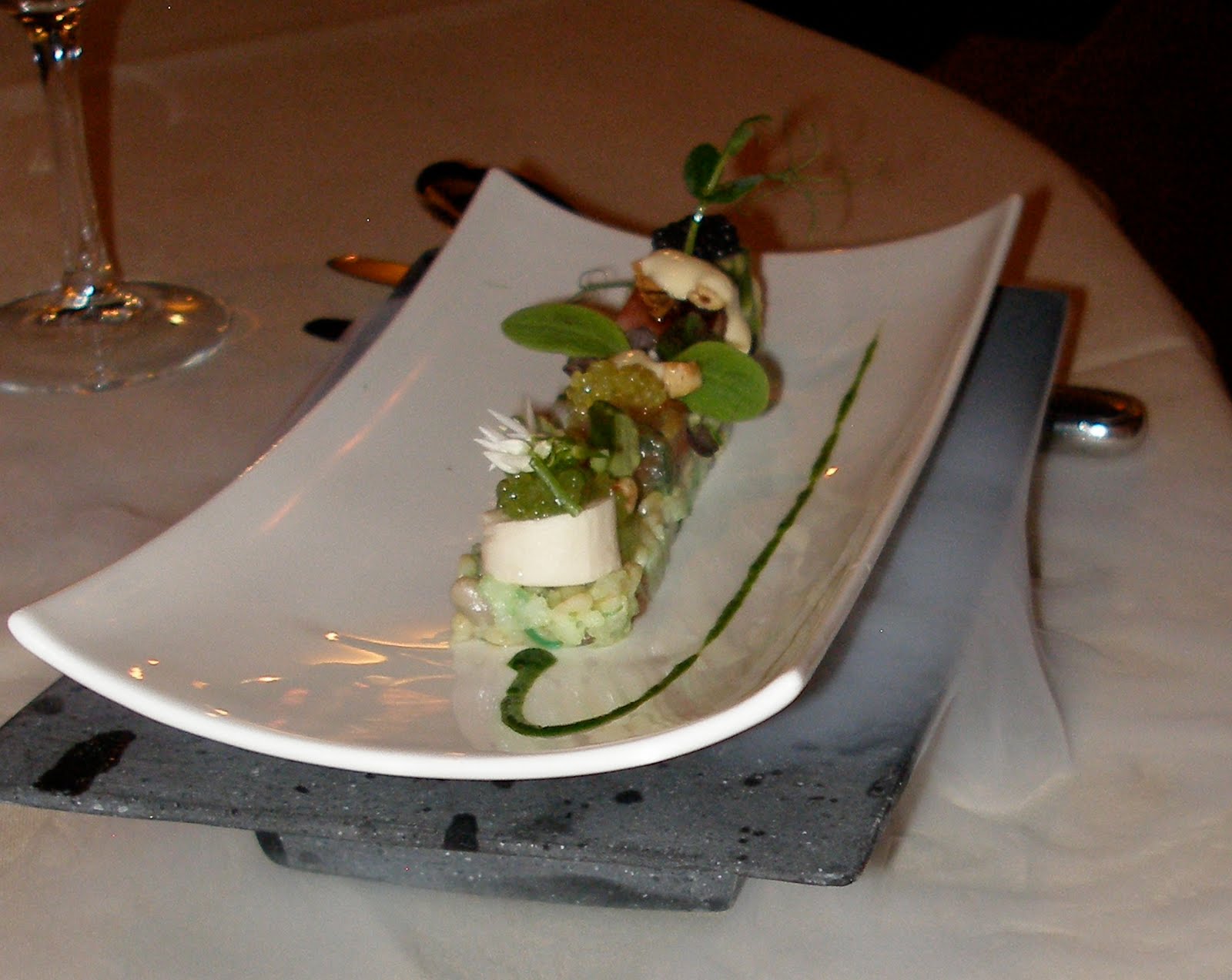
Then it was time to get down to serious business, with a progression of four fish dishes. Each was remarkably different from the other, giving you a great appreciation for just how wide the possibilities are when dealing with seafood. Each plate was exquisite, particularly the crab claw that had been arranged on a painting of cucumber sauce that turned the plate into a piece of Italian marbled paper. Another course had a rich, buttery piece of langoustine tucked into a hollow in a hot stone, covered with a pile of delicate froth (rather than sauce) that melted in your mouth. But my favourite dish in this range was the scallop with carrots. Sounds fairly prosaic, eh? The single scallop at the centre of the long, rectangular plate was succulent and perfectly done. On either side, two quenelles of carrot puree. These showed off the range of colour and taste, running from white, to yellow, to the familiar orange, to black. Like the cauliflower, each taste was a concentrated burst of the essence of the vegetable, and the difference between flavours in each variety was wonderfully surprising.

Having done justice to the seas, it was time to move inland and start working towards a flavour climax. Bring on the foie gras. In this case, grilled in Lagavulin whisky, and the universally acknowledged favourite dish of the night. The main essence here was smoke: the plates came out under glass domes, whisked away simultaneously so we could each breathe deeply of aromas of charcoal, peat, smoke and meat. One whiff was the condensation of every chilly but delightful winter bonfire you've ever attended. The whisky was a surprisingly fine match to the foie gras, complemented by the sweet flavours of dried fruits and Jerusalem artichoke.

La Distillerie features a charming maitre d' with a remarkable memory; he clearly recalled our visit in the summer of 2008. He took us through our matching wines, up to this point introducing us to four different whites. In fact, the range of the wine selections was pleasingly broad, escaping the usual parade of French classics to include the USA, Italy, Chile and even Luxembourg. My favourite amongst the whites was the Wente "Morning Fog" Chardonnay '06 that was matched with the foie gras; delightful to see a Californian option showing off for European gourmets. The rest of the table leaned towards the Ciprea Pecorino, matched with a white fish slow cooked with truffles. No, not pecorino cheese, but a little known Italian grape variety from the Abruzzi and Marche regions. The wine was complex in flavor, deep golden in colour and almost musky in scent, reminding me of some of the best chablis we tried on our Burgundy trip. While my taste buds went for the simpler American notes, the Pecorino was definitely the discovery of the night.

In fact, red wine lovers would have been disappointed, as there was only one offering with the main courses. This was a classic Burgundy from Sauvigny les Beaune, which had a pleasing combination of fruit and sharpness well suited to cut the rich, fatty luxury of the veal that came next. The meat here was a bit of a let down after the perfection of the foie gras, but I was deeply impressed by the side dish, a bar of parsnip and cabbage mash dressed with boiled whole grains and topped with liquorice (not the candy, the actual root).

We'd peaked. It was clearly time to transition to the sweets. Cheese, please. And out came one of the most unusual cheese boards I've ever sampled, with four bite-sized morsels each composed to pack a flavourful punch while pushing you to consider interesting combinations. My pick: goat's cheese wrapped around a grape, topped by a beetroot puree. The soft cheese with banana and rum has to be mentioned for the sheer bravado of the pairing, though I wouldn't do it at home. Brie with truffles and celery milk, however? Happy to eat that again, though I couldn't possibly figure out how to produce it in my own kitchen. We were sipping the first of two dessert wines here, a chardonnay/sauvignon blanc mix that reminded me how good sweet whites are with cheese, and how limited we can be in England always pairing with the port.

By this time our taste buds were overwhelmed with musky, strong notes and a palate freshener was in order. And out came ... perfume. The chef presented us with a culinary interpretation of Yves Saint Laurent's Parisienne, the scent sprayed on a card next to a dessert of dark berries, cream, flower petals and white chocolate that somehow managed to exactly mimic the perfume, while tasting like a dream. And finally to dessert, an artistic compilation of four sweets arranged, as per those long-ago apericubes, as much as modern art as food. While each taste was delightful, the cube of dark chocolate fondant dipped in white chocolate and then coated in gold leaf was the one we all went home remembering. This was a chocolate bar for the very rich, and very picky. Paired with this was a sparkling red wine called Desiderio from Italy's Piedmont region, another much discussed discovery. Of course, there was another artistic platter of sweets to accompany the coffee. A chocolate morsel here, some glazed fruit there ... after the 10 preceding courses and eight glasses of wine, I can't remember all the details of this, other than recalling that it was all so good, I wished I had room to try everything. But alas, even my avaricious taste buds had given up in sheer, happy exhaustion.

The cost for a night of decadent indulgence? At current exchange rates, £150 including service, coffee and an additional champagne before we got started. As mentioned at the start, this is a full £100 less than the chef's menu with wine flight at the Fat Duck. Of course, you have to get to Luxembourg. But if you're looking to say "carpe diem" in a big way, this is the place. Get there now, before René Mathieu is discovered by Michelin, American food writers and the rest of the arbiters of foodie heaven. He's already been named chef of the year in Luxembourg and been awarded 18 out of 20 on the Gault Millau scale. International acclaim is bound to follow the local fame, and he'll soon have prices and waiting lists like his more famous colleagues. I'm going to be very happy to say "I knew him when..."

Tuesday, 2 December 2008

Vianden is a fairy tale castle well worth the hike

Last entry I told you about the Northern European Fusion that is Luxembourg's fine food. The fusion concept applies to the country's architecture as well, nowhere more so than in the achingly picturesque village of Vianden.

Vianden lies in the northeast of the country, near the German border. It occupies a stony promontory overlooking the river Ours, a perfect location for a substantial castle. This one is of the fairy tale variety, a jumble of towers, conical roofs and looming walls on a high outcropping above the river. It has a bit of Neuschwanstein about it, yet was all the more pleasant to me because I'd never heard of it. There's something truly glorious about feeling like you've discovered a place. The feeling of discovery was exacerbated by the fact that we were two of perhaps only 20 tourists roaming the castle halls on that gloomy December day. (I've borrowed someone else's photo from a more clement time of year for the illustration at right.)

It's a substantial hike to the castle from the nearest car park; perhaps 200 yards up a fairly steep incline. Then through the gatehouse and you're climbing another 200 yards through castle courtyards over rough cobbles. The tour of the castle itself requires clambering up and down lots of long, steep staircases. This is not a place for the unfit, or, truth be told, for the heavily pregnant. My friend Cora had to take things very slowly.

It is, however, worth the exertion. Everything is in a glorious state of repair, for good reason. Despite its rich history dating back to the Middle Ages, most of what you see at Vianden today is a reconstruction achieved in the 1970s and '80s. Which also explains why, once you're inside, the visit is mainly about the raw architecture of rooms rather than furniture or decoration. There's a procession of lofty halls roofed with impressive Gothic vaulting. One houses a pleasant collection of church vestments and gold and silver ceremonial objects. Another shows off armour and weapons. There's a kitchen, oddly placed in the centre of the building, kitted out to demonstrate life in "olden days". A dining room and bedroom are the only other furnished rooms. Elsewhere rooms have been used as museums to the house of Nassau-Orange, owners of the castle who managed to end up on the thrones of the Netherlands and England as well as running the Grand Duchy of Luxembourg.

At the very top of the castle are two long halls given over to photographs: the first showing the restoration and the second all the famous people and heads of state who've visited. Clearly, this is where anywhere important is brought on official visits. It's fascinating to compare the ruined shell in the photos to what you see today. The best part of this section of the castle, however, is the magnificent views from windows at the top of the photo to the left. You are now at the highest point, a dizzying distance above the tiny town below and able to see for miles over hill and valley.

The castle's two finest features sit side by side. First is the medieval chapel, refurbished a century before the other restorations by Viollet-Le-Duc. That French master of neo-Gothicism last made his appearance in this blog at Vezelay, where he was responsible for much of the abbey we see today. Here at Vianden he was making a point about the importance of medieval paintwork, reminding us that Gothic masterpieces were anything put pale and white. The small but lofty space is vividly picked out in orange, yellow and grey, giving you the feeling you're standing inside some giant, upturned orchid. It's a lovely space that manages to be both beautiful and contemplative. And, on our visit, very, very cold.

The approach from the main body of the castle to the chapel is through a magnificent open loggia, at least two generous stories high, punctuated on each side by large windows framed with trefoil arches. This is called the Byzantine passage, presumably after the wife of one of the 15th century counts who was also daughter to the emperor of Constantinople. It's easy to imagine her insisting on this gracious piece of architecture to enliven her primary residence. The windows on one side look down on the village and river below, and on the other open up onto a rooftop terrace filled with potted plants and trees. There are rampart walks here that give you further fine views of the town below, as well as more interesting angles on the castle's picturesque exterior. It was beautiful on a grim and grey December day; it must be one of the loveliest spots in Luxembourg in summer.

The town of Vianden is just as charming as the castle, winding away down the hillside like a tail wrapped around the animal above. The architecture is a pastiche of German and French, and well worth a stroll. At the bottom of the hill a bridge crosses the river and you'll find the Hotel Victor Hugo, commemorating the fact that the famous novelist spent several holidays here and was an early proponent of Vianden's restoration. Certainly it's easy to imagine the place inspiring Quasimodo. Vianden is the kind of vastly atmospheric, enchanted location you usually only get in novels or film sets.

Sunday, 30 November 2008

Gourmet Luxembourg continues to delight with Toit pour Toi

Three visits to Luxembourg have yielded three magnificent restaurant experiences. I remain amazed by the culinary heaven offered by this little-known, rarely-visited bit of Europe. Take the best of traditional French cooking, overlay Germanic, Swiss, Belgian and Austrian touches, fire it with a hip, modern sensibility, and you get a Northern European fusion that’s hard to beat.

Friday night we headed for Toit pour Toi, tipped by the VLM airlines in-flight magazine. Well, almost. Its sister restaurant La Table des Guilloux, owner of two Michelin stars, nabbed the review as one of Luxembourg’s greatest restaurants. Turns out the son of the proprietors, Katell Gillou, has opened his own place across the courtyard from mere et pere. Though lacking its own stars, I find it difficult to imagine being more satisfied than we were with the junior experience.

Both restaurants occupy a converted farm complex in the suburb of Schouweiler. La Table occupies the old manor house, Toit pour Toi the barn across the wide courtyard. Both have expansive walls of glass allowing a view into their warm interiors. The former is all classic elegance, the latter cool, quirky and modern. There’s a flat-roofed, rectangular, glass-walled addition at the barn’s back that, I suspect, looks out over quite a magnificent view. It was dark, but the complete absence of lights implies one of Luxembourg’s typical field and forest vistas. We, however, ate in the main barn building.

Rarely have I seen such a delightful conversion. You ascend from the stone-paved ground floor up a wide wooden stair, currently overhung by a 20-foot Christmas tree suspended upside down and covered with blue lights and red and clear glass ornaments. The peaked roof, held by substantial wooden beams, towers above, showing off venerable stone walls. A bright fire roars in a fireplace the size of a small car. The décor is quirky: a series of oversized profiles of grinning pigs on one wall; a portrait of a wild boar in 18th century formal wear over the hearth, a black, spidery chandelier looking like a prop from a Tim Burton film; ridiculously formal silver candlesticks, blazing with white tapers, contrasting with the simple country-style wooden tables.

We started with the house cocktail, presumably designed to match the quirky interior. A mix of champagne, grapefruit juice and violet liqueur created a brew that was, rather disturbingly, exactly the same shocking purple colour as the legendary “skull juice” served at the fraternity I haunted at University. This, however, tasted a lot better and looked fantastic in its champagne flute, topped with a floating red rose petal. A trio of amuse bouche included a frothy soup of petit pois, slices of saucisson and a cold, marinated white fish with onions, all served on a doughnut-shaped white platter that encircled the candles in the middle of the table.

The menu was more traditional than the décor, but cooked to perfection and presented with great flair. I started with the ravioli of foie gras with a celery cream sauce. Not strictly ravioli, rather pieces of pan-fried foie gras slid in between a long, accordion-folded sheet of pasta; this was rich, satisfying and filling enough to be a meal in itself. My main course of venison with forest mushrooms and red currants, served with Austrian spaetzle and a small poached pear filled with more red currants, was a perfect complement to the tastes in the first course. It would, of course, be almost impossible to consume dishes this rich without a hearty red wine. Having indulged in this much hearty tradition, cheese seemed the necessary finish. The plate was a pleasant but unexceptional trio, the best part being the vinaigrette on the side salad. I would have been a tad disappointed had I not been able to reach across the table to sample a few bits of Cora’s chocolate fondant as well.

Reports on, and tastes of, the other dishes around the table were excellent. Cora’s starter of shrimp scampi was a particularly elegant take on this old favourite, with a batter so light it was almost approaching tempura, and served with a generous salad. Both Cora’s Bresse chicken and Didier’s fillet of beef fell into the satisfying comfort food category. Didier’s dessert of waffles seemed a bit extreme in heft after all that substantial food, but he looked happy.

Only two complaints. The service was spotty, being excellent at times and then ignoring us for long stretches. Particularly irritating when it took three separate requests and 20 minutes to procure water. The wooden farmhouse chairs with their thin cushions are remarkably uncomfortable as you push past two hours at the table. These are problems that are easy enough to fix, and can be forgiven considering the delight engendered by everything else.

At 87 euro per person (71 pounds, 110 dollars) including the cocktails and an excellent bottle of wine, Toit pour Toit is a bit cheaper than restaurants of similar quality back in the UK, though not much of a deal for Americans. It is another proof point in my growing conviction that if you want to plan a gourmet weekend away from London, Luxembourg may actually be your best bet.

Sunday, 27 July 2008

Trier is just as good the second time 'round

When last Ferrara's View visited Trier, it was a cold and gloomy winter weekend enlightened by the city's fantastic Christmas market. (See entry for 2/12/07). It was the highlight of that first trip to Luxembourg and, with apologies to the Grand Duke and the fine people of his Duchy, this charming German town remains my top sightseeing pick in the area.

Trier's main claim to fame is its very long history, particularly as a prosperous Roman town and provincial capital in the late empire. There's a wealth of Roman ruins here, a couple of them on par with anything you can see in Italy. (If you're planning to visit a few, opt for the combined ticket.) A stroll of a couple of miles takes you around the biggest sites.

The blockbuster is the Porta Negra, one of the most intact and monumental Roman city gates left in the world. Certainly the best I've ever seen. And I've seen a lot of Roman ruins.

Last winter I'd only circled the outside; this visit we took the time to clamber through it. An interior exploration highlights just how big the structure is. You wander through a substantial hall and climb about three stories of stairs before coming out onto the arched, open galleries above the gate. There are three levels of these, all with great views over the city. The Porta Negra had been turned into a church in the Middle Ages, you can still see the incongruous carvings of saints and baroque garlands in between the austere Romanesque columns. Thankfully, some clever locals in the 19th century realised that a Roman gate was far more interesting, and a more unique draw to their city, than yet another German baroque church. So they ripped out the Christian additions and restored the gate, as best they could, to its original state.

Equally impressive, and intact, is Constantine's basilica. Basilicas were massive halls, initially created by the Romans as a centre for administrative and judicial proceedings, then adopted by Christians as a model for churches. Thus there are usually just two options for seeing a basilica these days: massive but incomplete walls in ruins, or a Roman skeleton that's been encrusted with centuries of religious decoration. Though the basilica in Trier is used as a church, it's escaped the encrustations, and stands as a pure, if stripped down, example of what the basilica would have looked like in its profane days. There's a display along one wall that provides the history of the building and offers a view of what it would have looked like in the 4th century. Simple yet monumental, I love this building.

A stroll through some pleasant but unexceptional Baroque gardens brings you from the basilica to the Roman baths. This site could use a bit more interpretation for those unfamiliar with what they're viewing. There are a few substantial walls standing but the site is mostly hints of walls and foundations. About a half mile beyond this, up a steep hill that marks this edge of the Moselle river valley and sports vineyards at its top, is the arena. Again, some imagination is required here, as there are no impressive stoneworks. The wall around the arena is intact, but the rows of seats are now earthworks. You can clamber beneath the arena to see the storage and production areas. This is wonderfully creepy and dank, with wooden walkways laid over flooded areas. They lay on gladiatorial contests here for the kids on summer weekends, which would be worth checking out.

Another echo of Rome is the way Trier's antiquities sit amongst a wealth of baroque buildings. One particularly amusing example is the pink and white elector's palace, an edifice that looks more like it was piped from icing sugar than built with bricks and mortar. Originally the archbishop's palace, it was built next to the basilica. The mix is so odd, it's as if the two buildings were floating at sea and rammed into each other. The palace is now a government building but is open on occasion. For a euro it's probably worth going inside to see the large courtyard reflecting the many centuries of building and the outrageously over the top main staircase, awash with fat putti gamboling in a pink and blue heaven. Anyone familiar with "Precious Moments" figurines from the States will wonder if their creator was the reincarnation of the man who did this room. (I thought my resolutely male traveling companion was going to break into hives if we didn't clear out quickly.)

We returned to the Cathedral, which I'd visited briefly in the winter. This time flooded with light, it was exposed as an even more spectacular building, with layers of decoration spanning several hundred years. The woodwork in the choir alcove at the back of the building is worth taking some time to study. Not to be missed is a trip up to the lofty altar, where a separate chapel holds a rock crystal casket the size of a tomb holding ... they say ... the robe Christ wore on his walk to execution. (Or, as the man dubbed it, "God's tee shirt".) This relic only gets an airing every few decades. It left me thinking that, in both relics and wine, German marketeers are just not rising to the challenge. Surely this should be just as famous as the Shroud of Turin? Whether or not you believe in such things, it's fascinating to see the effort and art that went into preserving it.

There are other churches, Marx's birthplace and some museums to see. But after ticking off the main sights, my recommendation is simply to stroll around and take in the architecture, much of which is of the storybook Germanic type that always seems to illustrate fairy tales. The main square is particularly pleasant with its romantic architecture, ornate fountain and sprinkling of market stalls. We ate lunch there, outside in the sunshine, complementing the atmosphere with sausage, sauerkraut and mustard and watching the world go by. Another fine day.

Tuesday, 22 July 2008

The best inspiration for peace in our time

The pastoral prosperity of Luxembourg, Belgium, Northern France and Southern Germany fills the observer with a sense of peace. It's hard to imagine anything violent, or even particularly energetic, taking place within these gentle valleys, wooded hills and winding rivers.

Of course, that couldn't be further from the truth. For both World Wars, most especially the first, this region saw horrific fighting, death and destruction. And that was just the culmination of centuries of petty princelings and power-hungry kings arranging borders with the blood of their people.

The memories are all around you. Motorway exits all along the route between Calais and Luxembourg are a list of past horrors: Ypres, Verdun, the Somme. Evidently farmers still plough up the detrius of the trenches. It seemed almost inevitable that one evening we ended up watching "Paths of Glory", one of Stanley Kubrick's early films featuring Kirk Douglas as a particularly sane leader in the trenches trying to defend his men from the insanity of the generals' orders.
Moving on to the next war, the Maginot Line snakes across the nearby French countryside. Now just a tourist attraction, it was once a wall, punctuated with bunkers, to keep the Germans from attacking. (It worked, sort of. The Nazis went through Belgium instead, avoiding the barrier all together.) Near Luxembourg city you'll find two sprawling military cemeteries from WWII. One for the Germans, one for the Americans. In a perverse reminder of how close the fighting was, the burial grounds are barely a mile from each other, and easily visited together.

Both are sobering, but in different ways. The American site is vast, with clean lines, bright white crosses, rigidly tidy landscape, a modernist memorial and massive walls with displays carved upon them showing the progress of the war. Amongst the hundreds of graves, one in particular stands out. General Patton, who grew to old age and died at home, wished to be buried here amongst his men. It is poignant, tragic, and causes you to thank the people who made the ultimate sacrafine, whilst contemplating the horror of war. But for oppressive gloom, you have to move to the Germans.

The German cemetery is set within a dark wood. You walk down a quiet wooded path until you're confronted with a door in a dark granite wall. Once inside, more of the requisite lines of crosses commemorating lives too short. But these are all of dark stone, in a heavier, more medieval shape. Combined with the encroaching wood, it's not a place you want to linger. But like the American site, it does its job. You walk away shaken, a bit tearful and deeply appreciative of the peace that now blankets this land.

Really, when you think about it ... how amazing is that? Just 60 years ago the place was a bloodbath, with a multiple-century history of the same. Today, it's a quiet backwater where only a few sites and signs even remind us of past violence. Could things change this fast in the Middle East? Might tourists in some future Iran or Iraq shake their heads in wonder that so much strife once took place across peaceful lands? I doubt the boys in the trenches in 1914 could have imagined today's Luxembourg. So, who knows?

All I can say is that, given these musings, two of the most beautiful sites I saw on my whole holiday were the French and German border stations on the highways in and out of Luxembourg. Both closed. Mouldering. Desolate. Utterly obsolete. Never have rotting, abandoned buildings been so beautiful. For in their abandonment is a celebration of a real peace in our time.

Let's hope it spreads.

Saturday, 19 July 2008

A secret culinary hot spot, with a good spa thrown in

People clearly enjoy their food in Luxembourg. I don't know whether it's the natives, the 60% of the population who are expats from other countries, or simply the result of so much affluence, but this is a country awash with fine restaurants and great wine lists, delivering the goods for 30% to 50% less than equivalent places in the UK.

At the top of the week's experiences must come the Restaurant la Distillerie inside the Chateau de Bourglinster, where we threw ourselves with abandon into the chef's nine-course "symphonie culinaire" with matching wines. (11 courses if you include the amuse bouche and the chocolates with coffee.) You will not be surprised that the meal lasted for five glorious hours, delivering taste, artistry and a balance of flavours so exquisite as to put this place on par with the world-ranked Fat Duck, despite holding two fewer Michelin stars. And at half the price for the equivalent experience, it might be worth a trip to the Grand Duchy just for a meal here.

The dining room is a solid, vaulted medieval room on the ground floor of the castle with gothic windows overlooking the small village and forests tucked in between limestone bluffs. There were just 10 tables in the room; this is intimate, almost private dining. The amuse bouche sent out by the chef to accompany our initial glasses of champagne set the standard for what was to come. A flower pot, from which sprung a forest of skewers, each topped with a different morsel to perk up your taste buds. The variety of colours and shapes did indeed make this look like an edible flower arrangement. One bite in particular provided the memory of the meal: fois gras and chocolate, topped with chocolate space dust (the candy that fizzes once it works with the moisture of your mouth). I know it sounds bizarre, but it was one of the most decadent and delicious things I've ever tried.

Another highlight was an artistic turn on "surf and turf": a large marrow bone, hollowed and cleaned. Then filled with an artificial marrow of vegetable paste. Topped with a langoustine claw. Served with a matching "cocktail" ... a highball glass with a couple of inches of langoustine bisque in it, and a sprig of mint emerging from the top that you were supposed to inhale as you sipped the bisque through a straw. As with the fois gras and space dust, the nose full of greenery had us giggling at the same time we appreciated the flavours. Other courses included pigeon, lobster and more fois gras. The cheese course was one of the most beautiful I've ever seen, with four pieces of local cheese each matched with the appropriate biscuit, fruit or chutney, displayed as if tiny works of art. Just when I thought it couldn't get better, dessert arrived. Six tiny pots lined up along a long, rectangular plate, featuring the whole gamut of sweet options (fruits, creams, chocolates) presented in a suggested order so that your taste buds started at mild to and worked up to intense. Every course was matched with the appropriate wines. I wish I could remember details, but suffice it to say that it was all perfect.

The chef here, who kindly signed our menus before allowing us to take our coffee in the sunny, mostly empty castle courtyard, used to be the chef for the Grand Duke of Luxembourg. So if you want to get a taste of what a state banquet with royalty must be like, this is the place to do it. It's a safer bet, I regret to say, than me getting visitors an invite to pop across the river and dine with my royal neighbour in Windsor.

We didn't need to spend big money or go the lavish, nine-course option to find great food elsewhere. The wine town of Remisch dished up two fine lunches. The covered veranda at the Hotel de L'Esplanade served up a classic lunch of pate and l'escargot, consumed at leisure as we watched the Moselle flow by. An even better option was the restaurant about a mile up river at the St. Martin winery, where a sea of crisp white linen dots a lawn overlooking the water. Here we had some extra-ordinary "salads" : the lettuce merely a picturesque green cradle for the abundance of seafood or meat arranged atop it. (Strange thing about this little landlocked country. The seafood was fantastic.) Check out the scallops on the left side of my plate in the picture. I've never seen any that big before.

In Luxembourg city, we had another fine range of seafood at the Maison du Homard (House of Lobster). This place sits on the main square, just a few hundred yards from the Grand Duke's palace, and offers both fine food and great people watching from its outdoor tables. Not being an oyster fan, I can only attest to the quality of the satisfaction on my friends' faces as they dug in to one of the restaurant's specialties. I opted for a seafood pasta so heavily laden with fish that I left much of the pasta behind, unable to push on with the generous servings.

If you're going to go for full on indulgence, then at some point all that food and wine really should be complemented by a spa. So with the boys back at work, Cora and I went for the ultimate girls' treat at the spa in Mondorf. Although this wasn't quite so "girlie" a treat as anticipated. This was my first full-on continental spa, where Germanic types of both sexes come for medical reasons. As opposed to your typical Anglo-Saxon spa, which is all about luxury and beauty treatments and is almost exclusively female.

The architecture here was rather hideous; a brutal concrete spread from the '60s or '70s, clearly meant to evoke its serious medical purpose. (There are lovely examples of art nouveau and French Empire elsewhere in town, but the modern builders ditched those for the main facility.) Even more disturbing were the naked men strolling around the pool and saunas. As with all my (few) experiences with public nakedness, I once again observed that anyone with a body worth exhibiting remained clothed, while those who were ready to reveal everything...

Well, you have to admire their confidence. Cora and I, swimming costumes solidly affixed to bodies, headed to the lower pool where the temperature was higher and clothing required. And here, I found heaven. I should admit here that I'm the kind of person who can easily spend three hours in a bathtub with a good book, topping up the hot water as needed. At Mondorf I found a huge, steamy bathtub, half indoors and half out, dotted with a wide variety of jets, currents, waterfalls and bubbles with which to pummel yourself before swimming over to a submerged bench to lounge. The mineral water flows straight out of the earth at 25 degrees c and has been drawing crowds since 1847. The sensation of lying in that delicious warmth, looking up at the trees swaying above was pure bliss.

I could have stayed in there all day. And almost did, with the exception of a 90-minute facial and a lovely lunch in the restaurant. (Where I was rather miffed to have to put on shoes. I mean, really, if men can expose their private parts in sauna and pool, why did I have to cover my toes in order to grab a bite to eat?) I would not have wanted to try to figure out this place without speaking French, but now that I've been there and navigated the differences I'd happily return. The full day pass to the hot pool was less than £10; the facial was about the same price as ones I've had in London, but of a much better quality and with more services included as part of the base price.

So, another surprising vote for Luxembourg. As a hedonistic retreat, it can hold its own with the best of them.

Friday, 18 July 2008

Oddly American Luxembourg provides a holiday of deep relaxation

Saying you've been on holiday to Luxembourg provokes some very strange reactions. People expect you to be lying on a beach, heading off for culture or even adventure trekking through the developing world. They don't expect you to spend 10 days in a landlocked European backwater that's famous for little more than being tiny and having the world's highest GDP. I wouldn't have been here, of course, had it not been for the temporary residence of my friends Cora and Didier in the Grand Duchy. But I have to tell you: the tail end of Benelux provided a fine and deeply relaxing holiday, awash with wonderful scenery, picturesque outings and stupendous food and wine.

Despite an ancient history, a ruling Grand Duke, a generous sprinkling of castles and natives speaking the remarkably odd Luxembourgish, the place reminds me more of America than anywhere I've been in Europe. Large, well maintained highways lead out of the city centre to a ring of prosperous suburbs filled with generously proportioned houses. The city is about the size of a mid-range Midwestern town, filled with small high tech office buildings. A remarkably prosperous population shops in impressive supermarkets, returning to the big cars they use to go everywhere. Everything seems tidy, well maintained and remarkably modern, even if the skyline is broken by castle towers and church steeples.

Evidently I'm not the first to notice this; many people I spoke to said it was a frequent observation. Perhaps it comes from the heavy post-war American presence, perhaps from the huge expat community living here now. Or maybe I was just getting the lingering influence of the American Womens' Club's Fourth of July Party, at a local park complete with line dancers, Elvis, a mechanical bull and copious amounts of free food and drink given to anyone of any nationality who turned up. God Bless America.

My top impression of Luxembourg is landscape. Not dramatic mountains or seascapes, but lovely, rolling acres of hills, valleys, fields and forests. It's a soothing countryside, filled with simple pastoral pleasures. Golden wheat fields dotted with poppies and cornflowers, patchworks of agricultural abundance stretching to the horizon, the Moselle river meandering lazily through vineyards. It's a great place for aimless walks or slow drives with the top down.

Visiting wineries along the Moselle was probably my favourite excursion; so good I ended up in the riverside town of Remisch three times in the week. First for a post-prandial riverside stroll in golden evening sunshine after a remarkable meal (of which more in another post), second for some vineyard visits and a river excursion, third because I really wanted to get back to that one vineyard that we missed the first time...

We discovered some fantastic wines at reasonable prices, all the more exciting because none of this stuff gets exported. Who's ever heard of Luxembourgish wine? Anyone dining at my place in the next few months, to be sure, since my cellar is now stocked. I was particularly impressed with the region's sparkling whites, similar in taste to fine champagnes (that region is only two hour's drive, after all) but with a bit less sparkle. I also became a big fan of the pinot noirs, especially a lovely light red from St. Martin vineyards that will be great with poultry white meat or fish. It would be fantastic with the Thanksgiving turkey, but I can't imagine the six bottles I brought home lasting that long. My particular recommendation goes to the Caves Wellenstein, which has a modern tasting room staffed by a friendly attendant who offers a huge range. We liked their sparkling wine under the brand name of "Cult" enormously.

Boat rides leave from the town centre at regular intervals. At about £5 for an hour's cruise this seemed a great deal. For an extra Euro you can bring your dog aboard. What a civilised country. The views from the water are as gentle as the wine; a few castles and charming village roofscapes, but mostly just zigs and zags of vineyards stretching up the hills, highlighted by the occasional gash of an exposed limestone bluff.

Luxembourg city centre is the obvious tourist attraction here, and we were in and out of it several times throughout the week. There aren't any real blockbuster sites; the appeal is more in the mix of old and new buildings in a striking setting. The city grew up around a deep valley, really more of a gorge, with fortified buildings at the various high spots. Today the gorge is crossed by a series of dramatic bridges. There's an old town filled with buildings with a vaguely Austrian feel in the valley. (This was, after all, part of the Habsburg empire for a few centuries.) The newer buildings sit above the valley, but they share street space with castle ruins, old churches and the Grand Duke's impressive palace, which looks like it's just dropped in from the Loire Valley for an urban getaway. The polyglot feel to the architecture continues as you wander about the main streets. The main town squares feel defiantly French; some buildings support resolutely Germanic towers; a modern stretch filled with bank offices looks disturbingly like Clayton, Missouri.

Though it's not a top tourist spot, there are sightseeing buses. We hopped on one that looks like a miniature train and provides a one-hour loop through upper and lower towns, complete with town history. And myth. The medieval knight who built the first castle here was supposed to have sold his soul to the devil and started his dynasty after pairing up with a water nymph who was the prevailing spirit of the place. Yes, there's more character here than you'd expect.

I suspect the modern residents of Luxembourg, whether the natives or the 60% who are expats, are just as fond of their pleasures as that first ruler. The streets are remarkably laden with cosmetics and interior decor shops, restaurants are of a lavish quality and we went to a marvelous spa. Of those sybaritic adventures, more tomorrow.