Wednesday, 4 May 2022

When will you realise? Vienna waits for you

 If you're only allowed one adjective for Vienna, it must be elegant.

Other European capitals are edgy, cosmopolitan, exciting, even more beautiful. But nothing is quite like Vienna on the elegance scale. You can watch it on television every year as formally-attired Viennese turn out for New Years' concerts and balls. See it in their love of grandiose architecture and formal coffee houses. Hear it as Mozart and Strauss still offer a soundtrack for the city. Touch it in stiff white tablecloths and tightly clipped park greenery. Live it if you ever have to assemble a guest list to a business event (the
Viennese demand the use of, and respect for, every title they've earned.) Though it's been more than a century since her heyday, Vienna is still a grand dame of the late 19th century; affluent, rigorously intellectual, traditional to a fault yet adventurous enough to let Klimt paint her portrait. And seemingly completely unaware that the Austro-Hungarian empire has been consigned to history.

Mr. B and I both knew the city already, me from a flurry of business conferences I attended in the late '00s when the entry of a group of Eastern European countries into the EU en masse meant Vienna seemed to be the centre of everything for a while. I hadn't been back since, but little in the centre has changed beyond continuing cleaning and restoration projects. The grande dame is looking better than ever. 

Having done the basics, we ignored most of the cruise ship's organised activities to head off on our own. Here's what Vienna lovers get up to on a repeat visit.

Arms and Armour

Vienna's Imperial Amoury is, in my experience, the best collection of Western arms and armour in the world. Because my husband hadn't seen it, our plan was to spend a big chunk of a day here. Then circumstance smiled upon us. The Armoury's curators have plucked the most beautiful examples from the collection, augmented them with some unique loans and created Iron Men: Fashion in Steel, running in the main Kuntshistorisches Museum until 26 June 2022.

The show concentrates on those years, roughly aligned with the Renaissance, when armour was losing its efficacy on the battlefield but gaining ground as a symbol of authority for leaders on parade. Though there are plenty of examples of outrageous fashion from earlier eras, most notably ridiculously pointed metal shoe tips that must have been like walking in swim flippers, 

the displays really get going from 1500. Freed from most defensive requirements, armour's artistic qualities came to the fore and much in this show can be considered enormous slabs of body jewellery. 

Some of the more spectacular examples include a suit where a special process turned the steel blue-black, then makers embellished the borders with gold; detachable armour sleeves meant to look like the billowing, puffy fashion of the age; a "repousse" example where scores of writhing figures and foliage were punched out from the inside to make 3-D scenes, and enameled examples bold with colour. 

There are helmets so outrageous I refused to believe they could have been worn in a joust until I saw the 14th c illustrations that proved it. 

The exhibition is rounded out with accessories, design sketches, contemporary illustrations, reliquaries, and even toys, but the main draw here is case after case of spectacular suits of armour and their matching helmets. 

If you happen to be in Vienna before 26 June do check out this fantastic show, otherwise head to the Armoury to seek out these pieces in the larger collection.

Art ... and one of the best Cafes in Vienna

The exhibition meant I didn't even have to cajole my husband into the art museum. We were already there. As you might expect, the Habsburgs accumulated an astonishing art collection, much of it hanging on the walls here. And they housed it in one of the most spectacular buildings to call itself a museum anywhere in the world. The central hall and magnificent staircase have turned up in historical films as a proxy for royal palaces. Frankly, it's more opulent than many real palaces. You don't even need to go into the galleries to be impressed. 

When you do, you'll find at least one of pretty much every great master, with a concentration on Northern European art. They have more works by Bruegel here than anywhere else in the world. If you have time for only one painting, head for his Tower of Babel and ponder this timeless metaphor for the pointlessness and danger of human ambition. 

But there's more than paintings here; my favourite part of the museum is the Kunstkammer ... 20 rooms of treasures collected by Habsburg rulers from the late Middle Ages to the Baroque. Essentially a vast assortment of decorative tchotchkes and pointless oddities people tend to collect as they travel the world, but on steroids. 

Rock crystal dragons. Gold encrusted drinking horns. Jewelled game boards. Gilded and lacquered robotic sailing ships designed to roll across dining tables firing tiny cannon. Scores of figurines created in every precious material known to mankind. Most famous of all, Cellini's golden salt cellar. 

It's like a garage sale of the impossibly rich with good taste. I could spend days in here; every cabinet contains quirky, extraordinary wonders.

And if you need sustenance, you can slip out to the museum cafe, paved in coloured marbles and housed beneath a towering, ridiculously lavish dome. No shortcuts here, we're in Vienna. The waiters have the same bow ties and starched aprons of the more famous cafes, the menu features the same gorgeous cakes. But the surroundings are incomparable. If you don't want to bother with art, come here, sip a Cafe Mozart and pretend you rule an empire.

Horses ... and another famous cafe

Our one excursion with Viking was a behind-the-scenes tour through the Lippizaner's stables. Honestly, I was underwhelmed with the value offered for the money on this excursion (approx €90 per person), but if you're not in Vienna on a day where the famous white stallions perform, this is a way to see the horses and get inside the arena. You start in that famous performance space, where you learn about this history of the horses and why they're still doing what they do, and private access does give you the ability to get some fine photos...

Then you head across the street to the stables to learn more about how the horses are bred, selected and trained. The stables are impressive, with an interior courtyard surrounded by colonnaded upper stories that wouldn't embarrass a human palace. Strictly no touching allowed, but you can get nose to nose with some of the most pampered high performance horses on the planet. They are exquisite. (But for the total equine experience, the Lippizaner stables, performance and flamenco show in Cordoba trounces Vienna.)

Part of the price tag on this excursion was afternoon tea at Cafe Central, one of Vienna's most famous cafes guaranteed to have a long queue outside it at most times. The bonus of jumping the queue is delightful, getting seated in the back room set aside for groups not so much so. Mind you, this room was nothing to sneeze at, with a soaring atrium and a formal split staircase ascending to higher floors all in a late 19th century gothic revival, 

but it was a bit grey and gloomy compared to the light filled white and gold arches of the front room, where a pianist serenaded diners. The Sacher Torte, coffee, service and bathrooms were the same, however, and at that point in the afternoon such comforts probably trumped the effort of waiting in a queue.

An astonishing library

Given my love of a lazy day curled up with a good book, it's no surprise that my ideas of heaven include a magnificent library. (There's a dining room and a beach, too, of course.) I've already mentioned the wonders of Melk on this trip, and there's a host of English country house libraries that are candidates for my vision of paradise. Add the State Hall of the Austrian National Library to the list, claimed (by the Austrians) to be the biggest Baroque library in the world. If, like me, you are made happy by simply being surrounded by books, this place is an enormous hit of dopamine.

Architecturally, it's like a cross-shaped cathedral, with two long naves coming off a domed centre point with extending apses on either side. There are two enormous stories of books, with a balcony running around the space between. All those leather tomes are embraced in warm, gleaming wood, accented by marble columns and plenty of gold gilt. Above, the requisite Baroque deities frolic across tromp l'oeil scenes celebrating the Habsburgs and the joys of learning. All that's missing is properly comfortable furniture to sink into while enjoying your book. 

Visitors are treated to a rotating exhibition of the library's treasures in these exquisite surroundings. (People my age will note that this all feels a bit like visiting the treasures of the British Library once felt, when they were housed in Georgian splendour at the British Museum, before they moved out to the modernist brick bunker in Euston.) The current exhibition is The Emperor's Animals, a beguiling set of watercolours cataloging all the magnificent beasts that either lived in the Habsburg's menagerie, or whose images were captured in the wild for Habsburg delight.

Music ... and a proper Viennese dinner

Had we booked a little earlier, our night in Vienna would have seen us swept away by the magic of Tristan and Isolde at the Vienna State Opera. It was sold out by the time we booked the cruise, unfortunately. Viking, undoubtably like every cruise on the river, offered the inevitable Strauss and Mozart concert. Which would have been fine, and which got rave reviews from our fellow guests. But we were looking for something different, hopefully with a broader programme and a smaller audience.

I'm not sure if we fully succeeded, but we were happy with our night out in the red salon of the Palais Schönborn Batthyány, where a sextet provided the music while a soprano and tenor dropped in and out for some classic arias and a bit of dancing. The conductor and lead violinist was a stern woman who seemed capable of organising armies as well as musicians, and the delivery was flawless except for an overly-loud piano and soprano, both of whom hadn't quite gotten the hang on modulating their power for such a small audience (there were about 120 of us). They were both excellent, however, so the excess volume could be forgiven.
In addition to the expected Mozart and Strauss (the singers delivered a sexy Là Ci Darem La Mano and an amusing excerpt from Fledermaus) we were treated to one of Brahms' Hungarian Dances, a bit of Haydn and Bach and some erroneous but pleasant Vivaldi.  The drawing room was exquisite, most notable for its wood-panelled window apses decorated with gilded floral curlicues and modern art on the red damask walls.

The concert came with dining vouchers at Cafe Landtmann, a traditional, multi-roomed place across from the Burgtheatre and tucked in the university district. While not as fancy or well known as Demel or Cafe Central, it has a long history with intellectuals and an impressive Weiner Schnitzel. I'd like to come back here and linger rather dashing off to a concert.
Vienna, after all, is a place best enjoyed at a leisurely pace. It's something Billy Joel told the world in 1977 in Vienna, one of the lesser known tracks on the perfect album that is The Stranger.

Slow down you crazy child
Take the phone off the hook and disappear for a while
It's alright, you can afford to lose a day or two
When will you realize... Vienna waits for you?


It was a sentiment that the 13-year-old me couldn't really grasp. These days, I both understand and yearn after it. I need more Vienna in my life. 

Monday, 2 May 2022

Imperial past turns up the sightseeing heat as rivers go East

 VIKING’S GRAND EUROPEAN TOUR, WEEK TWO Regensburg, Passau, Melk, Vienna, Budapest*

As you sail steadily towards each sunrise, everything gets grander. Church spires become domes, domes morph into showy onions crowned with golden spikes. Buildings take on increasingly festive colours and more statuary adorns their walls. The architecture of the aristocracy … palaces, gardens, tombs and abbeys … becomes more extreme.  

The first week had plenty to dazzle, but seemed a bit more democratic in its appeal. From Amsterdam through Nuremberg most of those historic towns had fierce merchant guilds who proclaimed their independence, or ancient universities pitting gown against town. The closer you get to the heartlands of the Habsburg emperors, and to the starting points of the exotic trade routes that filled their coffers, the more imperial it all gets in art, architecture, food and wine.

Even the waterways turn up the power. First comes the Rhine-Main-Danube canal, a miracle of modern engineering only completed in 1992. It's essentially an aquatic staircase climbing up and over the European watershed, which is marked my a monument in an otherwise pastoral scene. The canal connects the waterways that empty into the Black Sea with those that drain into the North Sea and the Atlantic, allowing navigation across the continent. The highest point is 406 metres above sea level and you get there through locks that are as deep as a five story building. When the ship pulls into one, and you're at the bottom of that inky cement well, it's both frightening and awe inspiring. 

Once up and over, you're into the Danube (Donau in the local language), the width of which makes the Rhine and Main seem small. And that's before it's joined by two tributaries at Passau and gets even larger; it's the first European river I've been on that can match the Mississippi. It's also generally the same muddy colour, despite what Strauss' waltz might lead you to expect. the Wachau Valley around Melk, however, is a good deal more picturesque than anything American rivers can throw at you, even without the castles and abbeys that elevate the landscape.

Besides the sailing itself, here are the highlights.

Regensburg and Passau

These two towns on the Danube have a lot in common. Both were Roman settlements marking the Northern edge of empire, both evolved into vibrant trading centres in the Middle Ages, wealthy enough to pack their city centres with lovely architecture, and both managed to avoid much WWII damage. And though both are technically in Bavaria, they're both in a bit called Franconia that stands proudly aloof from Munich.

By population, Regensburg is triple the size of Passau, but its town centre is still easily walkable. Though the architecture is primarily medieval through baroque, it's oddly cosmopolitan, with some buildings feeling almost Venetian, others copying the exterior fresco style of Southern Bavaria and most adorned in festive colours of more Southern climes. Our tour guide explained that much of this is fairly new; Regensburg has been on a 20-year mission to beautify its streets and attract tourists. Though it's slow waking up from COVID, the campaign has clearly worked, with a town centre rich with galleries and local craft shops, interesting hotels and a food scene that had been booming. Of all the places we visited, this was the one that leapt onto my "potential girls' trip" list. (And regular readers will know the balance of culture, restaurants, spas, shopping and exclusivity that we ask from a girls’ trip is tough to achieve.)

King Ludwig I of Bavaria was quite fond of Regensburg, too, building himself a neo-gothic summer residence on the edge of town and two magnificent neo-classical monuments on the river on either side. The Befreiungshalle to the West is a circular temple bedecked with goddesses representing the Germanic tribes, built to celebrate defeat over Napoleon. Walhalla, to the East, is a Parthenon-inspired temple to German genius, full of portrait busts of the nation's great and good. Sadly, these wonderful places were beloved of Hitler and tarnished with his ignominy. But, like much of Wagner's repertoire, enough time is passing that people are starting to appreciate them for their merit before the Nazi hijack. While both are spectacular seen from the river, I'd love to go back and get inside. 

Regensburg’s cathedral is also a blockbuster, complete with a spectacular triangular entry porch I can't remember seeing elsewhere. It's exterior stonework is delicate as lace, its statues expressive and all getting a good clean at the moment. Cologne Cathedral is traditionally thought to be the most significant on this trip's route, but I think Regensburg is better inside and out.

Passau’s claim to fame is the meeting point of three tributaries of the Danube. It's here that the river reaches its full, majestic power, and the landscape reflects the glory. The town centre is on a promontory shaped like an arrowhead pointing to the confluence where three differently-coloured streams come together. Hills rise on each side, adorned with castles and churches.

The town centre itself is a bit hilly, rising to a point with its magnificent baroque cathedral, and the surrounding buildings continue the Baroque look thanks to a fire in 1662 that triggered the building boom you seed today. The price-bishop's residence is on a grand, bustling square behind and below the cathedral; though it's mostly used for administrative offices you can poke your nose in and see the magnificent staircase.

Quieter streets towards the confluence point offered up surprises like early Medieval wall paintings preserved in a chapel set behind glass (just across from the Modern Art Museum) 

… and a magnificent potter's shop. 

Passau's also home to several quirky museums, including one about glass and another devoted to dachshunds. Just across from the glass museum is a lovely town hall with a carillon in its tower that offers concerts three times a day. On sunny days, the Ratskeller moves service from the basement to the square out front, where you can listen to the chimes while looking across the Danube at the castle above you.

Melk

When British royalty travelled around the country, they chose to say with the peers of the realm, leaving the UK with a legacy of grand country houses. When the Habsburgs and their nobles moved around their empire, they stopped at abbeys instead. It’s only by wrapping your head around this fact that you can make sense of the ludicrous grandeur of religious establishments dotting the Austrian countryside. (I’ll write more about another, Gottweig, in an upcoming post.) They weren’t just religious communities and schools, but royal palaces that could be fired up to accommodate the court. Abbey churches needed to offer a suitable backdrop to imperial ceremony. Nowhere makes this statement more profoundly than Melk, which is generally the No. 1 example trotted out in art history books for the pinnacle of the Austrian baroque.

There’s a lot more to explore here than the famous church. The complex, a fantasia of yellow and white stucco topped with red tile roofs and billowing sculpture, sits on a promontory atop the town in the beautiful Wachau valley. The views from there are magnificent, and no traveller could miss it. Still a Benedictine abbey and a prestigious school, recent renovations have turned the old royal apartments … approached up one of those ubiquitous grand staircases … into an interesting and thoughtfully displayed museum of the abbey’s history, full of lavish treasures. From there you spill out into the grand hall that would have been used for royal business: windows on three sides taking in magnificent scenes, scagliola columns offering “marble” in outrageous colours, royals and classical gods frolicking on a tromp l’oeil ceiling. Grand as this is, it’s the least impressive of the sights to come.

Next it’s out onto a horseshoe-shaped balcony. A courtyard and the sinuous front of the abbey church is behind you, the sylvan glory of the Wachau Valley before. At the other end of the horseshoe is the entry into the Abbey’s famous library. More tromp l’oeil ceilings, but here they crown two towering stories of gleaming wooden bookshelves accented with gold gilt and exotic marquetry. Doors within the shelves open to alcoves set into windows not otherwise seen; you could choose a book in the dark glory of the library, then slip away to the sunny embrasure to read. A second library room is equally grand, though slightly smaller, and offers an exquisite wrought iron stair to ascend to the upper level. (Monks and scholars only.) 

But it’s the church that’s particularly noteworthy here, and it deserves its glory. You enter, gasp and fall speechless at a vision that is almost too spectacular for the human brain to grasp. Baroque churches were supposed to transport you, for the length of the service, into the bosom of heaven. This delivers all the classic elements … gold and silver gilt, swirling clouds, joyous saints … with a cumulative impact I’ve only seen in Munich’s legendary Asamkirche

Particularly noteworthy here is the use of silver, gold and rose gold gilt (I can’t remember seeing the last), and a series of “boxes” in the clerestory on either side of the nave. These looked like opera or theatrical boxes, almost sacrilegiously so, with obelisks, grills, curtains and the like featured in the architecture. There was nothing about this detail in the tour materials; I can only guess it was for the royals and their court to be seated with the saints in heaven during services. 

If the counter-reformation is about celebrating the theatricality of the religious service, then Melk is a supreme example.

Vienna

Two days is a ludicrous amount of time to spend in a place as big and treasure-rich as the Austrian capital, so much so that I’m giving it its own story.  Here, I’ll simply mention that if you are doing a power-tourism sweep through Europe, Viking makes the most of those days. The ship pulls in on the morning of the first day and leaves early evening on the second, so you do have two full days for sightseeing. A half-day tour, part bus and part walking, is included. Then you can load up on organised tours (Lippizaners, art, classical music, etc.) or do your own thing. We were fairly unusual doing the latter, but we were the only Europeans on board and both knew Vienna well already.

Anyone who questions the size and impact of the river cruise industry need only take a look at Vienna’s purpose-built cruise port at Handelskai. At least nine ships were docked when we were there, and the facility could have berthed at least four more. Access roads are designed so tour buses can sweep right up to the ships; if you’re only doing organised activities this was the most convenient of all ports. It’s also about a 20-minute walk to the Vorgartenstrasse underground station, and from there just four stops to the centre of town at St. Stephansplatz. One more stop, a change of lines and six more stations offers public access to Schonbrunn Palace (a fraction of the cost of the organised bus tour). If you’re feeling lazy, it’s about 20€ in a taxi … which is actually a good call at night since the lighting on Handelskai isn’t great and the walk to and from the underground could feel a bit edgy after sunset.

Budapest

I can’t think of another city quite as spectacular from its river (Prague comes close). The flat bank of Pest is lined with grand imperial architecture while the opposing hills of Buda offer medieval ramparts, renaissance towers and monuments from all ages. The bridges crossing the span are all as decorative as functional. Surely there’s no better capital to arrive into on the water than this one, and our stately gluide to our dock on the penultimate morning of our tour was one of the most satisfying pieces of scenic cruising during the trip.

After that spectacular arrival, however, I confess that I couldn’t warm to Budapest. Though forever linked with Vienna as a joint capital of the Austro-Hungarian empire and sharing the other city’s late-19th and early-20th century architectural style, Budapest lacks Vienna’s atmosphere. The grandeur on the Pest side is barely skin deep. Look carefully in even the best areas and you’ll see buildings in bad repair, weeds and unkempt public spaces. The further you get off the main tourist track the more obvious the blight. Much of Pest reminded me of Palermo, but without the madcap Italian energy.  (Clearly, Budapest was held back from chasing Vienna’s and Munich’s revival by its decades under Soviet rule; the current building boom is trying to overcome the communist blight but they have a lot of work to do.)

The tourist money seems to be going into Buda, where the old-town atop the ancient citadel, mostly flattened in WWII, is being steadily rebuilt in classic style. The must-see spot up here is the Fishermen’s Bastion, a 19th century, neo-Romanesque observation point almost completely rebuilt from the late ‘50s. It’s lovely, but the whole area lacked authenticity. It felt like Budapest produced by Disney. But I might have just been tired.


River cruising is a stately and relaxing European holiday alternative, but this particular agenda skews the most significant sightseeing towards the end. I was far less rested at the end of week two than at the close of week one. It’s something to keep in mind if you’re considering doing this route; for a more restful start, head off from Amsterdam. For a more relaxing finish, Start from Budapest. 


* Viking runs this itinerary back and forth all season. If you start in Budapest, then what’s described here will be week one

Saturday, 23 April 2022

Welcome to the land of fairy tale and Baroque excess

VIKING’S GRAND EUROPEAN TOUR, WEEK ONE Kinderdijk, Cologne, Koblenz, Miltenberg, Wurzburg (Rothenburg ob der Tauber), Bamburg, Nuremberg 

I haven’t vacationed on an organised tour within Europe for more than 30 years, and its confines can feel as awkward as a stiff pair of new leather shoes. The sightseeing en masse, the constricted free time, the dashing through historical sites with only top-line summaries, the fresh locations with each day are all a far cry from the way we usually settle into a place and delve deep into local opportunities. It does, however, have its advantages.

A bit like a chef’s tasting menu, an organised itinerary pushes you to places you wouldn’t have bothered with on your own. Koblenz, for example, is a pleasant but unexceptional town best known for the monument at, and view down upon, the place where the Rhine and the Mosel come together. I wouldn’t go out of my way to visit its sprawling early-19th century Ehrenbreitstein Castle, but if you’re there already the guided tour conducted by an actor assuming the character (although not the accent) of a British officer who knew the place at its construction was quite entertaining. 

A deep restfulness comes with not having to think. If, as we were, you are mentally exhausted by the demands of leading projects at work, having someone else organising your every move so you don’t even need to be aware of what day it is or what you’re doing next is bliss. And if, like me, you have the tendency to sightsee to physical exhaustion, the need to weigh anchor and keep moving enforces the down time. 

I won’t bother with an entry on each destination as, to be honest, few are worth that level of detail. The first week of Viking’s tour collapses instead into four broad categories: fairy-tale villages, scenic cruising, baroque places and windmills.

FAIRY-TALE VILLAGES

Thanks to Walt Disney, people around the world know what to expect from picturesque German villages. Half-timbered, steep-roofed houses broader above than below. Stuccoed buildings in pastel colours with fanciful gables. Churches with onion domes or narrow, pointed spires. Wells adorned with baroque sculpture. Wooden shutters, gabled windows projecting from roofs and window boxes full of geraniums.  The town hall will inevitably have a Rathskeller for drinking and dining below (cue Gaston using antlers in all of his decorating) and a glockenspiel chiming the hours in the tower above. If you’re lucky, some automatons might pop out and do something interesting on the hour.

There are copious opportunities to take in such scenery in this first week. Miltenberg is a pretty little town beside the Rhine with a charming central square, a high street distinguished by an unusually long, uninterrupted run of historic buildings and a particularly pretty historic coaching inn that combines half-timbering with decorative painting, polychromed saints figures and an ornate wrought iron sign. 

Something that’s nominally a castle, but looks more like an aristocratic step-gabled manor house sits on a hill above town. Bamburg leans a little more to the Baroque, with its stuccoed building fronts and ornamental rooflines, but there’s charm aplenty inside its city centre. The town hall, built on an island in the river that cuts through town, is particularly attractive; part half-timbered, part covered in lavish fresco. Head to Schlenkerla brewery for a place so atmospheric Snow White and the Seven Dwarves could be in charge. (Their distinctive smoke-flavoured beer is one of the highlights of Bamberg).

Nuremberg is the second-largest city in Bavaria, so no village here, but the bit inside the old city walls has buckets of old-world charm. The square outside the Albrecht Durer House, tucked against those walls, is a particularly charming place to settle for a while, particularly as there are two establishments serving up Augustiner beers. The artist’s house is well worth a visit; something I may cover in more depth later. (And for more on Nuremberg, see my report from an earlier visit here.)

But for photographic charm, all these pale to insignificance beneath the fanciful towers, gables, spires and cupolas of Rothenberg ob der Tauber. It’s so perfect it’s been drafted into service as a film location multiple times, most recently notable in the live action version of Beauty and the Beast. Everything inside the city walls, which you can walk around, is stage set cute and the locals play on this. Every shop vies for tourist attention, every restaurant is traditional. Other places mentioned above have more history and culture … we dipped into the local museum on the 30 Years War and weren’t terribly impressed with the hotch-potch of displays and basic details … but nowhere else is so resolutely photogenic in every direction. Tourists have figured this out, of course, and this is the only place in Germany I’ve been to, other than Neuschwanstein, that feels like it exists only for tourists rather than having a reality of its own. I suspect that, like Mont Saint-Michel, the secret is to spend the night here so you can enjoy the edges of the day without the bus tours and drive to lesser known villages when they arrrive.

SCENIC CRUISING

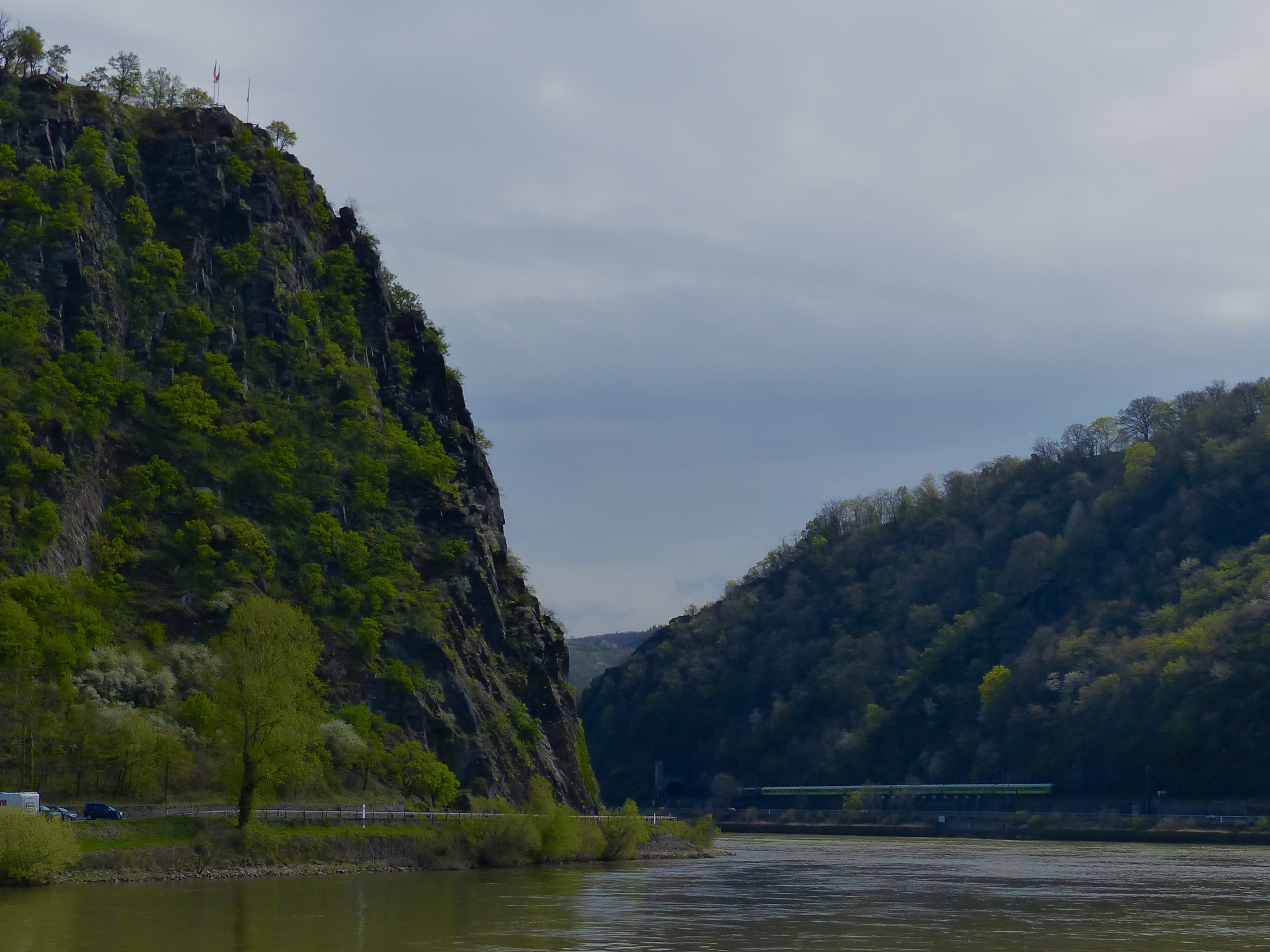
The stretch of the Rhine between Koblenz and Miltenberg is a highlight of the trip. For more than two hours of steady cruising the Rhine squeezes between forested hills broken by outcroppings of ruddy granite. Where the land slopes to gentle bottomlands there are charming villages. Vineyards climb up steep terraces. Orderly caravan parks expand the local population in riverside fields while every picture-worth building seems to be a hotel. At one dramatic point, the Lorelei Rock, the river here is particularly narrow, deep, and … before modern navigation aids … dangerous. Winds around the rock murmur and sigh, and the area is laden with legends.

Whether cruising or staying, visitors undoubtably enjoy the pastoral views, but it’s the castles that pull people in. It seems like a new one comes into view each time an old one disappears to your stern. And there’s a reason for that. The owners of these castles maintained commerce on the river. You can think of them as servants of the people or owners of a brutal protection racket, but whichever way you fall you’ll admit the architecture of their fortresses makes this a special part of the world. 

Ironically, most were just mouldering ruins until the 19th century, when the Romantic movement coincided with all those German states jockeying for power in a Germany on its way to unification. They look like something out of storybooks because that’s the way they were designed. At their most picturesque there are castles on the heights and at the riverside, presumably once working together. The most picturesque is Burg Pflazgrafenstein on an island in the river with Burg Gutenfels looming above. 

The lower could be a jewelled charm in a medical monarch’s cabinet of wonders; the upper is the kind of brooding ruin worthy of gothic horror.  The progression of castles on this stretch runs the gamut in between. Unsurprisingly, many now operate as luxury hotels. If you live in Europe, we’ve realised you could book into one of those hotels for a long weekend, take a day cruise and re-create this part of our journey fairly easily.

BAROQUE PALACES

Catholic Germany had a tradition of strong prince bishops who had both secular and religious authority and a taste for grandiose architecture. While they rolled out lavish Baroque architecture in their churches to assert the appeal of their religion over dour, ascetic Protestantism, they used the architectural style at home to demonstrate their political heft. Just like Louis XIV, father of the movement, they equated architecture with power.

The biggest of these examples in the first week is the episcopal palace in Wurzburg, a hefty block of golden stone that would make the French king feel at home. These places have a pattern across Germany: a porte cochere that allows carriages to unload their passengers at the bottom of a grand staircase. 

Shallow treads ascend to a landing, divide and continue up on either side. Statuary ornaments the railings, there’ll normally be some massive architectural statement on the landing and it will all be covered with a tromp l’oeil ceiling full of Greco-Roman deities frolicking their way across the heavens. Wurzburg looks like all the rest, with the exception that its ceiling is by Tiepolo so far better than most. A series of state rooms always follows, dripping with ornamental plaster work. Wurzburg is unusual in its embedding of mirror fragments into the swirls of the plaster, no doubt adding an exceptional glow to candlelit events. The best site here is a mirrored room, larger than these things usually are and unusual in that the mirrors are over-painted with scrolls and scenes. What you see today is a post-war recreation of what was destroyed by WWII bombs; even in modern incarnation it’s magnificent but a bit too much to live with.

Grand as Wurzburg is, I far preferred the smaller palace, its accompanying hunting lodge and the grotto-style chapel at Brühl. 

They’re all the creation of Clemens Augustus of Wittelsbach, a young man who had no interest in the church … he was forced in by his power-seeking family … but a great passion for hunting and showing off. The lodge, Falkenlust, celebrates falconry in its interior decor, complete with a blue-and-white tiled staircase hall with hand-painted tiles showing stages of his birds’ lives. Blue and while tiles (the Wittelsbach family colours) also clothe a delightful dining room in the main palace. 

The mirrored room in the lodge, though only a fragment of the size of the Wurzburg room, is much nicer, and more traditional with its writhing gilded wooden frames with little plinths occupied by china birds.

Back at the main palace, the artists behind the staircase might not be as famous as in Wurzburg, but I found the colours fresher and the architecture … complete with giant figures holding up the columns … altogether lighter and more fun than other examples. The chapel, created as a fashionable shell grotto in the ever-present blue and white, has the same effervescence. August Clemens was doubtless a terrible representative of the Catholic Church but as a builder and part host, he was my kind of guy.


WINDMILLS

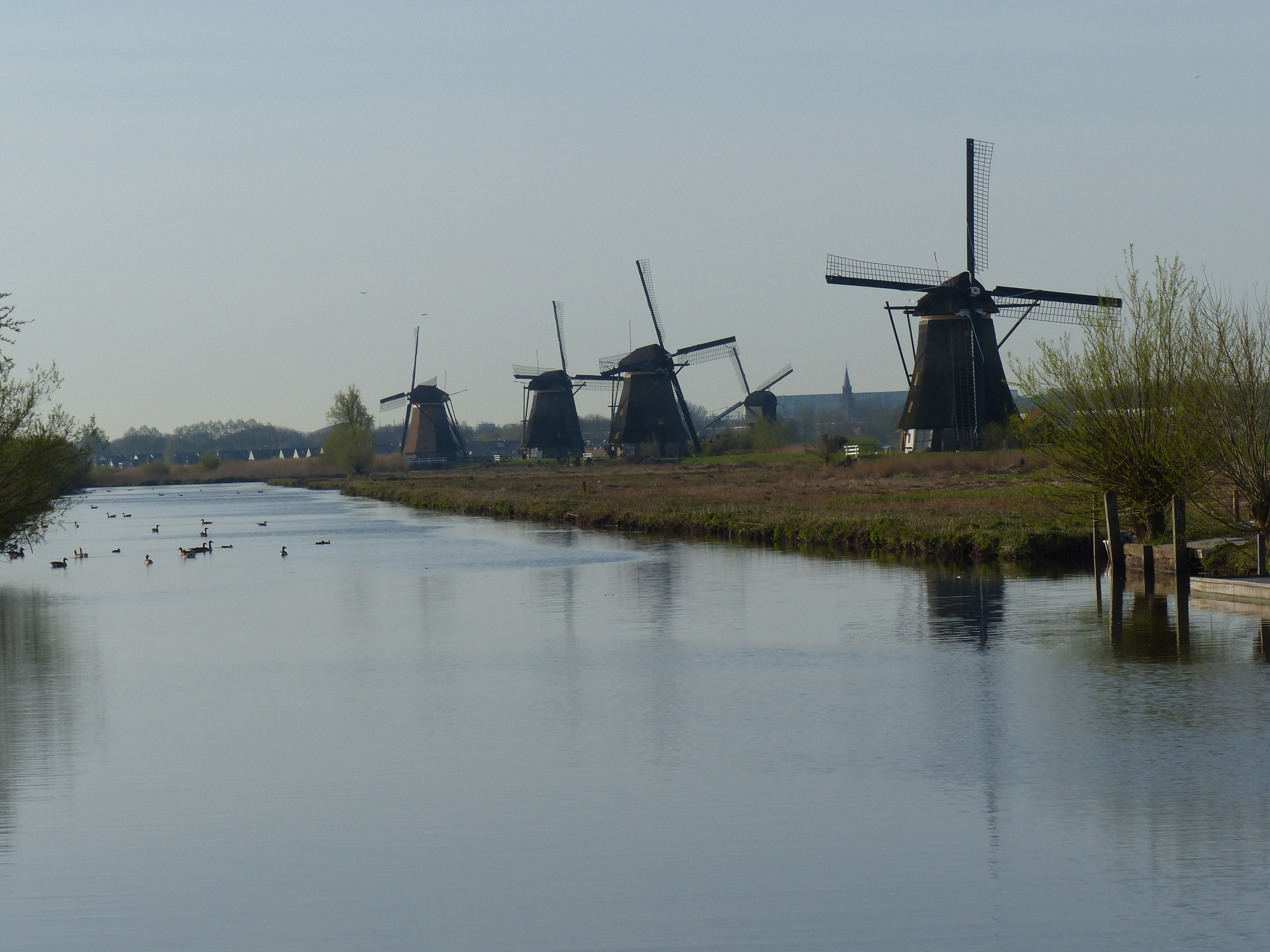
This falls into one of those pleasant surprises. Never in 20+ years of regular visits to Amsterdam has it ever occurred to me to travel to the windmills at Kinderdijk. I’ve been to individual Dutch windmills. I’ve seen them in the landscape. We have similar in Norfolk. What’s the big deal?

Well … UNESCO knows what they’re doing when they hand out those World Heritage Site designations. Kinderdijk isn’t just a bunch of windmills. It’s the largest concentration of these historic buildings … 19 from the 18th century or before … in the world, and demonstrates a unique ecosystem. The mills pumped water from one holding area to another, ever upward and to the sea. The “polder” is the cleared area left behind; a peat-rich, below-sea-level area of rich, green fields perfect for dairy farming. Windmills in such profusion are remarkably picturesque, and worth the visit to see whether you’re on a ship or in Amsterdam.


 * Viking runs this itinerary back and forth all season. If you start in Budapest, then what’s described here will be week one


Monday, 18 April 2022

River cruising is a smaller, more sedate version of oceanic holidays


One year and three cancellations past the plan, we’re finally on a Viking river cruise. Though not on the river we expected. Rather than blazing heat, crocodiles, hippos and ancient temples we’re on familiar European waters, with hawthorns blazing the hillsides with white, castles crowning promontories and half-timbered villages bankside. Welcome to the Grand European Tour, 15 days meandering from Amsterdam to Budapest at a stately pace.

Covid is, of course, the reason we’re here. The ability of Egyptian customs officers to deliver spot PCR tests and send failures to two weeks in a government quarantine hotel didn’t fill us with enough confidence to try that route. And Covid is still casting a long shadow, even over European travelling. We had to submit negative test results to get to our starting point, self-quarantining for a fortnight before the trip to ensure them. Staff illness wreaked havoc with Heathrow and its airlines, cancelling scores of flights including our original early hop to Schipol.  (While the rescheduled flight got us to the ship on time, it killed the possibility of getting to Keukenhoff Gardens for the tulips.) 

Though we were told we grabbed one of the last free cabins, the Viking Modi set sail with only about half of its full complement of 190 guests. Whether the no-shows were ill or just nervous, I can’t say. The on-board crew is short due to illness, though you’d never know it from excellent levels of service. 

Covid also introduces a new kind of holiday stress: the daily PCR test. The daily routine includes spitting into test tubes and delivering them to the front by 8am. Anyone with a positive test gets whisked off the ship to quarantine in a Frankfurt hotel, so there’s always a frisson of anxiety that a tap on your shoulder could eject you from holiday paradise … especially when you discover the people you’ve been drinking regularly with were amongst the six who’ve already had to leave.

The Covid situation means that an already small ship is even more intimate. Approaching a week on board, we’ve spent time with at least two-thirds of our fellow guests. After dinner, there are rarely more than 20 people drinking in the lounge. The barmen know and call everyone by name. One guest, adept at the harmonica, ended up duetting for two sets with the ship’s pianist. There’s an Agatha Christie-like vibe to the whole thing, with the familiarity of the lounge dwellers channelling Death on the Nile while the daily PCR test results conjure And Then There Were None.

Even with a full crew and guest list, river cruising would be a much cosier proposition than an ocean ship. There’s no pool, no spa, no grand lobby and only one restaurant. Public areas spread across three floors. On the lowest you‘ll find the restaurant, with just one seating per meal and the freedom to sit where you like. The middle … though it’s the highest enclosed deck … features a small library, a couple of computers, two 24/7 coffee and snack stations and the combined bar and lounge that opens into an outdoor area at the ship’s prow. 

Upstairs, running almost the entirety of the Modi’s 443-foot length, is a sun deck strewn with loungers, tables and chairs. The more active can walk around a track 12 times to make a mile, though most shore excursions will get you to your 10,000 steps a day. There’s also a shuffleboard court and a putting green. Unfortunately, the frequency of low bridges in the middle of the journey means the sun deck is closed for several days, but otherwise it’s a glorious place to enjoy down time.

And, as anticipated, there is down time aplenty. Half-way though this journey we’ve only had one truly packed day, with activities morning, afternoon and evening in Cologne. But the ship spends most of its time moving … a necessity when you’re covering more than 900 miles at a stately pace of no more than 22 kilometres per hour. It’s no surprise that Viking has done this for 25 years; their pacing along the route is masterfully planned. Industrial and lock-heavy areas usually glide by while you’re sleeping, though locks are such a feature of these waterways there are plenty in daylight hours, too. (There are 68 locks en route.) Many excursions start from unremarkable spots on the riverbank, bussing passengers to their sightseeing destinations while the ship keeps on with the business of sailing. 

It’s worth noting that despite what’s pictured in the brochures, and my photo up top from Cologne, the ships don’t usually moor right in the heart of the tourist district. You’re often in more industrial ports a short distance from town, making it difficult to walk anywhere. This is a challenge for the independent traveller who’d like to explore on their own … something that’s clearly not the norm. The expectation is that most guests will leave and return to the ship with the guided excursions, whether those are the included walking tours of destinations or the extra cost add-ons. Later in the cruise, when we get to destinations we know well and want to do on our own, we’ll be sharing the tour buses in and out but breaking off from the group for the time in between.

The river cruisers (of which Viking operates more than 70 in Europe) are surprisingly quiet. We can hear the engine from our balcony, though not from our room, but it’s a gentle purr rather than an intrusive growl. In the mornings, the burble of weirs and the dawn chorus of the local birds easily rises above it. The motion is also completely unlike sea cruises, with their constant rocking. Most times, it’s hard to even tell you’re moving without looking out the windows to see if countryside is passing by. I miss the sensation of being at sea, and that strange sensation of having to find your land legs when you disembark, but it does add to the placid relaxation of the whole scene.

The small scale of a river cruise also means a more sane approach to food than the big ships. Aside from the breakfast buffet, everything is a la carte with European portion sizes. While you can order as much as you want, sticking to two or even three courses a mean here is a saner, less weight-compromising affair than on ocean ships. 

The food is generally to excellent standard, and less inclined to global sameness than your typical cruise. Each night has a three-course local offering to reflect the countryside we’re sailing through. It’s not particularly seasonal … it seems odd to be on holiday in Germany in April without being bombarded with spargel, their beloved white asparagus … but I assume these menus are planned to be repeated year-round without variation for efficiency’s sake. There have occasionally been some Asian offerings that get closer in origin to the chefs and servers (mostly Filipino and Indonesian); a soul-warming tom kha gai and a chicken tikka masala that wouldn’t embarrass a top English curry house.

The crew is a well-oiled, customer service machine; this is unquestionably a five-star hotel that just happens to move. The design is more simple than Viking’s ocean ships, given the much smaller canvas they have to work with, but still a gorgeous mix of pale woods, thoughtfully mixed textiles and Nordic decorative elements. It is elegant and tasteful throughout. There’s the usual cruise industry variety of nationalities, with plenty of Eastern Europeans rounding out the already-mentioned Asians. A German hotel manager and Hungarian cruise director tie us solidly to our route. 

The guests, however, show no such variety. Despite Viking’s enormous investments in UK advertising and sponsorship, we are the only Brits on a vessel entirely populated by Americans. Perhaps three of those, by our current conversations, were born outside of the States, but on the whole it’s a very homogenous group. Which brings a few advantages, and a great many more disadvantages, I’ll write about in a future entry.

But next comes a round-up of our first week. 

Friday, 1 April 2022

Caractère deserves a Michelin star. Try it before it gets one.

There was a moment, about half-way through the procession of perfectly plated, succulent dishes that made up our tasting menu, when something extraordinary yet strangely familiar sat before me. 

It was half an artichoke heart, turned to such perfection it might have been engineered on a lathe, stuffed with a layer of umami goodness that might have been mushroom duxelles, covered with a perfect dome of some sort of light mousse and adorned with tiny crouton and micro herbs. It was only the accompaniment to the magnificent bit of skate wing that was billed as the main event, but it was so striking it took my mind back to one of the best dishes of my life … the decadent artichokes Lucullus at London’s iconic Le Gavroche.

“Who’s in the kitchen?” I gasped to the friend who’d invited me to this amazing lunch. “Is it a famous chef?” My friend wasn’t sure but did a bit of surreptitious Googling beneath the marble table and discovered a proverbial apple that hadn’t fallen far from the tree. Caractère is the culinary love-child of Emily Roux, daughter of Michel and grand-daughter of Albert, and Diego Ferrari, former head chef at the Roux-owned Gavroche and now Emily’s husband as well as business partner. 

Their exquisitely-designed, smoothly-staffed Notting Hill restaurant is a beautiful fusion of Italy and France. Classics from both sides of the Alps dance together here, though a hard look at the menu shows that ingredients lean towards the Italian while preparation methods look to the French. The wine list, as pricey as you might imagine, tends to split right down the middle and does have some good value by-the-glass choices for those trying to stay on the right side of profligate. (Lesser-known wines from Southern Italy help there.) The menu organisation is a bit mystifying, offering two choices under each of a list of five adjectives (Curious! Subtle! Delicate! Robust! Greedy!). Plus a sixth, Strong, for the cheese course. 

Nor do those adjectives really fit the dishes beneath them. I'd never call barbecued octopus delicate, and the desserts were far too petite to satisfy a truly greedy sweet tooth. Though they were perfectly-sized for a multi-course extravaganza that also featured a pre-dessert and petit four.

The perplexing menu set up may just be a clever marketing ploy to push you into the tasting menu (five courses for £90), or you can decide between the adjectives and select three courses at lunch time for £40. We were in a celebratory mood and went for the tasting, particularly appealing as it allowed individual choice for each course rather than mandating the whole table have the same. Some sanity prevailed, however, and we went for glasses of wine rather than the £80 accompanying wine flight. Thank heavens. I barely avoided the post-prandial nap home on the train as it was; nodding off might have ended my day in Cardiff.

The amuse bouche set the scene, as beautiful and packed with flavour as the rest of the meal would be.


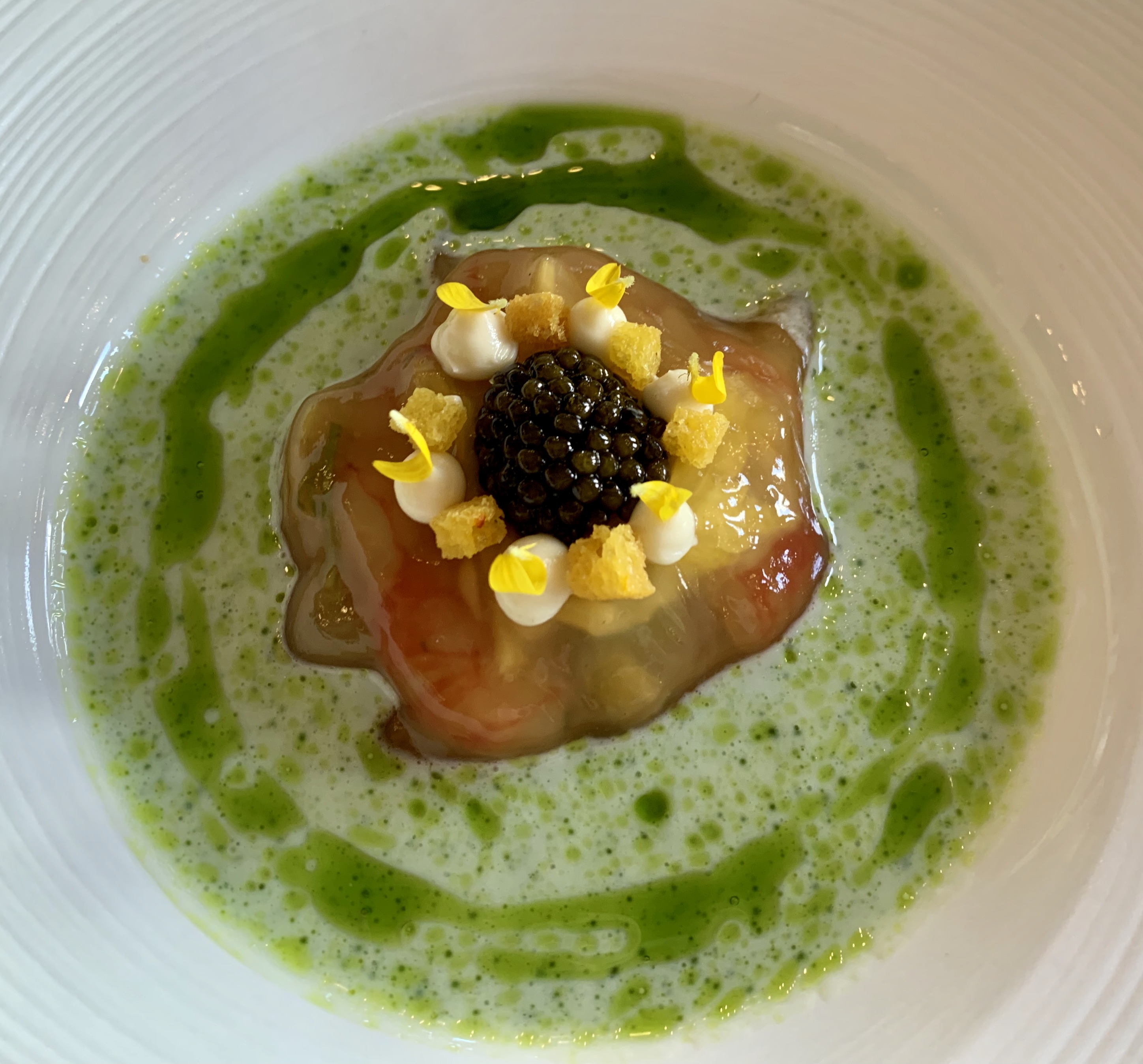
Then a Red Sicilian prawn tartare with tomato ponzu jelly and Kristal caviar.  Curious, evidently. I ordered it based on the memory of having those distinctive crustaceans in Sicily, where the natives all get very excited when fresh catches come in. The flavour, indeed, would have returned me to that magical island, had it not been for my fascination with what I could only call a blackberry of caviar on top of the jelly dome. Did they tweeze each egg into place? It was almost too beautiful to eat. I managed anyway.

Next came Caractère's trademark cacio e pepe, made with strips of celeriac rather than pasta. (That's subtle, evidently.) It sounds perverse, but is a substitute so perfect it's arguably better than the traditional tagliatelle. Lighter, a bit more bite, with just a hint of sharpness to balance the richness of the cheese. It is an almost laughable transformation of a humble peasant dish, and leaves you wanting more.

More comes not as pasta, but the exquisite skate and artichoke dish described above. aka delicate. Followed by a plate that deserved its robust description: roast loin of veal, layered potato, apple and smoked bacon, veal jus. I honestly can't tell you exactly what that triangle on top of the potato was. Presumably the apple and bacon pressed into a flat, crunchy delight. It tasted as good as it looked.

Greedy should have been applied to the cheese course, as anyone who moved on to that before the tripartite desert should consider a career in competitive eating. My oversized appetite is the bane of my existence ... or at least of my health ... but I couldn't have managed it. Although I would have loved to have seen what they did with it.

Beauty is an essential element of all fine dining; you eat with your eyes first. But that seems even more true at Caractère, where each plate did indeed seem like a little work of art. Did you spot the marbleised coating on those chocolate petit four above? The same attention is given to the dining room, all white marble, rich grey greens, terra cottas and burnished brass. The chairs are comfortable and the servers charming. Ours bore an almost-disturbing resemblance to Lin-Manuel Miranda, I wondered if we were going to end up in an Encanto flash mob as part of the soundtrack's Oscar bid. But the atmosphere remained quiet and peaceful throughout. They could cram more tables in here but I suspect have made a purposeful decision not to. It's a remarkably calming environment. 

For me, Caractère's only drawback is the challenge of getting to and from it; as it's not on our usual London flight path.  Which means, much as I'd love to try it again, I'm not sure when that will get into the diary. Though it should. Given that my husband and I have spent the entirety of our relationship bickering over whether French or Italian cuisine is better, Caractère feels like the ideal battleground to fight it out. Or exhaust ourselves trying.