Showing posts with label National Trust. Show all posts

Saturday, 31 October 2020

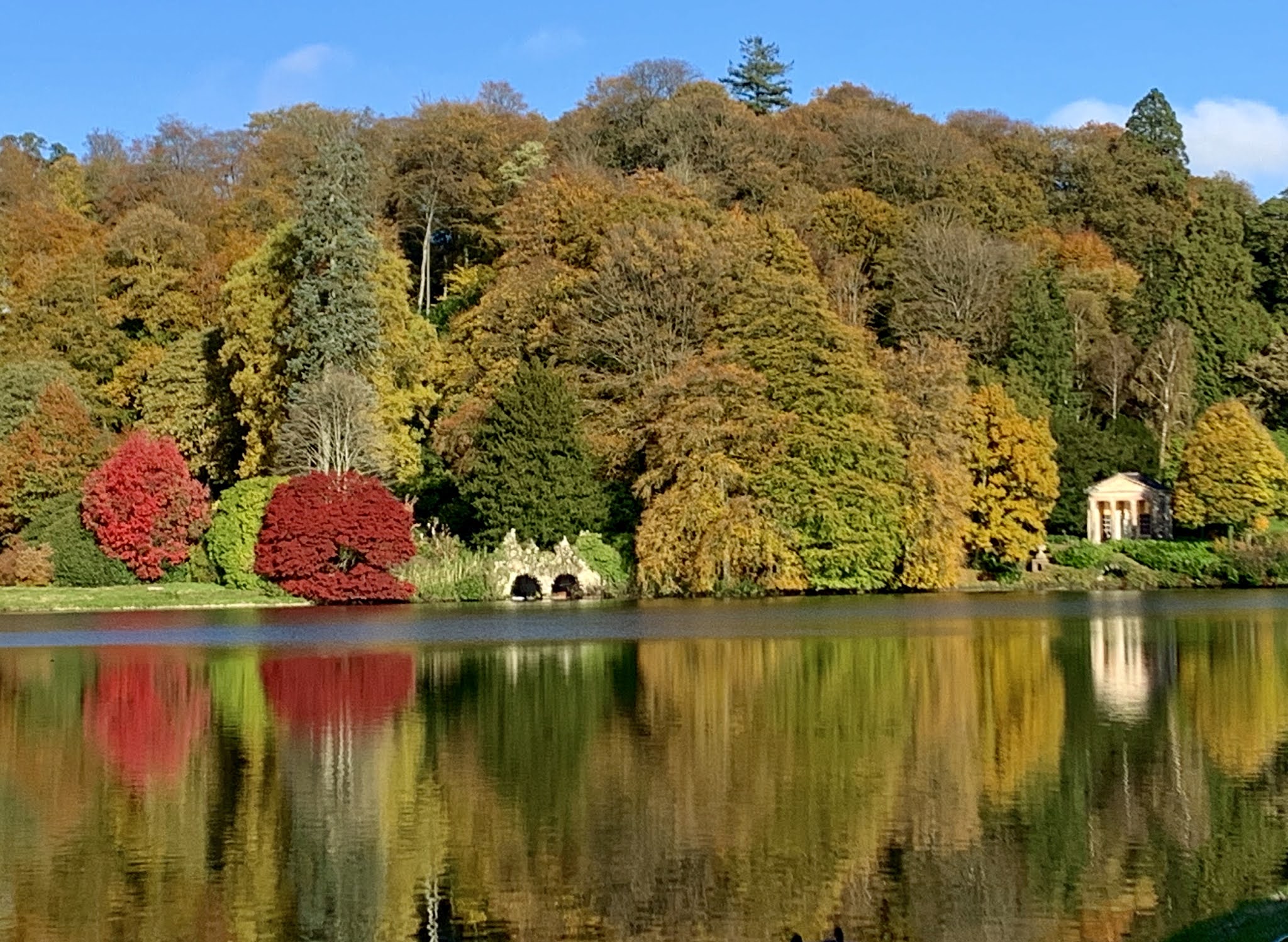
World’s best for autumn colour? Stourhead has a claim.

The English class system has done a lot of damage over the centuries, but we can also bless it for its impact on architecture and interior design. In the success-obsessed United States, new money has tended to splash out on bling-drenched conspicuous consumption. In England, while the consumption might be equally prodigious, self-made fortunes seek the best in establishment tastes and bend over backwards to rub off any taint of the new.

In just the past few months, the trend has shown up on this blog in articles about Harewood House and Bovey Castle. And here, on a crisp autumnal day en route to the West Country, the glorious Georgian mansion and landscape garden at Stourhead.

Stourhead was the country pile of the unfortunately-named Hoare banking family. They never quite washed the taint of trade off their hands. Though they kitted out a lavish bedroom for Queen Victoria she never visited, thinking the family too far beneath her. Presumably the Hoare’s had the last laugh, since they’re still in charge of the oldest private bank in the country and Victoria’s kingdom is now heavily dependant on financial services to survive. Had the queen lowered herself to a visit she would have discovered not only a house very much to her husband’s Italianate tatstes, but one of the two best examples of a classical landscape garden in the country. (The other is Stowe, bigger but, IMHO, not as dramatically beautiful.)

Wealthy tourists in the 18th century would return from the continent ... usually Italy ... laden with treasures that showed off what they'd seen, and fired with a passion to re-create some of the magic at home. Most houses of the time will feature Roman statuary in the gardens, or showy pieces of furniture inlaid with semi-precious stones (called pietra dura) from Florence, or a few paintings of Venice by Canaletto. That balanced approach wasn't enough for Henry Hoare, who was obviously obsessed to something bordering madness by all things Italian. 

The house is a stately Palladian cube, rather small as grand country houses go, packed to the gunnels with paintings of classical stories and Italian landscapes, plaster ceilings and decorations taken from Roman temples and Italian style furniture. Obelisks, classical statuary, collections of Roman seals and lofty gods and goddesses run amok. There are few masterpieces on the walls, but the theme is clear. Hoare was re-creating Italy in the England.

But the house wasn't enough. He went on to re-create the countryside itself. Ironically it was three Frenchmen of the time ... Claude Lorrain, Nicolas Poussin and Gaspard Dughet ... who became most famous for painting imagined scenes of Italian antiquity. Gods, heroes and historic figures play out their adventures in deep, romantically-wooded valleys dotted with classical temples. There's almost always a lake to reflect the architecture and the action. Many English tourists decided they'd try to re-engineer their gardens to evoke this look, but nobody did it as thoroughly as Hoare.

This Lorrain painting in Stourhead’s collection is thought to be a direct inspiration for the garden

He was lucky enough to have the wooded valley beneath his house as a foundation, but no lake. So he dammed a stream and time did the work for him. Once the valley floor was appropriately flooded, the temple building began.  There's a miniature pantheon, an ancient and stolid temple of Flora and a magnificently bonkers domed and columned temple of Apollo on a hillside. 

A gracious Palladian bridge links the two, purely for visual effect since it's bridging an inlet you could walk around in three minutes. 

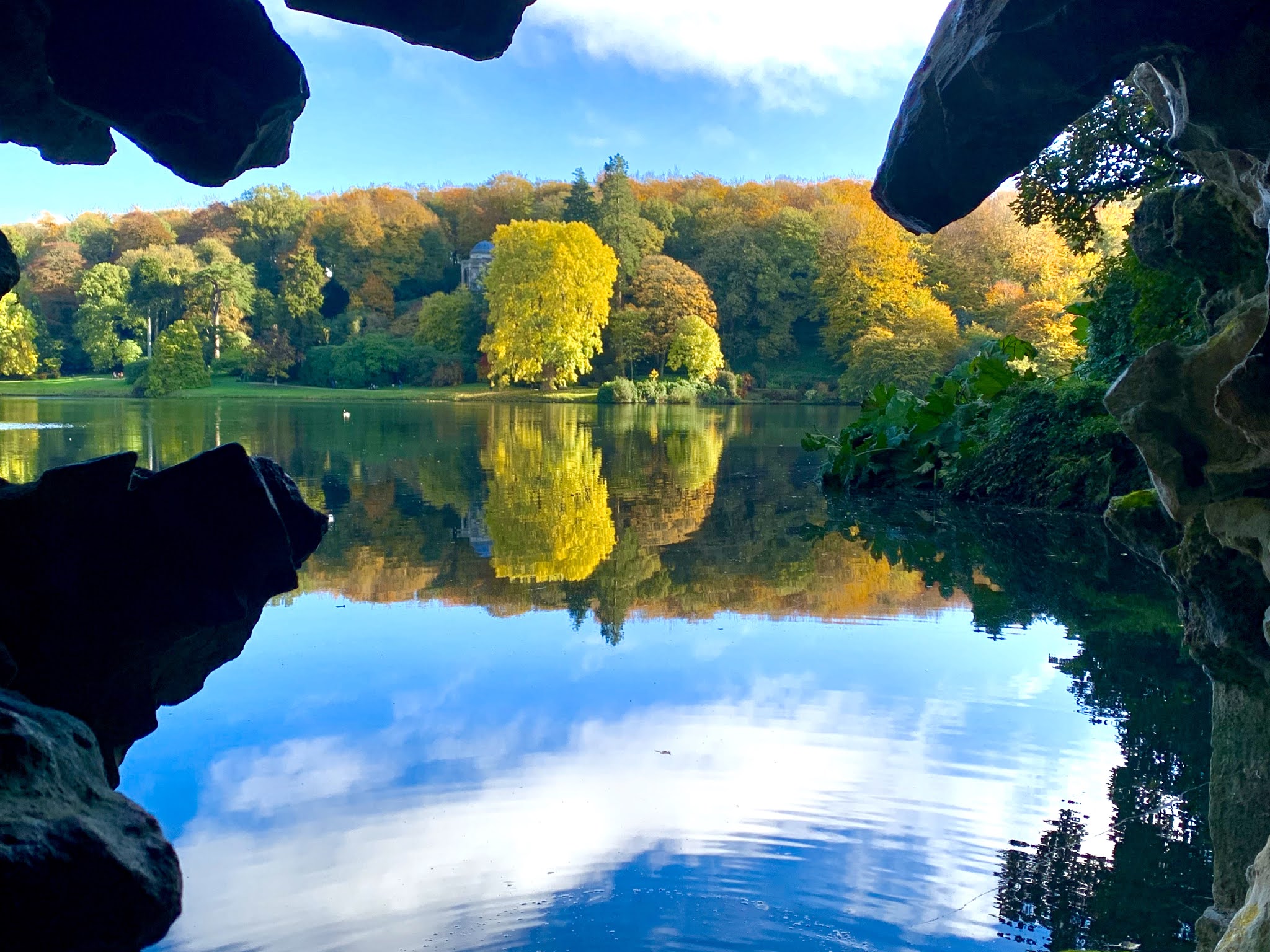
Each is designed to look out over at least one of the others, all set in a carefully chosen mix of trees. The lake is a mirror to add another dimension to your views. 

At one point, the path brings you into a dark cave where the sound of dripping water beckons you to a grotto where a water nymph and river god lounge in alcoves while carefully planned gaps in the wall conjure more artistic views across the lake to other temples. 

A towering obelisk adds to the classical antiquity, not near the lake but at the top of the hill with a long grassy avenue cleared through the trees to allow an impressive vista. In modern terminology the place is, as one of my friends proclaimed, top Instagram porn.

Despite the Hoare family’s obsession with the classical world, they couldn’t resist a few other passions of the time. There’s a sweet little cottage called The Hermitage with gothic windows and a thatched roof, playing on the passion for hermits and dark mysteries that came with the rise of gothic literature. A little over two miles from the lake stands King Alfred’s Tower, a 161-foot construction that looks rather strangely Germanic with its crenellations and pepper pot roof. It marks the spot where King Alfred was supposed to have mustered his troops in 878 before his success at Edington. Love of the gothic also led the family to rescue Bristol’s market cross, a glorious spire that was unloved and would have been destroyed by the town’s improvers had it not found a second life as a garden ornament. 

The cross marks the transition between the garden and what’s left of Stourhead village. A picturesque row of cottages, a parish church, a Georgian pub and an aristocratic stable block now mostly cater to tourists’ needs, with the cottages all B&B or holiday rental and space in the stables let out to shops and snack bars. The Spread Eagle Inn also offers accommodation, with its ground floor given over to picture-postcard pubbage. On the sunny afternoon we visited, the pub had extended service to tables in the stable courtyard and had a full menu from light pub classics to full three-course meals. I gave high marks to my ploughman’s but three of us all envied the fourth’s towering Waldorf salad, studded with local, seasonal apples, walnuts and cheddar.

I have been to Stourhead many times, in all seasons, but there’s no question in my mind it’s at its best in the autumn. And we couldn’t have timed our visit better. Oaks, maples, alders and chestnuts were blazing in a merry range of yellows, oranges and vivid scarlets, bearing miraculous testimony to the people who designed this planting scheme but wouldn’t live to see it mature. These trees weren’t put in haphazardly, but purposely placed so their autumnal foliage would create a living painting. It is, with blue skies in late October, quite simply one of the most beautiful places on Earth.

You’ve missed this year’s autumn show but the garden is open all year and the local National Trust managers do a fine job of programming special events for all ages. Winter illuminations run from 27 November to 3rd January. You can get tickets here.

Sunday, 13 September 2020

The show must go on ... and West Green makes it happen

England's legendary country house opera season is yet another victim of the COVID-19 crisis. From internationally-acclaimed productions at Glyndbourne and Longborough's renowned Wagner interpretations, to many small, humbler efforts, everyone got shut down this year. As prohibitions loosened some outdoor performances became possible, and while full operas couldn't be rehearsed and organised (or made to break even) in the circumstances, venues sprang into action to take advantage of any opportunity they could.

Our nearest, West Green House near Hartley Witney, Hampshire, managed to whip up a six-concert summer season in August and September, of which we took in the last: Mozart in Love.

It's hard to overstate just how glorious is was to hear live music again, surrounded by the soft murmur of an appreciative crowd. Even if that music was limited to one singer and a pianist, and the pre-booked attendees had been channeled into appropriately sized boxes chalked onto the lawns, socially distanced from their neighbours. 

Soloist Kirsty Hopkins (who also co-developed and directed the whole series) delivered an hour-long programme of 10 of Mozart's best soprano arias, from the heart-wrenchingly poignant Dove Sono I Bei Momenti to the enraged passion of Ah. Chi mi Dice Mai! Each came with anecdotes and back stories from Hopkins, adding context to the simple but powerful performance. She returned with an encore of the Alleluia from the Exsultate Jubilate, the music we used for the registry signing at our marriage. It always turns both our knees to jelly, but was particularly powerful in this rare event for 2020, just days before our anniversary, with the sun shining and swans gliding across the nearby lake.

With gates opening at 11am, music at noon and the ability to linger in the gardens until 4pm, the concert series allowed for one of the raisons d'etre of country house opera: elegant picnics. We were actually slumming it a bit, as many others had shown up with tables, cloths and full place settings, while we made due with plates on laps. But I'd wager our bbq chicken, arancini, barley salad and lime tarts were on par with anyone else's culinary efforts.

Of all the country house opera venues I've explored, West Green has the finest garden. (Yes, better even than Glyndbourne.) That's probably because opera here is a recent addition to venerable and well known horticultural efforts. At its heart is an enormous Victorian walled garden, with outlying paths, a lake, water features and follies. It's not a big place, but one where thoughtful design has given every section impact and clever vistas and borrowed landscape make it seem larger. Its most distinctive feature, however, is a light-hearted sense of humour.

Vegetables grow side-by-side with flowers. The palatial chicken coop has an Imperial Chinese theme, including willow-pattern water bowls.

A section of grassy mounds along a pathway looks like a recently-abandoned hobbit village. Classical portrait busts lurk at ground level amongst the greenery. 

Most amusingly, if you’re made aware of the joke or if your Latin is particularly good, there’s a column with a Latin inscription noting “this monument was built with a great deal of money which otherwise someday would have been given into the hands of the tax collector.”

The snarl against excessive inheritance tax came from former owner Alistair McAlpine, a Tory grandee in the 1980s responsible for the initial renovation of the garden. These days credit goes to Marylyn Abbott, an Australian immigrant who’s both a keen gardener and the former marketing manager of the Sydney Opera House. It’s she who started the opera tradition here. 

Both leased the house from the National Trust, which still owns the place and allows members into the gardens for free. (Others £9 and extra charges for events, of course.) It’s not the typical NT property, however. The lovely, Georgian brick house isn’t open to the public and is relatively modest in size, more like the places you see for sale in Country Life than the sprawling historic piles of the tourist trail. The Abbotts are regularly present for events and take a very personal hand in running the place. This also means there’s a more creative run of events than the usual NT property, with apple festivals, a car show, craft workshops and Christmas illuminations all on offer later this year. 

If COVID-19 allows, of course...


Monday, 1 October 2018

Brownsea is a safe haven for more than just red squirrels

Most people know the stories of how vast numbers of native Americans died in the early days of European exploration as they encountered for the first time, and were defenceless against, diseases brought by the newcomers. We don't hear so much about biological disasters coming the other way across the Atlantic, but they happened. It's how most of England ended without its native squirrel.

The distinctive red creature, with its tufted ears, intelligent eyes and diminutive frame, is today more familiar from Beatrix Potter illustrations than live observation. That's thanks to imported American grey squirrels who, in less than a century, spread from a curiousity in one aristocratic park to the dominant breed scrambling through trees across the country. I'd always assumed it was because the immigrant grays, who are three times the size of the reds, either killed their hosting cousins or stole their food. It turns out there was no rodent genocide. The grays simply carried a disease that doesn't bother them, but quickly wiped out the reds.

My fresh awareness is thanks to a guided squirrel walk on Brownsea Island, one of the last refuges of the native animal. We'd decided on the National Trust property in Poole Harbour as something new and different to do on a gorgeous autumn day before my visiting father headed back to the States. Expecting little, we were blown away ... not just by the squirrels but by the secret garden quality of the whole island and the unexpectedly magnificent sweep of Poole Harbour.

The communities around the harbour host some of Britain's priciest real estate, and one look at the view on a fine day makes it obvious why. This is the second-biggest natural harbour in the world after Sydney, but it's surprisingly devoid of commercial shipping or large buildings. None of the ports in the harbour are big enough to host cruise ships. Instead, this massive stretch of water ... an inland lake but for a narrow mouth opening onto the Solent ... is populated by pleasure craft, yachts and an archipelago of small, mostly privately-owned islands. The shores to the north and east are fringed with charming small towns (Poole foremost amongst them), sleek blocks of modern flats and mansions torn from the pages of architectural magazines. To the west, the Dorset hills fill the horizon, still the wild, green expanses of Thomas Hardy novels. It's spectacular.

Poole is a pleasant place to poke around in, with a higher-than-average number of independently owned boutiques and restaurants thanks, no doubt, to the higher-than-average income of local residents. If you're making for Brownsea, it's notable as being the main departure point for the harbour ferries that will get you there. (You can also depart from Sandbanks, but it's further from the motorways you'll probably use to get here.) There's plenty of room in a multi-story car park to abandon your vehicle for the day, but drivers of larger models should proceed with extreme caution. This is a vintage facility from the era when Brits drove tiny cars; every column and tight ramp entry is marked with the paint of vehicles that didn't judge the tight spaces correctly. Including mine.

Try to get here by noon so you can grab lunch in one of the restaurants along the High Street. There is a National Trust cafe on the island but the selection is very limited.  Alternatively, pack a lunch and take advantage of the island's abundance of gorgeous picnic spots. The ferry costs £11.50 and is not part of island admission, so even National Trust members need to pay up. It goes direct from Poole Harbour to Brownsea, which is a quick 10- to 15-minute hop. On the way back, however, you'll continue on a clockwise circumnavigation of the harbour with some informative commentary, so it's a pleasure cruise as much as practical transport.

A Victorian faux-castle and a range of suitably baronial outbuildings welcomes you as you arrive on the island, but they're some of the only signs of "civilisation". The castle is a private retreat run by the John Lewis partnership for its employees. The National Trust cafe occupies the old stable and some waterside lawns with spectacular views. Other outbuildings house a small gift shop and a couple of holiday cottages. Beyond is 500 acres of woodland, lawns, heath, salt marsh and cliff walks. At just 1.5 miles long and 3/4 mile wide, it's small enough to cover in a day but big enough to offer variety and ... at least on a weekday in October ... to find yourself alone in glorious woodland solitude.

With its salt marshes, Brownsea is a haven for bird watchers. It's also a sacred spot for the Boy Scouts because Baden Powell started the organisation with camping trips here. Scouts still regularly come to stay. But it's the red squirrels that draw most of the crowds. Though visitors should be aware that it's possible, and even common, to spend a day here without seeing any. Red squirrels are small (about seven inches tall without their tail and weighing in at about 10 ounces), fast and reclusive. Fortunately, the National Trust offers daily squirrel safaris with knowledgeable guides who will take you to the spots where you're most likely to catch a glimpse of one of the 200-strong population. By pure circumstance we ended up on the island in peak squirrel-spotting season, when the population is hard at work finding and caching nuts for the winter. We saw five on the group walk, then I returned on my own to commune with a few more.

A stand of beech, hazel and pine forest behind the island's church was the week's hot spot. It's woodland from a fairy tale, dense enough to provide shade and a springy carpet of loam, but well-spread enough to allow glimpses of dappled sunshine and long views through tree trunks to distant clearings. I perched on a log and opened my ears as well as my eyes; you can hear the squirrels scampering through the leaves before you spot them. There was a magical moment when one paused atop a fallen trunk less than 6 feet from me and looked me straight in the eye, but I can't prove it. By the time I raised my camera, he was gone.

We wandered around the island for a couple of hours. With warm summer weather, well provisioned and with a good book, you could lounge here for hours. It's not just a refuge for squirrels. If you want to disconnect from the modern pressures for a bit, this haven feels much further away from the "real world" than a 15-minute boat ride.


Thursday, 23 August 2018

Ickworth, Wimpole show off East Anglia's country house glories

Had life taken just a few turns differently, I might have settled in East Anglia.
My first tentative steps into English life, rather than tourism, happened there. My American employer had a subsidiary in Cambridge, and I managed to plead my way into two week-long assignments there following British holidays in the early '90s. Had they, rather than the London HQ, had longer-term roles, I would have happily started my expat life there. At about the same time I was getting to know my first British office, the man who would become my husband had inherited a quarter share of a farm in Norfolk. Reality called him to London as well, and the family sold up, though a drive by the old place this past weekend did trigger fantasies of me, freelancing after a career of tech marketing in Cambridge, married to a blackcurrant farmer and producing my line of boutique prosciutto from heritage-breed pigs. It could have happened...

Instead, this area is mostly a vivid memory imprinted by the typical, high-intensity explorer mode of my youth. I packed more tourism into the four weekends and 10 weeknights around those Cambridge business trips than most people do in years. What I found was quite possibly England's most densely-packed region for country houses, cathedrals and charming villages. While residents of the Cotswolds, Dartmoor or the Lake District might sneer at the flat landscape, the fens have a moody charm and there are some lovely beaches.

And yet, aside from one girls' trip in 2010, I've hardly set foot in the region since moving to England permanently in '99. This is primarily because of how inaccessible it is, thanks to Britain's overstretched transport networks. Though it's only 120 miles from our house to Cambridge, that will take you about four and a half hours if you hit the typical jams on the M4, 25 and 11. (Three on the rare traffic-free run.) Trains are expensive, uncomfortable and demand the hassle of a cross-London transfer. A journey requires a good excuse. And now we have one. A dear friend is about to "marry in" to the county, so we headed to her new village of Great Hockham for a long weekend.

The sightseeing options from here are vast. Bury St. Edmunds ... home and site of the martyrdom of England's original patron saint ... has an atmospheric town centre, a romantic ruined abbey and a modern sculpture trail commemorating Edmund's story. Newmarket is the home of British horse racing. Cambridge, of course, has all the dreaming spires, culture, punting and architecture of Oxford, but is slightly less overrun by tourism. Cromer, the nearest beach town, is famous for its crabs. Duxford offers one of the world's best aerospace museums, which I wrote about here.

On this visit, and having barely used my National Trust membership this year, I opted for countryhouses: Ickworth on the way up, Wimpole Hall on the way back. Both are spectacular examples of late Georgian/Regency style and, I wager, would be far better known if they were easier to get to. Distance does. however, have its advantages. Neither were particularly crowded, even on a weekend at the heart of school summer holidays.

Ickworth is unique for its enormous central rotunda. Intended as an impressive space for entertaining and showing off collections, it was designed by an imported Italian architect and is clearly meant to channel monumental ancient architecture with its ascending orders of columns and Parthenon-style external friezes. The result is a bit ungainly. Out of proportion with the wings on either side of it, the rotunda looks more like a museum or civic building than a gracious country house. But its sheer quirkiness makes it worth a wander.

The entry hall is particularly magnificent, soaring up the full height of the building beneath the dome, the space broken by a series of landings and fly-overs. Not only decorative, the landings along the upper stories are all lined with bookshelves, making the space a rather magnificent multi-story library.  The thing I remembered most from a visit here 20 years ago, however, was the Pompeii room. It's still just as striking, though two more decades of European tourism have given me the perspective to find it just a bit less unique than I thought it was, and in far worse repair than I remembered. Still, it's one of the earliest examples of the fad for copying what archeologists were digging up beneath Vesuvius, and it's gorgeous. I had not remembered the extensive collection of family silver, which is one of the best held by the National Trust.  One of the most amusing things about Ickworth, however, is simply checking out how its decorators worked with the challenge of curved outer walls. In some spaces, like the dining room, it throws proportion off and seems decidedly odd. But it enhances the drawing room to make it a dramatic spectacle.

Most of Ickworth came together during the Regency, that brief but critical inflection point between the Georgians and the Victorians. I adore this style. You have all the scholarly classicism of the Georgians, but it's tempered with a sense of humour and fun. And while it anticipates the lavish use of fabrics and pattern, and random mix of historic styles so beloved of the Victorians, it does it with a much lighter, airier touch. Wimpole Hall is an even better example.

The most memorable interiors here are the work of Sir John Soane, who went on to be one of the go-to architects of the early Victorian age and is now remembered best for his Bank of England building (based on a grand Roman baths complex) and his house-turned-museum. There's a marvellous story of how the owner of Wimpole, while on his Grand Tour, noticed an Englishman obsessively measuring the ruins at Paestum. It was Soane. When it came time for home remodelling a few years later, that sort of attention to detail meant Soane got the call.

Though this is early work, his obsession with domes and arches ... and mixing them up in interesting ways to bring light into a room through innovative sources ... was already in full flow. He created one of my favourite libraries in England here, with a light-filled ante-room under a series of arches, classical motifs in plaster picked out with grey-and-white delicacy. The house is most famous for his T-shaped, yellow drawing room, the odd angles and tall dome of which demanded the destruction of seven rooms to squeeze it into the framework of the old house.

My favourite, however, is his Roman-inspired indoor swimming pool. Visitors came down a circular stair from the bedroom level to enter a small room with a fireplace, towel racks and arched alcoves. From there, two arches open on curved stairs that sweep down, meeting in the middle on a wooden deck surrounding a deep pool. Not big enough for swimming laps, but eight or 10 people could happily take a dip here at once without crowding. Don't forget to shower before entering the pool! It's a Soane-designed piece of furniture: step inside the four wooden columns and beneath the round water tank (mahogany decorated with classical motifs) and pull the chain; water will drain through a lead grill to a pan beneath your feet. I wonder what Victoria and Albert made of it on their visit here. Evidently Soane designed a number of these, but this is the only one left.

Wimpole is more than Soane, however. In the best English country house tradition it shows off layers of design from different eras. The exterior and formal staircase, encrusted with decorative plasterwork on broad cornices, is Carolingian. There's a rare Baroque painted chapel by Thornhill that looks more suited to Hampton Court Palace than a Cambridgeshire country seat. Victorian tiles in ancient Roman style welcome visitors with a big "Salve" laid into the floor.

We can thank Elsie Bambridge for our ability to see any of this. Rudyard Kipling's daughter, and only surviving child, lived here from 1938 to her death in 1976, using royalties from her father's books to restore what was then a crumbling pile. Think of this as the house The Jungle Book built. Bedrooms and several sitting rooms appear as she left them when the place went to the National Trust, capturing the lovely pastiche English country house style of the late 20th century.

Outside there are walks through classic parkland, a dramatic ruined castle (actually a folly built from scratch) to catch the eye, an impressive stable block with cafe and shop, a separate restaurant in the service wing, the parish church and an enormous Victorian walled garden fully restored to grow fruit, vegetables and flowers. The old home farm buildings have been transformed to a model farm and petting zoo for kids; I didn't get that far but the flow of happy children walking back from that direction suggests it's probably a bigger draw than Soanian architecture.

Wimpole and Ickworth are just the tip of the country house iceberg in East Anglia. My introductory blitz in the early '90s gives me fond memories of the Baroque glories of Houghton, the Tudor ghost that is Anne Boleyn's childhood home of Blickling and the fanciful Jacobean skyline of Felbrigg. Holkham, the only house in the county I've visited and written about since starting this blog, is perhaps my favourite house in the country and has the added benefit of one of England's best beaches.

Yes, it's a pain in to get here from Hampshire. But I think I'm very happy that I have friends with a guest room in the region. It's time to get to know it again.

Friday, 26 February 2016

Get eye-to-eye with unique Renaissance treasures at The Vyne

It's easy, sitting in a comfortable house in England, to find the destruction of the treasures of Palmyra or the Bamiyan Buddhas by religious fundamentalists absolutely unbelievable. A careless and pointless desecration of history that's beyond our imagination. And yet ... it happened here not that long ago.

In the middle of the 1500s, and again 100 years later, religious conflict tore England apart. One notable victim was the country's religious art; particularly fragile stained glass windows. That's why a set of panels at a country house outside of Basingstoke is so remarkable. Until Easter, you have a once-in-a-lifetime chance to get nose-to-nose with them.

William Sandys created the Vyne to celebrate his success as Lord Chamberlain to a young Henry VIII. Though most of the house you see today is Georgian and Victorian, the chapel is a magnificent survival from the original. Up above the altar are three light-filled arches, each with six panels of vivid stories told in glass. The top panels are religious scenes, the bottom commemorate the notable royals who had made Sandys' career possible. These glowing, jewel-toned works of art demonstrate what was possible at the apogee of the Renaissance glass-maker's skill. They're just as good as the celebrated ones in Auch Cathedral (Gascony) I wrote about here. But these are the only ones of this quality you're going to see in England, in their original setting.

They have always been beautiful, but now they've been spectacularly reborn. Suffering from five centuries of weather, outdoor grime and indoor candle smoke, they were showing their age. Pitted, a bit grimy, wobbling dangerously in their leading. So the National Trust embarked on a comprehensive and risky restoration. They removed everything, cleaned and restored each panel, fit the jigsaw back together, then replaced them. But not before installing a second, high-tech, weather-proof set of clear glass panels between the original windows and the Hampshire weather. This modern double-glazing, combined with careful conservation indoors, should mean that these unique treasures will be be preserved for generations to come.

But you only have four more weeks to see them at eye level. The National Trust has left the workers' scaffolding in place, so you can clamber up and look straight at them. It's only from this perspective that you really grasp the nuance and sophistication. Lavish architectural detail. Tiny trees and buildings in the landscape behind the main figures. Animation and expression in the characters' faces. The the fluid spring of a running dog keeping pace with a small boy. This is the kind of detail you just don't grasp when you're standing 12 feet below. It's a testament to the makers' search for perfection that they incorporated so many fine points they knew most people would never notice.

Equally interesting to any Tudor history buff is who's in the windows.
Henry VIII is in the centre. Not the broad, grim wife-flipping
brute of popular imagination, but a handsome, beardless blond youth with an eager look and an equally young blonde wife. She's on his left, and you can tell from the pomegranate design on her sleeve that it's Catherine of Aragon. Not the tired, post-menopausal woman fighting to keep her marriage, but a beautiful and confident newlywed. It's fascinating, and tragic. The other woman is Margaret, Queen of Scotland and Henry's sister. (Check out the perfect contentment of her lapdog, cheekily curled up on the lavish purple velvet of her prie dieu.)  These are very rare contemporary portraits of people we think we know well. The faces here suggest that we don't.

Thanks to the fine work of the National Trust and specialist restorers Holy Well Glass, you'll be able to appreciate these treasures for the rest of your life. But if you want to appreciate their details to the degree described here, you have four weeks.  Get there. You won't regret it.


Monday, 24 August 2015

Pack plenty into a weekend in culture-rich Kent and East Sussex

Chartwell, Sissinghurst Castle Garden, Battle of Hastings Abbey and Battlefield, Bodiam Castle


A typical Englishman might be surprised by the density of tourist sights in North Hampshire (written about here), but he'll take it for granted in Kent.  It's hard to drive more than three miles in the so-called "garden of England" without stumbling on another brown sign pointing to something significant.

It was precisely that quality that saw me using Kent as a base when a young, eager, yet cash-strapped tourist.  I'd done my research.  Nowhere else outside of London allowed me to use more of my "Great British Heritage Pass" in such a short radius.  (The passes are, sadly, no longer sold.  They offered access to National Trust, English Heritage and privately owned sites for a single price.)  I spent an entire fortnight's holiday staying there and sometimes slipping over the border into neighbouring East Sussex in the early '90s.  I returned many times after, meaning that though I haven't spent much time there recently, I actually know the county and its sights well.  Not so for my husband.  We had an event in Tenterden on Sunday, so though ... why not make a long weekend of it?

With the exception of a quick garden visit, I let him pick the locations.  Which, unsurprisingly, leads us on a trail linked by military history.  Being Kent and East Sussex, of course, that also means good architecture, lush landscape and inspiring gardens.  Here's what we got up to.

Chartwell
Winston Churchill's home is in the northwest corner of the county and if, like us, you're coming from the west, this is the perfect gateway sight to welcome you to Kent.  Leave plenty of time, however.  This is one of the National Trust's most popular properties, and they only let a certain number of people into the house each half hour.  When all the tickets are distributed, you're out of luck.  Arriving around noon on a Friday snagged us tickets for 2:30; I certainly wouldn't have wanted to risk getting there after 1.  I'd go earlier on a weekend.

Spending your time before getting into the house is no problem.  There's a restaurant here where we stopped for lunch.  The views are better than the food, but the basic lunch fare won't let you down.  The bigger-than-usual National Trust shop has, as you would expect, lots of Churchill memorabilia and books, plus a fine range of plants you'll find in the gardens.  In fact, I found the gardens as much of a highlight as the house.  There's a beautiful walk to the house looking over a grassy valley to the wooded ridge beyond, ending at the lily pond where the great man used to sit to think and paint. A formal, walled area billowing with roses greets you near the house; beyond that is a lawn cornered by
a pavilion commemorating Churchill's ancestor's victory at the Battle of Blenheim.  Follow the slope down through the orchard to Churchill's studio, still packed with his paintings.  Whether you regard them as art, or an insight into his coping strategies, they're fascinating.  Work your way back up to the house through the walled vegetable and flower garden, unusually built into quite a steep slope.  That makes the view from the top all the more dramatic.

Of course, the house is the main event.  The Churchills left it to the nation and his family's close personal involvement before they handed it over means you're seeing something put together with thoughtful care.  The decor has been carefully arranged to show Chartwell as it was between the wars.  These were Churchill's wilderness years when he was out of government, waiting, worrying, thinking and writing.  What a wonderful setting to do those things in.  In most rooms, it looks as though someone has just stepped away, and will be back at any moment.  You can even spot those famous cigars perched in ashtrays.  Several upstairs rooms are given over to a wonderful museum where you can learn more about Churchill's life while seeing his uniforms and gifts accumulated from respectful fans ... common people to world leaders ... around the world.  Don't miss the slightly hideous cut class and silver bowls from Stalin; exactly the kind of art you'd expect a brutal dictator to favour.

Sissinghurst Castle Gardens
This was my non-negotiable stop.  I can't be within 20 miles of what's probably the world's most famous garden without popping in for a look at what's in bloom.  I've been here many times, going back to my first visit when we stayed in the farmhouse on property, and there's always something new to see.  This was my first visit in August, seeing the white garden at its peak.  Areas that stand out in
spring and early summer (the orchard, the the lime walk) fade to obscurity, while the cottage garden is exploding with oranges, reds and yellows and the rose garden ... its main occupants past their prime ... gives over to asters, dahlias and chrysanthemums.  The herb garden is also at its best at this time of year.

One thing that never changes here is the crowds.  Get here before the place opens.  Have a coffee, walk around the perimeter, check out the vegetable garden (not part of the ticketed area).  Go in when the main garden opens, and you'll be leaving just as the crowds start outnumbering the flowers.

Battle Abbey
Even Brits who are terrible at history can usually drag "Hastings 1066" out of their brains.  Fact is, William of Normandy may have landed at Hastings, but he beat the Anglo-Saxons at a place called Senlac about six miles inland.  The fight there was such a horrific bloodbath the pope ordered conqueror William to establish an abbey there in atonement, which is how the abbey and town of Battle came to be.

The abbey passed into private hands at the dissolution of the monasteries and followed the usual path of such things:  church torn down for building materials, domestic buildings turned into an aristocratic home, a few ruins left standing for picturesque value.  By the middle of last century, the buildings were put to their current use as a school.  But the battlefield, remarkably, was never built on.  Now under the care of English Heritage, your entry fee gets you an audio guide that will take you through the late-medieval gatehouse, to an exhibition centre explaining the story of the battle, around the battlefield, ending at the ruins of some abbey buildings.  (You can't go in the school.)

The exhibition and the guide combine to give good insight into the dynastic struggles that led up to the conflict and the drama of the day.  I've never heard the claims of William and Harold stated in such a balanced way, explaining why about 7,000 people on EACH side were willing to give their lives for the cause.  (The Bayeux Tapestry, which I wrote about here, unsurprisingly makes Harold's
case pretty weak.)  Even people who don't care much for battlefields should enjoy the stroll, which includes fine views and quiet forest paths.  If you're a bit of a battle geek, however, you may find the guide simplistic.  We were hungry for more details: what kept William from trying a flanking manoeuvre?  How has the topography changed?  The visitors' centre could use a diorama that shows the landscape of 1066, before 1000 years of farming and trees altered things.  The ruins do their picturesque job, but aren't much to see.  If the theatrical troupe is doing their battle play for the kids, however, stay around to watch.  They are hysterically funny.

If you're looking for food while in the area, try the Pilgrims' Rest just across the street, where you'll find generous ploughman's platters and other lunch classics in an historic half-timbered hall.

Bodiam Castle
Jump forward 300 years from Battle's battle, and Kent was fearing French invasion again; this time in the 100 Years' War.    That might have been Sir Edward Dalyngrigge's excuse for building his castle at Bodiam, but it's obvious that, right from the start, he was as interested in luxury as defence.  The castle was carefully placed within landscaped gardens, in the middle of a larger-than-usual moat.  The exterior architecture is particularly graceful and the wealth of large fireplaces inside hints at the comfort its residents enjoyed.  The place was never used for military purposes in the Middle Ages, but met its doom in the English Civil Wars, when it was destroyed by parliamentarians as a preventative measure.  It became one of the Romantic Era's most popular picturesque ruins, painted by JMW Turner amongst many others.  Lord Curzon, a giant of historic preservation, bought the place in 1916, stabilised its fabric and gave it to the nation a decade later.  (Read about my visit to his magnificent family home here.)


Since then, it's become one of England's best known castles.  Even though there's almost nothing inside, the exterior is perfectly preserved and its setting in its placid lake is worthy of a fairy tale.  It's used extensively as a film set.  The problem with visiting is that, once you take in the view, there's little to captivate.  There's not much left to explore inside, and the museum is pretty basic.  If you're not a National Trust member, I don't think it's worth the admission fee (£7.80 for adults, £3.90 for kids) unless there's an event on.  You can catch a free view from the car park that's not bad.  Turner and the other Romantic artists had the right idea, though.  The best way to do Bodiam is to bring a picnic lunch, sit on the hill above it and try to paint the place.

These were all add-ons, however, to the main attraction of the weekend: a winery tour.  In England?  Yes, indeed.  I'll cover that in the next entry.


Tuesday, 18 August 2015

Quiet North Hampshire is a sight-seeing treasure trove

The Vyne, Silchester Roman Ruins, Stratfield Saye, Chawton Cottage, Winchester Cathedral and the Bombay Sapphire Distillery

As a consideration while house hunting, density of nearby sight-seeing spots is probably not high on the lists of most English people.  It's a different story for the American expat.

Twelfth Night at The Vyne
For Americans who can find the time and money to push beyond the local choices of Canada, Mexico, or the Caribbean, Great Britain is the No. 1 choice for foreign travel.  If they're visiting, the effort of trans-Atlantic flying means they'll be staying a while.  (Rocketing good guest accommodation up that house-hunting list as well.)  As their host, you'll probably want to spend time showing them around, so you want a range of sights that won't bore you, and aren't a hassle to reach.  If you can't take time off work, you want locations close enough for public transport, taxis, or easy drop off and pick up.  If you live in London, of course, this is no problem.  Once you move out of the capital, things can get challenging.

Not, however, in North Hampshire.  My Aunt Marian has just finished a long weekend here, reminding me of just how culturally rich our little part of this green and pleasant land is.  We spent three of her four days within 22 miles of home, packing in a delightful range of activities.  Don't let the charmless modernity of Basingstoke fool you into dismissing the whole area; there's gold in those surrounding fields.  Here's an overview.

The Vyne
The more I go to our local National Trust property, the more I love it.  (With the exception, earlier this summer, of a run-in with a particularly nasty volunteer who was channelling every sour, old, fun-hating librarian stereotype known to man.  I'll grant she might have been having a bad day, and forget it.)  The house is a gem.  Grand enough to impress, small enough to digest.  Distinct layers of history telling a story about how such places come together by slow amalgamation.  (Tudor, Carolingian, Georgian, Victorian)  And there's a good handful of blockbusters for history and architecture geeks: A
contemporary portrait of Catherine of Aragon in the chapel stained glass; a neo-classical staircase to make Wedgwood fans pant with desire;  one of the best Regency print rooms still in existence ... it's the supposed inspiration for the Duke of Wellington's rooms at Stratfield Saye;  Fascinating links to Horace Walpole and Jane Austen.  If you can play the piano, which is what my aunt actually does for a living, you can sit down and have a go at their Victorian ivories.

Outside, the gardens are pretty though unexceptional.  The real stars are the riverside and woodland walks.  In front of the house, lawns are thoughtfully dotted with deck chairs for your use, sloping down to a "lake" (created by holding up the flow of the river) graced by ducks, geese and swans.  Walk along its banks, swaying reeds towering above you, and you'll come to a remarkable marsh given over to wildfowl.  There's a wooden hide where you can sit and watch.  Or continue on for miles of meandering through the forest, silent but for the occasional hoot of a child's glee.

Every summer The Vyne hosts The Lord Chamberlain's Men, a traditional Shakespearean troop that performs, in a style the Bard would have recognised, on the lawns.  We were impressed by their Macbeth a few years ago (review here), and were equally delighted ... though considerably more cheered ... by this year's Twelfth Night.

Silchester
The Vyne has a fine collection of Roman artefacts unearthed locally, and one legend concerning its unusual name has the Roman Emperor Probus ordering the first vineyard in England on this spot.  Nobody can prove the wine lore, but there's no doubt about Romans being here.  Just six miles beyond the National Trust house, you'll find the remains of Calleva Atrebatum in the sleepy village of Silchester.  At the height of the Roman empire this was a bustling, walled town of more than 20 square blocks, complete with its own forum, government buildings, baths and a small amphitheatre outside the walls.  It was a major crossroads (much as Basingstoke is today), from where the road from London split into branches heading for Bath, Gloucester and Old Sarum.

While universities tend to excavate here every summer, and have unearthed some lovely stuff, you need to moderate your expectations.  No ruined buildings, mosaics or stacks of columns here.  Silchester's claim to fame is the only unaltered ring of Roman urban walls in England.  (You can see some fine circumferential walls in York and Chester, but they're mostly Medieval built on Roman foundations.)  Calves was completely abandoned by the 7th century, usurped by the Saxon settlements of Basing and Reading, and has spent more than a thousand years since as farmland.  At points, it takes some imaginative thinking to see that the tree covered ridge with the gentle slope down to a shade-dappled stream is, indeed, the remains of the old wall and the defensive ditch in front of it.  That's actually part of Silchester's magic.  You'll feel like you're an explorer stumbling on a lost city for the first time.  Other than the occasional local walking his dog, you'll probably be alone.  The most impressive bit is the West Gate, where a good-sized chunk of the wall looms out of the fields on either side, and the gap in its run makes clear where a stately gatehouse would have been.  The pastoral views from here are soul-soothing.  The silence is broken only by birds and wind-rustled leaves, putting you in just the right mood for a slightly melancholy contemplation of how easily the mighty can fall.

Stratfield Saye
Another local estate to benefit from Roman goodies unearthed in these fields is Stratfield Saye, though it's far more famous as the family home of the Dukes of Wellington.  Aunt Marian and I were both captivated by a quadruple-biography called Sisters of Fortune, which explored the fascinating lives of the four grand-daughters of the last surviving signer of the American Declaration of Independence.  Three moved to England and the eldest, Marianne, is reputed to have been the love of the first Duke of Wellington's life ... though she married his brother.  And, in her previous marriage, she was briefly sister-in-law to Jerome Bonaparte, brother of Wellington's arch rival.  A great case of truth being better than fiction.  Marianne is the only person not of the family "blood" whose portrait
hangs in the dining room here, and a miniature of that dining room portrait was found inside the Duke's pocket watch when he died.  Aunt Marian, who, like her historic name-sake, is also from Baltimore, had to make a pilgrimage to see where part of the story took place.

Most people will be more familiar with Wellington's public exploits: building the foundations of the empire in India, the Peninsular Wars, Waterloo, Prime Minister, mentor to Queen Victoria and godfather to her youngest son.  The estate here was supposed to hold a palace equivalent to the one John Churchill received from the crown to commemorate Blenheim, but things never worked out.  The Duke, always a man of simple tastes, made some basic alterations to the existing house.  His descendants followed suit.  Thus these days you have a fairly modest estate, crammed with treasures from the Great Duke's life that are often amusingly wedged into spaces too small to do them justice.  It's still very much a family home, only opened for a few weeks a year.  The tour guides know their stuff and all have more than a bit of hero worship for the man who established the line.

While in the area, check out The Iron Duke, an excellent gastropub in the estate village.

Chawton Cottage
At a big 17 miles from home, this is starting to push the sightseeing envelope ... but the drive alone is a thing of joy if you appreciate the beauty of rolling farmland and twisting lanes overhung by ancient trees.  At the end of the drive you'll find the charming village of Chawton, where a modest house (roughly the equivalent of a modern 4-bedroom suburban home today) saw Jane Austen write her greatest works.  Today, it's a museum to her life, family and novels.

Your enjoyment of Chawton will be in direct proportion to how much you know and love Austen's work.  Real fanatics can spend hours here, delving into possible influences for different characters and plotlines across her classics.  The casual reader may be more interested in how four genteel but cash-strapped women managed to co-exist in this relatively small space, or spend time wandering in the lovely gardens ... at their peak this time of year.  People who haven't read Austen should probably give this a pass; I know better than to ever drag my husband here!

Winchester Cathedral
Our most distant point, at a whopping 22 miles, is our county town of Winchester.  It never seems to be near the top of the English cathedral lists, perhaps because Medieval engineering and subsidence conspired to leave it without a cathedral's trademark spire.  It's a special place, however, and deserves more renown.  Like all English cathedrals, you'll need to pay to get in; the Church of England doesn't have the revenues to let tourists crawl all over its best assets for free.  Your admission (besides helping to maintain this glorious place) gets you a guided tour, and the volunteers are excellent.

I believe the greatest glory of Winchester is its chantry chapels, some of the best and most abundant in the land.  The rarest treasure, however, might be its Anglo-Saxon baptismal font, probably the best of its type to be seen.  Don't miss the Winchester Bible, the chapel with pre-Raphaelite windows by Bourne-Jones, and the caskets containing the bones of the Anglo-Saxon kings.  In their time, after all, this was the capital of the kingdom rather than London.

Beyond the cathedral close you'll find a provincial market town well worth exploring, with plenty of Georgian architecture enlivened by Medieval and Victorian neighbours.  Other than a ruthlessly ugly, but welcome, multi-story car park, there's not much evidence of the modern world.  Winchester also manages to have a decent proportion of independent restaurants and shops, making it a great place for a wander.

Bombay Sapphire Distillery Tour
Roughly half way between us and Winchester, The Bombay Sapphire Distillery straddles the crystal clear river Test in a wooded valley right out of a fairy tale.  We were early adopters last year, not too long after the company consolidated its distilling here at Laverstoke Mill and made their play for the tourist market.  (Initial report here)  All the essentials remain the same, but the eight months of development have helped them knock the rough edges off.  The plants in the greenhouses ... magnificent structures rising from the river and showing off the botanicals that go into the gin in their growing state ... have matured a bit so the display no longer looks so raw.  The tour guides have polished their patter; delivery was smoother, more amusing and had a few more jokes.  While this is a good option for a mid-winter visit (something not true of many other places in this entry), it's at its
best in the summer.  Pink lythrum and tall reeds swayed along the river bank, trout hung suspended in the water waiting on fat flies and visitors enjoyed the cocktail included with their tour on a broad sun-trap of a patio.  (Despite the clouds in my photo, we got intermittent sunshine while there.)  They've managed to capture the essence of English summer.  Which, depending on your perspective, is either ironic or perfectly logical coming from a brand developed specifically for the American market, relying on British style to generate sales.

I didn't buy any Bombay.  I confess, we're a Tanqueray house, though we've been sampling a lot of boutique, small batch distillery offerings lately.  And this is probably the least repeatable of the activities on my list simply based on price.  At £15 per person, it's the most expensive of the local attractions.  (The Roman walls at Silchester are the cheapest, being free.)  But this visit was worth it not just to give Aunt Marian a special experience ... Bombay is her brand ... but to discover a stunning cocktail called the Laverstoke.  I'll wrap this entry with the recipe.

The LaverstokeGlass – Balloon or large wine
Ingredients – 50 ml Bombay Sapphire
15 ml Martini Extra Dry (autumn season), Rosso (winter), Bianco (spring), Rosato (summer)
15 ml Bottlegreen elderflower cordial
100 ml Fever Tree ginger ale
Method – Pour the Bombay Sapphire, vermouth and elderflower cordial into a balloon glass. Stir with a bar spoon, then squeeze and drop a fresh lime wedge in. Add cubed ice and stir. Pour ginger ale in and gently stir. Garnish with second squeezed lime, two slithers of fresh ginger slices and a sprig of mint, grouped together on one side of the glass.