Tuesday, 4 May 2021

Englefield House gardens mix English romance with Italian formality

When I last told you about the 5th Marquess of Winchester (in my article on Old Basing), he'd just seen his spectacular mansion destroyed by Cromwell and its bricks offered to the villagers to enhance their cottages. Poor John Paulet spent the rest of the Civil War, and the Interregnum, paying for his allegiance to the king in various forms of incarceration, with the threat of execution and the sale of his lands hanging over him. It's no wonder that, with the freedom and restored fortune brought by Charles II, the marquess decided not to return to Basingstoke’s bad memories.

He retreated, instead, to an estate 20 miles to the northwest called Englefield. Though the current house has been much expanded and remodelled since his time, it still stands. And though most of the exterior you see today is 19th century, its "Jacobethan" pinnacles, cupolas and lace-like stonework would have made Paulet feel right at home.

The house isn’t open to visitors, but the gardens welcome them on Mondays throughout the year. Admission is free to members of the Royal Horticultural Society, the National Gardens Scheme and the Historic Houses Association. It’s one of those places I’ve driven by scores of times over the years but never managed to prioritise. In this time of staycations, it finally got my full attention this bank holiday weekend.

These are Victorian gardens, reflecting the age’s twin obsessions with plant hunting and Italy. The formal parts of the garden, stretching to one side of the house, are comprised of three enormous terraces bounded by stone balustrades, arches, urns and other bits of architectural framing.

A team of Italian craftsmen took up residence to build them; one can only imagine how exotic they must have seemed in rural Berkshire in the 1860s. The result is something that would fit naturally beside a Baroque Roman palace, softened by the lush colours of traditional English planting schemes and gentle views over the adjacent valley. The polo team practicing below added to the slightly odd Anglo-Italian mash-up.

I assume these terraces blaze in mid-summer with beds of bright annuals. But I suspect my early May  visit saw the garden at its best. A hillside above the house is covered with a lightly-planted woodland carpeted in bluebells.

A broad, grassy path runs along the woodland to the top of the hill, where there's a thoughtfully-placed bench from which to contemplate house, garden and the wide valley stretching beyond. The other side of the path gives way to thickets of azaleas and rhododendron, most at the peak of their bloom.

The hill on which they're planted slopes gently, arriving in a grassy valley bordered by a stream that comes through a vaguely Japanese rockery. At this time of year it's awash with forget-me-nots.

From here, the grass leads to the top of the terraces, where everything goes from informal to rigid, sinuous to dead straight. But even here there's plenty of colour, with Japanese maples putting out their bright early leaves, bulbs blooming in pots and borders, and a profusion of flowering fruit and magnolia trees. From the edge of the terrace in front of the house there's a lovely view down towards the estate village and its parish church.

Though it was my first time at Englefield House, it all felt quite familiar. The answer came when I got home and a bit of research revealed it's a wildly popular filming location. (An hour out of London, just off the M4, tourists only on Mondays. Perfect!) The King's Speech, X-Men, and Black Mirror are just a few of its more recent film credits and it's a regular background for luxury brand photo shoots. But I recognised it from something much older: it was the setting of the the first-ever episode of the Jeeves and Wooster television series. It's also a high-end conference and wedding reception venue. Recent brides include Pippa Middleton.

Wander down towards that church and you'll find an old-school estate village. A small shop, a junior school, a row of charming cottages in matching architecture. It's all within the estate so there's no incursion from the outside world; it reminds me of the enclaves you find within Windsor Great Park. Unsurprisingly, this slice of old-word cosiness supports an estate that hasn't left the family since the John Paulet with whom we started our story. The title has gone, and the family name has changed multiple times following descent through female lines, but the tie remains. The current owner is Lord Richard Benyon, a conservative politician who's had long involvement with the Department of Environment, Food and Rural Affairs. His financial affairs ... more public than most stately home owners because of his political life ... make it clear he has no need of the tourist pounds that the Monday garden visitors bring in. I'm delighted the family is happy to share just for the joy of it. It's a garden that deserves an appreciative public.


Saturday, 10 April 2021

West of Basingstoke: Literary roots, architectural surprises and dreamy riverbanks

Many great men have made their mark on Basingstoke, but it's a woman who'd achieved only a modest reputation by the time she died who stars on the signs marking the entrance to our borough.

Jane Austen's fame has grown exponentially since her death in 1817. If you're a foreign tourist making an effort to get to North Hampshire, there's a good chance she's the reason why. I've visited, and written before about, her house and museum at Chawton Cottage and her burial place at Winchester Cathedral. But I'd never made the effort to check out her birthplace at Steventon, just seven miles to the west of Basingstoke. 

It was an ideal objective for staycation exploration and lies just off a road that offers one of my favourite drives in the area. Turns out there are some pretty walks along it, too.

Calling Steventon a village is a stretch. It's a broadly-scattered collection of houses and farms just off the road that runs west from Basingstoke to Whitchurch (the B3400). The land here slopes gently down from the B3400 before starting to climb to a tree-lined ridge. From its top, you get a soothing view of the rolling hills and valleys, patch-worked with farm fields and woodland, that characterise this bit of England. 

The house where Jane grew up no longer exists, but Steventon's high point ... both geologically and for tourism ... is the church where her father was vicar.

I can imagine her eyes tracing the patterns on the painted arch, watching dust motes dance in the pools of sunlight and letting her mind drift to making up stories about other villagers in other places.

There are memorials to her father, mother and brother, who followed in his father's parish footsteps, near the altar. But as with the memorials in Winchester Cathedral, it took fans from later generations to commemorate Jane's presence here.

Returning to the main road, you continue west to the pretty and much larger village of Overton. In Jane's day it was probably best known for being near the source of the River Test, and would have been the easiest place for her family to do a bit of shopping. Later in the 19th century its claim to fame was a mill that created the paper used for official government banknotes, now transformed into the Bombay Sapphire Distillery.

My usual destination on the B3400 lies a mile further west: Hardy's Cottage Garden Plants. But with my favourite nursery for herbaceous perennials still closed to the public, I decided to stop just short of it to take a look at something along the road that had always caught my eye.

Locals claim that the picturesque line of estate cottages at Freefolk comprise the longest continuous stretch of thatching in the country. Whether true or not, they're certainly make one of the most photogenic scenes in the local area.


And locals know it. They've even multiplied their charm by insisting on matching thatched bus stops out front.

Follow the brown sign to the Church of St. Nicholas, up a little lane across the road, for another treat. The old vicarage here is now a multi-million pound manor house beside the Test; the stuff lottery dreams are made of. 

Tucked into the south flank of the property is the tiny, ancient church. Its foundations date from the 13th century but the exterior you see today is thanks to some remodelling at the time of William and Mary (early 1700s).


The interior has a peaceful simplicity


but also reminds you of the layers of history that build up in a place like this. Recent work has uncovered some early wall paintings of St. Christopher, probably whitewashed during the reformation.

The most spectacular thing here, however, and delightful surprise in such a simple place, is the ornate tomb of Richard Paulet, son of the 2nd Marquess of Winchester. 

After seeing the relatively simple family tombs in the church at the family seat in Old Basing, it was a surprise to find one of them lying in such isolated splendour. 


A signboard outside reveals that there's a county-maintained trail linking 5 different mills along the Test, running from the Bombay Distillery at the Laverstoke Mill to the Silk Mill at Whitchurch. 


Following it a short way from St. Nicholas' (where there's free parking just across the lane) takes you down to the main road, past the thatched estate cottages and into a riverside woodland so magical it reminded me of the famous moss-garden we visited in Japan. (Sadly the light at the time didn't allow me to get any decent pictures of it.)

Beyond that, a bridge crosses the test offering magnificent views, and just a few steps further on a cement weir that offers you a place to sit beside the river.

The same geography that makes North Hampshire's rivers clean, swift-flowing and exquisitely beautiful also makes them rare, ecologically fragile and home to prized brown trout. This means that most of the riverbanks are fenced off on inaccessible private land, jealously guarded for their fishing rights and zealously protected from polluters. This is one of the few places I've found where you could sit quietly beside the water, and I plan to be back. Next time, it will be with a picnic hamper, a chair and a watercolour set. 

I suspect not much has changed here since Jane Austen's day ... and I'd guess that's just the way the locals like it. I certainly do.

Thursday, 8 April 2021

Old Basing's been forgotten by time ... to its modern benefit

Almost everywhere in and around Basingstoke is bigger and more significant today than it was in the past. Old Basing is a notable exception.

For a little over a century after 1531, Basing (the "Old" came later) snuggled against one of biggest aristocratic palaces in the country. In ornate red brick accented with stone, Basing House resembled Hampton Court and sprawled over two separate but interconnected buildings with more than 360 rooms. The village beyond its walls would have been a bustling place, ready to spring into action to support regular royal visits (Henry VIII and all his reigning children came here) or simply to take care of the resident Paulet family and their entourage. 

The grandeur was a statement of success by the man who became the first Marquess of Winchester. William Paulet was Lord High Treasurer of England for more than 20 years and served in major government roles under Henry VIII, Edward VI, Mary I and Elizabeth I. He must have been an extraordinary diplomat to remain in favour through those tumultuous administrations, particularly since he remained Roman Catholic throughout. 

The site where the house once stood is now a pleasant place to stroll around ruins, earthworks and gardens while you contemplate how the mighty can fall. The best time to come is when historical re-enactors are encamped to commemorate Basing's role in the Civil War. (I wrote about that here.) The site was closed due to COVID precautions when I had a recent ramble, but you can see the original castle mound which held one of the palace's two main buildings from certain spots in the village.

The old gate lodge offers some picturesque (and free) sightseeing just next to the village pub.
But the only significant building still standing from those glory days is the enormous tithe barn.
Paulet family diplomacy couldn't carry them through the Civil War, however. I suspect the 5th Marquess' overt Roman Catholicism and close friendship with the French Catholic Queen Henrietta Maria made him a particularly juicy target for Cromwell. The Parliamentary leader was so irritated by two failed sieges of Basing House he came to Basingstoke to direct the third personally. 

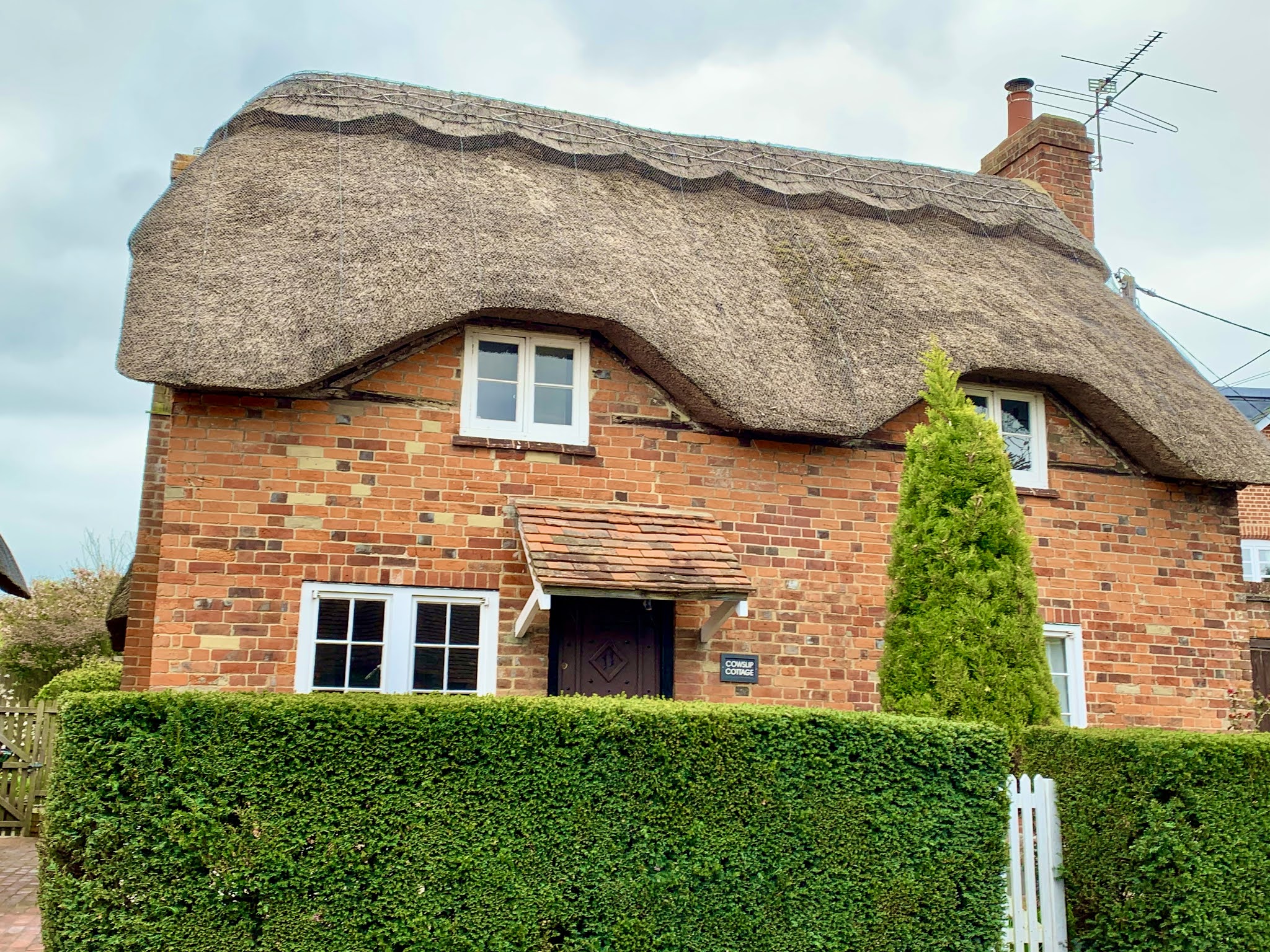
So eager was Cromwell to destroy the Paulets and their cause that, once he'd taken the house, he not only destroyed it but encouraged villagers to re-use its materials to enhance their own homes. Thus fuelling a bit of a building boom in Old Basing in the 1640s. (While I can't be certain these particular buildings were part of the post-war boom, they certainly look the part.)


Basing House was destroyed, but its owner lived on and his son's political choices were luckier. He supported the import of William and Mary from Holland (The Glorious Revolution) and they rewarded him with a new title: Duke of Bolton. He rebuilt a very grand hunting lodge next to the old tithe barn (another memory long torn down, sadly) and chose to be buried in the village church. By this point both he and the parish church had converted to Church of England, reputedly much to the locals' dismay.
Villagers also were doubtless irritated that Charles removed himself from cheek-by-jowl proximity to the village by building the new family seat within a buffer zone of hundreds of acres of enclosed parkland. His new neoclassical pile was equidistant between Basing and the flourishing market centre of Basingstoke. Thus began Basing's slide toward's backwater-dom.

About a mile's walk from Old Basing's village centre you'll find the main gateway to the estate he built, called Hackwood Park.

Hackwood Park is no longer in the family and ... thanks to the M3 motorway ... could no longer be considered a part of Old Basing since the massive, always-bustling highway now cuts through the old estate and forms an impressive barrier between its old village and the house. Though you once might have walked easily from village to house, today the new gates are on the other side of Basingstoke and it's a drive of several miles to reach them. (The house isn't open to the public.)

The land between the arch and the motorway became a public park called Crabtree Plantation after the M3's construction. The views are spectacular, though the constant whir of traffic undermines the bucolic scene.

A long, narrow strip on the north side of the park is woodland, however, which muffles the traffic noise. It's a popular local spot to exercise both dogs and children, and can seem almost Tolkeinesque is certain lights.

Meanwhile, back in Old Basing, nothing much happened. Following the trajectory of places like Bruges and Venice, with its main claim to fame gone the village sank into quiet obscurity. Though people added houses in the 19th and 20th century, the place retains the feel of the 16th - 18th, and is one of the loveliest places to ramble around Basingstoke. 
There's a beautiful walk along the river Loddon ... and an unusual one, since so much of the river's access is privately controlled because of conservation and fishing rights.

Sitting alongside the river is one of the prettiest pubs in the area, Barton's Mill:

And the village remains full of picturesque houses to appreciate:


Though the modern-day Paulets have decamped to South Africa, the original ones sleep soundly in the parish church.

The fifth marquess, who fought Cromwell and lost, had grander ambitions and had built a lavish mortuary chapel on a hill above Basingstoke. But it was destroyed in the Civil War and is now just a picturesque ruin. (See this story for more.) His ancestor's tombs frame the high altar in Old Basing's parish church, and his son's tomb (pictured above) is in a side chapel.


Old Basing seems to be working on a new claim to fame. Last autumn catering veteran Tim Goodwin opened The Street Bakeshop, an old-fashioned bakery where everything is done on-site, by hand. Their sourdough is the best I've had outside of Michelin star restaurants, and their pastries on par with anything the Danes could crank out.


Fortunately bread and cake fall into the "essential" category so the shop has been able to remain open for take-away though lockdowns two and three. It's rare to see the place without a queue outside, and it's quickly become a local legend. 

So for what's probably the most picturesque walk in the Basingstoke area: start at The Street for coffee and pastries, take a long ramble around the village and perhaps even around Crabtree Plantation, then collapse at the soon-to-be-reopened Barton's Mill for a pub lunch beside the Loddon.