Saturday, 20 April 2024

Herculaneum and Naples' archaeological museum deliver a double dose of luxury

What did the Romans ever do for us?

While I don’t remember luxury lifestyles and exquisite interior design being on Monty Python’s list, that’s the inescapable conclusion when you spend the morning wandering around Herculaneum and the afternoon in the archaeological museum where the Neapolitans keep all the wonders they excavated from the sites around Vesuvius. 
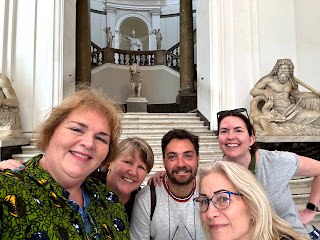
We splashed out on our own bit of luxury and hired a private guide for the day, which elevated what would already have been a good experience into a great one. Raffaele is a highly-trained working archaeologist who’s also an accredited and award-winning tour guide. Time living in London perfected his English. It was obvious within the first few minutes that we’d chosen well. Not only did he know his stuff, and have a great sense of humour, but he knew exactly how to time our route to avoid crowds, where to stand for the best views, and which highlights to bring out that visitors on their own might walk right by. (For example: a beautiful fresco of some wine bottles that turned out to be a menu with prices outside a wine bar; something highly relevant to our annual Girls’ Trips.)

I’ve been to Pompeii twice and, in a head-to-head battle, now that I’ve seen Herculaneum I prefer it. The differences are obvious from the beginning, when you arrive at the site without running the gauntlet of souvenir hawkers and tourist tat shops. Herculaneum … or, to give it the Italian name you need to look for on signs, Erculano Scavi … sits in a quiet and comfortable modern suburb of Naples with some apartments looking right down into the ruins. Without the road signs, you’d never guess your way from the train station to the tourist attraction. 

Once through the entry turnstiles you’ll see the most powerful view of the day as you stand above the excavations and take everything in at one glance. Pre-eruption, to be in this spot you would have had to hover, drone-like, about 25 metres above the beach immediately below. Today you’re looking down at the same waterfront buildings, but you’re standing on a cliff edge of the mud and pumice that excavators had to carve away to get to the city. The shoreline that would have been directly below you is now about a mile behind you. Through the doors of what’s obviously a waterside warehouse below you, you can see piles of human skeletons. They are the remains of citizens who flocked to the harbour and took refuge in port buildings hoping for rescue from the sea. It never came. Vesuvius looms on the horizon in front of you, looking innocent … but everyone knows it was entirely responsible for the disaster. Seeing it all at once fills you with awe, wonder and fear.
From a simple logistical point of view Herculaneum is smaller than Pompeii. It’s therefore easer to get around and to take it all in without becoming overwhelmed. It’s not quite as well known, therefore less crowded. The effects of the volcano were slightly different in the two places , so while Herculaneum was still buried and its inhabitants killed, the way it happened means preservation here is better. There are buildings with intact roofs, doors and beams, items of furniture … even a boat … all preserved because the heat was so extreme it instantly fossilised wood into stone-hard charcoal. Instead of the plaster casts of bodies everyone knows from Pompeii, here there are the skeletons. And if you are as obsessed with Roman art and architecture as I am, you’ll notice that stylistically the mosaics, frescoes and architectural details are at a consistently higher level here. There is no single thing quite as blockbuster as the famous frescoes at Pompeii’s Villa of the Mysteries, but in house after house you’ll see exquisite decoration done in subtle detail and striking colours. Pompeii decorators were following trend setters; Herculaneum’s residents were setting the trends.
My favourite was the house of Neptune and Amphitrite, where the sea god and his wife adorn one wall in a mosaic so detailed you may initially think it’s a painting. They’re surrounded by festoons of blue and green decoration, bright as the day it was installed, given texture by a border of sea shells. The colour scheme continues on the adjacent wall where animals bound through a hunt on that bright … and probably very expensive … blue background. Other parts of the room’s walls are done in a vividly contrasting fresco of a garden caught in the fiery orange blaze of sunset. This was a summer dining room, open to the air above, with niches for lamps and a fountain in the middle between the dining couches. It doesn’t take much imagination to recreate the beauty of life here, sipping an exquisite glass of Vesuvian wine to the music of the fountain as lamplight flickered off the glass of the mosaics. 

While Pompeii was a bustling port city, Herculaneum was an upscale beach resort surrounded by aristocrats’ sprawling holiday villas. If you think about the difference between modern Naples and Capri, you’re probably in the right ballpark. Thus Herculaneum had more than the average number of jewellery stores, public amenities and upscale food and wine outlets. The shop beside the house of Neptune and Amphitrite comes complete with wooden wine racks and partitions; possibly the best-preserved retail interior of the ancient world. Outside the best houses you’ll find benches built for “clients” to wait to see their patron. The more people waiting outside your house, the more important you were.

These days, we park ourselves outside the CEO’s office. Same routine, different architecture.

Raffaele explained that the conspicuous consumption here would have been fuelled by rich, freed slaves from Imperial and Aristocratic households who had both influence and cash, but not citizenship. Proclaiming their influencer status in this exclusive place not only built their profile, but smoothed the way for their children who could become full Roman citizens.

Citizens and wealthy freed slaves alike shopped on a gracious high street dignified by a triumphal arch. Most of its decorations are gone and there’s only a bit of the quadriga (four-horse chariot) that stood atop it left in the museum in Naples, but the brick core is enough to impress. Most of the buildings along this street still have their upper stories; some still have wooden screens and awnings. Shoppers might have gathered later to do business in the College of the Augustales, a civic building near the arch with some of the most memorable frescoes in town. 

A short walk away is an impressive school complex where the next generation could prepare to take their role amongst the elite. Most interesting here isn’t the posh architecture, however, but the fact that you can wander into some of the excavation tunnels and get an even better sense of how all of this stuff was chiselled out of the ossified mud. 
If the bustle of town was too much for you, you could sit to enjoy the quiet of small vineyards or orchards; now re-planted based on analysis of the calcified remains from 79 AD. Or you might head off to a small but exquisite gymnasium and bath complex. The separate women’s section still has some original glass in its round window and barrel-vaulted roofs ridged so that the condensation would slide down towards the walls rather than irritate anyone by dripping. Classy.

Don’t leave without checking out the two small museum buildings. One holds the boat that was found on the shore; a hoped-for escape never realised. The other has a collection of treasures brought out of the ground and too fragile or valuable to be left outside. There are more frescoes, statues, lamps, some beautiful pieces of furniture and a lot of gold jewellery that you’d happily put on today.

To see the real treasures of the excavations, however, you need to go back to Naples. After a restorative lunch break, we met back up with Raffaele for Part Two of our tour at the Museo Archeologico Nazionale di Napoli.

This is one of the great museums of the world and, happily, it’s undergone a transformation for the better since my last visit. Back in 2003 the whole building was in deplorable shape, complete with broken windows and vines growing through the gaps. Those windows are whole and clean. The entire place has had a major scrub down and re-paint, and the collection feels like it’s undergone a curatorial revolution in the way objects are grouped and explained. 

Though there are galleries of Egyptian and pre-historic stuff here, this is overwhelmingly a museum dedicated to the glories of Ancient Greece and Rome, brought together by two events. First, the discovery of Pompeii and neighbouring sites saw an unprecedented flow of treasures out of the ground. The presiding king at the time, Charles VII, kicked the military out of its HQ to start storing the finds there, and eventually converted that building into the museum it is today. Second came the same king’s inheritance of the Farnese collection of Greek and Roman statuary through his mother, which he added to his Vesuvian loot.

These days there are at least 30 galleries worth strolling through, so having a guide who knows the collection is tremendously useful. Raffaele took us through the key treasures that were unearthed in the Vesuvius sites, letting us revel in exquisite mosaics, fine jewellery, housewares, glass, and more. 

Some of the greatest treasures are from the Villa dei Papiri, a massive spread that was just on the outskirts of Herculaneum and is not open to the public. Anyone who has visited the Getty Villa in Malibu will be familiar with the Herculanean place, as Getty copied it exactly to build his Californian museum and then stuffed it full of Greco-Roman art. The Papiri artefacts get two large rooms here in Naples, stuffed with wonders. The bronze statues, particularly two young, male runners and a set of decorously clothed women who fuelled a fountain with water from vases in their arms, are so lifelike the story of Pygmalion seems perfectly credible.

Also upstairs, Raffaele showed us the enormous hall that the king built as a library and event space at the centre of his collection. Pride of place here is given to the Farnese Cup, more of a shallow bowl really, carved in agate with one scene on the inside, and another … a magnificent medusa’s head … on the opposite, or bottom. It is beautifully displayed with lights shining on it so you can appreciate the colours of the agate and how the scenes change depending upon the direction you are looking from. There’s also a small exhibition on the famous Alexander the Great mosaic, which is being restored right now so not visible.In another one of those great little tour guide additions, Raffaele also pointed out a sundial built into the floor with inlaid marble and bronze. There is a tiny hole in the roof, and at noon each day the sun comes through to tell you the date and what sign of the zodiac you are in based on where it lands on the floor. Without someone to call it to their attention, most people would walk right by.

My favourite artefacts on this floor are fragments of mosaic columns and niches, all in a glorious blue background, that I would have reproduced for my own garden room if I won a very large lottery.

Raffaele also took us through galleries on the ground floor containing significant treasures from other sites in the Southern Italy. This includes what is probably the best collection of ancient Greek bronzes outside of Greece, thanks to the Romans’ passion for the stuff.

We lingered after the end of our official tour to do the Farnese Collection on our own, marvelling particularly … as all the Grand Tourists before us have … at the larger-than-life sculptural group of young athletes trying to restrain a raging bull. My favourite piece in these galleries, though, is a little-known work. It’s a sculpture about waist high that shows one man wrestling a whole pig onto a barbecue shaped like a kettle, while another adds charcoal below. Might this have been the inspiration for the Weber company? More importantly, is it the first depiction of barbecuing in art? Now there would be an idea for a thesis if I went back to school for an advanced degree.

My brain would have enjoyed another three hours in the museum, but my body had given up. At this point, Raffaele came through one last time with a fabulous tip, sending us across the street to the Galleria Principe di Napoli. The building was partially boarded up, looked derelict and showed no hint of internal promise. And yet, at its centre was an exquisite cocktail bar called Tesoraria. It’s decorated in elegant Liberty style … the Italian version of Art Nouveau … complete with sinuous floral ironwork, statues, draperies, balconies and a magnificent bar. It was as if we had travelled in time to 1900 and Verdi and friends would enter dramatically in white tie and top hats at any moment. The cocktails tasted as good as the place looked, delivered by waiters in crisp uniforms and long aprons. We meant to return, and the restaurant in the basement looked intriguing, but our own garden was so beautiful we collapsed there on other nights for our happy hour.

In fact, everything I saw on our day with the Romans made me want to return to explore more. We covered an enormous amount of ground with Raffaele‘s help, but there is so much more beauty to drink in from that extraordinary time period. I am keeping Raffaele‘s name in my address book. Next time I plan a trip to Naples, he is going to be my first call.

Thursday, 18 April 2024

See Naples to live: A chaotic city delivers abundant rewards for those willing to embrace it

Naples is an assault on the senses.

It is the loudest city I’ve ever visited. Car and scooter horns vie with sirens and church bells. Planes rumble overhead toward an airport close to the city centre. The average Neapolitan speaks at a genial shout and works up. Your eyes will need sunglasses not just to shade them from the southern sun hitting a dazzling palette of building colours, but to knock back the fierce visual cacophony of graffiti that covers most surfaces. Exceptional Baroque architecture and Liberty-style statement buildings do battle with centuries of grime and crumbling plaster. Your nose will recoil from car exhausts, the ripe waft of an occasional sewer and old-world levels of smoking. That will soon be countered by the Neapolitan proclivity for strong perfumes and aftershaves and glorious gusts of oregano, tomato, baking dough and charcoal.

Life is lived on the streets but there are few green spaces or spots of solitude. Getting anywhere requires weaving and diving around crowds packed into narrow lanes. Keep one eye always on the ground: streets and pavements are as patchy as a teenager’s skin, with cobbles erupting and holes gaping. Keep the other eye on constant watch for scooters that speed out of nowhere and treat rules of the road with a cheerful disdain. “Vespa” is the Italian word for “wasp”; a triumph of product naming.

Naples is one of the oldest continuously occupied cities in Europe. It was a significant port and cultural hotspot within the Ancient Greek world in the 5th century BC, when the Romans were just a backwater tribe dreaming of expansion. That’s why so much of the city feels like a hotch potch. There is nothing truly new; everything in layered upon the past. The look of the 17th and 18th centuries dominates the main tourist districts. This is when Naples was at its richest and most powerful, with an enormous cultural significance. This, not Rome or Florence, was the must-see climax of the Grand Tour.

It’s quite an irony, then, that today’s Naples seems far less damaged by tourism than Italian cities further north. Venice and much of Tuscany now feel like cultural theme parks staffed by Italians for the benefit of … and to extract cash from … foreigners. Naples is crowded. Traffic is a constant and you’ll be jostled by humanity almost everywhere, but the majority were locals going about their daily lives. We were welcomed, but we were an addition to the life of the city and not the reason for it.

The most obvious example was Sunday evening in a triangle formed by the Castel Nuovo, the Castel d’Ovo and the Piazza della Repubblica, all jammed with people as if it were some massive festival, or crowds were exiting a football match. Nope, just the usual weekend passeggiata in a picturesque part of the city, where the population spills onto the street to promenade, gossip, dance, drink and eat.

There are, of course, tourists here. In high season more than 10,000 a day spill off the cruise ships docking at Beverello, according to one of our taxi drivers. But the majority of tourists … as I did on my first visit in childhood … are only passing through the city en route to Pompeii or Capri. Most of the tourist groups we rubbed shoulders with were Italian teenagers on school trips. Only Spaccanapoli, the long, straight lane that cuts through the heart of the historic district, was truly hard going. But even in the most touristy areas I heard as much Italian as anything else. 

This perspective may, admittedly, come from the time of year of our visit and, more importantly, where we stayed.

Locals continually told us that April and May are ideal times of year. It’s warm but not too hot, generally sunny, with flowers and trees bursting into life. Schools around the world are still in session so the main flow of foreign tourists hasn’t started.

We rented an apartment in the Rione Sanità, a neighbourhood I was distinctly warned not to go near on mylast visit twenty years ago. Times have changed. As with gentrification trends everywhere, the neighbourhood’s cheap rents attracted artists and other creative types. More trend setters followed. Now the local pizzeria is listed in the Michelin Guide and is angling for a star. (Review to come.) This is the best place to stay if you want to have a more authentic Neapolitan experience, for a better price than the traditional tourist hotels.

It still looks rough. Renovation may be taking place inside but from the exterior most of the buildings are streaked with dirt and missing chunks of plaster. One local explained that the city’s UNESCO world heritage site listing is more curse than blessing. It brings the visitors and preserves the history, but strict rules on renovation mean nobody can afford to fix anything.

I think many visitors … particularly Americans … equate that general look of decay with danger. We never felt unsafe, even when taking a wrong turn and twisting though small lanes after dark. There are far more beggars and homeless people lurking in doorways in London than we encountered here. The only real threat are motorbikes racing down small lanes at high speed; it’s essential to move towards the wall whenever you hear a beep behind you. In fact, the neighbourhood was so friendly that by our fifth morning, as we walked down our now familiar little lane with our luggage, the locals in all the small shops along the way smiled and waved goodbye.

Our apartment, Cerasiello, was idyllic. Like almost everything in Naples, its rough exterior belies what you’ll find inside. You enter through a tiny door in battered, ancient gates set in a massive, near featureless building that takes up a whole city block. You find yourself in a courtyard, sky visible four very tall stories above. 

It’s all a bit dingy and the first thing you’ll notice is the rather ugly lift dropped into the middle of the far side of the courtyard, looking like those temporary ones they erect on construction sites. As your eyes adjust to the half light, however, you’ll notice that all four stories of the wall behind the lift are dominated by a grand staircase, crumbling but still magnificent. 
Before the neighbourhood went into decline, it was full of grand palaces, and this was one of them. Once the heavy courtyard door shuts, the noise of the street disappears and the songbirds kept by residents overlooking the courtyard contribute a gentler soundtrack. Potted plants and hanging laundry jostle for space on windows, walls and landings.

Cerasiello is on the top floor. I was very glad of that lift, even though you need to feed it €.20 a ride. The property has four bedrooms, each with en-suite bathroom, surrounding a long sitting room, a small kitchen and a truly magnificent roof garden with a view of Vesuvius. We spent most of our time at home out here, surrounded by enormous potted plants that made it feel like a real oasis from the city. 
The tasteful decor is a mash-up of traditional Italian with a bit of Sicilian and North African, giving the whole place a slightly exotic feel. The owners have taken great care with the lighting, including up lighters on the roof garden and small, stained glass table lamps inside to create atmospheric puddles of light throughout.

You can book individual rooms rather than renting the whole property; in which case the living room, kitchen and roof garden become shared space with other guests. If you only rented one room, ask for the one with french doors that open directly to the roof garden. The window in the bedroom looks towards Vesuvius, while the one in the bathroom looks over the roofs and church domes of Rione Sanità and up at Castel Sant’Elmo. 

Cerasiello is on the very edge of Rione Sanità, only about 200 metres from the Via Foria that divides the neighbourhood from the historic centre. You’re only 10-15 minutes away from key sites like the archaeological museum, the Duomo, the cloisters at Santa Chiara and the street of the nativity scene makers. You’re also close to two different metro stations, though I confess that with four of us to split the cost we took taxis when we needed to go further than our feet would carry us.

Our roof garden and the feeling of being part of a local neighbourhood provided a welcome counterpoint to the noise and bustle of the city. Naples is a perpetual motion machine. It is exhausting and brutal, yet glorious and full of joy. It isn’t an easy city in which to be a tourist, but effort pays vast rewards in the treasures you see, the craftsmanship you can buy and the people you meet. The guys who made us coffee every morning felt like friends by the end of our long weekend.
Neapolitans themselves will tell you that the unique character of this place is due to its position directly beneath one of the world’s most menacing volcanoes. Vesuvius’ last big explosion … the one that buried Pompeii, blew the mountain’s top off and exerted a force equivalent to two atomic bombs … was nearly 2,000 years ago. Most vulcanologists say it's overdue for another major eruption. People live here with a constant awareness of death, reinforced by a muscular Catholicism that reminds people of death and resurrection in every church.

Even the most famous tourist line about the city brings up endings. “See Naples and then die” was the phrase constantly repeated by Grand Tourists, most memorably in Goethe’s letters home. The meaning was that you’d reached the best of everything here, and you didn’t need to see anything else for artistic and cultural fulfilment.

These days I’d change that phrase to “See Naples to live.” I can’t think of anywhere else that’s so chaotically, marvellously, exhaustingly alive.

Wednesday, 10 April 2024

The annual Northwestern Girls' Trip marks 25 years of marvellous adventures & priceless friendship


In October of 1999, three American expats living in England answered Northwestern University’s call to represent the institution at London’s Fulbright College Fair. They hadn’t known each other on campus, but the girls had all graduated within four years of each other and quickly hit it off. All eager to take advantage of the opportunities for tourism offered by life in England, they thought they might be good travel companions. In March of 2000 they put their suspicion to the test.

The rest is history.

Tomorrow, it’s officially 25 years of gloriously entertaining, adventurous, relaxing, story-spinning history. Our annual Northwestern Girls’ Trip hits the milestone when we board our British Airways flight to Naples.

There have been changes over the years. In the early days we were more likely to do multiple, short trips across the year. As we settled in to life in the UK and our jobs got progressively bigger, we focused on just one significant, annual journey. We’ve never missed a year, though parental illnesses, work travel, breast cancer and Covid all proved challenging. In 2020 we slipped a glorious road trip to Devon and Cornwall in between lockdowns but in 2021, despite two attempts, we only managed one day as a complete group due to positive Covid tests amongst us. Over time, our working lives became so busy we learned to compare diaries and pencil in the date for the next year as we were wrapping up the current trip. Once the dates are resolved, girls' trip is sacred.

In 2017, we expanded our trio to a quartet. It was a big decision, given the perfect balance we’d established, but we’d all known Suzy almost as long as we’d known each other. And though she hadn’t graduated from Northwestern, she’d worked for me twice … the first time straight out of uni … and I’d taught her much of what Medill taught me … so we granted her our special girls’ trip honorary degree. 
Finding ideal travel companions is no easy task. People like to move at different paces, do different things, and have different price points. Learning to go on holiday together was, by far, the biggest challenge of my marriage and one that took years to sort comfortably. From that first trip with the girls, however, it was clear that we were naturally in tune with each other’s preferences. 

The ideal girls’ trip should have a near-perfect balance of history, culture, fabulous food, vineyards, shopping, and indolent self-indulgence. We are all naturally curious and love to learn. We sightsee in high-energy bursts, then collapse happily into spas, wine bars or quiet spaces with a good book. We love an off-the-beaten-path experience. We’re also a gregarious bunch, and we’ve talked our way into a notable number of upgrades and remarkable extra treats. Perhaps the most extraordinary example took place in a forgettable town in central Spain. We were the only foreigners in the restaurant during a local festival. Our enthusiasm so charmed the waiters that they gave us a tour of their extraordinary wine cellars, dating back to Roman times, while we were waiting for a table. They lovingly described every course of the festival menu as we ate, then cracked out their home-made post-prandial firewater and invited us to drink with them after the restaurant closed. (Hillary will never let us forget she was the designated driver that day.) The older we get, the more we’ve noticed that young waiters rather enjoy a bit of mild flirtation from a group of women who could be their mothers. Though none have yet equalled those grizzled old Spaniards. 

Though we didn’t set out to define our journeys this way, they’ve become characterised by affordable luxury and often being just ahead of the curve of travel trends. Many places … most notably Speyside, Spain’s Duero wine road, Porto, and Split in Croatia … enjoyed time in the spotlight of the travel press just after we visited. We are the best travel documentary the BBC hasn't made. 

The affordable tag, of course, depends on your point of view, and our price point has crept up over the years with incomes and stress levels. But we’ve always focused on finding special places that are excellent value for money rather than just opting for whatever gets written up in a glossy magazine. These days we tend to look for four-bedroom apartments to rent rather than heading for upscale boutique hotels, and we’ve discovered the value of pooling our resources to hire private guides for outings.  

A set of girls’ trip guidelines took shape over the years. We travel over a long weekend, generally Wednesday or Thursday to the following Monday or Tuesday. It’s the least interruption to busy work schedules. Travel time should be no more than four hours. If you are celebrating a decade birthday (40, 50, etc.) then the destination is your choice alone. In other years, it’s a group decision based on a shortlist, with the final call made by vote or … in one memorable year … Lisa’s mother pulling the winning name on a slip out of a bowl after a Michelin-starred dinner. 

Combining resources to hire private guides has led to some of our most memorable experiences. These include a day wandering the slopes of Mount Etna with an oenologist who specialised in Sicilian wine and got us behind the scenes at several remarkable vineyards. 
A proud Basque showed us the little-visited seaside glories and Game of Thrones filming locations of the coast between Bilbao and San Sebastián. 
When a travel agent messed up our reservation in Iceland, a strapping Viking who usually only did high-end tours and had recently hosted Tom Hiddleston stepped in to drive us up to the glacier and take us spelunking in an Icelandic lava tube. 

This Friday, we'll be making new memories as a working archeologist leads us around the ruins of Herculaneum.

Vineyards have been high on the agenda over the years for this wine-loving quartet. Our intense interest in wine, thoughtful questions, focused tasting and … we like to think … tremendously genial personalities have often seen us invited by winemakers into their private cellars to taste stuff they usually don’t open and drinking with them well after official tours have ended. 

We haven’t always followed our own Girls’ Trip guidelines. Two of our journeys stretched over a week and one of those smashed through our 4-hour travel time limit. Lisa’s brief flirtation with moving back to the States meant that she was joining the 2007 trip from New York, so we turned it into a full-scale holiday in Tunisia. This was before terrorist incidents endangered tourism there. Even so, crowds were light outside of the main tourist resorts. Wandering virtually alone through the sprawling Roman ruins at Dougga is one of the great memories in the Girls’ Trip archives. 

Eight years later, when Hillary’s father was coping with an Alzheimer’s diagnosis, we travelled to the family home in Florida to revel in the warmth of his larger-than-life personality while he was still with us. 

Sharing parents has indeed become one of the hallmarks of the original trio. As women living thousands of miles from our families we all had a larger-than-average appreciation of time spent with parents. Over the years, a habit grew up of visiting parents including the other girls in a family meal whenever they were in London. All but two of those parents have left us now, but we have the memories forever. (And hope my dad and Hillary’s mum are with us for many years to come.) 

And so … older, wiser, and in need of a lot more down time than when we started … the girls are off to Naples. This year is a significant decade birthday for me, so the location, lodging and itinerary were mine to call. Culture abounds. I get to try to knock the rust off my very rusty Italian. Food here is lauded as amongst the best in a country already famous for its cuisine. And there’s a four-bedroom apartment with a roof garden waiting for us.  

La vita è bella. 

Here’s hoping for another 25 years. And here’s thanking my friends, God and good luck for the extraordinary adventures behind us. Great times with beloved friends are one of life’s most precious treasures on this endlessly diverting journey through life.


Sunday, 31 March 2024

British Museum makes Roman army life fun for all ages

As the daughter of an art historian, it never occurred to me that museums weren't standard territory for childhood fun until my own contemporaries started having kids. Only then did it begin to dawn on me that most people didn’t put culture at the top of their family outing options, and that many children considered the idea of spending time in museums both a chore and … gasp! … boring. Why had I never felt this way?

Quite simply: my mother had a unique talent for bringing art and culture to life for children. Trailing along in her wake, I never realised that she was the one turning places like The Art Institute of Chicago, The Getty Villa and the Victoria and Albert Museum into worlds of fantasy and wonder.

Thankfully, her superpower is no longer unique. Many are reinterpreting their collections and adding hands-on experiences to bring the past to life for children of all ages. The British Museum’s new Legion: Life in the Roman Army exhibition is a gloriously entertaining example. The curators have teamed up with Terry Deary, writer of the Horrible Histories series, to create an alternative path through the show for the young, and young at heart. Legion has received rave reviews across the board for its gorgeous design, exceptional artefacts and meaningful insights, but it’s this outreach to young people that impressed me the most.

You’re greeted by a cartoon rat named Claudius Terratus who’s decided to join the army to see the world, gain his citizenship and reap a juicy pension at the end of his service. He pops up throughout your visit to highlight the difficulties and pleasures of the life he’s selected, often accompanied by things to touch and do. You can see if you’re tall enough to make it into the legion, and see how you compare to the tallest-ever Roman. You can lift weights equivalent to the average pack of a soldier to see how you might fare on a march. You can play with knuckle bone dice. You can even put on a helmet and grab a shield.

It’s been a long time since I’ve seen that many children in a major exhibition, much less having so much fun. Curators around the world need to take note.

Sceptical academics, meanwhile, needn’t fear. The children’s track sits beside a serious deep-dive into this fascinating topic. My friends and family who’ve seen the show include army veterans, military historians and specialists in the Eastern Roman empire. All were impressed.

There are things of great beauty here, from a bronze head of Augustus to ceremonial helmets to one of my British Museum favourites … the Molossian dog that usually sits in a gallery that is too often closed to the public. It’s good to see him taking pride of place. There is, as you would expect, a lot of evidence of war, from the best-preserved Roman shield in the world to swords to horse armour. There’s a lot of evidence of everyday life, from letters home to an almost perfectly-preserved legionaries’ sock.

Poignant touches throughout make this the story not just of an empire or an army, but of people. The tombstones of the soldiers who never made it to that retirement; especially one shown with his grieving father. The armour of a man who died in the famous massacre of Varus’ legions in the Teutoburg Forest. The skeleton of a soldier who died trying to help the citizens of Herculaneum survive Vesuvius’ eruption.

There is something for everyone in this exhibition. Happily, that includes small people who might think museums are boring. Make some time to introduce them to a Roman rat and his horrible adventures, and you might just open a door to a world of fantasy and wonder they can enjoy for the rest of their life.

Legion: Life in the Roman Army is on at the British Museum until 23 June.

____________________

Joanlee’s Playbook
Want to get your kids to museums but don’t have something as cool as the British Museum’s take on the Romans to help you through? Here are three of my mother’s best tactics for getting young people involved.

Go treasure hunting
Pick one thing … dogs, crowns, swords, etc. … and set children out on a treasure hunt to find as many of that object as possible. This is particularly effective if you have two or more kids on your hands, especially if you offer a small amount of cash to be spent by the winner in the museum gift shop at the end of the visit. The hunt makes them actually pay attention to what’s in each room.

Be a time traveller 
Tell your young people they have access to a time machine for a one-way journey. Because of some kindof impending disaster (make it nasty, kids love that), you need to move to some other time in history. The kids are using the museum to do some research. Where are you going to go and why? What is life going to be like? What are you going to bring with you? What type of people will you set yourself up as when you go? Why not book a meal out after your museum visit and let the kids report back on their decisions over the food?

Go shopping
The kids have just won an enormous lottery and everything in the museum is on sale. They can buy three things. What would they buy for their palatial home and why? Where would they put it, or how would they use it? If they had to put the things in order, from what they’d pay most for to least, what would their order be? A variation on this, particularly useful in traditional art museums full of paintings, is to tell them that they can bring one artist back to life to paint their portrait. Who will they resurrect and why? What surroundings will they be painted in and what things will they have painted with them?

These days, almost all museums have education teams specifically dedicated to bringing their collections to life for young people. They’ll produce guides, games and videos that are often free. For many more ideas, seek them out and use them. Many are downloadable before your visit, so you can do some preparation as a family and turn your day out into a special event.

Friday, 22 March 2024

Fashion, social aspiration and pure loveliness combine in the Tate's "Sargent and Fashion" show

It’s one of history’s great ironies that after going to all that trouble to get rid of monarchy and aristocracy, modern Americans are utterly captivated by them back in the Mother Country. My university friends stateside, for example, are far more engaged in watching and speculating over the Princess of Wales’ sick leave than any of my British colleagues.

There’s nothing new about this, of course. Americans might have declared political independence but they still looked to Britain as an arbiter of style and culture from their earliest days. American money chose to build mansions that reflected English country houses. They vied to marry their daughters into the British aristocracy. The campus architecture at many top American universities apes Oxford and Cambridge; my sorority quadrangle in Evanston, Illinois, was designed to look like a Cotswolds village.

The height of this Anglo worship must surely have been the late 19th century, when vast amounts of American new money was trying to look old and believed that all things English offered the best fast track to becoming establishment.

Artist John Singer Sargent is one of the greatest representatives of this age, and one of the most artistically significant American expats to sink his roots in England. Those old v new, American v. England stories are lusciously represented in Tate Britain’s new show. It gives us both the artist as an example of the expat-gone-native, and lots of Americans keen to let the Sargent fairy dust polish off some of their New World edges. There are plenty of Brits here, too, but they tend to be the edgier, artsy ones. Even at the top of his game, Sargent’s American-ness would have put him slightly on the outside of the establishment. Such is the fate of the American cousin as immigrant, no matter how long he or she lives here.

This is not the focus of the show, however. It's a perspective I bring to it as an American who’s spent half her life in England. The curator’s objective … and a fabulous one it is … is to get you paying attention to Sargent and Fashion.

Portraits are always carefully composed to make a statement, but the late 19th century took this to extremes. Society was changing, people were leaping up ladders and, for some, power and wealth were growing exponentially. People wanted to show off, and Sargent was the man to help them do that. The show introduces us to an artist who worked much as a modern stylist does today, taking total control of someone’s clothes, accessories, and how they moved to convey a particular message.

Frans Hals and Anthony Van Dyck did the exact same thing, of course, which I’ve written about in reviews of previous exhibitions celebrating both men. But Sargent is so much closer to us in history that we have far more descriptions of what it was actually like sitting for him. We also, gloriously, have some of the clothes. 

The first gallery lays down the premise in pink glory. Here is Sargent’s magnificent portrait of Aline Rothschild Sassoon, a socialite, artist and intellectual who draws you in with her kind eyes and warm smile. She’s enveloped in a black cloak with a pink lining that gapes open on the diagonal to create a pink slash across the painting. That slash makes the image. It’s somewhere between salmon and Barbie pink, and it jumps out vividly from the blacks of her cloak. This portrait is in a private collection and I’ve only ever seen photos of it; they simply can’t convey how magnificent that pink lining is. Even more magnificent is the fact that the actual cloak stands in a case next to the portrait, so you can compare the reality to what Sargent created. It’s obvious that he twisted and pinned the garment into shapes it never would have taken on its own to get his vision across.  

This sets the mood for the rest of the show. (And will probably leave you weak with desire for a black, hooded opera cloak with a pink lining.) 

We meet Mrs. Fiske Warren, who wanted to be painted in a favourite green dress but was cajoled (or bullied, one suspects) into a light pink number borrowed from someone else while her daughter leans against her enveloped in a wrap of a darker shade. Sergeant has chosen a background of medieval antiques, deep greens and burgundies, out of which the two women shine like candle flames in the darkness. It’s the same trick as the pink slash in the opera cloak, but bigger. 

Then there’s Mrs. Sears, who adored bright colours. One of her Worth gowns is on display here, a sumptuous design but in an unnatural greenish yellow it would take a supremely confident woman to wear even today. It would certainly grab all the attention in the room. Sargent dissuaded her from colour and painted her in a white gown, bringing all of our attention to her personality.  

It’s a real treat to see the famous portrait of Ellen Terry playing Lady Macbeth next to the actual costume. Its bodice was knitted to mimic chain mail, then had green beetle wings attached all over it to give sparkle with a throbbing, Slytherin-esque menace. 

Any fan of fashion will love the clothes on display here, many from the iconic House of Worth. The design details and tailoring are breathtaking. As the corsetry must have been. Everything designed for the women looks painful to wear.  

Not so the men, of course, who look dashing and more than a bit rakish. One small but interesting
diversion you can listen to on your phone while exploring the show is speculation about the sexuality of both Sargent and some of his sitters. The commentator suggests they felt emboldened to express more of themselves in portraiture than they ever did in their public lives.  

If W. Graham Robertson’s portrait isn’t a gay icon, it should be. Despite the summer heat at the time of painting, Sargent made the young artist, writer, collector and friend of Oscar Wilde wear a long, black overcoat a size too small for comfort. Who knew anyone could be so sexy swathed in that much wool. For the ultimate in male sex appeal, however, look a few pictures to the left where Parisian doctor Samuel-Jean Pozzi was talked out of his standard black suits and into a full length red dressing gown and Turkish slippers. He is beguiling. 

Beyond all those wonderful clothes and personalities there’s much to admire here about Sargent’s painterly mechanics. He was a contemporary of the impressionists, and indeed close friends with Monet. You can see similarities to their style in the way his seemingly rushed, almost abstract dabs of paint melt into the perfect impression of lace, jewellery or other fine detailing when seen from a distance. But when it comes to faces he’s almost photo-realistic, given us dynamism and personality that’s obviously very specific to the sitter.  

This show has divided reviewers, with a horrified Guardian giving it just one star while the Evening Standard gushed with five. How you feel about it tends to correspond with how much of an artistic purist you are, and if you consider fashion worthy enough to be categorised as art. Call me frivolous, but I’m all for the frocks and the fabulousness. And I think Sargent would be, too. 

Sargent and Fashion is on at Tate Britain until 7 July. And if this sounds good you should probably check out Diva at the V&A, which I suspect has a similar vibe. It’s next on my list.


Sunday, 17 March 2024

Much-maligned Milton Keynes deserves more credit, both for modern living and heritage

Poor Milton Keynes. It is the butt of endless jokes. Friends from there say the typical reaction when they
tell people where they live is “oh, I’m sorry”. In a country that considers an important indicator of class to be inheriting one's furniture rather than buying it, and where a poky little cottage that’s charming and historic sells for twice its new-build alternative, a characterless “new town” created from nothing in the ‘60s will always have quite the reputational battle on its hands.

News Flash: Milton Keynes isn’t that bad. 

I recently spent a week there and discovered a metropolitan area that’s well-designed, threaded through with abundant parkland, is served by excellent and mostly pothole-free roads, and has more EV charging points than anywhere else I’ve visited in the UK. I’m not the only one to notice: the town has just made The Sunday Times’ “Best Place to Live” list for the first time ever.

OK, I admit, the town centre is a featureless, soulless collection of modern blocks and vast parking lots. There are few people visible because everything is designed to park and come indoors.  It is the most American place I've ever encountered in England and, as such, is very odd. 

That bit, however, is just a few square blocks within a sprawling and salubrious metropolitan area. The housing spreading out from the centre seems to offer something for everyone, from sleek modern apartment blocks to cozy developments that reproduce historic architectural styles. Everything I saw was clearly designed to integrate green space and was threaded through with walking paths.

The best part, from my resolutely old-world, charm-seeking perspective, is that there are gems of historic England threaded into the outskirts if you know where to look. One of my friends, for example, lives less than two miles from the town centre in an early-Victorian worker’s cottage across from fields still bordered by buildings that belonged to an ancient abbey. 

Just a little further out I discovered Great Linford Park (picture above), a collection of historic buildings, gardens, ponds and meadows around a Georgian manor house. The  Grand Union Canal stretches along one side, with festively-painted canal boats now used as holiday homes adding to the scene. Everything in and around the park is beautifully maintained, has plenty of parking and sits beside a historic village high street complete with a proper thatched pub called The Nag’s Head. We're only 50 miles north of London but interaction with people seems different than in the southeast. Strangers make eye contact and chat happily.

A little bit further along the canal, sitting beside Wolverton Road, you’ll find The Black Horse. It’s another historic pub, but much larger and solidly in the gastropub category. We had a fabulous dinner here. The weather was dire but it’s easy to imagine how wonderful it would be to sprawl in their canal-side gardens once the sun returns.

Like any part of heritage-packed England, Milton Keynes can lay claim to historic blockbusters on its doorstep.

My first port of call would have been Woburn Abbey, just 20 minutes away. The Palladian pile is the ancestral home of the Dukes of Bedford. It markets itself, along with places like Blenheim Palace and Castle Howard, as one of the Treasure Houses of England and has an art collection that would make many museums weep with envy. A dining room filled with an obscene number of Canalettos is a highlight. And the gardens are smashing, too. At least from what I remember on my last visit, probably 25 years ago. My memories weren’t to be refreshed, however, as the whole place is closed for a multi-year renovation.

England’s greatest landscape garden

My second choice, 25 minutes in the other direction, was Stowe Landscape Gardens. It was not only open, but the ideal place to take one’s canine companion. It’s a pity the weather has been so wet, windy and grey, but the place is spectacular in all circumstances and they provide a handy dog washing area before you return to your car to ensure you won’t be taking their mud home with you.

Stowe took shape across the 18th century and those involved were the design superstars of the age: Charles Bridgeman, Capability Brown, William Kent, etc. Most people are content with one or two garden follies. The Temple family wanted more. Around the house a whole classical world of temples, monuments and grottos appeared. Wandering here is like stumbling through a Poussin landscape, minus the people in togas. There are multiple temples (a play on the family name). A Palladian bridge. Commemorative arches and columns. Stick a few amusement park rides in and you could rebrand the place RomanEmpireWorld. Thankfully, nobody went for that moneymaking scheme so you’re left to wander through an idyllic landscape of peace and quiet.

Well, mostly quiet. The house at the centre of all of this is now a school and the Silverstone racetrack is too close for comfort. Both result in unwelcome noise occasionally cutting through your pastoral idyll.

History and politics nerds will enjoy an extra layer of interest as they wander around Stowe. The Temple family were heavyweights in the Whig party: aristocratic, liberal, enlightenment thinkers who faced off against the Tories for much of the 18th century. American readers, if they dig back into their memories of the Revolution, will remember that the Whigs tended to be pro-American and might have prevented the conflict had they been in charge. Instead it was a Whig prime minister who negotiated the peace treaty to end the war.

In the decades before that cataclysm, the Temples arranged their garden follies to reflect their political beliefs. There’s a path of virtue and a path of vice, with architecture and planting giving you clues as to which you’re on. Unsurprisingly, vice features a lot more confusing twists and turns through deep woodland, where virtue offers up long, gentle views and nicely curated paths. Back then, even the choice of column capital style or decorative scheme said something about your political beliefs. If you’re in any doubt, it’s made clear in the Temple of the British Worthies. 

This arcade of portrait busts features obvious people everyone could agree to endorse, like William Shakespeare and Queen Elizabeth I. They sit, however, which people like John Locke … radical philosopher whose writings are credited with sparking both the American and French Revolutions … and John Barnard, who pushed through a law making stock jobbing illegal in the wake of the bursting of the South Sea Bubble. The bubble was basically a Ponzi Scheme that saw its early investors (mostly Tories, and particularly the prime minister at the time) get very rich while many others were ruined. Given that few people today know the ins and outs of Georgian politics, all this stuff can seem quite arcane, but if you take a guided tour all will be revealed. Stowe certainly makes one hunger for a more gracious age when people used gardening rather than social media vitriol to define their beliefs.

A lesser-known Elizabethan jewel
My greatest discovery of this visit was Canons Ashby. The Elizabethan manor house is in the same direction from Milton Keynes as Stowe, but another 20-30 minutes on, and is also a National Trust property. If you didn’t want to linger, you could easily do both in a day. Canons Ashby is one of those
charming spots that, thanks to a combination of family neglect and lack of cash, didn’t get overly “improved” by successive owners. While there were modernising touches throughout the ages they're small, and the overall feel is of a time capsule back to the 17th century or earlier. 

The “canon” in the name comes from the officials of the Augustinian priory that was once here. The house you see today is typical of so many that sprung from Henry VIII’s dissolution of the monasteries. Up-and-coming families with lots of cash bought shuttered religious establishments off the government, used the old buildings as a quarry for their new house and built something fresh to proclaim that they’ve arrived. In this case they left part of the old church but turned it into a private chapel a stone's throw from the house. It's now a strangely oversized and beautiful medieval relic on a quiet country lane.

The house feels more medieval than Elizabethan as you enter it through a courtyard and into an old-style great hall. Things get much grander as you move on to a stolid Jacobean staircase and panelled reception rooms. The blockbuster sites are on the next floor, however, when what’s otherwise a relatively modest house yields up a sitting room with a preposterously over-the-top vaulted ceiling dripping with ornate Jacobean plasterwork. This complements a two-story chimney breast festooned with columns, crests and swags, still retaining its Elizabethan paint. The grandeur is so unexpected I gasped out loud when I entered. The guide told me it’s not an unusual reaction.

Beyond that is a bedroom that has original Elizabethan wall paintings. These were discovered by accident, when problems with the roof forced workers to take down the panelling in the room and revealed what had been covered beneath. I’ve never seen anything quite like it. 


Those two rooms alone are worth popping into the house, but there’s plenty more of interest. That includes a sitting room downstairs with faux marble columns painted by Elizabeth Creed, a Regency-era artist and cousin to the owners. Creed’s paintings behind the altar in the church are worth walking up the lane for, and a surprisingly elegant servants dining hall is another highlight as it's leant dignity by painted panelling moved here in some long-ago renovation. 

Outside, the terraced gardens aren’t large but they offer pleasant walks and dogs are allowed throughout. The views are lovely because the house and gardens are on the crest of a hill, so the gardens “borrow” the landscape sweeping away into the distance.  

And more to come 
My list of Milton Keynes-anchored sightseeing would have been longer had we been later in the year and had I done my planning a bit better. Sulgrave Manor, ancestral home to one George Washington, is only open Sundays, Mondays and Tuesdays. Something I discovered on the Wednesday. Boughton House, one of the best examples of the English Baroque, wasn’t yet open for the season. Rockingham Castle is one of a constellation of heritage properties orbiting nearby Northampton and was the setting for the BBC’s adaptation of By the Sword Divided in the 1980s. 

That show that kindled my infatuation with the Civil War and Restoration period and, arguably, stoked the passions that eventually led to me moving here. So while others may be dismissive about Milton Keynes, I'm already looking forward to my next visit. I have a lot of territory left to cover, and some excellent pubs to recover from sightseeing within.

Saturday, 2 March 2024

Angelica Kauffmann gave us strong heroines and a female take on history 200 years early

The run up to International Women’s Day is a poignant time for the Royal Academy to unveil its Angelika Kauffmann show. While the global day of celebration naturally focuses on the rights and achievements of contemporary women, it also tends to prompt the re-discovery of those whose achievements have been forgotten, or severely downplayed, in a history mostly written by men. 

Kauffmann is a perfect example. 

In her lifetime, she was a superstar of the art world. The great and the good sought her out for their portraits. Her epic history paintings graced the finest buildings. She was a founding member of the Royal Academy in London, and her studio in Rome became an essential stop for aristocrats on the grand tour. In her time, her name would have been regularly grouped with Gainsborough and Reynolds. These days, most people know them … but not her. This show aims to redress that balance.

It is a luscious exhibition full of people and landscapes that are easy on the eye. If you are someone who loves Bridgerton for feel-good entertainment that wraps you in a cosy bubble of rich, attractive people, you will be very happy in these galleries. Everyone sports a flawless complexion, pale as cream except for delicate pink blushes and rosy lips. Gorgeous clothes fold, cascade and drape around fit bodies. Most critically, eyes sparkle. Kauffmann doesn’t quite come up to the mastery of the smile that made last year’s Frans Hals show such a joy, but she is world class at painting eyes that radiate merriment, intelligence and jollity. Look at the scandalous but exquisite Emma Hamilton (above), or the charismatic thespian David Garrick (below). These are rooms full of people you’d follow on Instagram and pay dearly to party with.

Serious pundits of the art world will take my Bridgerton reference as a criticism. It’s not. In fact, it’s why Kauffmann represents her age so well.

In many ways, we are closer to the Georgians than to the buttoned-up, etiquette-obsessed Victorians and Edwardians who are nearer to us in time. Georgian London was an age of celebrity, often criticised for style over substance. Women were a long way from even, but there were famous female names in the arts, politics, and literature. Sexual mores were loser than they were to become. Artists searching for their truth didn’t typically plunge into disturbing depths, but rather looked for a composite of positives to give us a person’s best self, a landscape’s ideal look or a building’s most perfect iteration. Think social media airbrushing apps for an earlier age.

This isn’t just all about beautiful people, however. In her time, Kauffmann was particularly famous … and deeply unusual … for being a woman who embraced epic history painting. These, not portraits or landscapes, were considered the highest form of art by the Georgians. By their nature they were exclusive and male-oriented. They often focused on battles or warriors, generally full of thrusting, semi-naked men who it wouldn’t be considered appropriate for women to paint. More significantly, history paintings tended to explore nuances of ancient civilisations or classical myth that you had to be extremely well-educated to grasp. 

Your average shopkeeper was unlikely to look at a scene and instantly understand “those must be the Horatii boys taking their oath,” much less discuss the relevance of the story to modern politics over their port.  Women ... even rich ones ... tended not to get the educations that opened that world to them either. Nor were they allowed in to life drawing classes to master capturing male form. Emphasising that point is a fascinating group portrait in the show depicting all the founding members of the Royal Academy. It’s set in a life drawing classroom, which Kauffmann and her fellow female founder Mary Moser couldn’t enter, so they’re included as portraits on the wall. 
Kauffmann worked around that reality. The Swiss-born daughter of an established painter drank in both history and art at his knee and was quickly acclaimed a child prodigy. So it’s not surprising she took on history painting. But she did it with a difference. She gives us the great stories from a woman’s point of view. It’s still history, but an inversion of the familiar. My favourite in the show gives us the young Edward III on crusade before he became king. You can imagine the battlefield fun the men would have had with this. All that blood! All those exotic arms and armour! Kauffmann chooses instead a tale of the soon-to-be-queen Eleanor saving her husband’s life by sucking poison out of the cut of an assassin’s blade. 

Eleanor and Edward were one of the monarchy’s greatest love stories. London’s Charing Cross is the last of a series of memorials a heartbroken Edward built to commemorate every place her coffin rested en route from her death to her funeral and internment in Westminster Abbey. Here, they are young lovers. Kauffman’s feminine perspective still gives us bravery and nobility, those staples of history painting, but we get a quiet moment of tender intimacy, Eleanor’s lips pressed gently to her husband’s arm. Eleanor looks calm and determined, the maids behind her impressed, the future king awestruck by this demonstration of love. 

Think of the trend in Hollywood over the past 20 years to give us stories with stronger heroines, or to rework familiar tales from the woman’s perspective, and you’ll grasp what Kauffmann was doing 250 years ago. There are only a handful of her history paintings here. I would have liked more.  

In fact, I would have liked to have seen more of everything. Three galleries in the attic doesn’t seem enough to me for a woman of such significance, who left behind an enormous body of work. That includes contributions to architecture they could have shown off with models or projections. We do get the panels she painted for the ceilings of the new Royal Academy, but there’s nothing else of the contributions she made to Palladian country houses. She was a favourite of Robert Adam, and spent some time working in houses in Ireland that were following his style. I first encountered her work as a series of decorative pendants in the crumbling but still-magnificent Castletown House. 

I would also have liked more on her life, relationships and opinions. She was both phenomenally talented and exceptionally shrewd at business. An early self-portrait shows her torn between the muses of art and music. As a young woman she was as talented a singer as she was an artist, but the family priest warned her of the moral dangers of going down the operatic route.
Her travels with her father, the way she built her brand before she arrived in England so she stepped into a market ready to embrace her, an intriguing first marriage to a fraudster who pretended aristocracy and was presumably after her money, her role in the RA, her eventual establishment in Rome. It’s all here, but in brief. This show gives us a pencil sketch, and I wanted a fully realised history painting. 

Don’t let that put you off from going, however. In a world of art history dominated by men and masculine stories, Kauffmann provides a refreshing counterpoint and reminds us that there were a lot more women doing interesting things in 18th century Europe than we tend to remember.

Angelica Kauffmann is in the Jillian and Arthur M. Sackler Galleries at the Royal Academy, Burlington House, until 30 June 2024.