Friday, 25 October 2024

Val di Noto Part 2: My Tier 2 choices demonstrate the diversity of this fascinating region

If the whole glorious UNESCO World Heritage site takes its name from the town of Noto, and Noto is the No. 1 place in the region that most day trippers head to when they leave Sicily’s eastern shore, what’s it doing at No. 3 on my list? In a word: overtourism. 

I’m all about finding the authentic, tapping in to quiet moments of wonder and discovering something
new. Those are hard things to do when you hear more American accents than local, and the whole place is so curated for day trippers you feel more like you’re at the Italian pavilion in Disney’s Epcot than in an historic Sicilian town.

That’s not to say you should skip Noto. It’s gorgeous. Just not as wonderful as the towns I told you about in the first part of this report. Let’s move on to my “best of the rest” across this fascinating region cum World Heritage Site.

AN OVER-CROWDED THIRD: NOTO
Noto is a monumental piece of planned cityscaping, on par with the Champs d’Elysee in Paris or The Mall in Washington D.C. When the town planners went to work here, they decided to organise the city by social class and function. Magnificent went high, practical and utilitarian got a space down the hill. A wide strip down the middle hosted the civic buildings and spaces where everyone met. The whole place is built into a hillside facing due west, turning its honey-coloured stone face even more golden in the afternoon light and treating everyone to blockbuster sunsets. That’s the Instagram moment for modern sightseers, and one I skipped after seeing the crowds on a morning visit. (I also had the advantage of a private, rooftop hot tub with its own sunset view back at our apartment, Melifra.)

The Corso Vittorio Emanuele is the spine that separates high and low. It hosts churches, government buildings, theatres and some of the biggest palaces. There are more grand homes and monasteries above, with lots of showy staircases the locals have painted to promote upcoming events or simply as vertical murals. The commercial part of town is below; both elegant 18th century buildings and a sprawl of modern ones. Driving into Noto was the worst traffic I encountered in Sicily outside of Palermo; it took me more than half an hour to get from the main road through this bit to the main tourist car parks up by the municipal playing field.

The effort is worth it, especially if you arrive on the Corso at the right place. If you’ve parked near the sports field, find the Via Vincenzo Gioberti. Come down it and you emerge out of a small, dark lane onto an elevated piazza with the whole town spread beneath you. This is “the money shot” of the Val di Noto, with stairs and formal gardens ahead of you, the cathedral atop its massive flight of stairs below and to your right, the elegant town hall across from it and magnificent buildings stretching away. It’s no wonder a Sotheby’s Real Estate sign is the first bit of branding you see here. What appealed to rich people at the turn of the 18th century still appeals today.

Descend onto the Corso and you’ll find a variety of churches, small museums and shops to poke around in. It’s the same mix as the other towns in the Val: pottery, luxury foodstuffs, clothing, jewellery. But it feels like there’s a higher percentage of those tourist tat shops where you can be fairly sure the cheap magnets, colourful dish towels and miniature versions of Sicilian pots were made in China.

One spot stands above the rest and deserves your attention. Yes, Cafe Sicilia is exactly as delicious as you thought it would be when you watched the wonderful Chef’s Table documentary about it on Netflix. Yes, theirs are the best cannoli I’ve ever had in my life. (And trust me, this child of the Ferraras of Novara di Sicilia has consumed a lot of cannoli in her life.) 

I suspect it was because they use sheep’s milk ricotta rather than cow’s to create a cannoli cream that’s silky smooth yet not too sweet and has just a touch of sharpness to it. There’s no additional flavouring. No added chocolate chips. No ends dusted in crusted pistachios or anything else. Just cannoli cream in a light, perfectly crispy shell. The simplest of incarnations, and the most perfect. I tried that in house, in a dining area that feels like it hasn’t changed since the ‘60s despite the place’s recent fame, and got a box to take away with a variety of other goodies we sampled across the next few days. Their single-serving Cassata Siciliana was so amazing I may never attempt to make one again, so inferior are my efforts. If the traffic wasn’t so bad, and the crowds so thick, I would have probably returned to Noto several times just to continue working my way through Cafe Sicilia’s menu. 

Leave the architecture. Take the cannoli.

A FOURTH FOR THE CRAFTY: CALTAGIRONE
A profound danger of the combination of social media and digital photography is that certain things can be made to look dramatically grander than they actually are.

The 430-foot long staircase of Santa Maria del Monte is the most frequently shared photo of this town. It’s famous for the front of each step being tiled with a different pattern, representing the output of this legendary centre of ceramic production. Once a year, it’s decked out with an amazing floral festival. I knew I wouldn’t see that. But many other pictures show plants and pottery spilling out onto the length of the staircase, plants cascading from the balconies above and everything drenched in bright colour. The truth? The buildings on either side are a bit grungy, few shops extend their wares onto the steps and the patterns on the tiles are so small, and so subtle in their colouring, that the whole thing just appears grey from any distance. The Spanish Steps, it’s not.

Caltagirone sprawls a long way. It’s definitely worth hopping a ride on the little motorised train that tells you about the town while driving you around the highlights. You’re at the northwest tip of the region here and you’ve lost the golden stone of Ragusa, Scicli and Noto. The buildings are grey. Fewer have been restored and cleaned. There’s far less flamboyant Baroque architecture here.

So why bother? This is the centre of ceramics production in Sicily. You’ll find plenty of shops in every town in the Val di Noto selling interpretations of the classics, particularly pots shaped like the heads of kings and queens and the three-legged “trinacria” with Medusa’s head at the centre. Here, however, you’ll find them in bewildering abundance. 

If you like to see craftspeople at work, it’s great fun to wander down back lanes and look into studios where people are shaping or painting the clay. If you were a collector, this is the place you come for the new and different. It’s obvious that modern artists have their studios here beside the traditional producers and are creating stuff closer to Grayson Perry than the decor in every restaurant. I found it fascinating to wander shop-to-shop to see the differences, and to see how certain producers reacted to interiors trends or found a specific niche. One place leaned into African motifs and animal prints, another into a dark, spooky Goth vibe. Same basic shapes, radically different interpretations.

Pottery fans will find this all great fun. But Caltagirone is a bit of a one-trick pony. If you aren’t into the nuances of ceramics, you’re likely to poke your head into a few shops and then … as my husband did … retreat to a bench on a piazza with your Kindle while the pottery fans keep wandering. Even if you do love the art form, you may find the sheer abundance too overwhelming to make any choices. I did buy a piece of pottery, but not until later in Scicli, where I actually found having less choice helped me to hone in on a style I liked. There is no monetary advantage to coming to Caltagirone; I found prices fairly consistent across the whole region. So I’d advise that this is a town for the specialist rather than the casual tourist.

If you do find yourself here, however, make time for an al fresco lunch at A Cumacca. Its outdoor tables are beautifully located on a staircase … less famous than the one mentioned above but with the advantage of being in the middle of the upper town. Part of town, including the tiled staircase, stretches above you while more stairs plunge downward. The “lower town” rises from below and fills the other horizon. You can enjoy a lazy meal contemplating the workout anyone who lives here must get while walking around. No wonder they can pack away the pasta.

The best place to park for sightseeing is along the Viale Regina Elena at the top of town. Walk across the road to where the hilltop falls away beneath you to be treated to a spectacular view of the hills and plains of central Sicily, with Etna looming in the distance. When you consider that the volcano is more than 40 miles away from this point, you start to grasp just how big it is.

AN UNFAIR FIFTH? MODICA
Fair disclosure: We spent less than an hour nosing around Modica in advance of dinner at Accursio, a Michelin-starred restaurant there. (Report to come.) The meal was one of the highlights of the trip. The town, we could take or leave.
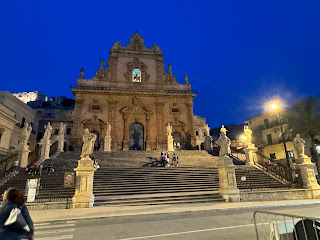
It has the requisite grand architecture: showy churches sitting atop mountainous staircases, extravagant palaces with ornate balcony braces and door and window surrounds. But it also has a major road making a dogleg right through the centre of town, and with that a feeling of almost big-city scale and modern usage. Modica felt a bit closer to Palermo or Catania than to its Val di Noto sisters.

Its biggest claim to fame is a distinctive kind of chocolate, which is sold in many specialist shops throughout town. Modica’s cioccolato is a PR and messaging triumph. You will read, hear and watch the same story repeated: this is special because it’s closer to the chocolate first brought over by Spaniards. It’s truly artisan. It’s unique. Connoisseurs appreciate its grainy nature. 

Let’s be honest, people. Sometimes “original” is not better. 

Chefs have been improving and perfecting chocolate for centuries. I prefer their innovations. We tried Modica’s speciality at multiple shops, from multiple makers, in multiple flavours. Uniformly, it tasted like chocolate that had gone wrong in the tempering process. The overwhelming top note is raw sugar, not cacao in any form. The fact that the chocolate presented by the local Michelin-starred chef was not grainy Modica stuff but the smooth, tempered, cocoa-forward version most of us know and love says it all.

Modica may possibly win the prize for best Val di Noto nightlife, though we didn’t go out enough to do a fair compare-and-contrast. We left the restaurant around 10:30 to find the streets heaving with people. Not tourists, but Italians, disproportionately under 40. There were so many people the main street had been shut down and pedestrianised to facilitate socialising. (This necessitated a long, dark, twisting, sometimes white-knuckle reroute home that would not have been for the faint-hearted driver.) The crowds were not out for a festival or anything special, this was just the Saturday night passeggiata in Modica. Grab a drink, take a stroll, celebrate life with your friends. Impressive.

BEYOND ARCHITECTURE…
The reason for the Val di Noto World Heritage listing is Baroque buildings. But if you’ve had enough, there’s also a lovely coastline dotted with small fishing villages, beaches (mostly empty during our September visit) and the wonderful Vendicari Nature Reserve. There are more than 3,700 acres of protected landscape along the coast in this reserve. Well-maintained hiking trails take you through lagoons, grasslands, salt marshes, beaches and some picturesque ruins. The latter includes an impressive old tuna production facility, or tonnara, making a statement as romantic as any castle on the coast.

Information boards throughout tell you about the flora and fauna, explaining that more than 180 species of birds visit the reserve on their annual migratory paths. This makes spring and autumn the best times to wander here. In late September we were lucky enough to see the beginning of the flamingo migration. Numbers would have increased in the coming month but there were still about 50 on the lagoon we hiked to. These were nowhere near the vivid pink of the genus lawnus plasticus, but rather a rose-tinted cream. They are marvellously odd-looking creatures whose long-legged marsh wading and angular bending for feeding is incredibly entertaining. We completely lost track of time perched in the bird-watching hides taking in their antics.

There are a variety of different beaches along the shore here, some smooth and powdery, others rockier and with more waves. The reserve web site has clear descriptions. In a country where “beach” usually means serried ranks of chairs and umbrellas hired from beach clubs who control patches of sand, this is where you’ll find the wilder, more natural coasts common in other parts of the world.

Not far off this shore, but outside the reserve, is the Villa Romana del Tellaro, which is your best chance to see spectacular ancient mosaics in the region if you don’t have time to get all the way to the Villa Romana del Casale.

We drove the coast road from Vendicari down to Portopalo di Capo, Sicily’s southeastern tip. It’s 12 miles of vineyards, commercial tomato farms, still-working fishing communities, quiet coastal roads and small pockets of beach. 
I saw a lot of signs for agrotourismi … the Italian take on farm-based B&Bs … and I suspect there’s an entirely different sort of tourist that fills this coast in high summer. You could do a moderately priced beach holiday here with plenty of activity, local colour in the port villages of Marzamemi and Portopalo, without ever bothering with the architecture-rich World Heritage Site.

Whatever your preferred holiday, my experience made it clear that the Val di Noto is worth more than a day trip. This is a place to sink in, go local and enjoy.

Wednesday, 16 October 2024

Val di Noto Part 1: Ragusa and Scicli top my list in a region that wasn't quite as expected

Most visitors to Sicily do the Val di Noto as a day trip from Catania or Taormina, heading for the eponymous Noto and perhaps one other town. That was never going to work for me.

This UNESCO World Heritage Site is comprised of eight different towns, all famous because they were built in a flamboyant Sicilian Baroque style after this whole part of the country was levelled by an earthquake in 1693. Given how much I love Baroque architecture, and how much I love Italy, this was an area I needed to sink into. It was worth the effort. These are spectacularly beautiful towns, bearing more resemblance to enormous opera sets than normal living spaces. In a country where so much of life is conducted outdoors, this makes perfect sense. You can almost see the men in their flamboyant frock coats and wigs escorting ladies in their enormous skirts, promenading down the gracious avenues and piazzas, their colourful clothes thrown into stark relief against the uniform gold of the local stone.

Deciding which of these towns to prioritise was tricky, particularly since my pre-trip research didn’t throw up a lot of distinction between them. Everyone has their favourites, but few correspondents lay out specifics as to why. I’ll try to buck that trend by giving you my take, from most to least favourite and the reasons for my preferences.

But first, the region itself. All of the travel literature had me envisioning something like the hill towns of Tuscany. Get that image out of your head right away. While each town has a gorgeous Baroque core, most are surrounded by fairly ugly modern developments. They’re also all a lot bigger than I imagined. It’s hard to get the “time traveller” shot here like the ones so easy to take of Tuscany’s San Gimignano or the Cotswolds’ Bibury, where everything in your view is picturesque and of its period. You might get a pretty glimpse of a few domes and towers, but they’ll be rising from a sea of grunge.

The area is also a bustling commercial region with intensive agriculture … there was a veritable sea of polytunnels in the five miles between our flat and the coastline … and lots of light industry. That means that normal Italians live and work here, giving you a more authentic experience than you might get elsewhere, even if large tracts are less than picturesque.

It’s also worth noting that the Val di Noto is not a valley, despite the name. The Italian for valley is “valle”. Val is a uniquely Sicilian evolution of an Arabic word for an administrative region, “wilayah”. And this region is big. It took us more than two hours to drive from its northeast corner to our base in Ispica, near the middle of its southern border. (We consistently found both Google and Apple Maps wildly optimistic; travel time regularly took two to three times longer than their estimates and I was not dawdling.) There are some excellent highways but once you’re off them, you either seem to be motoring through industrial areas or taking winding roads through dramatic but often desolate landscapes of craggy limestone peaks.

An ambitious tourist might do two of the eight towns in the UNESCO listing in a day, but with navigating local roads, finding parking and walking into town centres before sightseeing even begins, one a day is a much more realistic pace. Especially if you treat yourself to a lingering lunch somewhere with a good view, something I’d consider an essential part of the Val di Noto experience. Plus, even for an architectural obsessive, the towns do look remarkably similar once you’re within them. There comes a point when the ornate balcony supports, sumptuous scrollwork and writhing foliage in stone, concave and convex facades, cavorting angels and grimacing “grotesques” all start to look the same. For me, it was Day Five. For others, it’s likely to be less.

I’ll start in this article with my two favourite towns, and come back in Part Two with the best of the rest and some other delights in the area.

MY FAVOURITE: RAGUSA IBLA
After the earthquake, most towns in the Val abandoned their original sites and rebuilt on virgin land. Ragusa bucked the trend, stubbornly rebuilding on its ancient foundations while building a new town above it at the same time. Today, that means there’s an upper and lower town, with the lower … Ibla … being the one on the older foundations. But don’t let “lower” fool you. The only thing on the valley floor here is the car park. Ibla is on the lower of two hills, and it covers the crown of it. The newer town, with its modern expansion, crawls up the higher hill behind. Because Ibla had built out its hilltop before the end of the 18th century, this is the most picturesque, historically uniform skyline you’ll get in the Val di Noto.

Because they rebuilt on old foundations, the smaller lanes twist and wind more than in the other towns, adding more charm. You climb steadily uphill from the car park, passing increasingly ornate palaces of long-dead aristocrats, before you crest the hill and find yourself at the back of the cathedral. From there it’s a gentle but increasingly attractive slope down, as the best architecture in town faces onto this long rectangle of a piazza in front of the church. Like many in the Val the holy building sits atop a prodigious staircase; climbing to heaven isn’t just a metaphor in this part of the world. (Top photo.)

The streets from here to the end of town, equivalent to perhaps eight square blocks in American measurement, are packed with grand old buildings, smaller piazzas, more grand churches and a wealth of restaurants. You’ll find the same sorts of tourist shops throughout the Val di Noto: ceramics, textiles, jewellery, linen clothing, luxury food items, hand-made cosmetics and soaps high in olive oil and lemon content. But they seemed more distinctive and of higher quality here. For example, Colori del Sole, an artists’ collective selling clothing and home wares in shops across the island, has their biggest store here. I was delighted with a small shop in which a graphic artist sold his Sicilian-inspired designs for phone covers. The most distinctive shop in town, though you’re unlikely to buy anything there, is Cinabro Carrettieri, a traditional Sicilian cart maker. It’s great fun to wander in and watch them at work. If their painted scenes look familiar, there’s a reason for it. Dolce and Gabbana outsource the design of their Sicilian-themed housewares to the artists here.

The end of town is marked by some formal, 19th-century municipal gardens built in the grounds of an old monastery with fabulous views. Several disused church buildings have become garden follies within it. It’s a wonderful place to rest in the middle of your wandering.

Of course, rest comes at restaurants and cafes as well, and there are two that deserve attention here. Gelati di Vini, on the main piazza in front of the cathedral, is a combination wine and gelato shop that makes wine flavoured ice cream. They produce only a few wine flavours a day amongst more traditional flavours, and when they’re gone, they’re gone, so don’t delay. They were already sold out of one option when I stopped in at 11am but Moscato (usually a desert wine) and Brachetto (a light red) were delicious enough to make me wonder why this is the first time I’ve come across wine-flavoured ice cream. If alcoholic tastes are not your thing, they also do innovative flavours like fennel and violet.

When it’s time for lunch, stroll down to the next piazza down from the main one and grab a table at Cucina Sincera, in the shadow of the bombastic facade of the church of San Giuseppe. Its sinuous lines and bold statues will give you plenty to look at while you eat. The restaurant drew me in with a bold chalkboard that said “We are against war and tourist menus” and they were as good as their word. This was one of the best meals I had the whole trip, even though … as the name implies … it was all simple, traditional dishes. Caponata where the individual vegetables held their own shape and taste, and the balance of sweet and sour was perfect. Comforting cavati Norma with aubergine, tomato and ricotta (what my mother used to call pink sauce). An elegantly simple, obviously fresh cannolo. All consumed while sketching the church across the way, with a friendly waiter on hand when I needed him. Perfetto.
There were plenty of tourists here, and Ragusa Ibla is clearly attuned to them, but it never felt overly crowded. There were few groups; it was overwhelmingly independent travellers. And the groups I did spot were all Italian, here to check out the key locations used in the Montalbano detective series.

You can take a Montalbano tour in English, as well, but I haven’t seen the series so that would do me no good. You can sign up for tours to get inside old palaces and the grand 18th century assembly rooms. You can go back to Cinabro on a tour where they’ll explain the whole cart making process to you. I never got into the cathedral, or climbed up to the newer town. Attractive B&Bs and luxury hotels dot those winding streets behind the cathedral. If I were to return to the Val di Noto for just a couple of nights, rather than settling in to a long stay at the apartment we rented, I’d come here. I loved everything about the place.

THE RUNNER UP: SCICLI
The approach to Scicli (pronounced shee-klee) is as dramatic as its Baroque architecture. Unlike most of the other towns, it’s nestled in a steep-sided valley. My drive in on the Via Guardagna featured winding roads clinging to the side of pockmarked limestone cliffs, going down and down until you come through a defile and you’re suddenly on a street of golden stone houses tucked into the gap. The valley holding the town widens beyond that. The other road in, the Via San Nicolo, features a greener landscape but is just as steep, taking you up multiple hairpins before you get back to main roads.

In any country with a decent amount of rain, you’d never build here; the flood risk would be enormous. But in sun-baked Sicily, one drainage channel through town (bone dry in September) was enough. This sheltered valley proved a pleasant place for more fans of flamboyant Sicilian architecture to plant their roots. Though Scicli’s historic town centre was the smallest of all the towns I visited, it possibly had the best stone carvers. In a land of exceptional balcony brackets, the mermaids, horses and monsters here seemed particularly lifelike. Churches bristle with columns, ornate capitals, gesticulating saints and ornate ironwork. 

The Palazzo Beneventano is perhaps the grandest of all the palace exteriors I saw in this land of opulent palaces. The usual ornate balconies were topped with ornate door surrounds, windows were all unusual shapes, the corners of the building were dressed in rusticated stone covered with odd shapes and statues, and each doorway on the ground floor was topped with a giant, monstrous head. It’s an insane assault on the eyes, but lavishly gorgeous, and the essence of the Sicilian Baroque in the Val di Noto.

You can spend time studying this explosion if you stop for a meal at Ristorante Baqqalà, a fish restaurant with a triangular outdoor deck dining area where two lanes come together next to the palace. You are literally just a stone’s throw from the town’s biggest public space, the Piazza Italia, but few tourists seem to wander here. It’s a blissfully quiet place to explore traditional Sicilian food with some innovative twists while surrounded by the architecture that makes this area so famous. I didn’t bother with a starter but got served a basket of soft rolls fresh out of the oven with local olive oil. The daily pasta special was freshly-caught white fish quickly cooked with just-picked tomatoes and aubergines and a hint of spice. To follow, the only place in Sicily that dared to play with the sacred cannoli. Here, a cannolo verticale. Instead of the usual tube, they’d cooked the shell as round disks and layered it with the cannoli creme. Basically a Sicilian take on a mille feuille. It tastes pretty much the same as the standard cannolo but is a fun variation and, given how fiddly cannoli shells are to make, might be one to try at home.

Sightseeing in Scicli, whether you do it before or after eating, is just a few streets. The most picturesque is the Via Francesco Mormino Penna, with a good variety of shops, churches and cultural attractions. There’s a Museum of Costume, a historic apothecary’s shop and a couple of palaces, including an intriguing one with a Baroque outside and Liberty Style Interiors. Unfortunately, nothing was open to walk-up trade. I got the impression that … at least in September … there aren’t enough tourists in Scicli to staff such things for continuous opening, so they’re only available in conjunction with tours you book through the tourist information office. I was happy enough to just wander on my own appreciating exteriors, but that’s proof that there’s plenty to do in Scicli if you want to spend quality time here.

After days of nosing around ceramics shops, this is also where I finally made a purchase. Though everything in the shop had been made in Caltagirone, another town within the World Heritage Site designation that I’d already visited, I think the smaller, more curated selection in Scicli made it easier for me to narrow down a choice.

It is worth walking a few minutes away from this main tourist strip to check out the Church of San Bartolomeo. It sits on the Via Guardagna, just where that mountainous defile I came down to get here opens up into the town. There’s also a fair amount of street parking in front of it. Just don’t miss the signs pointing out that you have to pay for it. I did, and am still waiting to see if I get a ticket. If I did, I will pay it hoping it goes to support more amazing renovation works in town like those done at San Bartolomeo. The interior is a pastel candy fantasy of whites, blues, greens and golds. Built a bit later than many of the Baroque churches here, it’s just tipping into neo-classicism, so all the swirls, foliage, clouds and flying putti of the old style are matched with an explosion of capitals, architraves, cornices and pendentives. It’s like the architects decided they had to use every single trick in their repertoire. It is just as mad as the Palazzo Beneventano, but more colourful. Don’t miss the enormous presepe, or nativity scene, showing that it’s not just Neapolitans who know how to big up a humble Christmas tradition into a year-round show.

Ragusa and Scicli, my two favourite towns in the Val di Noto, are only 19 miles apart as the crow flies … though over an hour’s driving time on those windy roads. Thus it’s certainly possible to do them both in one day. But I think it would be the visual and intellectual equivalent of having too much sugar at once and making yourself sick. These Baroque towns are rich dishes to be consumed slowly, with time to digest between them.

Next time, I’ll cover the rest of my Val di Noto highlights.

Saturday, 12 October 2024

Mosaic Madness: The Roman villas around the Val di Noto are beyond compare

I went off to university with strict instructions: no easy classes, and everything should directly support a prosperous career. I put two full academic years behind me before I could get my mother be at peace with me braking those rules to take Roman Art and Architecture.

It was the most effortless “A” I ever earned at Northwestern. Not because the course was easy, but because I treasured every minute spent with Professor Jim Packer, consumed every bit of course material with enthusiasm and found the artistic observation and analysis required of me to be something my mother had baked in to my character. I loved that class, and it laid down a bucket list of sites I’ve spent my life working through. Of those not in danger zones, the most significant left was the Villa Romana del Casale in the Sicilian countryside.

This trip, I finally got there, and it lived up to 40 years of dreaming expectations.

The Villa Romana del Casale is one of the great sights of Sicily. It’s just outside Piazza Armerina, a Baroque hill town on the edge of the Val di Noto Unesco World Heritage site. The Villa is a World Heritage Site on its own. It’s hard to throw a cannolo in heritage-laden Sicily without hitting one.

“Villa” is a bit of a misnomer. This is more of a palace, with the latest scholarly opinion thinking it may have belonged to Maximian, one of four emperors splitting ruling responsibilities in the late 3rd century. (He shared power with Diocletian, whose enormous retirement villa evolved into the town of Split.) Some sort of governmental function would explain the almost ludicrous scale here. You just can’t imagine private citizens having a complex this large and reception rooms on this scale, no matter how wealthy they were.

But you’re not here for the size. You come for the mosaics and, to a smaller extent, the preserved frescoes on the remaining walls. This is a place to be captivated by details. I have marvelled at a lot of Roman mosaics in my life, but have never seen so many wonders in one place. (The Bardo Museum in Tunis is the only thing that comes close.)

Room after room of floors surge with life. People, animals and plants are hemmed in my colourful geometric borders. If you couldn’t clearly see the lines, you’d swear they were paintings. It’s hard to get your head around the idea that all of these extraordinary scenes are comprised of tiny squares of glass and stone.

The place proclaims it’s not your average “villa” from the very first room, a massive chamber that spills out into a covered walkway like a cloister that goes around a square almost the size of a football pitch. The reception room you can see beyond that is the shape and size of a full Roman basilica rather than a domestic space. You see it all from raised walkways because nobody is allowed to tread anymore on what were made as floors. Even the most casual observer will need at least 45 minutes to walk through all of the rooms. I needed more than two hours.

There’s a wide variety of scenes and styles here; so many a modern interior designer would probably criticise the lack of consistency across the complex. These days, that’s what makes it fun. The Villa is most famous for a long, wide hallway showing the hunting for, capture and transport of wild African animals who were to be used in shows in the Colosseum and other Roman arenas. 
There’s another animal-themed room off the main quadrangle where Orpheus is charming scores of wild beasts with his songs. And another hunt. It’s a good hint that was what rich people came to the forests around here to do. The level of detail is extraordinary, though there are times you suspect the artists had never seen some of the more exotic beasts they were called upon to depict. There are some decidedly dodgy crocodiles and hippopotami. But when the artists bring hunters face-to-face with lions or wild boar they’re at their best, showing the raw emotions of both combatants.

Elsewhere, there’s an elliptical room where the floor has been turned into a chariot-racing arena, with the contestants going hell-for-leather mid race. One is even caught taking a spill, with the drivers behind him pulling hard on reigns to avoid him. 

In the family’s private rooms, as a send-up to that impressive racing art, is a room where cherubs contest each other in little carts tied to birds. Elsewhere in the private rooms, life-sized women engage in various workouts at the gym; this is the other particularly famous bit of the Villa, renown for their classical-era bikinis. 

At the entrance to the baths, a regal woman thought to be the lady of the house greets visitors with her staff behind her. There’s another set of reception spaces off to one side of the main building where the mosaics show scenes of the gods and Hercules battling across the room at a scale about twice life-sized. To be honest, if you were trying to do business in here when the floor was complete I think it might make you a bit queasy, so crazy are the proportions.

My favourite mosaic was in a semi-circular room approaching the kitchens with what would have been a fountain at its centre. Here, in one of the best places in the world to eat seafood, is an aquatic scene of a staggering variety of fish and waterfowl, interspersed with playful cherubs swimming, fishing and sailing in a seascape with exquisite colonnades of classical architecture framing the shore. 
Too much pattern can make your head spin, so I also enjoyed quieter spaces where the floors are mostly geometric designs, sometimes standing alone and sometimes framing details of plants or animals. Another of the kitchen rooms, with braids and wreaths around seasonal fruits and vegetables at their peak, would work in a home today. 

The Villa Romana del Casale was the single most crowded attraction we went to in Sicily. (Remember we skipped highly-trafficked Cefalù, Taormina and Ortigia.) Though there’s nothing but farmland for several miles around, the Villa has an enormous pay-to-exit car park in a deep valley and there’s a small mall of tourist booths on the way to the Villa from there full of pottery and other Sicilian crafts. This is definitely bus tour territory. Curiously, most of the tourists were continental Europeans. We heard only one English-speaking group come through. Though there were at least 20 individual cars there, the majority of visitors definitely came off buses. The secret, we learned, was to take your time, stand still and admire details while the bus tours flowed around you. In between them, you were often almost alone.

To be truly alone with Roman antiquity, however, you can head to another villa with murals on the other side of the Val di Noto. The Villa Romana del Tellaro was much smaller than Casale. Only the partial remains of four rooms’ floors and a hallway remain today, but the quality here is almost as good as the more famous villa. The intricately patterned hallway suggests that oriental carpets form a direct line of descent from Roman mosaics. There are more impressive hunting scenes here, a delightful vignette of lovers and a particularly fabulous tiger strolling through acanthus leaves. 

This is relatively new as a tourist site. For much of the 20th century this was an abandoned farmhouse, like so many that dot the Sicilian countryside. At some point in the ‘60s, someone discovered ancient mosaics here and started selling them out of the country on the black market. Customs officers discovered the scheme, then the government bought the house and excavated the ruins. Despite the fact it’s just a stone’s through from immensely popular Noto, this feels very undiscovered.
The Villa Romana del Casale is definitely worth a special trip. (Try Villa Trigona, as described in my introductory article, for a place to stay.) But if you can’t get that far and are in Ortigia or Noto, then at least do yourself the favour of getting to Tellaro. Both of these villas show off the incredible opulence of Sicily in the late Roman Empire. Particularly if you happened to be a Roman overlord. They created a feast for the eyes that, thanks to durable building materials, is still truly wondrous.

Thursday, 10 October 2024

Sicily's Western tip balances a few sightseeing gems with long stretches of stark reality

I have been to a lot of famous wine regions, and they all tend to look the same. Verdant hills with stripes of vines are dotted with prosperous-looking farmhouses or estates while charming villages ... usually packed with upscale boutique hotels, independent restaurants, art galleries and cute shops ... are tucked into the valleys. 

The west of Sicily breaks that mould. Though it produces more than 50% of Sicily's wine, it is a stark and empty place. It is beautiful but in a haunting way: vast, lonely and melancholic. That's strange, given that the white wines that come from here ... Grillo, Cataratto, Inzolia, golden Marsala ... are glasses of cheerful sunshine.

Maybe I should blame my SatNav for my first impressions. The day I explored most widely it took me on the direct but little-travelled route through back country menaced by inky clouds and violent downpours. Even in benign conditions, however, you would have noticed the emptiness. I went for almost 10 miles without seeing another car, a human being in the fields or an inhabited building; just acres of vines punctuated by abandoned farm houses. The only thing that moved besides me and the rain was a herd of goats grazing its way through one of the vineyards.

The people clearly all live in the towns, not the countryside, and the towns are uninspiring. The local road between Mazara del Vallo and Marsala mixes light industry with big agricultural businesses, a lot of roadside rubbish and some unlovely small towns that seemed entirely the product of a troubled 20th century.

Marsala, the furthest west and north I went on this part of the trip, was equally grim despite its storied past. World War II deserves much of the blame. This base of great cultures since the Carthaginians, home of legendary wine, starting point of Garibaldi's revolution, was "wiped off the map" by American bombing in 1943, according to a New York Times headline of the time. The rebuilding was rushed, utilitarian, and not really worth a wander for today's tourists. 

Curiously, though the town is right on the coast, it doesn't have much of a seafront. A large chunk of land is taken up by the ruins of Carthaginian Lilybaeum, exciting in concept but the reality is untended scrubland you wouldn't realise was a historic site unless someone told you. The only thing of historic interest along the waterfront is a handful of old Marsala warehouses and some traditional salt production flats. These are why you want to come to town.

As drinking habits and export markets have changed, the Marsala wine industry has shrunk from many production houses to just a few, and of those Florio is the biggest name with the grandest history and the broadest variety of tasting experiences. If you've watched The Lions of Sicily on Disney Plus then it also has the benefit of its association with that series' protagonist. The historic Vincenzo Florio, whom photos suggest was a good deal less sexy than his TV counterpart, bought up multiple small wineries and combined them into what became the dominant name in the industry. It's still the most impressive and best-maintained building along Marsala's seafront. 

But before I take you inside, let's clarify what I mean by Marsala. There's a lot of wine produced in the province of Marsala, much of it "normal" whites, rosés, and some reds that fit into the table wine category. But Marsala as a Denominazione di Origine Controllata (DOC), is only a fortified wine similar to Port. Like its Portuguese cousin, Marsala was created by British entrepreneurs who saw the potential for shipping and selling it back home. Two centuries ago, tastes leaned towards sweeter wine, wines didn't travel well and Britain didn't produce any of its own. If you add alcohol to a wine you stop its natural fermentation process while stabilising it for travel. It was perfect for exporting to Britain, and many Brits moved to the continent to make wines to send back home. While the Port-producing British families and their influences are there to this day (as evidenced by the Porto Cricket Club), Sicily's Inghams and Whitakers eventually sold their operations to Florio, leaving nothing British but their names on a few heritage sites.

Port remains a staple on the British dining table, particularly at the end of a celebratory meal. Marsala, however, enjoyed its peak in Continental Europe between the wars as a high-class aperitif before its reputation plummeted and it almost disappeared from the market. 

We can blame WWII again. With production facilities flattened and both the population and the fields devastated by war, winemakers needed products that would inject some cash fast. Enter the cooking Marsala your grandmother probably had in her pantry. This "Marsala Speciale" was artificially sweetened to a level far beyond the original and promoted along with recipes like veal marsala and tiramisu. While that tactic drove a surge in profits and saw Marsala-driven recipes become all the rage in the '50s and '60s, the food trend peaked, passed on, and the market started to shrink. In its wake, few people remembered ... much less drank ... the original styles.

Proper Marsala, as awarded the DOC and sampled at Florio, is a wine of delicacy and variety. Much of it isn't sweet, having a flavour profile closer to sherry, and most of it is white. Even the red was a very light shade. Though it was called "ruby" to differentiate it from the golden and amber we tried, it's nowhere near as dark or sweet as a Ruby Port; it's much closer to a 20-year-old tawny. 

In addition to the tasting, the Florio tour welcomes you through the gates into their "baglio", a courtyard complex complete with a central garden, houses, offices, production facilities, the maturing warehouses and a beautifully styled, very upscale shop. Over the main gate is a striking stone carving of a lion drinking at a pond, the original logo that also sparked the description of the family as "the lions of Sicily." 

The facility is in great shape and looks very historic now, but the reality is that it was all re-built after the war. And though its long, narrow, maturing warehouses look enormous, they are just four of the 13 original. That post-war rebuilding wasn't done by the Florio family, however, as they'd squandered their enormous fortune by the '30s. The winery stayed in Italian hands, however, going first to the Cinzano people before joining the Saronno group, of Amaretto fame. Italians and aperitivi go hand in hand. 

Florio offers a variety of tasting experiences but only a few in English. It's best to pre-book on their website rather than walking in, though anyone could pop in to the store.

Another staple of the Italian table is produced about 20 minutes north along that unremarkable coastline: sea salt. There's a string of salt marshes along the shore between Marsala and Trapani where salt is still produced as it would have been for thousands of years. Let sea water into shallow pools where the water can evaporate, keep turning the salt as the moisture goes, end eventually you end up with piles of glistening white crystals. Move them to bigger mounds for packaging, open the sluice gates and start over. There is almost no reason to continue this process: the salt you'd get from removing the water with machines would taste pretty much the same. Experts say that the shape of the crystals is unique when you do it the old way, and that can give you a nicer crunch when you put it on food. 

The real reason for keeping the old ways going is that it's become a tourist attraction.

At Saline Gonna it's easy to see why. I can't think of another production process that's so attractive. The salt pools have a milky, reflective sheen that mirrors the world in a magical way. There are endless variations of blue, green and white here between water, clouds, the land behind you and an island in the bay. Piles of freshly-made salt glisten like diamonds. 

As pretty as it all is, you'll be hard-pressed to spend more than half an hour here, and that includes browsing through the shop of salt-based products. You could linger a bit longer with an escorted tour, but most of those are in Italian; check the website and pre-book in English if you're interested. The real point of this place is dining with a view. I was here mid-afternoon, when the restaurant ... seafood based and with one side open to the sea ... was quiet. Two enormous terraces of outdoor tables were roped off, waiting for the evening clientele. The sun sets directly off the coast from here, and it's supposedly at its most beautiful at sunset.

At the other end of the SS115, that hard-working stretch of road that showcases the Sicily of normal people rather than tourists, lies Mazara del Vallo. The numerous descriptions I'd read of it as one of Sicily's largest fishing ports, and consequently as a flashpoint for illegal immigration, didn't lead me to expect much. To my surprise, however, Mazara was a good deal more picturesque than Marsala, with a seaside promenade full of attractive restaurants with views, a surprisingly opulent main church, a lovely central piazza that had retained its Baroque splendour, and one very small but exceptional museum.

In 1998 a boat of local fishermen briefly believed they'd dredged up a body in their nets before realising that they'd discovered an ancient bronze statue. There's still a great deal of debate over whether it's an original by Praxiteles, the greatest sculptor of the Greek world, a later Greek copy, or an even later Roman one. Whatever the truth, it's astonishingly beautiful, and slept on the sea bed for about 2,000 years. 

It's an exquisite young man, the muscles in his perfect body clearly delineated as he throws his head back in an ecstatic dance. Unlike so many other Greek bronzes, this one has retained its alabaster eyes. Those, the lifelike swing of his hair and the incredible sense of motion captured by the sculptor make him bizarrely lifelike. If Ancient Greece was full of statues like this, the myth of Pygmalion willing one to life becomes perfectly believable.

This one-room museum in the nave of a small, deconsecrated church is called, quite logically, the Museum of the Dancing Satyr. Also on show is a variety of pottery and ancient decorative items showing the same figure in the same pose. This explains how art historians knew he was a dancing satyr. The statue might have disappeared, but its legend lived on in ancient homeware. Today's satyr dances without arms or one leg. Fishermen continued to dredge the area but haven't found the rest of him. The museum holds some other items brought up in the local area, however, including one intriguing foot and lower leg of a bronze elephant. It's life-sized, and just as realistic as the satyr. It must have been incredible.

There's also an area where you can watch a film that explains, with English subtitles, how the fishermen found the satyr and the high-tech process scientists and restorers used to clean him up and get him ready for display. 

Despite treasures like the Dancing Satyr, Western Sicily from Mazara to Marsala isn't really a tourist area. I suspect we would have found more densely-packed, traditionally beautiful attractions had we driven another hour up to Trapani and Erice. But this first part of the holiday was also about rest, and we'd booked ourselves into such a glorious hotel we didn't want to leave. 

The Almar Giardino di Costanza is a destination hotel with a fabulous spa. (See my introductory entry for more.) You don't need more than a night or two on this coast if you're only interested in sightseeing. But if you're looking for a balance between the sights and high quality R&R, book into the Almar and plan on the sites above, plus Selinunte. Add Trapani and Erice and you could have a very happy week entirely off the beaten track, while also understanding a bit more about modern Sicily beyond the tourist hotspots.

Tuesday, 8 October 2024

The Greek Pompeii? Selinunte is a lesser-known wonder on Sicily’s southwest coast

It doesn’t take much browsing through online travel forums to realise that the vast majority of tourists go to a tiny number of places ordained as “must sees”. In Sicily, the default itinerary is Cefalù, Taormina, and Ortigia. If you’re up for some Greek ruins you’ll throw in a day trip to Agrigento. In a search for a more authentic, less crowded Sicily, we avoided all of these spots.

When it came to the island’s Greek roots, we headed for Segesta and Selinunte and were richly rewarded.

Selinunte was one of our favourite experiences of the whole trip, and we both enjoyed it even more than Agrigento, which we explored thoroughly and loved on a visit a decade ago. (We actually drove right underneath the ridge of temples at Agrigento this time on our way to Piazza Armerina, but didn’t stop.)

There are three reasons Selinunte had such an impact: the vast scale of the place, its striking location, and the relative absence of tourists.

First, some context: With its strategic position right in the middle of the Mediterranean, Sicily was a prize colony from the moment the first gang with boats and swords came up with the idea of an overseas pied a terre. Phoenicians, Carthaginians and Greeks all sunk roots, creating colonial city states rather than taking over the whole island. Ortigia/Siracusa and Agrigento were such entities, Selinunte another, lying 58 miles west of Agrigento along the same coast. Greeks founded it in the 600s BC as their westernmost colony. The Carthaginians took it over in the 400s BC and it later became a battleground in the wars between Rome and Carthage. By 200 BC it was already a ruin.

While Agrigento remained a population centre with layers of successive building repurposing and layering over its Greek foundations, Selinunte mostly lapsed back into countryside. When people got interested in classical antiquity and started digging stuff up, they could easily unearth the enormous sprawl of the city beneath olive groves and pastures. Today’s site spreads over about two square miles with three distinct areas for exploration: The East Hill, with the most complete temple ruins (this is what you see in most photos of the place), the Acropolis (essentially the city centre, with housing and public buildings), and Gaggera Hill in the west, with another big temple complex. Unless you want to hike miles through arid, coastal scrubland, buy the ticket that includes shuttle services. Oversized golf carts will whisk you between the main areas while giving you some excellent views.

The entry building is the only place you’ll encounter a crowd; once people get their tickets and set off to explore the landscape everyone fans out. The first thing you’ll see on entering is the most-reconstructed of the temples on the East Hill, with the Acropolis to your left and the sea beyond it. It’s a stunning introductory view. 

Everyone naturally makes for the almost complete building, Temple E, first. It is in as good a shape at the temples at Agrigento but unlike the more famous site you can walk inside these. It’s a real thrill and puts the monumentality of these structures in a whole new light. Temples F and G next door are essentially just piles of rubble, but rubble you can touch, wander amongst and scramble over. Standing next to a column capital that’s wider across than you are tall gives you profound respect for ancient builders. The back temple, G, was the largest in the world when it was under construction, and a walk around its remaining platform is awe inspiring. Sadly, this potential wonder of the world was destroyed before it was ever completed thanks to those invading Carthaginians.

From there, we took the golf carts over to the other end of the site to see more clusters of temples on Gaggera hill. You need a bit of imagination to get a sense of the glory of the place, but the descriptive panels and the audio guide (an extra charge but worth it) help you to pick out the sacrificial altar, spot the sluices where water ran through the site and the channels on which the temples’ massive bronze doors slid. Only people who’ve bought into the transport tend to get this far and we were alone in the complex for quite a while, no sound except the crashing of the surf on the beach below.

Then we came back to what was the city’s acropolis, sitting high on a hill that had been sheathed in stone walls. Several still exist. There, you’ll see more temples … the central one features an impressive set of standing columns, though isn’t a complete rectangle … plus the remains of theatres, shops and houses. Architectural historians believe they’ve found evidence of the world’s first circular staircase here. There are some boards in Italian and English but if you want to really grasp subtle points like that it’s best to add the audio guide onto your entry ticket.

For the best understanding of the site, however, you’re going to have to add on a visit to the Palermo Archaeological Museum 75 miles away. The best preserved temple sculptures and hundreds of artefacts unearthed in excavations are stored here, as well as some excellent models, graphics and descriptions that bring Selinunte at its height to life. 

In one of the courtyards they show off a row of lion’s head waterspouts from one temple and also feature several copies painted as they would have been when the temple was in use. 
There’s also an excellent AI headset you can try on to take a walk through the complete temples at their height. There’s only one, but as almost nobody goes to this museum it’s unlikely you’ll have to wait. It’s a shame this stuff isn’t in an interpretive centre down in Selinunte, as it would make a visit even more meaningful and I suspect few tourists actually do both. But those who make the effort to see both will come away with something similar to seeing Pompeii or Herculaneum in conjunction with the archaeological museum in Naples

I had also planned a wander around Segesta, conveniently located between Palermo Airport and our hotel outside of Mazara del Vallo. A 90-minute queue to pick up the hire car (Avis/Budget in Palermo Airport NOT recommended) ate into our sightseeing time. When we got there … further off the highway and down far more winding roads that you’d think from the map … we realised that there would be a hefty hike involved to get up to the temple. But there was a rather brilliant view from the car park. And so, dear readers, your reporter failed you, opting for cocktails at the hotel rather than in depth sightseeing. The theatre here, further up the hills and not visible from the road, will have to remain a mystery. 

Our short excursion allows me to observe three things. If you’re basing yourself out of Palermo and want to get a taste of the Sicilian Greek world, this is the most logical day trip and the temple here is impressive enough to satisfy most people. The view from the road is dramatic enough that it’s worth the half hour detour off the motorway to take a look; you can get some great photos without going in. If you are going to explore, however, this is a place for stout walking shoes and lots of energy.

Whichever you opt for, seeing some Greek ruins is an essential part of touring Sicily. They’re an important part of the island’s history and one of the many factors that make it different from the rest of Italy.

Tuesday, 1 October 2024

Extreme Sicily can challenge and delight: here’s an itinerary to balance the wonder with R&R

Someone once explained to me that Italy gets more extreme the further south you go. If, by Rome, your nerves are a bit on edge from the noise, the traffic and the queue cutting, if the contrast between opulence and grime is grating, if you’re feeling over-stuffed by food and wine … it might be time to stop. If, however, life is just seeming brighter, the sights more magnificent and the dinners ever better, press on. On until, as far south as you can go before you hit Africa, you reach Sicily.

Sicily feels like everything Italian … the good and the bad … distilled to its most powerful essence.

It is incredibly ancient compared to the rest of Italy: the Phoenicians, Carthaginians and Greeks all lived here. Want to see some of the best Greek ruins in the world? Forget the Acropolis, come here. Every building in Sicily is built on the bones of past ages, and most of them seem to be crumbling. Even the new ones.

Other than for a few hundred years of glory in the early Middle Ages, the island has been a colony rather than its own boss. The nationalities of the absentee landlords might have changed, but in turns they abused, ignored and siphoned off resources. (Very occasionally, as with whoever built the Villa Romana del Casale, they fell in love with the place and ploughed their own resources into improving it. But this was the exception.) Many Sicilians, including my ancestors, argued that Italian unification was simply another foreign invasion; now the abuse came from Savoy, then Rome, rather than Madrid. Colonial overlords … and the mafia brutes that took advantage of their distance … drove Sicily to such a state that when emigration became a viable possibility for the average person, vast numbers of its people went elsewhere. An empty countryside scattered with abandoned houses is a vision of modern Sicily.

Extremes, age and colonial exploitation have created a place that’s both Italian and distinctly alien. Many places in Sicily remind me more of Tunisia or South Africa than Tuscany or the Veneto. Tourism in Sicily can be challenging. While gleaming new motorways are a testimony to EU improvement projects, local roads can be an adventure. Visual clues that usually tell you “turn around, you’re in a dangerous neighbourhood” don’t work the same way here; a dark alley full of graffiti and rubbish can host upscale jewellery shops or magnificent Baroque oratories. UNESCO heritage town centres are surrounded by hideous, often collapsing post-war housing. Cultural attractions can be light on English explanations; my basic Italian gets used here far more than in the north. And yet, if you love culture, history and food … the foundations of this blog … Sicily delivers rewards out of all proportion to the effort you put in. There is no place else in Europe quite like it.

I decided on two weeks here to celebrate my 60th birthday and our 13th wedding anniversary. (Marrying on your birthday is an excellent way to ensure neither of you ever forget your anniversary.) I wanted something indulgent and celebratory. Something that offered loads of top quality sightseeing with proper R&R and tremendous food. Opera at Palermo’s Teatro Massimo and cooking class with a Duchess in her palazzo was the icing on the cake.

Our itinerary went like this:

Days 1 - 5: Almar Giardino di Costanza, near Mazara del Vallo
The idea was to start the holiday with some restorative pamper time. We flew into Palermo and picked up a car at the airport. Unfortunately, our 90-minute queue at Avis/Budget/Maggiore took only a little less time than our whole drive south. The delay was so extreme we had to modify our plans to visit the Greek ruins at Segesta and content ourselves with a drive by. Which, to be honest, is still quite impressive and offers great photo opportunities without paying for admission.

The hotel is one of those Sicilian contrasts: a lush and luxurious walled complex surrounded by the dry, dusty, ruin- and rubbish-filled agricultural outskirts of Mazara. The few miles between motorway and hotel will make you wonder what you’ve gotten yourself into; once you’re through the gates you’re in another world. An old agricultural estate has been repurposed as luxury hotel and spa. The building is a big white and yellow “U” surrounding gardens, pools and fountains. We upgraded to a pool/garden view, which gave us an enormous balcony with table, chairs and sun loungers. 

The bedroom featured towering ceilings, an enormous television, arm chairs for watching, and a cheerful bouquet springing from a traditional Sicilian head vase to wish me happy birthday and anniversary. (A cake with burning candle also showed up on the actual day.) The basement … part of it opening onto the lowest level of the garden … features an upscale restaurant and a high-end spa. There’s an indoor swimming pool, hot and cold bathing tubs, saunas, steam rooms, and relaxation rooms all designed in a modern take on Arab-Norman architecture.

In short, it’s the kind of place you don’t really have any need or desire to leave. Even the private beach, accessible by hotel shuttle for morning or afternoon stints, didn’t seem worth the effort. Lots of things on my local possibilities list fell to the competition of napping to spa music and lounging in hot water, namely Trapani and Erice. But a few sightseeing excursions did demand the effort: the Greek ruins at Selinunte, the Greek statue of “the dancing Satyr” in Mazara del Vallo, a look at the salt flats above Marsala and a tasting of that town’s eponymous wine at Florio.

Days 5 - 6: Villa Trigona, Piazza Armerina
The next major stop in the itinerary was the Val di Noto, which would have been a straight 4-hour drive along the southwest coast of Sicily had we gone direct. But a date with a bucket list item demanded a detour. About 40 years ago Professor Jim Packer beguiled me with his Art and Architecture of Ancient Rome class at Northwestern, and his descriptions of the Villa Romana del Casale in the Sicilian Countryside have haunted me ever since. It was worth the detour. (More to come on that in a future article.)

We spent the night at another old agricultural estate turned to tourism. The Villa Trigona isn’t as big or as high-end as the Almar, but it was correspondingly less expensive. The family still owns and runs the place and has done a major renovation in the past few years, so venerable architectural details sit comfortably with fresh plaster and sheet glass walls of modern extensions. Our room, however, was 19th century in all but its electrification: old school wooden furniture, beautiful bed linens, decorative floor tiles, whispy curtains screening french doors to Juliet balconies that looked out over the surrounding woodlands and mountains and down into the front courtyard of the estate house. Another set of French doors led out to our own roof terrace. It was almost a shame to only be here just one night. 

The family offers dinner in that modern extension. It was hearty and delicious if not memorable, but we were grateful to be able to eat in. Villa Trigona is off winding, mountainous roads 10 minutes from Piazza Armerina and I wouldn’t have enjoyed navigating after dark. There’s nothing in walking distance. 
Days 6 - 11: Melifra, Ispica
Next came five full days enjoying the Val di Noto, proclaimed a UNESCO world heritage site because of its baroque architecture. All the guidebooks will tell you about the 1693 earthquake that flattened southeastern Sicily, and how the towns in the area rebuilt in a florid Baroque style that makes them gems of the architectural world. What they probably won’t mention is that these exquisite town centres are ringed by large and unattractive sprawls of modern development, that the Val is thick with modern industry and commercial agriculture, and that it’s a harsh landscape of pockmarked limestone peaks and scrubby brush with lots of winding roads between points A and B. This is not the charming hill towns of Tuscany.

The towns, however, are worth the effort. Noto is the most famous and therefore the most crowded; I enjoyed Scicli and Ragusa Ibla (top photo) much more. The Baroque heart of Modica was much bigger than anticipated, and the large crowds socialising on the streets at 11 pm on a Saturday testified to the fact this is a modern, living town, not just a tourist destination. We were there not for the late-night passeggiata but for dinner at a Michelin-starred restaurant, Accursio, that was one of the highlights of the trip. If you get sick of Baroque towns, there are beaches and a nature reserve where migrating birds … notably flamingoes … pause during their spring and autumn migrations. There will be more all of that in articles to come. 

We stayed in an AirB&B rental called Melifra that was absolutely ideal. It’s on the edge of a modern development on the outskirts of Ispica (this one, unusually, rather attractive … though still cursed with the Sicilian plague of unfinished or unkempt properties, like rotting teeth in the middle of an otherwise gleaming smile). While not usually listed amongst the highlights of the Val di Noto, Ispica has the same baroque heart as its neighbours with a handful of standout buildings. For us, however, its greatest advantages were that it sat in the middle of everything we wanted to see, and the views to the sea are quite spectacular. Even more so when you’re sitting in the hot tub in the roof garden at Melifra, glass of cold local wine in your hand while watching the sunset.

Melifra occupies the top floor of a three-story townhouse at the end of a block; access is up a dramatic winding staircase with a glass roof above. There are two bedrooms, each en suite, and a combined sitting room/kitchen dining area, but the crown jewel is undoubtably that roof garden. In addition to the hot tub there’s a shower, two loungers, a sofa, coffee table and chairs, and a large TV pre-programmed with all the streaming services (you will need your own password to sign in). Someone with highly-attuned interior design sensibilities has been at work here; colour schemes, decorative items, rugs and art have all been selected to complement a single colour scheme.

It was as tasteful as a luxury hotel, but all ours. Hosts Gianfranco and Barbara were fantastic, establishing a WhatsApp group for us for the duration of our stay, flooding us with useful information and responding quickly when we needed more.

I soon got into the habit of sightseeing during the day, nice lunch out, then back to Melifra for a soak in the hot tub. We’d spend the evenings in the outdoor seating area, nibbling a light dinner, drinking local wine and working our way through “The Rings of Power”. The dramatic landscape here seemed to fit a foray into Middle Earth.

There were only two flies in the Melifra ointment. If you are very tall, this apartment built under the eves may present a hazard. It’s beautifully designed, with skylights with automatic blinds in the roof that can flood the space with sunlight, but my husband whacked his head multiple times before he got used to stooping at the sides of rooms. You’re also about 3/4 of a mile from the town centre so it’s not really easy walking distance for going out. We only went out for dinner once and we preferred the extreme quiet, but this might be an issue for others.

Days 11-15: L’Olivella B&B, Palermo
Palermo can be hard work: it’s magnificent and exciting, but also noisy and dirty. If Sicily is like the concentrated essence of Italy, Palermo is the further distillation of Sicily. I thought I’d put it at the end of our agenda for when we were well-rested and had grown accustomed to the pace of the island. I also opted for the humblest of our accommodations here, figuring we’d had our luxury and would spend less time “at home” in the city.

L’Olivella is closer to what used to be called a “pensione”: you take one of a suite of rooms let out in your landlady’s house, there’s a modest sitting room, all the guests sharing a table at breakfast and then you’re unlikely to get a glimpse of your host or the other guests until the next morning. The whole place has towering ceilings with a few retaining some lovely frescoes that look to be from the 1930s. The floors are tiled with a beautiful array of Liberty Style (the Italian take on Art Nouveau) patterns. Our bedroom, Lingotto, was generously sized with French doors letting in light from two sides of the building: one side with a tiny balcony just big enough for two chairs and a narrow table. The location is superb. From our balcony we looked into the windows of the archaeological museum. The opera house loomed above the end of the street, between us and its front door were 200 metres of restaurants and artisan shops. A 10 minute stroll took us to Quattro Canti, the sightseeing heart of town.

We had two prime objectives in Palermo: Turandot at the opera and a very special cooking class in a palace in the Kalsa district. We’d already seen the Palatine Chapel and the cathedral at Monreale on a previous trip, so we were free with the rest of our time to explore some of the “Tier Two” sites. I spent a lot of time drinking in outrageous Baroque religious interiors, notably the oratories of Serpotta and the Jesuit church known as the Casa Professoressa. Honouring that rare and wonderful period in Sicilian history when it was the intellectual and artistic heart of Europe, I revelled in the mosaics in La Martorana and the Arab-Norman lines of San Cataldo. Yes, it was very church heavy!

We also spent a very happy morning poking around the Archaeological Museum, which is mostly distinguished by having the best bits of Selinunte under cover. In many ways it’s a shame that this stuff isn’t on site there, as the displays here explain the ruins far better than anything in Selinunte, and the treasures they’ve preserved really bring the place to life. This museum experience towards the end of our trip made our explorations at the beginning even more meaningful.

I could have done so much more. There was a museum of Sicilian tiles on my list, and a day trip to Cefalù. I was disappointed to discover that the traditional puppet shows only happen on weekends, and we were only in town for weekdays. The weather was exquisite and we could have headed to Mondello beach. But it was the end of the trip and we were mindful that we wanted to head home relaxed and refreshed. So multiple-hour, multiple-course lunches with multiple bottles of wine featured more prominently than high-impact sightseeing. About all that food, of course, there are articles ahead.

In coming weeks I’ll cover key sites, food and experiences. This gives you context and big picture for a two-week Italian itinerary I’d happily recommend, and do again.