Wednesday, 26 January 2022

Eight elusive Roman treasures still haunting my bucket list

I know Rome well. From my first visit on a school trip, when I ditched classmates more interested in shopping to scramble over the Palatine Hill on my own, I've always wanted to scratch beneath the standard bus-tour itinerary and touch history. Back in the early '00s I spent a whole week there on my own, dedicating myself to niche sights and small attractions unlikely to captivate fellow travellers. 

But Rome is a big city, with prodigious layers of history. It would take a lifetime to see it all. Here's my "bucket list" of eight places I'm keen to go but haven't managed to see in the Eternal City. 

SANTA MARIA DEL POPOLO

From its fabulous Medieval origin story of the exorcism of Nero's ghost to a line of popes who decided to endow the place with masterpieces, this is one of Rome's blockbuster churches. But Rome has a lot of blockbuster churches. Santa Maria del Popolo is the only one with two big Caravaggios facing off in all their dramatic glory. The Cerasi chapel features the Conversion of St. Paul on one side and the Crucifixion of St. Peter on the other. The bad boy of Baroque art rolled out all of his dramatic tricks of lighting and perspective to dominate the small space and pull you into the scene. Presumably you hardly notice the knockout-in-any-other-space Assumption of the Virgin by Carracci over the altar, the frescoed ceiling, and the opulent, gilded plasterwork. But I can't tell you, because every time I have tried to visit the church it's been closed for renovation. Now it's closed for Covid safety. I live in hope.

THE DOMUS AUREA

I suspect the Emperor Nero would have had a soft spot for Caravaggio, given their shared reputations for wild excess, violence and love of art. The last Julio-Claudian emperor built a palace called the Domus Aurea for himself that he set out to make an architectural and artistic wonder of the world. Its marble walls were studded with gold and gemstones and it had a famous dining pavilion with open sides and a rotating dome. It was lost for centuries before being re-discovered in the Renaissance. Much of the classically-inspired style of the time comes from artists ... including Michelangelo and Raphael ,,, who lowered themselves into the underground chambers, copied the decorations they found there and used them prolifically in their work. It was only opened to the public in 1999, and then floods in 2006 closed it down for more years. It now appears to be re-opened, and is run as part of the archeological park that includes the colosseum, but the "buy tickets" link leads to a 404 message.

PALAZZO FARNESE

Many a visitor to Rome has stood in the Campo dei Fiori and looked up into the windows of the French Embassy ... aka the Palazzo Farnese ... slack jawed at the glittering interiors on display. It is a famous treasure house of art, particularly noted for its ceiling fresco cycle on the Loves of the Gods by Annibale Carracci. The facade has been copied repeatedly by architects around the world. And opera fans know it as the place where Scarpia attempted to seduce Tosca before she killed him. In recent years the French have started to offer guided tours, but they are extremely limited and must be booked in advance through the official web page. No options work for my next trip, so my wait continues.

THE MUSEUM OF ROMAN CIVILISATION IN EUR

EUR is a business and residential district built by Mussolini in anticipation of a World's Fair that never happened. Its collection of distinctive buildings in Fascist neo-classical style has always intrigued me and would definitely be worth a wander on a day when you didn't have other things on your Roman priority list. (I haven't had one of those yet.) The key reason to make the trip is a model. The most famous display in the Museo Della Civilta Romana shows the Rome of 300 AD in astonishing detail at 1/250 scale. Though few tourists make it to suburbia to see the physical model, they'll see it repeatedly throughout their visit. It is the source for all of those guidebooks and display panels that show you what the ruins you're looking at used to look like. Ridley Scott even used bits of it in Gladiator. Sadly, the museum has been closed for renovation since 2014, though news reports say the work itself didn't start for another three years, and no date has been announced for re-opening. (I suspect you're noticing a pattern of inaccessibility here.)  

VIA APPIA

The Appian Way connected Rome to the port of Brindisi, jumping off point for the Eastern Mediterranean. It was one of multiple major arteries leading in and out of the city, but a quirk of history means this is the only one that still exists for picturesque stretches as Roman road bordered by Roman monuments. Those monuments are often impressive tombs. Romans forbid burial inside their cities, tending to commemorate their dead along the roads just outside city gates. What was then on the outskirts of the city is now a regional park ... the second-largest urban park in Europe ... that protects landscape and ruins around the road up to the 10th Roman milestone. It's a well-known though rarely crowded spot for a walk. Traffic is still allowed on part of the road but there's not supposed to be much, and it's closed to motor vehicles on Sundays. I did come this way to visit Christian catacombs as a child, but I've always dreamed of a leisurely meander to check out the tombs. Though this Vespa tour looks like a more stylish and efficient way of getting around.

PALAZZO MASSIMO

Some of the choicest pieces of art from ancient Rome have been collected and put on display in this relatively new museum, a branch of the Museo Nazionale Romano created from a derelict palace at the turn of this century.  From the website, it looks like this is probably the best concentration of Roman sculpture outside the Vatican museum; in fact they share a few, since most great Roman statues were copies of Greek originals. But the main attraction for me are the frescos from the house of Livia. I've only seen examples on loan to a travelling exhibition in Paris, but never seen them all or in their home city. I do know they set decorative trends for nearly a century, and are gorgeous. To be honest, I never even knew where they lived (and suspect they were in storage for a long time). This is probably my easiest visit to accomplish next trip, as both the museum and our hotel are near the main train station.


CINECITTA

The largest film studio in Europe, Cinecitta's early days gave us classics like Ben-Hur, La Dolce Vita and Roman Holiday. In the modern era the studio has continued with film (I'm highly amused that Gangs of New York was made here) but also branched into TV. Both Rome and The Young/New Pope series were filmed here on sets that delivered a completely convincing Ancient Rome and Vatican City. The Cinecitta studio tour has multiple routes for exploration including views into the production process and a costume collection. But I suppose most visitors are here for the sets: ancient Rome, the temple of Jerusalem and 1400s Florence. There's also the re-creation of an American S-33 submarine used in the film U-571, which I suspect will be of more interest to my husband than to me. (Although having looked up the film and seen that it stars both Matthew McConaughey and Bon Jovi in the full flower of youth, I could be persuaded to watch the movie.)

QUARTIERE COPPEDE

This 31,000 square metre suburban district was designed by a single architect, Gino Coppede, in the early 20th century. Given the photos I've seen, he's Rome's unsung version of Gaudi, and much of the highly-decorated Art Nouveau/historic mish-mash here reminds me of bits of Barcelona. Or Disney fairy tale film sets. While I know I would enjoy a wander around, my real ambition is to find a wonderful VRBO apartment in the district and stay here for a week or two. During which I would concentrate on getting through the list above, while also visiting old favourites.


Sunday, 23 January 2022

Ten quirky Roman sights beyond the average tourist list

We are 17 days away from our next attempt at international travel. While the risk of a major trip to Egypt and Jordan was not worth taking, a rugby weekend in Rome looks far more manageable. And, crucially, far easier and less expensive to cancel at the last minute if we must.

Italy is always an uneasy holiday venue for the Bencards. For me, it is a spiritual home where I feel more alive. It is rich with memories of childhood and exquisite family holidays, brimming with the art and food I like best. It is the only place in the world I have any chance of comprehending and making myself understood in another language. Though my husband is not quite the Italophobe I jokingly paint him, the country’s romantic appeal is mostly lost upon him. If left to make his own choice he would generally prefer to be anywhere else north of the Alps. His tomato allergy doesn’t help. And, crucially, for a man who can get by in four languages and, before meeting me, never really vacationed in a place where he couldn’t chat with the locals, not understanding what’s going on around him bothers him profoundly. 

Experience has taught us that a bit of travel planning is essential for marital harmony. If we each set out our priorities before a trip, and are honest about what we don’t want to do, life is more comfortable. I’ve also learned that my husband is far more likely to be captivated by the odd or quirky than anyone’s traditional Top 10 list. And so, to help with our preparations, here’s the first of two round-ups of Roman sightseeing possibilities. Below, my choice of the 10 best things to see that are off the usual tourist track. I’ve visited them all, but my husband has not. Next time, I’ll offer my wish list of things I still haven’t managed to see but want to explore.

1. THE OTHER THREE PAPAL BASILICAS

Everyone knows about St. Peter’s, but there are actually four papal basilicas in Rome. A papal basilica is differentiated by a holy door only opened in Jubilee years, a baldachin (decorative canopy) over the high altar and a restriction against anyone but the pope celebrating mass at that canopied altar. The three basilicas that most people miss are St. Giovanni in Laterano, St. Paolo Fuori le Mura and St. Maria Maggiore. Though all were “improved” by the same counter-reformation trends that made Rome’s churches a festival of the Baroque, the main fabric of these three is much older. All have the original footprint of the vast rectangular Roman civic buildings early Christians adopted as their first major churches, and a wealth of early Christian mosaics. They are unlike almost all the other churches in Rome and feel profoundly ancient. They aren’t close to each other, however, so seeing more than one of them in a trip would require dedication. If I had to choose one I’d opt for Santa Maria Maggiore, which has the most early Christian stuff plus a collection of impressive tombs. Though if you want really quirky, go to St. John Lateran and then pop across the street to the Scala Sancta. This marble staircase is supposedly the one Christ ascended for his appearance before Pilate. St. Helena brought it back to Rome. It now has a wooden staircase sheathing its precious original substance and pilgrims ascend on their knees, praying at each step. I am glad I did this when I was 11 as I can’t imagine my knees holding out for the whole climb these days.

2. SAN CLEMENTE

This church is a variation on the theme above. It is also an early-Christian, basilica-shaped building with fantastic early mosaics. It’s a lot easier to get to than the three above, being just a gentle stroll from the Colosseum. But what really differentiates it is what lies below. You can climb into the basement where you’ll see the foundations of the first church, which dates to the late 4th century. Then you get to scramble down another level, and you find yourself in the excavated remains of a Roman street with the foundations of an apartment block and a temple of Mithras, with intact altar surrounded by stone benches for the celebrants. (See photo above). There’s no better place in Rome to appreciate the city’s layers of history and probably no better-preserved Mithraeum. (London’s version, despite its curators’ high-tech attempts to bring it to life, looks sadly underwhelming in comparison to this one.)

3. OSTIA ANTICA

Pompeii is world-famous and the reason most tourists make the effort to get to Naples. Few realise there’s an ancient Roman cityscape almost as well-preserved that is easily accessible by a suburban train from the capital city. Ostia was the port of ancient Rome. Throughout imperial times this was a bustling, affluent and cosmopolitan town of up to 100,000 people. With political instability in the 5th century came a lack of engineering will to keep the waterways open. The port silted up, people moved away and nature reclaimed the abandoned site. These days you can walk down empty city streets where many buildings have preserved ground floors. There are several bath complexes with impressive mosaic floors in situ, and lots of architectural detail to stumble upon in shops and villas. At the town’s centre is an impressive theatre and a marketplace surrounded by offices of all the traders who were once based here, their businesses advertised in mosaic in front of their thresholds. The best part … at least when I visited … is that there’s hardly anyone here. For at least a third of my visit I was wandering through ruins entirely alone, creating the sense I was discovering the place for the first time. It’s magical.

4. THE CAPUCHIN MUSEUM AND CRYPT

The most macabre, bizarre sight in Rome and not to be missed if there’s a shred of Goth in your soul. When the capuchin friars moved in to their new church of St. Maria Della Concezione dei Cappucini in 1631, they brought 300 cartloads of remains of their deceased brothers through history with them. And this being the height of the Baroque era, they decided to not just bury them, but use their skeletons as building materials for a wildly ornate decorative scheme in the basement. Femurs, tibias, skulls, vertebrae and the like were separated like piles of Lego, coming back together as columns, arabesques, flowers, domes, circles, etc. And just so you don’t forget what you’re actually looking at, some of the brothers’ skeletons remain complete, dressed in moth-eaten robes, glaring down at you through empty eye sockets to remind you that the glory of the world is fleeting. 

5. THE MUSEUMS ON THE PINCIAN HILL

For a less gruesome take on the Baroque, head to the Galleria Borghese. This is one of the world’s great small museums: the collection is small enough to get round without feeling overwhelmed, but it’s jammed with masterpieces. It’s best known for having Bernini’s most famous sculptures and an impressive group of Caravaggios. It’s all housed in an eye-wateringly opulent palace that would be worth the trip even without the art. A short walk away is the National Etruscan Museum at the Villa Giulia. This is another aristocratic villa once built as a suburban retreat at the edge of Rome, now quite central. And like the Borghese, it’s worth visiting just to nose around the impressive building. The Etruscans are a bonus. Rulers of central Italy before the Romans turned up and muscled in on their territory, the Etruscans influenced the Romans but are distinctly a people apart, with art that’s more reminiscent of ancient Crete or Egypt. This is a fascinating repository of beautiful things from a mysterious and little-known culture.

6. TRAJAN’S MARKET

Almost all visitors to Rome will have seen this amphitheatre-shaped complex of ancient commercial buildings from the modern road that cuts through the Imperial Fora. Few would have gone in. This is essentially the world’s first multi-story shopping mall, with a design so practical it’s still used by urban planners today. (Though they may be unaware of the source.) Though heavily skewed towards shopping, the market held a library, concert halls, offices and spaces to hang out with your friends. The world’s foremost expert on the place happens to be a professor I studied with at Northwestern, Jim Packer, so I’ve felt a special bond since he introduced me to it. Like Ostia, it’s a place you can get up close and personal with the Roman world without lots of tourists bothering you.

7. TIVOLI

Trajan’s Market is vast and imposing, but it’s insignificant compared to the villa his successor Hadrian built at Tivoli. Anticipating Disney’s International Showcase at Epcot by almost 2,000 years, Hadrian made his holiday retreat from the capital a city-sized sprawl of architecture collected from around the Empire. There’s Greece here, Egypt there, a nod to the Near East over that bridge. It’s a glorious place to wander around, but it presents you with a major challenge. It takes most of the day to see it properly, and it’s just one of three notable attractions in this town 40 minutes northeast of central Rome. If you prefer gardens, or fancy yourself a hydraulic engineer, you’ll head for the Villa d’Este, where owners from the Renaissance through the Baroque shaped the steep inclines below the house into some of the most outrageously opulent water gardens ever seen. There’s also the Villa Gregoriana, a park full of managed, romantic wildernesses created around the ruins of yet another rich family’s country retreat. (I’ve never found time for that one.)

8. PALAZZO DORIA PAMPHILJ

Most tourists wandering down the Corso, Rome’s main commercial street, walk by the rather plain gateway of this palace without realising it’s a tourist attraction, much less one of the most lavish aristocratic palaces in Italy filled with one of the world’s most valuable private art collections. To tell the truth, I find the interiors a bit gloomy, but the sense of discovering a hidden treasure is better than the decor. I also love the way it’s occupied by a modern family still involved in its maintenance and management. The current owner, Prince Jonathan Doria Pamphilj, is a long way from your average Italian aristocrat. He travelled the world and ran a restaurant in Brazil before inheriting the house. He’s a gay rights activist who, with his partner and their adopted children, has been instrumental in advancing changes in Italian law and perception. And as the son of an Englishman … his Maidenhead-born father married into the family and changed his surname as the palace and title went down the female line … he takes an English aristocrat’s approach to managing the estate. He narrates the audio guide, rooms are available for private hire (a former employer of mine used to use the place for customer events) and upstairs apartments are let out at a peppercorn rent to artists and writers. Other space is given over to the centre that supports positive relations between Anglicanism and the Roman Catholic Church.  

9. TRASTEVERE

This eclectic neighbourhood sits behind the Vatican and across the river from most major tourist sites, so has traditionally gotten little tourist footfall. (Though this has changed in recent years.) The winding streets are a delightful hotch-potch of architectural remnants, with Medieval walls and Roman columns often turning up in the facades of more modern buildings. There are loads of interesting shops and restaurants that all feel profoundly local. It’s a great place for a gentle wander.

10. VILLA FARNESINA

Aside from eclectic wandering, this is the main reason to venture into Trastevere. Yup, it’s another lavish villa built by a famous Roman family with papal associations. And while the whole thing is very nice, those in the know seek it out for just one thing: a spectacular ceiling. Everyone flocks to the Sistine Chapel; I’ll take Raphael’s loggia here any time.  Originally open-sided and perched above the Tiber, the loggia served as a summer banqueting pavilion for the outrageously wealthy Chigi family. Legend says they served dinners on gold plates and once empty threw them into the Tiber below to show off their limitless resources. But the family money came from canny banking and they were no fools; they strung nets below the loggia to capture the whole dinner service for washing and re-use. Obviously, a family that fond of display was going to invest in some serious interior design. Enter Raphael, also busy at the nearby Vatican for the Popes. Here, unleashed from religious restrictions, he created a wonderland of gods and goddesses in the pursuit of love. The colours are vibrant, the perspectives bewitching, the action non-stop and some of it lascivious in the extreme. It is one of the most beautiful rooms on the planet. (The Farnese, whose name brands the palace now, didn’t buy it until it was almost 60 years old. They are more directly related to another magnificent fresco cycle, which will show up on my next list.)


Thursday, 20 January 2022

Death on the Nile: Four tough travel lessons from the pandemic

 Travel during a global pandemic demands steely nerves and deep pockets. I've exhausted both. 

Tomorrow afternoon, I should have been sitting beside the Nile, dressed in flowing white linen, sipping a gin & tonic and contemplating the extraordinary two weeks ahead. Instead, I will be spending yet another cozy Friday evening in front of the TV chez Bencard. The story of why and how this happened reveals a lot of things I wish I'd known sooner. I'm sharing to help you avoid the stresses.

We'd put our deposit down on a Nile cruise, with an extension to Jordan, as an indulgent Christmas present to ourselves in 2019. We planned to travel at Easter 2021. While that seems like an extraordinary amount of time between booking and travel, it was perfectly logical. Viking Cruises' luxurious Nile boats are small ... ours had just 24 cabins ... and the Nile cruising season is limited. Options tend to book up more than a year in advance. When pandemic swept across the world in March of 2020, we were relaxed. The trip was a full year away. That seemed safe. The start of a vaccination programme before the end of 2020 gave us increased hope.

We all know how that went. As the 2021 Lenten season drew to its close I was chatting with Viking regularly as we played an amicable game of chicken. If they cancelled on me, I'd get a cash bonus as an apology and could take my money back or roll the reservation. If I cancelled first, no extra cash compensation ... but I'd nab a prime spot ahead of all those other people who would soon be re-booking all those cancelled cruises. And there was a cabin available on the same boat for the 2021 Christmas cruise. Just a little more expensive because it was peak season. That seemed safe.

We travelled internationally in September and were hopeful for December, but Omicron swept through the UK and infection rates exploded. I got COVID on 11 December and had to isolate until the day before we were supposed to leave. And I wasn't feeling great. Viking had room on the same itinerary on the same boat available a month later. More expensive, naturally, because the only cabin available was the nicest one. That seemed safe.

This is where things started to come unstuck. Medical fact says there's no safer time to travel than after recovering from Covid. You're surging with antibodies. Mine were enhanced with three doses of vaccine. The Covid recovery pass which, in a blaze of technological efficiency not typical of the NHS, appeared promptly and automatically on my NHS app was supposed to guarantee my transit even if I tested positive on a PCR test. Which I probably would. 

Turns your PCRs are likely to turn up positive for up to 90 days after having Covid. Long after you've recovered and are non-infectious. (And doctors advise that the older you are, the longer it's probably going to stay in your system.)  I thought my recovery pass would make travel trouble free. Reality? It's worthless.

As anyone who's attempted international travel since the pandemic knows, there are no international standards. Every country has its own rules, and they can shift at any moment. PCR tests are the closest the world seems to have come to agreement. Negative: you may pass. Positive: you're in trouble. 

Having returned to health but assuming I'd test positive, I started looking for assurance that my Covid pass would see me through Heathrow, Cairo and Amman. Despite the medically-proven fact that you could be fit to travel yet testing positive, I found nothing in writing to assure me of this. Only bellicose warnings that a positive PCR spelled doom. I tried to connect with human beings. 

Nobody seems to work at BA any more. Their customer service line doesn't even offer a chance to stay on hold to wait for assistance. Redirect to digital or go away. No reply to my tweet and the only answer to my email was a re-direct to the web pages I'd already poured over that contained no answer. How about the Egyptian consulate? Web site under construction. No answer on the telephone number found on Google. No reply to the email. Viking, the only player in this game who regularly answered phones, couldn't give me clear answers at first but eventually got back to me with the cold, hard truth.

They understood Covid recovery passes, and I'd be safe once I was within their hands. There was a good chance BA would let me out. But there was a high probability neither Egypt, nor Jordan, would budge off the simple black and white PCR rule. Egypt was even in the habit of doing spot PCR tests and sending those who came back positive into a government quarantine hotel for 10 days. Which I am fairly sure would bear no resemblance to my stateroom on the Viking Ra. Finally, I had the clarity to understand that any attempt to travel would be high risk and unwise. 

It was just a shame that Viking's representative hadn't realised that when I called from my Covid sickbed to reschedule the Christmas cruise. I suspect Viking management had spotted this fly in the ointment, as well, since they offered me a full roll-over of my payment into credit for two years, even though by their terms and conditions I was so close to departure they could have kept my cash. 

I should have been heartbroken that after three attempts, the land of the pharaohs was out of reach. Instead, I was flooded with relief. Uncertainty, angst and the fear of losing our payment hanging over my head no longer kept me up at night. We'd been isolating for more than a month to try to stay healthy for travel. We finally ventured out to the cinema for date night. A long list of complications fell away.

The lessons learned from this two-year adventure?

Lesson No. 1: Assume that a diagnosed case of Covid means no international travel for 90 days. Sadly, that means that every time you're stepping out your door you're endangering your ability to travel. I'm hoping regulations change soon, since I have a trip to Rome scheduled 61 days after diagnosis. So I haven't completely lost the stress. Therefore...

Lesson No. 2: Limit international travel to spur-of-the-moment opportunities. Given that one of my keys to happiness is holiday planning, it pains me to type this. But it's reality. You're far more likely to complete a trip you book a week or two in advance. We plan to start using our Viking credit by waiting until European restrictions loosen and then calling to ask "do you have any open cabins for anywhere in the next few weeks?" Given the number of cancellations travel companies are dealing with right now, we're hopeful.

Lesson No. 3: In times of ongoing uncertainty, take your cash back. In hindsight, I should have waited for Viking to cancel the first time, taken my cash and forgotten about Egypt for several years. I hope never to live through something like this pandemic again, but if I do ... money will triumph over hope.

Lesson No. 4: You get what you pay for. We all know this, but it's even more relevant in a crisis. Yes, Viking Cruises are expensive. But they've proven their worth. At every step there have been humans to talk to, when others have abandoned their customers to self service. Their advice was thoughtful and informed, and their policies generous. The past two years have built my fidelity to their brand. Stay tuned for a report from one of their ships, somewhere, someday...


Saturday, 13 November 2021

Remarkable holiday rental helps Hastings punch above its weight

You might think the 20th annual version of the Northwestern Girls' Trip would demand a spectacularly
memorable location. In a world still convulsed by pandemic, however, just spending some time together would be a win, wherever we went. Even that proved elusive.

Our first attempt was the Dorset coast in early July. A few days before departure I was sidelined by a Covid quarantine, healthy myself but locked in with a husband who'd tested positive. The girls pushed on to the house we'd rented. A second attempt headed for Hastings in October, an altogether quirkier and more urban spot, though sharing the South Coast seaside appeal. All looked optimistic until Hillary caught the bug and had to leave another incomplete team to get on with things. This year was girls' trip by relay race.

The irony: the planner of each trip is the one who couldn't go. I got the better end of that deal, because the loft in the the old printworks on Claremont Street in Hastings stands out as one of the most memorable places we have ever stayed.

LOFTY ACCOMODATION

Occupying the upper two floors of a high Victorian printworks, it is a magnificent space for any group that could use four bedrooms. Each of those bedrooms is distinctive; the one with antique French furniture, a long, low sofa and a wall of windows looking over the rooftops of the Victorian town towards the old port and its castle was clearly the nicest. Beds were firm and comfortable, and the size of each room generous. Two bedrooms on the lower floor share a bathroom with a massive modern shower, while a full room under the eaves upstairs has been turned into a bathroom with a free-standing, claw-footed tub at its centre.

But it was in the public spaces where this loft really burns its way into the imagination. 

There are two sitting rooms. One is at the front with a wood burning stove and the same view as that best bedroom. Turn to one side in the projecting bay windows and you're looking straight to the beach and sea 150 metres away. But that's a poky sideline compared to the enormous main sitting room with its soaring industrial ceiling dotted with skylights. This space is large enough to take a refectory table that  seats 10, a trio of sofas and a sizeable open kitchen. 

Someone with an eye for design clearly spent a lot of time thinking this place throughout. It’s obvious in the mix of mid-century industrial design pieces with European antiques, the banks of house plants, the subtle mix of earth tones and pastels and the eclectic variety of art. If that weren’t enough, the owner drives the message home with artfully arranged stacks of home design magazines and a gash in the aged plaster of one wall turned into an art installation with the insertion of tiny people climbing it like Everest.

HASTINGS, GOOD AND BAD

Hastings itself is, sadly, less glamorous than the flat. It hasn't yet shaken off that downmarket, tired, "I've seen better days" atmosphere that came to characterise English seaside resorts once the population started jetting off to sunnier places. There's a lot of beautiful but run-down architecture waiting for a saviour. Though there are some charming shops and restaurants in the Victorian centre (particularly the wonderful library-cum-cafe Hanushka Coffee), they're currently outnumbered by "everything's a pound" stores, chippies, kebab shops and old-style boozers with rough-looking patrons. There are also, sadly, a fair number of homeless people including one who accosted us when we didn't give him money when leaving the flat. Parking options are 1/3 of a mile away and I was a bit nervous walking from car to flat at night by myself. The loft and nearby attractions were memorable enough to compensate for the immediate area, but it's best to go in with your eyes wide open.

A brisk, 20-minute walk east on the seafront brings you to the historic port area, a far more pleasing prospect for dining and tourism. The seafront itself has all the classic attractions: fun fair, aquarium, crazy golf. The last has three 18-hole courses, including a pirate-themed adventure on which I sank two holes in one. So, naturally, that's highly recommended.

But if you're looking for more grown-up fun, follow George Street as it runs parallel to the coast, one block north. A shoppers' dream, this long and picturesque stretch of mostly historic buildings is occupied entirely by local businesses. While there's definitely a festival-going, tie-dyed vibe to many shops, the variety is vast. Dusty antique dens and vintage clothing boutiques sit beside modern interior design spots, upscale florists, and purveyors of historic hardware. There's another Hanushka Coffee here with the same book-lined dining space, and a wonderful half-timbered pub called Ye Olde Pumphouse that meanders over three stories. 

George Street ends at the old High Street. Turn left and you'll enjoy another long stretch of shops, dining and drinking options. This bit is marginally less charming but still beats the vast majority of retail areas calling themselves High Streets and remains free of chain stores. There are a few more artisans up this way. I suspect the rent is cheaper the further you get from the seafront and therefore friendlier to people who're making a living off hand-knit alpaca socks or jewelry crafted from gold-gilt flowers.

A bit east from here, on a hillside covered with picturesque Georgian brick buildings that I suspect was Hastings' best neighbourhood until those 19th century improvers got to work, sits The Crown. The gastropub was recommended by our landlords as the best dining spot in town and is the kind of local everyone dreams of: historic surroundings with modern service, informal atmosphere with upscale menus, locally sourced products with culinary inspiration from around the world. The local sourcing even extended to the bar, where beers, ciders, gins and wines showed off the treasures of Sussex and Kent.

AWARD-WINNING ITALIAN

If you want fine dining, you'll need to leave Hastings. But you don't need to travel far. St. Leonards is the next community west along the coast, and would appear no different from Hastings were it not for a subtle-but-steady improvement in the repair of the buildings. There's less retail and more residential here, and the fact that sleek, modern luxury flats seem to have replaced most of the shabby, post WW2 apartment blocks suggests that developers have a sweet spot for this bit of coast. 

It's here, right on the sea front, that you'll find La Bella Vista, named best restaurant in Sussex multiple times in various polls in recent years. The best proof point of its popularity was the crowd at 5:30 on a Saturday. It was the only slot we could get, and in a country where few eat dinner before 7, it was obscenely early. Yet every table was full when we arrived and none stayed empty long as we dined.

The menu is classic Italian, heavy on local seafood. Calamari were delicately battered, crisp and tasty, a tower of insalata caprese was made with top quality bufala and heritage tomatoes unusually succulent for this time of year (I suspect enough airmiles here to balance the virtue of your local seafood). We all had variations on pasta: seafood linguini showed off the day's haul in a sweet tomato sauce, vongole was classic with garlic and herbs. A limoncello tart was the perfect flavour profile to wrap things up. Book well in advance to score a traditional dining time, or skip lunch and dine at an American hour. Just don't attempt it without a reservation.

PICTURESQUE RYE

If you want the charm without real-people, real-economy intrusions, head for Rye. This stage-set of  a  town is 25 miles up the coast from Hastings but might as well exist on a different planet. One sponsored by Walt Disney and produced by the Downton Abbey team to give foreigners the England of their dreams. (Places like Rye are why a visiting uncle of mine concluded that England was a country far richer and better educated than the United States.) 

Every view in Rye a postcard. All the pubs are traditional, all the shops are boutique and the antique stores have been curated for interior design, not packrat collectors. There's still a medieval gate and bits of defensive wall around what once was a port town sitting directly on the English channel. Today, rather than looking out to sea you're looking over miles of flat river valley that's silted up over the past 500 years. It makes Rye a sister-city in experience to Bruges, another tourist favourite frozen in time when its port silted up.

Rye is an ideal day trip for those who like to mooch around shops, and will provide hours of giddy delight to fans of architecture from the medieval through the Georgian. I could easily spend a week here on a sketching and painting holiday. It is, in fact, far more typical a girls' trip destination than Hastings.

Would I have traded our industrial chic loft in the edgy Hastings neighbourhood for a bijoux property in Rye? Not for a girls trip. I liked the variety of the weekend's venues, and the size of the flat allowed us to come together or retreat to private corners as we wished. It's set the standard for future years, wherever we go. Here's hoping that whatever the location, we end up with four healthy girls on holiday together at the same time.

Sunday, 31 October 2021

This bechamel recipe is my prize Cretan souvenir

 Farmers looking for ways to diversify their revenue streams should take a look at the Cretan Olive Oil farm. I have rarely seen a better example of milking a property for all it's worth.

This relatively compact grove of trees between the main coastal road and the water just outside of Agios Nikolaos offers tourists a number of distractions. You can wander through their gardens to learn about Cretan herbs and their affect on health. You can sign up for a traditional Cretan pottery making workshop. In the shade of an old, open-sided barn, you can learn all about olive oil production, even helping to turn the original 19th-century olive press or raking olive pulp before the advance of the crushing millstone. If you're like us, of course, you'll be heading for the cooking class.


This is a homespun, informal session with a local who demonstrates the classics of the Greek home kitchen, There's no "chefiness", no written instructions and not a great deal of organisation. The instruction reminded me of Italian relatives handing down their techniques: nothing is measured, there are no specific recipes. There's only a general framework of a dish, which may change based on the availability of ingredients or your mood. Those who like to follow recipes line by line may find themselves a bit discombobulated, but the instructor is always at your elbow to assist. It's a great journey through the basics, you'll end up eating a massive lunch and for any like us whose resort package includes dining, it may be the closest you get to culinary authenticity on your whole trip. At 48.00€ per person it's also great value for money.

We took the meat course, which runs every Wednesday at 11:30. (There's a fish option on Mondays.) The centrepiece of the Wednesday class is traditional Cretan Moussaka, a Cretan salad with smoked pork, tzatziki, and sausage and onions. The web site also listed a cheese  pie with honey which we didn't do, thank heavens, because the waste was already epic. Each individual will be cooking a dish that serves four, and the salad and sausage dishes are as worthy of being a main course as the moussaka. When you sit down to eat at the end of the course you can hardly make a dent in what you've prepared, and they have no take-away containers. (If you're staying in the area and not on a dining package, bring materials to take away what you've cooked and you'll have at least three additional meals.)

The crazy abundance, as well as the recipe-free coaching, took me back to the Italian-American kitchens of my youth.

Our most valuable lesson of the day turned out to be an unusual, and promised to be foolproof, approach to bechamel. The difference is starting with something like a batter before engaging with any heat.

  • Start by whisking together a half litre of milk and a whole egg
  • Add 3/4 of a cup of butter, a good glug of olive oil and a cup and a half of strong white flour. Continue to whisk until reaching batter consistency
  • Season to taste with salt, pepper and plenty of nutmeg
  • Only now do you put it on the heat. Whisk while cooking until it thickens to something like stiff porridge
  • Add about two cups of grated cheese. In Crete we used kefalotiri, a semi-dry goat’s cheese. Back home I used a mix of shredded mozzarella and pecorino

The other essential tip of the day: grate (rather than slicing) the cucumber for you tzatziki. Then salt it and let it sit for a while. Once the seasoning has had its water-extracting effect, squeeze the heck out of the veg, one handful at a time, before putting it into the yogurt. The drier you can get the cucumber, the thicker and more unctuous the sauce will be. I was interested to see her finish it off with a glug of balsamic vinegar and well as one of olive oil. This dish, and the sausage and peppers, shared a love of the agrodolce technique common in Sicilian cuisine.

One of the joys of cooking classes is often the company with whom you are dining at the end. People interested enough in food to spend part of their holiday on it tend to share other interests, and our conversation flowed merrily down diverse paths. The group was split between Germans and Brits, from young backpackers to mature travellers. 

I tried several of the recipes after returning home and they were just as good, and easy to produce, in my kitchen as in a balmy Cretan olive grove. While holiday is now a memory, the food can bring some of the atmosphere back at will.

Monday, 25 October 2021

Anything Goes is the best of my London theatrical blitz

While I can enjoy an edgy drama, appreciate quirky oddities or savour the catharsis of weeping over a tragedy, my comfort zone is uncomplicated mirth that delivers a happy ending and sends you out of the cinema or theatre dancing on a cloud of happiness. Maybe I watched too much Disney as a child. But I refuse to apologise. In a world full of darkness, infusions of pure joy should be celebrated.

If you need one now, get to the Barbican immediately for their glee-inducing revival of Anything Goes.  

With a hit-laden Cole Porter score, a book by P.G.Woodhouse and the glamour of a trans-Atlantic cruise ship between the wars, this may be the best musical ever created. Add Broadway star Sutton Foster reprising her Tony Award-winning Reno Sweeney with a deep cast of West End veterans including Robert Lindsay’s hysterical Moonface Martin, and it’s no wonder everyone’s been trekking across London to see it. (The Barbican lacks the transport links, restaurants and atmosphere of the West End but, to be fair, it is a wonderful theatre for staging big productions.)

The orchestra soared, the set dazzled, the costumes wowed and the dancing knocked Strictly into a cocked hat. Whether it was the opulent, full-cast numbers like Anything Goes or Blow, Gabriel, Blow, the poignant, elegant dance of You’d be So Easy to Love or the laugh-out-loud madness of The Gypsy in Me (with Haydn Oakley putting in a memorable performance as the repressed English lord daring to break free), this production delivers scene after scene of hummable classics you want to watch again and again. 

But the reason this production has been such a huge hit this year may be down to the big number as the ship is casting off. Oh there’s no cure like travel, to help you unravel the worries of living today. When the poor brain is cracking, there’s nothing like packing a suitcase and smiling away. Take a run round Vienna, Granada, Ravenna, Sienna, and then around Rome. Have a high time, a low time, and in no time you’ll be singing home, sweet home. In a world where international travel has been almost impossible, that chorus was an elegiac cry from Londoners used to frequent escape from this island. While the virus makes real travel a challenge we can still … for now … escape through the medium of the theatre.

Anything Goes was the best of a quartet of productions I drank in during October. Regular readers of this blog will know that when my Dad visits, he takes full advantage of London (and Basingstoke) to see the kinds of live music, opera and theatre that rarely get to central Missouri. I joined him at these.

ROCKY HORROR PICTURE SHOW 

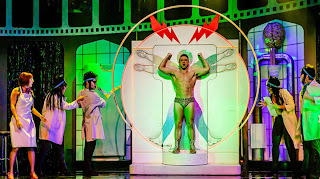
There are many things I wouldn’t have predicted about my life when I was 17; at the top of the list is  probably the idea that I would ever attend Rocky Horror live with my father. I don’t think I’ve seen it in any form since I was 17, when partaking at the midnight show was a daring … but harmless … act of rebellion by Catholic schoolgirls who shouldn’t know about or see such things. (What we wanted to see even more was the banned-by-the-Vatican Life of Brian, but that had to wait until university). I don’t think I really grasped much of what was going on, and I’m not even sure I liked it that much. But the music was good and we thought the weirdness of the whole thing gave us a worldly sophistication. 

Forty years later, with more than 20 of those spent in England, the biggest revelation about Rocky Horror was how very, very English it is. Cross dressing! Bad puns! Barely-disguised sexual innuendo! Being weird well, hell, just for the fun of it! Rocky Horror is a very naughty pantomime, infused with a lot of Carry On films and a great soundtrack. Given the numbers of university students in the audience at the Peacock Theatre (which sits in the middle of the LSE’s campus), it seems the bizarre formula continues to entertain. 

LEOPOLDSTADT

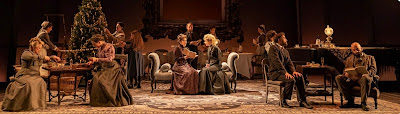
You’d think there couldn’t be much new to bring to Holocaust drama, but when it comes from the pen of Tom Stoppard you pay attention. Everyone I knew who’d seen the semi-autobiographical story of a family in Vienna before and after the war raved about it, and I didn’t want to pass up the opportunity to see it before it closed. Even though I suspected it would make me cry. (It did. A lot. Bring tissues.) The innovation here is following a family for generations leading up to the war; a family that is as close to the establishment as you would think possible, and who practices their Judaism lightly, if at all. In the opening scene they’re decorating their Christmas tree. They’ve intermarried. They’re movers and shakers. They’re rich.

Absolutely none of which helps them in the late ‘30s when the atmosphere turns against them. We are spared the direct horror of the camps, getting it instead as three survivors … one who was raised a Christian Englishman and barely knew his Jewish heritage … talk about all the people who died. Bright, vibrant characters you got to know and care about in the first half. The main point here, for me, was how tenuous freedoms are and how quickly they can be lost. A potent message for these days. 

THE MIRROR AND THE LIGHT

This is the stage adaptation of the third and final book in Hillary Mantel’s trilogy re-imagining Thomas Cromwell as a good guy, adapted for stage by the author and Ben Miles, the actor who’s played Cromwell in the other RSC productions. It will please any lover of history; a compelling tale of rise, fall and the hubris that triggers it, though I’m not sure it has the dramatic heft of A Man for All Seasons. The vast book takes place mostly in Cromwell’s mind, a spectacularly difficult thing to bring to stage. We get a more pedestrian stepping through the story that most people know here.

The venal, backstabbing politics of the Tudor court is well captured, though I don’t think they delivered the story of class struggle quite as powerfully as in the book. Cromwell was always doomed, Mantel’s story goes, because he was an outsider. It’s there, but doesn’t hit you in the play with the force of the source material. What’s done even better, however, is the meeting between Henry VIII and Anne of Cleves. It may, in fact, be as close to reality as we’ll ever get. The aging, ill, overweight king who still sees himself as a youthful hero. The young princess who’s been sold a fantasy, The split second when, without warning, she confronts the reality of her husband-to-be and is unable to control her shock. Henry’s enormous but childish ego unable to deal with the “emperor’s new clothes” moment. That flash of pure honesty drives history to unpredictable places, including Cromwell’s downfall. Rosanna Adams’ Anne gives us the best moment in an entertaining if not hugely memorable production. 


Wednesday, 6 October 2021

Domes of Elounda delivers 5-star rehab from a stressful life

One person’s luxury is another’s outrageous excess. One’s necessity another's luxury. Some save for years to book a five-star hotel for a special occasion. Others treat them as standard. You can spend a fortune to be disappointed, or find that a modest place with personalised service is actually more luxurious than famous brands. Luxury is tough to define and tricky to deliver.

Two weeks ensconced at the five-star Domes of Elounda firmed up five of my own opinions about luxury:

  1. Great design and beautiful surroundings are the “table stakes” in this game, but it’s small touches and personal interaction that provide the winning hand.
  2. Luxury resorts are perfect for the exhausted seeking a revival of body and soul, but do put you at a distance from the local experience … and edge into a waste of money if you’re going to spend much time away from them. (We didn't, extracting full value from our investment.)
  3. From what we saw of the hotel-filled coastline from Heraklion east, the immediate environ of Domes is the only place I’d want to holiday in Crete. 
  4. Given the hours they work and the range of challenges they face, the jobs of customer-facing staff at places like Domes of Elounda make my work look easy.
  5. When you love the sun but your husband is practically allergic to it, a suite with its own sun lounging area and plunge pool may be edging towards necessity.
I have rarely occupied a more spectacular living space in a hotel, and our suite will go down in memory as the highlight of our stay at Domes. Modern, airy, and almost Scandinavian in its clean lines, it featured a large, high-ceilinged sitting room adjoining a bedroom with an enormous bed dressed superbly (Domes is part of the Marriott family and the brand’s famous pillows are always a delight). Off that was a bathroom with separate shower and toilet rooms, a bathtub and a double sink so big you could have put a toddler to bed in it. The floor was cool grey stone, the fixtures and fittings sleek crome or chocolate-coloured wood. Both rooms had large televisions that … in anticipation of what I suspect will be the future … didn’t actually have a content feed. It’s assumed you come with your own devices and will cast whatever you want to watch onto the screens via the hotel’s high-speed broadband and an app you download. (Such fiddling fell outside of the total relaxation remit for the trip and I was feeling stubborn about paying for an app I wouldn’t use again, so we left the TVs blank and watched the iPad.) 

The spectacle, however, comes from what’s outside. Three long rows of suites march across the top of the hill occupied by Elounda, built from local stone so that their grey, rust and charcoal almost fades into the landscape. The simple cubist architecture mimics fishing huts in the town of Plaka below, but those clean lines, sharp angles and prominent lintels would make an ancient Minoan feel right at home. Both sitting- and bedroom had glass walls opening onto a patio running the length of the suite, and then a long pool stretching along the border of that. Immediately beyond, a bank of local flowers (newly-planted, but destined to be lushly beautiful) sloped down to the row of suites below before the spectacular panorama of Mirabello Bay stretching towards Elounda and Agios Nikolaos. Mountains reared up sharply to the right and formed a misty horizon line to the left. We could enjoy the view from two outdoor loungers with cushions as thick as bed mattresses, or a table that sat four beneath a canopy of wooden slats casting dappled shade.  

Curiously, an outdoor kitchen ran down one side of the patio. Curious because there’s no cookware or utensils, so not really anything you can do with it. The pool was long enough to do a bit of swimming, with shallow entry steps that also make a comfortable seat for semi-submerged reading. Being locked down here for months wouldn’t have been an effort, and we spent a lot of time in our cozy eyrie. 

There was plenty within the resort to tempt us out, however. 

On the north side of the suites, the hill fell away towards the main reception area, featuring a buffet restaurant, bar, spa, the adult pool and the path to the beach. Everything here is designed to take in the spectacular view of the island of Spinalonga with its Venetian fort and ruins across the water. 

The adult pool is an enormous oval, little populated when we were there and enormously quiet. 
The beach below is one of the highlights of the resort and, I suspect from what I could see of others, is one of the best in Crete. You hike down quite a steep path, over-run with bougainvillea and other flowering tropical bushes, cross under the main road and come out on a long beach, divided into distinct terraces and thickly planted with olives and greek pines. While there are patios and decks jutting over the water that offer full sun, there are more options for dappled or full shade ... by far the better choice under the intense Greek sun. The sand here is paler and finer than the compacted, mud-like stuff we saw on many of the other beaches on our excursion day to Knossos, and the swimming area protected by buoys is enormous. You can swim about 100 metres out into the bay and perhaps 200 up and down the beach. 

The water isn't quite Caribbean or Maldivian, but there's plenty of variation from deepest cobalt to glittering turquoise and it's a comfortable swimming temperature, particularly in the shallows. Because you're in a such a sheltered area, with other islands forming a massive breakwater against the main Cretan Sea, the water can be calm as a lake, with almost no waves. The only adverse conditions we experienced were in the second week, when strong autumn winds blew up a vigorous chop on the water's surface. The beach has a bar at its centre, a gift shop for beachwear and one of the hotel's a la carte restaurants at its southern edge. To the north, it's overlooked by a picturesque little domed church, while Spinalonga dominates the view across the water. And, of course, it's all ringed with the ubiquitous mountains.

The bulk of Domes' hotel rooms cling to the side of the hill between the reception centre and the suites at the hill crest, arranged in clusters of buildings and traversed by a winding stone path. The design here switches from Minoan cubist to a more exotic Arabic vibe with domes, narrow windows and fretwork screens, all painted a uniform dark coral and lushly landscaped. The hilltop suites may draw their architecture from the vernacular, but this part of the resort looks more exotic ... like a stage set for the Voyages of Sinbad.

The other side of the hill, falling south from the suites, features parkland, an outdoor gym, tennis courts, the kids' and teenagers' clubs and a plateau housing "The Core". This area is the resort's internal village high street, with free-standing shops along a promenade leading to a square surrounded by food trucks. This may sound quite rustic but the shop buildings are high-design concepts in glass and geometry, the merchandise is more art gallery gift shop than beachfront souvenirs and the music played when the food trucks are serving leans to 21st century clubbing rather than Zorba the Greek. There's also a fun outdoor gallery here where a modern artist has re-imagined the monsters of Greek mythology. The Core space had a lot of potential but seemed fairly new and without an established identity yet. The food trucks only serve two nights a week and the shops are only open when the trucks serve, so most of the time this whole area is empty.


Just below is the enormous family pool, a football pitch -length strip of water crossed by four high, arching bridges, feeling a bit like a Venetian canal. (But one that's pristinely clean and available for swimming.) Pergolas on either side offer dappled shade, with a bar on one side and a restaurant on the other. While the adult pool only featured about 10 pairs of lounges, this enormous pool deck has scores of them. The "family" designation meant that this pool was louder than the others; our preferred September holiday time eliminates school-age children but Domes was awash with toddlers. But the family pool wasn't as bad as I'd feared. It's so big you're likely to be able to find a quiet patch, even if a pack of little people is staging pirate battles at one end. One drawback: this pool closes at 6pm so swimmers won't disturb the poolside restaurant. (The adult pool closes early, too.) Though that's great for dining, I did think it was a shame there were no possibilities for a moonlight dip. Unless, of course, you had your own private plunge pool...


We had unlimited access to the "Haut Living Room", a lounge next to the family pool. It features a concierge desk staffed with an enthusiastic and cheerful team who feel more like friends than staff by the end of a two-week visit. Coffee, soft drinks, beer and wine are available all day, while a full bar makes an appearance at 6pm. A small buffet of savouries and desserts is available throughout the afternoon, switching to cheese plates, olives and nuts at 6pm. While we still added a healthy amount to our bill with a bottle of wine each night with dinner, this set-up meant we could manage other drinks costs by confining them to cocktail hour in the lounge each night. We rarely hit the buffet during the day, given our preference for quieter pool areas and the fact that we rarely ate breakfast before 10:30. 

Our package included breakfast ... buffet style in one of two restaurants ... and dinner in one of three. (With the addition of the food trucks as options two nights a week, once for Greek street food and once for burgers.) After trying all three restaurants, we started alternating between the two a la carte places. While the buffet was tasty and changed key dishes nightly, it lacked the atmosphere of the other two, was far more attractive to the toddler brigade (thus much louder), and came with the inevitable dangers of eating far too much. 

My husband and I were split on our favourite from there. Always a sucker for views and seashores, my pick was Topos, the open-aired restaurant at the south end of the beach. If you request far enough in advance, you can get one of the tables on the pier, enjoying the exceptional panorama of the bay at night, the mountains across the water and the cheerful conviviality of the restaurant itself. Dining here under a full moon was one of the highlights of my stay.
There's a mix of live entertainment here which can actually be a bit distracting if you're under the restaurant's roof; another reason we preferred the pier. (The night with traditional Cretan music was fantastic. The one with Greek pop/club tunes mixed by a DJ significantly decreased our enjoyment of that evening, particularly because we were between the DJ and the kitchen in maximum volume range.) Topos felt a bit more "local" with a fantastic variety of Greek starters ... one night we went double on these and skipped mains completely ... and fresh seafood. 

Blend, next to the family pool and the Haut Living Room, won my husband's vote. The views are fabulous here, too (nowhere in the resort suffers on that front), but the modern surroundings and the sleek restaurant design aren't quite as quiet and romantic as the beachside restaurant. The menu here is, like the architecture, a bit more modern and cosmopolitan: an upscale grill focusing on excellent cuts of meat and a bit of fish. I was surprised ... and, in these days of concern about climate change, concerned ... about how far the meat had travelled. English pork, American beef, New Zealand lamb. Casting your eyes to the dry landscape with its scrubby vegetation, it's easy to imagine the locally sourced options for meat are sparse. I will confess, with guilt, that those American steaks were tasty. 

Dishes in both restaurants were beautifully presented and cooked with care. In two weeks we tried most of the items on both menus and only hit a few things we'd dismiss as average. The pork belly should have stayed in England, where they understand how to render that fat and crisp the crackling. Food was at its best when it edged into the local: grilled sea bass, anything with aubergines, tzatziki and hummus, calamari. We particularly enjoyed sampling local Greek wines, expertly guided by the manager of Blend and our regular waiter at Topos. They, plus the concierge team at the Haut Living Room, will be amongst our fondest memories of the place. 


One slight frustration with the meal plan was the amount of surcharges. If you wanted the nicer cuts at Blend, you paid an additional fee. Same with the array of fresh fish of the day at Topos. And these fees, I suspect, added up to a meal much pricier than the local restaurants. You were welcomed to shift your dinner credit (€50) to lunch and go out for the evening, but if you weren't having your generous breakfast until 10:30 that was just too much food. 

Domes of Elounda was exactly what we needed this holiday. We were exhausted. It revived us. If I wanted to do more sightseeing, or get a more local experience, this might not have been the best option. If, like us, you don't have any children you'll want to consider booking very carefully. With both kids' and teenagers' clubs, plus multiple pools and food all within its boundaries, this is an excellent choice for families. Which means those seeking peace and quiet should avoid school holidays at all costs. And even outside of those holidays, should consider the suites with the private pools for perfect calm. 

The older I get, the more "peace and quiet" factors in to my definition of luxury. At Domes of Elounda, sitting beside my private pool hearing nothing but the Cretan wind whistle around the buildings, I found that in abundance.